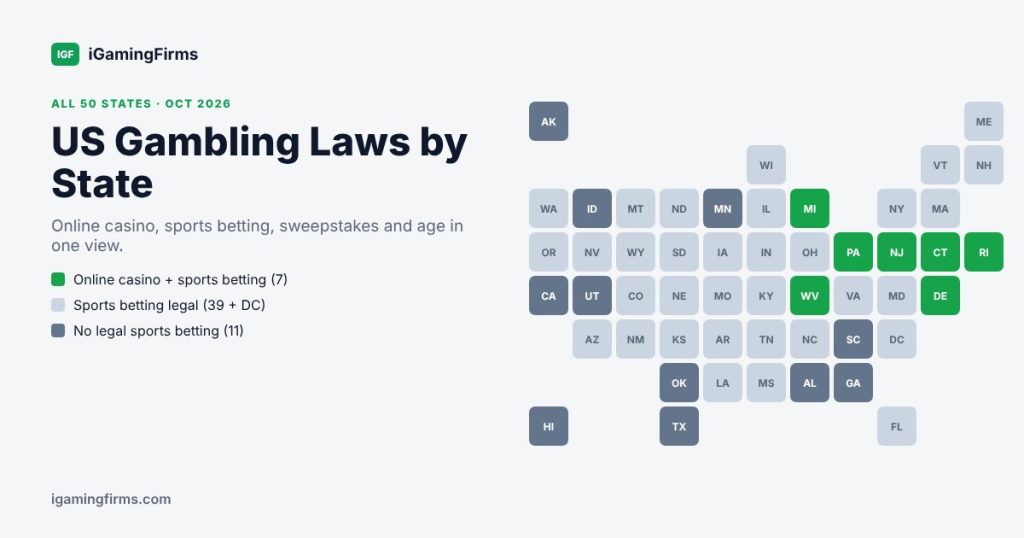
The short answer: there is no single US gambling law. US gambling laws by state differ product by product, and each state decides for itself. As of October 15, 2026, real-money online casinos are live in seven states (Connecticut, Delaware, Michigan, New Jersey, Pennsylvania, Rhode Island and West Virginia), with Maine legal but not yet live.
Sports betting is legal in 39 states plus DC, and online in 31 of them plus DC. Eleven states have no legal sports betting at all. Sweepstakes casinos are closed in 13 states today and 14 from November 1, when Oklahoma’s ban takes effect. The minimum age is 21 for most casinos and sportsbooks, but 18 in a handful of states and at some tribal casinos.
If you are deciding where to launch, where to send traffic or which clients you can safely supply, “is it legal?” has to be answered state by state and product by product. A state can license mobile sportsbooks and still ban online casinos, tolerate daily fantasy without a law, and have just made sweepstakes casinos a felony.
This hub puts the four questions operators and affiliates actually ask into one table for all 50 states and DC: online casino, sports betting, daily fantasy sports (DFS) and sweepstakes casinos, plus the minimum age and the regulator. It then explains the federal rules underneath, the products that changed in 2026, and what each status means for your business. Where we have a detailed state guide, the table links to it.
Is online gambling legal in the US? How federal and state law fit together
Online gambling is legal in the US only where a state has licensed it. No federal law legalizes or bans online gambling across the board, and no federal law makes it a crime for a player to place a bet online. Federal law shapes the edges; states draw the map.
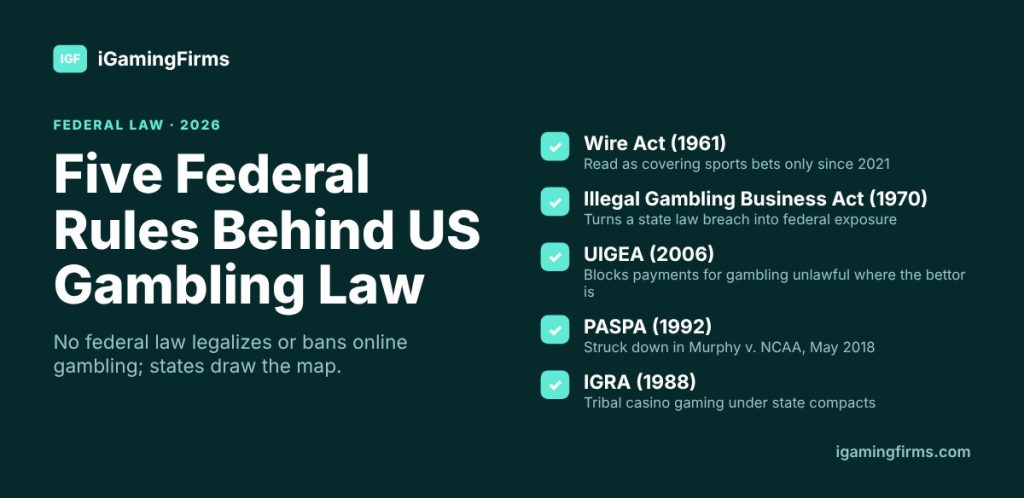
Five federal rules matter:
- The Wire Act (1961) bars businesses from using wire communications to take bets across state lines. After a 2021 First Circuit ruling in the New Hampshire Lottery case, it is read as covering sports bets only, which is why licensed sportsbooks keep every bet inside the state where the bettor is located.
- The Illegal Gambling Business Act (1970) makes it a federal crime to run a sizeable gambling business that violates the law of the state where it operates. It is the main federal tool against unlicensed operators, and it turns a state law breach into federal exposure.
- The Unlawful Internet Gambling Enforcement Act (UIGEA, 2006) does not define any game as illegal. It stops banks and payment firms from processing payments for gambling that is unlawful where the bettor is. That is the hook that reaches offshore sites and, increasingly, payment processors for sweepstakes brands.
- PASPA (1992), the federal sports betting ban, was struck down by the Supreme Court in Murphy v. NCAA in May 2018. Every legal sportsbook market since then exists because a state passed its own law.
- The Indian Gaming Regulatory Act (IGRA, 1988) lets federally recognized tribes run casino gaming under compacts with their state. Tribes are the main or only casino operators in states such as California, Oklahoma, Florida, Washington and Wisconsin, and online expansion in those states runs through tribal compacts.
So, is online gambling a federal crime? Not for players. For operators, taking bets from a state that has not licensed you can breach state gambling law, and payment flows can breach UIGEA. That is the risk offshore sites carry everywhere in the US, which we cover in our guide to whether offshore sports betting is legal.
Why are more states legalizing gambling?
Since Murphy, states have legalized mainly for tax revenue and to pull demand away from offshore and unlicensed sites into a regulated market with age checks, geolocation and consumer protection. The brakes are just as consistent: tribal exclusivity under compacts, problem gambling concerns and, for online casinos, land-based casinos and unions worried about losing revenue and jobs. That is why sports betting spread quickly and online casinos have not.
US gambling laws by state: the 50-state table (October 2026)
How to read the table:
- Online casino: real-money online slots and table games licensed by the state.
- Sports betting: “Online + retail”, “Online only”, “Retail only” or “None”.
- DFS: paid daily fantasy contests. “Licensed” means a state law regulates them; “No DFS law” means operators offer contests without a specific statute; “Not offered” means the major operators exclude the state. Pick’em contests are restricted separately in several states, so check product by product.
- Sweepstakes: dual-currency sweepstakes casinos, using the same categories as our sweepstakes casino legal map. “Open” means no ban or completed enforcement closes the state, not that the state approves the model.
- Age: the minimum age to gamble at a casino and to bet on sports. Individual venues and operators can set a higher age.
| State | Online casino | Sports betting | DFS | Sweepstakes casinos | Age (casino / sports) | Main regulator |
|---|---|---|---|---|---|---|
| Alabama | No | None | Licensed | Open | 21 (tribal) / not legal | No state gaming regulator; tribal gaming under NIGC |
| Alaska | No | None | No DFS law | Open | No casinos (bingo 19, pull-tabs 21) / not legal | Department of Revenue (charitable gaming) |
| Arizona | No | Online + retail | Licensed | Open | 21 / 21 | Arizona Department of Gaming |
| Arkansas | No | Online + retail | Licensed | Open | 21 / 21 | Arkansas Racing Commission |
| California | No | None | Contested (AG opinion, 2025) | Banned (AB 831) | 18 or 21 (tribal), 21 (cardrooms) / not legal | Gambling Control Commission; Bureau of Gambling Control |
| Colorado | No | Online + retail | Licensed | Open | 21 / 21 | Colorado Division of Gaming |
| Connecticut | Yes (2021) | Online + retail | Licensed | Banned (SB 1235) | 21 / 21 | Department of Consumer Protection |
| Delaware | Yes (2013) | Online + retail | Licensed | Open | 21 / 21 | Delaware Lottery |
| District of Columbia | No (bill pending) | Online + retail | No DFS law | Open, bill pending | No casinos / 18 (some books 21) | Office of Lottery and Gaming |
| Florida | No | Online + retail (Seminole Tribe only) | Contested | Open, under AG lawsuit | 21 (18 for poker) / 21 | Florida Gaming Control Commission |
| Georgia | No | None | No DFS law | Open | No casinos / not legal | Georgia Lottery Corporation |
| Hawaii | No | None | Not offered | Open (many operators block) | No legal gambling | None |
| Idaho | No | None | Not offered | Off-limits (constitution) | 18 (tribal) / not legal | Idaho Lottery; tribal gaming agencies |
| Illinois | No | Online + retail | Licensing framework (SB 3019, rules pending) | Open, under regulator action | 21 / 21 | Illinois Gaming Board |
| Indiana | No | Online + retail | Licensed | Banned (HB 1052) | 21 / 21 | Indiana Gaming Commission |
| Iowa | No | Online + retail | Licensed | Open, regulator powers (SF 2289) | 21 / 21 | Iowa Racing and Gaming Commission |
| Kansas | No | Online + retail | Licensed | Open | 21 / 21 | Kansas Racing and Gaming Commission; Kansas Lottery |
| Kentucky | No | Online + retail | Licensed (from 2026) | Open, under AG lawsuit | No casinos (racing 18) / 21 since July 15, 2026 | Kentucky Horse Racing and Gaming Corporation |
| Louisiana | No | Online + retail | Licensed (by parish) | Banned (HB 883, HB 53) | 21 / 21 | Louisiana Gaming Control Board |
| Maine | Legal, not live (early 2027 target) | Online + retail | Licensed | Banned (LD 2007) | 21 / 21 | Gambling Control Unit |
| Maryland | No | Online + retail | Licensed | Open, under regulator action | 21 / 21 | Maryland Lottery and Gaming Control Agency |
| Massachusetts | No | Online + retail | Licensed | Open | 21 / 21 | Massachusetts Gaming Commission |
| Michigan | Yes (2021) | Online + retail | Licensed | Off-limits (regulator enforcement) | 21 commercial, 18 or 21 tribal / 21 | Michigan Gaming Control Board |
| Minnesota | No | None | No DFS law | Open (ban passed Senate, died) | 18 at most tribal casinos / not legal | Alcohol and Gambling Enforcement Division |
| Mississippi | No | Retail only | Licensed | Open | 21 / 21 | Mississippi Gaming Commission |
| Missouri | No | Online + retail (since Dec 1, 2025) | Licensed | Open | 21 / 21 | Missouri Gaming Commission |
| Montana | No | Retail only (state-run, in licensed venues) | Not offered | Banned (SB 555) | 18 / 18 | Gambling Control Division; Montana Lottery |
| Nebraska | No | Retail only | No DFS law | Open | 21 / 21 | Nebraska Racing and Gaming Commission |
| Nevada | No (online poker only) | Online + retail | Not offered | Off-limits (unlicensed gaming law) | 21 / 21 | Nevada Gaming Control Board and Gaming Commission |
| New Hampshire | No | Online + retail | Licensed | Open | Varies by venue / 18 | New Hampshire Lottery Commission |
| New Jersey | Yes (2013) | Online + retail | Licensed | Banned (A 5447) | 21 / 21 | Division of Gaming Enforcement |
| New Mexico | No | Retail only (tribal) | No DFS law | Open (no ban; regulator calls them illegal) | 21 / 21 | Gaming Control Board; tribal gaming agencies |
| New York | No | Online + retail | Licensed | Banned (S 5935) | 21 commercial, 18 or 21 tribal / 21 | New York State Gaming Commission |
| North Carolina | No | Online + retail | No DFS law | Open (online) | 21 / 21 | North Carolina State Lottery Commission |
| North Dakota | No | Retail only (tribal) | No DFS law | Open | 21 / 21 | Attorney General Gaming Division; tribes |
| Ohio | No (bill pending) | Online + retail | Licensed | Open, bill pending | 21 / 21 | Ohio Casino Control Commission |
| Oklahoma | No | None | No DFS law | Ban from Nov 1, 2026 (SB 1589) | 18 floor, 21 at some tribes / not legal | Tribal gaming commissions; state Gaming Compliance Unit |
| Oregon | No | Online + retail | No DFS law | Open | 21 at most venues / 21 | Oregon Lottery; tribal gaming agencies |
| Pennsylvania | Yes (2019) | Online + retail | Licensed | Open, bill pending (HB 2801) | 21 / 21 | Pennsylvania Gaming Control Board |
| Rhode Island | Yes (2024) | Online + retail | No DFS law | Open | 18 (21 online casino) / 18 | Rhode Island Lottery |
| South Carolina | No | None | No DFS law (under litigation) | Open | No casinos / not legal | None for gaming (Education Lottery only) |
| South Dakota | No | Retail only | No DFS law | Open | 21 Deadwood, 18 or 21 tribal / 21 | South Dakota Commission on Gaming |
| Tennessee | No | Online only | Licensed | Banned (SB 2136) | No casinos / 21 | Sports Wagering Council |
| Texas | No | None | Contested (2016 AG opinion) | Open | 21 at most tribal venues / not legal | TDLR (lottery); Texas Racing Commission |
| Utah | No | None | No DFS law | Open (constitutional ban on all gambling) | No legal gambling | None |
| Vermont | No | Online only | Licensed | Open | No casinos / 21 | Department of Liquor and Lottery |
| Virginia | No (2026 bills died) | Online + retail | Licensed | Open | 21 / 21 | Virginia Lottery |
| Washington | No | Retail only (tribal) | Not offered | Off-limits (RCW 9.46.240) | 18 or 21 (tribal) / 18 or 21 (tribal) | Washington State Gambling Commission |
| West Virginia | Yes (2020) | Online + retail | Licensed | Open (many operators block) | 21 / 21 | West Virginia Lottery |
| Wisconsin | No | Retail only (tribal online law signed April 2026, not live) | No DFS law | Open | 21 at most venues / 21 | Tribes; Division of Gaming |
| Wyoming | No | Online only | No DFS law | Open | 21 (tribal) / 18 | Wyoming Gaming Commission |
Sources: state statutes and regulator sites, and our own state guides linked above. Lottery, horse racing and charitable gaming are left out of the table for space. Alabama, Alaska, Hawaii, Nevada and Utah have no state lottery; most other states set 18 for the lottery, with exceptions such as Arizona, Iowa, Louisiana and Mississippi at 21 and Nebraska at 19.
Online casino legal states: only seven are live
Real-money online casinos are the narrowest category in US gambling. Seven states have them live, one more has passed a law, and no state added a live market in 2026.
| State | Live since | Regulator | Model |
|---|---|---|---|
| New Jersey | November 2013 | Division of Gaming Enforcement | Licences tied to Atlantic City casinos |
| Delaware | November 2013 | Delaware Lottery | Lottery-run, one platform partner |
| Pennsylvania | July 2019 | Pennsylvania Gaming Control Board | Licences tied to land-based casinos |
| West Virginia | July 2020 | West Virginia Lottery | Licences tied to the five casinos |
| Michigan | January 2021 | Michigan Gaming Control Board | Commercial and tribal licensees |
| Connecticut | October 2021 | Department of Consumer Protection | Two tribes plus the state lottery |
| Rhode Island | March 2024 | Rhode Island Lottery | State monopoly with one operator |
| Maine | Not live | Gambling Control Unit | Tribal exclusivity under LD 1164 |
Maine became the eighth state to legalize online casinos when LD 1164 became law in January 2026, giving the Wabanaki Nations exclusive online casino rights. The law took effect in July 2026, but operators cannot take wagers until rulemaking and licensing are finished. In October 2026, reporting on the Gambling Control Unit’s third round of draft rules and a federal lawsuit over tribal exclusivity put the launch in early 2027.
Several pages ranking for this search still name only four online casino states, leave out Maine, or list Nevada as an online casino state. All three are wrong.
Are online casinos legal in Nevada?
No. Nevada licenses online poker and mobile sports betting, but not online slots or table games, so Nevada residents cannot legally play online casino games for real money even though Las Vegas is the center of land-based gaming. The minimum age for everything Nevada licenses is 21.
Which states came close in 2026?
Virginia got furthest. Both chambers passed online casino bills in late February 2026, but the conferees could not agree on how to split the tax revenue and the bills died when the session ended on March 14 (SBC Americas). Illinois (HB 4797), New York, Maryland and Indiana all had bills that did not reach the governor. DC (B26-0656), Ohio (HB 298) and Pennsylvania’s sweepstakes bill all pair online casino policy with a sweepstakes ban, the approach in the NCLGS model iGaming bill. Expect 2027 to bring the same names back.
Sports betting legal states: 39 plus DC
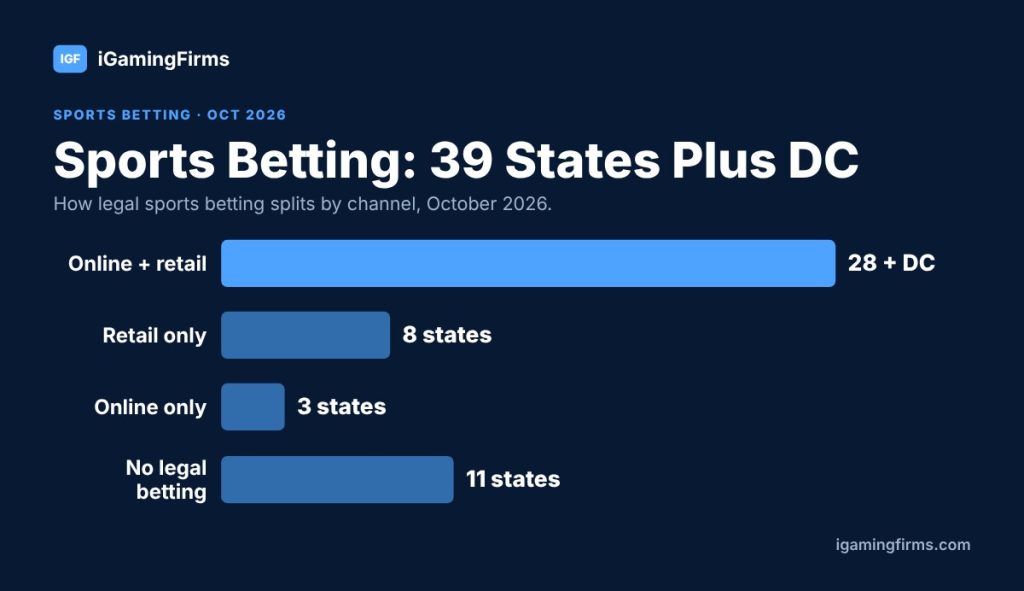
Sports betting is legal in 39 states plus DC as of October 2026. The split matters more than the headline number, because “legal” covers anything from a full mobile market to one tribal sportsbook.
| Status | Count | States |
|---|---|---|
| Online and retail | 28 plus DC | Arizona, Arkansas, Colorado, Connecticut, Delaware, Florida, Illinois, Indiana, Iowa, Kansas, Kentucky, Louisiana, Maine, Maryland, Massachusetts, Michigan, Missouri, Nevada, New Hampshire, New Jersey, New York, North Carolina, Ohio, Oregon, Pennsylvania, Rhode Island, Virginia, West Virginia |
| Online only | 3 | Tennessee, Vermont, Wyoming (no retail sportsbooks) |
| Retail only | 8 | Mississippi, Montana, Nebraska, New Mexico, North Dakota, South Dakota, Washington, Wisconsin |
| No legal sports betting | 11 | Alabama, Alaska, California, Georgia, Hawaii, Idaho, Minnesota, Oklahoma, South Carolina, Texas, Utah |
Most retail-only markets run through tribal casinos, and Montana’s product is run by the state lottery inside licensed venues.
Which states have legal online sports betting?
Thirty-one states plus DC. Missouri is the newest, with its first legal bets on December 1, 2025, after voters approved Amendment 2 in November 2024. Many state lists put all 39 states in one group with only a general note that some are retail-only. If you build geolocation rules or affiliate targeting from those lists, check the eight retail-only states first.
Market structure varies as much as legality. Florida has a single operator, the Seminole Tribe’s Hard Rock Bet, under a compact that runs to 2051. New Hampshire and Oregon each have one mobile sportsbook (DraftKings) run for the state lottery. North Carolina has seven licensed apps and raised its online tax from 18% to 23% on July 1, 2026, and Illinois charges a per-wager tax on top of a 20% to 40% graduated rate. Our guide to how to start a sportsbook covers the licence and platform side, and our comparison of gambling licence costs by jurisdiction puts the fees in context.
States without legal sports betting, and why
The 11 holdouts are not one group. California needs a constitutional amendment, voters rejected two in 2022, and tribes are preparing a 2028 measure. Texas needs a two-thirds vote and a referendum, and its Legislature next meets in January 2027 (Texas guide). Georgia’s amendment failed in the House 63-98 on March 6, 2026 (Georgia guide). Oklahoma’s tribal sports betting bill failed in the Senate 21-27 in April 2026. Minnesota’s tribal mobile bill was heard without a vote (Minnesota guide), and Alaska’s two 2026 bills died in committee (Alaska guide). Alabama’s lottery and gaming bills stalled in committee, South Carolina’s sports betting bill never left a Senate subcommittee, and Hawaii and Utah ban gambling of every kind.
What states can you sports bet at 18?
State law sets 18 as the sports betting age in New Hampshire, Rhode Island, Wyoming, Montana and DC, and some tribal sportsbooks in Washington accept 18-year-olds. Everywhere else with legal sports betting the minimum is 21. Operators can set a higher age than the law requires, and several DC sportsbooks, including BetMGM and Caesars, use 21. Our legal gambling age by state guide breaks this down for casino, lottery and online play as well.
Kentucky is no longer on that list. The legislature overrode Gov. Andy Beshear’s veto of HB 904 in April 2026, and the betting age rose from 18 to 21 on July 15, 2026 (Legal Sports Report). Some state maps still list Kentucky at 18. Our Kentucky guide covers the other HB 904 changes, including the new DFS licence.
For casinos, 18 is more common than many guides suggest, but it is almost always set by a tribe or a single venue, not the state:
| Where 18-year-olds can gamble | What it covers | What sets it |
|---|---|---|
| Oklahoma | Tribal casinos such as WinStar, Choctaw and Osage; Cherokee and River Spirit are 21 | Tribal compact floor plus each tribe’s house rules |
| California | Some tribal casinos, usually without alcohol on the floor; cardrooms are 21 | Each casino’s policy |
| Idaho, Minnesota, Washington | Many tribal casinos | Tribal policy under compacts |
| Michigan, New York, South Dakota | Some tribal casinos; commercial casinos are 21 | Tribal policy |
| Florida | Live poker at Seminole casinos (slots and tables are 21) | Seminole policy |
| Rhode Island, Montana | Casinos and sports betting (Rhode Island online casino is 21) | State law |
Texas is a good example of why venue-level checks matter: its tribal venues are mostly 21, but Speaking Rock in El Paso admits players at 18. For affiliates, the safe default is 21 for any casino or sportsbook content unless you are naming a specific venue or state where 18 applies.
Sweepstakes casino laws by state: 13 closed now, 14 from November 1
Sweepstakes casinos are the fastest-moving column in the table. They are not licensed anywhere; they rely on the argument that free “Sweeps Coins” and a mail-in entry remove the consideration element of gambling. States have spent 2025 and 2026 rejecting that argument by statute.
- Banned by statute (9): California, Connecticut, Indiana, Louisiana, Maine, Montana, New Jersey, New York and Tennessee.
- Ban from November 1, 2026: Oklahoma (SB 1589), where operating or facilitating becomes a Class C felony. The legislature overrode the governor’s veto to pass it.
- Off-limits under existing law or enforcement (4): Idaho, Michigan, Nevada and Washington.
- Open but under active enforcement: Florida (AG lawsuits against Stake and VGW), Illinois (65 cease-and-desist letters), Iowa (new regulator powers), Kentucky (AG lawsuit against VGW) and Maryland (regulator letters).
Several of the new laws reach beyond the operator to affiliates, payment processors, game suppliers and geolocation providers, so this column matters even if you never run a sweepstakes brand. The full state-by-state detail, effective dates and an operator index are in our sweepstakes casino legal map.
Daily fantasy sports and prediction markets: the federal and “skill” workarounds
DFS
Paid daily fantasy contests are available in most states, but on three different legal footings. Roughly half the states license or regulate DFS by statute, with Kentucky’s licence (2026) and Illinois’s SB 3019 framework the newest. Another group has no DFS law and operators rely on the argument that skill predominates. And a handful are closed to the major operators: Hawaii, Idaho, Montana, Nevada and Washington.
California’s Attorney General declared DFS illegal in a July 2025 opinion, and operators moved Californians to peer-to-peer formats rather than leave. Texas has a 2016 AG opinion against DFS that has never been tested in court. Pick’em contests are the part of DFS regulators target most, so a state’s DFS status does not tell you whether a pick’em product is allowed there.
Is DraftKings legal in all 50 states?
No. DraftKings Sportsbook can only take bets in states that have licensed online sports betting and approved DraftKings, and its online casino is limited to states within the seven live online casino markets. Its daily fantasy product reaches more states because of the DFS footings above, and its prediction market product runs under federal CFTC rules instead of state licences. The same split applies to FanDuel and other national brands, so “available in my state” depends on which product you mean. Check the operator’s own state list before you build targeting around it.
Prediction markets
Kalshi, Polymarket US and the event-contract products from FanDuel, DraftKings, Robinhood and others operate under federal CFTC oversight rather than state gambling licences. They are available in most states, usually from age 18, and that is the fastest-growing legal fight in US gambling. Courts have split: the Third Circuit accepted the federal preemption argument, while the Sixth Circuit (Tennessee) and Ninth Circuit (Nevada, plus a California tribal case) have ruled against it for sports contracts.
Minnesota banned prediction markets by statute in May 2026, but a federal judge blocked the law in July. A federal judge blocked Illinois’s SB 3019 exchange-wager rules on October 2, 2026. North Carolina went the other way and will tax them at 6% from January 2027. Our explainer on how prediction markets and event contracts work covers the model and the cases.
States where gambling is (almost) completely illegal
Utah and Hawaii are the only two states with no legal gambling of any kind: no lottery, no casinos, no racing wagers and no sports betting. Utah’s ban is in its constitution. Close behind are:
- South Carolina: the Education Lottery, charitable bingo and raffles, and casino boats that sail into international waters. No casinos, no sports betting and an online ban dating to the end of video poker in 2000.
- Alaska: no lottery and no casinos; charitable gaming and two tribal bingo halls (Class II only).
- Georgia: the lottery (including online sales), charity bingo and raffles, and coin-operated amusement machines whose winnings, since July 1, 2026, can only be redeemed as replays, lottery products or gift cards.
- Texas: the lottery (retail only since 2025), racing, charitable bingo and three tribal Class II venues.
For operators, these states have the most unlicensed demand and the most aggressive use of general gambling statutes against offshore, sweepstakes and promotional activity. South Carolina’s 1710 loss recovery law, which lets anyone sue a “winner” for treble the losses, is the clearest example.
What changed in 2026: a timeline
- January: Maine’s LD 1164 becomes law, making Maine the eighth online casino state. California’s AB 831 sweepstakes ban takes effect.
- February and March: Illinois regulators send 65 sweepstakes cease-and-desist letters. Georgia’s sports betting amendment fails. Virginia’s online casino bills die in conference on March 14. Indiana signs its sweepstakes ban.
- April: Kentucky overrides the governor’s veto of HB 904, raising the betting age to 21 and licensing DFS. Wisconsin signs AB 601, allowing tribal online sports betting once compacts are amended. Oklahoma’s sports betting bill fails in the Senate.
- May: Oklahoma overrides the veto of its sweepstakes ban, Tennessee and Louisiana sign bans, Minnesota bans prediction markets and its sweepstakes ban dies in the House.
- July: Kentucky’s age 21 rule and Indiana’s sweepstakes ban take effect. North Carolina raises its online sports betting tax to 23%. A federal judge blocks Minnesota’s prediction market ban.
- August and September: Florida’s AG sues Stake and VGW. New York settles with VGW for $8 million. The Sixth and Ninth Circuits rule against Kalshi on sports contracts.
- October: a federal judge blocks Illinois’s prediction market rules (October 2). Maine’s launch slips to 2027.
What to watch next
- November 1, 2026: Oklahoma’s sweepstakes ban takes effect, and brands still serving the state have to geofence it.
- November 3, 2026 elections: governor races in Oklahoma, Florida, Georgia, South Carolina, Wisconsin and Texas, among others, will shape compacts, sports betting bills and enforcement in 2027.
- Maine’s online casino launch: final rules and the tribal exclusivity lawsuit decide whether it goes live in early 2027.
- Wisconsin compacts: statewide tribal mobile betting needs amended compacts and Interior Department review.
- 2027 sessions: Virginia, Illinois, New York and Maryland on online casinos; Texas, Georgia, Minnesota, Oklahoma and South Carolina on sports betting; Florida, Maryland, Minnesota, Mississippi, Virginia and Pennsylvania on sweepstakes.
- Prediction market appeals: a Supreme Court decision on the circuit split would change the picture in every state at once.
Our monthly iGaming regulation roundup covers each of these as it lands.
What US gambling laws by state mean for operators, suppliers and affiliates
| Your role | How to use the state table |
|---|---|
| Licensed operator | Online casino is a seven-state market and sports betting a 31-state online market, each with its own licence, tax and partner rules. Model taxes per state (from Tennessee’s handle tax to Illinois’s per-wager charge) before you rank launch targets. |
| Sweepstakes operator | Geofence the 13 closed states now and Oklahoma before November 1, and treat Florida, Illinois, Iowa, Kentucky and Maryland as enforcement states. No state has created a licence for the model. |
| Affiliate or media buyer | Match content to the column: licensed sportsbooks only where sports betting is legal online, online casino promotion only in the seven live states, and 21+ by default. Several sweepstakes bans name “promotion” and media affiliates. |
| Game studio, platform or aggregator | Supplier licences are needed in every regulated state you serve. If you also supply sweepstakes brands, New York and California law reaches content suppliers and platform providers. |
| Payment, KYC and geolocation providers | Restricted-state lists must follow this table, not last year’s. Age gates need to handle 18 and 21 in the same state where tribal venues differ. Our KYC requirements by jurisdiction guide covers what regulators expect at onboarding. |
Next step
Use the table as a starting point, then open the state guide for any market you are entering or targeting. For a specific state or contract, compare iGaming law firms and licensing consultants with US experience.
This article is general information and analysis, not legal advice. State positions change quickly; confirm current law with qualified counsel before making decisions.