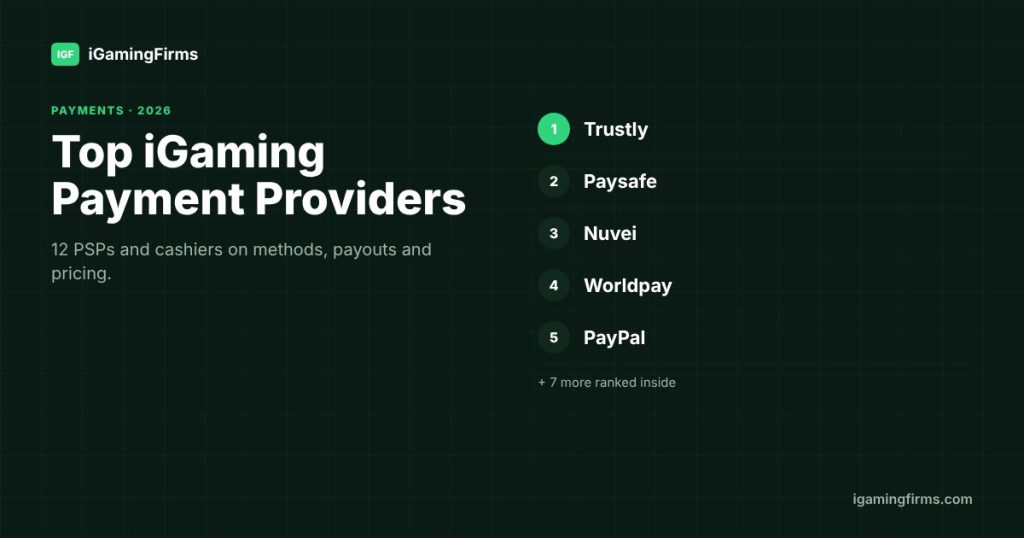
The short answer: Trustly, Paysafe and Nuvei are the strongest iGaming payment providers for regulated operators in 2026, with Worldpay and PayPal close behind for card acquiring and e-wallet coverage. Praxis and PaymentIQ lead on cashier and orchestration, AstroPay and Pay4Fun cover Latin American wallets and Pix, and Brite, Corefy and Gigadat fit specific needs.
No single PSP is “best”. The right mix depends on three things: which payment methods your markets actually use, how fast you can pay players out, and how much card risk you carry in chargebacks and reserves. A declined first deposit sends a new player to a competitor, a slow withdrawal turns into a complaint, and a chargeback spike can cost you a card acquirer altogether.
This guide compares twelve providers across acquirers, e-wallets, open banking, cashiers and local rails, shows what a €50 deposit really costs on each rail, maps 2026 payment rules (including Brazil’s September 2026 betting ban) to provider choice, and lists the questions to ask before you sign. If you want the fundamentals first, such as how rails, reserves and chargebacks work, start with our iGaming payment solutions explainer; this page is the vendor comparison.
Everything here comes from each provider’s own documentation, filings and case studies, third-party review sites such as G2 and Trustpilot, trade coverage, and primary regulatory texts, and none of the providers paid to be included.
Top iGaming payment providers 2026 at a glance
| # | Provider | Type | Best for | Pricing |
|---|---|---|---|---|
| 1 | Trustly | Open banking (A2A) | European operators that want instant deposits and payouts with low fraud | Quote only |
| 2 | Paysafe | E-wallets, eCash and card acquiring | Operators that want Skrill, Neteller and paysafecard plus US acquiring from one group | Quote only |
| 3 | Nuvei | Acquirer and APM platform | Multi-market operators that need cards, 700+ local methods and US state coverage | Quote only |
| 4 | Worldpay | Enterprise card acquirer | Large operators that need high-volume card processing and fast card payouts | Quote only |
| 5 | PayPal | E-wallet | Approved operators in markets where players trust PayPal | Published list prices; gambling rates negotiated |
| 6 | Praxis Tech | Cashier and orchestration | Operators connecting many PSPs behind one cashier | Quote only |
| 7 | Pay4Fun | Brazil Pix payment institution | Brazil wind-down and refunds now; Brazil re-entry if betting is legalised again | Quote only |
| 8 | Brite Payments | Open banking (A2A) | Nordic and EU operators wanting instant bank payments with KYC built in | Quote only |
| 9 | PaymentIQ | Cashier and orchestration | Operators wanting a mature iGaming cashier with 260+ PSP connections | Quote only |
| 10 | AstroPay | E-wallet | Operators targeting Latin America outside Brazil | Quote only |
| 11 | Corefy | Orchestration | Operators that want transparent, per-transaction orchestration pricing | Published per-transaction tiers |
| 12 | Gigadat | Interac e-Transfer (Canada) | Operators in Ontario, Alberta and wider Canada | Quote only |
Providers do different jobs, so read the “Type” column first. A cashier or orchestration layer does not replace an acquirer, and an open banking provider does not replace card acceptance. Most operators combine three or four of these.
Feature matrix: what each provider documents publicly
“Yes” means the provider documents it on its own site or in official material. “Partial” means a related capability or coverage through partners. “Not stated” means we could not find public documentation, which does not prove it is missing.
| Provider | Card acquiring | Open banking / A2A | E-wallet | LatAm methods (Pix etc.) | Crypto | Fast payouts | Cashier / orchestration | Public pricing |
|---|---|---|---|---|---|---|---|---|
| Trustly | No | Yes | No | Partial | No | Yes | No | Partial |
| Paysafe | Yes | Partial | Yes | Partial | Not stated | Yes | Partial | No |
| Nuvei | Yes | Yes | Partial | Yes | Yes | Yes | Partial | No |
| Worldpay | Yes | Not stated | Not stated | Not stated | Not stated | Yes | Not stated | No |
| PayPal | Partial | No | Yes | Not stated | No | Partial | No | Yes (list) |
| Praxis Tech | Via PSPs | Partial | Partial | Yes | Partial | Not stated | Yes | No |
| Pay4Fun | No | Yes (Pix) | Partial | Yes | No | Yes | No | No |
| Brite Payments | No | Yes | No | No | No | Yes | No | No |
| PaymentIQ | Via PSPs | Partial | Partial | Not stated | Not stated | Not stated | Yes | No |
| AstroPay | Partial (prepaid card) | No | Yes | Yes | Not stated | Partial | No | No |
| Corefy | Via PSPs | Partial | Partial | Not stated | Not stated | Partial | Yes | Yes |
| Gigadat | No | Yes (Interac) | No | No | No | Yes | No | No |
What an iGaming payment provider has to do
An iGaming payment provider moves money between players and operators: accepting deposits, paying out winnings, and handling the risk, compliance and reporting around both. Gambling is a high-risk merchant category, so many mainstream processors either refuse it or apply higher fees, rolling reserves and stricter monitoring.
Your payment stack usually has three layers:
- Processing. The acquirers, e-wallets, open banking providers and local rails that actually move funds.
- Orchestration. Routing each transaction to the best provider, cascading failed transactions to a backup, and reconciling everything in one place.
- Cashier. The deposit and withdrawal screens your players see, connected to your wallet in the player account management system.
PSP, cashier or orchestrator: which do you need?
| Layer | What it does | Providers on this list | You need it when |
|---|---|---|---|
| PSP or acquirer | Moves the money and carries the risk | Trustly, Paysafe, Nuvei, Worldpay, PayPal, Pay4Fun, Brite, AstroPay, Gigadat | Always: no cashier works without at least one |
| Cashier | The player-facing deposit and withdrawal flow | Praxis Tech, PaymentIQ | Your platform’s built-in cashier limits which PSPs or markets you can add |
| Orchestrator | Routing, cascading and reconciliation across PSPs | Praxis Tech, PaymentIQ, Corefy | You run three or more PSPs or several markets |
For a deeper look at rails, rolling reserves and what operators pay overall, see the guide to how iGaming payments work.
What a €50 deposit really costs on each rail
Headline percentages hide most of the cost. Fixed per-transaction fees, chargebacks and reserves change the picture, especially at typical deposit sizes. This illustration models 10,000 deposits of €50 each, €500,000 in total, using published or well-sourced fee ranges.
| Rail | Fee basis | Cost for 10,000 × €50 | Per deposit |
|---|---|---|---|
| Card, high-risk blended | About 2.5% to 7% blended (industry and vendor ranges) | €12,500 to €35,000 | €1.25 to €3.50 |
| Card chargebacks (extra) | Assumed 0.5% dispute rate: 50 disputes × (€50 lost + about €16 fee) | About €3,300 | Not per deposit |
| Card rolling reserve (cash tied up) | Often 5% to 10% held for 90 to 180 days | €25,000 to €50,000 held back | Not a fee, but a cash-flow cost |
| Open banking | Around 1.5% in industry estimates, or a fixed fee plus a gambling surcharge | About €6,000 to €7,500 | About €0.60 to €0.75 |
| E-wallet | About 1.9% to 2.9% plus a fixed fee | €9,500 to €18,000 | €0.95 to €1.80 |
| Pix (Brazil, benchmark only) | Around 0.22% in central bank analysis, against roughly 1% for debit cards. Pix can no longer be used for betting in Brazil since October 2026 | About €1,100 | About €0.11 |
Treat these as directional, not quotes: gambling pricing is negotiated and depends on your licence, volumes and risk history. The pattern is what matters. Cards carry the highest all-in cost once chargebacks and reserves are counted, open banking is far cheaper per deposit and push payments carry no card chargeback exposure, and fixed per-transaction fees dominate the cost of small deposits.
Card risk is also getting stricter. From 1 April 2026, Visa’s Acquirer Monitoring Program (VAMP) cut the “excessive” merchant threshold from 2.2% to 1.5% in the US, Canada, the EU and Asia-Pacific, and the ratio counts fraud reports as well as disputes. A chargeback spike can now threaten your card acceptance faster.
How this list was built
We started from the providers in the current Google results and the comparison pages ranking for this topic, almost all of which are written by payment vendors, then checked each provider against the same criteria:
- Market and method coverage: countries, currencies and payment methods actually documented.
- iGaming compliance and risk tooling: licences, gambling approvals, KYC, fraud and chargeback tools.
- Payout speed and player experience: documented payout times and deposit flows.
- Evidence of operator adoption: named iGaming clients, partnerships and filings.
- Pricing transparency: whether pricing is published.
Sources checked: provider websites, SEC filings and press releases, G2 and Trustpilot, and trade coverage from iGaming Business, Gambling Insider and others. Trustpilot scores for wallets and open banking providers mostly reflect consumers, not operators, and we say so where we use them. We did not run test transactions, and no provider reviewed this article before publication.
How the ranking was decided
Each provider was graded on the strength of public evidence for five weighted criteria: market and method coverage (25%), iGaming compliance and risk tooling (25%), payout speed and player experience (20%), operator adoption (20%) and pricing transparency (10%). “Strong” means detailed public documentation backed by third-party sources or named regulated clients, “Documented” means the provider documents it, and “Limited” means little or no public detail.
| # | Provider | Coverage (25%) | Compliance and risk (25%) | Payouts and UX (20%) | Operator adoption (20%) | Pricing transparency (10%) |
|---|---|---|---|---|---|---|
| 1 | Trustly | Documented | Strong | Strong | Strong | Documented |
| 2 | Paysafe | Strong | Strong | Documented | Strong | Limited |
| 3 | Nuvei | Strong | Strong | Documented | Documented | Limited |
| 4 | Worldpay | Documented | Documented | Documented | Strong | Limited |
| 5 | PayPal | Documented | Documented | Documented | Documented | Documented |
| 6 | Praxis Tech | Documented | Documented | Limited | Strong | Limited |
| 7 | Pay4Fun | Limited | Strong | Documented | Documented | Limited |
| 8 | Brite Payments | Documented | Documented | Documented | Documented | Limited |
| 9 | PaymentIQ | Documented | Documented | Limited | Documented | Limited |
| 10 | AstroPay | Documented | Limited | Documented | Documented | Limited |
| 11 | Corefy | Documented | Limited | Documented | Limited | Strong |
| 12 | Gigadat | Limited | Limited | Documented | Limited | Limited |
Where grades tie, operator adoption decided the order, then compliance. Pay4Fun’s grades reflect its documented track record before Brazil’s September 2026 ban; its practical usefulness for new business is limited until Brazil’s legal position settles. Providers can change a grade by publishing the missing documentation, and we update this table when they do.
The 12 best iGaming payment providers reviewed
1. Trustly

Trustly is the leading open banking provider in European iGaming. It is a Swedish payment institution supervised by Finansinspektionen, with an FCA-authorised UK entity, and Nordic Capital as its main owner.
- Best for: European operators that want instant bank deposits and payouts, lower fraud and fewer chargebacks than cards.
- Coverage: payouts in 30 European markets, Pay N Play in Sweden, Finland, Estonia, the Netherlands and the UK, plus a growing US pay-by-bank business (Hard Rock Bet went live in March 2025).
- iGaming features (vendor claims): more than 95% of payouts instant, 99.7% payout success, deposits in under six seconds, Pay N Play combining KYC with the first deposit, name and IBAN verification, affordability checks and PEP and sanctions screening.
- Clients (vendor claim): 800+ gaming brands, with logos for Flutter, Entain, bet365 and Kindred and case studies with William Hill, Mr Green and 888.
- Pricing: quote only. For reference, Adyen publishes a Trustly price of $0.13 plus €0.50 per transaction, with gambling rates up to 3% higher.
- What users say: Trustpilot 2.8/5 from 3,414 reviews, almost all from consumers. Complaints centre on payments not reaching merchants and slow refunds, which are worth monitoring in your own support data.
- Watch for: no card acceptance, so Trustly complements rather than replaces an acquirer.
2. Paysafe
Paysafe is a London-based, NYSE-listed payments group that owns Skrill, Neteller and paysafecard and runs card acquiring and gateway services. Its Q2 2026 results credited growth in merchant solutions to strong iGaming volumes in North America.
- Best for: operators that want the e-wallets iGaming players already use plus card acquiring and US coverage from one group.
- Coverage: digital wallets, eCash, card processing and gateway services across Europe and North America. Paysafe has processed for US iGaming since the 2018 market opening and said in 2022 that it supported 75% of US operators across 21 jurisdictions.
- Scale: Q2 2026 revenue of $447.4 million (up 4% year on year), with digital wallets at $206.6 million and merchant solutions at $246.1 million.
- Pricing: quote only.
- What users say: Skrill has 3.7/5 on Trustpilot from 27,846 reviews, mostly consumers, with recurring complaints about frozen accounts and KYC holds. Operators should expect players to raise wallet verification issues with their own support teams.
- Watch for: Paysafe was reported in February 2025 to be weighing a sale. Its Q2 2026 results mention no sale process, only an August 2026 debt refinancing, but check change-of-control terms in your contract anyway.
3. Nuvei
Nuvei is a Montreal-based payments platform taken private by Advent International in a $6.3 billion deal that closed in November 2024. On 15 June 2026 it agreed to acquire Payoneer for about $2.75 billion in cash, with closing expected around mid-2027.
- Best for: multi-market operators that need cards, hundreds of local payment methods and regulated US state coverage through one provider.
- Coverage (vendor claims): 200+ markets, 720+ alternative payment methods, 150 currencies and local acquiring in around 50 markets. Payouts via Visa Direct, Mastercard Send, open banking, e-wallets and crypto.
- US: Nuvei has said it is licensed in all regulated US states, with past named clients including BetMGM, 888 and PrizePicks. It also partners with platform provider GiG.
- Pricing: quote only.
- What users say: G2 4.3/5 from 20 reviews. Trustpilot 3.4/5 from 866 reviews, mostly small merchants, with complaints about fees and contract terms.
- Watch for: coverage figures vary between Nuvei’s own pages, so confirm the exact methods and markets you need in writing. Ask how the Payoneer integration will affect your account team and roadmap.
4. Worldpay
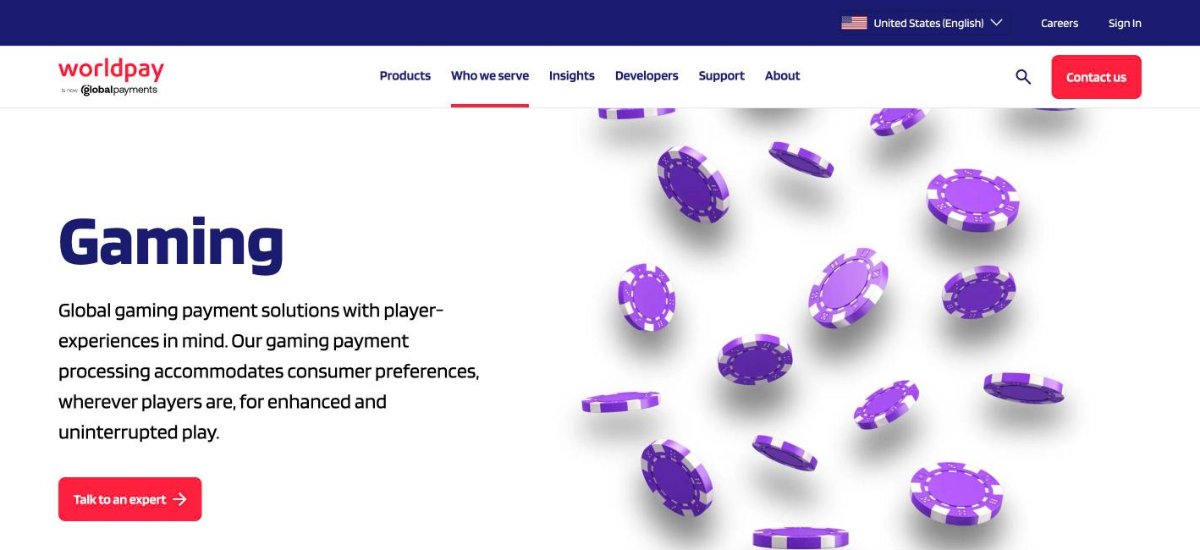
Worldpay is one of the world’s largest card acquirers, now owned by Global Payments after a deal completed in January 2026. Some older comparison pages still describe it as part of FIS, which sold its remaining stake in that deal.
- Best for: large regulated operators with high card volumes that need fast card payouts and enterprise-grade uptime.
- iGaming features (vendor claims): over 200 gaming operators served, first to market with Mastercard MoneySend payouts, 1,200 transactions per second capacity and 99.9% uptime.
- Brands shown: its gaming page displays logos for bet365, DraftKings, Entain, FanDuel and Flutter, without labelling them explicitly as clients.
- Pricing: quote only.
- What customers say (from Worldpay’s site): the gaming page focuses on payout speed and authorisation performance for high-volume operators.
- Watch for: onboarding for gambling is selective and suited to established, licensed brands. Plan for integration changes as Global Payments combines the businesses.
5. PayPal

PayPal is the most recognised e-wallet among players, but it only works with gambling merchants it has approved in advance, and only in jurisdictions where the activity is legal.
- Best for: licensed operators in markets where PayPal approves gambling and players already trust it, such as the UK and parts of Europe.
- Requirements: prior written approval, and the operator must block players in jurisdictions where gambling is not permitted. Check the current acceptable use policy for each market, including US states, before planning around it.
- Pricing: the UK list price is 2.9% plus £0.30 per transaction with a £14 card chargeback fee (page updated October 2026). Gambling rates are negotiated separately.
- What customers say (from PayPal’s site): PayPal positions itself on trust and checkout conversion; it publishes no gambling-specific case studies.
- Watch for: approval is strict and can be withdrawn, so never make PayPal your only deposit method.
6. Praxis Tech
Praxis Tech provides a cashier and payment orchestration layer. It does not process transactions or hold funds itself; it connects your cashier to the PSPs you choose and routes between them.
- Best for: operators running many PSPs across markets who want one cashier, smart routing and cascading.
- Features: cashier front end, routing and cascading across PSP connectors, PCI DSS Level 1 and ISO 27001:2022 certification.
- Clients (vendor claim): logos include GGPoker, Stake, Playtech and Codere Online, and a Stake partnership was announced in November 2025.
- Pricing: quote only; third-party reviews describe a set-up fee plus monthly and per-transaction charges.
- What customers say (from Praxis’s site): the vendor claims approval-rate uplifts of around 20% from routing, without published methodology.
- Watch for: it is not a processor, so you still need acquirers and APM contracts. Third-party listings say the US is not served.
7. Pay4Fun
Pay4Fun is a Brazilian payment institution that describes itself as the first betting payment institution authorised by the Banco Central do Brasil.
- Best for: operators that held a Brazilian licence and now need compliant Pix refunds and wind-down payouts, and operators planning a return if Brazil legalises betting again.
- Features: Pix pay-ins and payouts, account-ownership validation and fraud tools, with a BetConstruct integration announced in July 2026.
- Adoption (vendor claim): 500+ operators integrated, according to a 2024 company statement.
- Pricing: quote only.
- What customers say (from Pay4Fun’s site): the company emphasises regulatory status and Pix speed for Brazilian bettors.
- Watch for: Brazil’s Provisional Measure 1.394 banned fixed-odds betting from 25 September 2026, and Banco Central Resolution 597 bars Pix for betting except to wind down and refund players. Pay4Fun’s betting business depends on what Congress does with the measure, so treat it as a Brazil-only option on hold.
8. Brite Payments
Brite Payments is a Stockholm-based open banking provider supervised by Finansinspektionen, offering instant bank payments in 27 markets through 3,800+ banks.
- Best for: Nordic and European operators that want instant bank deposits and payouts with KYC built into the first deposit.
- iGaming features (vendor claims): Brite Play combines registration and KYC with the first deposit, closed-loop payouts back to the same account, payouts in seconds and an average 7.7% uplift in deposit value.
- Clients (vendor claim): testimonials from Rootz, Rhino Entertainment and PlayOne, and an FDJ United logo.
- Pricing: quote only.
- What customers say (from Brite’s site): operator testimonials focus on conversion and payout speed.
- Watch for: coverage is European only, and there is little independent review data. Bank-based KYC at deposit does not replace your own checks, so pair it with one of the iGaming KYC providers for document and age verification.
9. PaymentIQ
PaymentIQ is one of the most established iGaming cashier and orchestration platforms, connecting operators to 260+ PSPs. Worldline agreed in December 2025 to sell it to Incore Invest for about €160 million and completed the sale on 2 March 2026, so it now operates outside Worldline.
- Best for: operators wanting a proven iGaming cashier with wide PSP coverage and routing.
- Features: cashier, orchestration, routing and reconciliation across 260+ PSP connections.
- Pricing: quote only.
- What customers say: independent reviews were not available at the time of writing; ask for references from operators in your markets.
- Watch for: confirm the post-sale ownership, roadmap and support model in your contract.
10. AstroPay

AstroPay is an e-wallet with deep roots in Latin America. It received a Brazilian Central Bank payments licence in 2025 and supports Pix.
- Best for: operators targeting Latin American players who prefer a wallet to direct bank or card payments.
- Features: e-wallet and prepaid card, Pix support and local method coverage, with a sportsbook partnership with Digitain in 2021.
- Pricing: quote only.
- What customers say (from AstroPay’s site): the wallet is positioned on local methods and fast top-ups for players.
- Watch for: Brazilian payment institutions may not process betting transactions under Provisional Measure 1.394, so AstroPay’s Brazilian betting volume is off the table for now. Confirm current gambling licences and which other markets accept AstroPay for betting.
11. Corefy
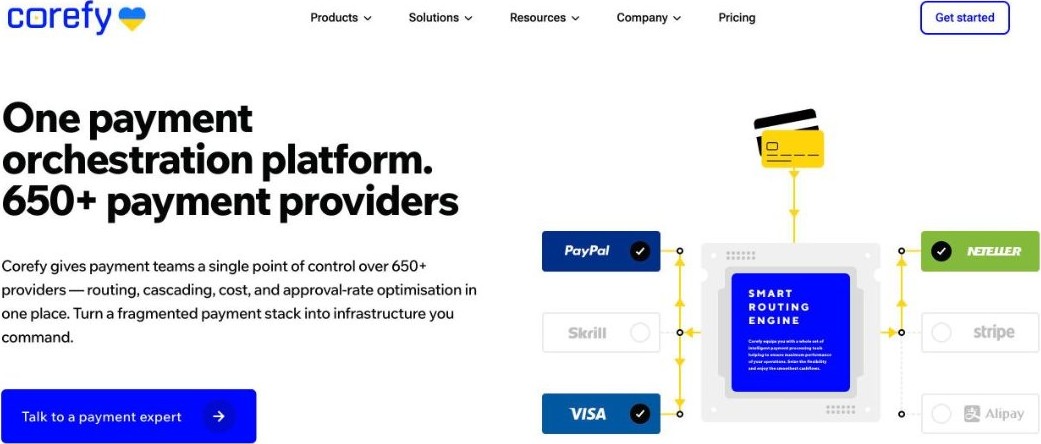
Corefy is a payment orchestration platform and one of very few in this space that publishes per-transaction pricing. Its pricing FAQ names gambling and betting businesses among its clients.
- Best for: operators that want orchestration with predictable, published costs.
- Features: connections to many PSPs, routing, cascading and reconciliation in one dashboard.
- Pricing (vendor site): the Standard plan includes 10,000 transactions a month, then €0.06 per transaction from 10,000 to 30,000. Professional drops to €0.02 per transaction between 100,000 and 1 million. Capterra lists Standard at €2,400 a month.
- What users say: Capterra 3.0/5 from 1 review, too few to draw conclusions.
- Watch for: limited public evidence of large iGaming clients, so ask for references.
12. Gigadat
Gigadat provides Interac e-Transfer pay-ins and payouts in Canada and has served 100+ merchants since 2013, with gaming as a core vertical.
- Best for: operators in Ontario, Alberta and the wider Canadian market, where Interac is a preferred deposit method.
- Features: Interac e-Transfer deposits and withdrawals focused on regulated Canadian iGaming.
- Pricing: quote only.
- What customers say (from Gigadat’s site): the company focuses on Interac speed and reliability for Canadian players.
- Watch for: it is Canada-only, and public company and client information is limited.
Other providers worth knowing
- Volt: an FCA-licensed open banking provider reaching 5,000+ banks, with past iGaming partnerships through GiG and MoneyMatrix.
- Crypto rails: Nuvei documents crypto payouts and Praxis lists crypto connectors, and specialist crypto processors also serve the sector. Security incidents and tightening rules mean they need extra due diligence, and many licensed markets do not allow them: Brazil’s 2024 payment rules barred crypto for licensed betting even before the 2026 ban. See our guide to crypto casino licences before adding a crypto rail.
- Platform-bundled payments: many turnkey platforms include a payment gateway. Convenient at launch, but it ties your payment data to your platform contract. See our guide to casino software providers.
Who are the biggest iGaming payment providers?
By scale, the largest names on this list are the card acquirers and wallet groups. Worldpay sits inside Global Payments, one of the biggest acquiring groups in the world, and says it serves more than 200 gaming operators. Paysafe reported $447.4 million in revenue for Q2 2026 alone and runs both Skrill and Neteller. Nuvei claims 720+ payment methods and is adding Payoneer. In open banking, Trustly is the largest gambling specialist by documented client count, with 800+ gaming brands.
Size is not the same as fit. A large acquirer may not approve a new licence holder, while a smaller local rail such as Gigadat can matter more in its home market than any global brand.
What 2026 payment rules mean for your provider choice
| Market | The rule | What it means for your stack |
|---|---|---|
| UK | Credit cards have been banned for online gambling since 14 April 2020. | Your acquirer must block credit cards for UK players. Debit cards, open banking and e-wallets carry the volume. See the UKGC licence guide for wider licence conditions. |
| Brazil | Provisional Measure 1.394 banned fixed-odds betting on sports and online games from 25 September 2026. New deposits stopped at once, licences under Law 14.790/2023 end 30 days after publication, and Banco Central Resolutions 595, 596 and 597 (2 October 2026) bar TED, boleto and Pix for betting; the TED and Pix rules allow wind-down and refund payments. The measure lapses unless Congress converts it within 120 days. | No new Brazilian deposits through any provider. Use your Banco Central-authorised partner, such as Pay4Fun, only for refunds and wind-down, and keep contracts in place in case the measure lapses. |
| Germany | The GGL has issued more than 30 payment-blocking orders against unlicensed operators, upheld in court in 2025. | Expect providers to demand proof of a German licence before processing German players. |
| United States | The UIGEA and Regulation GG require payment systems to block restricted unlawful internet gambling transactions, while state-licensed operators can accept payments within approved states. | Choose providers approved as vendors in each state you operate in, such as Paysafe, Nuvei and Worldpay. |
| Canada (Alberta) | Alberta opened a regulated private iGaming market on 13 July 2026 under the AGLC, Canada’s second after Ontario, with 50 operators approved at launch. | Interac is central in Canada, so add an Interac provider such as Gigadat alongside cards for both provinces. |
| Card markets | Visa’s VAMP “excessive” merchant threshold fell from 2.2% to 1.5% on 1 April 2026 in the US, Canada, the EU and Asia-Pacific. | Monitor fraud and dispute ratios closely and shift volume to A2A rails where possible. |
Primary source for the US rule: Regulation GG final rule (Federal Register, 2008). Brazil’s Provisional Measure 1.394 and Banco Central Resolutions 595 to 597 are published in the Diário Oficial da União. Brazil’s position is moving fast, so recheck it before you sign anything.
Which payment provider is best for online gaming?
The best payment provider for an online gaming business is the combination that covers your licensed markets’ preferred methods with fast payouts and manageable card risk. In practice:
- European operator, conversion and payouts first: combine Trustly or Brite for bank payments with Paysafe wallets and one card acquirer.
- US state-licensed operator: shortlist Paysafe, Nuvei and Worldpay, and confirm vendor approvals state by state.
- Brazil: no new betting deposits are allowed while Provisional Measure 1.394 stands. Keep Pay4Fun or another authorised partner only for refunds and wind-down.
- Latin America outside Brazil: AstroPay for wallet coverage, plus Nuvei for local methods.
- Canada (Ontario and Alberta): add Gigadat or another Interac provider alongside cards.
- Many markets and PSPs: put Praxis, PaymentIQ or Corefy in front as the cashier and orchestration layer.
Questions to ask before you sign
- Which of our licences and markets are you approved for, and can you show it in writing?
- What is the full price including fixed fees, gambling surcharges, chargeback fees and FX margins?
- What rolling reserve do you require, for how long, and how does it reduce over time?
- What share of payouts settle within minutes, and what is the documented success rate?
- How do you help us stay under card scheme fraud and dispute thresholds such as Visa’s 1.5% VAMP limit?
- Which KYC, name-matching and closed-loop payout checks are built in?
- If you terminate our account, how much notice do we get and when is the reserve released?
- Can we export full transaction and reconciliation data if we leave?
Red flags when choosing a payment provider
- The provider cannot show approval for your licensed markets.
- Pricing is quoted as a single percentage with no mention of reserves or chargeback fees.
- A provider offers to process players from markets where you are not licensed, or from markets such as Brazil where betting payments are currently banned.
- Your entire deposit volume would depend on one acquirer or one e-wallet.
- Settlement times and reserve release terms are vague.
- Comparison content from a provider that ranks itself first. Most pages ranking for this topic are written by payment vendors promoting their own service.
Next steps
Map the payment methods your markets actually use, shortlist one provider per layer, and model the all-in cost per deposit before you negotiate. Payments sit close to fraud and identity checks, so read our guides to iGaming fraud detection and starting a sportsbook as you plan your stack.