You’re pricing a gambling licence and every source gives you a different number. Licence agents quote packages, consultancies quote ranges with no currency, and half the comparison tables still show fee schedules that regulators replaced years ago. The figure you actually need is simpler: what the regulator charges, when, and what comes on top.
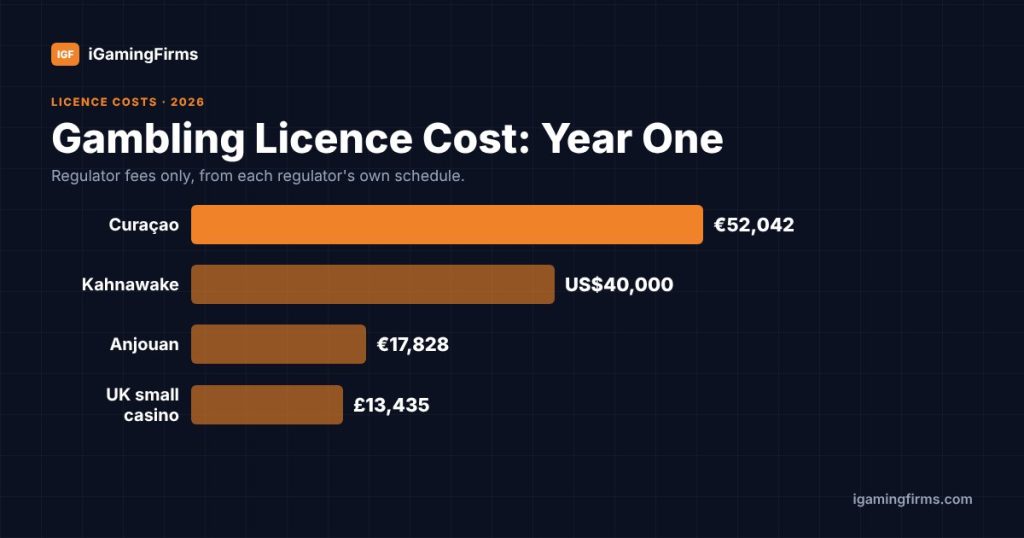
The short answer: gambling licence cost in 2026 runs from about €17,828 a year (Anjouan) to millions of dollars (Pennsylvania), depending on where your players are. Among the main offshore and hub licences, regulator fees in year one run from roughly €18,000 to €53,000: Anjouan €17,828, Kahnawake US$40,000 with one key person, Isle of Man £42,000 and Curaçao €52,042. Local-market licences add revenue-based costs that usually matter far more than the fee, such as the UK’s 40% Remote Gaming Duty or the roughly 20% of gaming revenue iGaming Ontario keeps.
This guide compares 15 jurisdictions using each regulator’s own fee schedule, with the currency and the date of the source, then turns them into a year-one cost table with stated assumptions. It’s written for operators choosing a licence, and it’s just as useful for affiliates and suppliers who need to know what their partners are paying for.
Gambling licence costs at a glance: 15 jurisdictions
All figures are regulator fees in the currency the regulator charges. We haven’t converted them, because exchange rates move and the regulator bills in its own currency. “Key person” means the individual approvals some regulators charge for directors, owners or managers.
| Jurisdiction (regulator) | Application fee | Licence / annual fee | Key person and other fees | Revenue-based cost | Source and date |
|---|---|---|---|---|---|
| Anjouan (Anjouan Gaming) | €17,828 issuance (B2C or B2B) | €17,828 a year | €500 per extra domain (B2C) | None published | Regulator fee page, modified 1 Apr 2026 |
| Curaçao (Curaçao Gaming Authority) | €4,592 | €47,450 a year B2C (€24,490 licence fee + €22,960 supervisory fee); €24,490 B2B | €150 per UBO from the second; €250 per added domain | No tax on gaming revenue | CGA fee schedule under the LOK (Dec 2024), amounts unchanged in version 2.0 (Nov 2025) |
| Kahnawake (Kahnawà:ke Gaming Commission) | US$35,000 incl. first annual fee (US$40,000 from 1 Jan 2027) | US$20,000 a year, covering up to six domains; US$500 a year per extra domain | US$5,000 per Key Person Permit incl. first year (US$6,000 from 2027), then US$1,000 a year | None published | KGC fee notices, 22 Apr 2025 (domains) and 13 Aug 2026 |
| Isle of Man (Gambling Supervision Commission) | £5,250 | £36,750 a year (full licence); £5,250 (sub-licence) | None in the fee schedule | Gambling duty on gross gaming yield | GSC fee schedule, effective 6 Jul 2023 |
| Alderney (AGCC) | £17,500 first-year fee for a new applicant with no prior Alderney activity (otherwise £35,000), plus a £10,000 deposit | Category 1: £35,000 to £400,000 a year by net gaming yield band | £3,000 per gambling business associate | Built into the banded annual fee | AGCC fees page, table dated 1 Apr 2015 |
| Malta (Malta Gaming Authority) | €5,000 | €25,000 a year (B2C) | Key function approvals | Compliance contribution: €15,000 to €375,000 a year for casino, €25,000 to €600,000 for betting; gaming tax on revenue from players based in Malta of 15% (Type 1, casino) or 10% (Types 2 to 4) since 1 Oct 2026, replacing the flat 5% | MGA fees and taxation guidance note, v2; Legal Notice 84 of 2026 |
| United Kingdom (Gambling Commission) | £8,185 remote casino; £6,535 remote betting (smallest band) | £7,000 casino; £5,937 betting (first year charged at 75%) | £463 per Personal Management Licence | Remote Gaming Duty 40% since 1 Apr 2026; remote betting 25% from 1 Apr 2027 | Government fee schedule from 1 Oct 2026; HMRC |
| Spain (DGOJ) | €10,000 per licence (general and each singular); €100 per authorisation | Annual fee of 0.75 per thousand of gross operating revenue | €38,000 technical compliance report (minimum); €2,500 register entry | Gaming tax on net revenue | Ley 13/2011, Article 49 |
| Netherlands (Kansspelautoriteit) | €61,300 (was €48,000) from 1 Apr 2026 | No fixed annual licence fee in the sources checked | €10,200 to change an existing licence | Dutch gambling tax | Government Gazette notice, reported Jan 2026 |
| Denmark (Spillemyndigheden) | DKK 343,300 betting or casino; DKK 480,600 combined | DKK 73,200 to DKK 6,447,500 a year by GGR band | None listed on the fee page | Built into the GGR-banded annual fee, plus Danish gambling duty | Regulator fee page, 2026 figures |
| Sweden (Spelinspektionen) | Not verified this update | SEK 240,000 supervision fee per online gaming or betting licence, per 12-month period | None found | Swedish gambling tax | SIFS 2026:1, in force 1 Mar 2026 (as reported) |
| Ontario (AGCO + iGaming Ontario) | Included in the registration fee | CAD 100,000 per gaming site per year | Supplier registrations CAD 2,000 to 15,000 a year | iGO keeps about 20% of gaming revenue | AGCO fee page; iGO annual report 2024-25 |
| New Jersey (DGE) | Not less than US$400,000 for an Internet gaming permit (US$100,000 deposit with the application) | Renewal not less than US$250,000 | US$250,000 a year for compulsive gambling programmes | 19.75% on internet gaming revenue since 1 Jul 2025, plus a 2.5% investment alternative (22.25% in effect) | N.J.S.A. 5:12-95.29; P.L.2025, c.66 |
| Pennsylvania (PGCB) | Interactive gaming certificate US$4m to US$12m; interactive gaming operator US$1m; sports wagering certificate US$10m | Renewals every 5 years: US$250,000 (certificate), US$100,000 (operator), US$250,000 (sports) | Separate supplier and employee licensing | 54% on online slots, 16% on online tables and poker | PGCB schedule of fees, effective June 2018 |
| Michigan (MGCB) | US$50,000 | US$100,000 on issue, then US$50,000 a year; 5-year term | Supplier: up to US$5,000 application, US$5,000 initial, US$2,500 a year | Graduated state tax on online gaming | Lawful Internet Gaming Act, MCL 432.306 and 432.308 |
The fee schedules behind the strongest-sourced rows are the UK government’s Gambling Commission fee schedule from 1 October 2026, the MGA licence fees and taxation guidance note, the Kahnawà:ke Gaming Commission’s fee notice, the Danish Gambling Authority’s betting and online casino fees and the AGCO’s internet gaming fees. The others come from the Anjouan Gaming fee page, the CGA’s LOK fee schedule, the GSC’s fee schedule, the AGCC fees page, Ley 13/2011, the PGCB schedule of fees, and the New Jersey and Michigan statutes. Fees change by decree or notice, so confirm with the regulator before you budget.
Tobique, Nevis and Gibraltar aren’t in this comparison. We only include licences whose fees we could check against a regulator’s own published schedule, and agent quotes for those three vary widely.
Year-one regulator cost: what you pay before you take a bet
The first table shows the fee schedules. This one shows what that means in cash during your first licensed year, for a single B2C brand. It’s the number most comparison pages skip, because it forces you to add the application fee, the first annual fee and the per-person charges together.
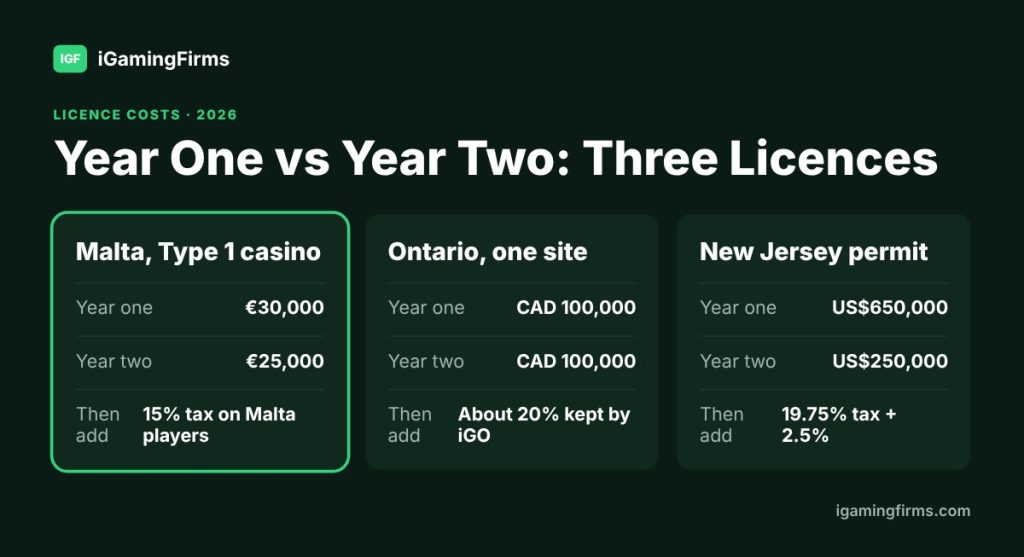
Assumptions: one B2C casino brand, one key person where a regulator charges per person, smallest revenue band where fees are banded, licence granted at the start of the year, no players from markets you aren’t licensed for. Revenue-based costs are listed separately because they depend on your gaming revenue.
| Jurisdiction | Year-one regulator cash | Year two | Then add |
|---|---|---|---|
| UK, remote casino, GGY under £250,000 | £13,435 (£8,185 + 75% of £7,000) plus £463 per PML | £7,000 | 40% Remote Gaming Duty on GGR |
| Alderney, Category 1, new applicant | £17,500 first-year fee (plus £10,000 deposit) | £35,000 (net gaming yield under £500,000) | Higher bands up to £400,000 as you grow |
| Anjouan | €17,828 | €17,828 | €500 per extra domain; company and agent costs |
| Malta, Type 1 casino | €30,000 | €25,000 | Compliance contribution, €15,000 minimum a year once a full licence period has passed; 15% gaming tax on revenue from players based in Malta (since 1 October 2026); paid-up share capital |
| Kahnawake (filed in 2026) | US$40,000 (CPA + one Key Person Permit) | US$21,000 | Hosting at Mohawk Internet Technologies; US$46,000 in year one if filed from 2027 |
| Isle of Man, full licence | £42,000 | £36,750 | Gambling duty on gross gaming yield; on-island substance |
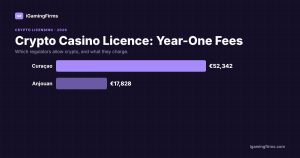
| Curaçao, B2C | €52,042 (€52,842 with three UBOs and two added domains); first-year fees may be pro-rated | €47,450 | Resident director now; local staff and office from 1 Apr 2027 |
| Netherlands | €61,300 application | Not verified | Dutch gambling tax and compliance build |
| Spain (one general + two singular licences) | €70,500 (3 × €10,000 + €38,000 + €2,500), plus 0.075% of gross revenue | 0.075% of gross revenue | Gaming tax; licence guarantee; you can only apply when a licence call is open |
| Ontario, one site | CAD 100,000 | CAD 100,000 | About 20% of gaming revenue retained by iGO |
| Michigan | US$150,000 (US$50,000 + US$100,000) | US$50,000 | State tax on online gaming; paid by the casino or tribe that holds the licence |
| Sweden | SEK 240,000 supervision fee per licence | SEK 240,000 | Application fee (not verified here); Swedish gambling tax |
| Denmark, casino, GGR under DKK 5m | DKK 416,500 (DKK 343,300 + DKK 73,200) | DKK 73,200 | Higher fee bands as GGR grows; Danish gambling duty |
| New Jersey, permit holder | US$650,000 (US$400,000 permit + US$250,000 annual programme fee) | US$250,000 | Permit renewal of at least US$250,000; 19.75% internet gaming tax plus the 2.5% investment alternative |
| Pennsylvania | US$5m to US$13m (certificate + operator licence) | Nothing until renewal | 5-year renewals; 54% tax on online slots |
Two things stand out. First, the cheapest year-one regulator bill in this list isn’t an offshore licence at all: a small UK remote casino pays less in year one than an Anjouan licensee. The UK becomes expensive through the 40% duty and the compliance work, not the fee. Second, the US states price entry for land-based casino groups, not start-ups. In New Jersey, Pennsylvania and Michigan the licence usually sits with a casino or tribe, and a new brand enters as its online partner.
Why the licence fee is the smallest part of the cost
Every licence carries four layers of cost. Only the first is published in a fee schedule.
- Regulator fees. Application, annual and key person fees, as in the tables above. Fixed and predictable.
- Revenue-based charges. Gaming duty, compliance contributions, GGR-banded fees and revenue shares. In local markets these quickly dwarf the fee: at CAD 10 million of gaming revenue, iGaming Ontario’s roughly 20% is CAD 2 million against a CAD 100,000 registration.
- Capital, guarantees and substance. Malta requires paid-up share capital, Spain requires a guarantee, the Isle of Man requires two resident directors and on-island servers, Kahnawake requires hosting at Mohawk Internet Technologies, and Curaçao requires a resident director now and local staff and an office from 1 April 2027.
- Advisers and certification. Company set-up, policies, legal opinions, game and RNG certification, and the system audits several regulators require. These are quoted case by case, and they’re where agent packages differ most.
Our Curaçao gaming licence guide and MGA licence guide model all four layers for those two licences, including share capital and the compliance contribution at different revenue levels.
Offshore and hub licences
These licences let you operate from the issuing jurisdiction into markets that don’t license online gambling locally. None of them lets you take players from a market that does, such as the UK, Spain, Ontario or a US state. Our guide on whether offshore betting is legal explains how that works market by market.
Anjouan: €17,828 to issue, €17,828 a year
Anjouan Gaming’s fee page lists one figure for issuing a B2C or B2B licence and the same figure for each annual renewal, plus €500 per extra domain for B2C. It’s the lowest flat fee among the offshore licences here. The trade-off is acceptance: payment providers, affiliates and B2B partners accept it less widely than Curaçao, and Comoros officials have disputed the legality of the bodies behind it. Check with your payment providers before you commit.
Curaçao: €4,592 application plus €47,450 a year
Under the LOK, in force since 24 December 2024, the Curaçao Gaming Authority licenses operators directly. The B2C annual cost is €24,490 to the National Treasury plus €22,960 to the CGA. Due diligence is €150 for each UBO after the first, and each added domain is €250. With three UBOs and two added domains, year one comes to €52,842. The CGA’s November 2025 update to its fee policy changed billing procedures, not amounts. There’s no tax on gaming revenue, but corporate income tax applies. Quotes of “ANG 9,000 application” or a monthly fee belong to the regime that applied before the LOK.
Kahnawake: US$35,000 plus US$5,000 per key person, rising in January 2027
The KGC’s Client Provider Authorization costs US$35,000 including the first US$20,000 annual fee, and each Key Person Permit costs US$5,000 including its first year. You need at least one key person, so the realistic minimum is US$40,000. The US$20,000 annual fee covers up to six domains, and each extra domain costs US$500 a year under the KGC’s notice of 22 April 2025.
Under the KGC’s notice of 13 August 2026, applications submitted from 1 January 2027 pay US$40,000 for the CPA and US$6,000 per key person, and the five-year CPA renewal rises from US$5,000 plus the annual fee to US$40,000 including it. Applications submitted before that date are charged under the current schedule even if they’re approved later, so filing this year saves money. Annual fees (US$20,000 for the CPA and US$1,000 per key person) don’t change.
Isle of Man: £5,250 application plus £36,750 a year
The GSC charges £5,250 to apply for any licence type and £36,750 a year for a full licence, a fee schedule in force since 6 July 2023. A sub-licence under a full licence holder costs £5,250 a year, which makes it one of the cheapest ways to hold your own tier-one licence for a white label. Gambling duty applies to gross gaming yield in bands, and you need a Manx company, two resident directors and on-island servers.
Alderney: £17,500 to start, then banded by yield
The AGCC charges new applicants with no prior Alderney licensed activity a £17,500 first-year fee for a Category 1 or Category 2 eGambling licence (£35,000 otherwise), plus a £10,000 deposit. From renewal, the Category 1 fee depends on annualised net gaming yield: £35,000 under £500,000, rising through seven bands to £400,000 at £30 million or more. The AGCC page presents this table as at 1 April 2015, so confirm it’s still current before you rely on it.
Malta: €5,000 application plus €25,000 a year, plus a compliance contribution
The MGA’s guidance note sets a €5,000 application fee and a €25,000 fixed annual B2C licence fee. The variable part is the compliance contribution, charged on gaming revenue with a floor and a ceiling: €15,000 to €375,000 a year for Type 1 (casino) and €25,000 to €600,000 for Type 2 (betting). New operators don’t owe the full minimum until a complete licence period has passed.
On top, gaming tax applies to revenue from players based in Malta: since 1 October 2026 it’s 15% for Type 1 (casino-type) games and 10% for Types 2 to 4 (betting, peer-to-peer and controlled skill games), replacing the flat 5%, under the Gaming Tax (Amendment) Regulations, 2026 (Legal Notice 84 of 2026), as summarised in PwC Malta’s note on the change. Our MGA guide works out the contribution at different revenue levels.
Local-market licences in Europe
These licences give you one regulated market, and each of them is required if you want that market’s players. The fee is rarely the deciding number.
United Kingdom: £8,185 to apply for a small remote casino
From 1 October 2026 the Gambling Commission charges £8,185 to apply for a remote casino operating licence and £7,000 a year in the smallest band (gross gaming yield under £250,000). Remote betting on real events costs £6,535 and £5,937. First annual fees are charged at 75%, and each Personal Management Licence costs £463.
The largest remote casino band pays £1,453,949 a year plus £272,324 for each extra £200 million of GGY above £1.6 billion. What makes the UK expensive is tax: HMRC raised Remote Gaming Duty from 21% to 40% on 1 April 2026, and remote betting moves to 25% on 1 April 2027 (UK horseracing excluded). A UK hybrid needs both a casino and a betting licence. Our UKGC licence guide covers the requirements and timeline.
Spain: €10,000 per licence, but only when a call is open
Article 49 of Ley 13/2011 sets the DGOJ’s fees: €10,000 for each licence application, €100 per authorisation, a minimum €38,000 for technical compliance reports, €2,500 for registration and an annual 0.75 per thousand of gross operating revenue. Spain uses general licences for each category of game and singular licences for each game type, so a casino with roulette and slots needs several. General licences are only granted through a public call, and you also post a guarantee and pay gaming tax on net revenue.
Netherlands: €61,300 to apply from April 2026
The Dutch online licence application fee rose from €48,000 to €61,300 on 1 April 2026, following a Government Gazette notice from the State Secretary for Justice and Security that indexed 2021 rates to cover the Kansspelautoriteit’s costs. Changes to an existing licence rose from €8,000 to €10,200. These figures come from trade reporting of the Gazette notice (stcrt-2026-1642); check the KSA’s own page before you file.
Denmark: DKK 343,300 to apply, then a fee banded on GGR
The Danish Gambling Authority charges DKK 343,300 to apply for a betting or online casino licence in 2026, or DKK 480,600 for a combined licence. The annual fee depends on gross gaming revenue, from DKK 73,200 below DKK 5 million to DKK 6,447,500 at DKK 500 million and above. Denmark also offers a revenue-restricted licence for small operators, with its own fee page.
Sweden: SEK 240,000 a year in supervision fees
Spelinspektionen’s regulation SIFS 2026:1, in force from 1 March 2026, sets the supervision fee for a commercial online gaming or betting licence at SEK 240,000 per licence for each 12-month period, as reported by SiGMA in February 2026. We couldn’t verify the separate application fee from a primary source for this update.
North America: Ontario and the US states
Ontario: CAD 100,000 per site, and iGO keeps about 20%
The AGCO charges internet gaming operators CAD 100,000 per gaming site per year. Gaming-related suppliers pay CAD 15,000 (manufacturers) or CAD 3,000, and non-gaming suppliers CAD 2,000. The bigger cost is the operating agreement with iGaming Ontario: its 2024-25 annual report says it remits 80% of gaming revenue to operators, and it kept CAD 574.1 million of CAD 2,901.5 million that year. Each brand you run on a separate site pays its own CAD 100,000.
New Jersey: at least US$400,000 for the permit
Under N.J.S.A. 5:12-95.29, an Internet gaming permit costs not less than US$400,000 to issue, with a deposit of at least US$100,000 posted with the application, and not less than US$250,000 to renew. The permit holder also pays US$250,000 a year towards compulsive gambling programmes. Since 1 July 2025 (P.L.2025, c.66), internet gaming revenue is taxed at 19.75%, up from 15%, and the 2.5% investment alternative still applies on top. Permits sit with the Atlantic City casino licensees, and online brands operate as their partners with their own DGE approvals.
Pennsylvania: US$4 million to US$12 million for the certificate
The PGCB’s schedule of fees (effective June 2018) lists the interactive gaming certificate at US$4 million to US$12 million for a five-year initial term, an interactive gaming operator licence at US$1 million, and a sports wagering certificate at US$10 million. Five-year renewals cost US$250,000, US$100,000 and US$250,000. The certificates are held by Pennsylvania’s casino licensees, and the 54% tax on online slots shapes every partner’s margin there.
Michigan: US$50,000 to apply, US$100,000 on issue
Section 6 of Michigan’s Lawful Internet Gaming Act sets a US$50,000 application fee, a US$100,000 initial licence fee and US$50,000 a year after that, for a five-year licence. Internet gaming suppliers pay up to US$5,000 to apply, US$5,000 on issue and US$2,500 a year. As in New Jersey and Pennsylvania, the operator licence sits with a Detroit casino or a tribe.
Sports-betting-only states follow the same pattern. Arizona’s Department of Gaming lists an event wagering operator at US$100,000 to apply, US$750,000 for the initial licence and US$150,000 a year, which is why the state-regulator fee pages that rank for this search show such large numbers next to small charity and card-room fees.
What is the cheapest gambling licence?
On the regulator fee alone, the cheapest full B2C licences in this comparison are:
- UK remote casino, smallest band: £13,435 in year one, £7,000 a year after. Cheap to hold, expensive to run because of the 40% duty.
- Alderney Category 1, new applicant: £17,500 in year one, then at least £35,000 a year.
- Anjouan: €17,828 to issue and €17,828 a year, with no revenue-based charge published.
- Malta: €30,000 in year one before the compliance contribution.
- Kahnawake: US$40,000 in year one with one key person, US$21,000 a year after.
“Cheapest” only means something next to your markets. If your players are in the UK, Spain, Ontario or a US state, the only licence that works is that market’s licence, whatever it costs. If they’re in markets without local licensing, the useful comparison is the total of fees, substance and payment access: an Anjouan licence that your payment providers won’t accept costs more than a Curaçao licence they will.
Why do you need a gambling licence?
Because the country your players are in decides whether you can legally serve them, and because almost every partner you need checks your licence first. Without one, you can’t lawfully take bets in markets that regulate gambling, and in many you or your promoters face fines or criminal liability. Payment providers, banks, game studios, aggregators and affiliate networks all ask for your licence number and check it on the regulator’s register before they onboard you. App stores also require real-money gambling apps to be licensed where they’re used.
For affiliates, the licence matters too. Promoting an operator into a market where it holds no licence carries advertising risk, and several regulators, Spain’s among them, make it an infringement to promote unlicensed gambling.
How long does it take to get a gambling licence?
Time is a cost too, because you pay for a team, a platform and an office while you wait. As a rule, the cheaper offshore licences decide in weeks and the local-market licences in months:
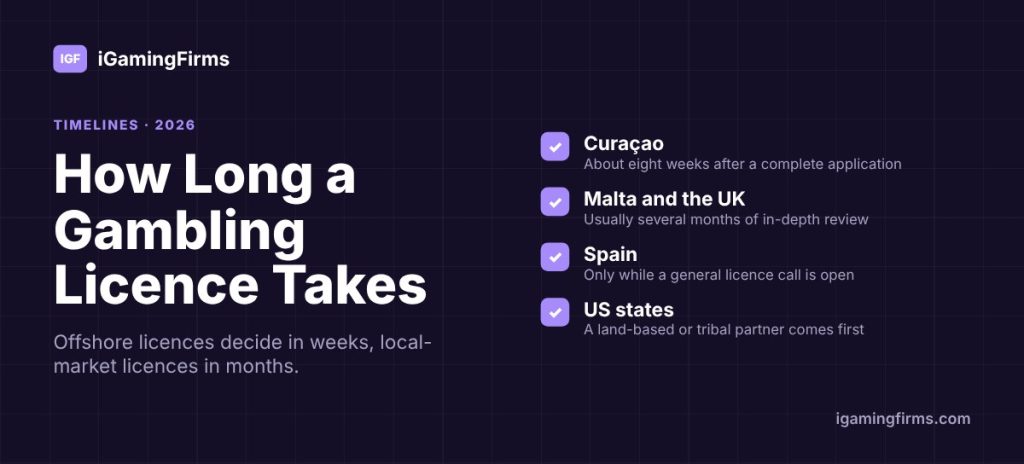
- Curaçao: the CGA aims to decide within about eight weeks of a complete application.
- Malta and the UK: usually several months, because both review your policies, key people and source of funds in depth.
- Spain: you can only apply while a general licence call is open, so your timeline depends on the DGOJ’s calendar.
- US states: you need a land-based or tribal partner first, then approvals for your brand and suppliers.
Whatever the regulator’s target, the clock only starts once your application is complete. Missing documents are the most common cause of delay.
How much money do you need to start a gambling business?
Much more than the licence. For a lean offshore sportsbook launch on a Curaçao licence, our guide on how to start a sportsbook models about €557,000 to €1.52 million in first-year capital once you add the platform, team, marketing and a cash reserve to pay winners. The licence line in that budget is about €52,000. If you run on a white label under a provider’s licence, the licence fee disappears but the provider’s revenue share, usually a percentage of GGR, replaces it.
How to budget for a gambling licence
- List your target markets first. Mark each one as locally licensed or not. Locally licensed markets each need their own licence.
- Pick the licence that covers the rest. Compare the offshore and hub options above on year-one and year-two fees, substance and partner acceptance.
- Count your people and domains. Kahnawake, Curaçao, the UK and Malta charge per key person, UBO, domain or role.
- Model revenue-based costs at three GGR levels. Duty, compliance contributions, banded fees and revenue shares change your answer as you grow.
- Add substance, capital and certification. Directors, hosting, share capital, guarantees, audits and lab testing.
- Check the dates. Kahnawake changes on 1 January 2027 and Curaçao’s substance rules on 1 April 2027. The UK fees and Malta’s gaming tax changed on 1 October 2026 and the Dutch fee on 1 April 2026.
- Get like-for-like quotes. Give two or three iGaming licensing consultants the same brief and ask what each quote excludes. For structural and legal questions, the gambling law firms comparison helps you shortlist counsel.
Fee figures to be careful with
Several pages ranking for this keyword still show figures that don’t match the regulators’ current schedules:
- Curaçao at “ANG 9,000 application, ANG 48,000 a year and ANG 4,000 a month”. That’s the old Gaming Control Board structure. Under the LOK it’s €4,592 plus €47,450 a year for B2C, with no monthly fee.
- Kahnawake at “US$40,000 application, US$20,000 annual”. Today the CPA costs US$35,000 including the first annual fee, and the US$40,000 figure is the CPA plus one key person. From 1 January 2027 the CPA alone is US$40,000.
- Malta at “€22,000 to €43,000 to apply”. The MGA application fee is €5,000. Larger numbers mix in the annual fee, the compliance contribution or adviser costs.
- The UK at “€25,700 to €68,000 to apply”. The Gambling Commission bills in pounds and publishes fees by band. A small remote casino pays £8,185 to apply.
- Anjouan at “€18,000” in one table and “€17,828” in the text of the same page. The regulator’s fee page says €17,828 for issuance and the same for each renewal.
Your next step
Write down three things before you call anyone: your target markets, your expected gaming revenue for the first two years, and how many key people and domains you’ll run. Take the year-one table above, cross out every licence that doesn’t cover your markets, and model what’s left at your revenue. Then read the guide for each licence still on your list and get quotes on the same brief.
This guide is independent information, not legal or tax advice. Fees are taken from each regulator’s published fee schedule, statute or notice as named above, checked between 11 and 15 October 2026; Dutch and Swedish figures come from trade reporting of official notices. Confirm current fees with the regulator or a qualified adviser before you apply.