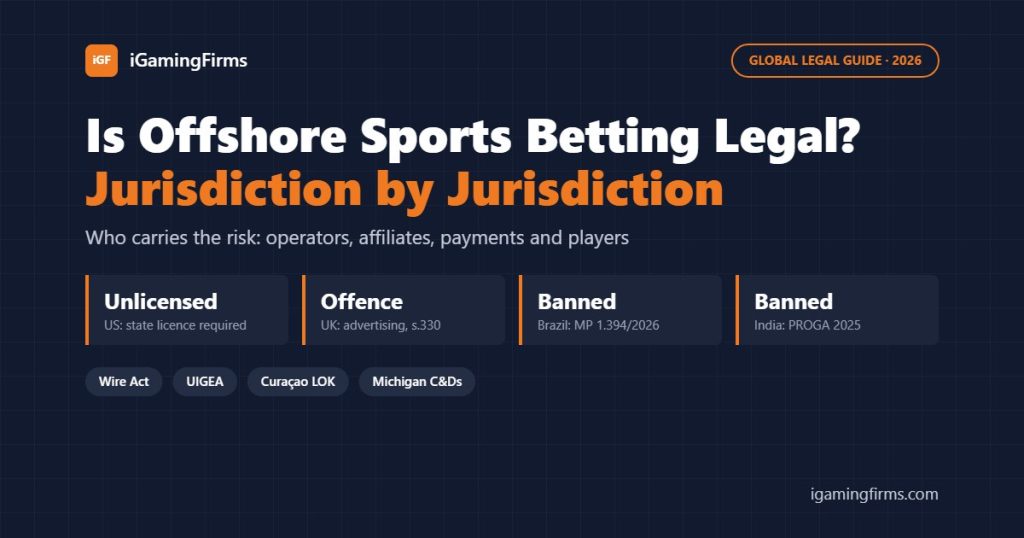
Is offshore sports betting legal? It is legal in the country that licenses the operator, and usually unlawful in the country where the customer is located unless that country has also licensed the operator. Gambling law in almost every major market follows the customer, not the server.
If you run a sportsbook, send it traffic or process its payments, that answer decides which markets you can serve, which partners will work with you, and whether a campaign becomes an enforcement problem. This guide explains who carries the legal risk in each major jurisdiction, what changed in 2026, and what an offshore licence does and does not cover.
The short answer
In most jurisdictions, the law targets the operator, its advertisers and its payment chain rather than the individual bettor. That is why operators, affiliates and payment providers face far more risk than players.

The offshore market is also large enough that regulators treat it as a priority. The American Gaming Association estimated in August 2025 that Americans wagered about $84 billion a year with illegal bookies and offshore sportsbooks, roughly 24% of US sports betting revenue, costing states about $1 billion in tax.
What does “offshore” mean in sports betting?
An offshore sportsbook is licensed or incorporated in one jurisdiction while taking bets from customers in another where it holds no licence. Common licensing hubs include Curaçao, Malta, Anjouan, Kahnawake, Antigua and Barbuda, Panama and Costa Rica.
Three tests decide whether serving a market is lawful:
- Point of consumption. Does the target country require a local licence to take bets from people located there? Most regulated markets do.
- Targeting. Do you market to that country, accept its currency or payment methods, use its language, or fail to block its traffic? Regulators treat these as evidence that you serve the market.
- Ancillary conduct. Where a regulator cannot reach the operator, it can still act against advertisers, affiliates, payment providers and app stores.
A licence from your home jurisdiction does not answer any of these tests.
Does it matter where the servers are?
No. Courts treat a bet as placed where the bettor is. In United States v. Cohen (2d Cir. 2001), the founder of an Antigua-licensed sportsbook was convicted under the Wire Act for taking bets from New York customers, even though the business and its servers were outside the US. Hosting, incorporation and licence location do not move the place of the bet.
Jurisdiction by jurisdiction: who carries the risk
The table below summarises the position for an operator without a local licence as of October 2026.
| Jurisdiction | Can an unlicensed offshore sportsbook serve residents? | Operator exposure | Affiliate exposure | Payment exposure | Player exposure |
|---|---|---|---|---|---|
| United States | No. Only state-licensed sportsbooks in states that allow betting | Federal and state law; state cease-and-desist letters | State enforcement and affiliate licensing rules | UIGEA payment restrictions | Low in most states; some state laws apply to bettors |
| United Kingdom | No. A Gambling Commission licence is required | Criminal offence | Criminal offence to advertise unlawful gambling | Regulator works with payment providers | No offence |
| Germany | No. A German licence is required | Enforcement, blocking and player refund claims | Advertising prohibited | Payment blocking orders | Technically an offence, rarely pursued |
| Netherlands | No. A KSA licence is required | Fines | Advertising prohibited | Limited | Not fined |
| Canada | No. Only province-run or province-authorised operators | Criminal Code and provincial enforcement | Restricted in Ontario and Alberta | Limited | Rarely pursued |
| Brazil | No. Fixed-odds betting is banned for all operators | Blocking, app removal and daily fines of up to R$200,000 | Advertising and sponsorship banned | Banks and Pix barred from processing bets | Not penalised |
| India | No. Online money games are banned nationally | Up to 3 years and/or ₹1 crore fine | Up to 2 years and/or ₹50 lakh fine | Up to 3 years and/or ₹1 crore fine | Not criminalised |
| Australia | No. Only state- or territory-licensed wagering providers | Criminal and civil penalties | Advertising is an offence; sites blocked | Credit cards banned for online wagering | No offence |
Is offshore sports betting legal in the US?
Not for the operator. An offshore sportsbook taking bets from people in the US operates without the state licence that every legal US market requires. For the state-by-state position on betting, casinos and sweepstakes, see our US gambling laws by state guide.
Federal law targets the business, not the bettor
The main federal statutes apply to people engaged in the business of betting or wagering:
- Wire Act (18 U.S.C. § 1084). Makes it a crime for a betting business to knowingly use wire communications to take bets across state or national lines, with up to two years in prison.
- UIGEA (31 U.S.C. § 5363). Bars betting businesses from knowingly accepting payments connected to unlawful internet gambling.
- Illegal Gambling Business Act (18 U.S.C. § 1955). Makes it a federal crime to run a gambling business that breaks state law, involves five or more people, and operates for more than 30 days or takes $2,000 in a single day.
None of these laws is written to punish an individual for placing a bet. Federal enforcement has historically targeted operators and payment facilitators.
States are the main enforcers
State regulators are increasingly active. On October 8, 2026, the Michigan Gaming Control Board sent cease-and-desist letters to 33 offshore operators offering casino, sweepstakes-style and sports betting products without a Michigan licence, after letters to 45 offshore operators announced in April 2026. Operators that ignore the letters can be referred to the Michigan Attorney General.
Michigan’s self-exclusion database only binds licensed operators, which regulators use as a key argument against offshore sites: a person who has self-excluded can still open an account with an unlicensed book.
Some state laws also apply to players. In Washington, knowingly transmitting or receiving gambling information over the internet is a class C felony unless the activity is authorised under state law.
Where is sports betting not legal in the US?
As of September 2026, 11 states had no legal sports betting: Alabama, Alaska, California, Georgia, Hawaii, Idaho, Minnesota, Oklahoma, South Carolina, Texas and Utah. Offshore sportsbooks are still unlawful in these states. There is simply no licensed alternative.
Is the FBI investigating sports gambling?
Yes. The FBI runs a dedicated programme on crime and corruption in sport and gaming, and it has stated that offshore sportsbooks operate illegally in the US and that dismantling illegal sportsbooks is a priority. For operators, the main risk is being drawn into wider fraud or money laundering investigations.
Can you get in trouble for using an offshore sportsbook?
In most states, criminal consequences for bettors are rare, but rare is not the same as legal. The practical risks are financial: no regulator to help recover withheld winnings, no self-exclusion protection, and winnings that remain taxable income. For operators and affiliates, those consumer harms are exactly what regulators cite when they pursue enforcement.
Is offshore sports betting legal in the UK?
Any remote operator transacting with or advertising to consumers in Great Britain needs a Gambling Commission licence, wherever it is based. Providing gambling facilities without a licence is a criminal offence. Our UKGC licence guide covers the requirements and fees for the legal route.
Under section 330 of the Gambling Act 2005, advertising unlawful gambling is also an offence, punishable by up to 51 weeks in prison, an unlimited fine or both. Each day an advert remains accessible counts as a separate offence. Players commit no offence by betting with an unlicensed site.
Is offshore sports betting legal in the EU?
There is no single EU gambling licence. Each member state sets its own rules.
- Germany. Online sports betting requires a licence under the 2021 State Treaty on Gambling. Taking part in unauthorised gambling is technically an offence, although enforcement focuses on operators. The larger risk is civil: players are suing unlicensed operators to recover losses. In the Tipico case (C-530/24), the EU Court of Justice’s Advocate General said in March 2026 that unlicensed sports betting providers can generally be required to refund stakes, with a narrow exception where authorities had tolerated the offering. The Court’s judgment is still awaited.
- Netherlands. A KSA licence has been required since October 1, 2021. The KSA fines unlicensed operators that target Dutch players. Players are not fined.
- Malta. Maltese law allows courts to refuse enforcement of certain foreign judgments against MGA licensees. This does not make serving other EU markets without a local licence legal.
Is offshore sports betting legal in Canada?
Under the Criminal Code, only provinces may conduct and manage gambling. An offshore sportsbook without provincial authorisation is unlawful anywhere in Canada.
Ontario runs a regulated competitive market through iGaming Ontario and the AGCO. Alberta’s regulated iGaming market went live on July 13, 2026, making it the second province with an open licensing model. Most other provinces offer online betting through provincial lottery corporations.
Is offshore sports betting legal in Brazil?
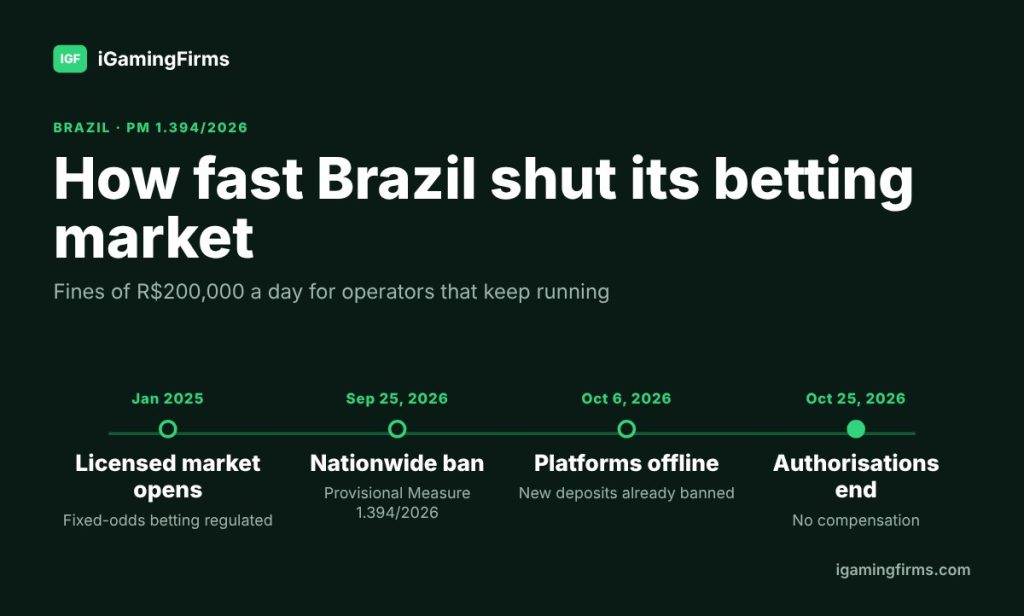
Brazil opened a licensed fixed-odds betting market in January 2025. On September 25, 2026, Provisional Measure 1.394/2026 banned the operation, offer, intermediation and advertising of fixed-odds betting nationwide, covering sports betting and online games.
- The ban applies to every operator offering bets to people in Brazil, including foreign companies.
- New deposits were banned immediately, platforms had to go offline by October 6, 2026, and all authorisations end on October 25, 2026, without compensation.
- Operators that fail to meet the shutdown and refund obligations face fines of up to R$200,000 a day, and the government can order website blocking and app store removal.
- Banks and payment institutions, including those running Pix transfers, are barred from processing betting transactions, except refunds.
- Advertising and sponsorship aimed at the Brazilian public are banned in any medium, which brings affiliates and influencers within scope.
The measure is in force but must be approved by Congress within 120 days to become permanent law, and industry associations have asked the Supreme Court (STF) to suspend it. As of mid-October 2026, no suspension had been granted. Industry groups also report a sharp rise in illegal betting domains since the ban, which is the classic offshore risk when a regulated market closes.
Is offshore sports betting legal in India?
The Promotion and Regulation of Online Gaming Act, 2025 bans online money games, including betting, across India. Penalties target the supply side:
- Offering online money games: up to 3 years in prison, a fine of up to ₹1 crore, or both
- Advertising them: up to 2 years in prison, a fine of up to ₹50 lakh, or both
- Facilitating payments for them: up to 3 years in prison, a fine of up to ₹1 crore, or both
The government can also order blocking of offshore platforms. Players are not the target of these offences.
Is offshore sports betting legal in Australia?
Online sports betting is legal in Australia through state- or territory-licensed wagering providers, although online in-play betting is prohibited. The Interactive Gambling Act 2001 makes it an offence to provide or advertise prohibited interactive gambling services to Australians. It is not an offence for the customer.
The regulator enforces the law by ordering internet providers to block illegal gambling and affiliate websites.
What does an offshore licence cover?
An offshore licence authorises you to operate from that jurisdiction. It does not authorise you to serve customers in any country that requires its own licence. To compare what each route costs, see how much a gambling licence costs across 15 jurisdictions.
- Curaçao moved to direct licences under the National Ordinance on Games of Chance in December 2024.
- Malta is an EU licence with strong compliance standards, but it does not work as a passport to other EU markets.
- Anjouan, Kahnawake, Costa Rica, Panama and Antigua are not recognised as authorisation in the US, UK, Canadian provinces, Brazil, India or Australia.
How regulators and partners spot an offshore sportsbook
Payment providers, affiliate networks, media buyers and regulators use the same signals when they decide whether a brand is serving a market without a licence. If you work with sportsbooks, run these checks before you sign:
- Licence mismatch. The site shows a Curaçao, Anjouan, Costa Rica or Panama licence but accepts customers from a market that requires a local one.
- No local regulator details. No state, provincial or national licence number, and no link to the local self-exclusion scheme.
- Market targeting. Local currency, local payment methods, local-language promotions or sponsorships aimed at a restricted market.
- Payment workarounds. Crypto-only cashiers, miscoded card transactions or third-party payment agents.
- Weak geo-controls. No location checks at registration or at the point of betting.
Any one of these can put an affiliate, payment partner or supplier inside the enforcement net, as Brazil’s advertising ban and the UK’s section 330 offence show.
Is sports betting with a VPN illegal?
For players, using a VPN is legal in most countries, but it does not change where they are legally located and it breaches the terms of licensed sportsbooks. For operators, knowingly accepting VPN traffic from a restricted market can be treated as serving that market. It is not a legal workaround.
Is sports betting legal overseas, and will it become illegal?
Sports betting is legal and licensed in many countries, including the UK, most EU member states, Canada’s provinces, Australia and most US states. What is rarely legal is serving those markets without their licence.
Markets can also close. Brazil shows that a regulated betting market can be banned within weeks, so market access should be reviewed regularly.
What this means for operators and affiliates
The answer to “is offshore sports betting legal” changes by market, so build these checks into your operations:
- Map your traffic against licences. Your exposure depends on where your customers are, not where your company is.
- Geo-block restricted markets. Block by IP, payment method, KYC address and phone country, and monitor VPN use. Our KYC requirements by jurisdiction guide sets out what each regulator expects at onboarding.
- Review affiliate activity. In the UK, Brazil, India and Australia, advertisers can be liable in their own right.
- Check your payment providers. Payment processors are directly targeted in the US, Brazil and India.
- Plan for civil claims. In some EU markets, players can recover losses from unlicensed operators.
- Review market access regularly. Regulations can change quickly.
This guide is general information, not legal advice. Consult a qualified gaming lawyer before entering or exiting a market; our comparison of iGaming law firms is a starting point.