A UKGC licence is the operating licence the Gambling Commission issues under the Gambling Act 2005, and you need one to offer gambling to consumers in Great Britain, wherever your company is based. For an online casino, the application fee now starts at £8,185 and the annual fee at £7,000 (smallest band, fees in force since 1 October 2026), and the Commission’s target for deciding a new operating licence is 16 weeks.
If you’re an operator or B2B supplier planning a GB launch, the licence fee is the easy part of the budget. The harder questions are which licence you actually need, what the Commission will ask for, how long it really takes, and what the 40% Remote Gaming Duty does to your numbers. Plenty of pages ranking for “UKGC license” still quote fees from before the 1 October 2026 increase or skip tax entirely. This guide covers the current fee bands, the requirements, a realistic timeline, what happens after you’re licensed and a year-one cost model with the assumptions shown.
UKGC licence at a glance (October 2026)
| Item | Detail |
|---|---|
| Regulator | Gambling Commission (UKGC), sponsored by the Department for Culture, Media and Sport (DCMS) |
| Law | Gambling Act 2005, plus the Licence Conditions and Codes of Practice (LCCP) and Remote gambling and software Technical Standards (RTS) |
| Territory | Great Britain (England, Scotland, Wales). Northern Ireland has its own separate law |
| Remote casino application fee | £8,185 (GGY under £250,000) to £165,069 (GGY £1.6bn+) |
| Remote casino annual fee | £7,000 to £1,453,949 (plus £272,324 per extra £200m GGY above £1.6bn); first annual fee charged at 75% |
| Personal Management Licence | £463 to apply, £463 maintenance fee every 5 years |
| Decision time (Commission target) | 16 weeks for a new operating licence, 8 weeks for a personal licence, “not guaranteed” |
| Validity | No fixed expiry for operating licences: they continue while you pay the annual fee and stay compliant |
| Main tax | Remote Gaming Duty 40% of gross gaming profits since 1 April 2026; remote general betting moves to 25% on 1 April 2027 |
| Statutory levy | 1.1% of the previous year’s GGY for online operators (since April 2025) |
Who controls gambling in the UK?
The Gambling Commission licenses and regulates commercial gambling in Great Britain under the Gambling Act 2005. DCMS sets policy and the fee levels, HMRC collects gambling duties, and local licensing authorities (councils) issue premises licences for physical venues. Northern Ireland sits outside the Act and the Commission’s remit, which is why a “UK gambling licence” is technically a GB licence.
On spelling: in British English “licence” is the noun and “license” is the verb, so the Commission issues a licence and you are licensed. Searchers use both, and they mean the same thing.
Do you need a UKGC licence?
Yes, if you do either of these:
- Offer gambling to consumers in Great Britain remotely (website, app, TV or any other remote channel), regardless of where you or your servers are based.
- Have any of your remote gambling equipment in Great Britain, even if you don’t take British customers.
That point-of-consumption rule has applied since 2014, when the old “white list” that let Isle of Man, Alderney, Gibraltar and other licensees serve British players ended. Every B2C brand needs to sit under a Commission operating licence, and suppliers who make or adapt gambling software used by GB-facing operators need a gambling software licence too. An offshore licence on its own gives you no right to serve British customers.
There are three kinds of licence a business may need:
- An operating licence from the Commission for the company. Remote, non-remote or ancillary, depending on the activity.
- Personal licences from the Commission for key people: a Personal Management Licence (PML) for senior roles and a Personal Functional Licence (PFL) for roles like croupier, cashier or surveillance in land-based venues.
- A premises licence from the local council for a physical venue (betting shop, casino, adult gaming centre, bingo hall). Pure online operators don’t need one.
Do you need a licence for a raffle, gaming machines or premises?
Small low-level gambling, such as a raffle run as a small society lottery or a couple of machines in a pub, is handled by councils through registrations and permits rather than by the Commission, so it doesn’t need an operating licence. Businesses that make, supply or repair gaming machines do need a Commission gaming machine technical licence. A premises licence is not open to anyone: the applicant generally has to hold (or have applied for) the matching operating licence and have the right to occupy the premises, and the council sets the premises licence fee within statutory maximums.
Which UKGC operating licence do you need?
Licences are activity-based, so a multi-product brand often holds several activities on one licence. The common remote ones:
| Licence activity | Who needs it |
|---|---|
| Remote casino | B2C online casinos: slots, table games, live dealer, poker against the house, where you contract with the player |
| Remote casino (game host) | Studios that run casino games for other operators without contracting with players (needs a gambling software licence too) |
| Remote general betting (standard, real events) | Sportsbooks taking fixed-odds bets on real events |
| Remote general betting (virtual events) | Virtual sports and virtual racing |
| Remote betting intermediary | Betting exchanges and peer-to-peer platforms |
| Remote bingo | Online bingo operators |
| Remote gambling software | B2B studios and platform suppliers that make, supply, install or adapt gambling software |
If you plan to launch on a white label, check where the B2C licence sits. The Commission holds the licensee accountable for every brand run on its licence, and depending on what the brand owner does (marketing only, or controlling customers and money), it may need its own licence. Our comparison of white label casino platforms covers how providers handle this.
How much does a UKGC licence cost?
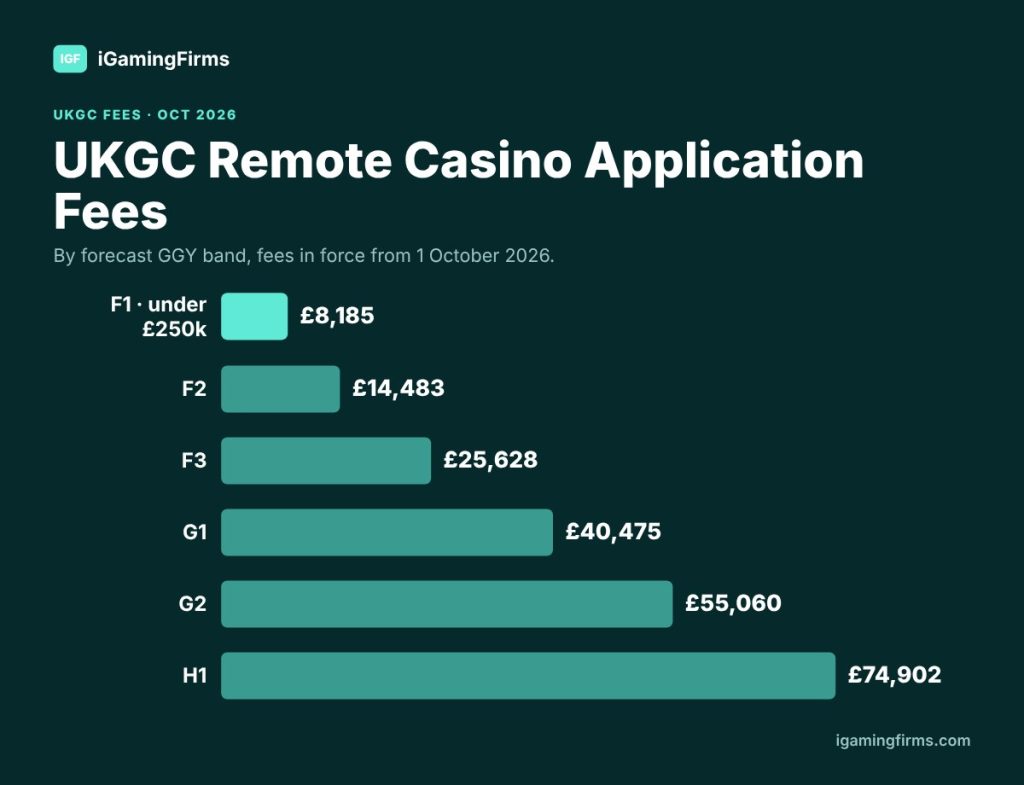
It depends on the activity and your gross gambling yield (GGY). The application fee is set by your forecast GGY band; the annual fee then follows your actual GGY. Fees rose by a headline 25% on 1 October 2026 after the government’s response to the fees consultation (published 30 June 2026). First annual fees stay at 75% of the standard fee and are due 30 days after the licence is issued.
Remote casino fees (from 1 October 2026)
| Band | Annual GGY | Application fee | Annual fee |
|---|---|---|---|
| F1 | Under £250,000 | £8,185 | £7,000 |
| F2 | £250,000 to £875,000 | £14,483 | £12,375 |
| F3 | £875,000 to £3m | £25,628 | £19,569 |
| G1 | £3m to £10.5m | £40,475 | £27,337 |
| G2 | £10.5m to £36.75m | £55,060 | £51,975 |
| H1 | £36.75m to £130m | £74,902 | £112,556 |
| H2 | £130m to £455m | £101,895 | £394,875 |
| I1 | £455m to £1.6bn | £122,274 | £1,181,625 |
| J1 | £1.6bn or more | £165,069 | £1,453,949 + £272,324 per extra £200m GGY |
Source: the Commission’s remote casino operating licence page, updated 1 October 2026. Combining two of remote casino, remote bingo and virtual event betting costs a flat £2,100 extra to apply and £6,250 extra a year; all three costs £4,200 and £12,500.
Remote betting and software fees (from 1 October 2026)
| Band | Remote general betting (real events): application / annual | Remote gambling software: application / annual |
|---|---|---|
| F1 | £6,535 / £5,937 (GGY under £250k) | £7,212 / £7,394 (sales under £875k) |
| F2 | £12,649 / £11,531 (£250k to £875k) | £13,307 / £13,756 (£875k to £3m) |
| F3 | £24,482 / £17,244 (£875k to £3m) | £24,555 / £22,950 (£3m to £10.5m) |
| G1 | £38,368 / £24,300 (£3m to £10.5m) | £44,198 / £42,525 (£10.5m to £36.75m) |
| G2 | £45,536 / £49,612 (£10.5m to £36.75m) | £66,297 / £97,549 (£36.75m to £130m) |
| H1 and above | £54,043 to £90,648 / £104,219 to £1,402,455+ | £99,446 / £191,880 (£130m+) |
Source: annex tables in the same government fees response. Software bands are based on gross value of sales, not GGY. Check the Commission’s fee calculator for your exact combination before you file.
How much does a personal licence cost?
A Personal Management Licence costs £463 to apply (up from £370) and a Personal Functional Licence costs £231 (up from £185), both paid by card online and non-refundable. Every five years you pay a maintenance fee to keep them: £463 for a PML and £181 for a PFL. You need a PML for anyone responsible for overall management, strategy, finance, marketing, regulatory compliance, gambling-related IT and security, or heading the AML function. One PML covers all of those roles for one person.
Why other pages show different numbers
- “£17,000+ application fee”: not a figure from the Commission’s tables. No remote casino band has an application fee in that range (F2 is £14,483, F3 is £25,628).
- “£463” or “£370” as the basic application fee: that’s the PML fee, new and old, not the operating licence fee.
- Figures like £4,224 or £91,686: these come from earlier fee tables. Any fee quoted without a date is probably outdated.
If you’re weighing GB against other markets, our gambling licence cost comparison across 15 jurisdictions puts these fees next to Malta, the Isle of Man, Curaçao and others.
UKGC licence requirements
The Commission assesses three things: your integrity, your competence, and your financial and other circumstances, including those of everyone relevant to the application, up to the ultimate owners. In practice the file needs:
- Ownership and structure. Group structure chart, every shareholder up to the ultimate beneficial owners, and management structure.
- Source of funds and finances. Proof of where the start-up money comes from, six months of bank statements, a business plan and profit and loss projections (advisers typically prepare three years).
- Criminality and identity checks on the applicant and relevant people.
- PML holders named for each key function, with their own applications.
- Policies and procedures showing you can meet the LCCP: AML and counter-terrorist financing, safer gambling and customer interaction, age and identity verification, complaints, marketing, and protection of customer funds.
- Customer terms and rules of play for every product.
- Technical documentation (remote applicants): platform and game suppliers, where equipment is hosted, and how you’ll meet the RTS. Games and RNGs must be tested by a Commission-recognised test house.
- A UK address for service (not a PO box), kept for the life of the licence.
- Overseas applicants also provide a credit report.
Age and identity verification is one of the areas the Commission checks most closely. Our breakdown of iGaming KYC requirements by jurisdiction sets the GB rules next to other regulators.
How to get a UK gambling licence: step by step
- Pick your activities. Casino, betting, bingo, software, or a combination. This sets your fee and document list.
- Line up suppliers first. Platform, game studios, payments, KYC and a test house. The Commission wants to see the actual set-up, not a plan to find one.
- Prepare the file. Structure, source of funds, business plan, policies mapped to the LCCP, terms, technical documentation.
- File PML applications for your key people at the same time.
- Apply online through the Commission’s “apply for an operating licence” service: choose activities, upload documents, pay the application fee by card.
- Work with your caseworker. A caseworker is assigned and gives you an indicative timescale. Expect follow-up questions and, often, an interview with key people.
- Decision and first annual fee. Pay the first annual fee (75% of the standard fee) within 30 days of the licence being issued.
If the Commission refuses the application, you can ask for a review and then appeal to the tribunal. The application fee isn’t refunded either way.
How long does a UKGC licence take?
The Commission’s published processing times are 16 weeks for a new operating licence, 12 weeks for a change of control, 8 weeks for a personal licence and for an operating licence variation, and 2 to 4 weeks for a personal licence variation. It says these timescales “are not guaranteed” and assume the application is complete when submitted.
| Stage | Realistic time |
|---|---|
| Supplier contracts, company set-up, bank account | 4 to 8 weeks |
| Writing policies, business plan, source of funds pack | 4 to 8 weeks (can overlap) |
| Commission assessment | 16 weeks target, longer if the caseworker asks for more information |
| Testing, go-live checks, first annual fee | 2 to 4 weeks |
Plan for six to nine months from a standing start. The 16-week clock is the Commission’s part only, and it lists application quality, complexity and suitability concerns as the main reasons decisions take longer. In practice that usually means incomplete source of funds evidence and policies that don’t match the platform you’ll actually run. The preparation stage estimates are our planning assumptions, not Commission figures.
How long is a UKGC licence valid?
A Commission operating licence has no fixed term and no renewal application. It continues until you surrender it, it lapses or the Commission revokes it, provided you pay the annual fee before each anniversary of the issue date. Fail to pay and the licence is revoked. Personal licences work differently: PML and PFL holders pay a maintenance fee every five years to keep them.
Changes still need the Commission’s approval or notice. Adding an activity is a variation (8-week target). A new controller taking over the business needs a change of corporate control application, with a £200 fee and a 12-week target. A UKGC licence can’t simply be sold or transferred to another company.
How to check a UKGC licence
Every licensed business, its licence number, activities and any regulatory action appear on the Commission’s public register. Use it before you sign with a white label partner, B2B supplier or affiliate programme: search the company name or licence number and confirm the licence status is active and covers the activity they claim. Check the trading names too, since every domain a licensee operates must be listed against its licence.
What you must do once you’re licensed
The licence is the start of the compliance workload, not the end of it. Ongoing obligations include:
- Dispute resolution and reporting: an approved alternative dispute resolution (ADR) provider, quarterly regulatory returns, key event reporting and annual assurance statements.
- Online slot stake limits: £5 per spin, or £2 for 18 to 24 year olds.
- Promotion rules: since 19 January 2026, bonus wagering requirements are capped at 10 times and bonuses that require play across two or more product types (for example, betting and slots) are banned.
- Deposit limits: since 30 September 2026, remote operators must offer gross deposit limits, call only those “deposit limits”, and give them at least the same prominence as other financial limits.
- AML and safer gambling: customer interaction, affordability and source of funds checks, and self-exclusion through GAMSTOP.
Year-one cost model: a small remote casino
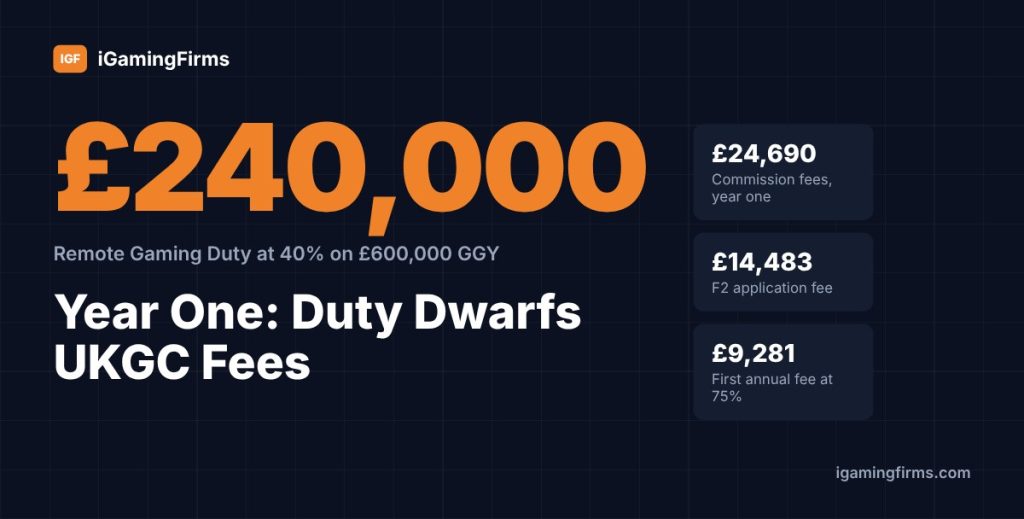
Worked example: a new remote casino forecasting £600,000 GGY in year one (band F2), two PML holders, no premises. Fees are the Commission’s October 2026 figures; duty is at the 40% Remote Gaming Duty rate.
| Cost | Amount | Note |
|---|---|---|
| Application fee (F2) | £14,483 | Paid on submission |
| First annual fee | £9,281 | 75% of £12,375, due 30 days after issue |
| Two PMLs | £926 | £463 each |
| Commission fees, year one | £24,690 | |
| Remote Gaming Duty (40% × £600,000) | £240,000 | Assumes gross gaming profits equal GGY |
| Statutory levy | £0 in year one, about £6,600 in year two | 1.1% of the previous year’s GGY |
The point of the model: Commission fees are about a tenth of the duty bill. A business case that only budgets the licence fee is missing the cost that decides whether GB works for you. The same £600,000 through a sportsbook pays 15% General Betting Duty today (£90,000), rising to 25% (£150,000) for remote general bets from 1 April 2027. Not included: legal and consultancy fees, test house fees, platform costs, ADR membership, and corporation tax.
UK gambling taxes after a UKGC licence
According to HMRC’s gambling duty changes policy paper (26 November 2025):
- Remote Gaming Duty: 40% from 1 April 2026 (was 21%).
- General Betting Duty, remote general bets: new 25% rate from 1 April 2027. UK horse racing bets keep their current treatment.
- General Betting Duty, non-remote bets: 15%, unchanged.
- Bingo Duty: abolished from 1 April 2026.
Duty applies to profits from GB customers wherever you’re based, so an offshore structure doesn’t change it. On top sits the statutory levy for research, prevention and treatment (1.1% of GGY for online operators, 0.5% for land-based casinos and betting).
Common mistakes that slow down a UKGC application
- Template policies. AML and safer gambling policies copied from another licence that don’t describe your platform, your thresholds or your staff.
- Thin source of funds. “Investor funding” without bank trails back to the origin of the money.
- Missing PML holders. Key functions with no named, licensed person, or one person stretched across too many roles without the experience to back it.
- Applying for the wrong activity. A studio applying for remote casino instead of game host plus software, or a sportsbook forgetting virtual events.
- Treating the licence as the finish line. The Commission’s largest penalties have mostly been for AML and social responsibility failures by already-licensed operators, so the compliance team needs budget from day one.
When a UKGC licence isn’t the right first move
If GB is not your core market, the 40% duty, the stake, bonus and deposit rules and the compliance cost may make it a poor first licence. Many groups start in markets with lower duty and add GB once they have the margin and the compliance staff to carry it. Our MGA licence guide covers the most common European alternative, keeping in mind that no offshore or EU licence lets you serve British players.
Your next step
Write down your activities, your forecast GGY band, your platform and game suppliers, and the people who will hold PMLs. Then take that page to two or three iGaming licensing consultants or gambling law firms and compare fixed-fee quotes against the Commission fees above. If you’re still pricing the whole launch, our guide to starting a sportsbook covers platform and launch costs.
This guide is independent information, not legal or tax advice. Fees, timescales and tax rates are taken from Gambling Commission, GOV.UK and HMRC publications as of the date above; confirm current figures with the Commission or a UK gambling adviser before you apply.