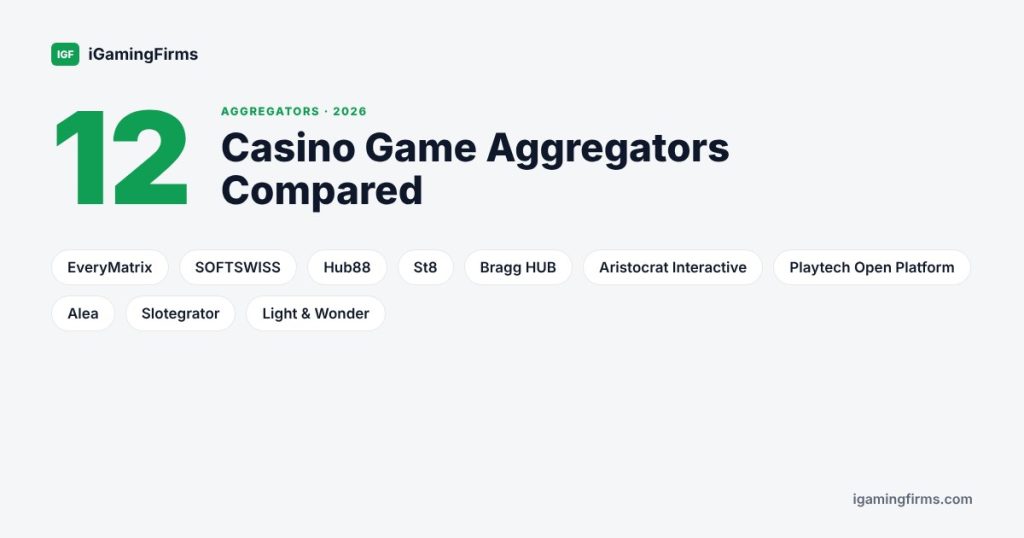
Casino game aggregators decide which slots and live games your players see, which markets you can launch in, and how much of your gross gaming revenue goes to content before you pay anything else. Pick one with the wrong certifications and you cannot launch in your next market; pick one with weak tooling and your CRM team has nothing to promote.
The short answer: EveryMatrix (SlotMatrix), SOFTSWISS and Hub88 are the strongest casino game aggregators in 2026 on public evidence, with St8 and Bragg close behind. Aristocrat Interactive, Playtech, Alea, Slotegrator, Light & Wonder OpenGaming, Relax Gaming and Groove each fit specific operator profiles. The right choice depends on three things: whether the aggregator is certified in the markets you hold licences in, which promotional tools sit on top of the content, and whether its commercial model lets you bring your own studio deals.
This page is the vendor comparison: twelve aggregators, what they cost, how a hybrid content model can cut your bill, how 2026 supplier licensing rules affect your choice, and the questions to ask before you sign. If you want the basics of how aggregation works first, read our explainer on what a casino game aggregator is and how it works.
Everything here comes from each aggregator’s own documentation, regulator records, trade coverage and company filings, and none of the aggregators paid to be included.
Top casino game aggregators 2026 at a glance
| # | Aggregator | Best for | Content (vendor claims) | Pricing |
|---|---|---|---|---|
| 1 | EveryMatrix (SlotMatrix) | Operators in the UK, US and Ontario that want one regulated aggregation layer | 34,000+ games, 350+ studios (June 2025) | Quote only |
| 2 | SOFTSWISS Game Aggregator | Operators launching in emerging regulated markets such as Brazil | 40,000+ games, 300+ studios | Quote only |
| 3 | Hub88 | Crypto-friendly operators that want strong bonus and tournament tools | 26,000+ games, 200+ studios | Revenue share plus set-up fee |
| 4 | St8 | Operators that want to bring their own studio contracts | 19,000+ games, 200+ studios | Flat fee or revenue share (model published) |
| 5 | Bragg HUB | US and Canadian operators wanting regulated content plus gamification | 15,000+ games (group) | Quote only |
| 6 | Aristocrat Interactive (Fusion) | US state-licensed operators | 14,000+ games, 150+ studios | Quote only |
| 7 | Playtech Open Platform | Operators already on Playtech’s IMS | 20,000+ games, 70+ studios (third-party) | Quote only |
| 8 | Alea | Operators wanting a big catalogue without minimum fees | 26,000+ games, 175 providers | No set-up or minimum fees |
| 9 | Slotegrator APIgrator | Start-ups needing a large catalogue and launch support | 20,000+ games, 150+ providers | Set-up fee plus commission |
| 10 | Light & Wonder OpenGaming | US and regulated-market operators wanting curated studios | Hundreds of studios (no count published) | Quote only |
| 11 | Relax Gaming | European regulated operators wanting curated partner studios | Silver Bullet and Powered By studios | Quote only |
| 12 | Groove | Operators wanting promotion tools on a mid-sized catalogue | 15,000+ games, 200+ studios | Quote only |
Game counts are vendor claims checked on 15 October 2026 and are not directly comparable: some count each localised version separately and some include studios you will never activate. Certification in your markets matters far more than the headline number.
Feature matrix: what each aggregator documents publicly
“Yes” means documented on the vendor’s own site or in regulator records. “Partial” means limited coverage or a related capability. “Not stated” means we could not find public documentation.
| Aggregator | Single API | 5,000+ games | UK / US / Ontario / Brazil certified | Tournaments / jackpots | Free spins / bonus API | Crypto | Public pricing |
|---|---|---|---|---|---|---|---|
| EveryMatrix | Yes | Yes | Yes (UK, US states, Ontario, Brazil listed) | Yes | Yes | Not stated | Partial |
| SOFTSWISS | Yes | Yes | Partial (Brazil and emerging markets) | Yes | Not stated | Not stated | No |
| Hub88 | Yes | Yes | No (MGA, UAE) | Yes | Yes | Yes | No |
| St8 | Yes | Yes | Partial (UK, Ontario claimed) | Partial | Yes | Not stated | Partial |
| Bragg HUB | Yes | Yes | Yes (UK, US states, Ontario) | Partial (Fuze) | Not stated | Not stated | No |
| Aristocrat Interactive | Yes | Yes | Yes (UK, US states, Ontario) | Not stated | Not stated | Not stated | No |
| Playtech POP | Yes | Yes | Not stated | Not stated | Not stated | Not stated | No |
| Alea | Yes | Yes | No (MGA, Curaçao) | Not stated | Not stated | Not stated | Partial |
| Slotegrator | Yes | Yes | No (Lithuania, Georgia, Sweden) | Yes | Not stated | Not stated | No |
| L&W OpenGaming | Yes | Partial | Yes (US, Ontario) | Not stated | Not stated | Not stated | No |
| Relax Gaming | Yes | Not stated | Partial (UK, Ontario) | Partial (Dream Drop) | Not stated | Not stated | No |
| Groove | Yes | Yes | No (Curaçao) | Yes | Yes | Not stated | No |
What a casino game aggregator has to do
A casino game aggregator connects your platform to hundreds of game studios through one integration, handles the wallet calls for every bet and win, and passes you reporting and invoicing in one place. In 2026 the job also includes certification: every game you offer has to be approved in every market you serve, and the aggregator’s integration often needs its own certificate.
An aggregator is not a casino platform. The platform runs your player accounts, payments and back office; the aggregator plugs game content into it. If you need both from one supplier, compare white-label casino platforms, which usually bundle an aggregator. If you want to buy from individual studios instead, see our list of slot game providers compared for operators.
When you compare aggregators, focus on four things:
- Regulated coverage. Which markets the aggregator and its studios are certified for, not just how many games it lists.
- Integration and wallet model. A seamless wallet that connects cleanly to your player account management system. With a seamless wallet the player’s balance stays on your platform and each bet is a real-time debit or credit call; a transfer wallet moves money into a separate game balance, which is simpler to build but harder to reconcile and worse for players moving between games.
- Promotional tooling. Free-spin and bonus APIs, tournaments and jackpots your CRM team can actually use.
- Commercial model. Whether you pay a full revenue share on all content or can route your own studio deals through a cheaper technical gateway.
Which casino game aggregator has the largest game library?
On vendor claims, SOFTSWISS has the largest catalogue, at 40,000+ games from 300+ providers. EveryMatrix’s SlotMatrix was cited at 34,000+ games from 350+ studios in June 2025, so it claims more studios but fewer games. Hub88 and Alea both claim 26,000+. None of these counts is audited, and the useful number is how many titles are certified in the markets you hold licences in.
How long does aggregator integration take?
Vendors quote anything from days to weeks. Hub88 says integration can take as little as three days, and SOFTSWISS quotes about three weeks from contract to launch. Those figures assume your platform already supports a standard seamless wallet. Certification in regulated markets, lobby set-up and testing usually take longer than the API work itself.
How much do casino game aggregators cost?
Studio royalties typically run from about 10% to 20% of GGR, and a full-service aggregator adds a markup on top, often quoted at 5 to 15 percentage points. Some aggregators, St8 among them, also offer a technical-only model where you bring your own studio contracts and pay a much smaller fee for the connection, commonly quoted at 1% to 3%. On top of the revenue share, ask about set-up fees, monthly minimums, currency conversion charges and whether the share is calculated on GGR or NGR.
How a hybrid content model can cut your content bill
Combining full-service content with your own studio deals can save real money without building a single direct integration.
Assumptions for this illustration: €500,000 monthly casino GGR, an average studio royalty of 12%, a full-service aggregator markup of 8 points, and a technical gateway fee of 2% for studios you contract directly. Your three biggest studios generate half of your GGR.
| Scenario | How content is bought | Monthly content cost | Annual cost |
|---|---|---|---|
| A. All full-service | All €500,000 at 12% + 8 points = 20% | €100,000 | €1.2 million |
| B. Hybrid through one aggregator | Top three studios contracted directly and routed through the gateway (€250,000 at 14%), the rest full-service (€250,000 at 20%) | €85,000 | €1.02 million |
| C. Direct integrations for the top three | Same fees as B, plus around €50,000 a year per direct integration to build and maintain | €85,000 plus integration costs | About €1.17 million |
In this example the hybrid model saves about €180,000 a year, while building direct integrations wipes out most of that saving. The figures are illustrative, not market prices: real contracts vary, some are calculated on NGR rather than GGR, and set-up fees and monthly minimums are excluded. The lesson holds, though. Ask every aggregator whether it supports a bring-your-own-contract model before you assume full-service pricing is the only option. Our aggregator explainer covers when direct integration starts to make sense.
Aggregator vs direct integration: the trade-offs
An aggregator buys you speed and breadth, but it adds a layer between you and the studio. Weigh these costs before you route everything through one partner:
| Issue | Through an aggregator | Direct with the studio |
|---|---|---|
| Cost | Studio royalty plus aggregator markup, unless you bring your own deal | Studio royalty only, plus your own build and maintenance cost |
| Speed | Hundreds of studios from one integration | One integration per studio |
| Studio incentives | Exclusive launches and marketing support may go to direct partners | Easier to negotiate early access and co-marketing |
| Bonus and data | Free-spin campaigns and round-level data pass through the aggregator, which can add lag | Direct access to the studio’s bonus tools and data |
| Risk | One outage or dispute can take a large share of your lobby offline | Failures are isolated to one studio |
Most operators end up hybrid: an aggregator for the long tail and direct or bring-your-own deals for the few studios that drive most of their GGR.
Can you switch aggregators after launch?
Yes, but plan for it before you sign. Switching means re-integrating the wallet, re-mapping game IDs in your lobby, moving active free-spin campaigns and jackpot contributions, and re-certifying where a market requires it. Put data export rights, game ID mapping files and a notice period in the contract so you are not locked in.
How this list was built
We started from the aggregators in the current Google results and the comparison pages ranking for this topic, most of which are written by aggregators, platform vendors or licensing consultancies, then checked each one against the same criteria:
- Content breadth: documented games and studios.
- Regulated-market coverage: licences and certifications in the UK, US states, Ontario, Brazil and the EU.
- Integration and tooling: single API, wallet model, bonus, tournament and jackpot tools.
- Operator adoption: named operator clients, regulator records and partnerships.
- Pricing transparency: whether the commercial model or prices are published.
Sources checked: aggregator websites, regulator records such as New Jersey’s Division of Gaming Enforcement, company filings and trade coverage from iGaming Business, SBC Americas, SiGMA, Gambling Insider and others. There are no meaningful G2 or Capterra review bases for aggregators, so we rely on documented adoption instead. We did not run test integrations, and no aggregator reviewed this article before publication.
How the ranking was decided
Each aggregator was graded on the strength of public evidence for five weighted criteria: content breadth (25%), regulated-market coverage (25%), integration and tooling (20%), operator adoption (20%) and pricing transparency (10%). “Strong” means detailed public documentation backed by third-party sources or named regulated clients, “Documented” means the vendor documents it, and “Limited” means little or no public detail.
| # | Aggregator | Content (25%) | Regulated coverage (25%) | Integration and tooling (20%) | Adoption (20%) | Pricing (10%) |
|---|---|---|---|---|---|---|
| 1 | EveryMatrix | Strong | Strong | Strong | Strong | Documented |
| 2 | SOFTSWISS | Strong | Documented | Strong | Strong | Limited |
| 3 | Hub88 | Strong | Documented | Strong | Strong | Limited |
| 4 | St8 | Documented | Strong | Strong | Documented | Documented |
| 5 | Bragg HUB | Documented | Strong | Documented | Documented | Limited |
| 6 | Aristocrat Interactive | Documented | Strong | Limited | Documented | Limited |
| 7 | Playtech POP | Documented | Documented | Documented | Documented | Limited |
| 8 | Alea | Strong | Limited | Documented | Limited | Documented |
| 9 | Slotegrator | Strong | Limited | Documented | Limited | Limited |
| 10 | L&W OpenGaming | Limited | Strong | Limited | Documented | Limited |
| 11 | Relax Gaming | Limited | Strong | Limited | Documented | Limited |
| 12 | Groove | Documented | Limited | Strong | Limited | Limited |
Where grades tie, regulated-market coverage decided the order. Aggregators can change a grade by publishing the missing documentation, and we update this table when they do.
The 12 best casino game aggregators reviewed
1. EveryMatrix

EveryMatrix sells casino aggregation under the SlotMatrix brand, as part of CasinoEngine, alongside its own studios, including Spearhead, Armadillo and Fantasma, and one of the broadest regulated footprints in this list.
- Best for: operators in the UK, US states and Ontario that want regulated content through one partner.
- Content (vendor claims): 34,000+ games from 350+ studios, as cited when SlotMatrix went live in West Virginia in June 2025. The vendor now markets SlotMatrix as the world’s largest casino library.
- Licences: UKGC, MGA B2B, Sweden, Greece and Curaçao on its own site, with 42 jurisdictions listed, including New Jersey, Pennsylvania, Michigan, West Virginia, Connecticut, Ontario, Alberta and Brazil. In New Jersey, a 2026 regulator letter shows EveryMatrix Americas transacting with operators such as Caesars, DraftKings and BetMGM under transactional approval while its CSIE application proceeds.
- Tooling: free spins, leaderboards and tournaments.
- Scale (vendor claim): 400+ clients in 50+ markets.
- Pricing: quote only; third-party reviews cite a “zero aggregator-layer fee” claim for some deals, which you should confirm in writing.
- Watch for: check the licence status for each US state you need, rather than assuming full licensing everywhere.
2. SOFTSWISS Game Aggregator
SOFTSWISS runs one of the largest aggregation catalogues in the industry through Stable Aggregator Ltd, licensed by the MGA, alongside its casino platform and Affilka affiliate software.
- Best for: operators launching in Brazil, Latin America, Africa and emerging European markets.
- Content (vendor claims): 40,000+ games from 300+ providers, with launch in around three weeks.
- Markets: the vendor claims compliance in more than 25 jurisdictions and names Brazil, Spain, Greece, Romania, Estonia, Peru, Nigeria and South Africa’s Western Cape. UK, Swedish and Ontario access depends on the operator’s own licence.
- Tooling: cross-provider tournaments and jackpots, with vendor claims of 22% more daily bets from tournaments and 50% more turnover per player from jackpots, plus game KPI reporting and a stated 99.999% uptime SLA.
- Certifications: ISO 27001, with GLI-19 and PCI DSS reported by third-party reviews.
- Recognition: Best Aggregator at SiGMA Eurasia 2026.
- Pricing: quote only.
- Watch for: no UKGC or US certifications, and only eight of the 25+ claimed jurisdictions are named publicly, so ask for the full list.
3. Hub88

Hub88, part of Yolo Group, is an MGA-licensed aggregator with one of the most complete promotional toolkits on the market and strong crypto support.
- Best for: crypto-friendly and international operators that want bonus, tournament and jackpot tools on top of content.
- Content (vendor claims): 26,000+ games from 200+ studios, with new studios such as Games Inc (May 2026) and Gametimetec (August 2026) added during the year.
- Licences: MGA B2B (MGA/B2B/536/2018), plus a UAE GCGRA vendor licence granted in October 2025.
- Tooling: a free-bets API, a promotions marketplace, HubConnect tournaments and jackpots through ThrillTech.
- Integration: the vendor says integration can take as little as three days.
- Payments: crypto support for BTC, ETH and LTC and 200+ currencies.
- Pricing: revenue share quote plus set-up fee.
- Watch for: no UKGC or US licences, so it does not fit operators in those markets. Its own pages give both 100+ and 200+ as the provider count, so ask for a current list.
4. St8
St8 stands out for publishing its commercial model and supporting operators who bring their own studio contracts.
- Best for: operators with direct studio deals that want a cheap technical connection, plus full content for everything else.
- Content (vendor claims): 19,000 to 21,000+ games from 200+ providers. In August 2026 St8 extended its Evolution and Pragmatic Play partnerships to Ontario and Alberta.
- Licences claimed: UKGC, AGCO Ontario, Alberta, Spelinspektionen, ONJN Romania, MGA, Anjouan and the Isle of Man. Check each in the regulator’s register.
- Certifications: ISO 27001, announced in September 2026.
- Tooling: a bonus API, a jackpot feeds aggregator, game-round replays and MCP access for AI tooling.
- Pricing model: a flat percentage fee for operators bringing their own studio deals, or a revenue share package for full content.
- Clients (vendor claim): Tonybet, CrazyBet and betlive.
- Watch for: no US presence.
5. Bragg HUB
Bragg Gaming operates Bragg HUB (formerly Oryx Hub) alongside its own studios and a strong North American licence portfolio.
- Best for: US and Canadian operators that want regulated content and gamification from one supplier.
- Content (vendor claim): 15,000+ games at group level across 30+ regulated markets.
- Licences: MGA B2B, UKGC, Romania and Greece, with US approvals including New Jersey, Michigan, Pennsylvania, West Virginia, Connecticut and Delaware, plus Ontario and British Columbia.
- Tooling: Fuze gamification.
- Company news: Q2 2026 revenue fell 12% to €22.9 million. Bragg completed the all-share acquisition of Drayton International for US$9 million, announced a further cut of about 19% of its global workforce in July 2026, and withdrew its 2026 guidance. It rejected sale proposals in 2024 and remains independent.
- Pricing: quote only.
- Watch for: corporate restructuring, so check support commitments and roadmap in your contract.
6. Aristocrat Interactive (Fusion)

Aristocrat Interactive was formed after Aristocrat completed its $1.2 billion acquisition of NeoGames in April 2024, bringing the former Pariplay Fusion aggregation platform into the group.
- Best for: US state-licensed operators that want aggregated content with strong supplier licensing.
- Content (third-party data): 14,000+ games from 150+ studios, with 300 to 450 new titles a month.
- Licences: UKGC, MGA B2B, Gibraltar, US supplier licences in New Jersey, Michigan, Pennsylvania, West Virginia and Connecticut, and Ontario.
- Pricing: quote only.
- Watch for: tooling and current market counts are thinly documented in public, so ask for a feature list.
7. Playtech Open Platform

Playtech offers third-party content through Playtech Open Platform (POP), integrated with its IMS player management system.
- Best for: operators already running Playtech’s platform who want third-party studios in the same back office.
- Content (third-party data): around 20,000 games from 70+ studios.
- Context: Playtech’s B2B revenue grew 14% to €394.8 million in H1 2026, with strong growth in the US, Canada and Latin America.
- Pricing: quote only.
- Watch for: current POP-specific documentation is limited, so confirm catalogue and market coverage directly.
8. Alea
Alea is a Barcelona-based aggregator with a large catalogue and an unusually operator-friendly fee structure.
- Best for: growing operators that want a broad catalogue without minimum fees.
- Content (vendor claims): 26,000+ games from 175 providers.
- Licences: MGA and Curaçao.
- Tooling: Looker-based business intelligence reporting.
- Pricing: no set-up fees and no minimum fees, with rates on request.
- Watch for: no UK, US or Ontario certifications.
9. Slotegrator APIgrator
Slotegrator is a Limassol-based supplier founded in 2012 whose APIgrator product combines game aggregation with launch support for new operators.
- Best for: start-ups that want a large catalogue and help getting to market.
- Content (vendor claims): 20,000+ games from 150+ providers, with third-party reviews citing up to 30,000.
- Certifications: API certified for Lithuania, Georgia and Sweden.
- Tooling: tournaments, jackpots and promotions.
- Pricing: set-up fee plus commission.
- Watch for: no named operator clients are published, and catalogue figures vary by source.
10. Light & Wonder OpenGaming
Light & Wonder runs OpenGaming, a curated aggregation platform focused on regulated markets, alongside its own slot studios.
- Best for: US and regulated-market operators that want curated studios with strong compliance.
- Content: hundreds of third-party studios, with no game count published. Playnetic content went live in August 2026, and White Hat Studios uses OpenGaming for US aggregation.
- Licences: Light & Wonder holds licences in 100+ jurisdictions at company level, including an Ontario supplier licence.
- Context: L&W’s iGaming revenue grew 14% to $92 million in Q2 2026.
- Pricing: quote only.
- Watch for: a smaller, curated catalogue rather than a long tail of studios.
11. Relax Gaming

Relax Gaming combines its own games with a curated aggregation network through its Silver Bullet and Powered By partner programmes. It was acquired by Kindred in 2021, which is now part of FDJ United.
- Best for: European regulated operators that want curated partner studios and a strong jackpot product.
- Licences: UKGC, MGA, Gibraltar, Romania and Ontario.
- Tooling: the Dream Drop jackpot network.
- Pricing: quote only.
- Watch for: no published game counts and no US licence.
12. Groove
Groove offers game aggregation with a solid set of promotional tools.
- Best for: operators in Curaçao-licensed and emerging markets that want built-in promotions.
- Content (vendor claims): 15,000+ games from 200+ studios.
- Licence: Curaçao.
- Tooling: free-spin campaigns, tournaments and jackpots.
- Pricing: quote only.
- Watch for: no named clients and limited regulated-market certification.
Other options worth knowing
- Games Global Plus and Hacksaw OpenRGS: studio-led distribution networks that bundle partner studios. See our guide to casino software providers.
- Digitain, SoftGamings, GR8 Tech and BetConstruct: platform providers with large bundled aggregation catalogues.
What 2026 supplier rules mean for your aggregator
| Market | The rule | What to check |
|---|---|---|
| UK | Anyone who manufactures, supplies, installs or adapts gambling software for British players needs a remote gambling software licence. New fees took effect on 1 October 2026. | The aggregator and every studio you activate for UK players hold a UKGC software licence. |
| Malta | B2B suppliers of critical gaming supply need an MGA B2B licence, with a €5,000 application fee and annual fees of €25,000 to €35,000 by revenue band. | The aggregator’s MGA B2B licence number and scope. |
| Ontario | Suppliers that make, build, offer or operate games and game systems for iGaming Ontario operators must register with the AGCO. | AGCO registration for the aggregator and each studio. |
| New Jersey | Suppliers need licensing or transactional approval from the Division of Gaming Enforcement before working with licensed operators. | Current DGE status and any expiry dates on transactional approvals. |
| Brazil | Portaria SPA/MF 1.207/2024 requires every game to be certified by an SPA-recognised lab, a separate integration certificate where a third-party platform is used, a minimum 85% RTP and recertification after critical changes. | Brazil certificates for each game and for the aggregator’s integration. |
Primary sources: the UK Gambling Commission’s remote gambling software licence, the AGCO’s iGaming supplier registration, and a 2026 New Jersey DGE ruling on EveryMatrix. For the operator side of UK licensing, see our UKGC licence guide, and for licence fees in Malta, see our MGA licence guide.
How to choose a casino game aggregator
- UK, US states or Ontario: shortlist EveryMatrix, Bragg and Aristocrat Interactive, and add Light & Wonder OpenGaming for curated US content.
- Brazil and emerging markets: start with SOFTSWISS and check Brazil certificates game by game.
- Crypto and international: look at Hub88, then Alea or Groove.
- You already have studio contracts: compare St8’s bring-your-own-deal model with a full-service quote.
- Start-up on a budget: compare Alea’s no-minimum model with Slotegrator’s launch support.
Can game aggregators support crypto casinos?
Some can. Hub88 documents BTC, ETH and LTC support and crypto-only studios, but most aggregators in this list do not state crypto support publicly, and many studios refuse crypto traffic in some markets. Your own licence decides what you can offer, so check it first in our guide to the crypto casino licence options, then ask each aggregator which studios accept crypto wallets in your markets.
Questions to ask before you sign
- Which of our licensed markets are you and each studio certified for today, with certificate numbers?
- Do you support a bring-your-own-contract model, and what is the fee?
- Is the revenue share on GGR or NGR, and how are jackpot contributions and bonuses treated?
- Which free-spin, bonus, tournament and jackpot tools can our CRM trigger through the API?
- How quickly do you add new studios and recertify games after updates?
- What are your uptime SLA and incident credits?
- Can we export full game-round data and game ID mappings if we change aggregator?
Red flags when choosing an aggregator
- A headline game count with no breakdown of which titles are certified in your markets.
- Offers of content for markets where you or the studio are not licensed.
- Revenue share terms that do not say whether they apply to GGR or NGR.
- No free-spin or bonus API, leaving your CRM team with nothing to promote.
- Corporate instability without contractual protection on support and roadmap.
- Comparison content from an aggregator that ranks itself first. Most pages ranking for this topic are aggregator landing pages.
Next steps
List the markets you will hold licences in over the next two years, shortlist aggregators certified for all of them, and model your content cost with and without your own studio deals. Then check how the aggregator connects to your CRM and payment stack before you sign.