Last updated: 15 October 2026
The short answer: a PAM in iGaming is a player account management system, the system of record for every player on an online casino or sportsbook. It holds each player’s identity, verification status, wallet, transactions, bonuses and safer gambling limits, and every other part of your stack reads from it or writes to it.
Every platform pitch you sit through mentions “the PAM”, usually in the same breath as wallets, bonuses and compliance. It sounds like one more module on a feature list. It isn’t. Pick the wrong one and you find out a year later, when a regulator changes a rule, an affiliate disputes a commission, or you try to move to a new provider and discover your player history doesn’t come with you cleanly.
This guide explains how a PAM works when a real player signs up and plays, how it differs from a platform, wallet and back office, which 2025 and 2026 rule changes now land directly inside it, what it costs, what a migration involves, and how to test one before you sign anything.
What is a PAM in iGaming?
PAM stands for player account management. A PAM is the system of record for every player on an online casino or sportsbook. It holds who the player is, whether they’re verified, how much money is in their wallet, every transaction they’ve made, which bonuses they hold, and which safer gambling limits apply to them. Every other part of your stack, from games and payments to CRM and affiliate tracking, either reads from the PAM or writes to it.
That’s why people call it the backbone of an iGaming platform. You can swap a game aggregator, a CRM or a front end without touching the player ledger. You can’t swap the PAM without migrating the ledger itself.
What does a PAM system control?
Vendors describe their PAMs in different ways, but the same core jobs show up everywhere. If a product is missing one of these, it’s a component, not a PAM.
| Function | What it holds | Who depends on it |
|---|---|---|
| Player identity and KYC | Registration data, date of birth, verification status, documents, duplicate-account checks | Compliance, payments, game launch |
| Wallet and ledger | Cash balance, bonus balance, deposits, withdrawals, every bet and win, adjustments | Finance, game providers, sportsbook, reporting |
| Bonus engine | Bonus grants, wagering progress, expiry, bonus cost per campaign | CRM, retention, affiliates (NGR) |
| Safer gambling controls | Deposit, loss and time limits, reality checks, time-outs, self-exclusion | Compliance, regulators, support |
| Reporting and data | Regulatory reports, GGR and NGR, raw event feeds | Regulators, BI, affiliate platforms |
Most PAMs also carry a back office (the screens your support and risk teams use), a loyalty or VIP layer, and an integration layer for payment providers and KYC vendors. Those are useful, but the five jobs above are what make it a PAM.
How does a PAM system work? One player’s first hour, step by step
The easiest way to understand a PAM is to follow a single new player through it. Here’s what happens behind the screen on a regulated casino.
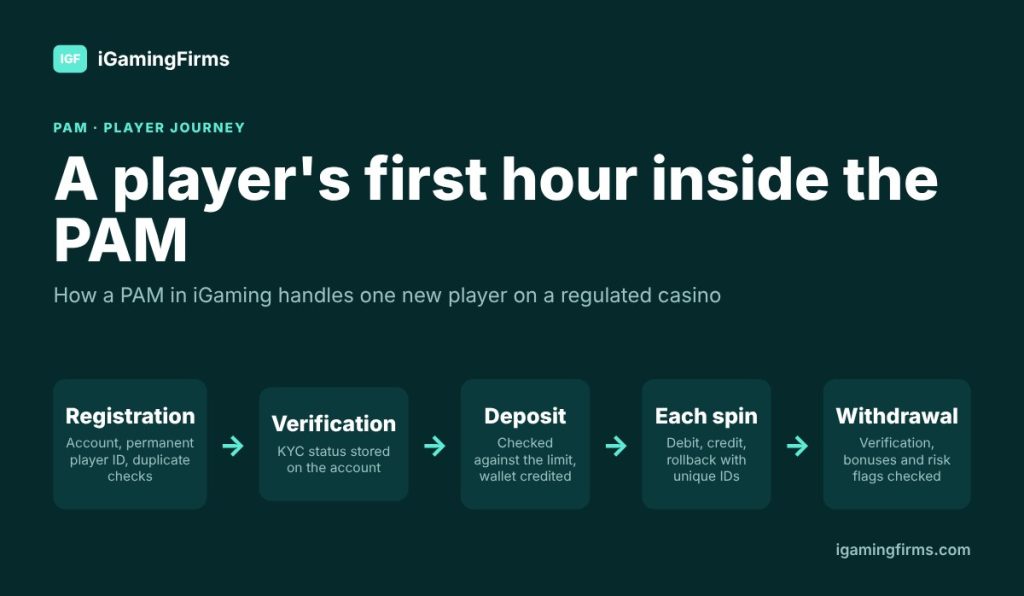
- Registration. The front end collects name, address, date of birth and email, then hands them to the PAM. The PAM creates the account, assigns a permanent player ID, and checks for duplicate accounts.
- Verification. The PAM sends the player’s details to one or more KYC providers and stores the result as a status on the account. Until the status says verified, the PAM blocks what the regulator requires it to block, such as deposits or play. What counts as “verified” differs by market; see KYC requirements by jurisdiction.
- Limit prompt. Before the first deposit, the PAM asks the player to set a financial limit and records the answer. In Great Britain this prompt is now mandatory (more on that below).
- Deposit. The cashier sends the payment to a payment provider. When the provider confirms it, the PAM checks the deposit against the player’s limit, then credits the wallet and writes a ledger entry.
- Game launch. The player opens a slot. The game usually comes from a studio through an aggregator, so the PAM passes the aggregator a session token tied to the player ID, and anything else the game needs to enforce the rules, like the player’s age band.
- Each spin. The game server calls the PAM’s wallet: a debit for the stake, then a credit for any win. If a call fails halfway, the game sends a rollback so the stake goes back. Every call carries a unique transaction ID, so a retried call never charges the player twice.
- Bonus play. If the player holds a bonus, the PAM decides which balance each stake comes from and tracks wagering progress until the bonus converts to cash or expires.
- Withdrawal. The PAM checks verification status, open bonuses and risk flags, holds the funds, and releases them to the payment provider once approved.
This flow is called a seamless wallet: one balance lives in the PAM and every product calls into it. The older alternative, a transfer wallet, moves money into a separate balance for each product, so the player has to shift funds between casino and sportsbook. Most new platforms use seamless wallets, and it’s worth confirming which one you’re being sold.
PAM vs platform vs CRM vs aggregator
These terms get blurred in sales decks, sometimes on purpose. Here’s how they divide up.
| System | What it does | Relationship to the PAM |
|---|---|---|
| PAM | Owns player state: identity, money, bonuses, limits | The record everyone else trusts |
| iGaming platform | The full package: PAM plus front end, cashier, back office, often sportsbook and games | The PAM sits inside it |
| CRM | Segments players and triggers messages and offers | Reads PAM events, asks the PAM to grant bonuses |
| Game aggregator | Connects hundreds of studios through one integration | Calls the PAM wallet for every bet and win |
| Affiliate platform | Tracks referrals and calculates commissions | Needs PAM events to count FTDs and NGR |
The simplest rule: the PAM owns state, everything else consumes it. When the CRM and the PAM disagree about a player’s bonus balance, the PAM wins. If you want the aggregator side in more depth, see how a casino game aggregator plugs into your wallet.
Is the wallet part of the PAM?
Usually, but not always. In most bundled platforms the wallet and ledger live inside the PAM. In more modular stacks the wallet runs as its own service and the PAM holds the player record and calls it. Either design works. What matters is that one system is clearly the source of truth for balances, and that you know which one it is before a game provider or auditor asks.
Is a PAM the same as a back office?
No. The back office is the set of screens your support, risk and finance teams use. The PAM is the system and data underneath. A good back office on a weak PAM still gives you weak controls, so test the API and the ledger, not just the screens.
The 2025 and 2026 rule changes that land inside your PAM
Most PAM explainers describe compliance in general terms. The reality is more specific: several recent rules can only be enforced from the player record, because that’s where the age, the limits and the bonus state live. If your PAM can’t do these, your front end can’t fix it.
| Rule | Market and date | What the PAM has to do |
|---|---|---|
| Online slots stake limits: £5 per game cycle for adults 25 and over, £2 for 18 to 24 year olds | Great Britain, £5 from 9 April 2025, £2 from 21 May 2025 | Supply the verified age band at game launch so the stake cap can be applied per spin, and update it when a player turns 25 |
| Bonus wagering capped at 10x, mixed-product promotions banned | Great Britain, in force since 19 January 2026 | Bonus engine must block wagering terms above 10x and stop offers that require play across two or more types of gambling, such as betting and slots |
| Prompt to set a financial limit before the first deposit, and annual prompts for players with no limit | Great Britain, from 31 October 2025 | Store the player’s choice, show the prompt at registration or first deposit, re-prompt at least every 12 months |
| Gross deposit limits must be offered, only gross limits may be called “deposit limits”, they must be on fixed time frames and as prominent as any other financial limit | Great Britain, in force since 30 September 2026 (moved from 30 June 2026) | Calculate limits on total deposits (not deposits minus withdrawals), reset them on fixed periods, block deposits once the limit is hit |
| GLI-19 v4.0 draft: dedicated player account chapter, mandatory multi-factor authentication at account creation, one-account-per-player controls, persistent device identification and monitoring | Global testing standard used by many US regulators, public comment draft dated 7 July 2026 | Expect MFA, account closure, inactive account and device-linking rules to become certification items for your PAM |
Sources: the UK Gambling Commission’s online slots stake limit guidance, its announcement on safer and simpler promotions, its notice on the deposit limit implementation extension, and GLI’s GLI-19 v4.0 executive summary.
Two things stand out from this list. First, the deposit limit change is a definition change, not just a new button. A PAM that only calculated net limits (deposits minus withdrawals) needs ledger-level work to calculate gross limits on fixed periods. The Commission pushed the deadline back three months after stakeholder feedback, and the rule has applied since 30 September 2026, so any British-facing PAM should already pass this test.
Second, GLI-19 v4.0 is still a draft, but GLI’s executive summary adds the term “Player Account Manager” to its definitions and moves player account rules into their own chapter. If you’re targeting US states, your PAM vendor should already have a view on it. For the wider British rulebook, see the UKGC licence guide.
The common thread: these controls must be enforced on the server, at the account record. A limit that only exists in the website’s interface can be bypassed through the API or a different app, and regulators treat that as a control failure.
Bundled, standalone or built in-house
You’ll get a PAM one of three ways, and the choice matters more than the vendor.
| Option | Best for | The catch |
|---|---|---|
| Bundled inside a turnkey or white-label platform | A first market with a fixed launch date | Each new market or rule change becomes a vendor roadmap item, and the PAM leaves with the platform |
| Standalone PAM with your own choice of front end, payments and KYC | Operators planning several markets or brands | More integration work and more vendor management on your side |
| Built in-house | Large operators whose product is the differentiation | A permanent engineering team and every certification done from scratch |
Track360’s 2026 buyer guide estimates an in-house PAM needs a permanent team of eight or more engineers, which is their own analysis rather than a market benchmark. Either way, the maintenance never ends while you hold a licence, because the rules in the table above keep changing.
Well-known PAM and platform suppliers include EveryMatrix, Pragmatic Solutions, White Hat Gaming, SOFTSWISS, GiG, Finnplay, Bede, Bragg and Playtech. For a side-by-side look at the biggest names, see the 10 best casino software providers in 2026. You can also compare platform suppliers in the platform and white-label directory, and there’s a fuller walkthrough of the commercial models in how new operators choose an iGaming platform provider.
What does a PAM cost? A worked example
PAM vendors don’t publish rate cards. One real price schedule is public, though: a 2023 agreement between Pragmatic Solutions and the operator High Roller, which was filed publicly and analysed in Interexy’s August 2026 review of 14 PAM platforms. It set:
- €40,000 setup and €20,000 migration
- €21,500 for each new market
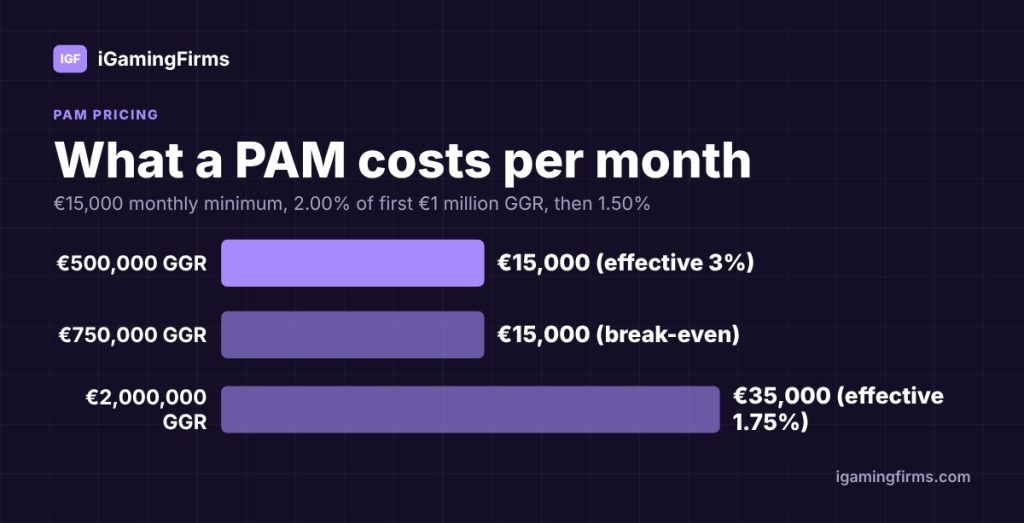
- A €15,000 monthly minimum
- 2.00% of the first €1 million of monthly GGR, then 1.50% above that
- Infrastructure priced separately
Here’s what that means in practice, assuming the minimum acts as a floor on the percentage fee:
| Monthly GGR | Percentage fee | What you pay |
|---|---|---|
| €500,000 | €10,000 (2%) | €15,000 (minimum applies, effective rate 3%) |
| €750,000 | €15,000 (2%) | €15,000 (break-even point) |
| €2,000,000 | €20,000 + €15,000 | €35,000 (effective rate 1.75%) |
The lesson isn’t the specific numbers, which will differ for your deal. It’s that small operators often pay an effective rate well above the headline percentage until they pass the minimum. Also check how the vendor defines GGR. One vendor’s GGR is stakes minus wins, another quotes a share of NGR after deductions, so two “2%” quotes can be very different prices.
What a PAM means for affiliates
If you run an affiliate program or work as an affiliate, the PAM is where your commission data starts. Six events carry the whole chain:
- Registration links the player to the affiliate through tracking parameters.
- KYC status changes decide whether a player qualifies for CPA.
- First deposit triggers CPA and hybrid deals.
- Deposits, bets and wins feed the GGR behind every RevShare deal.
- Bonus grants and costs become NGR deductions.
- Chargebacks, adjustments and closures drive clawbacks and negative carryover.
Two properties matter as much as the events themselves. The player ID has to be stable, so attribution survives a platform migration. And the event feed has to be replayable, so a downstream outage doesn’t permanently lose conversions. The affiliate platform directory lists the tools that sit on top of these feeds.
Can you replace a PAM? What a migration involves
Yes, but it is the hardest change you can make to a live operation, because the PAM holds the money and the obligations. A migration has to carry across, intact:
- Player profiles, login credentials and permanent player IDs
- Cash and bonus balances, plus the full transaction history behind them
- Verification status and stored KYC documents
- Deposit, loss and time limits, time-outs and self-exclusions
- Open bonuses with their wagering progress
- Affiliate attribution, so partners keep earning on the players they referred
The safer pattern is to run old and new systems in parallel, move traffic in stages (one brand or market at a time), and reconcile balances and ledgers between them every day until the old system is switched off. A self-exclusion that fails to migrate is a regulatory breach, not a data issue. Also check whether your regulator needs to be notified of, or approve, a change to a certified core system before you start.
Signs your PAM is holding you back
- You can’t get raw player and transaction data without a vendor ticket.
- Every rule change or new market waits for the vendor’s roadmap.
- Adding a brand, currency or payment method takes months.
- Your teams run manual workarounds in spreadsheets to reconcile balances or bonus costs.
- Performance drops during peak events and nobody can say why.
Common PAM mistakes operators make
- Enforcing limits in the front end only. If a deposit above the limit goes through when sent straight to the API, you have a compliance problem, not a bug.
- Accepting “data export will be agreed later”. Exit terms are where the real relationship is defined. Get the export format and schema in writing before you sign.
- Comparing revenue share percentages without the base. GGR, NGR and “net revenue” are not the same thing.
- Treating a launch timeline as a promise. Interexy’s review found published vendor timelines of one month to 14 weeks, while real announcement-to-launch gaps ranged from 43 to 441 days. Treat any quoted timeline as a floor.
- Letting group-wide controls stop at one brand. A self-exclusion should follow the player across every brand you run on that PAM.
How to test a PAM before you sign
- Ask for API documentation and a sandbox before shortlisting. A vendor that won’t share either until after contract is telling you how the relationship will run.
- Attempt a deposit above a limit through the API, not the interface. It should be blocked and logged.
- Force a failed withdrawal mid-flight and read the ledger entries it produces.
- Build a bonus yourself with a 10x cap and game-weighted contributions, then check the audit trail.
- Self-exclude a test player and confirm the exclusion blocks every brand and product.
- Request a raw event export and load it into your own warehouse to check format and delay.
- Ask how the PAM handles gross deposit limits on fixed periods and age-based slot stake caps. If you plan US launches, ask for their GLI-19 v4.0 roadmap too, including MFA at account creation.
Where to go next
A PAM decision is really a platform decision, so it’s worth reading alongside how to choose an iGaming platform provider, the KYC and compliance directory for the verification layer, and the CRM and retention directory for the tools that read your PAM’s events. If you’re launching betting first, how to start a sportsbook covers licence and platform costs, and iGaming fraud detection covers the signals your PAM data should feed.