Last updated: 15 October 2026
The short answer: to start a sportsbook in 2026, pick your target market, get a license that covers it, choose a platform model (white label, turnkey or custom build), secure odds data and risk management, set up payments and KYC, then fund marketing and a cash reserve to pay winners. For a lean offshore launch on a Curaçao license, a realistic first-year budget is about €560,000 to €1.5 million, including that reserve.
Whether you call it a sportsbook or a sports betting site, the steps are the same. The license itself is a small part of the bill. Marketing, staff and your platform deal decide whether the business works, and in high-tax markets like the UK the tax rate decides which platform deal makes sense at all.
Most guides give you a cost range so wide it’s useless (“$45,000 to $1 million+”) and fee tables that were out of date when they went live. In the last few weeks alone, UK license fees went up, Curaçao’s regulator took its licensing portal offline after a months-long breach, and Brazil suspended its regulated betting market by decree. This guide walks you through the seven decisions that shape a launch, with license fees taken from the regulators, platform pricing from vendor rate cards, and a margin model that shows how much of every 100 units of gross gaming revenue (GGR) you keep.
Step 1: Pick your target market before your license
The license follows your players, not your company. If you want UK customers, you need a UK Gambling Commission (UKGC) license. If you want US customers, you need a license in each state you take bets in, and in many states you also need a partnership with a land-based casino or tribe. An offshore license from Curaçao or Anjouan doesn’t give you access to markets that require local licensing.
So start with three questions:
- Where are your players? List target countries and check whether each one licenses online betting, bans it, or doesn’t regulate it. For the US, our state-by-state gambling law tracker shows where online sports betting is legal.
- What does that market tax? Betting duty on GGR ranges from zero (flat-fee offshore regimes) to 36% in Pennsylvania and 51% in New York.
- How stable is the rulebook? Brazil is the warning sign of 2026. On September 25, its president signed a provisional measure banning fixed-odds betting less than two years after the regulated market opened. It took effect immediately, stopped new deposits and gave players until October 5 to withdraw funds. Congress has 120 days to approve it, but licensed operators lost the market almost overnight.
For market-by-market detail, see the UK market page and the full markets index.
Step 2: Choose your license (with 2026 fees)
Here’s what the main licensing routes cost a new sportsbook today, using the regulators’ own fee schedules where they publish one.
| License | Application fee | Annual fee | Betting tax | What to know |
|---|---|---|---|---|
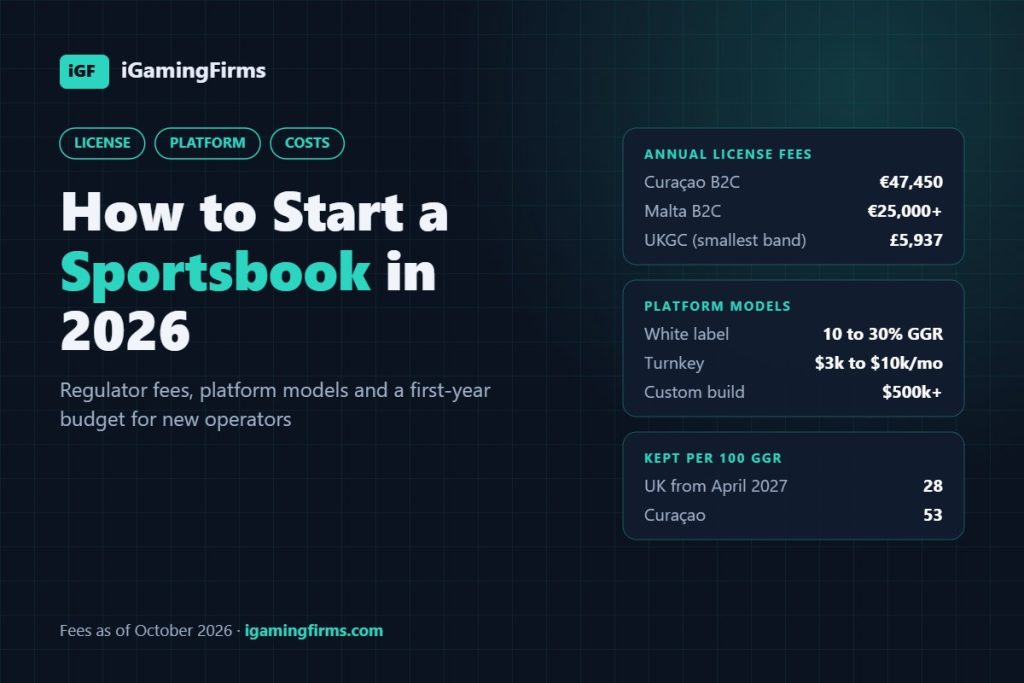
| UKGC remote general betting (real events), smallest band (GGY under £250,000) | £6,535 | £5,937 (first year charged at 75%: about £4,453) | 15% General Betting Duty now; 25% on remote betting from April 1, 2027 (remote bets on UK horseracing stay at 15%) | New fees apply from October 1, 2026. Key staff also need a Personal Management License at £463 each. |
| Malta (MGA) B2C Type 2 (fixed odds betting) | €5,000 | €25,000 fixed fee, plus a compliance contribution on a sliding scale (4% of the first €3 million of revenue), €25,000 minimum to €600,000 maximum | 10% gaming tax on revenue from players in Malta (up from 5% since October 1, 2026; casino-type Type 1 games pay 15%) | Minimum paid-up share capital for Type 2 is €100,000. Eligible start-ups can get a 12-month exemption from the compliance contribution. |
| Curaçao (CGA) B2C online gaming license | €4,592 (plus €150 per UBO) | €47,450 (€24,490 to the National Treasury + €22,960 to the CGA) | Flat annual fees, no GGR-based betting duty in the fee schedule | You need a Curaçao company with a local director. The first invoice is pro-rated; later years are due by January 15. The application portal is offline (see below). |
| US states (examples) | Pennsylvania: $10 million one-time fee. Missouri: up to $500,000 for an untethered mobile license | Pennsylvania 36%; New York 51%; Missouri 10% | Many states require a land-based partner. Budgets are in the millions, not thousands. | |
Sources: UK fees from the DCMS fee schedule effective October 1, 2026; UK duty from HMRC’s gambling duty changes; Malta from the MGA fees and taxation guidance note; Curaçao from the CGA license fees under the LOK (version 2.0). US figures are from state legislation as reported by trade press; check the state regulator before you budget. For a wider comparison, see what a gambling licence costs in 15 jurisdictions.
Watch out for outdated license figures
Several pages ranking for this topic still quote Curaçao at “$25,000 to $50,000” a year, which reflects the old sub-license era. Under the current LOK framework the annual B2C bill alone is €47,450, before company, director and compliance costs. Others quote UK fees from before the October 2026 increase. If a fee table doesn’t say which fee schedule it’s based on, assume it’s stale.
Which license fits which plan
- Curaçao fits a lower-cost launch into markets that don’t require a local license, but it isn’t the fast route it was a month ago. The CGA confirmed unauthorized access to its online gaming portal ran from December 2025 to September 2026, took the portal offline, and on October 7 said the portal will not return and it is moving to a new platform. Existing licenses stay valid, but ask how new applications are being processed under the interim arrangements before you plan a launch date. Banking and payment access is also harder. Our Curaçao licence guide covers requirements and timing.
- Malta fits an EU-facing brand that needs a stronger reputation with banks, payment providers and B2B partners. Expect higher fixed costs and more scrutiny. Our MGA license guide breaks down every fee and the timeline.
- UKGC is the only route to UK players. The license fee is modest at small scale, but the remote betting duty rise in April 2027 reshapes your whole margin (see Step 6). The UKGC licence guide walks through the application.
- US states fit well-funded operators with a land-based partner. Not a starting point for most new entrants.
A licensing consultant or an iGaming law firm can confirm which license your target markets actually accept.
Step 3: Pick a platform model
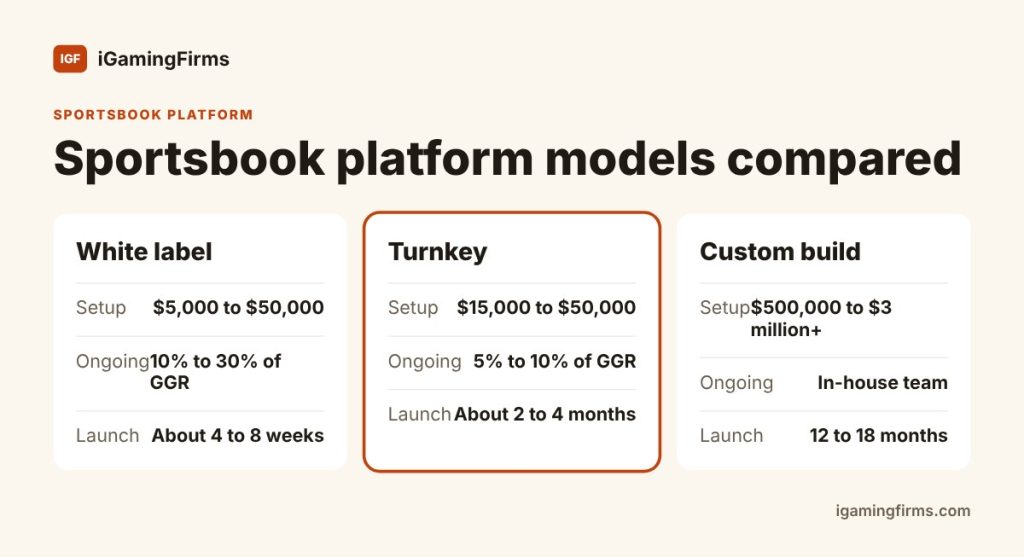
Your platform choice decides your speed to market, your upfront cost and how much of your revenue you hand to a vendor. The three models price very differently.
| Model | Typical setup fee | Typical ongoing cost | Time to launch | Best for |
|---|---|---|---|---|
| White label | $5,000 to $50,000 | 10% to 30% of GGR, sometimes plus a monthly platform fee | About 4 to 8 weeks | Testing a market with low upfront capital |
| Turnkey | $15,000 to $50,000 | $3,000 to $10,000 per month, or 5% to 10% of GGR | About 2 to 4 months | Operators holding their own license who expect steady volume |
| Custom build | $500,000 to $3 million+ | In-house team and infrastructure, no revenue share | 12 to 18 months | Established operators with large, predictable GGR |
These ranges come from published vendor rate cards and platform pricing guides. Vendors rarely publish firm prices, so treat them as negotiating anchors, not quotes.
The break-even rule between white label and turnkey
White label looks cheaper because the setup fee is small, but the revenue share grows with you. Here’s a simple way to find your crossover point.
Assumptions: white label at €3,000 per month plus 15% of GGR; turnkey at €8,000 per month with no revenue share.
- The turnkey deal costs €5,000 more per month in fixed fees.
- The white label deal costs 15% of every euro of GGR.
- Break-even monthly GGR = €5,000 ÷ 0.15 = about €33,000.
If you expect to pass roughly €33,000 in monthly GGR within your first year, turnkey running costs come out lower. Plug in your own quotes; the formula is the fixed-fee difference divided by the revenue share percentage. Before you sign any white label deal, also confirm you can take your player database with you if you migrate, and whether the revenue share is calculated on GGR or on revenue after bonuses.
For a deeper look at how operators pick between these models, see how new operators choose an iGaming platform provider, then compare vendors in the platform and white-label provider directory.
Step 4: Set up odds, trading and risk management
A sportsbook lives or dies on pricing. You need three things:
- An odds and data feed for pre-match and in-play markets, with scores and results to settle bets.
- Trading and risk management, either a managed trading service from your platform or data provider, or an in-house trader for your core sports.
- Liability controls: stake limits, customer profiling to spot sharp or arbitrage bettors, and rules for suspending markets.
Odds providers don’t publish standard pricing, so ask each one for a quote covering the sports and leagues you need, in-play latency, uptime commitments, whether managed trading is billed as a fixed fee or a share of GGR, and the cost of official league data where your market requires it. Our comparison of odds APIs by coverage, latency and pricing is a good place to start, then browse suppliers in the odds and data feeds directory.
Step 5: Line up payments, KYC and responsible gambling
Banks and payment providers treat betting as high risk, and your license largely decides who will work with you. A Malta or UK license opens more doors than an offshore one. Plan for:
- Payment providers (PSPs) that accept your license and support local methods in each target market. Get at least two, so one outage or account freeze doesn’t stop withdrawals.
- KYC and AML tooling for identity checks at sign-up, source-of-funds checks for larger players and transaction monitoring.
- Responsible gambling tools such as deposit limits, time-outs and self-exclusion. Every serious license requires them, and regulators check them in audits.
See the payment providers directory and the KYC and compliance directory.
Step 6: How much does it cost to start a sportsbook?
This is the part most guides skip. The license and platform setup fees are small next to the costs that run every month.
First-year budget for a lean Curaçao launch
| Cost line | Low (€) | High (€) | Basis |
|---|---|---|---|
| Curaçao license: application + first annual fees | 52,042 | 52,042 | CGA fee schedule (first-year fees may be pro-rated) |
| Local company, director, legal and policy drafting | 25,000 | 60,000 | Assumption, get quotes |
| Platform setup | 10,000 | 50,000 | Vendor rate cards |
| Platform running fee, 12 months | 36,000 | 120,000 | €3,000 to €10,000 per month |
| Odds, data and trading, 12 months | 24,000 | 96,000 | Assumption: €2,000 to €8,000 per month |
| KYC, fraud and AML tools | 10,000 | 40,000 | Assumption, volume-based |
| Core team (4 to 6 people: compliance, trading, support, marketing, operations) | 150,000 | 350,000 | Assumption, varies by location |
| Marketing and player acquisition | 150,000 | 500,000 | Assumption |
| Total spend | 457,042 | 1,268,042 | |
| Player liquidity reserve (held, not spent) | 100,000 | 250,000 | Assumption: cash to pay winners in a bad week |
| Total capital needed | 557,042 | 1,518,042 |
Only the license line is a fixed, published number. Replace every assumption with real quotes before you raise money or commit to a launch date.
How much of 100 GGR you actually keep
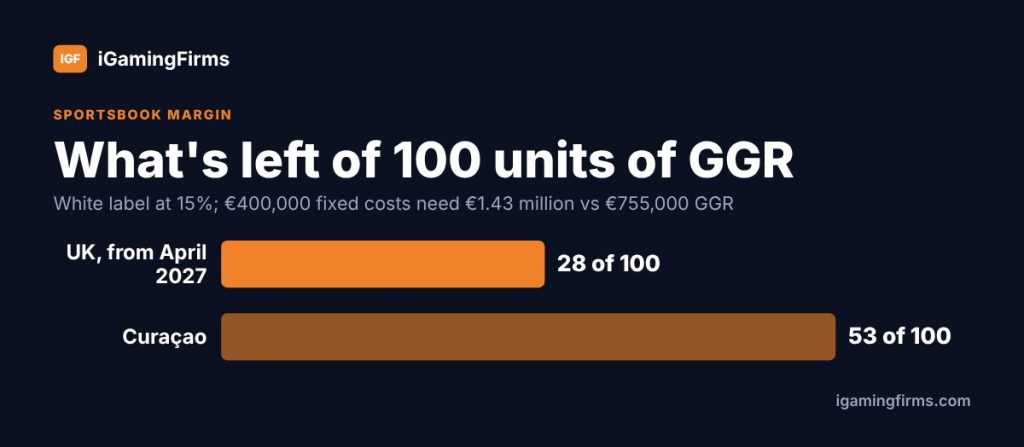
GGR is stakes minus winnings. It isn’t profit. The table below shows how much survives the variable costs in two scenarios, using a white label platform. Every figure except the UK duty rate is an illustrative assumption.
| Per 100 units of GGR | UK, from April 2027 | Curaçao |
|---|---|---|
| Betting duty | -25 | 0 |
| White label revenue share (15%) | -15 | -15 |
| Affiliate commissions and paid acquisition | -20 | -20 |
| Payment processing | -6 | -6 |
| Data, trading and KYC (variable part) | -6 | -6 |
| Left to cover fixed costs | 28 | 53 |
Now apply it to your fixed costs. If your team, license and fixed platform fees come to €400,000 a year, you need about €1.43 million in annual GGR to break even in the UK scenario (€400,000 ÷ 0.28), but only about €755,000 in the Curaçao scenario (€400,000 ÷ 0.53).
Two things follow from this. First, in a 25% duty market a 15% white label revenue share takes a big bite out of what’s left, so moving to a turnkey or fixed-fee deal matters earlier than it does offshore. Second, bonuses and free bets aren’t in this table, and they can easily take another 10 to 20 units, so model your promotion budget separately. If you plan to add a casino tab in the UK, note that Remote Gaming Duty rose from 21% to 40% on April 1, 2026, so casino GGR carries a far heavier tax than sports GGR.
How does a sportsbook make money?
A sportsbook earns its margin, often called the vig or overround, by pricing every outcome slightly shorter than its true chance. On a standard -110 / -110 line (decimal 1.91 on both sides), the implied probabilities add up to about 104.8%. If stakes are balanced on both sides, the book keeps about 4.5% of what’s wagered whatever the result.
Real books are rarely balanced, so what you actually keep is the hold: GGR divided by total stakes (handle). Parlays and same-game parlays carry much higher margins than single bets, which is why they matter so much to operators. In US commercial markets, the American Gaming Association reported $1.27 billion of sports betting revenue on $11.60 billion of handle in July 2026, a hold of about 11%.
Is running a sportsbook profitable?
It can be, but GGR is not profit. Once you take off betting duty, platform fees, affiliate commissions, payments and bonuses, the margin model in Step 6 shows you may keep between roughly a quarter and a half of GGR to cover fixed costs. Small books also face more volatility: one bad weekend of favourites winning can erase a month’s hold. Our breakdown of sports betting profitability from the operator side covers the numbers in more detail.
Can you start a sportsbook without a license?
Not legally in a market that licenses or bans betting. “Pay per head” bookie software lets someone take bets for a weekly per-player fee, but it doesn’t license anything: running an unlicensed book in the US breaks state law and can also fall under federal gambling statutes. Payment providers, data suppliers and B2B partners also won’t work with an unlicensed operator. If you’re weighing an offshore license instead, read whether offshore sports betting is legal first, because the law follows the customer, not the license.
Step 7: Launch checklist and timeline
Expect roughly 3 to 6 months from incorporation to launch on a white label or turnkey platform with an offshore or EU license, and longer for the UK or a US state.
- Weeks 1 to 4: confirm target markets, incorporate in your licensing jurisdiction, shortlist platform and odds vendors.
- Weeks 4 to 12: file the license application with your policies (AML, KYC, responsible gambling, terms). Curaçao processing times are uncertain while the CGA moves to a new platform; Malta and the UK usually take several months.
- In parallel: sign the platform contract, integrate data feeds, onboard PSPs and KYC providers.
- Before launch: test bet placement, settlement, deposits and withdrawals end to end; set trading limits; load responsible gambling tools; train support.
- Launch: start with a small number of sports and markets you can price well, then widen coverage as your trading data builds up.
Common mistakes new sportsbook operators make
- Budgeting the license and forgetting the reserve. One big upset on a popular bet can wipe out a month’s GGR. Keep cash set aside for payouts.
- Signing a revenue share without an exit plan. Check the minimum term, data portability and migration fees before you sign.
- Using old fee tables. Curaçao, UK and US numbers have all changed. Check the regulator’s current schedule.
- Ignoring tax in the platform decision. In a high-duty market, a percentage-based platform fee costs you far more than it looks on paper.
- Betting the business on one market. Brazil showed that a regulated market can close in weeks. Spread risk across markets where you can.
- Underpricing to win customers. Margins that are too thin attract sharp bettors and leave you with a loss-making book.
What this means for you
If you’re planning a sportsbook launch, decide your market first, then let it pick your license. Use the fee table above as a starting point and confirm every number with the regulator. Build your margin model before you choose a platform, because the tax rate in your market decides whether a revenue share or a fixed fee is cheaper. And keep a cash reserve that lets you pay winners on your worst week.
Ready to shortlist suppliers? Start with the platform and white-label providers, odds and data feeds and licensing consultants directories.
License fees and tax rates are correct as of 15 October 2026, based on the regulators’ published schedules. Platform and operating costs are estimates and assumptions. This guide is general information, not legal or tax advice.