The short answer: the best odds API is the one that delivers the freshness you need for the books you need at the lowest cost for your real request pattern. For sportsbook trading and in-play pricing, enterprise feeds like OpticOdds and LSports are built for sub-second delivery. For affiliate comparison pages and models that can live with 30 to 60 seconds of delay, The Odds API, TheRundown and SportsGameOdds cost a fraction of that.
Every odds API on the market says it is “real-time”. Then you read the pricing page and find that the free plan is five minutes behind, the plan you can afford refreshes once a minute, and the feed you actually wanted is “contact sales”. If you are building an odds comparison page, a pricing model or a trading tool, that gap between the headline and the tier is where most of your budget goes. This guide compares eight developer odds APIs on coverage, documented latency per plan and real pricing, then works out what one realistic workload costs on each.
Everything here comes from each provider’s own documentation, pricing pages and customer case studies, industry news coverage, and developer discussion on forums such as r/algobetting, and none paid to be included. If you need official league data, fixtures and settlement for a regulated sportsbook rather than an aggregated odds feed, that is a different purchase, explained further down.
Quick comparison: the best odds APIs in 2026
| # | Provider | Books | Speed | Entry price | Best for |
|---|---|---|---|---|---|
| 1 | OpticOdds | 200+ | Sub-second (claimed) | Quote | Sportsbooks and trading teams |
| 2 | LSports | 100+ | 0 to 1s in-play (claimed) | Quote, free trial | Books wanting trading tools |
| 3 | SportsDataIO | US legal books | Not published | Quote, free trial | US media and affiliates |
| 4 | OddsPapi | 350+ | Published per book | Free, then custom | Global and Asian books |
| 5 | TheRundown | 24 sources | 5 min to real-time, by plan | Free, then $49/mo | Buying speed step by step |
| 6 | SportsGameOdds | 82 on Pro | 10 min to sub-minute, by plan | Free, then $99/mo (annual) | Player props and DFS |
| 7 | The Odds API | 100+ | 40 to 60s | Free, then $30/mo | Affiliates and research |
| 8 | Sportsbook API | US + prediction markets | 60s | Free, then $10/mo | Smallest budgets |
What is an odds API (and what it is not)?
An odds API is a data feed that collects betting prices from many bookmakers, normalises them into one format and delivers them to your software. Instead of scraping DraftKings, Bet365 and Pinnacle separately, you make one request (or hold one stream open) and get every book’s moneyline, spread, total and prop prices for an event, usually in JSON. If any of those market names are new to you, our sports betting terms glossary defines them.
Two things often get mixed up under the same name:
- Aggregated odds feeds show you what other bookmakers are offering. Affiliates use them for comparison tables, analysts for models, and sportsbooks for benchmarking their own lines. All eight providers below sell this.
- Trading or pricing feeds give a sportsbook odds it can publish as its own, with margin control, suspensions and settlement. LSports TRADE, OpticOdds Copilot and the big official-data suppliers sit here. If you are launching a book, this is the decision that matters, and it is covered in our guide on how to start a sportsbook.
Odds API vs sports data API: what is the difference?
An odds API sells prices: what each bookmaker is offering on each market, and how those prices move. A sports data API sells the underlying events: fixtures, live scores, play-by-play, player stats and official results used for settlement. Some vendors (LSports, SportsDataIO, SportsGameOdds) bundle both, but the buying decision is different. Odds APIs are judged on book coverage and freshness; sports data feeds are judged on official rights, accuracy and integrity services. Sportradar and Genius Sports, the main official-data holders, are reviewed in our enterprise sports data feed comparison rather than here.
Latency is a pricing tier, not a product feature
This is the part most “best odds API” lists skip. On self-serve APIs, freshness is the main thing you pay for, and each provider documents it differently:
| Provider | Cheapest plan | Fastest plan | Push stream |
|---|---|---|---|
| The Odds API | 60s pre-match, 40s in-play | Same on every plan | No |
| TheRundown | 5-minute delay (Free) | Real-time ($399/mo+) | WebSocket from $399 |
| SportsGameOdds | 10-minute updates (Free) | Sub-minute ($299/mo+) | Custom plan only |
| Sportsbook API | 60s | 60s on every plan | No |
| OddsPapi | Pre-game only (Free) | Per book, many under 2s | B2B plan |
Two practical points follow. First, your real delay is the provider’s update interval plus your own polling interval. Polling The Odds API every 60 seconds can leave you looking at a price close to two minutes old. Second, polling faster than the provider refreshes buys you nothing: on SportsGameOdds Rookie, requesting every 30 seconds just returns the same 3-minute-old snapshot six times.
For in-play trading, none of the self-serve tiers above replace a push feed with a contractual latency figure. The Odds API’s update table is a useful benchmark for what “real-time” means on a polling API: 60 seconds pre-match and 40 seconds in-play for main markets, 60 seconds for props and 10 to 20 seconds for exchanges. Tens of seconds, not milliseconds.
What one workload actually costs
Every provider bills in a different unit (credits, objects, data points, requests), so headline prices are not comparable. Here is one realistic workload priced on each published plan.
The workload: an affiliate or app showing NFL and NBA main lines (moneyline, spread, total) from US books, refreshed every 60 seconds, around the clock for 30 days. Assumptions: about 12 upcoming NFL and NBA events returned per refresh in total, two sport requests per refresh, and 5 bookmakers where a provider bills per book.
Here is how each one counts:
- The Odds API: 1 credit per market per region per call.
- TheRundown: 1 data point per returned price row per bookmaker.
- SportsGameOdds: 1 object per event returned, however many markets and books it carries.
- Sportsbook API: a daily request allowance.
| Provider | Monthly usage | Plan that fits | Price | Data delay |
|---|---|---|---|---|
| The Odds API | 259,200 credits | 5M | $119/mo | 40 to 60s |
| TheRundown | 16.6M points | Pro | $149/mo | 30s |
| SportsGameOdds | 518,400 objects | Pro | $299/mo annual, $499 monthly | Under 60s |
| Sportsbook API | 2,880 requests a day | 5,000 requests/day tier | $25/mo | 60s |
How the numbers work: 60-second refreshes for 30 days is 43,200 refreshes. On The Odds API that is 43,200 x 2 sports x 3 markets, which is too much for the 100K plan. TheRundown’s $49 Starter plan covers the volume (its quota rose from 5M to 25M data points in September 2026), but it is licensed for internal or personal use only, so a public page needs Pro. SportsGameOdds’ Rookie plan stops at 100,000 objects and only refreshes every 3 minutes.
The same job costs $25 to $499 a month depending on the provider, and the cheapest options are cheap because they are slower or narrower. Slow the refresh to every 5 minutes and The Odds API drops to the $59 plan (51,840 credits) while SportsGameOdds lands just over Rookie’s 100k objects. Add player props, which most of these APIs bill per market or per price row, and these numbers multiply. Measure one real response before you commit to a plan.
How this list was built
The shortlist started from the providers that rank and get recommended most for odds data in 2026, then each was checked against:
- Vendor sources: pricing pages, API documentation, update-interval and coverage tables, and published customer testimonials, all read in October 2026.
- Industry news from the last six months, including partnerships, product launches and litigation.
- Developer discussion on r/algobetting, used only as a signal of recurring concerns.
Customer views below come from each vendor’s own testimonials, client lists and announcements, and are labelled that way. No API was tested hands-on and the order reflects fit for B2B buyers, not a score. Many “best odds API” rankings are published by odds vendors themselves, which is worth remembering when one names itself first.
The 8 best odds APIs, reviewed
1. OpticOdds
OpticOdds is the aggregator most often named when operators need speed and depth together. It pulls live and pre-match prices from 200+ sportsbooks into one standardised feed and was built by former traders and quants.
- Coverage: 200+ sportsbooks; main lines, alternates, player props, outrights and same-game parlay pricing, plus historical prices and closing-line data.
- Latency and delivery: markets “sub-second latency” with push, pull and queue delivery formats.
- Pricing: no public price list; the pricing page is a lead form that asks for company size and products needed.
- Beyond the feed: Odds Screen for traders, a Bet Builder and SGP engine, and Copilot, an automated trading service that generates benchmarked odds and settlement. In May 2026 it launched an MCP connector, making its odds data queryable from AI assistants.
- Best for: sportsbooks, B2B platforms, DFS and prediction markets (it lists Kalshi and PrizePicks as clients).
- Watch-outs: OpticOdds and OddsJam have been in litigation with Swish Analytics since December 2024, when Swish alleged they misappropriated odds data and claimed more than $100 million in damages. In August 2026 both filed antitrust counterclaims under California’s Cartwright Act. Nothing has been decided, but ask any aggregator how it sources each book’s prices.
- What customers say (from OpticOdds’ site): Kalshi says it was running on the feed in under 48 hours, the Yolo Group’s director of trading calls its in-play prop coverage unmatched, and BetMGM’s trading team praises how receptive the company is to feedback.
2. LSports (OddService)

LSports sells OddService, a raw odds feed from 100+ bookmakers, alongside a full trading platform (ARENA360). That split matters: you can buy just the market view or have LSports generate your own prices through TRADE.
- Coverage: 100+ bookmakers, 100 sports, around 2,500 markets including esports, about 175,000 pre-match and 95,000 in-play events a month.
- Latency and delivery: claims 0 to 1 second for in-play data, in XML, JSON or binary.
- Pricing: quote only, with a free trial.
- Best for: sportsbooks that want odds, fixtures, livescore and settlement from one supplier, and possibly managed trading on top.
- 2026 signal: became official data partner to ADI PredictStreet for the 2026 World Cup and partnered with gripAI on a Play Insurance product.
- What customers say (from LSports’ site): ADI PredictStreet, which picked LSports as its data partner for the 2026 World Cup and beyond, is quoted as calling it “exactly the partner we need” as it expands into every sport and market.
3. SportsDataIO

SportsDataIO’s odds API is built for the US market. It ingests all markets from legal US sportsbooks and tracks opening lines, closing lines and every move in between.
- Coverage: US legal sportsbooks; pre-match, in-play, historical and closing lines, props and futures.
- Latency and delivery: described as real-time with line-movement timestamps; no latency figure is published.
- Pricing: free trial, then a sales conversation.
- Stand-out feature: settlement verification feeds mapped to official game, team and player IDs, which alert you to pause payouts when data does not match.
- Best for: US media brands, affiliates building matchup pages, and operators who want a second source to check settlement.
- What customers say (from SportsDataIO’s site): its client list includes affiliate groups Better Collective, Catena Media and Action Network alongside DraftKings, FanDuel and Polymarket, and it publishes a case study on scaling Polymarket’s sports coverage.
4. OddsPapi
OddsPapi stands out for breadth outside the US and for transparency: it publishes a per-bookmaker table of maximum live and pre-match delays, something no other provider here does.
- Coverage: 350+ bookmakers (it reported 370 from its own bookmakers endpoint in May 2026), 60+ sports, including Pinnacle, Bet365, Singbet, Sbobet, crypto books, exchanges and prediction markets.
- Latency and delivery: published max live delays range from under 0.2 seconds for some books to 7 seconds for others (for example 888Sport around 0.84s, 20Bet 7s). REST and pull on custom plans; WebSocket push on the B2B plan.
- Pricing: free plan with 250 requests a month and historical data; paid plans are priced in a configurator by bookmakers, sports and requests.
- Best for: global comparison sites, Asian-market coverage, and model builders who need free historical odds.
- Watch-outs: its own disclaimer says full coverage of every book’s odds is not guaranteed, and recommends checking the free account first. Do exactly that for the books you care about.
- What customers say (from OddsPapi’s site): instead of testimonials, it lets you check its claims yourself, with a searchable bookmaker coverage list, the per-book latency table, free historical data and a public Discord for feedback.
5. TheRundown
TheRundown has the clearest price-for-speed ladder in the market, which makes it easy to start cheap and pay for latency only when you need it.
- Coverage: free plan covers BetMGM, DraftKings and FanDuel pre-match only; paid plans open all published sources (19 sportsbooks plus 5 exchange-style sources), props, alternates and history.
- Latency and delivery: per its pricing page, 5-minute delay (Free), 60 seconds (Starter, $49), 30 seconds (Pro, $149), real-time WebSocket (Ultra, $399, and up).
- Pricing: billed in data points (one price row per book); Starter includes 25M points, Pro 125M and Ultra 500M after a September 2026 quota increase at unchanged prices. Paid plans are hard-capped by default with optional overage, and higher plans run to $2,499 a month plus enterprise.
- Best for: US apps and affiliates that want transparent monthly pricing and a built-in usage estimator.
- Watch-outs: Starter is internal or personal use only; you need Pro or above to display data to end users commercially. That licence line is easy to miss.
- 2026 signal: TheRundown now offers its data as an MCP server for AI agents.
- What the vendor reports (from TheRundown’s site): 42M+ odds updates a day, 80M+ requests served a month and 100% uptime over the last 90 days, plus “no hidden fees” and instant plan changes.
6. SportsGameOdds
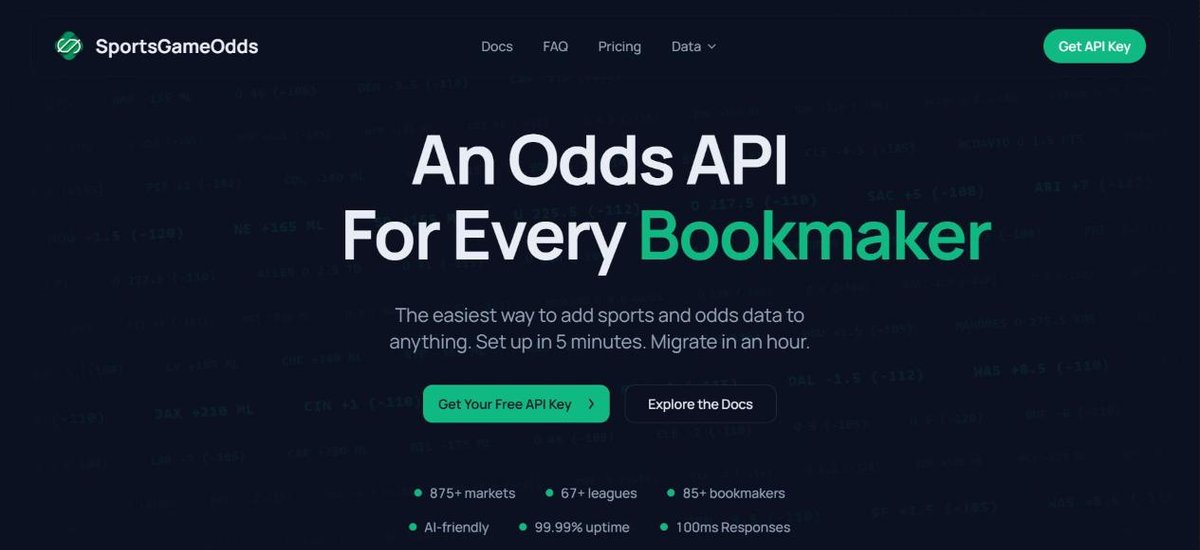
SportsGameOdds charges per event rather than per market or bookmaker, which can make it far cheaper for prop-heavy products: one NBA game with 100 markets across 20 books counts as a single object.
- Coverage: Free covers 9 books and 8 leagues; Rookie 77 books and 17 leagues; Pro 82 books and 53 leagues including Pinnacle, Bet365, Circa and PrizePicks. Scores, stats and results are included.
- Latency and delivery: 10-minute updates (Free), 3 minutes (Rookie), sub-minute (Pro). Real-time WebSockets are only on the custom All-Star plan.
- Pricing: Free includes 2,500 objects a month; Rookie (100,000 objects) is $99 a month billed annually or $149 monthly; Pro (unlimited objects) is $299 annually or $499 monthly.
- Best for: player prop tools, DFS and pick’em products, and +EV or fair-odds features (fair odds and book consensus are included).
- Watch-outs: the advertised “from $99” is the annual rate. The homepage’s 85+ bookmakers and 67+ leagues describe the full catalogue; the Pro plan lists 82 and 53, and WebSockets are on the custom plan only, even though several summaries describe it as a WebSocket API at entry level.
- What users say: on r/algobetting, developers credit it with the widest sports coverage at its price, while some say its data needs regular verification. Treat forum threads with care: several odds vendors post there themselves.
7. The Odds API
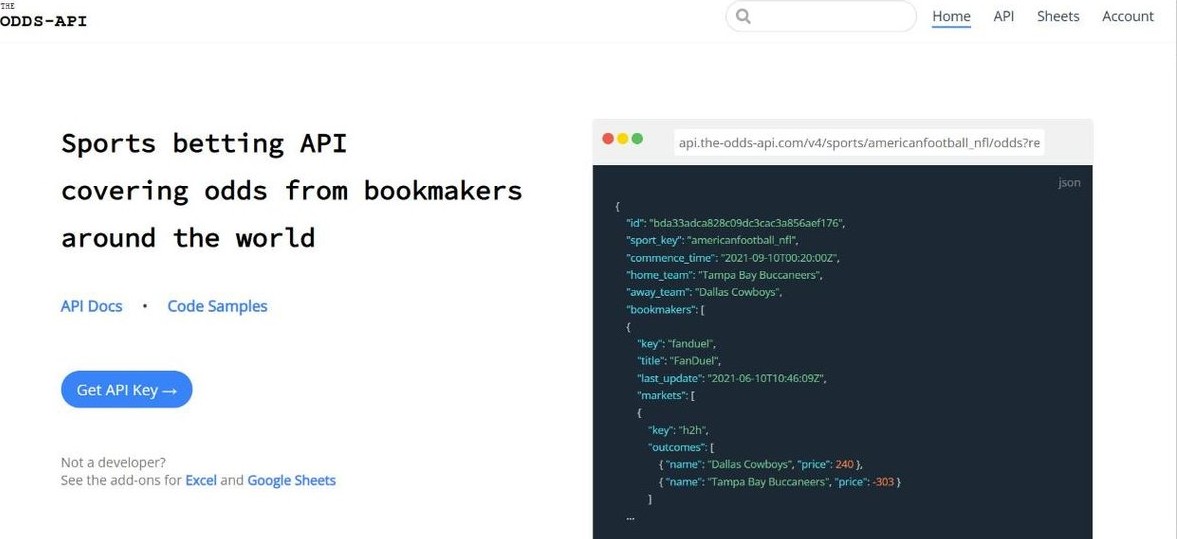
The Odds API has been running since 2017 and is where many developers start: simple REST endpoints, clear credit costs and the most generous documented free tier here.
- Coverage: 100+ sports keys and 100+ bookmakers across US, UK, EU, Australian and other regional groupings, including DraftKings, FanDuel, BetMGM, William Hill, Pinnacle and Betfair Exchange. Player props and alternates are available for selected US sports and books.
- Latency and delivery: 60s pre-match and 40s in-play for main markets, 60s for props, and 20s/10s for exchanges. JSON over REST, plus Excel and Google Sheets add-ons and an embeddable odds widget.
- Pricing: Free (500 credits a month), $30 (20K), $59 (100K), $119 (5M) and $249 (15M), all including historical odds back to 2020.
- How credits work: one credit per market per region per call; historical odds cost 10 per market per region. A three-market request uses three credits, so the free tier is closer to 166 useful calls than 500.
- Best for: affiliate comparison pages, research, back-testing and prototypes.
- Watch-outs: it is polling only, with no push stream and no trading or settlement layer. Several competitor-written comparisons put it at “about 40” bookmakers with no Pinnacle; its own bookmaker list runs past 100 unique books and includes Pinnacle (EU region) and Betfair Exchange. Note that its Pinnacle prices come from Pinnacle’s public website and may carry a delay.
- What users say: in r/algobetting threads it comes up again and again as the API developers start with, praised for good pricing, and threads from users looking to upgrade from it are common once they need more speed or depth.
8. Sportsbook API

Sportsbook API is the cheapest paid option on this list, sold through RapidAPI, and adds ready-made +EV, arbitrage and middle feeds on top of raw lines.
- Coverage: US books including DraftKings, BetMGM, Fanatics, BetRivers and Bovada, plus prediction markets Kalshi, Polymarket and ProphetX; NFL, NBA, MLB, NHL, college and major soccer leagues.
- Latency and delivery: odds updated once per minute, live included.
- Pricing: Free (50 requests a day), $10 (1,000 a day), $25 (5,000 a day), $100 (50,000 a day).
- Best for: small US affiliate sites and tools that want comparison and opportunity feeds without engineering their own.
- Watch-outs: notable gaps in the US book list (FanDuel is not named on its homepage) and no Pinnacle or exchanges, so check coverage against the books your audience uses.
- What customers say (from Sportsbook API’s site): it publishes its full sportsbook and league lists so you can check coverage before paying, and handles error reports directly by email.
Other odds APIs you will see recommended
A few more names come up in 2026 comparisons. They did not make the main list because their public documentation or pricing is thinner, or because they solve a different problem, but they are worth a look for specific needs:
- Odds-API.io: a newer aggregator that claims 365+ bookmakers, WebSocket streaming and flat monthly pricing from £49, with server-side value-bet and arbitrage endpoints. Those figures come from its own blog; its entry plan limits how many bookmakers you can select.
- OddsJam: best known as a consumer betting tool; its API is sales-gated. It is also a party to the Swish Analytics dispute above.
- BetsAPI and GoalServe: long-running feeds with broad sports coverage, used mainly for in-play and lower-tier events; check documentation quality and licence terms before you build on them.
- Betfair Exchange API: exchange prices direct from the source, with a free delayed key for development and an approval process for commercial use.
Is there an API for DraftKings or FanDuel?
Not a public one. Neither DraftKings nor FanDuel offers a self-serve developer API for its sportsbook odds. Every API above that includes them is aggregating their prices, either through partnerships or by collecting from their public sites. That is why provenance matters: if a book changes its site or objects to collection, coverage for that book can disappear overnight. Ask your provider how each book you depend on is sourced, and what happens contractually if it drops out.
Which odds APIs include Pinnacle and other sharp books?
If you price your own lines, measure closing-line value or build fair-odds features, you need at least one sharp book or exchange in the feed. From the providers’ own coverage lists:
- OddsPapi: Pinnacle, Singbet and Sbobet, plus exchanges.
- SportsGameOdds: Pinnacle and Circa on the Pro plan, not on Free.
- The Odds API: Pinnacle in the EU region (sourced from its public site) and Betfair Exchange in the UK, EU and AU regions.
- OpticOdds: sharp and offshore books within its 200+ list; confirm the exact books in your contract.
Sharp books are often reserved for paid tiers, so check the plan you will actually buy, not the provider’s full catalogue.
Are there free odds APIs?
Yes, but free tiers are built for testing, not production. The Odds API gives 500 credits a month, OddsPapi 250 requests, TheRundown 200,000 data points (20,000 a day) with a 5-minute delay, SportsGameOdds 2,500 objects with 10-minute updates, and Sportsbook API 50 requests a day. All are fine for checking data structure and book coverage. None will run a live comparison page for long, so read each plan’s terms on commercial display before you build on it.
Are odds APIs legal to use?
Buying odds data from a provider is a normal commercial arrangement, and affiliates, media groups and sportsbooks do it every day. The legal questions sit in two places. The first is the licence: many plans restrict commercial display, redistribution or use in betting products, so your use must match your tier. The second is provenance: the Swish Analytics litigation shows that how a vendor collects bookmaker prices can be challenged in court. Licensed operators have a third layer, because some regulators require official league data for certain bet types, which an aggregated odds feed does not provide. Get your contract reviewed and keep the sourcing answers in writing.
Who should pick what
- Launching or running a sportsbook: OpticOdds or LSports for sub-second aggregated prices and trading tools. If your regulator requires official league data, you will also need an official-data supplier such as Sportradar or Genius Sports.
- US affiliate or media site: The Odds API to start, TheRundown Pro once you display data commercially and want 30-second freshness, SportsDataIO if you want matchup content and settlement checks too.
- International or Asian-market comparison site: OddsPapi for the widest book list, verified against its published delay table.
- Prop, DFS or pick’em product: SportsGameOdds Pro for per-event pricing, or OpticOdds if you need in-play prop depth.
- Prediction market product: OpticOdds (it lists Kalshi as a client) or Sportsbook API and OddsPapi, which carry Kalshi and Polymarket prices alongside sportsbooks. Our explainer on how prediction markets and event contracts work covers the model.
- Back-testing and models: The Odds API historical endpoints (back to 2020) or OddsPapi’s free historical data.
- Smallest possible budget: Sportsbook API at $10 to $25 a month for US main lines.
If you are building an affiliate site on top of any of these, our guide to iGaming SEO covers how odds pages earn rankings. Operators weighing margins should also read the operator-side math of sports betting, because data costs sit inside that hold.
Red flags to check before you sign
- “Real-time” without a number. Ask for update intervals per market type and per book, in writing. OddsPapi and The Odds API publish theirs; anyone else can too.
- Annual pricing shown as monthly. Check the toggle. SportsGameOdds’ entry plan is 50% more on monthly billing.
- Commercial use limits. Lower tiers often ban displaying data to end users. TheRundown’s Starter plan is one example.
- Unclear data provenance. The Swish Analytics, OddsJam and OpticOdds dispute shows that how odds are collected can become a legal question. Your fraud and risk team should know where each feed comes from.
- Props billed per market. Model your real prop request before signing; per-market billing can multiply costs 10x or more.
- No sharp books. If you price your own lines or build closing-line models, confirm Pinnacle, Circa or an exchange is in your plan, not just the provider’s full list.
- Vendor-written rankings. Many comparison pages that rank for “best odds API” are published by an odds vendor that lists itself first. Check every competitor claim against the provider’s own docs.
The bottom line
The best odds API is the cheapest one that meets your freshness requirement for the books that matter to your product. Decide that number first (sub-second, 30 seconds or a few minutes), then compare providers on cost for your real request pattern, not on headline price or bookmaker count. If you need official data, fixtures and settlement feeds rather than aggregated prices, compare the official sports data providers instead.