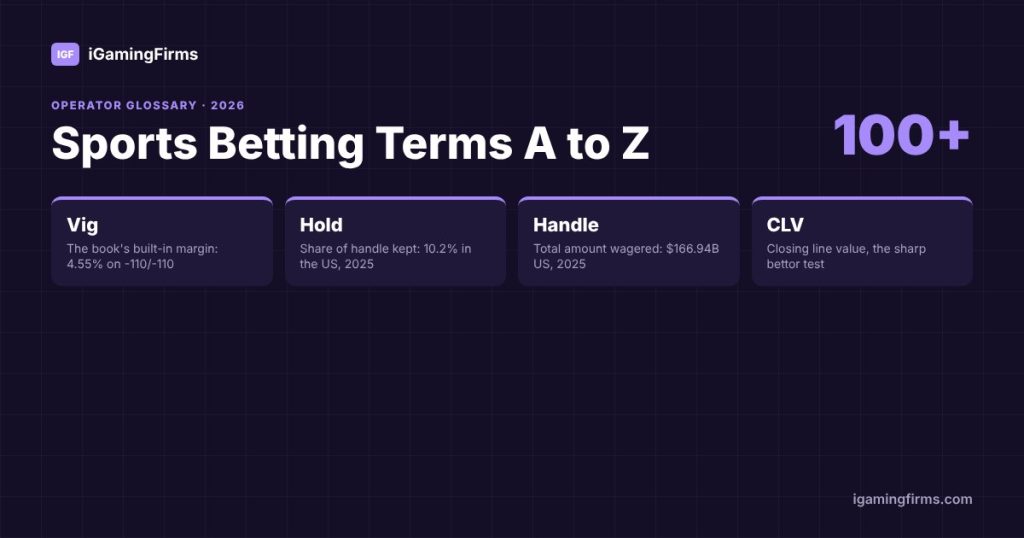
Betting vocabulary looks simple until three teams use it differently. Trading calls 4.55% the margin, finance reports a 10% hold, the content team writes that “juice is 10%”, and a customer complaint turns on whether a tied leg was a push or a void. If you run a sportsbook, write betting content or manage affiliate pages, one shared glossary of sports betting terms saves real time and real disputes.
Sports betting terms are the words sportsbooks, traders and bettors use to describe bets, prices and results. The ones to know first are moneyline, point spread, over/under, parlay, prop bet, odds, stake, vig (juice), push, hook, handle and hold. On a standard -110 line, the vig gives the book a theoretical margin of 4.55% of the money staked, not 10%.
This glossary covers more than 100 terms from A to Z, with the operator or affiliate meaning where it differs from the bettor’s, plus the business terms (handle, GGR, NGR, hold) that finance and affiliate teams report on. It explains terms only and does not recommend any bet.
What is a stake in betting?
A stake is the amount of money placed on a bet. If you put $50 on a team, $50 is the stake. “Wager”, “bet amount” and, in UK and Australian usage, “punt” all mean the same thing.
Do you get your stake back on a winning bet? Yes, on a normal cash bet. The return on a winning fixed-odds bet is the stake plus the profit. A $100 stake at +150 wins $150 profit and returns $250. Decimal odds already include the stake (a $10 bet at 2.50 returns $25), while American and fractional odds show the profit only. Many books do not return the stake on a bonus or free bet, so a winning $10 bonus bet at +150 typically pays the $15 profit only. Check the house rules for the exact treatment.
Three related terms that are easy to mix up:
- Stake is the money on one bet.
- Unit is a bettor’s standard stake size, used to report results (“up 5 units”) without revealing amounts.
- Bankroll is the total money set aside for betting, from which stakes are sized.
For an operator, stake is also a risk input. Maximum stake limits per market, per customer and per bet type are how a trading team controls liability, and stake factoring (scaling a customer’s limits up or down) is the main lever books use with customers they profile as sharp.
How to read the numbers: +200, +140, +4.5 and the plus/minus signs
Several of the most searched betting questions are about reading a single number. The rules are short enough to fit in three answers and one table.
What does + and – mean in betting?
In American odds, minus marks the favourite and plus marks the underdog. A minus number is what you stake to win $100 profit (-150: stake $150 to win $100). A plus number is the profit on a $100 stake (+200: win $200). On a point spread, the same signs mean giving points (-3.5) or receiving them (+3.5).
What does +200 odds mean (and +300 or +140)?
+200 means a $100 stake wins $200 profit and returns $300 in total. It is the same price as 3.00 in decimal and 2/1 in fractional odds.
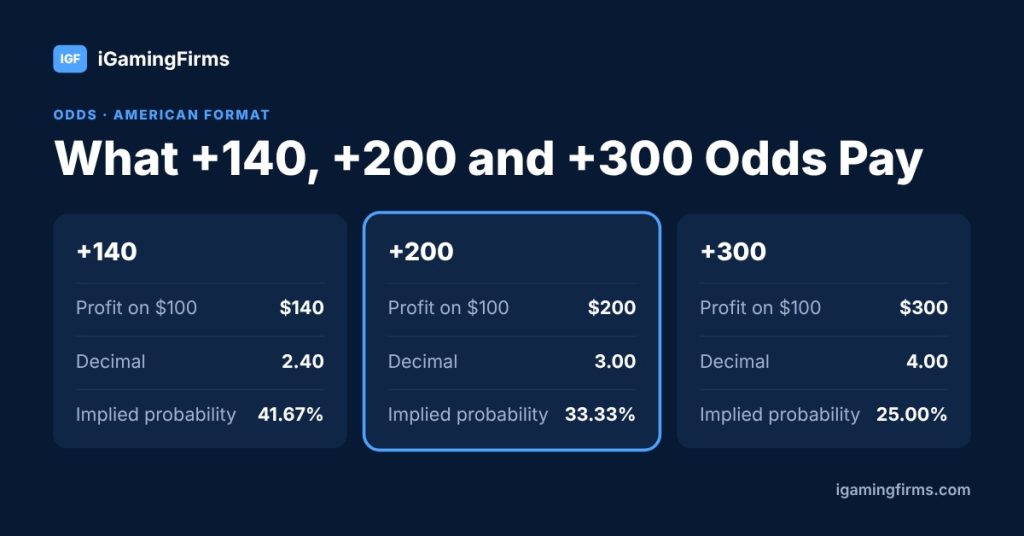
| Odds | Profit on $100 | Total return | Decimal | Implied probability |
|---|---|---|---|---|
| +140 | $140 | $240 | 2.40 | 41.67% |
| +200 | $200 | $300 | 3.00 | 33.33% |
| +300 | $300 | $400 | 4.00 | 25.00% |
| -110 | $90.91 | $190.91 | 1.909 | 52.38% |
Implied probability for plus odds is 100 / (odds + 100); for minus odds it is odds / (odds + 100), using the number without its sign. To convert to decimal, plus odds become (odds / 100) + 1 and minus odds become (100 / odds) + 1. These percentages include the book’s margin, so they are slightly higher than the true chance the price reflects. Odds feeds and trading systems usually carry prices in decimal and convert for display, which is one of the checks in the odds API comparison.
What does +4.5 mean in betting?
+4.5 is a point spread on the underdog. The team “receives” 4.5 points, so a bet on it wins if the team wins outright or loses by 4 or fewer. It loses if the team loses by 5 or more. The half point (the hook) means the bet cannot push.
Vig vs hold: the terms most glossaries get wrong
The most repeated error on the pages reviewed for this glossary is the size of the vig. At least one top-ranking glossary says a -110 spread “includes a 10% juice”. That mixes up three different numbers.
| Term | What it measures | Value on a balanced -110/-110 market | Where operators see it |
|---|---|---|---|
| Vig on the losing bet | Extra a losing bettor pays over the winner’s profit | $10 on a $110 stake to win $100 (the “10 cents”) | Price ladder |
| Overround | How far implied probabilities exceed 100% | 104.76% book, so 4.76% | Trading and pricing |
| Theoretical margin | Share of total stakes the book expects to keep | $10 of $220 staked = 4.55% | Trading and pricing |
| Hold | Revenue actually kept as a share of handle, over a period | Depends on results and product mix | Finance and state reports |
Real hold runs well above the theoretical margin on a straight bet. The American Gaming Association’s full-year 2025 report put US sports betting revenue at $16.96 billion on $166.94 billion of handle, a hold of about 10.2%. The gap comes from product mix (two -110 legs in a parlay already carry about 8.9% margin, and props and same game parlays are priced wider), unbalanced books and results. So “about 10%” is a fair description of US hold, and the wrong description of the vig on a single -110 bet. The operator-side maths is in is sports betting profitable.
Sportsbook business terms: handle, GGR, NGR and hold
Bettor glossaries stop at the bet slip. Operators, investors and affiliates also need the reporting vocabulary, because contracts, tax returns and revenue share deals are written in it.
| Term | Definition | Who uses it |
|---|---|---|
| Handle (turnover) | Total amount wagered in a period | Regulators, trading, investor reports |
| GGR (gross gaming revenue) | Stakes minus winnings paid, before costs | Regulators and tax returns in most markets |
| Hold | GGR divided by handle | Finance, state reports, analysts |
| NGR (net gaming revenue) | GGR minus bonus costs and, depending on the contract or jurisdiction, taxes, fees and chargebacks | Affiliate revenue share, platform and supplier fees |
| Liability (exposure) | What the book stands to lose on an outcome | Trading and risk |
| Theoretical margin | Margin priced into a market before results | Pricing and trading |
The NGR row matters most to affiliates: two revenue share deals at the same percentage can pay very differently if one deducts bonuses and taxes and the other does not. The guide to iGaming affiliate marketing covers how those deals are structured.
Sports betting terms A to Z
Synonyms are listed together so you can map US, UK and Australian usage. Where the operator meaning differs from the bettor’s, the entry says so.
A
- Accumulator (acca): the UK and European name for a parlay. One bet with several selections that must all win.
- Action: any bet that is live and will be graded. “Getting action” on a game means taking bets on it. “No action” means the bet is cancelled and the stake refunded.
- Against the spread (ATS): a team’s record measured against the point spread rather than wins and losses.
- Alternate lines: spreads or totals offered at numbers other than the main line, at adjusted prices. For a book, alternate lines and bought points are the same product: the customer moves the line and pays for it in the price.
- American odds (moneyline odds): odds shown against $100, with minus for the favourite and plus for the underdog.
- Ante-post: a UK term for a bet placed before the day of the event, usually on horse racing or an outright market, often at a bigger price with no refund if the selection does not run.
- Arbitrage (arb): backing every outcome of a market across different books at prices that guarantee a profit. Arbs come from stale or mispriced lines, which is why books detect and limit arbers.
- Asian handicap: a soccer handicap that removes the draw, using half and quarter goal lines (such as -0.5, -0.25 or +1.25). Quarter lines split the stake across the two nearest half and whole lines.
B
- Back: to bet on an outcome happening. On a betting exchange, the opposite of lay.
- Backdoor cover: a late score that changes the spread result without changing who wins the game.
- Bad beat: a bet that looked won and loses late.
- Bankroll: the total money a bettor sets aside for betting.
- Bet builder: the UK and European name for a same game parlay.
- Bet delay (acceptance delay): the short pause a book applies before accepting an in-play bet, so a price cannot be taken after the event has already moved it.
- Bet slip (ticket): the record of a placed bet, with selections, price, stake and potential return.
- Betting exchange: a platform where customers bet against each other, backing and laying outcomes, while the exchange charges a commission on winnings rather than building margin into prices. US event contract platforms work on a similar matched-order model, covered in prediction markets explained.
- Bonus bet (free bet, site credit): promotional credit that can be staked but usually is not returned with winnings.
- Book (sportsbook, bookmaker, bookie): the business that accepts bets and sets or takes prices.
- BTTS (both teams to score): a soccer market on whether both teams score at least once.
- Buying points: paying a worse price to move a spread or total in the bettor’s favour. Selling points is the reverse: a worse line for a better price.
C
- Cash out: an offer to settle a bet before the event finishes for an amount the book sets. The cash-out price includes margin, so it is a product with its own hold.
- Chalk: the favourite. A “chalk bettor” mostly backs favourites.
- Circled game: a game with reduced limits because of uncertainty such as an injury, weather or a lineup question.
- Closing line: the final price or line before an event starts, treated as the market’s best estimate.
- Closing line value (CLV): the gap between the price a bet was struck at and the closing price, with the vig removed. Books use it to spot customers who consistently beat the close.
- Consensus (betting percentages): the share of bets or money on each side of a market. Some books publish it; trading teams use their own as a liability signal.
- Correct score: a bet on the exact final score, mostly offered on soccer, with a wide overround.
- Cover: to win against the spread. A favourite covers by winning by more than the spread; an underdog covers by winning or losing by less.
D
- Dead heat: a tie for a position (common in racing and golf). The stake is usually divided by the number of tied selections and settled at full odds on the reduced stake.
- Decimal odds: the total return per 1 unit staked, stake included. The standard internal format for trading systems and odds feeds.
- Dime and nickel: US bookmaking slang for $1,000 and $500 bets.
- Dog (underdog): the side less likely to win, shown with a plus sign.
- Double chance: a soccer bet that covers two of the three outcomes (home or draw, away or draw, home or away).
- Draw no bet: a soccer bet where the stake is refunded if the match is drawn.
- Drift: a price lengthening after it opens, the opposite of a price shortening (steaming in).
E
- Each way: a UK bet made of two equal stakes, one to win and one to place. The place part pays a fraction of the odds for finishing in the paid places.
- Edge: an advantage over the price. For the book, the margin; for a bettor, a true probability higher than the implied one.
- Even money (evens): +100, 2.00 decimal or 1/1 fractional. Profit equals stake.
- Exotic bets: racing bets on more than one finishing position, such as the exacta (first and second in order), trifecta (first three) and superfecta (first four).
- Expected value (EV): the average profit or loss per bet if it were repeated many times, calculated as probability times payout minus the stake at risk.
- Exposure (liability): how much a book stands to lose on an outcome. Trading teams manage exposure with prices, limits and layoffs.
F
- F5 (first five innings): a baseball bet on the moneyline, run line or total after five innings only, which takes the bullpens out of the result. Books set their own rules on what happens if a game is shortened or a listed pitcher changes.
- Fade: to bet against a team, a public trend or a tipster.
- Favourite: the side more likely to win, shown with a minus sign.
- Flex parlay: a parlay that still pays a reduced amount if one (or more) legs lose, in exchange for a lower full payout. The insurance is priced into the odds.
- Fractional odds: profit relative to stake, such as 5/1 or 10/11. Still standard in UK and Irish horse racing.
- Futures (outrights): bets on an event settled in the future, such as a season champion or league winner. Futures tie up liability for months and usually carry a large overround.
G
- GGR (gross gaming revenue): stakes minus winnings paid, before costs. In sports betting reports, GGR divided by handle is the hold.
- Grading (settlement): deciding whether a bet won, lost, pushed or was voided, and paying it out.
- Grand salami: a total on the combined goals or runs in every game of a day in one league.
H
- Handicap: a head start or deficit applied to a team, the UK name for a spread.
- Handle (turnover): the total amount wagered. Handle is not revenue; what the book keeps is hold.
- Hedge: a bet placed against an existing position to reduce risk. When a book does this with another book, it is called a layoff.
- Hold: the share of handle a sportsbook keeps as revenue over a period. US hold was about 10.2% in 2025 on AGA figures.
- Hook: the half point on a spread or total, such as 3.5. It removes the push.
I
- If bet: a chain of straight bets where the next bet only goes ahead if the previous one wins (or, in some versions, pushes).
- Implied probability: the probability a price represents, including the margin.
- In-play (live betting): betting after an event has started, with prices updated from live data. Live markets depend on low-latency official data, covered in the sports data providers comparison.
J and K
- Juice (vig, vigorish): the bookmaker’s built-in commission. On -110/-110 it equals a 4.55% theoretical margin on total stakes.
- Key numbers: margins of victory that occur far more often than others. In the NFL, 3 and 7 are the most common final margins, which is why a half point either side of them is priced so differently.
L
- Lay: to bet against an outcome, acting as the bookmaker. Only possible on exchanges or as a book.
- Laying and taking the points: backing the favourite on the spread (laying) or the underdog (taking).
- Layoff: a bet a book places elsewhere to reduce its own exposure.
- Leg: one selection inside a parlay, teaser or round robin.
- Limit (max bet): the largest stake a book will accept on a market or from a customer. Limits usually start low when lines open and rise as they firm up.
- Line: the spread or total number, and loosely any price.
- Line movement: a change in a line or price between opening and close, driven by money, news or other books’ moves.
- Line shopping: comparing prices across books before betting.
- Linemaker (oddsmaker): the person or team that sets the opening prices. Many books buy opening lines from a supplier and adjust them.
- Lock: slang for a bet a tipster claims cannot lose. Affiliates in regulated markets should avoid the word, since “guaranteed win” style claims are a common advertising compliance problem.
- Longshot: a selection at long odds.
M
- Margin (overround): how much the implied probabilities in a market exceed 100%, the basis of the book’s profit.
- Matched betting: using free bets and exchange lay bets to extract the value of promotions. For operators it is a bonus abuse pattern; detection is covered in iGaming fraud detection.
- Middle: holding bets on both sides of a game at different numbers, so a result between them wins both.
- Moneyline: a bet on who wins the game outright, with no spread.
- Multiples (Trixie, Patent, Yankee, Lucky 15, Heinz): UK combination bets. A Trixie is 4 bets on 3 selections, a Patent 7 bets on 3, a Yankee 11 bets on 4, a Lucky 15 is 15 bets on 4, and a Heinz 57 bets on 6.
N and O
- NGR (net gaming revenue): GGR after bonus costs and, depending on the contract or jurisdiction, taxes and fees. The usual base for affiliate revenue share.
- NRFI and YRFI: baseball bets on whether no run (or a run) is scored in the first inning.
- Odds-on: a price shorter than evens, so the stake is bigger than the profit.
- Odds boost (price boost): a promotion that lengthens a price. Boosts reduce or remove the margin on that bet and are booked as a marketing cost.
- Off the board: a game a book has stopped taking bets on, often because of injury or weather news.
- Opening line: the first price or line posted for an event.
- Over/under (total): a bet on whether the combined score is above or below a number set by the book.
P
- Palpable error (obvious error): a clearly wrong price that a book’s house rules allow it to void or resettle. The rule needs to be published before the bet is taken.
- Parlay: one bet with two or more legs that must all win. Margins compound leg by leg, which is why parlays hold more than straight bets.
- Pick’em (PK): a spread of zero. Whoever wins the game wins the bet.
- Prop bet (proposition): a bet on something inside a game, such as a player’s yards or points, rather than the final result.
- Public money: bets from recreational customers, often on favourites and popular teams.
- Puck line and run line: the hockey and baseball spreads, usually fixed at 1.5 with the price moving instead of the line.
- Push: a result that lands exactly on the line, so the stake is refunded. A push is not the same as a tied game.
Q and R
- Quarter and half bets: spreads, totals or moneylines on one quarter or half only.
- Reverse line movement: a line moving against the side taking most bets, usually a sign that larger stakes are on the other side.
- ROI (return on investment): profit divided by total amount staked. The bettor’s mirror image of the book’s hold.
- Round robin: several smaller parlays built from one list of selections, such as every two-team combination of four picks.
- Rule 4 (Tattersalls Rule 4): a UK horse racing rule that cuts winnings when a horse is withdrawn after a bet is placed on the day. Under the Tattersalls Committee Rules on Betting, the deduction depends on the withdrawn horse’s price, from 90p in the pound for a 1/9 shot down to no deduction above 14/1, and total deductions cannot exceed 90p in the pound. It does not apply to ante-post bets.
- Rotation number: the number a Nevada-style board gives each team or selection, used to place bets at a counter.
S
- Same game parlay (SGP): a parlay with several legs from the same event, priced for correlation instead of simply multiplied.
- Sharp: a skilled bettor who consistently beats the closing line. Books may use sharp action to sharpen their own lines, then limit the account.
- Spread (point spread): a handicap on the margin of victory, usually priced at -110 on both sides.
- Square: a recreational bettor, also called a “rec” or the public.
- Stake: the money placed on a bet (see above).
- Steam: a fast, market-wide line move, usually from sharp money or news hitting several books at once.
- Straight bet (single): a bet on one selection.
- Syndicate: a group of bettors pooling money and models, often placing stakes through several accounts. A key risk profile for trading teams.
T
- Teaser: a parlay of spreads or totals where every line is moved in the bettor’s favour by a fixed number of points, usually 6, 6.5 or 7 in football, for a lower payout.
- Team total: an over/under on one team’s points rather than the game’s.
- Tout (tipster): someone who sells or publishes picks. Affiliates who publish picks take on extra advertising and consumer protection obligations in most regulated markets.
- Trading: the sportsbook function that sets prices, manages limits and controls exposure, either in house or through a supplier.
U and V
- Underdog: see dog.
- Unit: a bettor’s standard stake size, used to size bets and report results.
- Value: a price that pays more than the true probability justifies. Value claims need evidence before an affiliate publishes them.
- Void: a bet cancelled by the book, with the stake returned, for example after a postponement or a palpable error.
W, X and Y
- Wager: a bet, or the stake on it.
- Whale: a very high-staking customer, usually managed by a VIP team.
- Wiseguy: older US slang for a sharp.
- X (1X2): the draw in a three-way soccer market, where 1 is the home win and 2 the away win.
- Yankee: see multiples.
Betting slang and lingo: what bettors actually say
Bet lingo is the informal shorthand bettors use on social media, in forums and at the counter. If you write betting content or moderate a community, these are the phrases you will see most.
What are some slang words for “bet”?
Wager, punt (UK and Australia), play, action, ticket and “getting down” (placing a bet) all stand in for “bet”. A large bet may be called a “dime” ($1,000) or a “nickel” ($500).
Common betting phrases
- “Laying the points” means backing the favourite on the spread; “taking the points” means backing the underdog.
- “Hit” or “cashed” means the bet won.
- “Sweat” means watching a bet in play.
- “Chasing” means raising stakes to recover losses.
- “The public is on” means most bets are on one side; “the number moved” means the line changed.
“Chasing” is worth flagging for operators: loss chasing is one of the behaviours player-protection tools are built to detect, so it shows up in responsible gambling markers as well as in slang.
What do you call it when you bet on sports?
Sports wagering is the term in most US statutes and regulator reports. In the UK it is sports betting or fixed-odds betting, and in Australia, punting. Someone who bets on sports is a bettor (US) or punter (UK and Australia).
US and UK terms that mean the same thing
If your site or product serves more than one market, these pairs cause most of the confusion in content and support tickets.

| US term | UK and European term | Note |
|---|---|---|
| Parlay | Accumulator (acca), multiple | Same product |
| Same game parlay (SGP) | Bet builder | Same product, priced for correlation |
| Point spread | Handicap | UK “spread betting” is a different, index-based product |
| Moneyline | Match odds, to win | Soccer adds the draw (1X2) |
| Futures | Outrights, ante-post | Ante-post is mainly racing |
| Handle | Turnover, stakes | Total wagered, not revenue |
| Juice, vig | Margin, overround | Overround is quoted per market |
| Straight bet | Single | One selection |
| Push | Void (on the line) | Stake refunded either way |
What this glossary means for operators
- Write one internal glossary. Trading, finance, CRM and support should define margin, hold, push, void and palpable error the same way. Settlement disputes often start with a house rule that uses a term differently from the bet slip.
- Report margin and hold separately. Theoretical margin is a pricing decision; hold is an outcome. Treating them as one number hides product-mix and promotion effects.
- Localise the vocabulary, not just the odds format. A UK customer looking for a “bet builder” will not search for “SGP”. Match labels to the market, as you already do with odds formats.
- Know your supplier’s terms. Platform and trading suppliers label markets, voids and settlement rules in their own way. Map them before launch; the guide on how to start a sportsbook covers the supplier decisions.
What this glossary means for affiliates and SEO teams
- Get the vig right. “Juice is 10%” is one of the most common factual errors on ranking glossaries. A -110 line carries a 4.55% theoretical margin; about 10% is US hold.
- Answer the number questions directly. Searchers ask what +200, +140 or +4.5 means. A one-line answer plus a small table is easier to quote than a paragraph.
- Build a hub, not a padded list. A glossary works best when it defines each term in two sentences and links to deeper guides, rather than a 200-entry page padded with trophies and league names.
- Keep it informational. Defining a teaser is not a pick. Leave betting advice, “locks” and “best value” language out of glossary content, and follow each market’s advertising rules where you do promote operators.
This article explains industry terms for operators and affiliates. It is not betting advice. Gambling involves risk; in the US, the National Problem Gambling Helpline is 1-800-MY-RESET (call or text).