Prediction markets, explained simply: they are exchanges where people buy and sell contracts that pay a fixed amount, usually $1, if a specific future event happens and nothing if it does not. Because a contract’s price moves between $0 and $1, the price reads as the market’s estimate of the probability of that event.
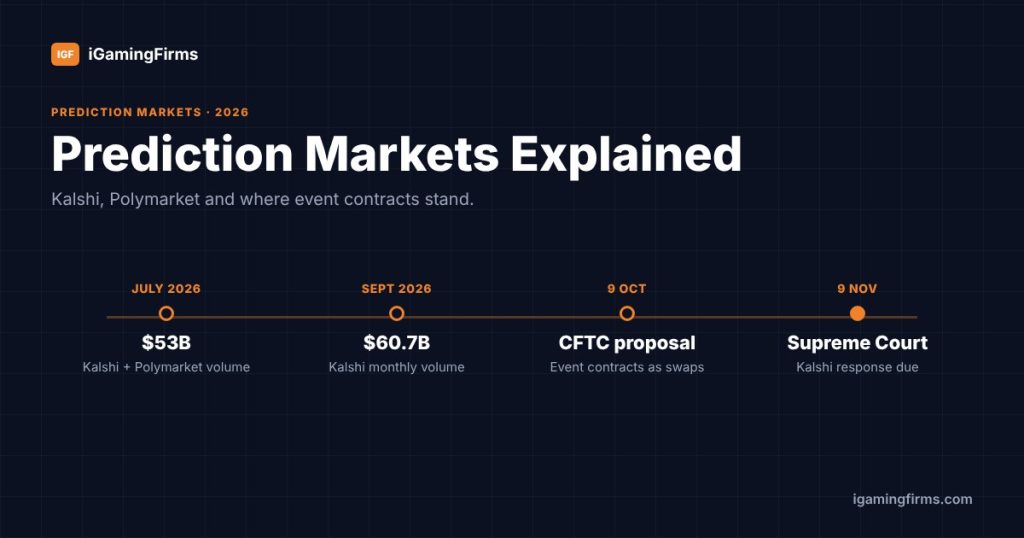
That definition is the easy part. The harder questions for anyone in the gambling business are who regulates these markets, how they differ from a sportsbook, and whether they are legal where your customers live. In October 2026 the honest answer to the last one is “it depends on which federal appeals court covers the state”. Kalshi and Polymarket cleared about $53 billion of combined volume in July 2026 alone, up from $0.8 billion two years earlier, and most of the growth came from sports.
This guide is written for operators, affiliates and SEO teams, not traders. It explains how event contracts work, where the category came from, who the venues are, how prediction markets differ from sports betting, where they are legal in the US and abroad, how accurate they are, what the main criticisms are, and what all of it means for your business.
What is a prediction market, in plain terms?
Each market asks one question with a clear deadline and a named source for the answer. “Will the Fed cut rates at its December meeting?” “Will Team A win on Sunday?” Traders buy “Yes” or “No” contracts from each other. When the event resolves, the winning side’s contracts pay $1 each and the losing side’s pay $0.
The US regulator, the Commodity Futures Trading Commission, describes these products as event contracts, typically structured as swaps, whose value comes from the outcome of an event. Its guide to prediction markets and event contracts notes that most are yes or no contracts with a fixed payout, usually $1, while some use ranges or multiple outcomes with partial payouts.
Three features separate a prediction market from a bookmaker:
- Peer to peer. You trade against other users, not against the house. The venue does not care which side wins.
- Price as probability. A contract at 65 cents implies roughly a 65% chance, before fees and spread.
- Exit before the end. You can sell a position at the current price at any time before settlement, which a fixed-odds bet only allows through a cash-out offer set by the book.
How do prediction markets work?
Binary contracts priced from 0 to 1 dollar
Every binary market has two sides that always add up to $1 at settlement. If “Yes” trades at 40 cents, “No” should trade near 60 cents. A buyer of “Yes” at 40 cents risks 40 cents to win 60 cents. A buyer of “No” at 60 cents risks 60 cents to win 40 cents.
Contracts are bought in quantity: 100 contracts at 40 cents costs $40 and pays $100 if correct.
Order books and market makers
Kalshi, Polymarket and the other regulated venues run a central limit order book, the same structure a stock or futures exchange uses. Buyers post bids, sellers post asks, and a trade happens when they cross. Thin markets are filled by market makers, professional firms that quote both sides and earn the spread between them. Polymarket pays makers rebates funded by taker fees, which is one way venues attract them.
Polymarket’s international platform uses a hybrid design: orders are matched off-chain, then settled on the Polygon blockchain. Users hold USDC, a dollar stablecoin, in their own wallets, and positions are tokens that redeem for $1 of USDC when the market resolves.
How does a prediction market make money?
The venue earns a trading fee rather than a bookmaker’s margin. Kalshi’s published fee schedule sets the taker fee at 0.07 × contracts × price × (1 − price), rounded up to the next cent. The formula peaks at a 50 cent price and shrinks toward 0 and $1.
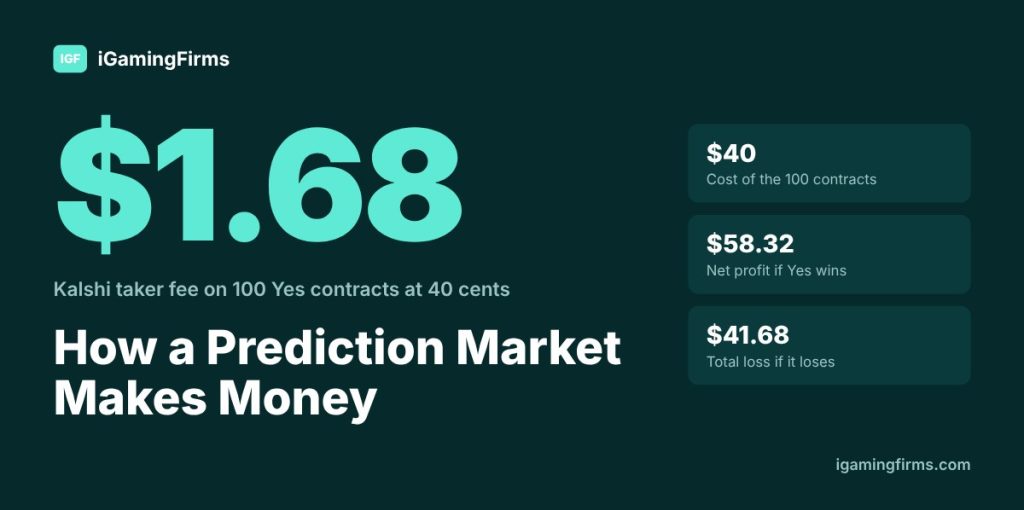
Worked example, using that formula: buying 100 “Yes” contracts at 40 cents costs $40 plus a fee of 0.07 × 100 × 0.40 × 0.60 = $1.68. If “Yes” wins, the position pays $100, for a net profit of $58.32. If it loses, you lose $41.68. Polymarket has used the same shape of formula with category rates from 0% (geopolitics) to 7% (crypto) since early 2026, which is why pages saying “Polymarket has no fees” are out of date.
How do prediction market payouts work?
Settlement depends on who decides the result.
- Regulated US venues (Kalshi, Polymarket US, Crypto.com, the sportsbook-owned products) resolve markets under written contract rules filed with the CFTC. The exchange checks the named source, settles winning contracts at $1, and pays dollars through its clearinghouse.
- Polymarket international uses the UMA optimistic oracle. A proposer posts the result, there is a two-hour challenge window, and disputes go to a vote of UMA token holders.
Either way, the payout is fixed at $1 per winning contract. The only variable is what you paid to get in.
The CFTC structure: DCMs and DCOs
In the US, a legal real-money prediction market needs two federal registrations. A designated contract market (DCM) is the exchange that lists contracts and polices trading for fraud, manipulation and insider trading. A derivatives clearing organization (DCO) holds customer funds and guarantees settlement. Kalshi holds both (KalshiEX LLC as the DCM since November 2020, Kalshi Klear as the DCO since August 2024). Polymarket bought both for its US business when it acquired QCX LLC and QC Clearing LLC for a reported $112 million in July 2025.
A broker such as Robinhood or Webull sits on top as a futures commission merchant, routing customer orders to the exchange. That layering matters for operators: the exchange carries the regulatory licence, the broker carries the customer relationship, and lawsuits and state cease and desist letters often name both.
A short history of prediction markets
Event contracts are not new. What changed after 2020 is that they became federally licensed consumer products.
- 1988: Iowa Electronic Markets. The University of Iowa’s research market began trading US presidential vote shares. It runs today under CFTC staff no-action letters from 1992 and 1993, which cap each trader at $500 per market.
- 1999 to 2013: Intrade. The Irish-based exchange became the best-known political market of the 2000s. The CFTC sued it in November 2012 for offering off-exchange options to US customers, Intrade closed US accounts in December 2012, and it suspended all trading in March 2013 citing possible financial irregularities.
- 2014: PredictIt. The CFTC granted no-action relief to Victoria University of Wellington in October 2014 to run an academic political market with an $850 cap per contract. The CFTC withdrew that letter in August 2022. PredictIt sued, won an injunction from the Fifth Circuit in January 2023, and in July 2025 reached an arrangement that raised its cap to $3,500. In September 2025 it was approved to run a regulated derivatives exchange.
- 2020: Kalshi and Polymarket. Kalshi became a CFTC-designated exchange in November 2020. Polymarket launched in June 2020 as a crypto market, paid a $1.4 million penalty in a January 2022 CFTC order for running an unregistered facility, and blocked US users.
- 2024: the election case. A federal judge in Washington ruled for Kalshi against the CFTC in September 2024, allowing contracts on which party controls Congress. The CFTC dropped its appeal in May 2025. The 2024 election pushed combined volume to $4.7 billion in November 2024.
- 2025: sports. Kalshi launched sports event contracts in January 2025, which is when states started suing. Robinhood opened a prediction markets hub in March 2025, Polymarket bought its way back into the US in July 2025, and DraftKings and FanDuel launched their own products by the end of the year.
- 2026: the courts. Federal appeals courts split on whether states can treat sports contracts as gambling, and the question is now in front of the Supreme Court. Details are in the legality section below.
What are the biggest prediction markets?
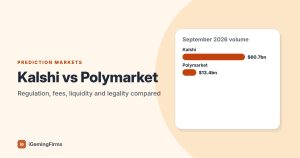
Kalshi is the largest by a wide margin. It traded $60.7 billion of notional volume in September 2026, about 78% of the total across seven venues tracked by DeFi Rate, against $8.8 billion for Polymarket US and $4.6 billion for Polymarket’s international platform. Volume is notional, not revenue: a $1 contract bought at 5 cents counts as more volume than cash.
| Venue | Licence and structure | Settles in | Main markets | Status, October 2026 |
|---|---|---|---|---|
| Kalshi | CFTC DCM (2020) and DCO (2024) | US dollars | Sports (about 75% of volume in May 2026, per Arkham), economics, politics, weather | Largest US venue; defendant in the most state actions |
| Polymarket (international) | No US licence; Panama-registered entity | USDC on Polygon | Global politics, geopolitics, crypto, culture | Closed to US users since 2022; blocked in several countries |
| Polymarket US | CFTC DCM and DCO (QCX, bought 2025) | US dollars | Sports first, broadening | Relaunched December 2025; enjoined in Nevada, sued in New York, on Ohio’s cease and desist list |
| PredictIt | Approved as a regulated exchange, September 2025 | US dollars | US politics | $3,500 cap per contract |
| Crypto.com | CFTC-registered derivatives exchange | US dollars | Sports, economics, crypto | Powers Underdog’s product; co-defendant in Nevada |
| Robinhood | Broker routing to Kalshi and ForecastEx | US dollars | Sports, economics, culture | $156 million event contract revenue in Q2 2026 |
| DraftKings Predictions | Own DCM via the Railbird Exchange purchase (October 2025) | US dollars | Sports | Offered mainly in states without legal online sports betting |
| FanDuel Predicts | Built with CME Group | US dollars | Sports, financial contracts | Sports contracts in 18 states as of January 2026 |
| Underdog | Through Crypto.com’s exchange | US dollars | Sports | Launched September 2025 in 16 states |
| Novig and ProphetX | CFTC DCM designations, June 2026 | US dollars | Sports | New sports-first exchanges; both on Ohio’s cease and desist list |
| Manifold and Metaculus | No licence needed | Play money or reputation | Forecasting questions | Research and forecasting only, no cash payouts |
Sporttrade, often listed alongside these names, is a different model: a sports betting exchange licensed state by state rather than a CFTC venue. Betfair in the UK is the same idea, licensed by the Gambling Commission.
What are prediction markets on Robinhood?
Robinhood does not run its own exchange for these products (it is reported to be building one). Since March 2025 its Prediction Markets Hub has let customers trade event contracts listed on Kalshi and ForecastEx through a Robinhood Derivatives account. The contracts and the settlement rules belong to the exchange; Robinhood earns a per-contract fee. Robinhood accounted for about 16% of Kalshi’s June 2026 volume, which shows how much of the category’s growth runs through brokerage apps rather than standalone sites. Brokers carry their own legal exposure: Robinhood Derivatives is one of the ten firms Ohio ordered to stop offering sports contracts in October 2026.
How big is the prediction market industry?
The Pew Research Center’s analysis of The Block data, published on 23 September 2026, puts combined Kalshi and Polymarket monthly volume at $0.8 billion in July 2024, $4.7 billion in November 2024, $12.0 billion in December 2025 and $53.0 billion in July 2026. Valuations have followed: Kalshi closed a $1 billion round at $22 billion in May 2026 and was reported by Reuters on 30 September 2026 to be in advanced talks to raise about $1 billion at a $40 billion valuation, while Polymarket was reported at $21 billion in August 2026.
Some ranking pages still quote “more than $24 billion a month” or older totals. Use dated figures and say which venues they cover.
Prediction market vs sports betting: what is the difference?
On a single NFL game the customer experience can look almost identical. The structure underneath is not, and that structure is why the legal fight exists.
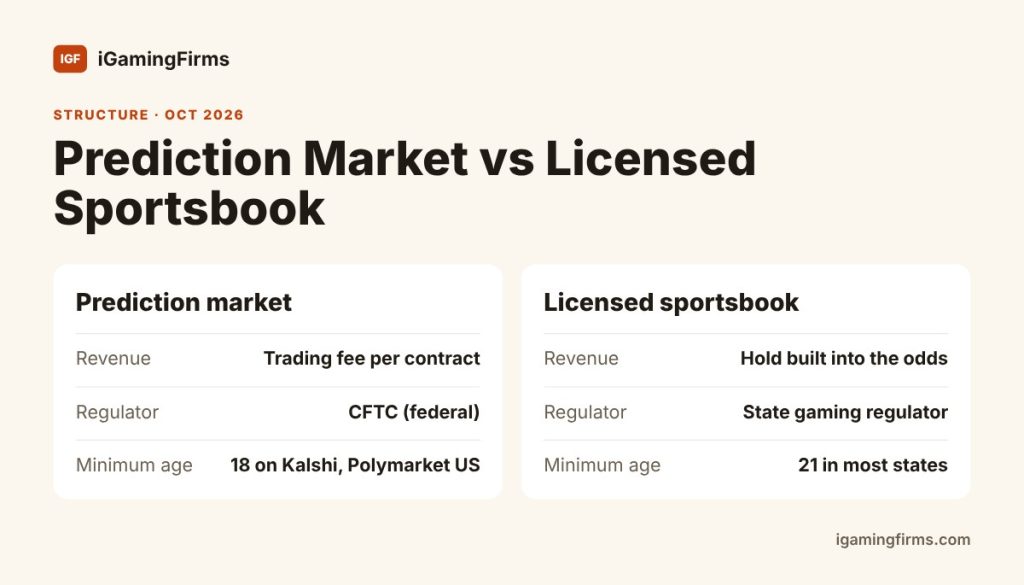
| Factor | Prediction market (CFTC exchange) | Licensed sportsbook |
|---|---|---|
| Counterparty | Other traders; the venue is neutral | The book takes the other side |
| Revenue model | Trading fee per contract | Hold built into the odds |
| Price setting | Order book, market makers | Trading team sets and moves the line |
| Exit before the event | Sell at market price any time | Cash-out only if the book offers it |
| Limits on winners | No house exposure, so no commercial reason to limit winners | Books can limit or close sharp accounts |
| Regulator | CFTC (federal); states contest it | State gaming regulator, state by state |
| Minimum age | 18 on Kalshi and Polymarket US | 21 in most states |
| State gaming tax | None in most states; Illinois added per-trade fees of 1.75% rising to 3.5%, now under court challenge | Tax on gross gaming revenue, from single digits to 51% in New York |
| Customer tax reporting | Form 1099-B on Kalshi; Section 1256 treatment arguable, with no IRS guidance (KPMG, 2026) | Gambling income; Form W-2G; from 2026 losses deductible only up to 90% of winnings |
| Market range | Sports plus economics, politics, weather, culture | Sports and approved events only |
Two points from that table matter most to operators. First, the exchange model has no hold risk, so a venue earns the same fee whichever team wins; our breakdown of whether sports betting is profitable shows why that is attractive next to a sportsbook’s volatile margin. Second, the state tax gap is large. A sportsbook in New York pays 51% of gross gaming revenue to the state; a CFTC venue serving the same customer pays no New York gaming tax at all. That gap is a big part of why states are suing. The age gap is the other: compare the 18 threshold with the legal gambling age in each state.
Is a prediction market the same as a betting exchange?
Mechanically, close. A betting exchange such as Betfair also matches backers and layers and charges a commission. The difference is the licence. A betting exchange is licensed as gambling by a gaming regulator. A US prediction market is licensed as a derivatives exchange by the CFTC and argues that state gambling law does not apply to it. Whether that argument holds is now the central legal question in US gambling.
Are prediction markets legal?
At the federal level in the US, yes, on CFTC-registered exchanges. Whether states can still treat their sports contracts as illegal gambling is unresolved in October 2026: one federal appeals court says no, two say yes, and the Supreme Court has been asked to decide. Claims that these platforms are “legal in all 50 states” are not accurate for sports contracts; several states have court orders, enforcement letters or pending suits in play.
The federal position
The CFTC says event contracts listed on a DCM are swaps under its exclusive jurisdiction, so state gambling laws are pre-empted. It has sued several states, including Arizona, Connecticut and Illinois in April 2026, plus New York and Minnesota, to block enforcement. On 12 June 2026 it proposed rules that would replace categorical bans with a contract-by-contract public interest review, and on 28 September 2026 it sent two rules to the White House for review.
On 9 October 2026 it acted on them. A proposed rule would write event contracts, including those on sports, politics, culture and weather, expressly into the definition of “swap”, with a 30-day comment period. An interim final rule, effective on publication, excludes casino-style gambling, including sportsbook wagers and casino games, from that definition. Chairman Michael Selig said casino-style gambling products “are not derivatives”. The proposal is not final, and courts, not the CFTC, will decide whether a state can enforce its own law; the Ninth Circuit has already said proposed changes carry no legal effect until adopted.
Are prediction markets regulated in the US?
Yes, by the CFTC, which supervises DCMs and DCOs, approves their rulebooks and polices manipulation and insider trading. What they do not have is a state gaming licence, state-level responsible gambling rules or, outside Illinois, a state charge on trades. Polymarket’s international platform is not regulated in the US at all. For the wider state-by-state picture on sportsbooks, casinos and sweepstakes, see our guide to US gambling laws by state.
The legality map, October 2026
| Jurisdiction | Status | Key date |
|---|---|---|
| US federal (CFTC) | Legal on registered DCMs; interim rule excluding casino-style gambling from “swap” in effect; rule defining event contracts as swaps proposed, not final | Proposal 12 June 2026; both new rules issued 9 October 2026 |
| Third Circuit (New Jersey, Pennsylvania, Delaware) | Sports contracts are swaps; New Jersey cannot enforce its betting law against Kalshi | 6 April 2026; New Jersey’s Supreme Court petition (No. 26-299) filed 2 September 2026 |
| Ninth Circuit (includes Nevada, California, Arizona, Washington) | Sports contracts likely not swaps; Nevada may enforce; tribes likely to win IGRA claims on their lands; Kalshi’s rehearing petition pending | 28 August and 16 September 2026 |
| Sixth Circuit (Ohio, Tennessee, Michigan, Kentucky) | States may regulate sports contracts as gambling; Kalshi petitioned for rehearing on 9 October | 25 September 2026; Ohio cease and desist letters to ten platforms and brokers, 16 October 2026 deadline |
| Fourth Circuit (Maryland) | Kalshi’s appeal against Maryland argued, no ruling yet | Argued May 2026 |
| Illinois | Federal judge granted a partial preliminary injunction: the state cannot apply its sports wagering licensing and criminal rules to Kalshi’s championship-winner contracts; challenge to the state’s prediction market trade fees still being briefed | 2 October 2026 |
| New York | Attorney General suing Kalshi and Polymarket US as unlicensed gambling; CFTC suing New York; Second Circuit appeal pending | 31 July and 24 September 2026 |
| Minnesota | Statutory ban on operating or promoting a prediction market blocked by a federal preliminary injunction before it took effect, in suits by the US and CFTC, Kalshi and Polymarket US | Injunction 27 July 2026; ban was due 1 August 2026 |
| Michigan | State-court preliminary injunction against Kalshi; Robinhood agreed to close Michigan sports positions | 1 September 2026 |
| Massachusetts and Washington | State enforcement actions against Kalshi’s sports contracts; Massachusetts question pending before the state’s Supreme Judicial Court | 2026, ongoing |
| Supreme Court | Petitions from New Jersey, Robinhood and Crypto.com’s US exchange pending, review not yet granted; 39 states plus DC, the NFL, the American Gaming Association and 145 tribes filed in support of New Jersey | Amicus briefs 7 and 8 October 2026; Kalshi’s response due 9 November 2026 |
| United Kingdom | FCA confirmed it is engaging with operators but treats the financial products it has seen as binary options under its retail ban; sports and political markets fall to the Gambling Commission and may need a betting licence | FCA annual public meeting, 6 October 2026 |
| European Union | No EU-wide regime; regulators in France, Italy, Spain, Portugal and Denmark, among others, have treated Polymarket as unlicensed gambling | 2024 to 2026 |
| Canada | Polymarket barred from Ontario under a settlement with the Ontario Securities Commission; it geoblocked Alberta, British Columbia and Quebec | Terms updated 6 July 2026 |
| Australia | ACMA ordered internet providers to block Polymarket under the Interactive Gambling Act | August 2025 |
What states are suing prediction markets?
Most of the action targets sports contracts. States with lawsuits, injunctions, cease and desist orders or enforcement in play in 2026 include New Jersey, Nevada, Ohio, Tennessee, Massachusetts, Washington, New York, Minnesota, Michigan, Kentucky, Arizona, Illinois, Maryland, Connecticut, Wisconsin, Iowa, Utah and Missouri, plus tribal suits in California. Not every action has gone the states’ way: Arizona’s criminal case against Kalshi was dismissed on pre-emption grounds in May 2026, and Minnesota’s ban was enjoined before it started. CNBC counted 16 states in legal proceedings in May 2026; the number has grown since.
Ohio shows how enforcement now works after an appeals court win. On 5 October 2026 its Casino Control Commission sent cease and desist letters to Coinbase, Gemini Titan, Moomoo, Novig, Plus500US, Polymarket, ProphetX, Robinhood Derivatives, Underdog Predict and Webull, with a 16 October deadline to confirm they had stopped serving Ohio customers. Kalshi was not on the list because it is already in litigation with the state.
The likely end point is the Supreme Court docket in Flaherty v. KalshiEX (No. 26-299). The fastest realistic path, according to gaming lawyer Daniel Wallach as reported by Covers on 7 October 2026, is a grant of review in December 2026 or January 2027 and a decision by June 2027. If the Court does not take the case early in 2027, a ruling probably slips to 2028.
Are prediction markets gambling?
Under federal law as the CFTC reads it, no: they are swaps, and its October 2026 interim rule draws the line at casino-style products and sportsbook wagers. Under the Sixth and Ninth Circuits’ reasoning, sports event contracts are gambling in substance whatever they are called. The Ninth Circuit put it bluntly in September 2026: the substance of Kalshi’s sports contracts “is sports gambling, regardless of whether Kalshi calls them swaps”. Even the Illinois judge who sided with Kalshi described the contracts as bets while finding them likely to be swaps. Until the Supreme Court rules, the safe working assumption for a business is that any state with an active suit, injunction, enforcement letter or statute treats them as gambling.
Are prediction markets correct?
On big, liquid questions, they have a good record, and the evidence is stronger for elections than for anything else. On small, niche markets, they are much less reliable.
- Long-run election evidence. A study by Berg, Nelson and Rietz in the International Journal of Forecasting (2008) compared the Iowa Electronic Markets with 964 national polls across five presidential elections from 1988 to 2004. The market was closer to the final result 74% of the time, and outperformed polls in every election when forecasting more than 100 days out.
- The 2024 election. A Vanderbilt preprint by Josh Clinton and TzuFeng Huang examined more than 2,500 political markets on four venues in the final five weeks of the 2024 campaign. The share of markets that predicted better than chance was 93% on PredictIt, 78% on Kalshi and 67% on Polymarket. Niche markets were the weakest, and Harris and Trump prices failed to sum to $1 on 62 of the 65 days before the election, which points to inefficiency rather than a perfect crowd.
- Venue self-reporting. Polymarket’s accuracy page says the leading outcome matched the result in 90.2% of resolved markets one month before resolution and 98.6% four hours before, with a Brier score of 0.0627. These are the venue’s own figures, without a published market count or date range.
Note what the Vanderbilt figures measure. They are not “accuracy rates” in the everyday sense, which is how some summaries present them. They are the share of markets that beat a coin flip.
Are prediction markets always right?
No. Prices are probabilities, so a 70% favourite should lose about three times in ten. Markets also suffer from thin liquidity, where one large order moves the price, and from long-shot bias, where cheap contracts trade above their true odds. The forecasting value is real for headline events and weak for obscure ones.
What are the main criticisms of prediction markets?
Insider trading
Insider trading is the criticism that has produced actual cases. In April 2026 the US Department of Justice unsealed an indictment, and the CFTC filed a civil complaint, against an active-duty US Army service member accused of trading Polymarket contracts on Nicolás Maduro using classified information, for alleged profits of more than $400,000. These are allegations, not findings. The same month, Kalshi published disciplinary notices against three political candidates who traded on their own races, with five-year suspensions and fines. Polymarket announced a partnership with Chainalysis to detect insider trading on 30 April 2026.
Manipulation and wash trading
A 2025 Columbia University study found wash-trading patterns in roughly a quarter of Polymarket’s historical volume, without alleging wrongdoing by the platform. Thin markets can be pushed around cheaply, and sports leagues now want visibility: on 9 October 2026 the NBA commissioner said the league wants access to prediction market data to detect manipulation, as CNBC reported.
Resolution risk: the Khamenei market
Kalshi’s market on whether Ali Khamenei would be out as Iran’s Supreme Leader drew more than $50 million in volume. When reports of his death emerged on 28 February 2026, Kalshi halted the market and applied a contract clause that stops markets settling “Yes” on a person’s death. It settled at the last traded price before the news and reimbursed fees and net losses. “Yes” holders expected $1. A proposed class action followed in March 2026. Polymarket resolved a similar market to “Yes”. For operators, it is a clear example of resolution risk: the contract rules, not the headline, decide the payout.
Gambling harm and age
Kalshi and Polymarket US accept customers at 18, against 21 for regulated sportsbooks in most states. Analyses reported by CNN and the American Gaming Association in 2026 put trading by 18 to 20 year olds above $5 billion for the year, mostly on sports. Prediction markets also sit outside state self-exclusion programmes and responsible gambling rules. Every state complaint so far cites these points.
What prediction markets mean for operators and affiliates
Cannibalisation: small so far, concentrated where you are not licensed
In their August 2026 earnings calls, DraftKings reported “no discernible impact” on its sportsbook and about 1% customer overlap with the largest prediction market operator in legal states, and Flutter said FanDuel saw a “low single-digit” impact. Citizens analyst Jordan Bender has estimated about 5% cannibalisation across the industry. The real shift is in states without legal online sports betting, such as California and Texas, where no licensed sportsbook can operate and prediction markets face no local competitor. The NFL told the Supreme Court that $1.8 billion of the $3.3 billion traded on prediction markets on the first Sunday of the 2026 season was on football.
Partnerships and licensing
The large operators have already chosen to join rather than fight: DraftKings bought a DCM, FanDuel partnered with CME, Underdog partnered with Crypto.com. Tribes are split, with some suing Kalshi and others launching apps on its exchange in October 2026. Illinois created per-trade fees on prediction market sports contracts, which is the template other states may copy if the federal side wins and the fees survive court review. If the states win, expect sportsbook-style licensing instead. For where the venues sit against listed groups by size, see our ranking of the largest gambling companies.
Affiliate programmes
Polymarket’s documented referral programme, terms updated 28 May 2026, pays 10% of net trading fees from direct referrals and 5% from indirect ones, but it belongs to the international, crypto-settled platform that cannot take US traffic. Kalshi has advertised an affiliate partnerships role, and large sports media groups run Kalshi promo pages, but neither venue publishes US commission terms.
Before you send a click: geofence by state, check which legal entity you are promoting, drop claims such as “legal in all 50 states”, and keep sports creative away from 18 to 20 year olds. Minnesota’s statute criminalises promotion, not only operation, and could bite if its injunction is lifted. Our guide to how iGaming affiliate marketing works covers the commission models these programmes borrow from.
Supplier opportunities
Every CFTC venue needs the same stack a sportsbook buys: KYC and age checks, geolocation precise enough for parcel-level tribal carve-outs and state-by-state cease and desist orders, payments, trade surveillance, and official sports data. Odds and data suppliers are moving fastest. Genius Sports launched Prediction.com in September 2026 to compare equivalent contracts across venues, and the odds API comparison covers the data feeds that venues, market makers and sportsbooks all depend on.
SEO opportunities
Most explainers ranking for prediction market queries in October 2026 are retail trader guides, broker and exchange explainers, affiliate hubs and policy primers. Few cover the circuit split, the October 2026 CFTC rules, the international position, tax or the operator angle, and generic summaries still describe nationwide legality. Content that carries dated court outcomes, correct fee formulas and named sources has a clear freshness edge. Date-stamp every figure, because this topic changes weekly; our monthly regulation roundup tracks the rulings as they land.
What to watch next
Four events will move this market before the end of the year: whether the ten platforms on Ohio’s list confirm they have left the state by the 16 October 2026 deadline, the comment period on the CFTC’s proposed swap definition, Kalshi’s rehearing petitions in the Sixth and Ninth Circuits, and Kalshi’s 9 November 2026 response to New Jersey’s Supreme Court petition.