This iGaming regulation news roundup covers every change from the past six weeks that moves money or compliance work for operators, affiliates and suppliers: what happened, what it means in practice, and the dates to put on your calendar.
iGaming regulation news: what changed this month?
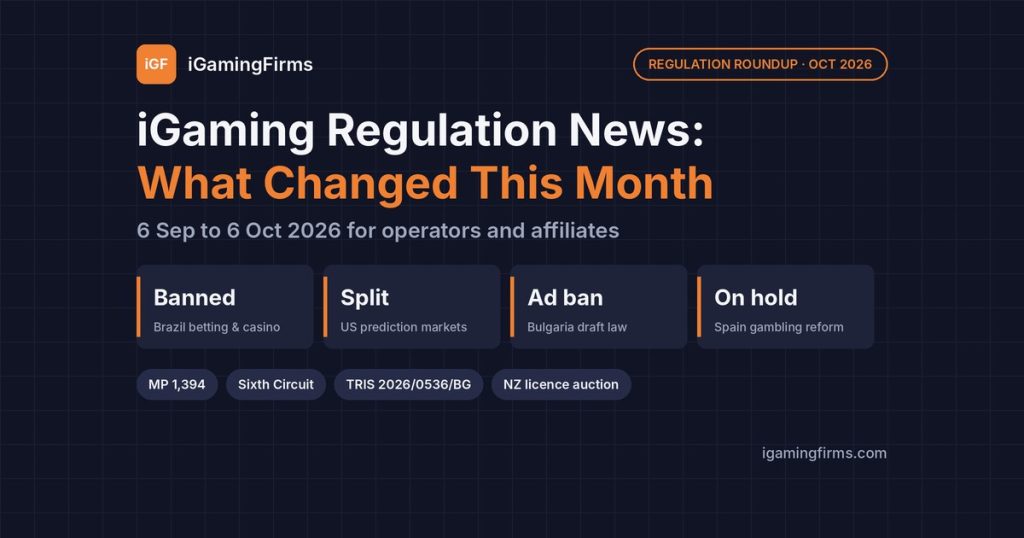
Brazil dominates. Provisional Measure 1,394/2026 banned fixed-odds betting and online gaming nationwide, licensed sites went dark on 6 October, the government is suing 17 operators for R$3.6 billion, and a court reprieve for Stake was reversed within days. In the US, the CFTC proposed on 9 October to define sports event contracts as swaps, a federal judge blocked parts of Illinois’ prediction-market law, and Ohio ordered 10 platforms to stop offering sports contracts by 16 October.
In Europe, Bulgaria is consulting on a full ad ban, Denmark tabled its marketing reform bill, Spain’s Gambling Act overhaul stalled ahead of a snap election, and UK licence fees rose 25% on 1 October. New Zealand named the 11 bidders that can now apply for online casino licences.
Here is the period at a glance.
| Market | What changed | Who it hits hardest | Status (15 October) |
|---|---|---|---|
| Brazil | Fixed-odds betting and online gaming banned by MP 1,394/2026; AGU lawsuit against 17 operators | Licensed operators, affiliates, suppliers | In force; three STF challenges pending; Stake injunction suspended |
| United States (federal) | CFTC proposes defining event contracts as swaps (9 October) | Prediction markets, state-licensed sportsbooks | 30-day comment period after Federal Register publication |
| United States (courts) | Sixth Circuit rules for Ohio and Tennessee; Illinois law partly enjoined; 39 states plus DC back Supreme Court review | Sportsbooks, prediction markets, affiliates | Circuit split; Kalshi’s cert response due 9 November |
| Ohio, Michigan | Ohio cease-and-desist letters to 10 prediction platforms; Michigan letters to 33 offshore sites | Prediction markets, offshore and sweepstakes operators | Ohio compliance deadline 16 October |
| Bulgaria | Full ad ban, online fee rising to 22%, affiliate licences ending | Online operators, affiliates | Consultation open to 23 October |
| Denmark | Bill L37: whistle-to-whistle ad ban, rules for affiliates and influencers | Operators, affiliates, influencers | First reading 22 October; phased in during 2027 |
| Spain | Snap election puts Gambling Act reform on hold | Operators planning 2027 marketing | Deposit limits decree still applies from 25 March 2027 |
| UK | Licence fees up 25%; new Category B machine standards; Lords ad-ban debate | All licensees, land-based operators | Fees in force since 1 October |
| New Zealand | 11 entities win the right to apply for online casino licences | Offshore operators serving NZ | Non-applicants must exit by 1 December |
| Curaçao | Hacked licensing portal closed for good | Curaçao licensees and applicants | Interim arrangements; filing deadlines postponed |
Brazil: the betting ban, the lawsuits and the court fight
Brazil was supposed to be the regulated success story of the decade. The market opened in January 2025 under Law 14,790/2023, operators paid R$30 million each for licences, and the sector was generating billions of reais in tax. Then, just over a week before the first round of the presidential election, it was switched off.
What does MP 1,394/2026 actually do?
The text of MP 1,394/2026, announced on 25 September, prohibits the operation, offering, intermediation and advertising of fixed-odds betting, covering both sports events and online gaming events. Sportsbooks and online casino products are both caught, and the ban applies to foreign operators serving Brazilian users, not just local licensees.
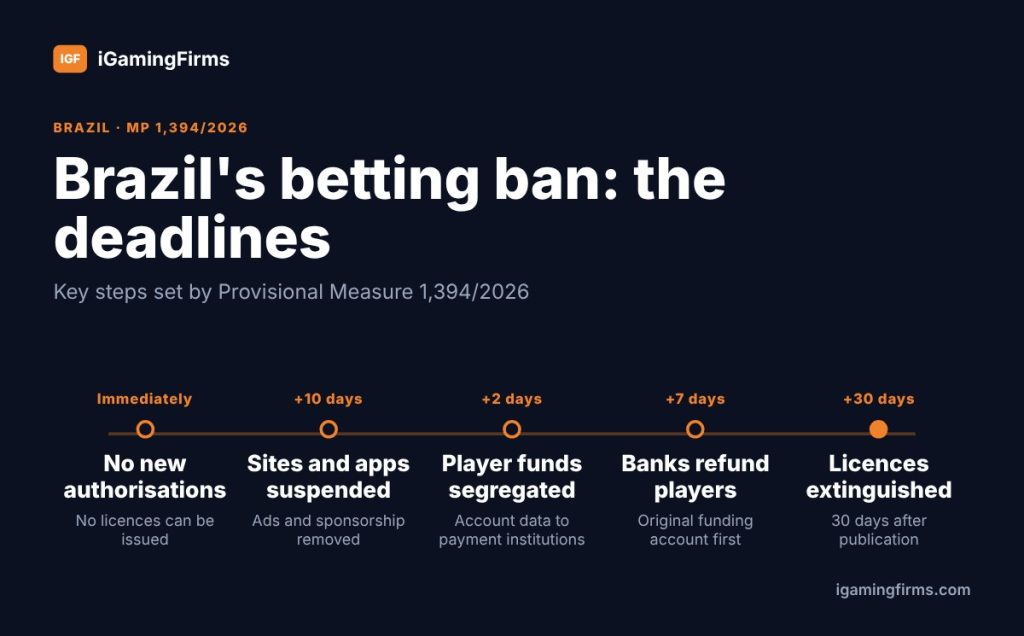
The key deadlines in the measure are:
- Immediately: no new authorisations can be issued.
- 10 days after publication: websites and apps must be suspended, and advertising and sponsorship material removed.
- 2 days after suspension: operators must segregate player funds and send account data to payment institutions.
- 7 days after receiving that data: banks refund players, prioritising the original funding account.
- 30 days after publication: existing licences are extinguished.
Banks and payment institutions are barred from processing betting transactions except for wind-down and refund operations. Open bets that were not settled by the suspension deadline are void and refunded in full.
What happened when the sites went dark?
The player withdrawal window closed at 23:59 on 5 October. Brazilian outlets reported that players had pulled about R$775.6 million since the suspension began, leaving roughly R$1.33 billion still in accounts for the bank refund process. On 6 October, the largest licensees, including Betano, Superbet, Sportingbet and EstrelaBet, took their Brazilian sites offline and redirected traffic to the government’s information portal.
The fallout landed fast. An ANJL survey released on 7 October counted more than 3,500 dismissals and contract terminations since 25 September and projected 5,600 cuts within 90 days. The Attorney General’s Office (AGU) says it blocked 10,435 illegal websites in the first week of the ban.
The AGU lawsuit against 17 operators
The AGU has also sued 17 licensed operators in the Federal Court of Pernambuco, seeking R$2.6 billion for costs to the public health system (SUS) and R$1 billion in collective moral damages. Defendants include the Brazilian entities behind Betano, bet365, Superbet, Sportingbet, Betfair, Novibet, Pixbet, KTO, Blaze and EstrelaBet. The claim covers the five years before the suit, so it reaches back before the regulated market opened.
Stake’s injunction: granted, then suspended
Stake won a federal injunction from the 9th Federal Civil Court of São Paulo allowing it to keep offering fixed-odds betting until 25 October. It lasted days. At the AGU’s request, the president of the Federal Regional Court of the 3rd Region (TRF-3) suspended it, citing regulatory inequality, legal certainty and the risk of copycat rulings. Stake is now under the same restrictions as every other operator, and the suspension stands until a final judgment or a further TRF-3 decision.
The lesson for other licensees: an operator-by-operator injunction route is unlikely to hold. The decisive fight is at the Supreme Court.
Can the ban be reversed?
Yes, and there are three routes.
- Congress. A provisional measure lapses unless Congress converts it into law within 60 days, extendable once by another 60, with the clock paused during the parliamentary recess. That means the ban can stay in force into early 2027 even if Congress never votes. The amendment deadline was extended to 13 October, and the joint committee had not yet named a rapporteur.
- The Supreme Court (STF). Three direct unconstitutionality actions (ADIs 8024, 8027 and 8028), including one from trade bodies ANJL and IBJR, ask for the measure to be suspended. Justice Luiz Fux is the rapporteur. The AGU has asked him to keep the ban, hear the Prosecutor General first and hold a new public hearing, which could push any ruling past the 25 October runoff. As a fallback, the industry has asked for authorised operators to keep running or for at least six months to wind down.
- The election. Flávio Bolsonaro led the 4 October first round with 47.03% of valid votes to Lula’s 45.16%, and the runoff is on 25 October. Public opinion cuts the other way: a poll reported by Gambling.com found 62% of Brazilians back the ban, so any reopening will be politically contested.
What this means for you
- Operators: treat Brazil as closed until at least the runoff and the first STF decision. Keep licence documentation, player fund records and refund logs complete, because a reopened market will scrutinise how you handled the wind-down. If you are named in the AGU lawsuit, budget for the defence now.
- Affiliates: the measure bans all advertising and sponsorship of fixed-odds betting, with no carve-out for affiliate content. Pull Brazilian-facing betting promotions, comparison pages and tracking links, and get local legal advice before you keep any archived content live.
- Suppliers: B2B revenue tied to Brazilian brands has stopped. If your platform, payments or KYC contracts are Brazil-heavy, review termination and suspension clauses. Our guide to iGaming payment solutions and rails covers how payment flows are typically structured if you need to restructure them.
Prediction markets: the CFTC moves, the states push back
For US operators, the biggest legal question this year is whether CFTC-registered prediction markets such as Kalshi can offer sports event contracts in every state, including states where sports betting is illegal or tightly licensed. Our explainer on how prediction markets and event contracts work covers the mechanics; here is what changed this period.
The CFTC’s 9 October swap proposal
On 9 October, the CFTC published a notice of proposed rulemaking to define “swap” so that it expressly includes event contracts on sports, politics, culture and weather. Chairman Michael Selig called event contracts “commodity derivatives squarely within the CFTC’s regulatory remit.” Comments are due 30 days after the proposal appears in the Federal Register.
This matters because the state wins in court have turned on the finding that sports contracts are not swaps. If the definition is finalised, Kalshi and others will argue that state gambling laws are preempted. Kalshi has already cited the proposal in asking the Sixth Circuit to rehear its loss to Ohio and Tennessee.
It sits alongside the CFTC’s 267-page proposal from June, which would allow contracts settled on aggregate sports outcomes with objective data while prohibiting contracts on injuries, officiating, single discrete plays and pre-collegiate events.
The court scorecard
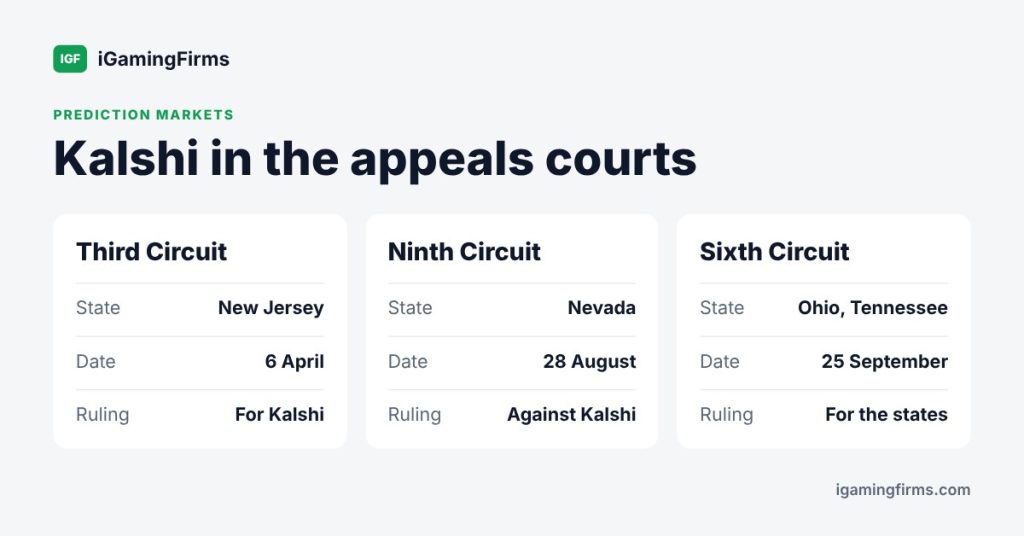
- Sixth Circuit (Ohio, Tennessee): on 25 September, the court ruled that Kalshi’s sports contracts are not swaps under the Commodity Exchange Act, so federal law does not stop the states enforcing their gambling laws (KalshiEX v. Schuler, No. 26-3196).
- Ninth Circuit (Nevada): ruled against Kalshi on 28 August.
- Third Circuit (New Jersey): ruled for Kalshi on 6 April. New Jersey’s petition (Flaherty v. KalshiEX, No. 26-299) asks the Supreme Court to decide. On 7 October, Ohio, 38 other states and the District of Columbia filed a brief urging the Court to take the case. Kalshi’s response is due 9 November.
- Illinois (district court): on 2 October, Judge Martha Pacold granted the CFTC, Kalshi and Coinbase preliminary injunctions against parts of Illinois’ budget law, which treated sports “exchange wagers” as state-regulated betting, required state licences and imposed a per-wager tax starting at 1.75%. She found the contracts are likely swaps, but said Illinois “may have a case” on some contracts. The parties must file a proposed injunction by 29 October, and a Seventh Circuit appeal is likely.
Ohio and Michigan step up enforcement
Relying on the Sixth Circuit ruling, Ohio Governor Mike DeWine and Ohio Casino Control Commission chair Thomas Stickrath sent cease-and-desist letters dated 2 October to 10 platforms: Polymarket, Novig, Underdog, Coinbase, ProphetX, Robinhood, Gemini Titan, Webull, Plus500 and Moomoo. The Commission treats their sports contracts as unlicensed bookmaking, a felony in Ohio, and set a 16 October compliance deadline, with possible penalties equal to the money taken in.
On 8 October, the Michigan Gaming Control Board sent cease-and-desist letters to 33 unlicensed operators offering casino-style games, sweepstakes-style games or sports betting to Michigan residents. Sweepstakes brands are squarely in scope; see our state-by-state sweepstakes casino legal map for where else the model is under pressure.
What this means for you
- State-licensed sportsbooks: the appellate trend still favours state authority, but the CFTC’s swap proposal and the Illinois injunction show the fight is far from settled. The Supreme Court can only decide whether to take the case after Kalshi responds on 9 November.
- Affiliates: promoting prediction-market sports contracts in Ohio, Tennessee or Nevada carries clear enforcement risk. Keep geo-targeting tight and review any Ohio-facing placements before 16 October.
- Prediction market partners and brokers: Ohio’s letters went to brokers such as Robinhood and Webull, not just exchanges. If you distribute event contracts, check your state exposure.
Europe: ad bans, reforms and enforcement
Bulgaria consults on a full gambling ad ban
A draft Gambling Act published for consultation on 23 September would ban gambling advertising regardless of type, method or place of distribution, with narrow exceptions for operators’ own websites and premises, limited venue signage and sponsorship of sports clubs, federations and leagues.
The same draft raises the online fee from 20% of stakes minus winnings to 21% from 1 January 2027 and 22% from 1 January 2028, with a minimum of €100,000 per month for online betting licences. It ends all existing affiliate licences on 1 January 2027 and requires foreign online licensees to operate through a registered Bulgarian place of business by 30 June 2027. Publishers of illegal gambling ads face fines of €10,000 to €20,000, or sanctions of €20,000 to €50,000 for companies. Consultation closes on 23 October, and the target start date is 1 January 2027.
If you are an affiliate with Bulgarian traffic, the affiliate licence deadline is the one to plan around. For operators, the €100,000 monthly floor makes small-volume Bulgarian licences hard to justify.
Denmark tables its marketing reform bill
On 7 October, Denmark’s tax minister submitted bill L37, replacing a version dropped after the March election. It would ban gambling ads from 10 minutes before to 10 minutes after live sports, ban ads on public transport and within 200 metres of schools and universities, apply the same rules to affiliates and influencers, and make marketing unlicensed gambling a crime. The first debate is scheduled for 22 October, with the rules phased in between January and October 2027 and the marketing rules from July 2027.
Spain’s reform on hold after a snap election
Spain holds a general election on 29 November, which pauses the planned overhaul of Law 13/2011 and may change its direction. Measures already enacted are unaffected. Cross-operator deposit limits under Royal Decree 520/2026, with defaults of €700 a day, €1,750 a week and €3,300 over four weeks, take effect on 25 March 2027, although trade body Jdigital has started legal proceedings against them.
The UK: fees, machines, ads and tax
- Licence fees. Gambling Commission fees rose 25% on 1 October, covering annual, application and maintenance fees, personal licences and single machine permits. Society lottery fees are frozen. Our UKGC licence guide covers the full fee structure.
- Category B gaming machines. On 30 September, the Commission confirmed new technical standards for new machines: easier access to gambling management tools, real-time display of time played and net position, celebratory effects only when a win exceeds the stake, and no turbo spin, quick spin or slam stop. A new session definition applies from 30 March 2027, most rules from 30 June 2027 and staff alerts from 3 October 2028. Existing machines are exempt.
- Advertising. A House of Lords Liaison Committee report called a comprehensive gambling ad ban “the most effective policy option” for reducing harm, and the industry publicly challenged its evidence in early October. The government will respond in due course; no ban is imminent. Separately, the consultation on banning sponsorship by unlicensed operators closed on 9 September, with a ban proposed from August 2027.
- Aim to permit. Gambling minister Vicky Foxcroft confirmed on 30 September that a consultation on the “aim to permit” licensing principle is coming, without giving a start date.
- Remote gaming duty. The rate rose from 21% to 40% in April 2026. HMRC receipts for July 2026 show nearly £590 million against £283 million a year earlier, a jump of more than 108%. General betting duty rises from 15% to 25% in 2027, so sportsbook margins are next.
The Netherlands: Meta in court, 711 called out
Dutch trade body VNLOK announced on 28 September that it had summoned Meta to an Amsterdam court, arguing Facebook and Instagram breach the EU Digital Services Act by failing to stop unlicensed gambling ads. VNLOK says more than 90% of the Facebook gambling ads it examined came from illegal sites, and Meta removed only 11% of flagged ads in May and 15% in June.
The regulator, the KSA, also publicly called out licensee 711 on 12 October over a rule requiring some players to wager deposits before withdrawing them. The KSA says such conditions are acceptable only when tied to a bonus, and this is its third public action on the practice. If your Dutch cashier has a similar rule, review it now.
Switzerland: Paf and Meta pilot licence checks
Paf announced on 6 October that it has agreed pilot terms with Meta to share licence documents and URLs so Meta can tell regulated operators and affiliates apart from illegal ones in Switzerland, with the aim of scaling the model to other markets. Affiliates running Meta campaigns should keep licence references for every brand they promote ready to hand.
Asia-Pacific, Latin America and the Caribbean
New Zealand’s online casino auction produces 11 applicants
New Zealand’s Department of Internal Affairs ran its auction for up to 15 online casino licences under the Online Casino Gambling Act 2026. It drew 32 bidders, ran 10 rounds and closed at NZ$15 million per licence. Eleven entities won the right to apply, including Betway (three rights), Entain (two), Rock Swift (two), SkyCity, Stake and TAB New Zealand.
Each must pay the licence price and submit a full application, and winning the auction does not guarantee a licence. Licences run for up to three years, with one renewal of up to five years, and no operator can control more than three. Providers that have not applied must stop offering online casino gambling in New Zealand by 1 December 2026, and online casino duty rises from 12% to 16% on 1 January 2027.
Peru: bill to raise the online betting excise to 5%
A bill in Peru’s Congress would raise the selective consumption tax (ISC) on online gaming and sports betting from 1% to 5% of each wager, on top of the existing 12% remote gaming tax. It has been introduced, not passed, but operators modelling Peru should stress-test margins against it.
Curaçao closes its hacked licensing portal
The Curaçao Gaming Authority confirmed in September that an unauthorised account had access to the customer-facing side of its licensing portal from December 2025 until September 2026. The portal was offline by 2 October, and a notice dated 7 October said it will not return. Existing licences remain valid, filing deadlines are postponed, and the CGA’s digital seal is affected while it builds an alternative way to show licence status.
If you hold or applied for a Curaçao licence, assume your application documents could be exposed, watch for phishing that impersonates the regulator, and be ready to evidence your licence another way. Our Curaçao gaming licence guide covers the licensing process and obligations.
What are the current US gambling laws operators should know?
Online gambling in the US is regulated state by state. Federal law sets the outer limits: the Wire Act covers interstate sports wagering, UIGEA targets payment processing for unlawful gambling, and the 2018 Murphy v. NCAA decision ended the federal sports betting ban. State gaming commissions issue the licences, which is exactly why the prediction-market cases matter so much. Our US gambling laws by state table shows where each vertical is legal.
Two federal tax changes from the One Big Beautiful Bill Act took effect in 2026 and keep coming up in searches about “the new gambling law”:
- W-2G threshold: the reporting threshold for slots, bingo and keno rose from $1,200 to $2,000 on 1 January 2026 and will be adjusted for inflation each year. Operators need systems that apply the new threshold and watch for states that do not follow the federal figure.
- 90% loss cap: from tax year 2026, players can deduct only 90% of gambling losses against winnings. A player who wins and loses $100,000 now has $10,000 of taxable income. This mainly hits high-volume players, which matters for VIP retention.
On the state front, Nebraska voters decide on online sports betting ballot measures on 3 November.
Key dates for the next 90 days
| Date | Market | What happens |
|---|---|---|
| 16 October 2026 | US (Ohio) | Compliance deadline for the 10 prediction platforms |
| 22 October 2026 | Denmark | First parliamentary debate on bill L37 |
| 23 October 2026 | Bulgaria | Consultation on ad ban and fees closes |
| 25 October 2026 | Brazil | Presidential runoff: Lula vs Flávio Bolsonaro |
| Late October 2026 | Brazil | Existing betting licences extinguished (30 days after publication) |
| 29 October 2026 | US (Illinois) | Proposed preliminary injunction due |
| 3 November 2026 | US (Nebraska) | Online sports betting ballot measures |
| 9 November 2026 | US (Supreme Court) | Kalshi’s response to New Jersey’s cert petition due |
| Mid-November 2026 (expected) | US (federal) | CFTC swap-definition comment period closes, 30 days after Federal Register publication |
| 29 November 2026 | Spain | General election |
| 1 December 2026 | New Zealand | Operators without a pending application must exit |
| 1 January 2027 | Bulgaria, New Zealand | Bulgarian affiliate licences end (if the draft passes); NZ duty rises to 16% |
How to use this roundup
A quick way to turn this into action is to sort each item into one of three buckets: stop (Brazil marketing and payments, Ohio-facing prediction-market promotion), prepare (Bulgaria, Denmark, New Zealand, UK machine standards and fees, Spain deposit limits) and monitor (the CFTC proposal, prediction-market litigation, Brazil’s Congress and STF, UK ad policy). Assign one owner per bucket, and review it again when the next edition lands.
If you want a fuller picture of how regulation affects acquisition, our iGaming SEO guide explains how affiliates and operators adapt content when ad rules tighten.