You want a licence that lets you launch quickly, serves a broad international footprint and doesn’t eat your seed budget. Curaçao has been that answer for twenty years, and most of the guides still ranking for it describe a system that no longer exists: master licence holders, sub-licences for a few thousand euros, 40 domains for one flat fee, a licence in two to three weeks.
The short answer: a Curaçao gaming licence for B2C operators costs a €4,592 application fee plus €47,450 a year in licence and supervisory fees (a B2B supplier licence costs €4,592 plus €24,490 a year). Plan for four to six months from incorporation to a definitive licence, a Curaçao company with a resident managing director, and real local substance from 1 April 2027.
Since 24 December 2024 the Landsverordening op de Kansspelen (LOK, the National Ordinance on Games of Chance) has been in force and the Curaçao Gaming Authority (CGA) issues every licence directly. This guide gives you the real fee schedule, what the CGA checks, a realistic timeline, a first-year cost model, and the deadlines still moving in late 2026, including the CGA’s decision in October 2026 to retire its hacked online portal.
Curaçao gaming licence at a glance (2026)
| Item | B2C (operator licence) | B2B (supplier licence) |
|---|---|---|
| Regulator | Curaçao Gaming Authority (CGA), formerly the Gaming Control Board | |
| Law | LOK, passed 17 December 2024, in force 24 December 2024 | |
| Application fee | €4,592, one-off, non-refundable | €4,592, one-off, non-refundable |
| Annual fees | €47,450 (€24,490 licence fee to the National Treasury plus €22,960 supervisory fee to the CGA) | €24,490 supervisory fee (no separate licence fee) |
| Due diligence fees | €150 per UBO or qualified interest holder; €2,551 per listed corporate UBO | |
| Minimum capital | No fixed figure; you must evidence enough liquidity to pay player winnings | |
| Review target | Two phases of about 8 weeks each, each extendable by up to 4 weeks | |
| Licence term | Indefinite while fees are paid and conditions met; provisional licence up to 6 months, extendable once | |
| Gaming tax | None on gaming revenue; normal Curaçao profit tax applies | |
| Who can apply | A company incorporated under Curaçao law with its seat in Curaçao and at least one resident managing director | |
| Filing channel | The CGA Online Gaming Portal was taken offline after a breach and retired on 7 October 2026; interim arrangements pending | |
Fee figures come from the CGA’s fee notice under the LOK, as reproduced by European Gaming in February 2025 and repeated unchanged by licensing advisers through September 2026. Fees are set by national decree and can change, so confirm the current schedule with the CGA before you budget. To see how these numbers sit against Malta, the UK and other hubs, use our gambling licence cost comparison across 15 jurisdictions.
What is a Curaçao gaming licence?
A Curaçao gaming licence is a direct authorisation from the CGA, under the LOK, to offer games of chance online from a Curaçao-incorporated company (B2C) or to supply critical gaming services to licensed operators (B2B). If you see older material talking about a “Gaming Control Board licence”, that’s the same authority under its previous name. The Gaming Control Board became the Curaçao Gaming Authority when the LOK took effect, with wider supervisory and enforcement powers and the role of AML/CFT supervisor for the sector.
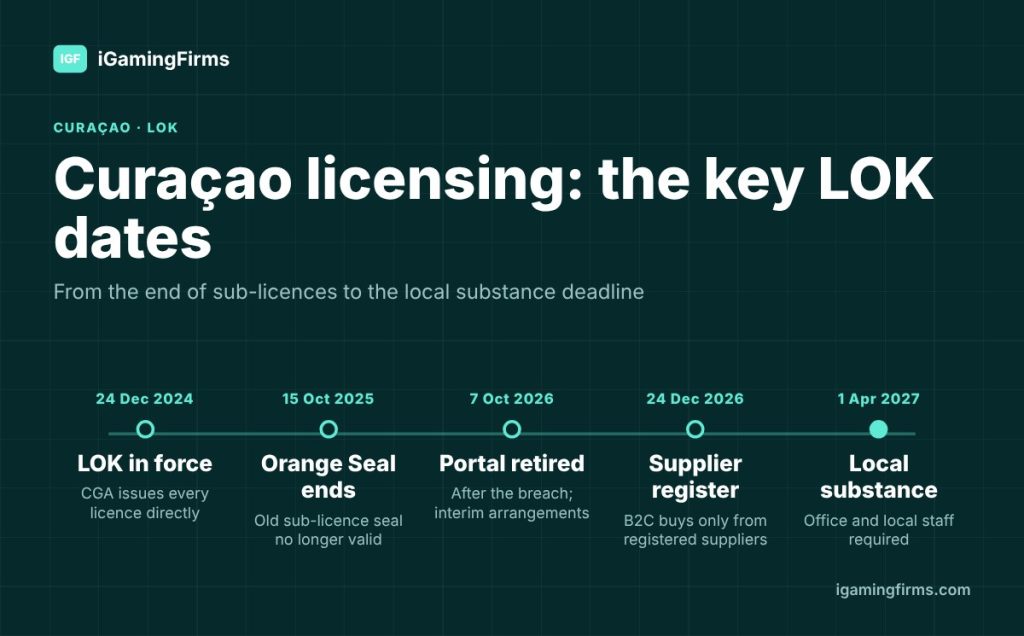
Before the LOK, four private master licence holders (Antillephone, Cyberluck or Curaçao eGaming, Gaming Services Provider and Curaçao Interactive Licensing) sold sub-licences to operators under the 1993 offshore gaming ordinance. That is the regime most “cheap Curaçao licence” guides still describe. It is finished: the master licences ran out between August 2024 and January 2025 and were not renewed, the transitional Orange Seal for former sub-licensees stopped being valid on 15 October 2025, and anyone operating under a Curaçao licence today holds, or has applied for, a direct licence from the CGA. Sub-licensing, sharing or leasing a licence is no longer permitted.
Under the LOK there are two licence categories:
- B2C licence for anyone offering games of chance to players: online casino, live casino, sportsbook, poker, bingo and lottery products, all under one licence.
- B2B supplier licence for suppliers of critical goods and services to those operators: RNG game studios, live dealer studios, poker and peer-to-peer platforms, sportsbook software, bet capture and settlement systems, odds compilers and game aggregators.
Holding both in one entity needs specific written approval from the CGA. Most groups keep them in separate companies.
Who needs a Curaçao gambling licence?
You need a licence because taking real-money wagers without one is illegal in Curaçao and, in practice, cuts you off from reputable game studios, payment providers and affiliates. You need a B2C licence if your company accepts wagers from players under a Curaçao licence, whether you built the platform yourself or run on a white label. A white-label deal doesn’t remove the requirement; it just means the platform owner holds the licence and you operate as a brand under their compliance umbrella, with the limits that implies. If you’re weighing that route, our guide to how to start a sportsbook walks through the trade-offs.
On the supply side, the rule depends on where you’re based. Under Article 1.5(1) of the LOK, a supplier established in Curaçao that provides critical goods or services to licensed operators must hold a B2B supplier licence and register. A supplier based outside Curaçao doesn’t need the licence but must still register with the CGA. Either way, from 24 December 2026 a B2C licensee may not buy critical services from a supplier that isn’t on the CGA’s public register (Article 5.16). The CGA confirmed that deadline in June 2026, asked Curaçao-based suppliers to file by 1 September 2026, and said registration for local and foreign suppliers was expected to open in October 2026. With the portal now retired, check the CGA’s notices for how registration will actually be taken. If you sell game content or sportsbook feeds into Curaçao-licensed brands, that applies to you.
Affiliates, marketing agencies, KYC vendors and payment providers are not on the CGA’s illustrative list of critical suppliers, though the regulator has said the list may expand.
Curaçao gaming licence requirements
The CGA assesses an application in two phases: corporate integrity and financial stability first, then the wider LOK requirements including technical compliance. Here’s what you need in place.
1. A Curaçao company with a resident managing director
The applicant must be a legal entity incorporated under Curaçao law (an N.V. or B.V.) with its statutory seat on the island, and at least one managing director who actually lives in Curaçao. Advisers report that the CGA checks real residence, not a nominee on paper. Incorporation typically takes about two weeks through a local corporate services provider.
2. Fit and proper key persons and full UBO disclosure
Every ultimate beneficial owner, qualified interest holder, director and anyone who influences governance, finances, policy or compliance is a “key person” and submits a personal history disclosure. Each one pays the €150 due diligence fee. A conviction in the past eight years for fraud, theft, extortion, money laundering or terrorist financing among key persons is a refusal ground, and so is capital whose source can’t be traced. Incomplete ownership disclosure is the most common reason applications stall, according to platform providers that handle filings.
Advisers’ document checklists for each key person typically include:
- A certified passport copy and a second form of ID
- Proof of address no more than three months old
- A CV and a certificate of good conduct (police clearance)
- A bank reference letter and a professional reference letter
- A source-of-funds and source-of-wealth declaration with supporting evidence
Expect requests for notarisation or certified translation of anything not in English or Dutch.
3. goAML registration before you file
Registration with Curaçao’s goAML reporting system (the Financial Intelligence Unit’s platform) is required before the CGA will process your application. Missing it is a refusal ground, not a fixable gap.
4. Business plan, policies and proof of liquidity
The application consists of four forms: the online gaming application, business and corporate information, a personal history disclosure per key person, and a business plan with financial projections. Alongside them you need a responsible gambling policy, an approved alternative dispute resolution (ADR) mechanism, AML/CFT procedures aligned with the CGA’s May 2024 AML regulations, and bank evidence that you can pay expected player winnings. There is no minimum share capital figure in the fee schedule, so treat any consultancy quoting a fixed “ANG 100,000+” capital requirement with caution.
5. Technical certification
Phase two covers your platform: RNG and game certification from an accredited lab, information security controls, and the CGA seal that must appear on every licensed domain (an iframe tied to your certificate URL and approved domains). Each extra domain costs €250 to add. After the portal breach the CGA said seal availability would be affected and promised an alternative verification mechanism, so check the current seal instructions before you add domains.
6. Player protection and marketing rules
The LOK treats anyone under 18 as a vulnerable person who may not be accepted as a customer, so robust age verification is a condition of the licence, not an option. Self-exclusion must be offered for at least six months, player complaints need a response within two weeks, and advertising must not mislead, encourage high-frequency play or target vulnerable people. From April 2026 the CGA also has a terms and conditions policy that requires all KYC and monitoring steps to be set out upfront in your T&Cs, with no passive acceptance; licensees had until 8 October 2026 to upload compliant terms.
7. Local substance (deferred to 1 April 2027)
Article 5.12 of the LOK requires licensees to have a meaningful economic presence on the island, not a letterbox. The CGA’s original plan, announced in September 2025, was at least one Curaçao-based staff member in addition to the resident managing director for the first four years, rising to three from the fifth year, plus a dedicated office. On 23 January 2026 the Minister of Justice used Article 5.12(6) to grant a general extension: no licensee has to meet the substance obligation before 1 April 2027. The CGA has not yet clarified acceptable staffing models, outsourcing arrangements or the minimum scale of on-island operations, so budget for a real office and at least one local hire from 2027 and treat anything more precise as a question for your adviser.
How much does a Curaçao gambling licence cost?
Regulator fees are fixed amounts in euros (the CGA invoices in euros, with guilder equivalents), not a percentage of revenue. That’s the main structural difference from Malta, where the compliance contribution scales with gaming revenue.
| Fee | Amount | When |
|---|---|---|
| Application fee (B2C or B2B) | €4,592 | At filing, non-refundable |
| Due diligence, per UBO or qualified interest holder | €150 per person | At filing |
| Due diligence, listed corporate UBO | €2,551 per entity | At filing |
| B2C licence fee (National Treasury) | €24,490 a year | First invoice pro-rated, due within 14 days of grant; then in full by 15 January |
| B2C supervisory fee (CGA) | €22,960 a year | Same schedule |
| B2B supervisory fee (CGA) | €24,490 a year | Same schedule |
| Add a domain | €250 | Per domain, when added |
| Certificate application | €383 | One-off |
| Change or add a UBO or qualified interest holder | €128 per person | When notified |
A few things the older guides get wrong, so you can spot stale quotes: there is no €18,500 “approval fee” and no €3,600 or €5,000 monthly fee under the LOK; those numbers belong to adviser packages or the interim 2024 regime. The “40 domains included” rule was part of the pre-LOK fee structure; today every additional domain is €250. “All-in” quotes of €20,000 to €25,000 date from the sub-licence era and can’t cover today’s €47,450 annual fees. And a Curaçao licence is not issued for five years; a definitive licence has no fixed expiry.
Year-one and year-two cost model (regulator fees only)
Worked example: a new B2C casino and sportsbook brand, three individual UBOs, one main domain plus two extra domains, licence granted in January so the first annual invoice isn’t pro-rated.

| Cost | Year 1 | Year 2 |
|---|---|---|
| Application fee | €4,592 | None |
| Due diligence (3 × €150) | €450 | Only for new key persons (€128 each) |
| Licence fee to National Treasury | €24,490 | €24,490 |
| Supervisory fee to CGA | €22,960 | €22,960 |
| Two extra domains (2 × €250) | €500 | None unless you add more |
| Regulator cash out | €52,992 | €47,450 |
A B2B supplier on the same assumptions pays €29,532 in year one (€4,592 plus €450 plus €24,490) and €24,490 a year after that.
The regulator bill is the predictable part. The costs that decide your real budget sit outside it and are quoted case by case:
- Company and local presence: incorporation, registered office, the resident managing director (usually a retained local professional), and from 2027 an office and local staff. Compare licensing consultants on what their packages include, because some quote the application only and bill policies, directors and office separately.
- Policies and legal: AML/CFT, responsible gambling, T&Cs that meet the April 2026 policy, and ADR enrolment. A specialist iGaming law firm is worth it here; template policies are a common reason for phase-two delays.
- Certification and platform: RNG and game lab testing, information security, hosting.
- Compliance tooling: KYC, AML and age verification tools that your policies commit you to.
- Payments: a Curaçao licence still gets a harder look from banks and tier-one PSPs than an MGA licence does. Budget time, not just money, for onboarding.
What about tax?
There is no tax on gross gaming revenue under the LOK. Profits are subject to Curaçao profit tax at the island’s standard rates (the headline rate is 22%). The 2% E-Zone rate that older guides still quote was abolished for new users from 1 January 2020 under EU pressure, with only time-limited grandfathering for companies already using it, so don’t build a business case on a 2% rate without current advice from a Curaçao tax adviser.
How long does a Curaçao gaming licence take?
The CGA’s own target is eight weeks per review phase, each extendable by up to four weeks, counting from a complete file. Advisers who file regularly estimate three to five months for the review itself. Here’s the full path.
| Stage | What happens | Realistic time |
|---|---|---|
| 1. Set-up | Incorporate the Curaçao N.V. or B.V., appoint the resident managing director, register with goAML, open a bank account | 2 to 6 weeks (bank accounts are the slow part) |
| 2. File preparation | Business plan, policies, ADR, personal disclosures and source-of-funds evidence for every key person, platform documentation | 3 to 6 weeks |
| 3. Submission | File with the CGA and pay the €4,592 fee and due diligence fees (see the portal note below) | Days, once a filing channel is open |
| 4. Phase one review | Integrity and financial stability of the company and key persons | 8 weeks target, up to 12 |
| 5. Phase two review | Technical compliance, policies, certification, seal and domains | 8 weeks target, up to 12 |
| 6. Grant | Pay the first (pro-rated) annual invoice within 14 days; licence and seal issued on payment | Days |
Total: four to six months if your structure, funding evidence and platform are decided before you start. The CGA can issue a provisional licence for up to six months, extendable once, when only a few conditions remain open after phase one, which lets some operators go live before the definitive licence lands.
The portal shutdown: what it means for new applications
Applications used to go through the CGA Online Gaming Portal. On 17 September 2026 the CGA disclosed unauthorised access to that portal, which it later said had started in December 2025 through an account registered under a false identity; a hacker then published tens of thousands of portal documents. The CGA took the portal offline, postponed portal filing deadlines, and on 7 October 2026 said the portal would not return to service. Licensing and supervision are to continue through interim arrangements that had not been published at the time of writing, and operators were told not to email documents meant for the portal. Existing licences stay valid and obligations are unchanged. Until the CGA publishes the interim process, build extra weeks into your timeline and don’t trust any adviser promising a filing date.
Industry reporting in spring 2026 also shows why “guaranteed in weeks” claims should worry you: of roughly 140 direct licence applications processed by April 2026, about 87 were reportedly approved and the rest rejected or shelved, close to a 38% non-approval rate. If your application is rejected, the CGA’s July 2026 wind-down rules give you six weeks to close in an orderly way, with no refund of fees paid.
Does a Curaçao gaming licence expire?
A definitive LOK licence has no fixed term. It stays valid as long as you pay the annual fees by 15 January each year, keep your key persons and ownership approved (changes need prior CGA approval and a €128 fee per person), and meet the licence conditions. Late payment leads to suspension and removal from the public register; the CGA has said it will also revoke provisional licences of operators who fail to show progress against their compliance checklist.
What does expire is the provisional licence, which runs for up to six months and can be extended once. The transition licences issued to former sub-licensees in December 2024 were extended by six months in June 2025 to a 24 December 2025 deadline, and the CGA said in December 2025 it was still reviewing some of them in 2026.
How do you check whether a Curaçao licence is valid?
If you’re an affiliate, supplier or acquirer doing due diligence on a Curaçao brand, three checks cover most of the risk:
- The CGA public register. Confirm the legal entity, licence number and whether the licence is definitive or provisional. A provisional licence can be revoked if the operator falls behind its checklist.
- The seal. A valid CGA seal links to a certificate page that lists the licensed entity and approved domains. A domain missing from that list isn’t covered. Since the portal breach the CGA has said seal availability may be affected, so confirm against the register if a seal fails to load.
- The entity name on the site. The company in the T&Cs and footer should match the licence holder exactly. Old “Antillephone” or “Curaçao eGaming” sub-licence seals are no longer valid on their own.
Where can a Curaçao gambling licence be used?
A Curaçao licence authorises you to offer games from Curaçao. It does not give you the right to take bets in any country that regulates online gambling itself. The regulator does not publish a list of prohibited countries; its March 2024 guideline put the responsibility on you to make reasonable efforts to comply with the law and sanctions rules of every country where your site can be accessed. In practice:
- Markets with their own licensing regime (the UK, Netherlands, Germany, Italy, Spain, Sweden, Ontario, US states and many others) require a local licence. Serving them on a Curaçao licence is illegal there and is a ground for the CGA to withdraw your licence. The Netherlands is explicitly off limits, and Dutch regulators have pressed Curaçao hard on this.
- Markets that block offshore operators actively, such as Australia, treat a Curaçao licence as no defence; regulators there pursue the brand, not the licence.
- Markets with no local online gambling regime, or that tolerate offshore operators, are where a Curaçao licence is typically used: much of Latin America outside Brazil and Colombia, parts of Asia and Africa, and some of Eastern Europe.
Geo-blocking the regulated markets you aren’t licensed in, and documenting that you do, is now standard practice under the LOK. If your plan depends on a regulated European market, read our MGA licence guide for the comparison.
What are the benefits of a Curaçao gaming licence, and when does it not fit?
The reasons to choose Curaçao in 2026 are concrete:
- Predictable, flat cost. €47,450 a year regardless of revenue, against Malta’s €25,000 fixed fee plus a revenue-based contribution that can run to hundreds of thousands.
- One licence, all verticals. Casino, live, sportsbook, poker, bingo and lottery sit under a single B2C licence.
- No gaming revenue tax.
- Crypto is permitted with rules. The CGA’s June 2026 crypto guideline lets B2C licensees accept cryptocurrency for gambling (not act as exchanges or custodians), with wallet screening, segregated wallets and a phased timetable to full compliance by June 2027. For crypto-led brands that is clearer than most jurisdictions offer; our crypto casino licence comparison sets it against the alternatives.
- A regulator that now exists. A direct CGA licence, a public register and a dynamic seal carry more weight with suppliers and payment partners than a sub-licence seal ever did.
It doesn’t fit when:
- Your core market requires a local licence. Curaçao is then a supporting licence at best.
- Your banking or PSP partners insist on an EU regulator. Expect more enhanced due diligence from acquirers with a Curaçao licence than with an MGA one.
- You can’t support real substance in Curaçao by April 2027. The “postbox” model the island is deliberately ending is the one many smaller operators relied on.
- Reputation is central to your brand. The regulator’s supervisory board resigned in September 2025, BC.GAME gave up its Curaçao licence in December 2025, and the September 2026 portal breach exposed ownership documents for hundreds of licensed companies. Partners will ask about this; have an answer.
What this means for operators and suppliers right now
If you’re applying for a B2C licence in late 2026, four things shape your plan: the interim filing process that replaces the retired portal, the T&C policy that took effect in October 2026, the crypto compliance milestones running to June 2027 if you take digital assets, and the 1 April 2027 substance date. Build the office and local hire into your year-two budget now rather than treating the extension as a reprieve; the CGA has said it isn’t one.
If you’re a supplier, the 24 December 2026 registration deadline is the one that matters. Register as soon as the CGA opens a channel if you’re based outside Curaçao, or apply for the B2B licence if you’re on the island, because from that date your Curaçao-licensed customers can’t legally keep buying from you otherwise. Watch for any extension, since the register was meant to open through the portal that has now been retired.
If you’re an affiliate working with Curaçao brands, check the CGA register before you sign, confirm the licence is definitive rather than provisional, and expect stricter marketing terms in your agreements as operators pass the LOK’s advertising obligations down the chain. Keep an eye on our monthly regulation round-up for the next CGA notices; the interim filing process, the supplier register and the substance guidance are all still being written.
Your next step
Before you pay anyone, put four things on one page: your target markets and how you’ll geo-block the rest, your UBOs and how you’ll evidence their source of funds, your platform and who will certify it, and how you’ll staff Curaçao by April 2027. Take that page to two or three licensing consultants and compare like-for-like quotes against the regulator fees above. Most Curaçao applications that stall do so on ownership disclosure or source of funds, not on fees, and those are the two things only you can fix before filing.
This guide is independent information, not legal or tax advice. Fees, deadlines and requirements are taken from CGA notices and dated industry reporting as of the date above; confirm the current fee schedule, filing process and transition rules with the CGA or a Curaçao-qualified adviser before you apply.