Last updated: 15 October 2026
You’ve picked Malta and now you need an MGA licence. Maybe your payment partners asked for an EU licence, maybe a B2B client won’t integrate without one, or maybe you’re tired of explaining a Curaçao or Anjouan licence to banks. Then you start pricing it and every adviser gives you a different number, timeline and document list.
The short answer: an MGA licence costs a €5,000 application fee, a €25,000 fixed annual licence fee for most B2C and B2B set-ups, €40,000 to €100,000 of paid-up share capital per game type, and a monthly compliance contribution based on your gaming revenue once you’re live. Malta-based advisers quote roughly 12 to 16 weeks for the MGA review of a complete file, but plan for four to six months end to end once you add incorporation, hiring key people and the system audit.
This guide covers who can apply, what the Malta Gaming Authority (MGA) actually checks, every regulator fee with real figures, a year-one and year-two cost model you can adapt, a realistic timeline, and what it takes to keep the licence once you have it. It also covers the Malta gaming tax change that took effect on 1 October 2026: the flat 5% rate is gone, replaced by 15% for Type 1 and 10% for Types 2 to 4.
MGA licence at a glance (2026)
| Item | B2C (Gaming Service Licence) | B2B (Critical Gaming Supply Licence) |
|---|---|---|
| Application fee | €5,000, one-off, non-refundable | €5,000, one-off, non-refundable |
| Fixed annual licence fee | €25,000 (€10,000 if you offer only Type 4 skill games) | €25,000 to €35,000 depending on revenue (€10,000 initial fee for back-office only) |
| Minimum paid-up share capital | €100,000 for Type 1 or 2, €40,000 for Type 3 or 4 (added together, capped at €240,000) | €40,000 |
| Compliance contribution | Monthly, tiered on gaming revenue, with a minimum and maximum per game type | Not charged on the B2C scale; the revenue-banded licence fee applies instead |
| Malta gaming tax (players in Malta only) | 15% for Type 1, 10% for Types 2 to 4, from 1 October 2026 (previously 5%) | Not applicable to supply licences |
| Key function approval | €50 per person per role | €50 per person per role |
| Licence term | 10 years | 10 years |
| Who can apply | A company incorporated in the EU or EEA | |
Fee and capital figures come from the MGA’s own Licence Fees and Taxation guidance note and its Capital Requirements Policy.
B2C or B2B: which MGA licence do you need?
Since the Gaming Act of 2018, the MGA issues two licences instead of the old four-class system.
- Gaming Service Licence (B2C) is for anyone offering games to players: online casinos, sportsbooks, poker rooms, bingo sites.
- Critical Gaming Supply Licence (B2B) is for suppliers whose product sits inside the gaming transaction: game studios supplying the material elements of a game, and platform or control-system providers that generate or process regulatory records.
Not every supplier needs one. If you sell CRM, affiliate tracking, marketing services or KYC tools that don’t touch the game logic or the regulatory records, you’re usually outside the licensing requirement. If you’re unsure, that’s a ten-minute question for a specialist iGaming law firm before you spend €5,000 on an application.
The four game types
Your licence lists one or more game types. The type drives your share capital, your compliance contribution and, since October 2026, your Malta gaming tax rate.

| Type | What it covers | Typical products |
|---|---|---|
| Type 1 | Games of chance played against the house, random outcome | Online casino, live casino, house-banked poker, lotteries, virtual sports |
| Type 2 | Games against the house where the outcome depends on an external event and the operator manages risk through odds | Fixed-odds sports betting, in-play betting |
| Type 3 | Games not played against the house; the operator earns a commission or fee | Peer-to-peer poker, bingo, betting exchanges |
| Type 4 | Controlled skill games | Fantasy sports and other skill-based formats |
A combined casino and sportsbook needs Type 1 and Type 2. That matters for capital: multiple types are added together, capped at €240,000.
MGA licence requirements: what the authority checks
The MGA’s Application Process guidance note sets out four questions it asks about every applicant: are you fit and proper, is your business strategy viable, do you meet the statutory and operational requirements, and have you built on a technical environment what you said you would build. Here’s what that means in practice.
1. An EU or EEA company with the right share capital
You need a company incorporated in the EU or EEA. Most applicants incorporate in Malta, but it isn’t strictly required. The share capital must be issued and paid up: €100,000 for Type 1 or Type 2, €40,000 for Type 3, Type 4 or B2B.
This is your money sitting in the company, not a fee. It needs to be there before you apply, and you need to keep equity above the minimum afterwards.
2. Fit and proper review of owners and key people
Every ultimate beneficial owner (UBO), director and key person submits a Personal Declaration Form through the MGA portal (LRMS). The MGA assesses shareholders, UBOs and key persons, and runs probity checks with other national and international regulators. A past licence problem elsewhere doesn’t automatically sink you, but undisclosed history usually does.
3. Source of wealth and source of funds
This is where many files stall. The MGA wants to see the economic activity that created each UBO’s wealth (employment, a business sale, inheritance) and the specific source of the money funding the gaming company. It also checks that the UBOs can sustain the licence through its life cycle, not just pay the first year.
4. Business plan and operating policies
Expect the MGA to read your financial forecasts closely, including marketing and distribution plans and growth targets. Alongside the plan you submit your incorporation documents and the full policy set listed in the MGA’s System Documentation Checklist: AML/CFT, responsible gaming, player funds protection, terms and conditions, game rules, and agreements with third-party suppliers. Your AML/CFT and player verification policies need to match how your stack actually works; our guide to iGaming KYC requirements covers what regulators expect at onboarding and withdrawal.
5. Key function holders
The MGA requires named, approved people for specific roles, each paying €50 per role and passing their own fitness check. The current roles include CEO, gaming operations, compliance, MLRO, legal, technology, data protection officer and internal audit. Some roles can’t be combined; the MLRO and DPO, for example, are kept separate. The MGA’s Key Functions page lists the eligibility rules and minimum yearly training hours.
Under the 2021 changes to the Gaming Authorisations and Compliance Directive, as summarised by Maltese law firms, you need to name the CEO, compliance officer and MLRO at application stage, with the remaining roles following after the licence is issued. Many startups fill the less central roles through outsourced, MGA-approved professionals rather than full-time hires.
6. Technical set-up and system audit
After the document review, the MGA tells you to implement your platform on a technical environment. You get 60 days. Within that window you trigger an external system audit by an independent firm from the MGA’s approved list, which checks the staged environment against what you submitted.
Big deviations mean a new application, so don’t change platform provider mid-process. If you’re still choosing, compare platform and white-label providers that already run MGA-audited stacks; it shortens this stage considerably.
How much does an MGA licence cost? Every regulator fee explained
Regulator costs come in four layers. Only the first is a one-off. If you’re still choosing a jurisdiction, our gambling licence cost comparison puts Malta’s numbers next to the other main options.
Application fee: €5,000
Paid with the application, non-refundable. A major change during review (more than 75% change in ownership or control, or a new business plan because your products or markets changed) means a new application and a new fee.
Annual licence fee: €10,000 to €35,000
Paid upfront before the licence is issued, then every year in advance.
- B2C: €25,000 a year, or €10,000 if you only offer Type 4 skill games.
- B2B: €25,000 a year up to €5 million in revenue, €30,000 between €5 million and €10 million, €35,000 above €10 million. Back-office-only suppliers pay a €10,000 initial fee, then €3,000 or €5,000 a year depending on whether revenue passes €1 million.
Compliance contribution (B2C only)
This is the variable part and the one that grows with you. It’s calculated on monthly gaming revenue and paid before the 20th of the following month. Each game type has its own sliding scale, with a floor and a ceiling.
| Game type | First-band rate | Rate on revenue above the top band | Annual minimum | Annual maximum |
|---|---|---|---|---|
| Type 1 (casino) | 1.25% on first €3m | 0.40% | €15,000 | €375,000 |
| Type 2 (betting) | 4.00% on first €3m | 0.40% | €25,000 | €600,000 |
| Type 3 (P2P, commission) | 4.00% on first €2m | 0.40% | €25,000 | €500,000 |
| Type 4 (skill games) | 0.50% on first €2m | 2.00% (this scale rises with revenue) | €5,000 | €500,000 |
Two relief rules help new operators. The full minimum isn’t due until a full licence period has passed, and startups that qualify under the MGA’s start-up directive get a 12-month moratorium with no compliance contribution at all. Ask your adviser early whether you qualify, because it changes your first-year cash plan.
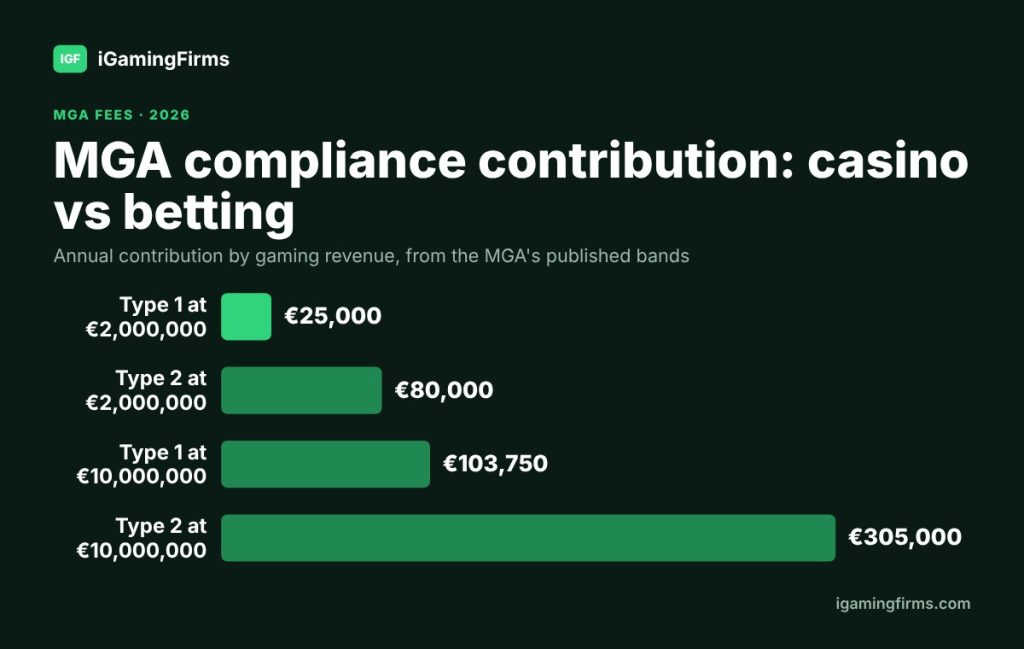
Here’s what the sliding scale works out to at different revenue levels (gaming revenue per year, calculated from the MGA’s published bands):
| Annual gaming revenue | Type 1 (casino) | Type 2 (betting) |
|---|---|---|
| €500,000 | €15,000 (minimum applies) | €25,000 (minimum applies) |
| €2,000,000 | €25,000 | €80,000 |
| €10,000,000 | €103,750 | €305,000 |
| €25,000,000 | €205,000 | €470,000 |
Notice how much heavier the Type 2 scale is at small and mid volumes. At €2 million in revenue a sportsbook pays more than three times what a casino of the same size pays. If you’re planning a sportsbook-led brand, model this before you commit.
Malta gaming tax: what changed on 1 October 2026
Malta’s gaming tax only applies to gaming revenue from players in Malta. Revenue from players elsewhere is not hit by this tax, which is why most export-focused operators barely notice it.
Until 30 September 2026 that domestic slice was taxed at a flat 5%. Legal Notice 84 of 2026, published on 1 April 2026, amended the Gaming Tax Regulations (S.L. 583.10) and replaced the flat rate from 1 October 2026:
| Game type | Until 30 September 2026 | From 1 October 2026 |
|---|---|---|
| Type 1 (casino-style games) | 5% | 15% |
| Type 2 (fixed-odds betting) | 5% | 10% |
| Type 3 (peer-to-peer, commission) | 5% | 10% |
| Type 4 (controlled skill games) | 5% | 10% |
The MGA and Malta’s tax authority announced the reform in a joint notice dated 2 April 2026. The same package merges the gaming tax and the gaming device levy into one structure and narrows the VAT exemption for some sports betting and casino offerings, with input VAT recovery available on the supplies that become taxable. Licence fees and the compliance contribution were not changed by this reform.
If you plan to market to Maltese residents, budget at the new rates, not the 5% still quoted in many older guides and in the MGA’s own fees note, which predates the change. If you don’t, the domestic tax stays a rounding error, but get Maltese VAT advice on how the narrower exemption affects your supplies.
Year-one and year-two cost model (regulator costs only)
Here’s a worked example for a common set-up: a new online casino (Type 1 only) that doesn’t qualify for the start-up moratorium, goes live in month one of the licence, and reaches €2 million gaming revenue in year two. Assumptions: six key-function roles approved, no players in Malta.
| Cost | Year 1 | Year 2 |
|---|---|---|
| Application fee | €5,000 | None |
| Fixed annual licence fee | €25,000 | €25,000 |
| Key function approvals (6 × €50) | €300 | Only for new appointments |
| Compliance contribution | Based on actual revenue; full €15,000 minimum not yet due | €25,000 (at €2m revenue) |
| Malta gaming tax | None (no players in Malta) | None |
| Regulator cash out | €30,300 plus monthly contribution | €50,000 |
| Share capital locked in the company | €100,000 | €100,000 |
Add Type 2 betting to the same brand and the picture changes: share capital rises to €200,000 and year-two compliance contribution on a further €2 million of betting revenue adds €80,000. Take Maltese players and the casino revenue from them now carries 15% gaming tax on top.
The regulator bill is the predictable part. The costs that actually decide your budget sit outside it, and they’re quoted case by case:
- Corporate and legal set-up: incorporation, registered office, application drafting. Compare licensing consultants on what’s included, as some quote the application only and bill policies separately.
- Key people: salaries for in-house roles, or retainers for outsourced MGA-approved key function holders.
- Platform and certification: the system audit fee, game and RNG certification, hosting.
- Compliance tooling: KYC, AML and responsible gaming tools that your policies will commit you to.
- Payments: merchant accounts and PSP onboarding, which an MGA licence makes easier but doesn’t guarantee.
- Ongoing audits: compliance audits after your first year of operation and on the schedule the MGA sets for you.
How long does it take to get an MGA licence?
The MGA doesn’t publish a fixed processing time. Malta-based advisers such as BDO quote about 12 to 16 weeks for the review when the file is complete. The months around it are what stretch timelines.
| Stage | What happens | Realistic time |
|---|---|---|
| 1. Preparation | Incorporate, pay up share capital, gather UBO wealth evidence, draft business plan and policies, choose platform, line up key function holders | 4 to 8 weeks |
| 2. Submission | File everything through LRMS with the €5,000 fee; incomplete files go into a one-time 60-day “Incomplete” window, then get rejected if not fixed | 1 to 2 weeks |
| 3. MGA review | Fit and proper, funding, business plan and technical documentation reviews, plus any clarification requests | About 12 to 16 weeks if complete |
| 4. Implementation and system audit | Build on a technical environment, external audit by an MGA-approved firm | Up to 60 days |
| 5. Licence issued | Pay the first annual licence fee upfront, receive a 10-year licence | Days |
Total: plan for four to six months if you start with your structure, funding evidence and platform already decided. Teams that start from zero, change platform mid-review or struggle to evidence source of wealth commonly run past six months.
What slows MGA applications down
- Weak source-of-wealth evidence for UBOs, especially wealth built from crypto, private company sales or earlier offshore gaming.
- Template policies that don’t match the platform you’re actually deploying. The system audit tests what you wrote against what you built.
- Changing scope mid-review. New markets, new products or a new majority owner can trigger a fresh application.
- Key function holders who fail eligibility or hold conflicting roles.
- Thin financial forecasts that don’t show the company can fund itself through slow early months.
After approval: keeping your MGA licence
The licence runs for 10 years, but it’s conditional on meeting your obligations every month of those 10 years. Plan for these from day one:
- Recurring payments: the annual licence fee in advance each year, and the compliance contribution monthly, before the 20th of the following month.
- Audits: a compliance audit after your first year of operation, then further compliance and system audits on the schedule the MGA sets.
- Key people: key function holders must stay approved and complete their minimum yearly training hours, and any replacement needs MGA approval before taking the role.
- Material changes: changes to ownership, control, key games or critical suppliers need to be notified or approved; big ones can trigger a new application.
- Renewal: before the 10-year term ends you apply to renew, and the MGA reviews your compliance record. Start that conversation with your adviser well ahead of expiry.
Recognition notices and corporate licences
Two other MGA authorisations are worth knowing about. A recognition notice lets an operator already licensed in another EU or EEA state, or another jurisdiction the MGA accepts, offer its services to players in Malta without a full MGA licence. A corporate licence lets a group cover several of its entities under one authorisation instead of one licence per company. Ask a gaming lawyer whether either fits your structure before you file a standard application.
Is an MGA licence worth it for you?
An MGA licence makes sense when you need what it uniquely gives you: an EU regulator’s name on your licence, easier conversations with banks and tier-one suppliers, and a credible base for markets that accept or recognise it. It’s also the default for B2B suppliers selling into regulated European operators.
It’s not a passport to everywhere. There is no EU-wide mutual recognition of gambling licences, and many large markets, including the UK, Germany, the Netherlands, Italy and Spain, require their own local licence, while the US is licensed state by state. If your core market is one of those, the MGA licence becomes a supporting asset rather than the thing that lets you trade. Check each target market’s rules first; for Great Britain, our UKGC licence guide covers what the Gambling Commission requires on top.
If you’re early stage with limited capital, compare the total cost of ownership honestly. Cheaper licences can cost more later in payment friction and supplier refusals, but the MGA’s capital, key people and audit burden are real, ongoing commitments, not one-off fees.
Your next step
Before you pay anything, put four things on one page: which game types you’ll offer, which markets you’ll target, who your UBOs are and how you’ll evidence their wealth, and which platform you’ll deploy. Take that page to two or three licensing consultants and compare like-for-like quotes. Most of the time and money lost on MGA applications traces back to one of those four answers changing halfway through.
This guide is independent information, not legal or tax advice. Fees and rules are taken from MGA publications and Maltese legislation as of the date above; confirm current positions with the MGA or a Malta-qualified adviser before you apply.
Weighing Malta against a cheaper offshore option? Read the Curaçao gaming licence guide for a like-for-like fee comparison.