The short answer: iGaming SEO is how a licensed gambling brand earns organic rankings in the markets it can legally serve. In 2026 it pays best when operators win their own brand, game, payment and market searches, leave “best casino” head terms to affiliates, and avoid the parasite and expired-domain tactics Google targeted with four spam updates this year.
You can buy traffic almost anywhere except where your players actually start: a search box. Google Ads gambling slots need certification and a country-by-country green light, social platforms keep tightening the rules, and affiliate CPA deals eat a bigger slice of every first deposit. So organic search keeps landing back on the operator’s roadmap. The problem is that most iGaming SEO advice is written by agencies selling links, and very little of it reflects what Google actually changed this year.
This guide is for operators and the in-house teams who run their acquisition. It covers what changed in 2026 (with dates), what the money results pages look like right now, where an operator can realistically win, how long results take, and a 90-day plan you can hand to your SEO lead. Affiliates and SEO consultants will find the policy and SERP sections just as useful. If you are looking for a vendor rather than a playbook, our separate comparison of specialist iGaming SEO agencies covers who does this work and what they charge.
What is iGaming SEO?
iGaming SEO is the work of getting a gambling brand’s pages to rank in organic search for the markets it is licensed in, so that searches turn into registrations and first-time deposits without paying per click. It uses the same building blocks as any SEO (technical health, useful content, links, brand signals), but it runs under three constraints most industries never face: gambling licences that are tied to specific countries or states, advertising and bonus rules that dictate what your pages can say, and some of the most aggressive spam competition on the web.
That last point matters more than any checklist. Google has written casino spam into its own policy examples. Its spam policies describe expired domain abuse using casino content placed on a former school website as an example. When your vertical is the textbook case, you are judged against a higher bar.
How is iGaming SEO different from regular SEO?
| Area | Regular SEO | iGaming SEO |
|---|---|---|
| Target markets | Anywhere the product ships | Only markets where you hold a licence; every other market is a liability |
| What pages can say | Normal consumer law | Bonus, wagering and advertising codes set by each regulator |
| Paid search fallback | Open to most advertisers | Certification and country approval required, so organic carries more weight |
| Competition | Mostly other brands | Affiliates, media brands with betting sections and spam networks |
| Trust bar | Varies by topic | Treated by most practitioners as Your Money or Your Life content |
| Site build | Usually crawlable by default | Logged-in lobbies, geo-blocking and age gates often hide content from Googlebot |
Is SEO still worth it for operators in 2026?
Yes, for most licensed operators, but not in the way agencies usually sell it. SEO is worth it when you aim it at searches you can actually win, and it is a poor use of budget when you aim it straight at “best online casino” style terms that media brands and affiliates own.
Three reasons it still pays:
- Paid search is narrow. Google’s 2025 Ads Safety Report says Google blocked or removed more than 270.7 million ads under its gambling and games category last year and restricted another 123.9 million gambling ads. Certification, country limits and policy reviews make paid search a channel you rent, not one you control.
- Brand and navigational demand is yours to lose. Every TV spot, sponsorship and affiliate review creates searches for your brand name plus “login”, “app”, “withdrawal” or “bonus”. If you don’t own those results, affiliates and complaint sites will.
- Organic players cost nothing per acquisition after the work is done. Compare that with CPA or revenue share paid to affiliates for the same player, often for the life of the account.
Where it is not worth it: launching a new brand in a saturated market and expecting to outrank established publishers on head terms within a year. Plan for that and you won’t be disappointed.
What changed in iGaming SEO in 2026
Most guides ranking for this topic were written before half of these events happened. Here is the 2026 timeline that actually affects gambling sites, taken from Google’s Search Status Dashboard and the regulators’ own announcements.

| Date (2026) | Change | Why operators should care |
|---|---|---|
| 19 January | UK Gambling Commission caps bonus wagering at 10x and bans mixed-product promotions | Any landing page, bonus page or affiliate review still showing old wagering terms is now inaccurate for UK traffic |
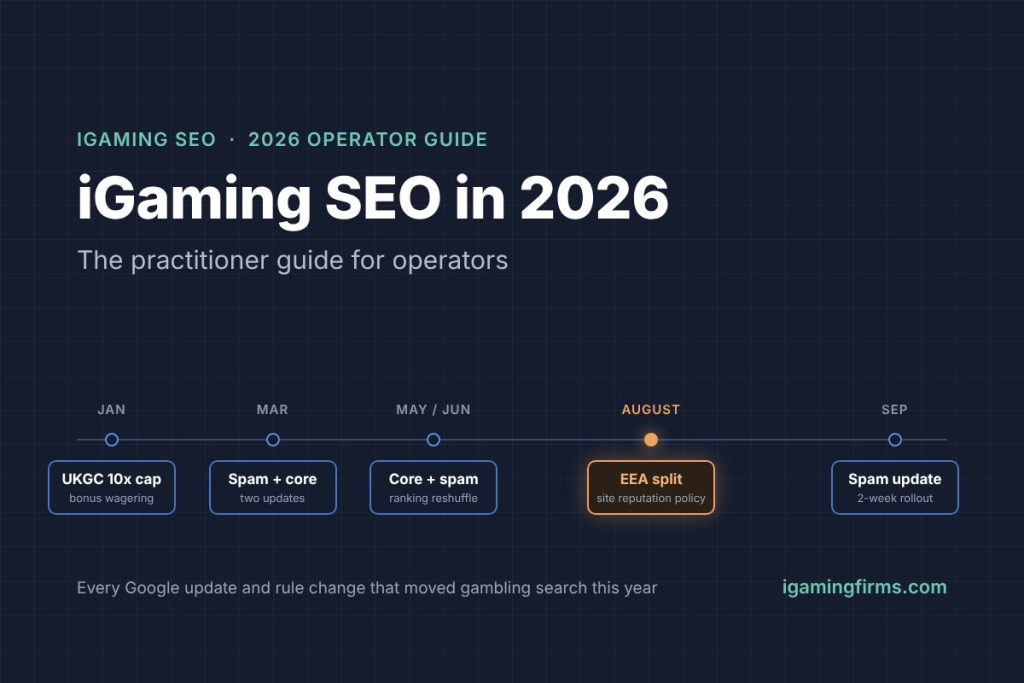
| 24 March | March 2026 spam update (about 20 hours) | First of four spam updates this year |
| 27 March | March 2026 core update (about 12 days) | Broad ranking reshuffle |
| 21 May | May 2026 core update (about 12 days) | Second core update in two months |
| 24 June | June 2026 spam update (about 2 days) | Short, global spam refresh |
| 18 August | August 2026 spam update (about 3 days) | Google said it did not target link spam or site reputation abuse |
| 28 to 30 August | Google changes how site reputation abuse manual actions work in the EEA | Parasite pages can be demoted in the US and UK yet still rank in Europe |
| 24 September to 8 October | September 2026 spam update (about 13.7 days, the longest spam rollout this year) | If rankings moved between late September and early October, check this window before blaming your own releases |
Two things stand out. First, four spam updates in one year is a lot, and gambling is the vertical that most often trips spam systems. Second, the August site reputation change is the biggest policy shift for gambling SEO this year, and none of the top-ranking guides we reviewed mention it.
The site reputation abuse split: what changed in August
Site reputation abuse is what most people call parasite SEO: a third party publishes content on a trusted domain (a news site, a university page, a big publisher’s “betting” section) mainly to borrow that domain’s ranking power. Casino and betting pages have been among the most common examples.
On 28 August 2026, Google announced in a Search Central blog post that, following discussions with the European Commission, manual actions under this policy would work differently from 30 August:
- Searchers outside the EEA (including the US and UK): a manual action still demotes the affected section of the site, as before.
- Searchers inside the EEA: the manual action has no direct effect on results. Google says the affected section may instead be separated in its systems so that, over time, it ranks on its own merits rather than on the host site’s reputation.
What this means in practice for an operator:
- You may see the same competitor page rank in Germany or the Netherlands and vanish in the UK. Don’t copy a tactic because it works in one EEA market. The UK sits outside the EEA, so UK results follow the stricter treatment.
- Your rank tracking needs a location per market. One URL can now rank differently depending on where the search starts, so a single global position no longer tells you much.
- If you pay a publisher for a “partner” casino section, read the policy’s control criteria. Google’s spam policy page says it looks at whether the host site actually controls the content, how consistent the presentation is, who authors it and whether the same content appears elsewhere. It also states that no single factor decides the outcome on its own.
- Don’t treat the EEA change as a free pass. Google’s wording suggests separated sections will lose the host’s reputation boost over time. A strategy built on borrowed authority has a shrinking shelf life even where manual actions no longer bite.
What gambling money SERPs actually look like right now
Before you set targets, look at who you are up against. We checked live Google results on 6 October 2026 and rechecked “igaming seo” on 15 October 2026 (English, not personalised by location beyond the country setting). These are snapshots, not a study, but the pattern is clear.
| Query (country) | Who ranks on page one | AI Overview? |
|---|---|---|
| best online casino michigan (US) | Local and national media brands with betting sections, specialist affiliates, a Reddit thread, one operator, and the state regulator’s list of authorised platforms | Not shown |
| best online casino uk (UK) | Sports and newspaper brands with casino sections, a Trustpilot category page, three operators ranking with their own homepages, and five results removed after legal requests | Not shown |
| igaming seo (US) | Agency blogs and service pages, a Trustpilot page, a LinkedIn post, and blogs from B2B platform and CRM vendors | Not shown |
| how to do seo for online casino (US) | Agency guides, a platform provider’s knowledge base, YouTube videos, Quora | Not shown |
Three lessons for operators:
- “Best casino” terms belong to media brands and affiliates. In the US especially, page one is publishers with dated “October 2026” titles refreshed every few days. An operator can still appear (one did in Michigan, three did in the UK), but usually with a strong brand and homepage, not a blog post.
- Regulators rank. Michigan’s official list of authorised platforms sits on page one. Being on that list, and making sure your brand name on it matches your site, is free trust.
- AI Overviews were absent on every gambling query we checked. That doesn’t mean they never appear for gambling topics, and signed-in or other-country results can differ. But it does mean “optimise for AI Overviews” should not be the first line of a gambling SEO plan in October 2026.
Where operators should compete, and where to leave it to affiliates
The most expensive mistake operators make is fighting affiliates on the affiliates’ own terms. A better split looks like this:
| Search type | Example | Who usually wins | Operator priority |
|---|---|---|---|
| Brand and navigational | “[brand] login”, “[brand] app”, “[brand] withdrawal time” | Should be you | Highest. Own every result you can. |
| Brand plus reputation | “is [brand] legit”, “[brand] review” | Affiliates, Trustpilot, Reddit | High. Publish clear licence, payout and support pages; earn independent coverage. |
| Product and game | “live blackjack [market]”, “[game title] slot” | Mixed: operators, studios, affiliates | Medium to high, if your game pages are crawlable and not thin. |
| Payments | “[brand] paypal withdrawal”, “casino with fast withdrawals [market]” | Affiliates, some operators | Medium to high. Few operators publish clear, method-by-method payment pages. |
| Market and legal | “is online casino legal in [state]” | Publishers, regulators, legal guides | Medium. Useful in newly regulated markets where you hold a licence. |
| Comparison head terms | “best online casino [market]” | Media brands and affiliates | Low as a direct target. Win these through affiliate partnerships and reviews instead. |
How to build an operator keyword map
Start from your licences, not from a keyword tool. List every market you can legally serve, then for each one pull the brand, game, payment and legal searches from Search Console and your keyword tool of choice. Map each search to exactly one page in the correct market folder or domain, so your UK and Ontario pages never compete for the same query. Anything that falls under comparison head terms goes on your affiliate team’s list, not your content calendar.
How do you promote an online casino?
In regulated markets the mix is usually brand advertising and sponsorships to create demand, affiliates to capture comparison searches, CRM to keep players, and SEO to make sure every search for your brand, your games and your markets lands on your own site. SEO is the layer that stops the other channels leaking. Our explainer on how the iGaming affiliate model works covers the partner side of that split.
Technical SEO problems that hit operator sites hardest
Operator sites break in predictable ways because they are built for logged-in players, not crawlers. If you are still choosing or changing a platform, put these on your platform evaluation checklist.
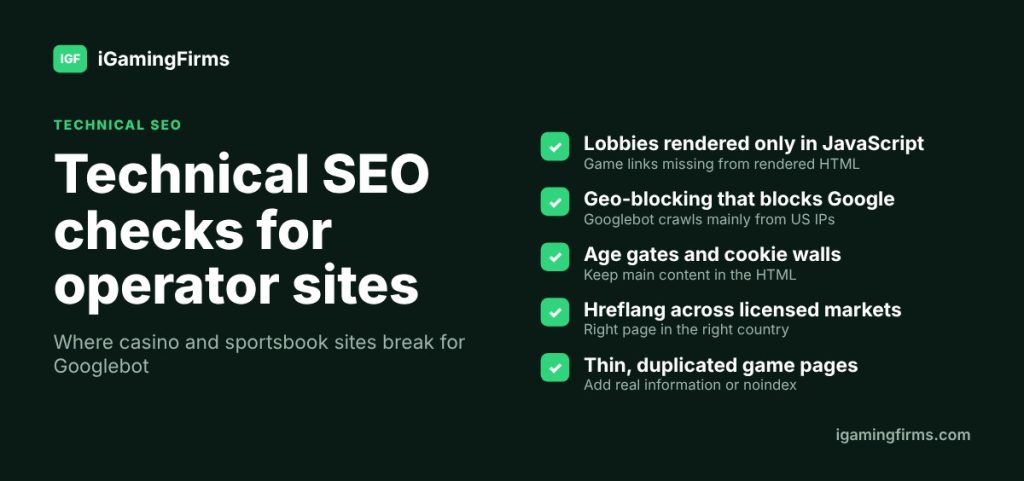
- Lobbies rendered only in JavaScript. Many casino front ends load the whole game lobby client-side. If game names, categories and links don’t appear in the rendered HTML Google sees, your game pages may never be discovered. Test with the URL Inspection tool in Search Console, not your browser.
- Geo-blocking that blocks Google. Google says Googlebot crawls mainly from US IP addresses. If your site redirects or blocks every US visitor because you aren’t licensed there, Google may be seeing a block page instead of your content. Serve a crawlable page with a clear “not available in your region” notice instead of hard redirects, and check what Googlebot actually receives.
- Age gates and cookie walls as full-page interstitials. Keep the main content in the HTML behind them, so crawlers and users can still see what the page is about.
- Hreflang across licensed markets. If you run separate .com, .co.uk and state or country versions, use hreflang correctly and don’t let one market’s page outrank another’s in the wrong country.
- Thin, duplicated game pages. Thousands of near-identical slot pages with only a provider description are a scaled content risk. Add real information (RTP range where you can confirm it, volatility, features, which markets it’s available in) or keep them out of the index.
- Faceted game filters creating endless URLs. Filter combinations (“slots + megaways + high volatility”) can waste crawl budget. Index the combinations people actually search for and noindex the rest.
- Structured data that overpromises. Organization and breadcrumb markup help Google understand your brand and site structure. Star-rating markup on reviews of your own brand is not eligible for review snippets, so don’t build pages around it.
Much of this sits in your player account management layer and front end. If you are not sure where the PAM ends and the website begins, our explainer on what a PAM is in iGaming covers the split.
Content: what Google rewards on gambling sites
Real-money gambling affects people’s finances, so most practitioners treat it as “Your Money or Your Life” territory, where Google’s systems lean hard on trust. In practice that means:
- Accuracy beats volume. A bonus page still showing 35x wagering to UK visitors after the 19 January cap is not just stale; it is wrong. Assign an owner and a review date to every page that states terms, limits or legal status.
- Licence and ownership pages that answer real questions. Who owns the brand, which licences it holds, how complaints work, how long withdrawals take by payment method. These pages rank for “is [brand] legit” searches and support everything else. If you hold a Malta licence, our MGA licence guide shows what players and partners expect you to disclose.
- Payments content. Withdrawal speed and payment method pages get searched heavily and are often weak on operator sites. Tie them to your actual cashier setup; our overview of iGaming payment solutions covers the options most operators run.
- Responsible gambling built in, not bolted on. UK operators must follow the advertising codes, including the rule against content with strong appeal to under-18s, and the same scrutiny applies to the pages you publish to attract players.
- AI-written pages at scale. Google’s scaled content policy specifically mentions using generative AI to create many pages without adding value. Using AI to help write is not the problem. Publishing hundreds of interchangeable pages is.
Link building for gambling sites in 2026
Links still matter in gambling more than in most verticals, and the market for them is full of risk. Keep three rules from Google’s own policy in front of whoever buys or earns links for you:
- Paid links must be marked. Google’s link spam policy says links exchanged for money should carry
rel="sponsored"orrel="nofollow". Paid placements that hide this are the classic violation. - Expired domains and private networks are the textbook example. Buying old domains to redirect or fill with casino content is exactly what Google’s expired domain abuse policy describes.
- Parasite placements now behave differently by region. See the August change above. A placement that “works” when you check rankings from an EEA IP can be demoted for your UK audience.
What tends to hold up for operators: coverage in gambling trade press (iGB, SBC News, EGR, Gambling Insider and similar), sponsorship and partnership announcements that earn links naturally, original data your team can publish (payout speed studies, market reports), and genuine listings with regulators, industry bodies and supplier directories. None of it is fast. All of it survives updates.
A note on the agency market: a quick look at search results for “igaming seo” shows guides recommending “Reddit parasite SEO” and expired domains on YouTube alongside the agency pages. Treat any proposal that relies on these as a short-term bet with your brand domain as the stake.
AI search: what to do and what to ignore
Google is direct about this. Its documentation on AI features and your website says there are no extra requirements or special optimisations needed to appear in AI Overviews or AI Mode. Pages need to be indexed and eligible to show a snippet, and that’s it. It also says clicks from AI features are counted inside the normal Search Console performance report, so you can’t separate them there.
So for an operator the useful work is:
- Make your brand facts consistent everywhere (licence numbers, ownership, markets, payment methods), because AI answers pull from many sources at once.
- Earn mentions on the sources AI tools tend to cite for your topics: trade press, regulator lists, review platforms and community discussions.
- Keep the clean, specific answer to common questions near the top of your pages, so both search snippets and AI tools can quote it.
Ignore anyone selling a special “AI Overview package” for gambling terms. Based on what we saw in October 2026, those overviews mostly weren’t there to win.
How long does iGaming SEO take?
It depends on what you are fixing. Technical fixes on brand and navigational pages can show up as soon as Google recrawls them, often within weeks. New content and links in a market you already rank in usually take months. Most practitioner guides put noticeable organic growth for a new gambling site at 6 to 12 months, and 12 to 24 months for competitive head terms where established affiliates already rank. Treat those as industry rules of thumb, not guarantees.
| Work | Realistic timeframe |
|---|---|
| Fixing rendering, geo-blocking or indexation problems | Weeks, once Google recrawls |
| Winning back brand searches lost to affiliates | One to three months |
| Game, payment and market pages in licensed markets | Three to nine months |
| Comparison head terms in mature markets | A year or more, and often better left to affiliates |
How to measure iGaming SEO
Rankings are a means, not the goal. Report these instead, split by market:
| Metric | Why it matters |
|---|---|
| Organic registrations and FTDs | The only numbers your finance team cares about |
| Brand vs non-brand organic clicks | Shows whether SEO is creating demand or only catching what marketing created |
| Share of brand searches landing on your own site | How much brand traffic you are leaking to affiliates and review sites |
| Indexed game and market pages vs pages published | Catches JavaScript, geo-blocking and thin-content problems early |
| Changes around Google update dates | Separates update effects from your own releases |
A 90-day iGaming SEO plan for operators
| Days | Focus | Done when |
|---|---|---|
| 1 to 30 | Technical audit: rendering, geo-blocking, hreflang, indexation of game and market pages. Map every brand search and who owns each result. | Googlebot sees your real content in every licensed market; you know which brand results you are losing |
| 31 to 60 | Fix and publish: licence, ownership, payments, withdrawal and market pages; update every page affected by 2026 rule changes; improve the top game pages | Every page stating terms has an owner and review date |
| 61 to 90 | Authority: trade press, partnerships, original data; tidy your affiliate programme so partners cover comparison terms you won’t chase | A link and PR pipeline that doesn’t depend on paid placements or expired domains |
If you are launching rather than optimising, build SEO into the launch plan from day one. Retrofitting a crawlable structure onto a live platform costs far more. Our guide on how to start a sportsbook covers where it fits in the wider launch sequence.
Should you hire an iGaming SEO agency or build in-house?
Most operators end up with both. An in-house lead owns the platform, the release process and the market pages, because those changes need developers and compliance sign-off. An agency adds capacity for audits, content production and digital PR. If you go that route, our comparison of iGaming SEO agencies and their pricing shows which firms work with licensed operators. Whoever you hire, screen for these red flags.
Red flags when hiring an iGaming SEO agency
- Guaranteed rankings for “best online casino” terms in a mature market.
- Link packages priced per domain authority score, with no mention of rel attributes or where links will appear.
- Expired domain redirects, private blog networks or “partner sections” on unrelated publisher sites as the core strategy.
- No questions about which markets you are licensed in or what your bonus terms are.
- Reports built on rankings and traffic, with no link to registrations or FTDs.