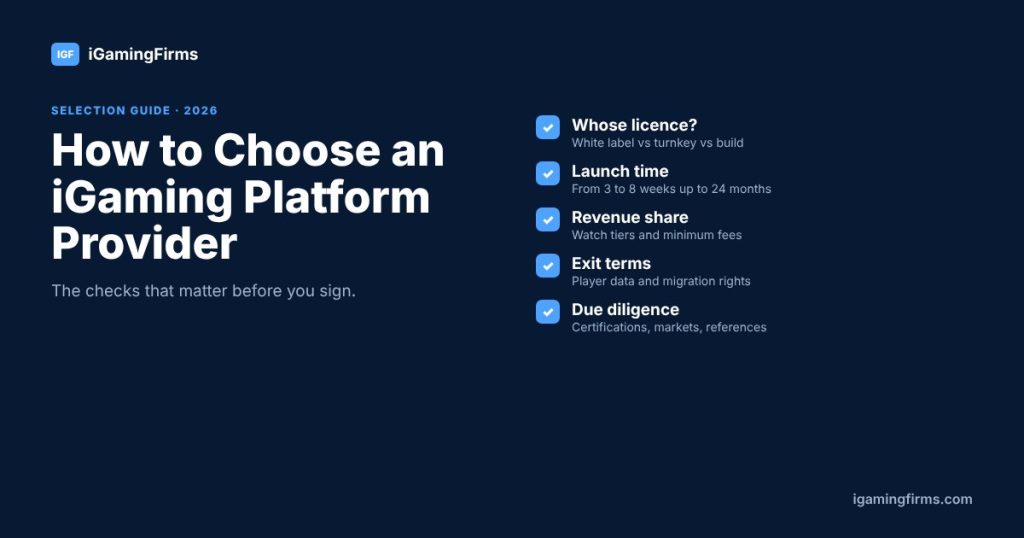
The short answer: to choose an iGaming platform provider, decide your operating model first (white label, turnkey or build), then shortlist only providers that are already certified in your target market and strong in your main vertical, and sign with the one whose revenue-share definition, data ownership and exit terms you can live with in year three, not just at launch. The cheapest launch is rarely the cheapest platform.
This is a selection guide for new operators. If you want vendor names, see our comparison of 12 white label casino platforms and the best casino software providers ranking. For detailed cost layers and licence fees, read online casino software explained: platforms, providers and costs. This page is about how to decide.
Key takeaways
- A platform provider decides your speed to market, your margin and how much of your own product you control. Pick the operating model before you shortlist vendors.
- White label launches fastest and cheapest upfront but gives you the least control, usually under the provider’s licence. Turnkey runs on your own licence with more control. Building in-house gives full control at the highest cost and longest timeline.
- Licensing, not software, usually sets your launch date. Many regulated markets do not allow white label at all.
- The definition of “revenue share” moves your P&L more than the headline percentage. Read how it is calculated.
- Exit and data-ownership terms matter more than the launch discount, because they decide whether you can ever leave.
What does an iGaming platform provider actually give you?
An iGaming platform provider supplies the core system that runs a betting or casino operation: player account management (PAM) and wallet, the game or odds layer, payments orchestration, bonusing and CRM hooks, KYC and responsible-gambling controls, and the reporting back office. Every serious provider offers these pieces. What you are really choosing between is how much of the stack they own versus rent, how much of it you are allowed to change, and how the commercials are structured around it.
Think of the platform as the operating system of the business. If the PAM is new to you, start with our explainer on what a PAM does in iGaming, because it is the part you will live with longest.
Platform provider vs game studio vs aggregator
These get confused in sales decks, and the confusion is expensive:
- Game studios make the games. A strong library tells you nothing about the backend that runs your accounts and payments.
- Aggregators connect you to many studios through one API. Many platforms bundle one, but it is a content layer, not a platform. See how a casino game aggregator works.
- Platform providers run the operation itself: accounts, wallet, payments, compliance, bonuses and reporting.
Step 1: define your requirements before you talk to vendors
A shortlist built before the brief wastes weeks, because every demo looks good when you have not said what you need. Write down, and split into “must have at launch” and “later”:
- Markets and licence: which countries, which licence, and which legal entity will hold it.
- Products: casino, sportsbook, live casino, poker, lottery, or a mix, and which one is primary.
- Brands, currencies and languages at launch and in year two.
- Payment methods your target players actually use, including local methods and, where legal, crypto.
- Existing systems you want to keep (CRM, BI, KYC, affiliate software).
- In-house team: how many engineers, traders, compliance and support staff you can fund.
White label vs turnkey vs build your own: which model fits?
Almost every provider maps to one of three operating models. The trade-off is consistent: the less you own, the faster you launch and the less of the upside you keep.
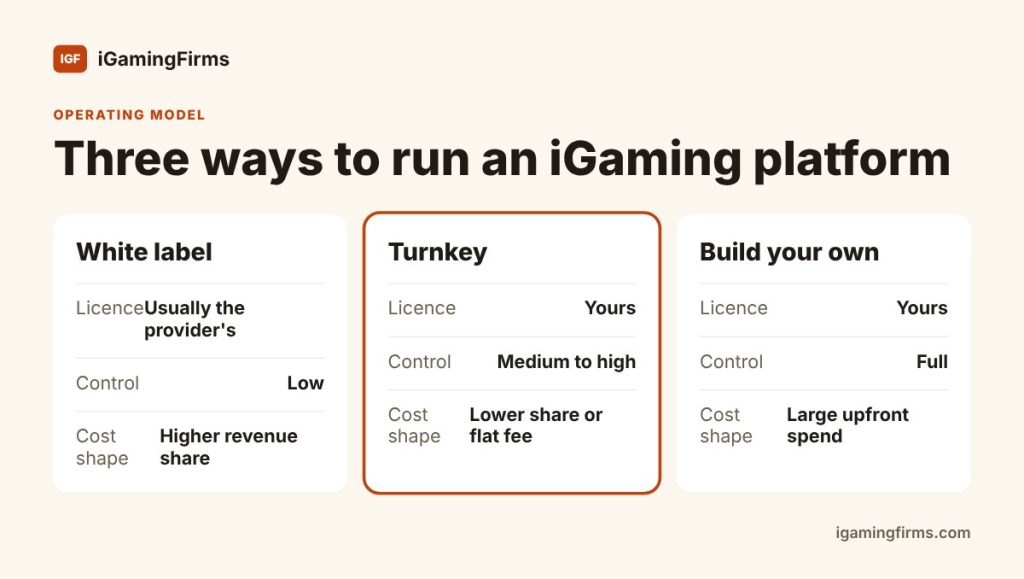
| Model | Whose licence | Control | Typical cost shape | Best for |
|---|---|---|---|---|
| White label | Usually the provider’s, where the market allows it | Low: branding, marketing, retention | Lower setup, higher revenue share for life | First-time operators testing a market |
| Turnkey | Yours | Medium to high: your PSPs, data, regulator relationship | Higher setup, lower share or flat fee, plus your own licence costs | Operators with a licence plan and growth beyond one market |
| Build your own | Yours | Full: roadmap and economics | Large upfront engineering and certification spend | Funded operators with a product a licensed platform cannot deliver |
Use the table to decide which row you are before you talk to anyone. White label and turnkey providers answer completely different questions, and many vendors sell both. For setup ranges and a break-even model between the two, see the casino software cost breakdown.
Who holds the gambling licence?
On a white label deal, the provider traditionally holds the operating licence and your brand runs under it. On turnkey or an in-house build, you hold your own. This is the single most important thing to confirm in writing, because it decides who is accountable to the regulator and what happens to your players if that licence has a problem.
Is white label still an option in 2026?
Only where the regulator lets a brand operate under someone else’s licence, and that list keeps shrinking. National regulators such as the UK, Germany, Sweden and the Netherlands require every brand to hold its own licence. Curaçao’s new gaming law (the LOK) took effect on 24 December 2024 and replaced the old master licence and sub-licence system with direct licensing by the Curaçao Gaming Authority. If your plan depends on white label, check the target market first: our Curaçao gaming licence guide and the comparison of what a gambling licence costs in 15 jurisdictions are good starting points.
Which capabilities separate one platform provider from another?
Once the model is settled, providers compete on capability. These are the features that actually differ from one platform to the next, and what each one changes for you as an operator.
| Capability | Why it matters | What to ask | White label | Turnkey / own build |
|---|---|---|---|---|
| Payment orchestration | Which PSPs and local methods work in your markets | Which PSPs are live today for my markets, and what does adding one cost? | Provider’s set and merchant accounts | Your own PSP contracts |
| Bonus engine | How flexibly you run acquisition and retention offers | Can my team configure bonuses without a developer? | Templated | Configurable |
| Game / odds aggregation | Breadth of content and speed to add suppliers | Which studios are certified for my market, and who handles certification? | Provider-led | Operator-led |
| Compliance and regulatory reporting | KYC, AML monitoring, limits, self-exclusion and regulator reports | Which functions are built in, which need a third party, and which stay with me? | Provider’s workflows | Yours to configure and own |
| APIs and integrations | Whether you can plug in your own CRM, BI and KYC tools | Can I see the API docs and a sandbox before signing? | Limited | Open, documented APIs expected |
| Data and reporting access | Whether you can query raw player data | Can I export raw data, in what format, and at what cost? | Dashboards only | Full access |
| Front-end control | How much of the player experience you own | What can I change without a provider ticket? | Themed | Fully custom |
Payments and KYC deserve their own shortlist even on a full platform. Our comparisons of iGaming payment providers and KYC providers for iGaming show which vendors are already integrated with the major platforms.
Sportsbook, casino or both: match the platform to the product
Platforms are not interchangeable across verticals. A sportsbook platform lives or dies on its odds feed, risk management, trading tools and in-play latency. A casino platform is judged on game aggregation, bonus mechanics and payment coverage. If you are launching a mixed product, confirm the provider is genuinely strong in your primary vertical rather than treating the secondary one as a checkbox. Ask for a live client in your market running that vertical, not a demo environment.
Sportsbook-first operators should also read our guide to starting a sportsbook, which covers trading, data feeds and the licence path.
How do platform providers charge?
The headline number is rarely the number that matters. What moves your P&L is how the revenue share is defined, and what sits on top of it. Read these definitions before the percentage.
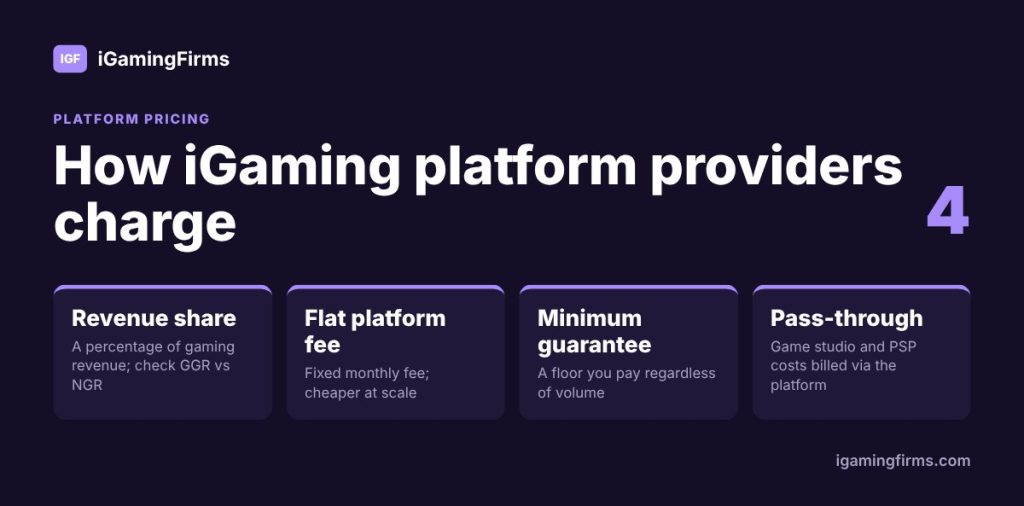
| Charge | What it is | What to watch |
|---|---|---|
| Revenue share | A percentage of gaming revenue | GGR vs NGR vs after-bonus: the base changes everything |
| Flat platform fee | A fixed monthly fee, sometimes with a smaller share on top | Cheaper at scale, painful before you have volume |
| Setup / integration fee | A one-off cost to stand the platform up | What is included vs billed later |
| Minimum guarantee | A floor you pay regardless of volume | Whether it ramps before you have traffic |
| Content and payment pass-through | Game studio fees and PSP costs billed through the platform | Whether the provider adds a margin on top |
| Per-feature add-ons | Extra modules (new PSP, market, language, brand) | Time and cost of each future integration |
Is a higher revenue share always worse?
No. A higher share on a white label deal can be cheaper overall than a turnkey setup or build you cannot yet use. Compare quotes on the same modules, the same GGR forecast and the same contract term, then check where the lines cross. Our worked white label vs turnkey cost model shows how to run that comparison.
How long does it take to launch on a platform?
The software is rarely what holds you up. Licensing is. SOFTSWISS, for example, puts its technical launch at roughly 3 to 8 weeks for both white label and turnkey, but on turnkey your own licence has to be in place first.
| Route | Software | Realistic total |
|---|---|---|
| White label (where allowed) | 3 to 8 weeks | 1 to 2 months |
| Turnkey, Curaçao licence | 3 to 8 weeks, in parallel | About 4 months or more, plus company setup |
| Turnkey, UK licence | 3 to 8 weeks, in parallel | 6 months or more, including preparation |
| Build your own | 12 to 24 months | 1 to 2 years |
Track each clock separately: company formation, licence, platform configuration, game and system certification, payment acceptance and migration. Ask the provider which of these it controls and which depend on regulators, banks or you. For UK timelines and fees, see the UKGC licence guide.
Should you use a platform provider or build in-house?
Building the stack yourself only makes sense when the platform is a long-term asset rather than a rental: when you have the funding, the engineering team and a product idea that a rented platform cannot deliver. For almost every new operator, that is not the first launch. The pragmatic path is to rent speed now, prove the market, and revisit ownership once the revenue justifies the build. Deciding that on day one, before you have players, usually over-invests in control you cannot yet use.
Due diligence: what to verify before you sign
Proof it works in your market
Ask for the exact licence, supplier approval or system certification that covers your target market, plus a named live operator using it there. A group licence in another country, a logo wall or a “planned launch” does not count. Check the regulator’s public register yourself (in the UK, the Gambling Commission public register), and ask which testing lab (for example GLI or BMM) certified the platform and games for that market.
Uptime, security and support
- A written uptime SLA with penalties, not “enterprise-grade reliability”.
- Incident history, recovery objectives, maintenance windows and DDoS protection.
- Security credentials such as ISO 27001 and recent penetration test results.
- Support response times by severity, and how support performed during the last big sporting event or launch.
Data ownership, exit and migration
Can you move your players to another platform later? Only if your contract allows it and the data is exportable in a usable form. Pin down who owns player, transaction, bonus and responsible-gambling data, the export format, any export fee, how long you keep access after termination, and what migration support the provider owes you. This is the hardest term to negotiate after signing, so settle it before you commit.
Questions to ask every provider
- Which regulated markets are you live in today, and with which operators?
- Whose licence will my brand run under, and what happens if that licence is suspended?
- Exactly how is the revenue share calculated, and on what base?
- Which PSPs, KYC vendors and game studios are already integrated for my markets?
- What can my team configure without raising a ticket?
- How are updates deployed, and do they cause downtime?
- What are the exit terms, migration timeline and data export costs?
Common mistakes new operators make
- Choosing on launch price and discovering the exit terms trap them a year later.
- Signing a revenue share without pinning down whether it is calculated on gross, net or post-bonus revenue.
- Planning a white label launch in a market that requires every brand to hold its own licence.
- Judging a platform by its game library instead of its backend.
- Picking a provider strong in the wrong vertical for their primary product.
- Under-scoping payments, then paying per integration for every new market and PSP.
- Buying control they cannot yet staff: a turnkey or in-house platform with no team behind it.
Next step: build your shortlist
Once you know your model, market and must-haves, shortlist two to four providers and compare them on the same scope. Start with the white label casino platform comparison if you want to launch fast, or the casino software provider ranking if you are going turnkey on your own licence.