Last updated: 15 October 2026
Online casino software is the stack of systems that runs a real-money casino: player accounts and wallet, game content, payments, bonuses, compliance and reporting. You can rent it as a white label, license it as a turnkey platform on your own gambling licence, or build it yourself.
The short answer: a white-label casino typically needs around €20,000 to €60,000 upfront, while a turnkey setup on your own licence sits around €60,000 to €100,000+, according to SOFTSWISS’s own figures (updated September 2026). The setup fee is the smallest number in the deal, though. Revenue share, game content fees and licensing are what decide whether your casino makes money.
Vendor quotes for the same project can range from tens of thousands of euros to seven figures, and few explain which fees stack on top of which. This guide breaks the software into the parts you actually pay for, explains the three ways to buy it, and gives you a cost model with 2026 regulator fees and stated assumptions, so you can see where white label stops being the cheap option.
What is online casino software?
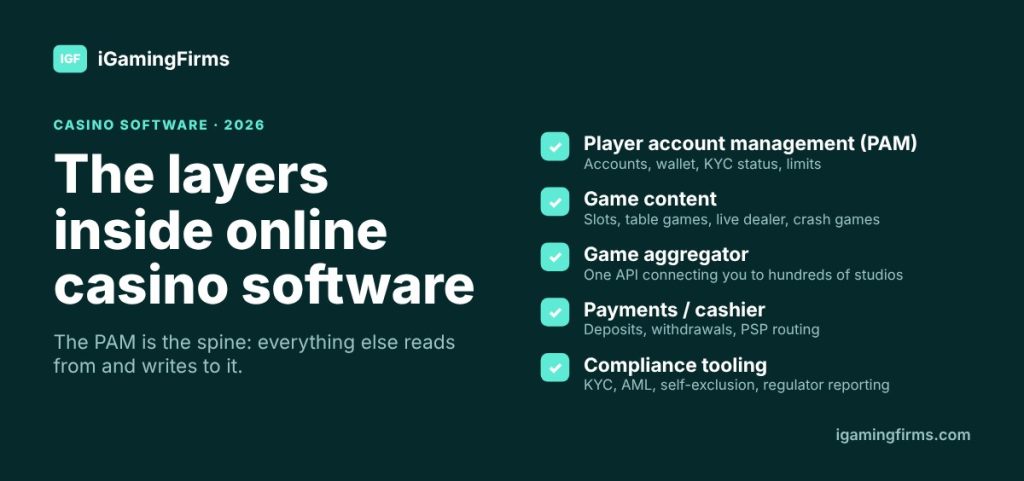
Online casino software isn’t one product. It’s a set of systems that together run the business, and a “platform” deal is usually a bundle of some or all of them:
| Layer | What it does | Who usually supplies it |
|---|---|---|
| Player account management (PAM) | Accounts, wallet, balances, KYC status, responsible gambling limits, audit trail | Platform provider |
| Game content | Slots, table games, live dealer, crash games | Game studios, usually through an aggregator |
| Game aggregator | One API connecting you to hundreds of studios | Aggregator (often the same company as the platform) |
| Payments / cashier | Deposits, withdrawals, PSP routing, reconciliation | Platform plus your own PSP contracts |
| Bonus engine and CRM | Free spins, deposit offers, segmentation, lifecycle campaigns | Platform or a dedicated CRM vendor |
| Compliance tooling | KYC, AML monitoring, PEP and sanctions checks, self-exclusion, regulator reporting | Platform plus KYC vendors |
| Affiliate tracking | Attribution and commission payouts for partners | Platform module or a dedicated affiliate platform |
The PAM is the spine. Everything else reads from and writes to it, so when you compare vendors, compare PAM quality first and lobby design last. Our explainer on what a PAM does in iGaming covers the modules in more depth.
One distinction trips up a lot of first-time buyers: a game aggregator is not a casino platform. The aggregator supplies the games; the platform runs the business around them. SOFTSWISS, for example, sells both separately and says on its Game Aggregator page that operators need both. That page lists 40,000+ titles from 300+ providers and a three-week launch for the aggregator alone. If you’re unclear on the split, read how a casino game aggregator works.
The three ways to buy casino software
| Model | Whose licence | Upfront | Tech launch | Ongoing cost driver |
|---|---|---|---|---|
| White label | Usually the provider’s | ~€20k to €60k+ | 3 to 8 weeks | High revenue share for life |
| Turnkey | Yours | ~€60k to €100k+ incl. licensing | 3 to 8 weeks, plus licensing time | Lower share or flat fee, plus your own licence fees |
| Build your own | Yours | Commonly $500k+ | 12 to 24 months | Engineering payroll, certification, hosting |
White label: rent the platform and the licence
You get a fully managed casino under your brand, running on the provider’s infrastructure and, traditionally, under the provider’s gambling licence. The provider typically covers hosting, game integrations, merchant accounts, fraud monitoring and KYC/AML tooling. You handle branding, marketing, retention and often first-line support.
- Launch time: SOFTSWISS puts it at roughly 3 to 8 weeks from agreement to launch.
- Upfront cost: around €20,000 to €60,000+.
- The catch: higher revenue share for life, limited control over games, PSPs and backend logic, and a shrinking list of markets that accept it.
Is a white-label casino still legal in 2026?
Only where the regulator allows a brand to operate under someone else’s licence, and that list is getting shorter. National regulators such as the UK, Germany, Sweden and the Netherlands require every brand to hold its own licence, so white label isn’t an option there. Curaçao also changed: its new gaming law (the LOK) took effect on 24 December 2024 and replaced the old master licence and sub-licence system with direct licensing by the Curaçao Gaming Authority. Some providers still run several brands under their own licences, but confirm in writing exactly whose licence your brand will sit under, and what happens to your players if that licence has a problem.
Turnkey: your licence, their platform
You hold the gambling licence. The provider delivers a production-ready stack (PAM, back office, game hub, payments hub, compliance tooling, hosting) and you run the business on it.
- Launch time: about 3 to 8 weeks for the tech, but that excludes licensing (see the timeline section below).
- Upfront cost: around €60,000 to €100,000+ including licensing and vendor fees, per SOFTSWISS.
- Why operators move to it: lower ongoing fees, a direct regulator relationship, your own PSP contracts and player data control, and the ability to add markets and brands without new white-label contracts.
Build your own (in-house)
Full control of the roadmap and economics, but you’re funding a large engineering team, RNG and platform certification, every integration, and a timeline measured in years rather than weeks. Industry estimates for a custom platform commonly start around $500,000 and 12 to 24 months before the first real-money bet, and that’s before licensing and marketing. It makes sense for well-funded operators with a clear reason a licensed platform can’t meet their needs. For almost everyone else, it’s turnkey or white label. Our guide to how new operators choose an iGaming platform provider walks through the selection process.
Who makes online casino software?
Vendors fall into a few groups, and many sit in more than one. Most of page one for “online casino software” is vendors’ own sales pages, and none of the ones reviewed for this guide publish a price list, so treat any “starting from” number in a comparison article as an estimate unless it comes from the vendor itself.
| Type | Examples | What you’d buy from them |
|---|---|---|
| Full platform (white label and/or turnkey) | SOFTSWISS, EveryMatrix, SoftGamings, Slotegrator, BetConstruct, Digitain, GammaStack, Gamingtec, NuxGame | PAM, back office, payments hub, game aggregation, often sportsbook |
| Enterprise platform and content | Playtech | Integrated casino, live, sportsbook, poker and bingo for large regulated operators |
| Game aggregators | SOFTSWISS Game Aggregator, EveryMatrix, Slotegrator, SoftGamings | One integration to hundreds of studios |
| Game studios | Pragmatic Play, Evolution (live), Play’n GO, NetEnt, Hacksaw Gaming | The games themselves, usually via an aggregator |
| Specialist modules | KYC, CRM, affiliate and payment vendors | Best-of-breed tools plugged into your platform |
This guide explains the categories and the economics. For a vendor-by-vendor shortlist with strengths and weaknesses, see our ranking of the best casino software providers in 2026. You can also browse vendors by category in our directories for platform and white-label providers, game aggregators and game studios.
How casino software is priced: the three commercial models
Before you compare numbers, check which pricing model each quote uses. Vendors mix them, and two quotes with the same headline figure can cost very different amounts.
- Revenue share: the provider takes a percentage of GGR or NGR every month. Low entry cost, but the bill grows with every euro you earn. Standard for white label and common for turnkey.
- Flat monthly fee (SaaS): a fixed platform fee, sometimes with a smaller revenue share on top. Predictable, and cheaper at scale, but it hurts in the months before you have volume.
- Licence buyout or source code: a one-off payment for a platform you own or self-host, plus a support contract. Highest upfront cost, lowest ongoing share, and you carry hosting, upgrades and certification yourself.
Whichever model you choose, game content is almost always charged separately as a share of the GGR each studio’s games generate.
What does online casino software cost? The five cost layers
Almost every quote breaks into the same layers. The trick is knowing which ones are fixed, which grow with your revenue, and which sit on top of each other.
| Cost layer | How it’s charged | Typical range | Source quality |
|---|---|---|---|
| Platform setup | One-off | ~€20k to €60k+ (white label); ~€60k to €100k+ (turnkey, incl. licensing) | Vendor-stated (SOFTSWISS) |
| Platform fee | Monthly flat fee, % of GGR/NGR, or both | Not published by most vendors; white label carries the higher revenue share | Quote only |
| Game content | % of GGR on each studio’s games, paid via the aggregator | Commonly cited around 10% to 20% of game GGR; some studios add monthly minimums | Industry estimate, no public rate cards |
| Payments | Per transaction / % of deposit volume | Varies by method and risk profile | PSP contracts |
| Licensing and tax | Application, annual fees, GGR-based contributions and duties | See the licensing table below | Regulator-published |
Two things catch operators out here.
Game fees usually come on top of the platform revenue share. A “15% revenue share” platform deal often doesn’t include what the studios take. Ask every vendor in writing whether game content fees are inside or outside their percentage.
GGR and NGR are not the same base. A share of GGR (bets minus wins) costs you more than the same percentage of NGR (GGR minus bonuses, taxes and some fees). A 15% NGR deal can be cheaper than a 10% GGR deal once bonuses are heavy. Get the exact deduction list written into the contract.
Costs the platform quote usually leaves out
- Game and RNG certification. Most regulated markets require games and random number generators to be tested by an accredited lab such as GLI, BMM, eCOGRA or iTech Labs. On a licensed platform with certified content this is largely covered; on your own build or a new market it is a separate budget line.
- Extra integrations. Adding PSPs, KYC vendors, a CRM or studios the platform doesn’t already support is often billed as custom work.
- Localisation. Languages, currencies, local payment methods and market-specific responsible gambling rules.
- Hosting rules. Some regulators require player data or game servers in the jurisdiction, which can rule out a vendor’s standard cloud setup.
- Sportsbook. If you want betting as well as casino, a sportsbook module and odds feed are usually priced separately.
- Local substance. Company setup, local directors and key-function staff that your licence requires.
Licensing costs in 2026 (regulator-published figures)
This is where many cost guides are out of date. You’ll still see Curaçao quoted at €6,000 to €12,000 a year (the old sub-licence price), but under the current law a B2C licence costs €47,450 a year before local substance costs. UK costs also rose twice in 2026, and Malta’s gaming tax changed on 1 October.
| Jurisdiction | Application | Annual fees | Notes |
|---|---|---|---|
| Curaçao (B2C, under the LOK) | €4,592 | €47,450 (€24,490 licence fee to the Treasury + €22,960 supervisory fee to the CGA) | Direct licensing by the Curaçao Gaming Authority; fees due by 15 January each year. See our Curaçao gaming licence guide |
| Malta (MGA, B2C Gaming Service Licence) | €5,000 | €25,000 fixed fee, plus a compliance contribution (Type 1 casino: minimum €15,000, maximum €375,000, starting at 1.25% of the first €3M of revenue) | From 1 October 2026 the flat 5% gaming tax was replaced by 15% for Type 1 (casino) and 10% for Types 2 to 4, on revenue from players in Malta (see our MGA licence guide) |
| Great Britain (UKGC remote casino) | From £8,185, banded by gross gambling yield | From £7,000, banded by gross gambling yield; fees rose by a headline 25% on 1 October 2026 | Remote Gaming Duty rose from 21% to 40% of profits on 1 April 2026. See our UKGC licence guide |
| United States | State by state | State by state | Real-money online casino is live in seven states (Connecticut, Delaware, Michigan, New Jersey, Pennsylvania, Rhode Island and West Virginia), with Maine legal but not yet live; operators and suppliers both need state approval |
Sources: the Curaçao Gaming Authority’s LOK fee briefing and its October 2025 fee guidance (version 2.0), the MGA’s licence fees and taxation guidance note, HMRC’s changes to gambling duties, the Gambling Commission’s fee schedule in force from 1 October 2026, and Malta’s gaming tax amendments effective 1 October 2026. For a wider comparison, see what a gambling licence costs across 15 jurisdictions.
The UK numbers change the platform question entirely. At 40% duty on top of game fees, platform fees and payments, the UK only works for operators with real scale and strong unit economics, and it never works on white label because each brand needs its own UKGC licence. If the UK is on your roadmap, read our United Kingdom market guide before you sign anything.
How long does it take to launch an online casino?
The software is rarely what holds you up. Licensing is.
| Route | Software | Licence | Realistic total |
|---|---|---|---|
| White label | 3 to 8 weeks | Provider’s licence (where allowed) | 1 to 2 months |
| Turnkey, Curaçao | 3 to 8 weeks, in parallel | CGA review in two phases of about eight weeks each | About 4 months or more, plus company setup |
| Turnkey, UK | 3 to 8 weeks, in parallel | UKGC target of 16 weeks for a complete application | 6 months or more, including preparation |
| Custom build | 12 to 24 months | In parallel | 1 to 2 years |
Regulator targets assume a complete application. Missing documents, source-of-funds questions and key-person checks are what usually push timelines out.
Worked example: when does white label stop being cheaper?
None of the comparison pages reviewed for this guide model this properly, so here’s a simple version you can rebuild with your own quotes. Every assumption is stated; swap in the numbers from your proposals.
Assumptions
- Casino only, Curaçao-licensed target markets, first full year.
- White label: €40,000 setup (inside SOFTSWISS’s €20k to €60k range), 20% of GGR platform revenue share, licence covered by the provider.
- Turnkey: €50,000 platform setup, €8,000 per month flat platform fee (assumption, get your own quote), plus your own Curaçao licence: €4,592 application and €47,450 per year.
- Both: game content at 12% of GGR and payments modelled at 4% of GGR for simplicity.
- Not included: local substance costs in Curaçao (company, director), marketing, bonuses, staff, affiliate commissions and corporate tax.
Results
| Annual GGR | White label, year 1 | Turnkey, year 1 | White label, year 2+ | Turnkey, year 2+ |
|---|---|---|---|---|
| €300,000 (€25k/month) | €148,000 | €246,042 | €108,000 | €191,450 |
| €1,200,000 (€100k/month) | €472,000 | €390,042 | €432,000 | €335,450 |
Here’s the formula behind it:
- White label = setup + (20% + 12% + 4%) × GGR
- Turnkey = setup + €96,000 platform fee + €47,450 licence (+ €4,592 application in year 1) + (12% + 4%) × GGR
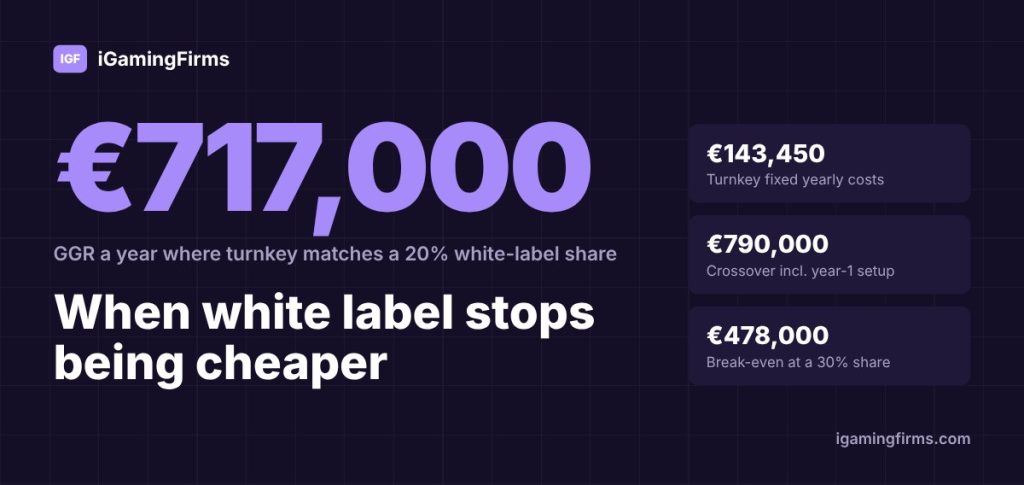
The break-even point: the turnkey model’s fixed yearly costs (€96,000 platform fee + €47,450 licence = €143,450) equal a 20% white-label revenue share at about €717,000 GGR a year, or roughly €60,000 a month. Including year-1 setup and the application fee, the crossover sits nearer €790,000 a year (about €66,000 a month).
So under these assumptions:
- If you expect to stay under roughly €60k monthly GGR, white label is cheaper on pure software and licence cost.
- Above that, every extra euro of GGR costs you 20 cents more on white label, and turnkey pulls ahead fast. At €100k a month, the gap is about €97,000 a year from year 2.
- If your white-label revenue share is 30% rather than 20%, the break-even drops to around €478,000 a year (about €40k a month).
That’s the real decision rule: white label is a market-test tool, turnkey is a growth tool. If your business plan assumes six-figure monthly GGR within 12 to 18 months, price the migration from day one, or skip white label altogether.
Questions to ask every vendor before you sign
- Is the revenue share on GGR or NGR, and what exactly is deducted? Get the list in writing.
- Are game content fees inside or outside your percentage? And do any studios charge monthly minimums?
- Whose licence does my brand run under, and what happens to my players and balances if that licence is suspended?
- Can I use my own PSPs and add game studios that aren’t already integrated, and what does each new integration cost?
- Who is the data controller for player data, and can I export full player and transaction history in a usable format if I leave?
- What are the exit terms? Notice period, migration support, fees for leaving.
- Which regulated markets is the platform certified for today, not “on the roadmap”?
- What’s the uptime SLA, the incident history for the last 12 months, and the guaranteed support response time? Stability and support quality are the issues operators raise most often, and they only show up after launch.
- What does the KYC/AML tooling actually do? Named vendors, liveness checks, configurable monitoring rules, self-exclusion integrations.
- Is a sandbox and full API documentation available before contract?
Red flags
- A very low setup fee paired with a revenue share that isn’t defined until the contract stage.
- “Licence included” with no clarity on which entity holds it or whether your target markets accept it.
- No raw data export or a vague data-ownership clause.
- Game fees, payment fees and “admin fees” that only appear in the appendix.
- Long lock-ins with automatic renewal and no migration support.
- Any vendor that suggests targeting markets your licence doesn’t cover.
What this means for your next step
If you’re launching your first casino in Curaçao-licensed markets and want to test demand, white label gets you live in weeks for the lowest upfront spend. Just model the break-even and agree the migration path before you sign.
If you already know your markets, expect meaningful volume, or plan to enter regulated markets like the UK, Brazil or Ontario, go turnkey on your own licence. You’ll pay more upfront and wait longer for licensing, but your costs stop growing with every euro you earn.
Either way, the software is only part of the build. You’ll also need licensing consultants, KYC and compliance tools, payment providers and a CRM that fits your markets.