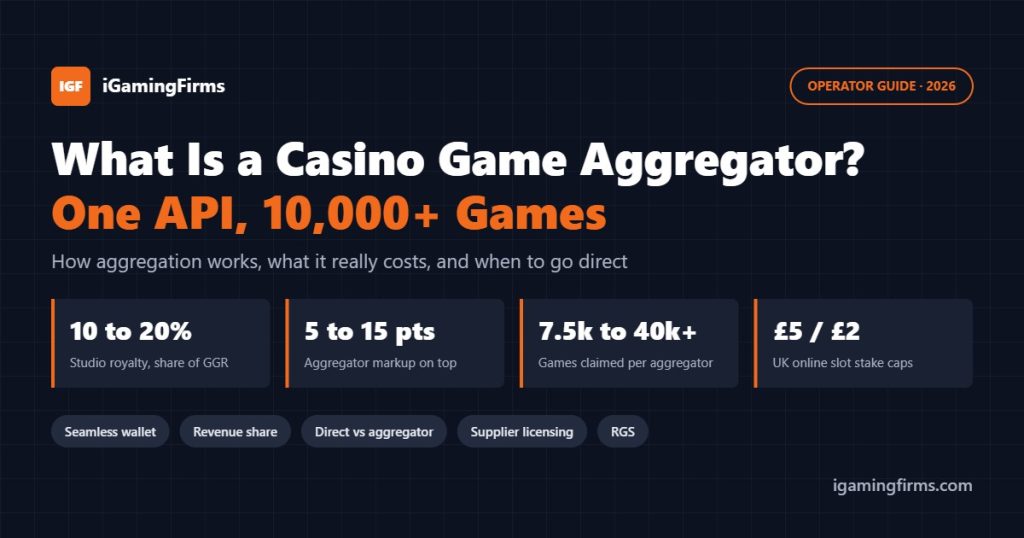
The short answer: a casino game aggregator is a B2B supplier that plugs your online casino into games from hundreds of studios through one API and one contract. You integrate once, and the aggregator handles every studio connection, contract and invoice behind it.
You want a casino lobby that can stand next to the big brands, and those brands carry thousands of slots, live tables and crash games. Building a separate connection to every studio behind them would take your tech team years. That gap is the whole reason casino game aggregators exist.
This guide explains how one API call reaches a game hosted by a studio you have never spoken to, what the “10,000 games” claim really means for your lobby, how aggregators charge, and the point at which going direct to a studio starts to pay. If you already know the concept and want to compare suppliers, go straight to our comparison of the top casino game aggregators.
What is a casino game aggregator?
A casino game aggregator is a B2B supplier that connects an online casino to games from many studios through one technical integration and one commercial contract. You integrate the aggregator once, and it handles the separate connections, contracts, certification paperwork and support for every studio in its catalogue.
Think of it as a wholesaler. The studios build and host the games. The aggregator signs them up, standardises their APIs into one, and resells access. You pick the titles you want and they appear in your lobby, while each spin still runs on the studio’s own server.
It is a B2B product only. Players never see the aggregator’s name, and operators, platform providers and white-label brands are its customers.
Aggregator vs game studio vs game API provider
The three terms get mixed up in sales decks:
- A game studio (or game provider) designs the games, owns the maths and runs the remote game server. It sells its own titles.
- A game aggregator sells access to many studios’ titles through one integration. It does not make the games.
- “Game API provider” is usually a marketing label for an aggregator. Some vendors also use it for a single studio’s integration kit, so ask whether the API covers one studio or many.
How does a game aggregator work?
Every aggregator does the same three jobs: it connects to studios, it translates their different systems into one standard, and it passes traffic and money messages between you and them. Here is what happens when a player clicks a slot in your lobby:

- Launch request. Your platform sends the aggregator the player ID, currency, language, device, market and, in some markets, the player’s age band.
- Routing. The aggregator checks the game is enabled for your brand and that market, then opens a session on the studio’s remote game server (RGS).
- Game play. The game loads from the studio. The aggregator never runs the maths; the studio’s certified RGS does.
- Wallet calls. Each bet, win and rollback travels back through the aggregator to your wallet, usually as a seamless wallet call, so the player’s balance lives in one place: your platform. Older transfer wallet setups move money into a separate game balance instead, which is clunkier and harder to reconcile.
- Reporting and billing. The aggregator logs every round, totals gross gaming revenue (GGR) by studio, and invoices you monthly. It then pays each studio its share.
The part buyers underestimate is step 4. Every transaction needs a unique ID so a timeout or a duplicate message does not pay a player twice. Ask any aggregator how it handles retries and rollbacks before you look at its game count.
Where the aggregator sits in your stack
Aggregators get confused with platforms all the time, partly because many platforms bundle one. Each layer owns something different:
| Layer | What it does | What it does not do |
|---|---|---|
| Operator (you) | Holds the licence, owns the player, runs marketing and responsible gambling | Build or host the games |
| Platform / PAM | Player accounts, wallet, bonuses, KYC hooks, back office | Supply third-party games on its own (unless an aggregator is bundled) |
| Game aggregator | One API and one contract for many studios, catalogue data, game reporting, studio support | Hold your player wallet or take over your licence duties |
| Game studio | Makes the games, runs the RGS, gets games certified | Give you access to other studios |
How long does integration take?
Vendors quote anything from a few days to about six weeks for the technical integration (see the table below). Treat that as the best case. Contract signing, studio approvals and per-market game certification often take longer than the code, so plan the launch around the slowest studio you cannot open without.
Examples of casino game aggregators
Most suppliers lead with their catalogue size. Here are the headline numbers several well-known casino game aggregators publish on their own sites, checked on 9 October 2026:
| Aggregator | Games claimed | Studios claimed | Integration time claimed |
|---|---|---|---|
| SOFTSWISS Game Aggregator | 40,000+ | 300+ | Under 3 weeks |
| Hub88 | 26,000+ | 200+ (100+ in another section) | As little as 3 days |
| Vyking | 25,000+ | 250 studios | Not stated |
| Altenar (Agreegain) | 25,000+ | Not stated | Not stated |
| Evenbeter | 15,000+ | 230+ | Environment ready within a week |
| GR8 Tech | 15,000+ | 175+ | Not stated |
| Celesta | 7,500+ (4,500+ in its FAQ) | 100+ | 4 to 6 weeks |
| EveryMatrix CasinoEngine | “World’s largest” library, no figure | Not stated | Not stated |
Notice the inconsistencies. Two of these suppliers give different numbers on the same page. These are marketing figures, not audited ones, and that is the first lesson about the “10,000 games” pitch. This guide stays on how aggregators work; for licences, pricing notes and a ranked shortlist of each vendor, see our side-by-side review of 12 aggregator platforms.
The different types of casino game aggregators
- Standalone aggregators sell content to any platform. Hub88 and Vyking are examples.
- Platform-bundled aggregators come inside a casino platform or turnkey deal, as with SOFTSWISS, EveryMatrix, Altenar and GR8 Tech. Handy if you are already on that platform; harder to leave later.
- Studio-owned hubs are run by a game company that distributes its own titles plus partner studios. Expect their own games to get the best placement in the pitch.
- Regional and niche aggregators focus on one market (Latin America, Asia, Africa) or one product (crash games, live dealer, crypto content).
Does one integration really get you 10,000 games?
Technically yes. In practice, the number that reaches your lobby is much smaller, for four reasons:
- Market approval. A game can only go live where the studio holds the right licence and certification. A title available in Curaçao may not be approved in Great Britain, Ontario or Brazil. Your live catalogue is the overlap between the aggregator’s library, the studios’ licences and your own licence. Our Curaçao licence guide covers how that licence choice shapes your options.
- Market configuration. Rules change game settings. In Great Britain, online slots have been capped at £5 a spin for adults aged 25 and over since 9 April 2025, and £2 for 18 to 24 year olds since 21 May 2025, according to the Gambling Commission’s stake limit guidance. That means your platform has to send the player’s age band with every launch, and the studio’s game has to enforce the right cap. The aggregator is the pipe in between, so ask how it passes that data.
- Studio sign-off. Some studios approve each operator individually or keep their biggest titles for direct partners. “Available in the catalogue” does not always mean “available to you”.
- Your own curation. Ten thousand titles is a navigation problem, not a feature. Most operators launch with a few hundred proven games and add studios in waves, measuring what players actually open.
So when an aggregator quotes a catalogue number, ask for the list of games currently live and approved for your specific licence, currency and markets. That list is the real offer.
How many studios do you actually need?
Fewer than the brochure suggests. What matters is whether the handful of studios your target players already know are live in your markets, plus enough variety in slots, live casino and instant games to fill each lobby category. A catalogue of 20 well-chosen studios that are all approved for your licence beats 300 studios you cannot switch on.
How much does a casino game aggregator cost?
Almost every aggregator charges a share of the GGR your players generate on its games, invoiced monthly. On top of that you may see a one-off setup or integration fee, a monthly minimum, and fees for extras like jackpot or tournament tools. Pricing is rarely published, so treat every figure below as a starting point for negotiation, not a quote.
The fee has two layers:
- The studio’s royalty. Game provider royalties typically take 10 to 20% of GGR, according to Hub88’s guide to GGR and NGR. Premium studios and live casino usually sit at the higher end.
- The aggregator’s margin. The aggregator adds its own cut on top of the studio’s royalty, or blends both into one rate. Published estimates vary widely: PieGaming’s guide puts typical markups at 1 to 4 percentage points over provider rates, while full-service deals with more support bundled can cost noticeably more. Where you land depends on your volume, your markets and what is included.
Common aggregator pricing models
| Model | How it works | Best fit |
|---|---|---|
| Revenue share | One blended percentage of GGR per studio or game type | New casinos with uncertain volume |
| Markup on studio rate | Studio royalty passed through, plus a fixed number of points for the aggregator | Operators who want to see what each studio really costs |
| Tiered share | The percentage falls as your monthly GGR crosses agreed thresholds | Growing brands that expect volume to climb |
| Fixed fee or hybrid | A flat monthly fee, or a lower base fee plus a smaller GGR share | High-volume operators where a percentage gets expensive |
Read the billing definition carefully. Some contracts charge on GGR before bonuses, others let you deduct bonus costs first. On a promotion-heavy casino, that one line can move your bill more than the headline rate.
How aggregators make money
An aggregator earns the gap between what you pay and what it passes to studios. Because it brings many operators to each studio, it can negotiate studio rates that a single new casino could not get, which is why the blended price is sometimes close to going direct. Its profit grows with your GGR, so a good aggregator has a real interest in helping your lobby perform.
Aggregator vs direct integration: when to go direct
An aggregator saves you engineering time. A direct deal saves you margin. The question is when the margin you give away each year is bigger than what a direct integration costs to build and run.
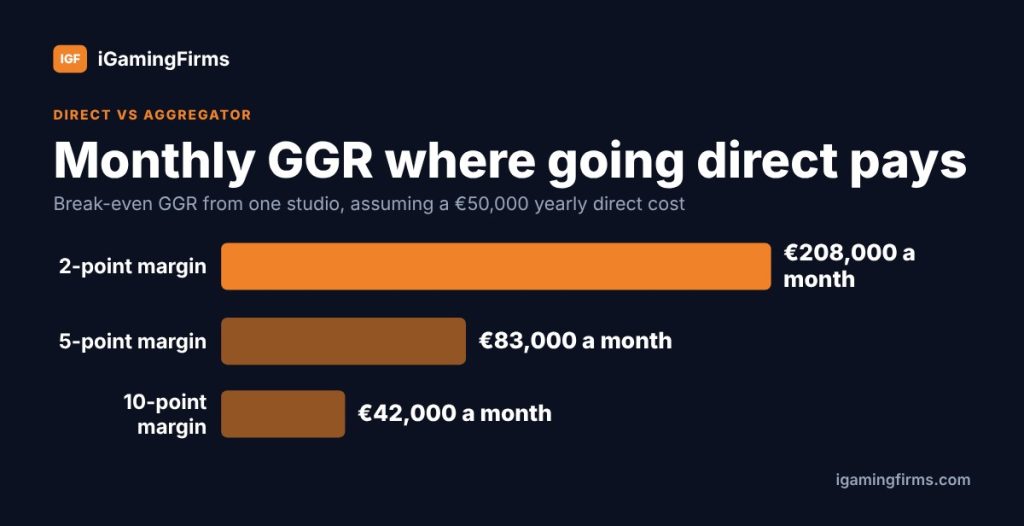
Here is a simple way to work it out for one studio. The inputs below are assumptions for illustration, so swap in your own numbers:
| Input | Assumption |
|---|---|
| Aggregator margin on top of the studio royalty | 2, 5 or 10 percentage points (three scenarios) |
| One-off cost to build and certify a direct integration | €60,000, spread over 2 years = €30,000 a year |
| Yearly cost to maintain it (updates, support, reconciliation) | €20,000 |
| Total yearly cost of going direct | €50,000 |
Break-even monthly GGR from that studio = yearly direct cost ÷ 12 ÷ aggregator margin.
- At a 2-point margin: €50,000 ÷ 12 ÷ 0.02 = about €208,000 a month in GGR from that one studio.
- At a 5-point margin: €50,000 ÷ 12 ÷ 0.05 = about €83,000 a month.
- At a 10-point margin: €50,000 ÷ 12 ÷ 0.10 = about €42,000 a month.
Below that line, the aggregator is cheaper. Above it, start a direct conversation. The thinner the aggregator’s margin, the more GGR a studio has to earn you before direct pays. In practice, that is why established operators often run a hybrid: direct deals with the two or three studios that earn most of their GGR (often the big live casino and slot brands), and one or two aggregators for the long tail. The studio still has to agree to a direct deal, and a direct contract does not guarantee a lower royalty than the aggregator has already negotiated, so get both quotes in writing.
Who should use a casino game aggregator?
- New and white-label casinos that need a full lobby at launch and have no engineering budget for dozens of studio integrations.
- Sportsbooks adding casino, where the casino vertical is a cross-sell and speed matters more than margin.
- Operators entering a new regulated market, who need content that is already certified there.
- Multi-brand groups, which can switch the same studios on across brands from one contract.
A pure aggregator setup makes less sense once a few studios drive most of your GGR. That is the point to run the break-even maths above.
What are the risks of using an aggregator?
- Single point of failure. If the aggregator’s API goes down, every game behind it goes down with it. Ask for the uptime SLA, the incident history and what you get back if they miss it.
- Lock-in. Bundled aggregators can be hard to separate from the platform. Check the exit terms and whether you keep game IDs and history if you move.
- Less control over studios. Studio relationships, exclusive titles and early releases tend to go to direct partners. Through an aggregator you are one of many.
- Margin stacking. If your platform resells someone else’s aggregator, you may be paying two layers of markup without knowing it. Ask who actually holds the studio contracts.
- Reconciliation gaps. Three parties (you, the aggregator, the studio) each record the same transactions. Mismatches happen, so agree who investigates and how fast before launch.
- Compliance assumptions. Some aggregator marketing implies it “handles compliance”. It does not take over your licence. Responsible gambling, age checks, stake limits and market rules stay your obligation as the licensed operator.
Can you switch aggregators later?
Yes, but it is a migration, not a setting. Game IDs, lobby configuration, player game history and open bonuses, free spins or jackpot contributions are tied to the old integration. Many operators reduce the risk by adding a second aggregator first, moving studios across in batches, and only then giving notice. Agree the data handover in the original contract, while you still have leverage.
Licensing: what an aggregator needs, and what stays with you
Because a casino game aggregator supplies gambling software to operators, regulated markets license it too. In Great Britain, any business that manufactures, supplies, installs or adapts gambling software for remote gambling needs a Gambling Commission remote gambling software licence. Updated fees for it took effect on 1 October 2026, with application fees from £7,212 to £99,446 and annual fees from £7,394 to £191,880, depending on the supplier’s gross gambling yield. In Malta, aggregators hold an MGA B2B Critical Gaming Supply licence, and both Hub88 and SOFTSWISS list their MGA B2B licence numbers on their sites. US states and Ontario also license or register gaming suppliers one market at a time.
For you, that creates a simple checklist before signing:
- Does the aggregator hold the supplier licence for every market you plan to enter?
- Is every game you want certified for those markets, and can they show the certificates?
- Can their launch flow pass the player data your regulator requires (age band for UK stake limits, for example)?
- Who reports to the regulator, and in what format, if a game malfunctions?
If you are entering Great Britain, our UKGC licence guide covers the operator side of those rules.
How to choose a casino game aggregator
- Start from your markets, not their catalogue. Ask for a live game list filtered by your licence, currencies and target countries.
- Check the studios you actually need. If your players expect specific live casino or slot brands, confirm those are included for your markets.
- Test the integration. Get sandbox access, read the API docs, and test failed bets, rollbacks and timeouts, not just a successful spin.
- Compare price on the same basis. Same GGR definition, same bonus treatment, same minimums, same markets.
- Check support and tools. 24/7 incident contacts, reporting by studio and game, and promotion tools such as tournaments, free spins and jackpots.
- Read the exit clause. Notice period, data handover and what happens to running jackpots or campaigns.
If you are still picking a platform, decide on the aggregator at the same time, because many platforms push their own. Our guide to how new operators choose an iGaming platform provider covers that decision, and our list of the best casino software providers in 2026 compares the main options.
What aggregators mean for affiliates and SEO teams
If you run casino review or comparison sites, casino game aggregators explain why so many casinos share near-identical game lobbies. Game count stopped being a meaningful differentiator once any new brand could plug into 10,000 titles in weeks. Studio exclusives, live casino quality, payout speed and market-specific content say far more about an operator than its total game number.
Where to go next
Ready to shortlist? Our casino game aggregator comparison ranks 12 platforms on catalogue, licences and integration, or browse slot game studios if you are weighing direct deals.