Last updated: 15 October 2026
The short answer: the best casino software providers in 2026 are Evolution for live casino; Pragmatic Play, Play’n GO and Hacksaw for slots; Playtech, EveryMatrix and SOFTSWISS for platforms; and Light & Wonder, Games Global and IGT for distribution and casino-floor brands. Which one is best for you depends on which layer of your casino stack you are buying.
Ask three operators who their “casino software provider” is and you get three different kinds of answer. One names a turnkey platform. One names an aggregator that plugs in hundreds of studios. The third names Evolution, because live casino is half their revenue. All three are right, and that is why most “best provider” lists are hard to use: they rank a platform, a slot studio and a live studio on the same scale, as if you could swap one for another.
This guide places each of the 10 providers below in the layer of your stack it actually fills, then reviews it on what matters when you sign a contract in 2026: financial health, ownership changes, licensing footprint and compliance issues from the last 12 months. If you need the basics first, start with our explainer on how online casino software works and what it costs; this page is the vendor ranking.
The research draws on each vendor’s own documentation, investor reports and case studies, trade coverage, review sites such as G2, Capterra and Trustpilot, and operator comments in public partnership announcements. No provider paid to be included.
Quick comparison: 10 best casino software providers in 2026
| # | Provider | What you are buying | Best for | Ownership | 2026 signal |
|---|---|---|---|---|---|
| 1 | Evolution | Live casino + RNG content (NetEnt, Red Tiger, Big Time Gaming, Nolimit City, Ezugi) | Operators where live is a core revenue line | Listed, Nasdaq Stockholm | Q2 revenue €517.8m; RNG up 14%, live down 3.6% |
| 2 | Pragmatic Play | Multi-product content: slots, live, bingo through one API | Fast content coverage outside the US | Private | Exited US sweepstakes in 2025 |
| 3 | Playtech | Platform (IMS / Playtech ONE) + slots + live | Large regulated operators wanting one B2B partner | Listed, London | Now a pure B2B company after €2.3bn Snaitech sale |
| 4 | Light & Wonder | OpenGaming content and aggregation platform | US and land-based brands going online | Listed, ASX only | Q2 iGaming revenue up 14% to $92m |
| 5 | Games Global | Studio network + distribution (ex-Microgaming catalogue) | Jackpot-led and legacy-content portfolios | Private | 30+ studios, 1,400+ proprietary games |
| 6 | Play’n GO | In-house slot studio | Regulated markets that value long-tail slot performance | Private | Still expanding US state by state |
| 7 | Hacksaw | Slot studio + OpenRGS third-party studio platform | High-volatility, younger-skewing audiences | Listed, Nasdaq Stockholm (June 2025) | Q2 revenue up 31% to €59.3m |
| 8 | IGT | Land-based slot brands online + gaming tech | US operators chasing recognised casino-floor titles | Private (Apollo funds) | Merged with Everi in $6.3bn deal |
| 9 | EveryMatrix | Modular platform: PAM, casino aggregation, sportsbook, payments, affiliates | Multi-vertical operators in regulated Europe | Private | Acquired FSB and Fantasma; 300+ clients |
| 10 | SOFTSWISS | Turnkey casino platform + 40,000-game aggregator | New launches, multi-currency and crypto-friendly brands | Private | Game Aggregator of the Year, SBC Awards Europe 2026 |
If you are still deciding between turnkey, white-label and self-managed, read how new operators choose a platform provider first, and our guide to what a PAM is for where the account layer ends. You can also browse all white-label and turnkey casino platforms, or our separate shortlist of slot game providers if you only need content studios.
What is a casino software provider? Know which layer you are buying
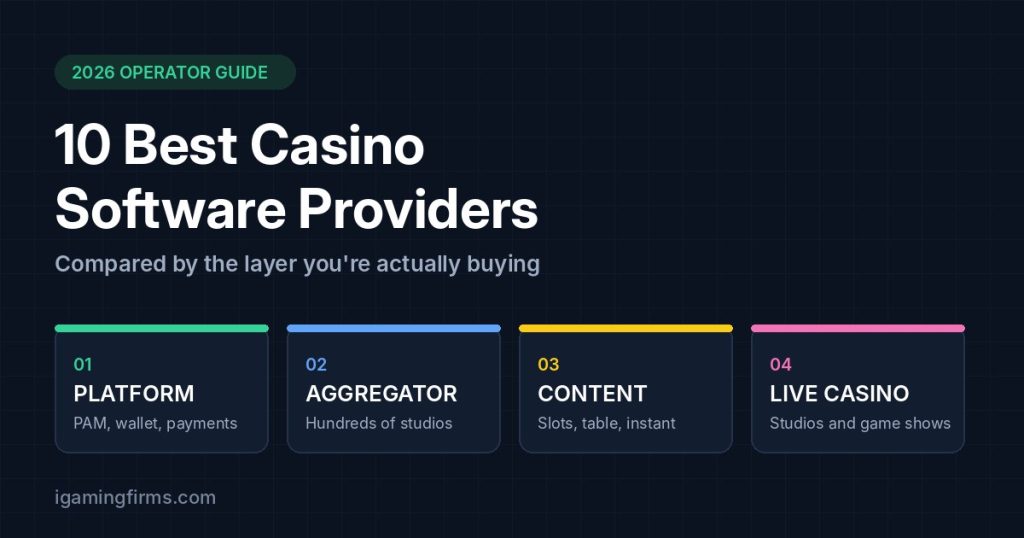
A casino software provider is any B2B company that supplies part of the technology an online casino runs on. A working casino needs four layers, and a single company rarely leads in all of them.
- Platform (PAM). Player accounts, wallet, bonusing, KYC hooks, payments, reporting. This is the hardest layer to switch later. Examples here: Playtech, EveryMatrix, SOFTSWISS.
- Aggregator. One integration that gives you hundreds of studios. It saves integration time but adds a fee layer on top of studio revenue share. Examples: SOFTSWISS Game Aggregator, Light & Wonder OpenGaming, Games Global Plus, EveryMatrix CasinoEngine. Compare more options in our casino game aggregators roundup.
- RNG content studios. Slots, table and instant games. Examples: Pragmatic Play, Play’n GO, Hacksaw, IGT.
- Live casino. Studios, dealers, game shows. Examples: Evolution, Pragmatic Play Live, Playtech Live.
The practical rule: pick your platform first, because it decides which aggregators and studios integrate cleanly and how fast. Then add one aggregator for breadth and sign direct deals only with the two or three studios that drive most of your GGR, so you are not paying an aggregator margin on your biggest earners.
How this list was built
The shortlist started from the providers that operators most often run in regulated markets, then each was checked against:
- Vendor sources: official product pages, investor reports and Q1/Q2 2026 results where published.
- Industry trade coverage of 2025 and 2026 deals, licences, settlements and ownership changes.
- Review sites (G2, Capterra, Trustpilot) and operator quotes from partnership announcements.
- Award results from the 2026 European award season (SBC, SiGMA, EGR).
No provider was tested hands-on and no ranking was paid for. The order reflects breadth of offer and fit for a typical operator, not a score.
The 10 best casino software providers, reviewed
1. Evolution
Evolution is the default live casino supplier for most regulated operators, and since buying NetEnt, Red Tiger, Big Time Gaming and Nolimit City it is also one of the largest RNG content groups. Older lists that describe it as “live only” are years out of date.
- Layer: live casino and RNG content.
- Key products: Lightning and Monopoly-branded game shows, Crazy Time, Ice Fishing, plus the NetEnt, Red Tiger, BTG and Nolimit City slot catalogues; Ezugi as a second live brand.
- 2026 numbers: Q2 2026 net revenue was €517.8m, down 1.2% year on year (up an estimated 2.4% at constant currency). Live revenue fell 3.6% to €437.3m while RNG rose 14% to €80.5m. North America grew 9.5% and Latin America grew 26.3%. Regulated markets now make up 49% of revenue, up from 44%.
- Best for: operators where live casino is a top-three revenue line, especially in the US, UK and LatAm.
- Watch-outs: In July 2026 Evolution agreed a £4.75m settlement with the UK Gambling Commission after its content appeared on six unlicensed UK-facing sites. Asia revenue fell 3.7% quarter on quarter, which the company linked to volatility and cybercrime. Its Galaxy Gaming acquisition had not closed when the agreed closing period expired on 17 July 2026, so either party can now walk away. None of this affects product quality, but it matters if your compliance team does supplier due diligence.
- What reviewers say: Gambling.com’s 2026 software review treats Evolution as the industry standard for live dealer production and credits it with defining the game-show format. Operators are voting with tables too: Monopoly Live rolled out across four US states in Q2 and a second Michigan studio opened.
2. Pragmatic Play
Pragmatic Play sells slots, live casino, bingo and other verticals through a single API, which makes it one of the fastest ways to fill a lobby with proven content.
- Layer: multi-product content (RNG + live).
- Key products: Gates of Olympus, Sweet Bonanza and Big Bass franchises; Pragmatic Play Live tables and game shows; bingo and arcade-style games.
- 2026 facts: The company says it releases up to eight new slots a month alongside live games, with a late-2026 roadmap that includes Gates of Olympus 2500 and new arcade titles. SOFTSWISS’s August 2026 provider ranking names Pragmatic the largest slot provider on its aggregator by turnover.
- Best for: operators in Europe, LatAm, Canada and other non-US markets who want one contract to cover a large share of slot and live demand.
- Watch-outs: Pragmatic stopped licensing games to US sweepstakes operators in September 2025, after a City of Los Angeles civil action against Stake.us named several suppliers. At that point it was not active in licensed US state iGaming. If US launch matters to you, confirm its current state licences directly before planning around it.
- What operators say (from Pragmatic’s partner announcements): Operators such as Kindred and 888 have cited the quality of the live product and the convenience of moving slots and live onto one native API.
3. Playtech
Playtech is one of the few companies that can supply the platform, the slots and the live casino as a single B2B partner. After selling its Italian consumer business Snaitech to Flutter for €2.3bn, it now describes itself as a focused, mostly pure-play B2B technology company.
- Layer: platform + RNG content + live.
- Key products: IMS player management and Playtech ONE omnichannel platform, Age of the Gods jackpot network, Playtech Live, CRM and responsible gambling tools.
- 2026 facts: Regulated markets account for over 80% of B2B revenue, and the company reported US and Canada B2B growth above 70% at constant currency in 2025. It runs dedicated US live studios.
- Best for: large regulated or omnichannel operators (retail + online) that want deep integration and are willing to pay for it.
- Watch-outs: A full-stack partner means a bigger integration, so get the timeline and total contract cost in writing, not just launch fees. Its Caliente agreement in Mexico was restructured in 2025, a reminder to check how much of any supplier’s revenue depends on a few large clients.
- What reviewers say: Gambling.com’s 2026 review singles Playtech out as one of the few big suppliers with a strong US presence in both slots and live casino, pointing to its networked Age of the Gods jackpots and three dedicated US studios.
4. Light & Wonder
Light & Wonder (formerly Scientific Games) combines land-based slot brands with OpenGaming, a content and aggregation platform that carries its own games and those of partner studios.
- Layer: RNG content + aggregation.
- Key products: OpenGaming platform, land-based franchises adapted for online, table game IP.
- 2026 numbers: In Q2 2026 its iGaming segment grew 14% to $92m, and wagers processed through OpenGaming hit a quarterly record of $31.3bn. The group completed its move to a sole ASX listing after leaving Nasdaq in late 2025.
- Best for: US operators and land-based groups who want recognisable casino-floor content plus a wide partner network through one integration.
- Watch-outs: In Q1 2026 it set aside reserves including part of a $128m settlement tied to its dispute with Aristocrat. Content involved in IP disputes can be pulled or modified, so check which titles in your lobby are affected before promoting them heavily.
- What operators say (from L&W’s partner announcements): Partners highlight ease of integration and the volume of third-party studios available through one connection.
5. Games Global
Games Global took over Microgaming’s Quickfire distribution business and back catalogue in 2022. If an older list still calls Microgaming a game developer, it is describing a business that now sits with Games Global.
- Layer: RNG content + distribution.
- Key products: Mega Moolah and the legacy Microgaming catalogue, exclusive titles from partnered studios, Games Global Plus aggregation (which carries third-party studios such as Hacksaw, Stakelogic and Gaming Realms).
- 2026 facts: Games Global says it works with more than 30 in-house and partnered studios and holds over 1,400 proprietary games. Recent deals include an expanded UK partnership with Flutter and a WWE-branded content agreement.
- Best for: operators who want progressive jackpot pull and a deep catalogue of proven titles through one distribution deal.
- Watch-outs: Studio partners range widely in quality and release cadence, so ask for per-studio performance data in your markets rather than buying on catalogue size.
- What studios and operators say (from partner announcements): Partner studios join for reach, describing the network as one of the broadest distribution channels in regulated markets.
6. Play’n GO
Play’n GO is a privately owned Swedish studio that builds all its games in-house and has refused to supply sweepstakes casinos, a stance that suits regulated-only operators.
- Layer: RNG content.
- Key products: Book of Dead and the Rich Wilde series, Reactoonz, Fire Joker, Piggy Blitz.
- 2026 facts: After entering the US in Michigan in 2022, it has kept expanding operator by operator. In 2026 it launched with Ember Entertainment in West Virginia, with Pennsylvania and New Jersey launches planned next.
- Best for: regulated operators in Europe and the US who want stable, long-lived titles rather than short trend cycles.
- Watch-outs: As an in-house-only studio it covers slots and a few table games, not live or platform. Its US footprint is still growing, so check which states and operators are already live.
- What operators say (from Play’n GO announcements): Rush Street Interactive’s CEO praised its portfolio when the partnership expanded to Pennsylvania; DraftKings ran Play’n GO titles as timed exclusives before general release.
7. Hacksaw
Hacksaw built its name on high-volatility slots and instant-win games, and it now also runs OpenRGS, a remote game server that distributes third-party studios.
- Layer: RNG content + studio distribution.
- Key products: Wanted Dead or a Wild, Chaos Crew, scratch cards and instant wins; OpenRGS with 11 partner studios.
- 2026 numbers: Hacksaw listed on Nasdaq Stockholm in June 2025. Q2 2026 revenue rose 31% to €59.3m, and it shipped 17 in-house games plus 17 partner titles in the quarter. After the quarter it secured supplier registration in Alberta.
- Best for: operators with a younger, high-volatility-seeking audience, and those who want fresh mechanics on a steady release schedule.
- Watch-outs: A board member stepped in as interim group CEO during Q2 2026, so leadership is in transition. Hacksaw was also among the suppliers named in the Los Angeles action against Stake.us; check how its sweepstakes exposure squares with your licensing jurisdictions.
- What reviewers say: Gambling.com’s 2026 review calls Hacksaw one of the fastest-growing studios, praising its high-volatility slots, creative bonus mechanics and mobile-first design. That volatility is also the trade-off: it will not suit every player base.
8. IGT
IGT is now a privately held company after Apollo funds completed a $6.3bn deal in July 2025 that merged IGT’s Gaming & Digital business with Everi. The lottery business was split off as Brightstar Lottery.
- Layer: RNG content + land-based gaming tech.
- Key products: Cleopatra, Wheel of Fortune and other casino-floor brands online; the new IGT is organised into Gaming, Digital and FinTech units, the last of which comes from Everi’s payments business.
- 2026 facts: Former Aristocrat Gaming CEO Hector Fernandez was named to lead the combined company from late 2025.
- Best for: US operators, especially those tied to land-based casinos, whose players look for familiar Vegas titles.
- Watch-outs: Post-merger integration and new leadership can shift account management and roadmap priorities. Ask who your contacts will be and how the Digital unit’s roadmap is changing.
- What reviewers say: Gambling.com’s 2026 review values IGT for turning recognisable Vegas machines into online games that keep their familiar feel, which is its main draw for players who know the casino floor.
9. EveryMatrix
EveryMatrix sells its stack as modules, so you can take the whole platform or just the parts you need.
- Layer: platform + aggregation + sportsbook.
- Key products: GamMatrix (player account management), CasinoEngine (casino aggregation with JackpotEngine, BonusEngine and loyalty tools), OddsMatrix (sportsbook), MoneyMatrix (payments), PartnerMatrix (affiliates), plus in-house studios including Fantasma.
- Latest numbers found: In Q1 2025 (the latest figures we could confirm; check its investor updates for 2026) net revenue was €54m, up 39%, with more than 1,400 staff and over 300 clients. It bought sportsbook provider FSB Technology and studio Fantasma Games in 2024, and signed SkyCity to a full turnkey casino deal ahead of New Zealand regulation.
- Best for: operators running casino and sports in regulated European markets who want to mix modules rather than accept one vendor’s full stack.
- Watch-outs: Modular flexibility means more decisions on your side. Map exactly which modules you need, and get migration timelines in writing if you are moving from another platform.
- What operators say (from EveryMatrix announcements): Clients moving onto the platform point to the breadth of the product suite and the option to add sports and payments without a second vendor.
10. SOFTSWISS
SOFTSWISS is a turnkey option built for speed: casino platform, a very large game aggregator, jackpots, sportsbook and affiliate software under one roof.
- Layer: platform + aggregation.
- Key products: Casino Platform, Game Aggregator, Jackpot Aggregator, Sportsbook, Affilka affiliate software, and a Prediction Markets Platform launched in 2026.
- 2026 facts: The Game Aggregator offers more than 40,000 games from over 300 providers across 24 regulated jurisdictions, and won Game Aggregator of the Year at the SBC Awards Europe 2026. Several modules can run on other platforms, not just its own.
- Best for: new brands that need to launch quickly, multi-currency and crypto-accepting casinos, and operators who want one contract for platform plus content.
- Watch-outs: Check which of your target licences the platform already holds approvals for. Depth of customisation is lower than with heavier enterprise platforms.
- What users say: On Trustpilot (20 reviews), partners praise the team and long-term working relationships, while critical reviews mention slow platform response and difficulty getting issues resolved. A Kantar survey commissioned by SOFTSWISS in late 2024 gave its Casino Platform a 7.4 out of 10 satisfaction score.
How to choose a casino software provider
Once you know the layer, compare shortlisted vendors on the same seven points. Ask for written answers, because these are the terms that decide cost and launch speed later.
| Criterion | What to ask | Why it matters |
|---|---|---|
| Target markets | Which of my jurisdictions is the provider licensed or registered in, and which games are certified there? | A game that is not approved in a market cannot go live in your lobby there, whatever the contract says. |
| Testing and certification | Which accredited labs (for example GLI, BMM, eCOGRA or iTech Labs) certified the RNG and games? | Regulators expect lab reports for each market, and missing ones delay launch. |
| Game maths | What RTP settings and volatility profiles are available per market? | Some regulators cap or fix RTP, and the RTP setting you choose affects both margin and player retention. |
| Integration | Direct integration, aggregator or RGS? Seamless or transfer wallet? | Each direct integration takes engineering time; an aggregator is faster but adds a fee layer. |
| Engagement tools | Are free rounds, tournaments, jackpots and network promotions included? | These tools drive retention and often cost extra or depend on platform support. |
| Commercial terms | Revenue share on GGR, monthly minimums, setup fees, branded-game premiums, market-specific fees? | Minimum fees can outweigh the headline revenue share for a new brand with low early GGR. |
| Support and SLAs | Uptime commitments, incident response times, reporting access? | Downtime on a top game or the wallet costs you revenue by the minute. |
How much do casino software providers charge?
Pricing depends on the layer. Content studios and live casino suppliers usually charge a revenue share on the GGR their games generate, often with a monthly minimum. Aggregators add their own margin on top of the studio share. Platform providers typically combine a setup fee, a monthly fee and a revenue share, and white-label deals bundle the licence and operations into a larger revenue share. Rates are negotiated and rarely published, so treat any single figure you see online as a starting point for your own quotes.
Which provider fits your situation
- Launching a new brand fast, multi-currency or crypto-friendly: SOFTSWISS for platform and aggregator, then add direct deals with your top two content providers.
- Multi-vertical operator in regulated Europe: EveryMatrix or Playtech for the platform, depending on whether you want modular choice or one deep integration.
- Launching in US states: Evolution for live, IGT and Light & Wonder for casino-floor brands, Play’n GO and Hacksaw for online-native slots. Confirm Pragmatic Play’s current US licensing before counting on it.
- Live casino is your main product: Evolution first, with Pragmatic Play Live or Playtech Live as a second supplier for pricing leverage and redundancy.
- Jackpot-led acquisition: Games Global (Mega Moolah) and Playtech (Age of the Gods) both run networked jackpots.
Red flags to check before you sign
- Sweepstakes exposure. US regulators and city attorneys are now targeting suppliers as well as sweepstakes operators. Ask every studio which unregulated markets its content reaches, and check where sweepstakes casinos are legal or banned by state.
- Content leaking to unlicensed sites. Evolution’s UKGC settlement shows a regulator will hold a supplier responsible for where its games end up. Ask how the provider monitors and cuts off unlicensed distribution, because your regulator may ask you the same question.
- Ownership changes. IGT (Apollo), Playtech (pure B2B) and Hacksaw (new listing, interim CEO) all changed shape in the last 18 months. Changes like these can move account teams, pricing and roadmaps.
- Double fees through aggregators. If one studio drives a large share of your GGR, compare its direct revenue share with the aggregator rate before you route it through a hub.
- Platform lock-in. Ask for data export formats, player migration terms and exit fees up front. The platform is the one layer that is painful to replace.
The bottom line
There is no single best casino software provider, because you are not buying a single thing. Choose the platform that fits your markets and launch timeline, add the live and slot suppliers your players actually play, and check each one’s 2026 compliance record as carefully as its game list.