If you run or market an iGaming business, you have probably noticed that every iGaming industry statistic you read disagrees with the last one. One report says the market is worth $88 billion, another says $120 billion, and a third says $365 billion. None of them are lying. They are measuring different things. This guide gives you the 2026 numbers that matter for operators and affiliates, explains which definition each one uses, and breaks revenue down by region using regulator and trade-body data wherever it exists.
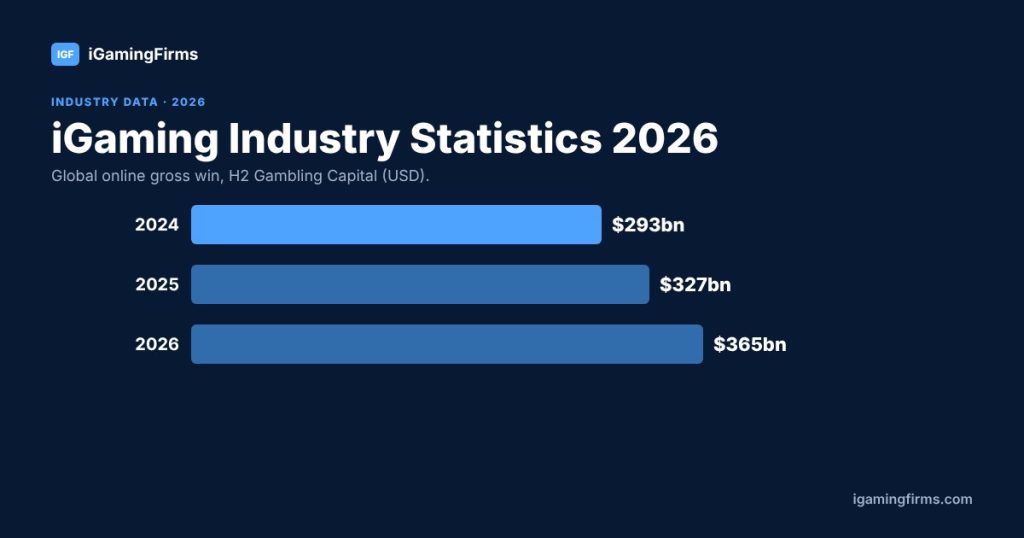
How big is the iGaming industry in 2026? Regulated online gambling worldwide is worth roughly $100 billion to $120 billion in gross gaming revenue in 2026, depending on the research house, and about $365 billion if you count every online bet including offshore and unlicensed play, which is H2 Gambling Capital’s April 2026 estimate. On H2’s figures, online makes up about 45 percent of a global gambling market of roughly $811 billion in 2026.
Key iGaming industry statistics for 2026
- $365bn: estimated global online gambling gross win in 2026, onshore and offshore (H2 Gambling Capital, April 2026).
- $97.7bn: regulated online gambling market in 2026, growing 11.0% a year to 2033 (Grand View Research, 2026 report).
- 2029: the year online is forecast to overtake land-based, at 50.3% of a $979bn global market (H2 Gambling Capital, April 2026).
- $10.74bn: US commercial iGaming revenue in 2025, up 27.6% (American Gaming Association, February 2026).
- €47.9bn: online gambling GGR in Europe in 2024, 39% of the European market (EGBA and H2 Gambling Capital, 2025 edition).
- £8.3bn: UK remote casino, betting and bingo yield in April 2025 to March 2026, up 6.9% (UK Gambling Commission, September 2026).
- BRL37bn (about $7bn): GGR in Brazil’s first licensed year, 2025, from 79 operators (Secretaria de Prêmios e Apostas, January 2026).
- 55%: share of global online gross win still taken by offshore operators in 2024 (H2 Gambling Capital, April 2026).
What the iGaming industry is, and what the numbers include
iGaming is any form of gambling delivered over the internet: online casino (slots, table games, live dealer), online sports betting, poker, bingo and online lottery. It is a subset of the wider gambling industry, which also includes land-based casinos, betting shops, gaming machines and retail lottery. It is not the video game industry, even though Google often mixes the two when you search for “gaming industry”.
The industry has four layers, and the layer a statistic covers changes the number:
- Operators (B2C): the sportsbooks and casinos players use. Their gross gaming revenue (GGR) is stakes minus winnings paid out. Almost every market-size figure measures this layer.
- Platforms and suppliers (B2B): player account management systems, game studios, aggregators, odds feeds, payment providers and KYC vendors. An iGaming platform is the software stack an operator runs on: the player account, wallet, bonus engine, game integrations and back office. Supplier revenue is a slice of operator GGR, so adding it to operator GGR double counts.
- Affiliates and marketing: paid out of operator marketing budgets.
- Regulators and tax: US states and local governments took a record $18.1 billion in gaming taxes from commercial operators in 2025 (American Gaming Association, February 2026).
When you compare figures, check three things: whether it is GGR or handle (total stakes, which can be 10 to 20 times larger than GGR), whether it includes unlicensed or offshore play, and whether online lottery is in scope. Most of the gaps between headline numbers come down to those three choices.
How big is the online gambling industry? The main 2026 estimates side by side
These are the figures you will see quoted most often, with what each one actually measures.

| Source (date) | Figure | What it measures |
|---|---|---|
| H2 Gambling Capital (April 2026) | Online gross win $293bn in 2024, about $327bn in 2025 and about $365bn in 2026; total gambling $712bn (2024), about $758bn (2025) and $811bn (2026) | All online gambling worldwide, onshore and offshore, including online lottery. The broadest definition in use. |
| H2 Gambling Capital, onshore only (2024 actual) | $132bn, or 45% of $293bn online gross win | Only play with locally licensed operators. Offshore and unregulated play was still 55% of global online gross win in 2024. |
| Grand View Research (2026 report, 2025 base year) | $88.0bn in 2025, $97.7bn in 2026, $202.8bn by 2033 at 11.0% CAGR | Regulated online gambling revenue; sports betting about 50% of the total; Europe over 41%. |
| The Business Research Company and Mordor Intelligence (as compiled by DemandSage, May 2026) | $117.5bn in 2025, $120.35bn in 2026, $211.99bn by 2031 at about 12% CAGR | Online gambling revenue, broadly defined; methodology not published on the compiling page. |
| Statista Market Insights (2026) | $655bn in 2026 for all gambling, online and land-based; 2.28% CAGR to 2030 | B2C gross gambling revenue across every channel, excluding illegal gambling. Not an online-only figure. |
So which number should you use? If you are sizing a regulated market for a licence application, a board deck or an affiliate business plan, use the onshore figures from regulators (next sections) and treat the $88 billion to $132 billion range from research houses and H2’s onshore figure as the global ceiling for licensed play. If you are explaining the total addressable market, including the grey market you are competing against, use H2 Gambling Capital’s $365 billion and say so. Quoting a $365 billion figure next to a $97 billion figure without that caveat is the most common mistake in the pages that currently rank for this topic.
Is the iGaming industry growing or declining?
Growing. Online gambling is expanding at roughly 10 to 12 percent a year globally, while land-based gambling grows at low single digits. That gap is the whole story of the industry.
- H2 Gambling Capital’s April 2026 forecast implies online gross win grows at about 10.4% a year from $293bn in 2024 to $530bn in 2030, against about 6.4% for all gambling (our calculation from H2’s figures). Online becomes the majority of global gambling revenue in 2029 (50.3% of $979bn) and reaches 51% ($530bn of $1,031bn) in 2030.
- Grand View Research (2026) projects 11.0% CAGR for regulated online gambling from 2026 to 2033.
- The regulators agree on direction. US commercial iGaming revenue rose 27.6% in 2025 and was still up 15.7% year on year in July 2026 (American Gaming Association). UK remote casino, betting and bingo yield rose 6.9% to £8.3bn in the year to March 2026 (UK Gambling Commission, September 2026). Europe’s online GGR rose 11.7% in 2024 (EGBA and H2 Gambling Capital, 2025 edition).
- The biggest operators are growing faster than the market averages because they are taking share. Flutter’s group revenue rose 17% to $16.4bn in 2025 (Flutter FY2025 results, February 2026) and DraftKings’ rose 27% to $6.05bn (DraftKings FY2025 results, February 2026). EGBA’s member operators grew online GGR 34% to €18bn in 2025 (EGBA Annual Activity Report 2026).
Is gambling dying? No, on every regulator dataset you can check, but the growth is concentrated online and in a handful of newly regulated markets (the US, Brazil, Ontario, the Philippines and parts of Africa). Land-based is close to flat in mature markets: UK land-based yield rose only 1.1% in the year to March 2026 (UK Gambling Commission).
iGaming revenue by region in 2025 and 2026
Research houses give regional shares, but shares of different totals are hard to compare. The table below uses actual reported figures from regulators and trade bodies, in each market’s own currency, with the approximate US dollar value the source itself published where available.
| Market | Measure and period | Figure | Change | Source |
|---|---|---|---|---|
| United States (commercial iGaming) | GGR, calendar 2025 | $10.74bn | +27.6% | American Gaming Association, Feb 2026 |
| United States (commercial sports betting) | GGR, calendar 2025 | $16.96bn on $166.94bn handle | +22.8% revenue, +11.0% handle | American Gaming Association, Feb 2026 |
| Ontario, Canada (private iGaming market) | Operator gaming revenue, calendar 2025 | C$4.04bn (about US$2.98bn) | +34% | iGaming Ontario monthly data, Jan 2026 |
| Europe (EU 27 plus UK), online | GGR, 2024 actual and 2025 forecast | €47.9bn in 2024; €51.1bn forecast for 2025 | +11.7% in 2024 | EGBA and H2 Gambling Capital, 2025 edition |
| United Kingdom, remote | Gross gambling yield, April 2025 to March 2026 | £8.3bn, including £5.7bn online casino and £2.4bn online betting | +6.9% | UK Gambling Commission, Sept 2026 |
| Brazil (licensed online betting) | GGR, calendar 2025 (first regulated year) | BRL37bn (about $7bn), 79 licensed operators | New market | Secretaria de Prêmios e Apostas, Jan 2026 |
| Philippines (e-games and online) | GGR, calendar 2025 | PHP201.1bn (about $3.35bn), 50.8% of all Philippine GGR | +30.0% | PAGCOR, April 2026 |
| South Africa (all gambling) | GGR, fiscal 2024/25 | About R75bn (about $4.3bn), with online betting about 60% | About +26% | National Gambling Board, Oct 2025 |
| Macau (land-based casinos, for scale) | GGR, calendar 2025 | MOP247.4bn (about $30.9bn) | +9.1% | DICJ, Jan 2026 |
For the continental picture, H2 Gambling Capital’s April 2026 update gives all-channel gross win by region, which is the only consistent regional series that covers Asia and Africa.
| Region | 2024 gross win (all channels) | 2030 forecast | Implied growth |
|---|---|---|---|
| Asia and Middle East | $270bn | $398bn | About 6.7% a year |
| North America | $193bn | $284bn | About 6.7% a year |
| Europe | $177bn | $236bn | About 4.9% a year |
| Latin America and Caribbean | $29bn | $51bn | About 9.9% a year |
| Oceania | $28bn | $33bn | About 2.8% a year |
| Africa | $14bn | $31bn | About 14% a year |
Growth rates are our calculation from H2’s start and end points. H2 notes its forecasts are nominal and use constant exchange rates, so dollar figures in future years would be lower at current FX.
North America: the fastest-growing large market
The US is the largest single gambling market in the world, with commercial gaming revenue of a record $78.7bn in 2025, up 9.2% (American Gaming Association, February 2026), and it is the one where online is still a small share. Only seven states have live commercial online casino, and Pennsylvania (about $3.5bn, up 28%), Michigan and New Jersey produce nearly 90 percent of the $10.7bn US iGaming total between them, according to the AGA’s State of the States 2026 report (May 2026). Legal sports betting is far wider, running in more than 35 states plus Washington DC; our state-by-state guide to US gambling laws has the current list. FanDuel held 41% of US sportsbook GGR and 28% of US iGaming GGR in Q4 2025 (Flutter FY2025 results).
Two things shape the 2026 outlook. First, the AGA still counted seven iGaming states in its May 2026 report, so growth is coming from deeper penetration in existing states, not new launches. Second, prediction markets such as Kalshi and Polymarket are taking event-contract volume that would otherwise be sports betting handle; the AGA’s revenue tracker estimated close to $1bn in potential state gaming taxes lost to them between the start of 2025 and May 2026. Our regulation roundup tracks the state-by-state court fights.
Ontario is the other North American story: C$4.04bn in operator revenue in 2025, up 34%, with casino at C$3.15bn, sports betting at C$815m and 1.28 million active player accounts (iGaming Ontario data, January 2026).
Europe: the largest regulated online market
Europe (EU plus UK) is still the biggest regulated online region. EGBA and H2 Gambling Capital put total European GGR at €123.4bn in 2024, with online at €47.9bn (39%) and forecast to pass 40% in 2025 at €51.1bn. By 2029 they expect online to reach €66.8bn, or 45% of the market. Online casino is the largest online product at €21.5bn, about 45% of internet GGR; online sports betting is €13.7bn, about 29% (EGBA and H2 Gambling Capital, 2025 edition).
The UK and Italy are the two largest single European markets. Great Britain’s total gross gambling yield was £17.5bn in April 2025 to March 2026, up 4.4%, of which £8.3bn was remote (UK Gambling Commission, September 2026). Online share varies widely by country: about 73% of Danish GGR was online in 2025 (Danish Gambling Authority), against about 18.5% in France (ANJ, 2025).
The 2026 variable for UK operators is tax. Remote Gaming Duty rose from 21% to 40% of profits from 1 April 2026, and a new 25% rate of General Betting Duty for remote betting applies from 1 April 2027 (HM Revenue and Customs policy paper, November 2025). Expect UK online casino GGR growth to slow and operator margins to compress from the 2026/27 reporting year onward.
Latin America: Brazil’s first regulated year
Brazil’s licensed market opened on 1 January 2025 and produced BRL37bn (about $7bn) in GGR from 79 licensed operators in its first year, with 25.2 million people placing bets, according to Secretaria de Prêmios e Apostas data released in January 2026. Operators paid close to BRL10bn in federal taxes and about BRL2.5bn in licence fees (BRL30m per licence). The regulator blocked more than 25,000 offshore sites, but many estimates still put the illegal market at up to half of total betting. A 2025 law change raises the GGR tax gradually to 15%. H2 Gambling Capital expects Latin America and the Caribbean to be one of the two fastest-growing regions through 2030.
Asia and the Middle East: big totals, mostly land-based
Asia is the largest region by total gross win ($270bn in 2024, H2 Gambling Capital) but most of it is land-based: Macau alone produced about $30.9bn in 2025 (DICJ). The regulated online exception is the Philippines, where e-games and online overtook licensed casinos in 2025 to reach PHP201.1bn (about $3.35bn, 50.8% of all GGR, up 30.0%), according to PAGCOR (April 2026). India moved the other way: its 2025 ban on real-money online gaming led Flutter to book a $556m non-cash impairment (Flutter FY2025 results). Most of Asia’s online gambling volume is offshore and shows up in H2’s $365bn figure but not in any regulator’s.
Africa: the fastest growth rate from a small base
Africa was a $14bn all-channel market in 2024 and H2 Gambling Capital expects it to more than double to $31bn by 2030, the fastest regional growth rate. It is mobile-first and betting-led. South Africa is the largest regulated market: national GGR was R59.3bn in fiscal 2023/24, up 25.7%, with online betting at R28.97bn (National Gambling Board, October 2024), and rose to about R75bn in 2024/25 with online betting about 60% of the total (National Gambling Board presentation to Parliament, October 2025). Treat Nigerian and Kenyan figures with care; most are industry estimates rather than regulator data.
How large is the sports betting industry?
Online sports betting is about half of all online gambling revenue worldwide. H2 Gambling Capital puts online betting gross win at $148bn in 2024 (50% of online) and forecasts $248bn by 2030, with online casino at $233bn (April 2026). Grand View Research (2026) also puts sports betting at about 50% of the regulated online market.
In the US, commercial sportsbooks generated $16.96bn in revenue on $166.94bn in handle in 2025, a hold of about 10.2% (American Gaming Association, February 2026; hold is our calculation). That is the clearest answer to “how much money does sports gambling generate”: about $17bn a year for US commercial operators, with another $3.71bn going to states in tax. In Europe, online sports and events betting was €13.7bn of the €47.9bn online total in 2024 (EGBA and H2 Gambling Capital). Our analysis of whether sports betting is profitable explains why handle and revenue tell such different stories.
Online casino versus sports betting: which is bigger?
It depends on the market. Globally, online betting was 50% of online gross win in 2024 and online lottery about 6%, which leaves casino, poker and bingo at roughly 44% (H2 Gambling Capital, April 2026; split is our calculation). By 2030 H2 expects the two to be close: $248bn for online betting against $233bn for online casino. In Europe, online casino is the larger product (about 45% of online GGR against 29% for sports betting in 2024). In the UK, online casino yield (£5.7bn, of which £4.8bn is slots) is more than twice remote betting (£2.4bn) in 2025/26 (UK Gambling Commission). In Ontario, casino is almost four times sports betting. In the US the order is reversed because only seven states allow online casino, yet those states still produced $10.74bn in 2025, nearly two thirds of the $16.96bn generated by sports betting across far more states (American Gaming Association).
For operators the practical point is that casino, where it is legal, produces more GGR per player and higher margins than sports betting. For affiliates, it means a casino licence in a market is worth watching far more closely than a sports-only licence.
What share of iGaming is mobile?
Most of it, and the share keeps rising. In Europe, mobile produced 58% of online gambling GGR in 2024, up from 45% in 2019, and H2 Gambling Capital forecasts 67% by 2029 (EGBA and H2 Gambling Capital, 2025 edition). Grand View Research (2026) still records desktop as the largest device segment in its regulated-market model, which is one more reason to check definitions before you quote a figure. Newer markets such as Brazil, the Philippines and Africa are mobile-first from day one, so if you build product or content for them, design for the phone.
Who are the biggest iGaming companies?
The largest online gambling company by revenue is Flutter Entertainment, which owns FanDuel, Paddy Power, Betfair, Sportsbet, Sisal, Snai and PokerStars. Its fiscal 2025 results show group revenue of $16.4bn (up 17%), US revenue of $6.97bn (up 20%) and 15.9 million average monthly players. It guided to about $18.4bn of revenue for 2026.
Is FanDuel bigger than DraftKings? Yes. FanDuel (Flutter’s US division) generated $6.97bn in 2025 against DraftKings’ $6.05bn for the whole company, and FanDuel held 41% of US sportsbook GGR in Q4 2025 (Flutter FY2025 results). DraftKings is growing faster in percentage terms (27% against 20% in 2025) and guided to $6.5bn to $6.9bn of revenue for 2026 (DraftKings FY2025 results).
Other operators you will see in any size ranking: Entain (Ladbrokes, bwin, BetMGM joint venture), Bet365 (private), Evolution and Light and Wonder on the supply side, and Betsson and FDJ United (owner of Kindred since 2024) in Europe. Our ranking of the largest gambling companies in the world by revenue covers the full list. There is no single “biggest gambling website” by traffic that regulators measure; by revenue, Bet365 is widely believed to be the largest single brand outside Flutter, but as a private company it publishes only UK statutory accounts.
How common is online gambling?
Globally, the Lancet Public Health Commission on gambling (October 2024) estimated that 46.2% of adults and 17.9% of adolescents gambled in the past year. In regulated markets the online share is now high. In Great Britain, 47% of adults gambled in the past four weeks and 38% gambled online, or 16% if you exclude people who only played lottery draws (UK Gambling Commission, Gambling Survey for Great Britain 2025, July 2026). Brazil counted 25.2 million people betting with licensed operators in 2025, roughly 15% of the adult population by our calculation, in the market’s first year. Ontario had 1.28 million active accounts in 2025 (iGaming Ontario) in a province of about 16 million people.
In the US, the AGA’s August 2025 illegal market study found that only 24% of online casino players use legal sites exclusively, down from 52% in 2022. That finding matters more to you than any participation rate: most of your prospective US iGaming players are also depositing offshore.
How big is the illegal and offshore market?
This is the number the ranking pages avoid, and it is large. H2 Gambling Capital estimated that offshore operators still took 55% of global online gross win in 2024 (about $161bn of $293bn, our calculation from H2’s 45% onshore share), though onshore is on course to overtake as more markets regulate. In the US, the AGA’s August 2025 study put illegal and unregulated gambling at $673.6bn in wagers and $53.9bn in revenue, or 31.9% of the total US market, including $18.6bn from illegal online casinos (up nearly 38% since 2022) and $5bn from illegal sportsbooks, costing states $15.3bn a year in tax. In Brazil, many estimates put offshore betting at up to half of the total (Secretaria de Prêmios e Apostas data, January 2026).

For operators, the grey market sets your customer acquisition cost, because it is who you are bidding against for players. For affiliates, it defines the compliance line: in markets such as Brazil and the UK, promoting unlicensed brands exposes you to regulatory enforcement and financial penalties, not just the loss of a listing.
How is the iGaming industry doing right now?
Healthy on revenue, tighter on margin. In July 2026 US commercial gaming revenue was up 8.6% year on year, iGaming up 15.7% to $1.01bn and sports betting up 27.0% to $1.27bn (AGA Commercial Gaming Revenue Tracker). EGBA members reported a record 2025. Flutter and DraftKings both guided to double-digit revenue growth for 2026.
The pressure is on costs and tax. UK Remote Gaming Duty nearly doubled in April 2026. Brazil’s rate is heading to 15% of GGR. EGBA members’ average return to player fell to 93.4% in 2025 from 93.7% (EGBA Annual Activity Report 2026), meaning operators are keeping a slightly larger slice of each stake. Flutter guided to adjusted EBITDA of about $2.97bn in 2026, growth of about 4% against roughly 12% revenue growth, partly because it is spending $250m to $300m on FanDuel Predicts (Flutter FY2025 results). In other words, the industry is growing but buying that growth with margin, and the markets that offer the best returns in 2026 are the ones that regulated recently and have not yet raised taxes: Brazil, Ontario and the US iGaming states.
What this means for operators and affiliates
If you are an operator choosing a market, size it on regulator GGR, not research-house projections. The US iGaming states, Ontario, the UK, Italy, Brazil and the Philippines all publish monthly or annual data. Check tax changes before you check growth rates: a 13% growth market with a 40% duty can be worth less than a flat market at 20%. Licensing cost is the other side of that equation, and our comparison of gambling licence costs across 15 jurisdictions shows how far fees vary.
If you are an affiliate, the regional tables above tell you where new regulated demand is appearing (Brazil, Ontario, Africa) and where mature demand is shifting between products (casino ahead of betting in Europe). Rising duties in the UK will push operators to cut CPA rates and tighten revenue share terms in 2026 and 2027, so diversify away from any single market.
If you supply the industry, remember that the B2B layer is paid out of operator GGR. Payments alone take a meaningful share: iGaming payment costs run from under 1% to several percent of deposits depending on rail and market, which matters more as duties rise.