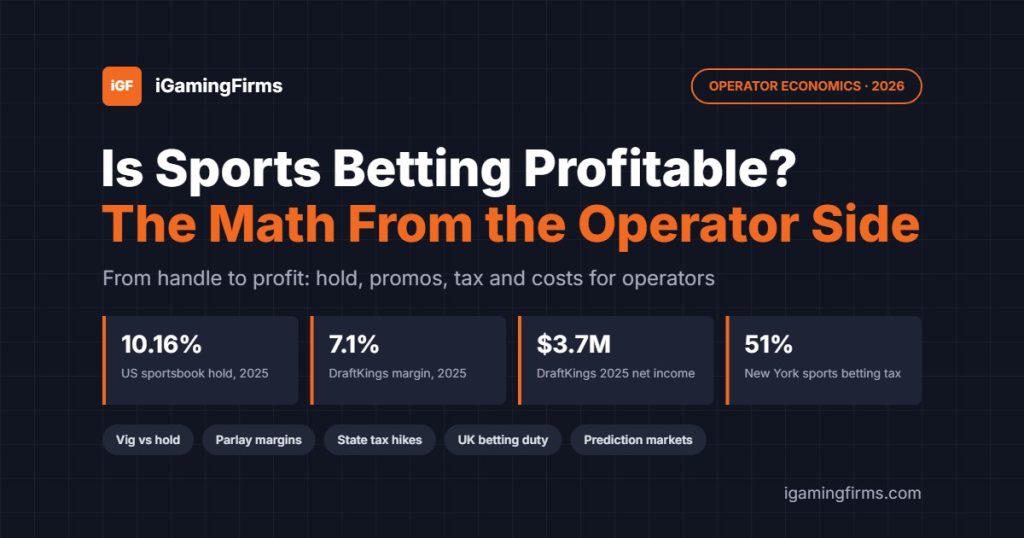
The short answer: sports betting is profitable for sportsbooks at the gross level, since US books kept 10.16% of everything wagered in 2025. It is only profitable at the bottom line for operators that control promotions, operate in workable tax states and have enough scale to cover fixed costs. In 2025, DraftKings turned $6.05 billion of revenue into just $3.7 million of net income.
Most answers to “is sports betting profitable” come from the bettor’s chair. You sit on the other side of the counter, so the question you care about is harder: if the house always has an edge, why do so many sportsbooks report losses, and what separates the ones that make money from the ones that don’t?
This guide works through the numbers from the operator side: vig versus hold versus margin, a handle-to-profit walk-through for a $100 million book in a low-tax and a high-tax state, what DraftKings’ 2025 and 2026 accounts show, and the tax changes of 2025 and 2026 that moved the math.
Is sports betting profitable for sportsbooks?
Yes at the gross level, and only sometimes at the net level. The American Gaming Association’s Commercial Gaming Revenue Tracker for 2025 reports that Americans legally wagered $166.94 billion on sports in 2025, up 11% on 2024, and sportsbooks generated $16.96 billion in revenue, a national hold of 10.16%. Online accounted for 96.5% of that market.
That 10% is gross gaming revenue, not profit. Before an operator sees a dollar of earnings, it pays for free bets and bonuses, state gaming tax, the federal excise tax, platform and data fees, payment processing, market access, marketing, staff and technology. The common shorthand that sportsbooks “keep about 10% of all money wagered” is accurate for gross revenue and misleading if read as profit.
How do sportsbooks make money? Vig, hold and margin
Sportsbooks make money by pricing a margin into every market, then letting bet volume and bet mix turn that margin into revenue. Most pages ranking for this question use vig, hold and margin interchangeably. They are different numbers, and confusing them is how operators build business plans that never hit their targets.
| Term | What it measures | Typical figure |
|---|---|---|
| Vig (overround) | The margin priced into a single market. Two sides at -110 add up to 104.76% implied probability. | 4.76% overround on a -110/-110 market |
| Theoretical hold | What the book keeps from a perfectly balanced market at those prices, as a share of handle. | 4.55% on a -110/-110 market |
| Actual hold (GGR / handle) | What the book really kept across all bets after results, before promotions. | 10.16% US average in 2025 |
| Net revenue margin | Revenue after promotional deductions, divided by handle. | 7.1% at DraftKings Sportsbook in 2025 |
Two errors come up again and again. The first is quoting 4.76% as what the book keeps on a -110 market. On a balanced $1 million book, the winners’ side gets back $954,545 and the book keeps $45,455, which is 4.55% of handle. The second is citing a 5% to 8% industry hold. The real national hold has been above 9% since 2024 and passed 10% in 2025.
For bettors, the -110 price means a break-even win rate of 52.38% (110 divided by 210). That is the same number seen from your side: anyone who wins less than 52.38% of straight -110 bets is paying your margin.
Why parlays changed the math
If the theoretical margin on a straight bet is around 4.5%, how does the national hold reach 10%? Mostly through bet mix. Margins compound across parlay legs, so every extra leg raises the book’s expected take.
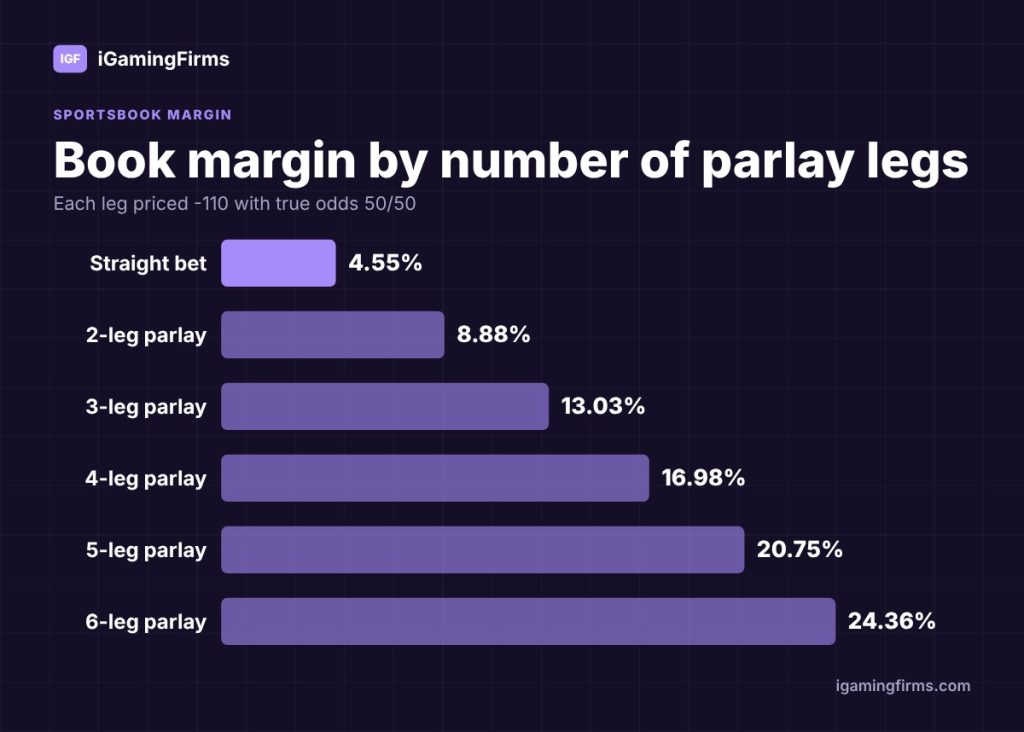
| Bet (each leg priced -110, true odds 50/50) | Theoretical book margin |
|---|---|
| Straight bet | 4.55% |
| 2-leg parlay | 8.88% |
| 3-leg parlay | 13.03% |
| 4-leg parlay | 16.98% |
| 5-leg parlay | 20.75% |
| 6-leg parlay | 24.36% |
Calculation: margin = 1 minus (0.5 to the power of legs, multiplied by 1.909 to the power of legs). Same-game parlays add correlation pricing on top, which this simple model leaves out.
This is why same-game parlays and multi-leg products sit at the centre of every large operator’s product roadmap. A book whose handle shifts from mostly straights to a heavy parlay mix can lift its hold several points without changing a single straight-bet price. It also explains why hold has kept rising nationally even as bettors get better tools for shopping lines.
How much profit does a sportsbook make? The handle-to-profit waterfall
Here is where $100 million of handle actually goes. The walk-through uses the 2025 national hold, DraftKings’ reported 2025 net revenue margin and cost ratios as anchors, plus assumptions you can replace with your own.
Assumptions: $100M handle; 10% gross hold ($10M GGR); promotions and free bets bring net revenue to 7.1% of handle ($7.1M); gaming tax is charged on net revenue (whether promos are deductible varies by state); federal excise tax of 0.25% of handle; platform, odds and data, payments, geolocation, KYC and market access together at 15% of net revenue; marketing at 22.8% of revenue and technology plus G&A at 18.7% of revenue, matching DraftKings’ 2025 ratios.
| Line ($M) | 20% tax state | 51% tax state |
|---|---|---|
| Handle | 100.00 | 100.00 |
| Gross gaming revenue (10% hold) | 10.00 | 10.00 |
| Promotions and free bets | -2.90 | -2.90 |
| Net revenue | 7.10 | 7.10 |
| State gaming tax | -1.42 | -3.62 |
| Federal excise tax (0.25% of handle) | -0.25 | -0.25 |
| Platform, data, payments, compliance, market access | -1.07 | -1.07 |
| Contribution before marketing | 4.37 | 2.16 |
| Marketing | -1.62 | -1.62 |
| Technology and G&A | -1.33 | -1.33 |
| Operating profit | 1.42 | -0.78 |
| Operating profit as % of handle | 1.4% | -0.8% |
Three things stand out:
- Gross is not net. A book that “keeps 10%” ends up with about 1.4 cents per dollar wagered in a 20% tax state, and loses money in a 51% state on the same cost base.
- Tax has a break-even point. Under these assumptions, the break-even state tax rate is about 40%.
- Hold variance hits the bottom line hard. If hold drops from 10% to 8% in the 20% tax scenario while promotions, marketing and overhead stay the same, operating profit falls from $1.42M to roughly $0.1M. Two points of hold is nearly the whole profit.
A smaller operator would look worse than this table, because the technology and G&A line is a fixed cost. DraftKings spreads it across $6 billion of revenue. A regional book with $50 million of revenue cannot. If you are modelling a launch, the sportsbook start-up costs guide covers the fixed side in more detail.
Do sportsbooks lose money? What DraftKings’ numbers show
Sportsbooks lose money on individual games all the time, and can lose money for whole quarters. The cleanest public check on the waterfall is DraftKings, the largest pure-play US online operator. Its fiscal year 2025 results show where each revenue dollar went (figures include iGaming, not just sportsbook).
| FY2025 line | $M | % of revenue |
|---|---|---|
| Revenue | 6,054.5 | 100% |
| Cost of revenue | 3,556.9 | 58.7% |
| Sales and marketing | 1,379.9 | 22.8% |
| Product and technology | 459.9 | 7.6% |
| General and administrative | 673.6 | 11.1% |
| Loss from operations | -15.8 | -0.3% |
| Net income | 3.7 | 0.06% |
| Adjusted EBITDA (non-GAAP) | 620.0 | 10.2% |
DraftKings finished 2025 with its first positive annual net income since going public, after a net loss of $507 million in 2024. Its 10-K reports a sportsbook net revenue margin of 7.1% in 2025, up from 6.0% in 2024 and 5.6% in 2023. That climb in margin, not handle growth alone, is what turned the company profitable.
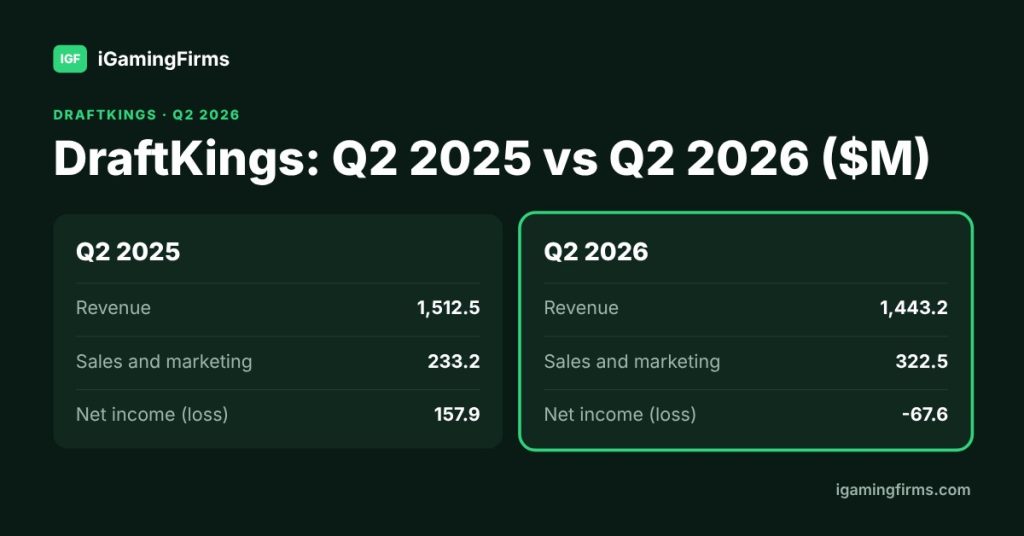
The swing back the other way shows how fragile it is. In its second quarter 2026 results, DraftKings grew Sports Consumer Volume 14.5% to $13.1 billion, yet revenue fell 4.6% to $1.44 billion, which it put down to “customer-friendly sport outcomes” and heavier promotional reinvestment to acquire customers for its Sportsbook and Predictions products.
| DraftKings ($M) | Q2 2025 | Q2 2026 |
|---|---|---|
| Revenue | 1,512.5 | 1,443.2 |
| Sales and marketing | 233.2 | 322.5 |
| Income (loss) from operations | 150.6 | -68.2 |
| Net income (loss) | 157.9 | -67.6 |
| Adjusted EBITDA | 300.6 | 114.6 |
More handle, less money. DraftKings kept its full-year 2026 guidance of $6.5 billion to $6.9 billion of revenue and $700 million to $900 million of adjusted EBITDA, so management treats the quarter as variance plus investment rather than a broken model. For context on how other groups compare by revenue, see the largest gambling companies ranking.
What is the average return on sports betting?
For bettors as a group, the average return is the hold with the sign flipped. In 2025, US bettors collectively lost about 10.2 cents of every dollar wagered before promotions, based on the AGA’s handle and revenue figures. Bonuses and free bets returned part of that, which is the gap between the 10.16% national hold and net revenue margins like DraftKings’ 7.1%.
For you, that number has a practical meaning: your customers’ average loss rate is your gross margin. A product mix that lowers it (more straight bets, more sharp customers) shrinks GGR. A mix that raises it (more parlays and same-game parlays, more recreational customers) grows it.
What percentage of sports bettors actually make money?
A small minority, and the book’s whole risk model is built around finding them. Winning bettors beat the closing line, shop prices across books and bet into markets the trader has priced poorly. Operators respond by limiting stakes, adjusting prices and moving lines faster, which is why a sharp customer is a cost to a retail sportsbook rather than a source of revenue.
The figure you will see repeated across top-ranking pages is that only 2% to 3% of bettors profit long term. None of them links that figure to a published dataset, so treat it as an industry estimate rather than a measured statistic. What is measurable is the aggregate: the 10.16% national hold means bettors as a whole lose heavily, whatever the split between winners and losers.
Is sports betting skill or luck?
Over a single weekend, mostly luck. Over thousands of bets, skill shows up, which is exactly why operators segment customers by betting behaviour and why bonus abuse and arbitrage detection sit alongside fraud controls. The iGaming fraud detection guide compares the tools that handle this.
The five levers that decide operator profitability
- Hold and product mix. Parlay share, same-game parlay pricing and in-play margins move hold more than straight-bet prices do. One point of hold on $100 million of handle is $1 million of GGR.
- Promotional efficiency. The gap between gross hold and net revenue margin is your bonus bill. Promos that buy customers who stay are investment; promos that pay bonus hunters are leakage.
- Tax jurisdiction. State rates run from 6.75% in Nevada and Iowa to 51% in New York, according to the Tax Foundation. In the waterfall above, the same book swings from a 20% operating margin to an 11% loss on tax alone.
- Variable cost stack. Platform revenue share, odds and data feeds, payments, geolocation and KYC scale with revenue. Renegotiating these is often worth more than a marketing cut. The payment solutions guide breaks down what operators pay on the payments side.
- Scale and variance. Fixed costs need volume, and a small book feels a bad weekend of results far more than a large one. Margin in sports betting is real, but it arrives over a season, not a week.
The 2025 and 2026 tax changes that moved the math
States have spent the last two years raising sports betting taxes, and these changes matter more for operator profit than any strategy tip.
- New Jersey raised its online sports betting tax to 19.75% from 13%, effective July 1, 2025.
- Maryland moved to 20% and Louisiana to 21.5% for online sports betting in 2025.
- Illinois added a per-wager tax from July 1, 2025: 25 cents on each of the first 20 million wagers a year and 50 cents per wager after that, on top of a graduated revenue tax that reaches 40%. Some operators pass it to customers; a bill to repeal it (HB 5143) was filed in February 2026.
- North Carolina raised its sports wagering tax from 18% to 23% of gross wagering revenue under the budget bill (SB 257) signed on July 7, 2026. The same law adds a 6% tax on prediction market platforms’ net trading fee revenue from January 1, 2027.
- United Kingdom: the November 2025 Budget raised Remote Gaming Duty from 21% to 40% from April 1, 2026, and introduces a 25% remote betting rate within General Betting Duty from April 1, 2027, up from 15%, according to HMRC’s gambling duty changes. Horseracing bets are excluded from the new rate.
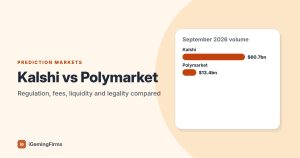
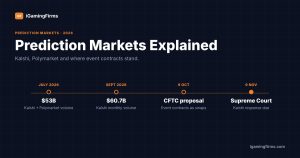
- Prediction markets. DraftKings launched DraftKings Predictions, offering CFTC-regulated event contracts, in December 2025, and now cites it as a major investment area. These products sit outside state gaming tax regimes, which is one reason states such as North Carolina have started taxing them separately. The prediction markets explainer covers how event contracts work.
A per-wager tax is worth singling out because it breaks the usual percentage-of-revenue logic. At 50 cents per bet, a $5 wager carries a tax equal to 10% of stake, which is more than the whole expected hold on a straight bet. Small-stake, high-frequency customers become unprofitable unless the fee is passed through. Track new changes as they happen in the iGaming regulation news roundup.
What this means for you
If you run or plan a sportsbook, model profit from net revenue after promos and taxes, not from hold. Stress-test your plan with a two-point hold miss and with your actual state tax base, including whether promotional credits are deductible. If the plan only works at a 10% hold every month, it does not work.
If you are an affiliate, revenue share deals are usually calculated on net gaming revenue, so you carry the same hold variance and promo deductions as the operator. A quarter like DraftKings’ Q2 2026, with more handle and less revenue, shows up in your statement too. In high-tax states, expect operators to push harder for CPA or hybrid deals as their margins tighten. The guide to iGaming affiliate marketing explains how those deal structures work.
If you advise operators on SEO or acquisition, the biggest cost line you influence is marketing, which ran at 22.8% of revenue at DraftKings in 2025. Organic acquisition that lowers blended customer acquisition cost goes straight to the bottom line.