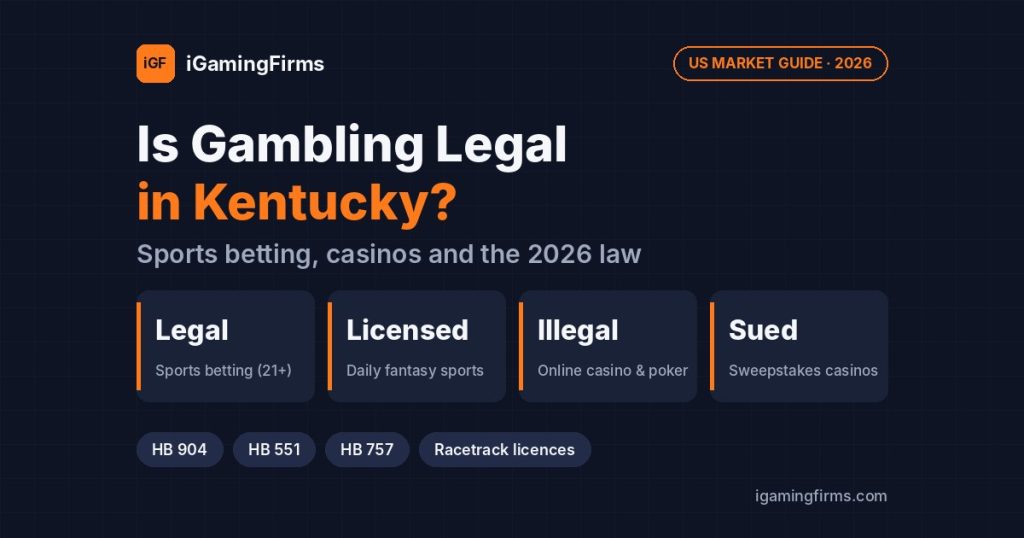
Is gambling legal in Kentucky? Partly. Kentucky allows sports betting, horse racing, the lottery and charitable gaming, but online casinos, online poker and commercial casinos are illegal, and the state is suing sweepstakes and prediction market operators it treats as unlicensed gambling.
The short answer for operators: Kentucky is a sports betting and horse racing market, not a casino market. Online and retail sports betting are legal through the state’s racetracks. Daily fantasy sports became a licensed product in 2026. Every legal route runs through a racing licensee, and anyone who comes in another way faces the state’s Loss Recovery Act.
This guide covers what Kentucky’s gambling law prohibits, what is legal right now, what the 2026 Wagering Consumer Protection Act changed on July 15, and where each type of iGaming business stands. For the national picture, see our state-by-state guide to US gambling laws.
The quick answer: is gambling legal in Kentucky in 2026?
| Product | Status (Oct 2026) | Minimum age | Regulator / legal basis |
|---|---|---|---|
| Online sports betting | Legal, through a licensed racetrack partner | 21 (since July 15, 2026) | Kentucky Horse Racing and Gaming Corporation (KHRGC), HB 551 (2023) |
| Retail sports betting | Legal at racetracks and their gaming facilities | 21 | KHRGC |
| Horse racing (pari-mutuel, ADW) | Legal, online and on-site | 18 | KHRGC |
| Fixed-odds horse racing | Newly allowed under a supplemental licence | 18 | HB 904 (2026) |
| Historical horse racing (HHR) machines | Legal at licensed tracks and gaming halls | 18 | KHRGC, SB 120 (2021) |
| Daily fantasy sports | Legal, licence now required | 18 | HB 904 (2026) |
| Lottery | Legal, including online play | 18 | Kentucky Lottery Corporation |
| Charitable gaming | Legal for licensed charities | Varies by game | KRS Chapter 238 |
| Social gambling (home games) | Players are not prosecuted; hosting for profit is promoting gambling | n/a | KRS 528.010 (player and social game definitions) |
| Commercial or tribal casinos | Not legal | n/a | No authorizing law; no federally recognized tribes |
| Online casino and online poker | Not legal | n/a | No licensing path |
| Sweepstakes casinos | Under state litigation | n/a | AG sued VGW in June 2026 |
| Prediction markets (sports event contracts) | Operating under CFTC oversight, under state litigation | n/a | AG sued Kalshi and Polymarket in June 2026 |
| “Gray” skill machines | Banned | n/a | HB 594 (2023), upheld on appeal in 2026 |
What Kentucky gambling law prohibits: KRS Chapter 528
The default rule sits in KRS Chapter 528. Gambling means staking something of value on a contest, game or scheme decided by chance, with an agreement that someone wins something of value on a given outcome. Anything not carved out by another statute, such as pari-mutuel racing, the lottery, licensed sports wagering or charitable gaming under KRS Chapter 238, falls under that ban. Skill-based contests and e-sports competitions are excluded from the definition.
The chapter targets the business side, not the bettor:
- Players are protected. Someone who bets solely as a contestant and takes no profit beyond personal winnings is a “player”, and player status is a defense under the chapter. A person who plays a social game of chance on equal terms with the others does not “advance” gambling by organizing or hosting it without payment.
- Promoting gambling in the first degree (KRS 528.020) is a Class D felony. It covers bookmaking with three or more people and more than $500 in bets in a day, running a lottery or mutuel scheme above the same threshold, and setting up and operating a gambling device.
- Promoting gambling in the second degree (KRS 528.030) is a Class A misdemeanor: knowingly advancing or profiting from any unlawful gambling activity.
- Records and devices. Possessing gambling records or a gambling device is a separate offense, and the chapter allows forfeiture and civil penalties.
For an iGaming business, the practical reading is simple: an unlicensed operator, white label or payment intermediary serving Kentucky is the party that “advances or profits from” gambling, so the criminal and civil exposure lands on you, not on the customer.
Sports betting: legal, but only through the racetracks
Kentucky legalized sports betting with HB 551, signed in March 2023. Retail books opened on September 7, 2023 and mobile apps followed on September 28, 2023.
The structure is what matters for operators. There is no standalone sportsbook licence you can apply for. Kentucky’s nine licensed racetracks hold the sports wagering licences, and each track can partner with up to three online operators, which caps the online market at 27 skins. Every online brand in the state runs through a track.
Which sportsbooks are licensed in Kentucky?
DraftKings is legal in Kentucky, as are the other major national brands, because each one holds a service provider licence and a track partnership:
| Online sportsbook | Racetrack partner |
|---|---|
| DraftKings | Cumberland Run |
| Circa | Cumberland Run |
| FanDuel | Churchill Downs |
| Prime Sports (live since July 28, 2025) | Churchill Downs |
| bet365 | Sandy’s Racing and Gaming |
| BetMGM | Sandy’s Racing and Gaming |
| Fanatics | Oak Grove |
| Caesars | The Red Mile |
| theScore Bet | Ellis Park |
That is nine apps against a ceiling of 27 skins, but open skins on paper do not mean an easy deal: tracks choose their partners, and the national brands with the largest customer bases have already signed. Any app not on this list that takes Kentucky bets is unlicensed. If you are planning an entry, our guide on how to start a sportsbook covers the platform and licensing budget around a market like this.
Licence fees and tax rates
According to the KHRC sports wagering FAQ:
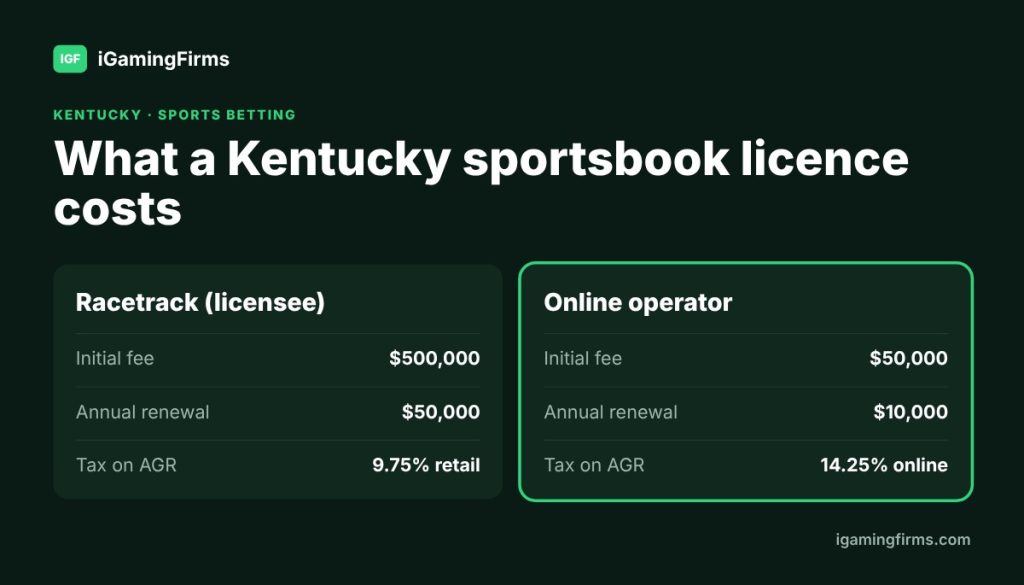
| Item | Racetrack (licensee) | Online operator (service provider) |
|---|---|---|
| Initial licence fee | $500,000 | $50,000 |
| Annual renewal | $50,000 | $10,000 |
| Tax on adjusted gross revenue | 9.75% (retail) | 14.25% (online) |
Those are modest numbers next to states like Illinois or New York. The catch is not cost. It is access: you need one of a limited number of track partnerships, and most of the valuable ones are taken.
How big the market is
Figures below come from KHRGC’s monthly sports wagering reports, as compiled by RG.org.
| Period | Handle | Gross gaming revenue | Hold | State tax |
|---|---|---|---|---|
| 2024 (full year) | $2.63B | $272.1M | 10.43% | $38.6M |
| 2025 (full year) | $3.00B | $305.4M | 10.19% | $46.5M |
| 2026, January to August | $1.96B | $195.7M | about 10.0% | $27.7M |
The 2026 row is the sum of the eight monthly reports published so far. Online accounts for almost everything: in March 2026, 97.9% of all wagers were placed on mobile. Retail books are a compliance requirement for the tracks, not a revenue line.
What changed on July 15, 2026: the Wagering Consumer Protection Act
This is where most Kentucky guides are now out of date. House Bill 904, sponsored by Rep. Michael Meredith, rewrote large parts of Kentucky gaming law. Gov. Andy Beshear vetoed it on April 13, 2026, mainly over a clause letting the KHRGC and the Kentucky Lottery Corporation issue regulations without his signature. The legislature overrode him the next day (67-7 in the House, 26-5 in the Senate), and it became Acts Chapter 184. The session adjourned on April 15, so most of its laws, this one included, took effect 90 days later on July 15, 2026.
Here is what it means in practice:
| Change | What the law now says | Who has to act |
|---|---|---|
| Sports betting age | Raised from 18 to 21. Horse racing, HHR and DFS stay at 18. | Sportsbooks, KYC vendors, affiliates targeting 18 to 20s |
| DFS licensing | Fantasy contest providers need a KHRGC licence, geolocation, independent audits, fraud and AML controls, and problem gambling messaging | PrizePicks, Underdog, Sleeper-style operators and their suppliers |
| DFS licence fees | $7,500 initial / $5,000 renewal if already a sports wagering service provider; $15,000 / $10,000 for others; $5,000 / $1,000 for providers under $50,000 in annual receipts | DFS operators |
| College player props | Bans props on athletes at Kentucky college teams where the bet wins only if the player falls short of a threshold or has a negative outcome. Betting on in-state college games is still allowed. | Sportsbooks, odds and trading suppliers |
| Prediction markets | Tracks, sports wagering licensees, fantasy licensees and their affiliates cannot participate in or contract with platforms offering event contracts through a prediction market in Kentucky | Sportsbooks that also run prediction products |
| Child support registry | Licensed online operators must check applicants against a monthly child support arrearage registry, deny new accounts and suspend existing ones that appear on it | Online operators, KYC and account management vendors |
| Fixed-odds horse racing | Allowed with a $2,500 supplemental licence; taxed at 9.75% on-site and 14.25% online; minimum bet limit of at least $1,000 per race | Tracks, ADW operators |
| Enforcement | The Attorney General gets concurrent jurisdiction with local prosecutors to enforce the racing and charitable gaming chapters | Anyone operating without a Kentucky licence |
| Charitable gaming | Higher licence fees and fines, cordoned areas for electronic pull-tabs, and a freeze on new electronic charity game ticket locations from April 15, 2026 to April 25, 2027 | Charities, pull-tab distributors and manufacturers |
Two points deserve a closer look.
The prediction market clause was narrowed late. Earlier drafts would have barred any Kentucky licensee from running a prediction market anywhere in the US, which would have forced DraftKings, FanDuel and Fanatics to choose between their Kentucky sportsbooks and their national prediction products. Operators warned that could cost the state around $40 million a year in tax. The final version focuses on prediction market activity in Kentucky. The enacted summary is still broadly worded on affiliates and “beneficial interest”, so if your group runs both products, have counsel read the enacted text rather than relying on news coverage.
The age change did not crater the market. July 2026, the first month with the 21+ rule in force for half of it, still produced $216.5 million in handle, up 34% on July 2025. August, the first full 21+ month, came in at $206.2 million. Two months is not a trend, but it suggests the 18 to 20 segment was smaller than critics expected.
Casinos: why there are none, and why that is unlikely to change soon
Kentucky has no commercial casinos and no tribal casinos. There are no federally recognized tribes in the state, so the tribal compact route used in Florida or Oklahoma does not exist here. Casino gaming would need new legislation, and casino bills have repeatedly failed. The most recent serious attempt, Rep. Thomas Huff’s 2025 bill for county-level referendums on casinos with a 21% tax on gross gaming revenue, did not advance, and nothing in the 2026 session moved casinos or iGaming forward.
What Kentucky has instead is historical horse racing. HHR machines look and play like slots, but each outcome is tied to a past horse race. The Kentucky Supreme Court ruled in 2020 that the machines then in use were not true pari-mutuel wagering, and the legislature responded in 2021 with SB 120, which rewrote the definition and kept them legal. There are now more than 8,000 HHR machines in the state, up from about 5,000 in 2020, according to a KHRGC presentation to lawmakers in September 2025. They only operate at licensed tracks and their satellite gaming halls, so they are another racing-licensee monopoly, not an opening for outside operators.
Online casino and online poker
Neither is legal, and Kentucky has a long record of going after operators who serve its residents anyway. In 2008 the state tried to seize 141 gambling domain names. It then sued PokerStars under its Loss Recovery Act, a statute that lets the state recover gambling losses suffered by residents. That case produced an $870 million judgment in Franklin Circuit Court in 2015. The Court of Appeals threw it out, the Kentucky Supreme Court reinstated a nearly $1.3 billion award in December 2020, and Flutter, which owns PokerStars, paid $300 million to settle in September 2021.

The Loss Recovery Act is the tool to understand here. It turns every Kentucky player’s losses into potential damages, which is why the state can pursue offshore and grey-market operators for large sums years after the fact. Online poker was included in a 2022 House bill alongside sports betting, but the Senate rejected it, and no standalone iGaming bill has advanced since.
Are sweepstakes casinos legal in Kentucky? Now a courtroom question
Kentucky has no statute that names dual-currency sweepstakes casinos. It decided it does not need one. On June 17, 2026, Attorney General Russell Coleman sued VGW, the company behind Chumba Casino, LuckyLand and Global Poker, in Franklin Circuit Court. The complaint argues that buying Gold Coins bundled with redeemable Sweeps Coins is real-money casino gambling, and it alleges violations of the state’s gambling laws, the Consumer Protection Act and the Loss Recovery Act. The state is asking for a permanent injunction and civil penalties. VGW has said it will fight the case.
That combination is what makes Kentucky risky for the sweepstakes model. A cease-and-desist letter asks you to leave. A Loss Recovery Act claim asks you to pay back what players lost. Our sweepstakes casino legal map shows how Kentucky compares with the states that have banned the model by statute.
Is Kalshi legal in Kentucky? Prediction markets: sued, taxed and fenced off
Kalshi operates under CFTC oversight, but Kentucky is attacking prediction markets on three fronts at once.
- Lawsuits. In the same June 2026 filing wave, the AG sued Kalshi (with Coinbase) and Polymarket, arguing that sports event contracts are unlicensed sports betting.
- A tax. HB 757, passed in April 2026, imposes a 14.25% excise tax on prediction market operators’ transaction fees, the same rate as online sportsbooks. A coalition of Kalshi, Polymarket, Crypto.com and Robinhood sued on June 12, 2026, calling it discriminatory and preempted by federal law. The tax is scheduled to apply from January 1, 2027.
- Licensee rules. HB 904 stops Kentucky’s licensed tracks, sportsbooks and DFS operators from partnering with prediction markets in the state.
The federal question is still open. Prediction markets argue that the CFTC, not states, regulates event contracts, and courts across the country have split on it. Whatever happens nationally, Kentucky has made its position clear, and it is one of the first states to use licence eligibility as a lever. For how event contracts are structured and cleared, see prediction markets explained.
Skill games and “no-risk” machines
The gas-station machines that spread across Kentucky after 2021 were banned by HB 594 in 2023. A Franklin Circuit judge upheld the ban in June 2024, and the Court of Appeals unanimously affirmed it in February 2026. When manufacturers came back with “no-risk” versions, the AG told prosecutors in September 2024 that those were illegal gambling devices too. Today the only legal machine gaming in Kentucky is HHR at licensed tracks and electronic pull-tabs run by licensed charities.
How old do you have to be to gamble in Kentucky?
Kentucky runs two age thresholds side by side, and the split got wider on July 15, 2026.
| Activity | Minimum age | Notes |
|---|---|---|
| Kentucky Lottery | 18 | Retail and online play |
| Online and retail sports betting | 21 | Raised from 18 by HB 904, effective July 15, 2026; Kentucky was one of the few 18+ sports betting states until then |
| Pari-mutuel and historical horse racing machines | 18 | Includes ADW, fixed-odds racing and HHR at licensed tracks |
| Charitable gaming | 18 | Licensed charities under KRS Chapter 238; varies by game |
| Sweepstakes casinos / DFS | Operator policy, typically 18+ | DFS is 18 under HB 904; sweepstakes casinos are under state litigation |
That 18-and-21 split is why Kentucky’s KYC and age-verification rules differ from the single 21+ norm elsewhere: one state, two thresholds, and a sports betting age that only changed in mid-2026. Our legal gambling age by state table shows where else the thresholds split by product.
Who carries the risk in Kentucky: an exposure map by business role
Most Kentucky pages are written for bettors. If you are on the business side, the better question is which door is open to you and how hard the state will push if you come in the wrong one.
| Your role | Legal path | Exposure | Practical move |
|---|---|---|---|
| Online sportsbook not yet in Kentucky | Yes, via a track partnership | Low if licensed | Map which of the nine tracks still have open skins before budgeting a launch |
| Licensed sportsbook with a prediction product | Yes, with conditions | Medium | Keep prediction products out of Kentucky and get a legal read on the affiliate wording |
| DFS operator | Yes, new licence | Medium if unlicensed after July 15 | Apply to KHRGC; budget for audits, geolocation and self-exclusion integration |
| Online casino or poker operator | No | High (Loss Recovery Act, KRS 528) | Geofence Kentucky; there is nothing to apply for |
| Sweepstakes casino operator | No | High | Decide on geoblocking now; the VGW case will set the tone |
| Prediction market or FCM | Federal only | High and contested | Track the Franklin Circuit cases and the HB 757 tax challenge |
| Platform, odds or trading supplier | Yes, via service provider licensing | Low | Update in-state college prop logic for the HB 904 restriction |
| KYC, age and geolocation vendors | Yes | Low, but rules changed | Support 21+ for sports and 18+ for DFS and racing in one state, plus the child support registry check |
| Affiliates and media buyers | Yes, for licensed brands | Medium for offshore or sweepstakes traffic | Drop 18 to 20 sports targeting; exclude Kentucky from sweepstakes and offshore campaigns |
| Machine manufacturers and distributors | Only HHR and charitable pull-tabs | High for skill games | No route for skill or “no-risk” devices; charitable locations are frozen until April 2027 |
The pattern: Kentucky is open for business if you come through the racing industry, and openly hostile if you do not. Every legal gaming product in the state, from sportsbooks to HHR to fixed-odds racing, is anchored to a track licence, and the 2026 laws tightened that link further. Neighbouring Tennessee takes the opposite approach to market access, with no track requirement; see our guide to online gambling in Tennessee.
What to watch next
- VGW, Kalshi and Polymarket cases in Franklin Circuit Court: an early injunction ruling would tell sweepstakes and prediction operators whether to leave Kentucky.
- The HB 757 tax challenge: whether a court blocks the 14.25% prediction market tax before it applies on January 1, 2027.
- KHRGC regulations for DFS and fixed-odds racing: the statute sets the frame; the regulations will set the operating detail.
- The 2027 session: watch for another casino referendum bill and any attempt to widen the prediction market restrictions again.
What this means for you
If you are planning a Kentucky entry, the realistic options are sports betting through a track partner, DFS under the new licence, or supplying the operators who already hold those licences. Online casino, poker and sweepstakes are closed doors, and the state’s Loss Recovery Act makes walking through them anyway an expensive bet.
For the licensing and compliance work, you can compare iGaming law firms and licensing consultants with US state experience, review KYC and compliance providers for split-age verification and geolocation, or check how payment providers handle restricted states. For a comparison with another US state, see our guide to online gambling laws in Florida, or browse the market-by-market guides.
This article is general information and analysis, not legal advice. Check current positions with qualified Kentucky counsel before making decisions.