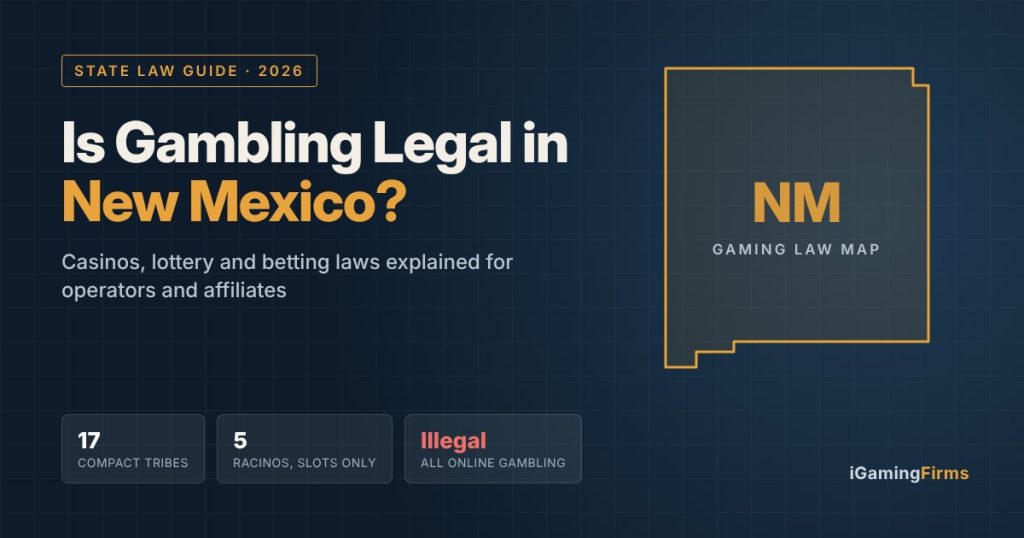
Short answer: Gambling is legal in New Mexico only in the forms the law specifically allows: tribal casinos (including in-person sports betting), five slots-only racetrack casinos, pari-mutuel horse racing, the state lottery and licensed charitable gaming. Real-money online gambling of any kind, including sweepstakes casinos and mobile sports betting, is illegal.
If you’re sizing up New Mexico as a market, most search results won’t help much. They’re written for players, several still call sweepstakes casinos “legal”, and almost none explain the document that actually decides what can happen in the state: the 2015 tribal-state gaming compact.
This guide gives you the legal map as it stands in October 2026: what’s allowed, who can run it, what the compact protects, the criminal penalties that reach operators, and which live disputes (Kalshi, the SunRay racino move, a push to reopen the compact) could change the picture next. For the same picture across every state, see our US gambling laws by state guide.
Is gambling legal in New Mexico?
Yes, but only the forms the law specifically allows. Everything else is illegal by default. The Gaming Control Board states that unless gambling is specifically permitted by law, it’s prohibited under Section 60-2E-4 of the Gaming Control Act and Sections 30-19-1 through 30-19-15 of the Criminal Code.
In practice that leaves five legal channels: tribal casinos (including in-person sports betting), five racetrack casinos with slots only, pari-mutuel horse racing, the state lottery, and licensed charitable gaming. Real-money online gambling of any kind is not one of them.
What’s legal and what isn’t, at a glance
| Activity | Status (Oct 2026) | Who can run it | Overseen by | Minimum age |
|---|---|---|---|---|
| Tribal casino gaming (slots, table games) | Legal | Tribes and pueblos under the 2015 compact | Tribal gaming agencies; Gaming Control Board monitors compact compliance; NIGC | 21 |
| Sports betting | Legal in person at tribal casinos only | Tribes | Tribal gaming agencies | 21 |
| Racetrack casino slots | Legal at 5 racinos, slots only | Licensed racetracks | Gaming Control Board | 21 |
| Pari-mutuel horse racing | Legal at licensed tracks | Licensed racetracks | New Mexico Racing Commission | See track rules |
| State lottery | Legal, retail only | New Mexico Lottery Authority | Lottery Authority | 18 |
| Bingo, raffles, pull-tabs, nonprofit gaming machines | Legal with a license | Qualified nonprofits, veterans and fraternal clubs | Gaming Control Board | Varies |
| Online casinos, poker, sports betting | Illegal | Nobody | n/a | n/a |
| Sweepstakes casinos | Illegal, per the Gaming Control Board | Nobody | n/a | n/a |
| Online lottery sales and couriers | Not permitted | Nobody | n/a | n/a |
| Prediction market sports contracts | Contested in court; the state calls them illegal sports betting | n/a | n/a | n/a |
The compact is the real rulebook
New Mexico’s gaming market is built around tribal exclusivity. Under the federal Indian Gaming Regulatory Act (IGRA), tribes need a compact with the state to offer Class III gaming, which covers slots, table games and sports wagering. When a tribe shares revenue with the state, the compact has to protect the tribe’s exclusive rights in return.
According to a June 2026 briefing to the Legislature’s Indian Affairs Committee, the current compact was approved in 2015 after almost four years of negotiation and runs through June 30, 2037. Seventeen tribes and pueblos have signed it, and 14 currently operate Class III gaming.
The same briefing sets out the key terms:
- Facilities: most tribes may run up to two gaming facilities, certain larger tribes can qualify for a third, and legacy provisions apply to some.
- Regulators: tribal gaming agencies are the primary regulators. The Gaming Control Board appoints a State Gaming Representative to check compact compliance, and the National Indian Gaming Commission provides federal oversight.
- Exclusivity: tribes get exclusive rights to most Class III gaming, with limited exceptions for racetrack gaming machines, the state lottery and certain charitable gaming.
- Player protections: responsible gaming signage, a statewide self-exclusion program, funding for treatment and prevention, and a $10 million liability insurance requirement.
Two more details matter for vendors and analysts. Revenue sharing applies to gaming machine revenue only; table games aren’t part of it. And alcohol can’t be sold or served where Class III gaming takes place on tribal casino floors, which is why some properties run separate Class II areas. Arizona runs a similar tribal-exclusivity model with a different outcome on mobile betting; our Arizona gambling law guide shows how that compact was reopened.
How many casinos are in New Mexico?
Fourteen tribes and pueblos currently operate Class III gaming under the 2015 compact, with most allowed up to two facilities and some larger tribes a third. On top of that, five racetrack casinos offer slots only. Counting both, the state has roughly two dozen casino properties, and every one with table games or a sportsbook is tribal.
Can you drink alcohol in New Mexico casinos?
Not on the Class III gaming floor of a tribal casino. Drinks are served in separate bars, restaurants or Class II areas. Separately, the Gaming Control Board notes that commercial gambling is banned on liquor-licensed premises, so bars can’t run their own games.
Tribal revenue sharing rates under the 2015 compact
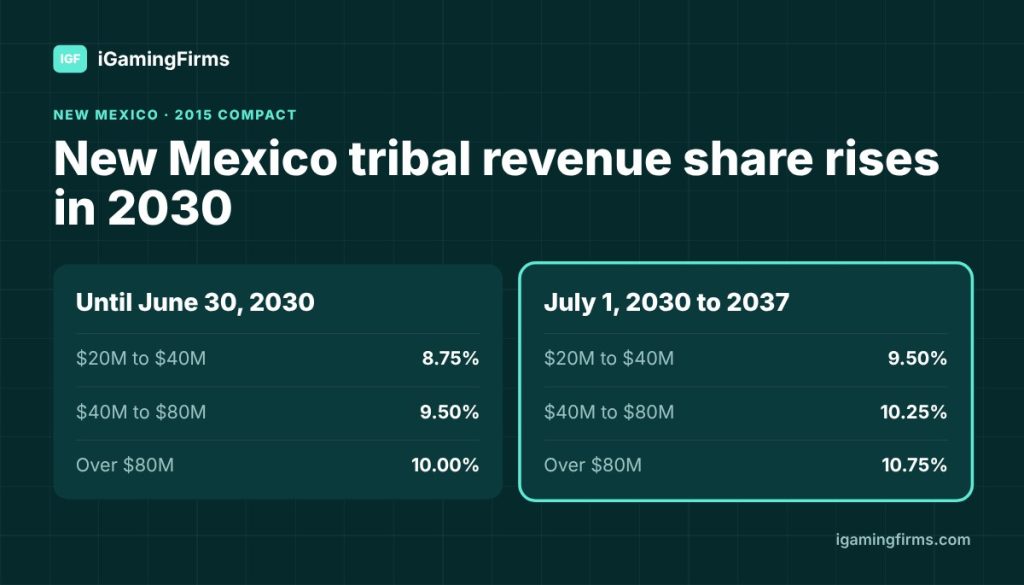
Tribes pay the state a share of “adjusted net win” from gaming machines. Rates step up on July 1, 2030.
| Annual adjusted net win | July 1, 2018 to June 30, 2030 | July 1, 2030 to June 30, 2037 |
|---|---|---|
| Under $20 million | 2% of the first $6M, 8.75% on the rest | 2% of the first $6M, 9.50% on the rest |
| $20M to $40M | 8.75% | 9.50% |
| $40M to $80M | 9.50% | 10.25% |
| Over $80M | 10.00% | 10.75% |
Source: 2015 compact rate table as presented to the New Mexico Legislature (June 2026). The AGA’s 2025 New Mexico fact sheet prints a misaligned version of this table; the legislative version is used here.
Worked example. Reading the tiers as written (one rate on the whole net win above $20M):
- A property group with $50M adjusted net win pays 9.50%, or $4.75M a year today. From July 2030 it pays 10.25%, or $5.125M. That’s $375,000 more per year for the same revenue.
- A smaller operator with $15M pays 2% on the first $6M ($120,000) plus 8.75% on the other $9M ($787,500), for $907,500 in total. After July 2030 that becomes $975,000.
If you’re pricing a supply or revenue-share deal with a New Mexico tribe, that 2030 step-up is a margin change worth building into multi-year terms now.
What would break tribal exclusivity (and why online is stuck)
This is the part most New Mexico gambling guides skip, and it explains nearly every “why hasn’t New Mexico legalized X?” question.
A Legislative Finance Committee hearing brief lists what would end revenue sharing under the compact. The state would lose those payments if it:
- restricted the scope of Indian gaming;
- let anyone other than six licensed racetracks and veterans or fraternal groups operate gaming machines;
- allowed racinos longer hours, more machines or table games; or
- let other entities run Class III gaming beyond the state lottery, horse and bicycle race betting, and nonprofit gaming machines.
| Possible change | What happens under the compact | Practical read |
|---|---|---|
| Sports betting at racinos or other non-tribal venues | Could void revenue sharing | The LFC weighed estimated new tax of $12M to $21M against $60M to $70M a year in tribal payments at risk |
| More racino machines, longer hours or table games | Ends revenue sharing | Racino expansion is effectively frozen without a renegotiated compact |
| A seventh non-tribal casino | Ends revenue sharing (compact caps racinos at six) | Only one more racino license is possible under current terms |
| State-authorized internet gaming | Triggers good-faith renegotiation of the compact | Online casino or mobile betting realistically needs tribal agreement first |
| New lottery games | Compact carves out a state-sponsored lottery | The LFC judged a sports-linked lottery game likely wouldn’t void the deal |
The upshot: online sports betting or iGaming in New Mexico isn’t mainly a question of whether lawmakers like the idea. It’s a question of whether the tribes agree to reopen the compact, and then whether the governor, the Legislature and the U.S. Interior Department sign off on the changes. That’s why every online push so far has stalled.
Racetrack casinos (racinos)
New Mexico has five racinos: Sunland Park Racetrack & Casino (Sunland Park), Zia Park (Hobbs), Ruidoso Downs and Billy the Kid Casino (Ruidoso Downs), The Downs at Albuquerque, and SunRay Park and Casino (Farmington). The compact allows six, but the Racing Commission declined to award the sixth license in 2019 after years of contested bids.

Racinos operate under tight limits set by statute and the compact:
- Slots only, no table games and no sports betting.
- Up to 600 gaming machines of their own, plus up to 150 leased from another track with unused allotment, for a maximum of 750.
- Machines can run only on live race or simulcast days, for up to 18 hours a day and 112 hours a week.
- The casino license is tied to live racing minimums; a track that loses its pari-mutuel license loses its gaming license too.
Tax and fee load. Per the American Gaming Association’s 2025 state fact sheet, racinos pay an effective 46.25% of net take: 26% gaming tax, 20% to racing purses and 0.25% for problem gambling programs. On $10M of net take, that’s $4.625M. The Gaming Control Board reports that racino gaming revenue added about $53M to horse racing purses in fiscal 2024. Operator licenses cost a $25,000 application fee (plus background costs), a $4,000 renewal and $100 per machine. Slot manufacturers pay $10,000 plus a $10,000 background deposit; distributors pay $5,000 plus $5,000. Machines must match a model approved by the Board, a Board-selected lab, or Nevada or New Jersey regulators.
The SunRay move to Clovis
The biggest racino story of 2026 is SunRay Park’s attempt to relocate from Farmington to Clovis on the Texas border. The Racing Commission approved the move 3-0 in February 2026, citing a roughly 60% revenue decline at Farmington. San Juan County challenged it, and in August District Judge Daniel Ramczyk ruled the Commission had exceeded its authority and vacated the approval, as reported by KSJE and CDC Gaming. As of late September no appeal had been filed, but operator Western Gaming said it still intends to pursue the relocation and signaled an appeal.
Why it matters: a Clovis racino would compete for the same Texas customers that Zia Park and several tribal properties rely on, which is exactly why Zia Park and tribal interests objected. Texas itself still has no casinos or legal sports betting, as our Texas gambling law guide explains, which is what makes the border so valuable.
Is sports betting legal in New Mexico?
Yes, but only in person at tribal casinos. No statute authorizes it; tribes offer it as Class III gaming under the compact, which allows “any and all forms” of Class III gaming on Indian lands. Santa Ana Star opened the first sportsbook in 2018 and Buffalo Thunder followed in 2019.
Key rules you should know:
- No mobile or online betting, including statewide apps tied to a tribal book.
- Bettors must be 21 or older.
- Tribal books don’t take bets on University of New Mexico or New Mexico State University games.
- Racinos can’t offer sports betting under current law, and adding it there could void tribal revenue sharing.
Are DraftKings and FanDuel legal in New Mexico?
Their sportsbooks are not. No state law licenses online sports betting, so neither brand can take real-money sports bets from New Mexico. Any offshore site that does is operating illegally; see our guide to offshore sports betting legality for how US enforcement works. Daily fantasy contests are a separate grey-zone question, covered below.
Will New Mexico legalize online sports betting?
Not before 2027 at the earliest. In June 2026, Rep. John Block (R-Alamogordo) urged the tribes during an interim Indian Affairs Committee hearing to reopen the compact and allow statewide online sports betting, arguing the state is losing tens of millions of dollars a year. Any change would need the tribes to reopen the compact, then sign-off from the governor, the Legislature and the Interior Department. With the 2026 session over, January 2027 is the earliest the Legislature could act.
Is online gambling legal in New Mexico?
No. This is where many player-facing guides are out of date. The New Mexico Gaming Control Board runs a public service announcement on its homepage stating that online real-money gambling, explicitly including online casinos, poker, sweepstakes casinos and sports betting, is illegal in New Mexico. It adds that online raffles and bingo are illegal too, and that it doesn’t regulate any form of online gambling because online gambling in any form is illegal in the state.
The Board also says it can’t resolve complaints from players who lose money on these sites, and it runs an anonymous tip line for reporting illegal gambling.
Two things follow for the industry:
- For affiliates: there’s no licensed online product in New Mexico to promote, and the state regulator has put sweepstakes casinos in the illegal column. Treat New Mexico traffic as a market with no compliant online offer.
- For sweepstakes operators: New Mexico hasn’t passed a dedicated sweepstakes ban like the ones enacted in several states in 2025 and 2026, but the regulator’s public position is already clear, which makes geoblocking the state a sensible risk call.
Are sweepstakes casinos legal in New Mexico?
No. The Gaming Control Board’s public notice lists sweepstakes casinos as illegal alongside online casinos, poker and sports betting. There is no dedicated sweepstakes statute, but the regulator’s stated position makes geoblocking New Mexico the prudent call for dual-currency operators. Our state-by-state sweepstakes casino tracker shows where New Mexico sits against the states with formal bans.
Daily fantasy sports sits in a grey zone. There’s no fantasy-specific statute, and DFS operators have treated it as outside the gambling definition, but the Board’s “any form” language is broad. Get state-specific legal advice before launching.
Penalties for illegal gambling in New Mexico
The Criminal Code draws a sharp line between players and the people who profit from gambling:
| Offence | Statute | Penalty class |
|---|---|---|
| Gambling (making a bet, playing a gambling device) | NMSA 30-19-2 | Petty misdemeanor |
| Commercial gambling (running or profiting from gambling) | NMSA 30-19-3 | Fourth degree felony |
Permitting premises to be used for gambling (30-19-4) and dealing in gambling devices (30-19-5) are separate offences. For operators and affiliates, the commercial gambling felony is the one that matters. The Gaming Control Board’s guidance applies it even to small cases, such as charging people to play a home slot machine. Equipment used for illegal gambling can also be forfeited under Section 30-19-10.
Is Kalshi legal in New Mexico? The live fight in 2026
New Mexico is now one of the most active fronts in the fight over sports event contracts. For how these products work and why states treat them as betting, see our prediction markets explainer.
- May 2026: the Mescalero Apache Tribe and the Pueblos of Isleta, Pojoaque and Sandia sued Kalshi in federal court, arguing its sports contracts violate IGRA, the compacts and tribal gaming ordinances on their lands.
- June 2026: Attorney General Raúl Torrez filed a state court suit in Santa Fe. The complaint alleges Kalshi runs what amounts to an unlicensed sportsbook and lets 18- to 20-year-olds trade, below the state’s minimum gaming age of 21.
- September 2026: the tribes filed their final written arguments for a preliminary injunction that would bar Kalshi’s sports contracts on tribal lands and require geofencing, Source NM reported. They cited an August federal appeals ruling that let Nevada regulators bar Kalshi’s sports contracts. U.S. District Judge Margaret Strickland set a hearing on the injunction and Kalshi’s motion to dismiss for September 23 in Las Cruces.
As of this update, no ruling on the injunction had been reported. Kalshi argues its contracts are federally regulated swaps under the Commodity Exchange Act, and courts elsewhere have split. If you operate or partner in prediction markets, New Mexico is a state where you should expect geofencing to be on the table.
The New Mexico Lottery
The lottery was created by the 1995 Lottery Act and sells Powerball, Mega Millions, Lotto America, Roadrunner Cash, Pick games and scratchers at licensed retailers. Players must be 18 or older.
Its revenue model is unusual: by law the lottery must send 30% of gross revenue to the Lottery Tuition Fund, which pays for the Legislative Lottery Scholarship. It hit a record $51.1M transfer in fiscal 2024; fiscal 2025 transfers were about $44.7M. A 2026 bill (SB 309) to replace the 30% rule with a fixed minimum and allow higher prize payouts died without a full Senate vote, so the 30% requirement still stands.
There’s no online lottery. Jackpocket, the DraftKings-owned courier, suspended New Mexico service in early 2025 after an Attorney General opinion found it was effectively reselling tickets without authorization, and said its arrangement with the Lottery Authority amounted to authorizing internet gaming.
Charitable gaming and horse racing
Qualified organizations can run bingo, raffles and pull-tabs under the Bingo and Raffle Act, licensed by the Gaming Control Board. They generally need two years of continuous existence in New Mexico, and proceeds must go to lawful purposes. Raffle prizes over $75,000 need ten days’ notice to the Board. The Board approved updated bingo and raffle rules (Title 15, Chapter 4) in August 2025, including licensing and accounting requirements.
Licensed veterans and fraternal clubs can also operate gaming machines, with tight limits: no more than 15 machines, prizes capped at $4,000, play only between noon and midnight, and a $100 application fee plus $100 per machine. The state takes 10% of net take. The Board reported 46 such clubs licensed and operating as of June 30, 2024.
Pari-mutuel wagering on live horse racing at licensed tracks is legal and regulated by the Racing Commission. Whether off-track betting through online advance deposit wagering accounts is lawful is less clear: a 2022 Senate memorial described off-track betting as the state’s only legal online gambling, while the Gaming Control Board now says online gambling in any form is illegal. If ADW is part of your plans, get a formal legal opinion.
How old do you have to be to gamble in New Mexico?
New Mexico uses 21 for casino-style gaming and sports betting and 18 for the lottery, with charitable and pari-mutuel rules set by the licensee or the track. Our legal gambling age by state table compares these thresholds nationally.
| Activity | Minimum age | Notes |
|---|---|---|
| Tribal casino gaming and sports betting | 21 | Set under the 2015 compact and tribal gaming ordinances |
| Racetrack casino slots | 21 | Licensed by the Gaming Control Board |
| State lottery | 18 | Retail sales only; no online lottery |
| Charitable gaming | Varies | Bingo, raffles and pull-tabs under the Bingo and Raffle Act; minors can’t play senior citizen bingo |
| Pari-mutuel | See track rules | Regulated by the New Mexico Racing Commission |
The 21 threshold is now an enforcement tool in its own right: the Attorney General’s complaint against Kalshi cites 18- to 20-year-olds trading on the platform as below the state’s minimum gaming age of 21, so KYC teams should treat 21 as the operative line for anything that looks like casino play or sports wagering.
What this means for you
If you’re an operator or supplier: New Mexico is a B2B market, not a licensing opportunity. The realistic routes in are supplying tribal properties (where tribal gaming agencies set licensing rules and IGRA allows management contracts) or supplying the five racinos through Board-licensed manufacturer and distributor channels. There’s no state online license to apply for, and there won’t be one without a compact deal.
If you’re an affiliate or marketer: there’s no legal real-money online product to send New Mexico traffic to, and the regulator has publicly named sweepstakes casinos as illegal. Content that targets New Mexico players with online offers carries risk with no compliant upside.
If you’re in compliance or legal: keep these dates on your watchlist.
- The federal court’s decision on the tribes’ injunction request against Kalshi, plus the AG’s state case.
- Any appeal by Western Gaming of the ruling that blocked SunRay’s move to Clovis.
- The January 2027 legislative session, the earliest point any online betting bill could move.
- July 1, 2030, when tribal revenue sharing rates step up.
- June 30, 2037, when the 2015 compact expires and the whole framework is renegotiated.
The short version: New Mexico gambling is legal, busy and almost entirely tribal, and it will stay offline until the tribes decide otherwise.