Arizona has one of the busiest online sportsbook markets in the US, 26 tribal casinos, a regulator that sends cease-and-desist letters to sweepstakes brands, and an attorney general who filed criminal charges against Kalshi. It has no legal online casino. That mix is why “is online gambling legal in Arizona?” gets such different answers. Some ranking pages still say the tribal compacts expire in 2022, one says reservation casinos admit 18-year-olds, and another describes sweepstakes casinos as “licensed and regulated” by the state.
The short answer: some online gambling is legal in Arizona and some is not. As of October 2026 you can legally bet on sports through 12 live mobile sportsbooks licensed by the Arizona Department of Gaming (ADG), play paid daily fantasy contests with ADG-licensed operators, and bet on horse races through permitted advance deposit wagering (ADW) accounts, if you are 21 or older and physically in Arizona. Real-money online casino games and online poker are not legal; casino gambling happens only in person at tribal casinos, also at 21. The Arizona Lottery does not sell tickets online. Sweepstakes casinos have no specific statute, but the ADG says only genuinely free-to-play games are legal and has sent cease-and-desist letters to several sweepstakes brands, including Stake.us, which left the state in 2025.
This guide covers each product and its minimum age, how Arizona’s tribal-and-sports-team licensing model works, the sweepstakes rules and enforcement, the Kalshi prosecution, offshore sites, taxes, and what it all means for operators, suppliers and affiliates.
What gambling is legal in Arizona? Product-by-product status
| Product | Status (Oct 2026) | Legal basis | Minimum age |
|---|---|---|---|
| Online sports betting | Legal since September 2021; 12 live operators | A.R.S. Title 5, Chapter 11 (event wagering) and the 2021 amended tribal-state compacts | 21 |
| Retail sports betting | Legal at licensed sports facilities and tribal casinos; nine bar and racetrack (LEWO) locations approved but not yet launched | Same chapter | 21 |
| Online casino games (slots, table games, live dealer) | Not legal | No licence exists; gambling is illegal unless an exception in A.R.S. § 13-3302 applies | Not applicable |
| Online poker | Not legal | Same as online casino | Not applicable |
| Tribal casinos | Legal; 16 tribes run 26 Class III casinos | Tribal-state gaming compacts with all 22 federally recognized tribes | 21 |
| Daily fantasy sports | Legal with ADG-licensed operators (15 active) | A.R.S. § 5-1202 and ADG fantasy sports rules | Set by ADG rules and operator terms |
| Online horse race betting (ADW) | Legal through providers holding an Arizona ADW permit | A.R.S. § 5-112 and Ariz. Admin. Code R19-2-404 | 21 |
| Arizona Lottery | Legal; retail only, no online, phone or mail sales | State lottery law | 21 |
| Sweepstakes casinos (dual currency) | No specific statute; ADG says only genuinely free-to-play games are legal and has sent cease-and-desist letters | General gambling law, A.R.S. §§ 13-3301 to 13-3305 | Set by each operator |
| Prediction markets (Kalshi and others) | Contested; 20 criminal counts filed against Kalshi in March 2026, prosecution blocked by a federal injunction that the state is fighting | Commodity Exchange Act (federal) vs. Arizona gambling law | Platform terms |
This matches the Arizona row in our US gambling laws by state hub: no online casino, online and retail sports betting, licensed DFS, no sweepstakes statute, 21 for casinos and sports betting, and the Arizona Department of Gaming as the regulator. Arizona is also one of the few states where the lottery age is 21 rather than 18.
Is online sports betting legal in Arizona?
Yes. Arizona’s amended tribal-state gaming compacts were signed by Gov. Doug Ducey and the tribes on April 15, 2021 and took effect on May 24, 2021, alongside the state law that created event wagering and fantasy sports licences. The first mobile sportsbooks went live in September 2021. The ADG licenses and regulates every operator.
Two rules apply to every bet. You must be in Arizona when you place it, because tribal licensees may only take mobile wagers off reservation lands within the state, and sports-team licensees take mobile wagers statewide. And no licensee may “allow a person under twenty-one years of age to place a wager”, under A.R.S. § 5-1311. The same section bars licensees from taking bets from people on the self-exclusion list or from prohibited participants such as athletes and others who can affect an outcome.
How Arizona’s licensing model works
Arizona’s structure is unusual and matters to anyone trying to enter the market. Under A.R.S. § 5-1304, the ADG may issue up to 20 event wagering operator licences:

- Up to 10 for sports-side applicants: owners of an Arizona professional sports team or franchise, the operator of a facility hosting an annual PGA Tour event, a qualifying stock car race promoter, or their designee. These licensees can run a retail sportsbook at or near their facility (within a five-block radius) and mobile wagering statewide.
- Up to 10 for Arizona tribes (or a wholly tribally owned entity or designee) that have signed the most recent compact. These licensees offer mobile wagering off their Indian lands, throughout the state.
No one may hold more than one licence, and licences run for five years. In practice, every national sportsbook brand in Arizona entered through a partner: a team, a racetrack, a golf venue or a tribe. The ADG’s privilege fee on event wagering cannot exceed 10% of adjusted gross event wagering receipts under A.R.S. § 5-1318. The ADG reopens applications when slots free up. Its most recent window ran from June 26 to July 10, 2026 (CDC Gaming Reports), and it announced a new event wagering licence allocation on August 3, 2026.
What gambling apps are legal in Arizona?
The ADG’s approved operators page lists these event wagering licensees and their Arizona partners as of October 2026:
| Sportsbook | Arizona partner | Status |
|---|---|---|
| Bally Bet | Phoenix Mercury | Live |
| bet365 | Ak-Chin Indian Community | Live |
| BetMGM | Arizona Cardinals | Live |
| Caesars | Arizona Diamondbacks | Live |
| Desert Diamond | Tohono O’odham Nation | Live |
| DraftKings | TPC Scottsdale | Live |
| Fanatics | Tonto Apache Tribe | Live |
| FanDuel | Phoenix Suns | Live |
| Hard Rock Bet (Hard Rock Digital) | Navajo Nation | Live |
| theScore Bet (PENN) | Phoenix Raceway | Live |
| betcris (Plannatech) | San Carlos Apache Tribe | Live |
| BetRivers (RSI) | Arizona Rattlers | Live |
| Circa Sports | San Juan Southern Paiute | Licensed, not yet launched |
| Golden Nugget | Hualapai Tribe | Ceased operations in Arizona |
| Sporttrade | Quechan Indian Tribe | Ceased operations in Arizona |
That leaves 12 live mobile sportsbooks. Any other app taking sports bets from people in Arizona is unlicensed. For affiliates, this list is the full compliant universe for Arizona sports betting content.
Is DraftKings legal in Arizona? Can I use FanDuel in Arizona?
Yes to both, for sports betting and daily fantasy. DraftKings is licensed through TPC Scottsdale and FanDuel through the Phoenix Suns, and both also hold fantasy sports licences. What neither can offer in Arizona is an online casino. DraftKings Casino and FanDuel Casino run only in the seven states where online casinos are live (Maine has legalized iGaming but not yet launched). Because location decides legality, an Arizona resident who is physically in, say, Michigan or New Jersey can use those casino apps there, and a visitor to Arizona can use a licensed sportsbook while in the state.
Our guide on how to start a sportsbook covers the licence, platform and partner side of entering a market like Arizona.
When did sports gambling become legal in Arizona?
The amended compacts and the event wagering law came in spring 2021: the compacts were signed on April 15, 2021 and took effect on May 24, 2021. Mobile betting launched in September 2021, which is the date most operators and the regulator use as the start of the market.
Are online casinos legal in Arizona?
No. Arizona has no licence for real-money online slots, table games, live dealer games or online poker, and a site offering them to people in Arizona is unlicensed whatever licence it holds elsewhere. Casino gaming in Arizona is tribal gaming, conducted in person at tribal facilities under the compacts.
Why can’t I play games for money online in Arizona?
Because Arizona’s starting point is that gambling is illegal unless a specific exception applies. The criminal code defines gambling as risking “something of value for the opportunity to obtain a benefit from a game or contest of chance or skill or a future contingent event” (A.R.S. § 13-3301(6)). Section 13-3302 then carves out amusement, social and regulated gambling, plus certain raffles. Regulated gambling covers what the state has authorized: tribal casinos under the compacts, event wagering, licensed fantasy contests, the lottery, horse racing and charitable gaming. Online casino games are not on that list, so offering them for real money falls back into the general ban. Running a business that accepts bets outside those exceptions is a class 1 misdemeanor under § 13-3305, and the ADG cites §§ 13-3303 to 13-3305 when it warns operators.
Will Arizona legalize online casinos?
Not soon, on current evidence. Arizona has not passed an online casino law and no iGaming bill advanced in 2026. Because the tribes hold casino gaming rights under the compacts, any future iGaming expansion would in practice have to be negotiated with them, in the same way the 2021 compacts paired new tribal rights with sports betting for teams and venues. That is our analysis rather than a stated position of the state or the tribes.
Tribal casinos: what Arizona already allows
According to the ADG, gaming in Arizona is governed by compacts between the state and all 22 federally recognized Arizona tribes. Each compact is substantially identical, lasts 10 years and can be renewed for another decade plus an additional two-year term. Today 16 tribes operate 26 Class III casinos. The other six tribes have no casinos but hold slot machine rights they can lease to tribes that do, through transfer agreements.
- Machines: up to 1,400 gaming machines at each current gaming facility.
- Tables: 100 card game tables for facilities more than 40 miles from a city of over 400,000 people, and 150 for those within 40 miles. The ADG counted about 550 card and table games in operation as of January 1, 2022.
- Revenue sharing: tribes contribute a share of net gaming revenue to the state and local governments; the ADG reported $47.59 million in tribal contributions for the first quarter of fiscal year 2027.
One ranking page says the compacts are “set to expire in 2022”. They were amended and restated in 2021, with further amendments in 2022, and the 10-year term runs from there. Another counts “over 34” tribal casinos; the ADG’s figure is 26 Class III casinos.
How old do you have to be to gamble in Arizona?
The gambling age in Arizona is 21 for casinos, sports betting, horse racing and the lottery.
| Product | Minimum age | Source |
|---|---|---|
| Tribal casinos | 21 | A.R.S. § 5-601(B); compacts since June 1, 2003 |
| Sports betting (mobile and retail) | 21 | A.R.S. § 5-1311(B)(1) |
| Horse racing (track and ADW) | 21 | A.R.S. § 5-112(J) |
| Arizona Lottery | 21 | Arizona Lottery (purchase and redemption) |
| Daily fantasy sports | ADG rules and operator terms | A.R.S. § 5-1202 leaves contest rules to the ADG |
| Sweepstakes casinos | Operator terms | No state licence |
| Prediction markets | Platform terms | Disputed by the state |
A.R.S. § 5-601(B) requires every compact executed, modified, extended or renewed from June 1, 2003 to “prohibit persons under twenty-one years of age from wagering on gaming activities.” Before that date many tribal casinos admitted 18-year-olds, which is probably where the claim on one ranking page that reservation casinos are 18+ comes from. It is out of date by more than two decades. Arizona is a 21 state for every form of casino gambling, unlike Oklahoma or parts of California where some tribal casinos still admit 18-year-olds (see our legal gambling age by state table).
Is PrizePicks in Arizona? Daily fantasy sports
Yes. PrizePicks is on the ADG’s list of licensed fantasy sports operators, and so is Underdog. The full active list as of October 2026 is Betr, Dabble Sports, DataForce, DraftKings, FanDuel, FastDraft Fantasy, FFPC, Flexbets, ParlayPlay, PrizePicks, RealTime, Splash Sports, SportsHub, Underdog and Yahoo. OwnersBox is listed as having ceased operations in Arizona.
This is a real difference from neighbouring markets. In states where pick’em contests are restricted, PrizePicks and Underdog often run limited versions or none at all. In Arizona they operate under a state licence. For affiliates, the test is the same as for sportsbooks: if a fantasy product is not on the ADG list, do not market it as legal in Arizona. Winnings from fantasy contests are taxable income, covered in the tax section below.
Is online horse race betting legal in Arizona?
Yes. Arizona allows advance deposit wagering, the account-based model that national racebook apps use. Under A.R.S. § 5-112, an ADW provider needs an Arizona ADW permit, which the state issues only if the provider’s home-state racing regulator has approved it. Permitted providers may take wagers from Arizona residents on in-state and out-of-state races, pay a share of gross ADW revenue into the state’s racing regulation fund, and report wagers daily. Permits run for up to three years under Ariz. Admin. Code R19-2-404. The same statute bars permittees from knowingly letting anyone under 21 wager.
Arizona legislators also filed SB 1614 in 2026 to adjust the ADW provisions in § 5-112, including how ADW deposits flow into the racing regulation fund. For racebook operators the takeaway is that Arizona is a permit market: confirm a provider holds a current Arizona ADW permit before you market it there.
Are sweepstakes casinos legal in Arizona?
Arizona has no law aimed specifically at dual-currency sweepstakes casinos, so they are not banned by statute. But the regulator has made its position clear, and it is not friendly to the model.
The ADG’s sweepstakes guidance says “only certain games styled as ‘free-to-play’ are legal in Arizona” and notes that “sweepstakes” is not a term defined in Arizona law. To stay outside the gambling ban, the ADG says an operator must:
- Allow participation for free, with no purchase or consideration of any kind required.
- Give free participants the same manner of play, the same extent and the same odds of winning as paying participants.
- Add no extra hurdles for free entry, such as extra forms, mailings or limited entries.
- Not tell anyone they have won a prize unless they have.
- Display the free option clearly and conspicuously.
- Do nothing to suggest payment is required or make free play harder than paid play.
- Publish rules disclosing its business address, the odds of winning each prize, the number, value and nature of prizes, any payment schedule and all contest rules.
- Comply with federal mail law (39 U.S.C. § 3001).
Read against the typical dual-currency model, where free Sweeps Coins mostly arrive bundled with Gold Coin purchases and the free route is a mailed postcard, points 2 and 3 are the hard ones. That checklist is the most useful thing on this topic for operators and is missing from the ranking pages reviewed for this guide.
Enforcement so far
- Cease-and-desist letters: the ADG has sent several rounds since late 2024. Coverage names Bovada (December 2024); Stake.us, High 5, Novig, ReBet, BettorEdge, Fanthem and Dallas Safari Club in one round (Gaming America); seven unnamed sites in late June 2025 (Deadspin); and ARB Gaming (Modo.us), Epic Hunts, Generiz, ProphetX, MyBookie and BetUS in a later round (SweepsChaser, Gaming America). The ADG said the sites were promoting illegal gambling and cited state laws on illegal control of an enterprise and money laundering.
- Operator exits: Stake.us added Arizona to its excluded states on August 12, 2025 after the regulator’s warnings. Other brands block Arizona on their own.
- No ban bill enacted: Arizona was not among the states that passed sweepstakes bans in 2025 or 2026.
Some ranking pages call sweepstakes casinos in Arizona “licensed and regulated by the ADG”, and others present them as plainly legal for players aged 18 and up. No such licence exists, and the regulator’s published test is far narrower than either claim suggests. The accurate summary is that no statute names them, the regulator treats anything short of genuinely free play as illegal gambling, and the biggest brand has already left. Our sweepstakes casino legal map lists Arizona as open in the statutory sense, and the letters above are why many operators treat it as closed anyway. High 5 is worth noting for suppliers: it is also a licensed game supplier in regulated markets, so a letter like this carries licensing risk elsewhere.
Is Kalshi legal in Arizona?
Arizona says no and became the first state to try to prove it in a criminal court. The timeline:
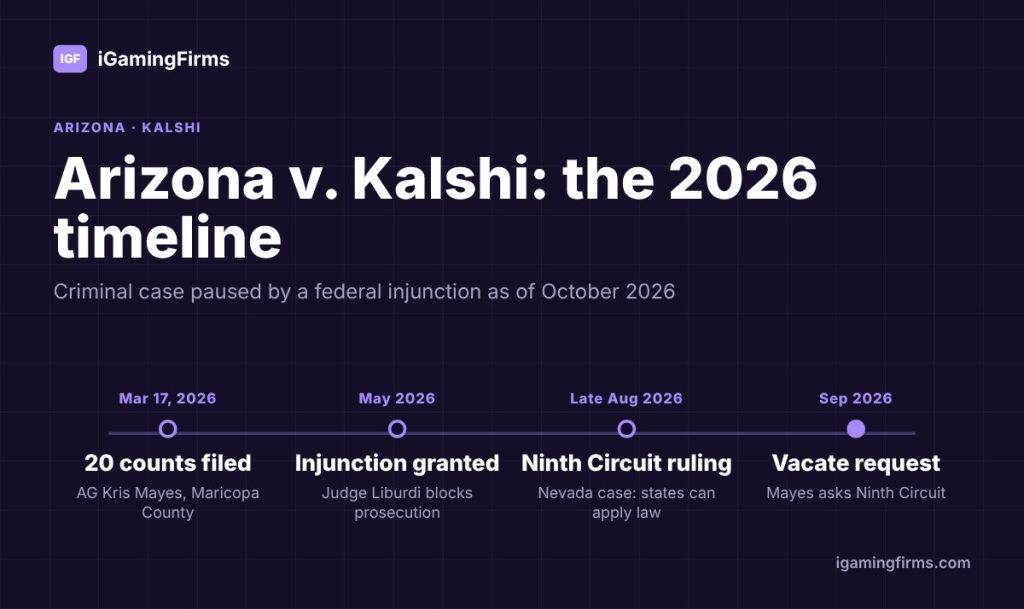
- March 2026: Kalshi sued Arizona in federal court a few days before charges were filed, arguing that the Commodity Exchange Act and CFTC jurisdiction override state gambling law. US District Judge Michael Liburdi denied a temporary restraining order on March 16.
- March 17, 2026: Attorney General Kris Mayes filed 20 misdemeanor counts in Maricopa County Superior Court, accusing Kalshi of running an unlicensed wagering business. Sixteen counts cover sports contracts (professional sports, college athletics and individual player performance) and four cover election contracts, including the 2026 Arizona governor’s race. The maximum fine reported is $400,000 (Gaming America).
- April 2026: On 9 April Judge Liburdi again declined Kalshi’s request to stop the state case. The next day, on a request from the DOJ and CFTC arguing federal preemption, he issued a temporary restraining order halting the prosecution, and the United States sued Arizona, Connecticut and Illinois, arguing that the CFTC has exclusive authority over event contracts.
- May 2026: Judge Liburdi granted Kalshi a preliminary injunction barring the Attorney General from prosecuting it under Arizona gambling law, finding that oversight of the platform falls within CFTC authority (Gambling News).
- Late August 2026: the Ninth Circuit, which covers Arizona, held in the Nevada case that the Commodity Exchange Act does not stop states applying their gambling laws to Kalshi’s sports-event contracts. It sent the question of election contracts back to the district court.
- September 2026: Mayes asked the Ninth Circuit to vacate the Arizona injunction to the same extent, calling the two cases virtually identical (Gambling News, September 2026).
So as of October 2026 the criminal case is on hold under a federal injunction, and Arizona is trying to get it lifted on the strength of a Ninth Circuit ruling that covers Arizona too. Expect the sports counts and the four election counts to be treated differently, since the Nevada ruling left election contracts open. Some local reports in late August described the block as permanent, so check the current docket before relying on either description. Our explainer on how prediction markets and event contracts work covers the wider fight between states and the CFTC.
Is it illegal to gamble on offshore sites in Arizona?
Offshore casinos and sportsbooks are not licensed in Arizona, and the ADG treats them as illegal gambling operations. Its “Check Your Bet” campaign tells players to confirm an operator is on the ADG’s lists of tribal casinos, event wagering and fantasy sports licensees, or racing permit holders before playing, and to report anything else to the ADG or the Attorney General. The ADG’s statement on its sweepstakes page is broad: engaging in, promoting or benefiting from gambling is illegal unless an exception applies.
In the enforcement covered in this guide, Arizona has gone after operators rather than individual players. The practical risk for players is losing access to funds with no regulator to complain to, and none of the state’s self-exclusion or dispute processes apply. The legal risk sits with the operator and the businesses that promote or process payments for it. That is why ranking pages that call offshore casinos “100% safe” for Arizona players are misleading. Our guide on whether offshore sports betting is legal explains how the Wire Act and UIGEA fit in.
What are the tax obligations for gambling winnings in Arizona?
Gambling winnings, including sportsbook, casino, fantasy, racing and lottery prizes, are taxable income for federal purposes and count toward Arizona income tax. Licensed operators issue Form W-2G above the federal thresholds, which changed for payments made in 2026, and from tax year 2026 the federal deduction for gambling losses is limited to 90% of losses. Arizona Lottery prizes of $600 or more must be claimed at a Lottery office or by mail. Check current IRS W-2G instructions for the exact thresholds by game type.
What to watch next
- Ninth Circuit, Arizona v. Kalshi: whether the court vacates the injunction and lets the Maricopa County prosecution resume, and whether the election counts are split from the sports counts.
- New sportsbook entrants: the 2026 licence window and the August 3 allocation could add a brand to the live list, and Circa Sports is licensed but not yet launched.
- Retail expansion: nine Limited Event Wagering locations with Caesars at bars and Turf Paradise are approved but not live, and the ADG announced new LEWO licence allocations on September 15, 2026.
- Sweepstakes: further ADG letters, and whether Arizona follows the 2026 wave of statutory bans in its next session.
Our monthly iGaming regulation roundup covers each of these as it lands.
What this means for operators, suppliers and affiliates
| Your role | What Arizona’s law means for you |
|---|---|
| Sportsbook operator | Entry runs through a partner: one of up to 10 sports-side licences or 10 tribal licences, with a privilege fee capped at 10% of adjusted gross receipts. Watch the ADG’s application windows; Golden Nugget and Sporttrade have ceased operations in Arizona, so the live market is smaller than the licensee list. |
| Online casino operator | No licence exists, and casino gaming rights sit with the tribes under the compacts. Any future iGaming model would most likely run through tribal partners. |
| Sweepstakes operator | No statute, but an active regulator with a published free-to-play test. If your free route is not genuinely equal to paid play, assume the ADG views the product as illegal gambling. The largest brand has already geofenced the state. |
| DFS and pick’em operator | One of the more open pick’em markets, under an ADG fantasy licence. Get licensed before offering contests. |
| Racebook (ADW) operator | Legal under an Arizona ADW permit, which requires home-state approval, revenue contributions to the racing regulation fund and daily wager reporting. |
| Prediction market or exchange | A criminal case is paused by a federal injunction that the state is asking the Ninth Circuit to undo. ProphetX also received an ADG letter. |
| Affiliate or media buyer | Promote only the 12 live licensed sportsbooks, the licensed fantasy operators and permitted ADW providers to Arizona audiences, at 21+. Do not present offshore or sweepstakes casinos as legal options; the ADG’s letters accuse operators of promoting illegal gambling. |
| Game studio, platform, payment or KYC provider | ADG vendor certification applies if you supply tribal casinos or licensed operators. A sweepstakes client that receives an Arizona letter can become a problem for your certifications here and in other regulated states. |
Next step
If you are entering Arizona or advising someone who is, start with the ADG’s licensing rules for your product and line up a tribal or sports-side partner early; our list of iGaming law firms includes firms with US state experience.
This article is general information and analysis, not legal advice. State positions change quickly; confirm current law with qualified counsel before making decisions.