Last updated: 15 October 2026
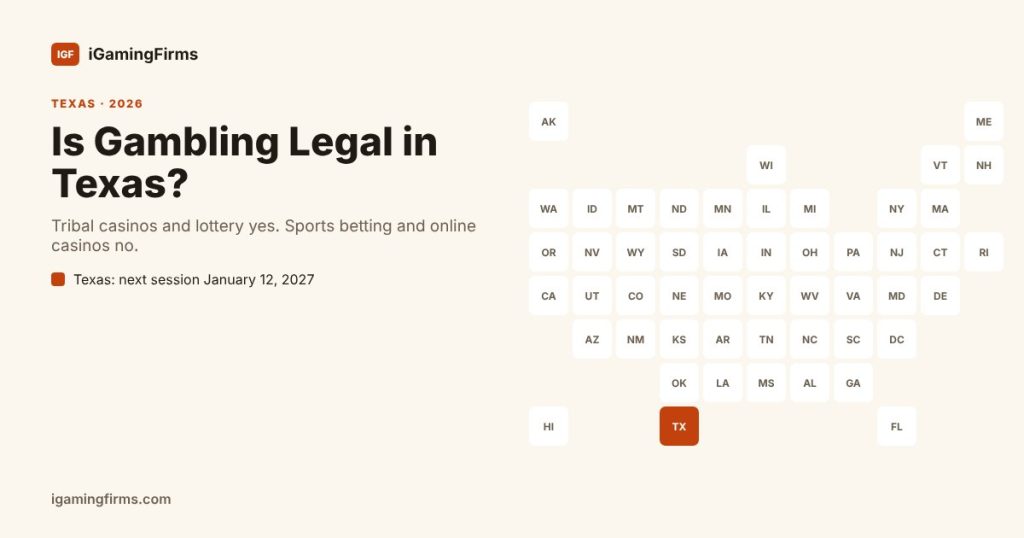
Short answer: Gambling is legal in Texas only in a few narrow forms: the state lottery, charitable bingo and raffles, pari-mutuel betting on horse racing, and Class II electronic bingo at three tribal casinos. Commercial casinos, sports betting, online casinos and online poker are not legal. Nothing can change before the Legislature returns on January 12, 2027, and full legalization needs a constitutional amendment approved by voters.
So is gambling legal in Texas for the industry? Mostly no, and that is the problem. Texas has more than 30 million people, major league teams in every big sport and a betting audience that already shows up in everyone’s traffic data. If you run a sportsbook, supply games, build casino content or buy traffic in the US, the demand is obviously there, but the legal door is mostly shut. The rules that do exist are scattered across a constitution, a penal code, federal tribal law and a lottery overhaul that only landed in 2025.
This guide pulls it into one place: what is legal right now, what is not, the gray areas that keep generating lawsuits, the Penal Code sections that reach operators and affiliates, and what the November 2026 elections and the 2027 session could change. For the same picture across every state, see our US gambling laws by state guide.
Is gambling legal in Texas? What is allowed in 2026
| Activity | Status in 2026 | Legal basis | Who oversees it |
|---|---|---|---|
| Commercial casinos | Not legal | Texas Constitution Art. III, Sec. 47; Penal Code Ch. 47 | None |
| Tribal gaming (Class II) | Legal at 3 venues | IGRA, Restoration Act, Ysleta del Sur Pueblo v. Texas (2022) | Tribes and National Indian Gaming Commission |
| Sports betting (retail and mobile) | Not legal | Penal Code 47.02 and 47.03 | None |
| Online casinos and online poker | Not legal | Penal Code Ch. 47 | None |
| Sports event contracts (prediction markets) | Operating; contested | Federal CFTC oversight | CFTC; state position unsettled |
| Sweepstakes casinos | Operating; no specific law | Chapter 622, Business and Commerce Code (old sweepstakes rules) | No dedicated regulator |
| State lottery (retail only) | Legal | State Lottery Act; SB 3070 (2025) | Texas Department of Licensing and Regulation (TDLR) |
| Lottery couriers and online ticket sales | Banned, now a crime | SB 3070 (2025) | TDLR |
| Charitable bingo and raffles | Legal | Occupations Code Ch. 2001 and 2002 | TDLR (bingo) |
| Horse and greyhound pari-mutuel betting | Legal at licensed tracks | Texas Racing Act | Texas Racing Commission |
| Poker clubs (membership model) | Gray area, operating | Private place defense, Penal Code 47.02(b) | Local zoning |
| Daily fantasy sports | Gray area, operating | 2016 AG opinion says illegal; untested in court | None |
Why is gambling illegal in Texas?
Two documents do most of the work. Article III, Section 47 of the Texas Constitution tells the Legislature to prohibit lotteries and gift enterprises, then lists the few exceptions voters have approved over the years: charitable bingo, charitable raffles and the state lottery. Anything outside that list needs a new constitutional amendment.
Then Chapter 47 of the Penal Code turns the ban into offenses. Placing a bet on a game, contest or election, or playing a gambling device for money, is a Class C misdemeanor for the player. Running the business side is treated much more seriously, which matters if you are on the industry side (see the operator section below).
The constitutional angle is why legalization is so slow. A normal bill needs a simple majority. A constitutional amendment needs two-thirds of both chambers, which is 100 of 150 House members and 21 of 31 senators, and then a statewide vote (Art. XVII, Sec. 1). On top of that, the Legislature only meets in regular session in odd-numbered years.
Politics adds the final layer. Lt. Gov. Dan Patrick controls what reaches the Senate floor, and he has said he will only bring gambling bills up if a majority of Republican senators back them. In 2023 the House passed a sports betting constitutional amendment, HJR 102, while a resort casino resolution fell short of the votes it needed. The sports betting measure died in the Senate. In 2025 joint resolutions were filed again (HJR 134 for sports betting, SJR 16 for resort casinos and sports betting), but neither got a floor vote after a group of House Republicans said they would oppose any expansion and Patrick said the Senate would not take them up.
Are there casinos in Texas? Three tribal venues, all Class II
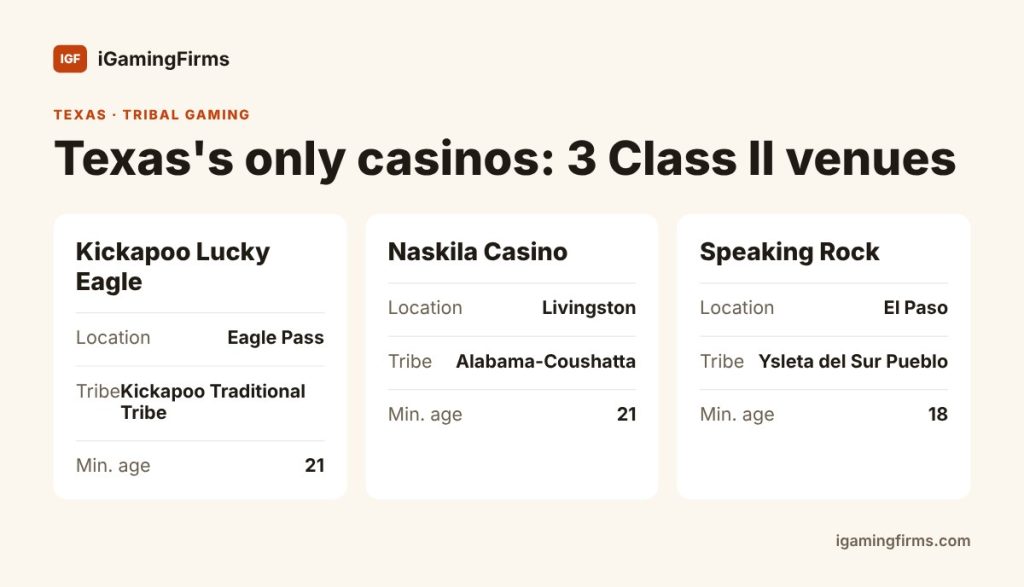
There are no commercial casinos in Texas. What exists is tribal gaming at three venues, and all three are limited to Class II games under federal law. In practice that means electronic bingo machines that look like slots, plus bingo and poker. House-banked games such as blackjack and roulette, and true Class III slots, need a tribal-state compact, and Texas has never signed one.
| Venue | Location | Operated by |
|---|---|---|
| Kickapoo Lucky Eagle Casino Hotel | Eagle Pass | Kickapoo Traditional Tribe of Texas (largest of the three; broke ground on a new hotel tower in July 2026) |
| Naskila Casino | Livingston, about 80 miles northeast of Houston | Alabama-Coushatta Tribe of Texas |
| Speaking Rock Entertainment Center | El Paso | Ysleta del Sur Pueblo |
The Alabama-Coushatta and Ysleta del Sur Pueblo spent decades fighting the state over whether they could offer electronic bingo at all. That ended with Ysleta del Sur Pueblo v. Texas in June 2022. The US Supreme Court ruled 5 to 4 that Texas can only stop the tribes from offering games that state law outright prohibits, and since Texas allows bingo, electronic bingo is allowed on their land. The state later told the Fifth Circuit it would not appeal a lower court ruling that Naskila’s electronic bingo is legal.
The key point for the industry: these venues are a ceiling, not a starting point. None of them offer online gambling, and they cannot move to Class III without a change to Texas law.
Is sports betting legal in Texas?
No. There are no licensed sportsbooks, retail or mobile, anywhere in Texas. Placing a bet on the result of a game is covered by Penal Code 47.02, and taking bets is covered by 47.03. DraftKings, FanDuel, BetMGM and other licensed US books geofence the state.
The industry has tried hard. The Texas Sports Betting Alliance, which brings together pro teams such as the Dallas Mavericks, Houston Astros and Dallas Cowboys along with major sportsbook brands, has lobbied for a constitutional amendment for several sessions. Gov. Greg Abbott has said he is open to the idea but “not there yet” on a constitutional change. The blocker has been the Senate, not public opinion, and nothing changes that before 2027.
Offshore books still take Texas action without any US licence. Our explainer on whether offshore sports betting is legal covers the federal and state exposure in more detail.
Is Kalshi legal in Texas? Prediction markets in 2026
This is where the real action is in 2026. Kalshi, Polymarket and other platforms regulated by the federal CFTC offer sports event contracts to Texas residents, and Texas has become one of their biggest markets. Research from Eilers & Krejcik Gaming published in April 2026 found that 43% of sports event contract volume came from just two states, Texas and California, both without legal sports betting. If you need the mechanics, see how prediction markets and event contracts work.
On September 15, 2026, the Texas Senate Committee on State Affairs, chaired by Sen. Bryan Hughes, held a 62-minute hearing on exactly this question. According to iGB’s coverage of the hearing:
- The American Gaming Association urged Texas to seek an order forcing platforms to geofence the state, and to sue in state court rather than federal court.
- Kalshi argued that blocking federally regulated markets would push Texas customers toward offshore sites with fewer protections.
- Sen. Bob Hall said he saw no real difference between an event contract and a sports bet, calling them “different costumes on gambling.”
No action came out of the hearing, and no legislation can pass until the 2027 session. But it showed which direction the Senate is leaning. If you have products or partnerships that depend on Texas prediction market volume, treat that exposure as uncertain for 2027.
Is online gambling legal in Texas?
Online casinos and online poker
Real-money online casinos and online poker are not legal in Texas, and no bill to legalize them is moving. Offshore sites accept Texas players, but they are unlicensed in the US and operate outside Texas law. A Texas Attorney General opinion (DM-344) has also rejected the argument that gambling online from home counts as a “private place” under the social gambling defense.
Are sweepstakes casinos legal in Texas?
Sweepstakes casinos sit in a different spot. They use a dual-currency, no-purchase-necessary model and keep operating in Texas because no statute targets them directly. Texas’s main sweepstakes law, Chapter 622 of the Business and Commerce Code, was written for the direct-mail era, and industry lawyers have pointed out that it, or the Deceptive Trade Practices Act, could still give the Attorney General a basis for enforcement. Louisiana’s Attorney General leaned partly on Texas case law when declaring sweepstakes casinos illegal there in 2025. No Texas enforcement action has been announced so far.
The national trend is moving against the model. California, New York, New Jersey and Montana passed bans in 2025, and in 2026 Tennessee, Indiana, Iowa, Louisiana, Maine and Oklahoma (where lawmakers overrode the governor’s veto) followed. Texas has no ban yet, but it is one of the larger markets where a 2027 bill or an AG action would hit hardest. Our sweepstakes casino legal map tracks the state-by-state status.
The Texas Lottery: what changed in 2025
The lottery is the most visible legal gambling product in Texas, and it went through a major overhaul in 2025 after two controversies: a $95 million Lotto Texas jackpot won by a group that bought about 99% of all number combinations, and an $83.5 million jackpot won through a courier app.
Gov. Abbott signed SB 3070 in June 2025. The new law:
- Abolished the Texas Lottery Commission and moved the lottery and charitable bingo to the Texas Department of Licensing and Regulation from September 1, 2025
- Banned lottery couriers and made online and app-based ticket sales a crime
- Capped a single person’s purchase at 100 tickets
- Added a security office and an annual state audit of the lottery
The law also sets a deadline. Unless the Legislature reauthorizes it after a Sunset Advisory Commission review, the state lottery is abolished on September 1, 2029. For lottery tech vendors and courier businesses, Texas is closed to digital sales, and the lottery’s long-term future is officially on the table.
Is poker legal in Texas? Poker rooms, bingo, racing and fantasy sports
Poker clubs and home games
Texas has dozens of poker clubs, and they rely on the private place defense in Penal Code 47.02(b): the game happens in a private place, nobody gets an economic benefit except personal winnings, and the odds are the same for every player. So the clubs don’t take a rake. They charge membership and seat fees instead. Home games that meet the same three conditions also fall under the defense.
Whether the club model holds up has been fought out in Dallas. The Fifth Court of Appeals sided with Texas Card House in August 2024, and in September 2025 the Texas Supreme Court declined to hear the city’s appeal, which left that ruling in place. That keeps the clubs open, but no court has ruled that the model is legal statewide, so it remains a gray area.
Charitable bingo and raffles
Licensed nonprofits can run bingo, and qualified organizations can hold raffles under strict rules. Bingo regulation moved to TDLR along with the lottery in 2025.
Horse and greyhound racing
Pari-mutuel betting is legal at tracks licensed under the Texas Racing Act and overseen by the Texas Racing Commission. Historical horse racing machines are not allowed. The Commission approved them in 2014, then reversed course in 2016 after the Legislative Budget Board withheld its funding, putting the Commission and live racing at risk.
Eight-liners and game rooms
Slot-style eight-liner machines in game rooms are only legal if they pay out non-cash prizes worth no more than $5 or 10 times the cost of one play, whichever is less (the “fuzzy animal” exclusion in Penal Code 47.01). Cash payouts make them illegal gambling devices.
Daily fantasy sports
In 2016, Attorney General Ken Paxton issued an opinion that paid daily fantasy contests are likely illegal gambling under Texas law, while season-long leagues where players split the pot generally are not. An AG opinion is not a court ruling, and DraftKings said at the time it would keep operating. DFS operators still serve Texas, but the legal question has never been settled.
How old do you have to be to gamble in Texas?
The minimum age depends on the product. Our legal gambling age by state table compares Texas with the rest of the US.
| Activity | Minimum age | Notes |
|---|---|---|
| Texas Lottery and charitable bingo | 18 | Retail lottery tickets only; online and courier sales are banned under SB 3070 |
| Pari-mutuel horse racing | 21 | At tracks licensed under the Texas Racing Act |
| Tribal casinos | 21 / 18 | 21 at Kickapoo Lucky Eagle and Naskila; 18 at Speaking Rock (confirm with the venue) |
| Sweepstakes casinos and DFS | Set by the operator | Typically 18+ or 21+; no Texas statute sets a specific age |
| Prediction markets (Kalshi etc.) | 18 | Under CFTC rules for federally regulated event contracts |
Operators and affiliates should treat 21 as the safe default for anything casino-like, and remember that under-18 access to any product is a Penal Code exposure.
What Texas gambling law means for operators, suppliers and affiliates
Most pages about gambling in Texas are written for players, and they mostly stop at “it’s illegal to bet.” For the industry, the more important question is which Penal Code sections apply to businesses, because the penalties there are much heavier than the fine a player faces. A Class C misdemeanor carries a fine of up to $500 and no jail. A Class A misdemeanor carries up to one year in county jail and a fine of up to $4,000.

| Penal Code section | What it covers | Penalty | Who it can reach |
|---|---|---|---|
| 47.02 Gambling | Making a bet on a game, contest or election; playing a gambling device for money | Class C misdemeanor | Players |
| 47.03 Gambling promotion | Operating or sharing in the earnings of a gambling place, bookmaking, holding stakes for gain, selling chances on games or elections, promoting a lottery for gain | Class A misdemeanor | Operators, bookmakers, anyone sharing in earnings |
| 47.04 Keeping a gambling place | Letting property be used for gambling | Class A misdemeanor | Venue owners and landlords |
| 47.05 Communicating gambling information | Knowingly sharing bets, odds or line changes with intent to further gambling, or providing equipment to transmit them | Class A misdemeanor | Odds feeds, tipsters, affiliates pushing unlicensed books |
| 47.06 Gambling devices | Owning, making or moving gambling devices with intent to further gambling (with a defense for shipping to a legal jurisdiction) | Class A misdemeanor | Machine makers, distributors, eight-liner operators |
Federal exposure on top of state law
Because the activity is illegal under Texas law, federal statutes can also come into play for businesses serving Texas. The Illegal Gambling Business Act (18 USC 1955) reaches operations that break state law, involve five or more people and either run for more than 30 days or gross $2,000 in a single day, with up to five years in prison. The Wire Act (18 USC 1084) covers transmitting sports bets across state lines, and the Unlawful Internet Gambling Enforcement Act targets payment processing for unlawful internet gambling. Texas law also allows gambling proceeds and equipment to be forfeited.
Practical takeaways
- Affiliates should look hard at 47.05. It is written broadly around communicating odds “with the intent to further gambling.” Publishing general sports content is not the issue. Actively funneling Texas users to unlicensed offshore sportsbooks with odds and links is the kind of activity that section was written for. Talk to Texas counsel before you target Texas traffic with real-money offers.
- Geofencing is the default. Licensed US operators already block Texas for real-money products. If you sell platforms or CRM tools to US operators, Texas will usually sit outside the licensed footprint, so plan your platform setup and CRM segmentation around that.
- Sweepstakes and prediction market partners carry the most 2027 risk. Both models are operating now, both drew attention from Texas officials in 2025 and 2026, and both could be targeted by a bill or AG action without needing a constitutional amendment.
- Lottery digital sales are closed. SB 3070 made online and courier ticket sales a crime. There is no gray area left for courier-style models in Texas.
This is a map of where the risk sits, not legal advice. If Texas matters to your business, get a Texas gaming lawyer to review your specific setup.
When could Texas legalize casinos or sports betting?
Here is the realistic timeline, based on how Texas changes its constitution:
- November 3, 2026: elections. Gov. Abbott and Lt. Gov. Patrick are both on the ballot, along with an open Attorney General seat (state Sen. Mayes Middleton, a Republican, against state Sen. Nathan Johnson, a Democrat). The lieutenant governor result matters most for gambling, since that office controls the Senate floor. The new AG will shape enforcement on sweepstakes and prediction markets.
- January 12, 2027: the 90th Legislature convenes. Expect bills on sports betting, resort casinos, prediction markets and possibly sweepstakes.
- Spring 2027: the two-thirds hurdle. A casino or sports betting amendment needs 100 House votes and 21 Senate votes. The House has come close before. The Senate has never taken a floor vote.
- November 2027 at the earliest: voters decide. If a joint resolution passes, it goes on the statewide ballot.
- 2028 or later: launch. Even with a yes vote, regulators would need time to write rules and license operators.
Restrictions are a different story. A prediction market geofencing push, a sweepstakes ban or tighter rules on poker clubs could pass as ordinary bills with simple majorities in 2027, with no voter approval needed. For most businesses, that is the more likely change to plan for.