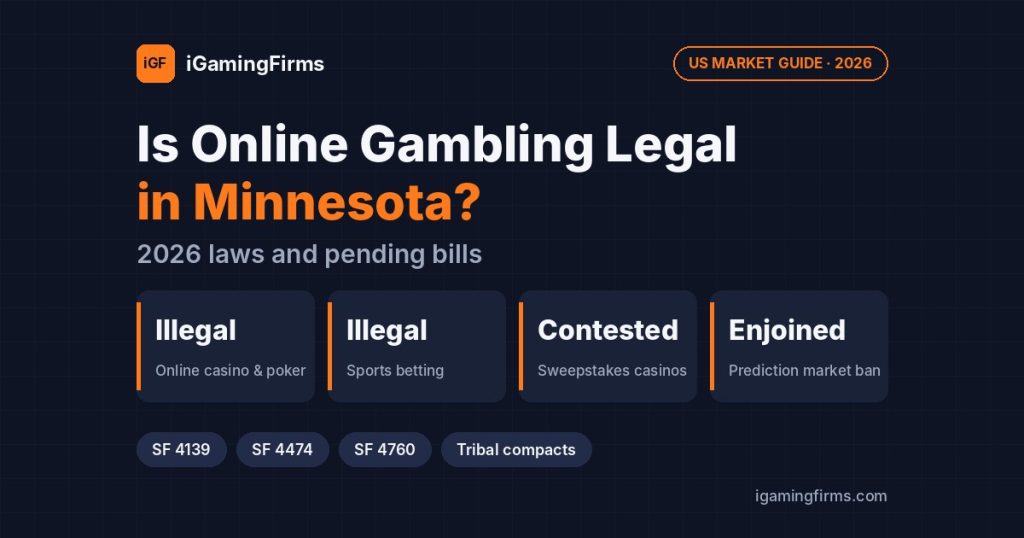
Is online gambling legal in Minnesota? No. As of October 2026, real-money online casinos, online poker and sports betting (online or retail) are all illegal in Minnesota, and the 2026 legislative session ended without creating a licence for any of them.
If you run a sportsbook, a sweepstakes brand, an affiliate network or a payments business, that makes Minnesota the Midwest market that keeps almost opening. Every bordering state now has some form of regulated sports betting, lawmakers file new bills every session, and yet the state still says no. In 2026 it went further and started writing new crimes instead of new licences.
This guide covers the laws that actually apply, what happened to every gambling bill in the 2026 session, what DraftKings, FanDuel and prediction markets can offer in the state today, where each type of business stands, and what to watch before the Legislature meets again in 2027.
The short answer: is online gambling legal in Minnesota?
Real-money online gambling is not legal in Minnesota as of October 2026. There is no licence for online casinos, online poker or sports betting, and none is likely before 2028.
Three things did change in 2026, though:
- Prediction markets: Minnesota passed the first state law that criminalises operating or advertising a prediction market. A federal judge blocked it before it took effect, and the case is still running.
- Sweepstakes casinos: a ban passed the Senate 62-3 but died in the House, so dual-currency sites remain in a contested grey zone that state officials already call illegal.
- Sports betting: a tribal-exclusive mobile bill was introduced with tribal and major-operator support, then stalled and died at adjournment.
Minnesota online gambling status at a glance (October 2026)
| Vertical | Status | What it rests on |
|---|---|---|
| Online casino (real money) | Illegal | No authorising law; general gambling crimes in Minn. Stat. 609.755 and 609.76 |
| Online sports betting | Illegal | Never legalised; sports bookmaking is a felony |
| Retail sports betting | Illegal | Tribal compacts cover only slots and blackjack |
| Online poker | Illegal | No licensing framework |
| Sweepstakes (dual-currency) casinos | Contested | No specific statute; AG and AGE say they break existing law; 2026 ban bill died in the House |
| Prediction markets (CFTC-registered) | Operating under a court injunction | 2026 state ban enacted, then blocked by a federal judge on July 27, 2026 |
| Daily fantasy sports, including pick’em | Available, not expressly authorised | No specific DFS statute; paid contests operate in the state |
| Online lottery | Limited | Run only by the state-operated Minnesota Lottery |
What Minnesota law actually says
Minnesota does not have an “online gambling” statute. It doesn’t need one. The criminal code makes every bet a crime unless the state has specifically authorised that form of gambling, and online wagering isn’t on the authorised list.
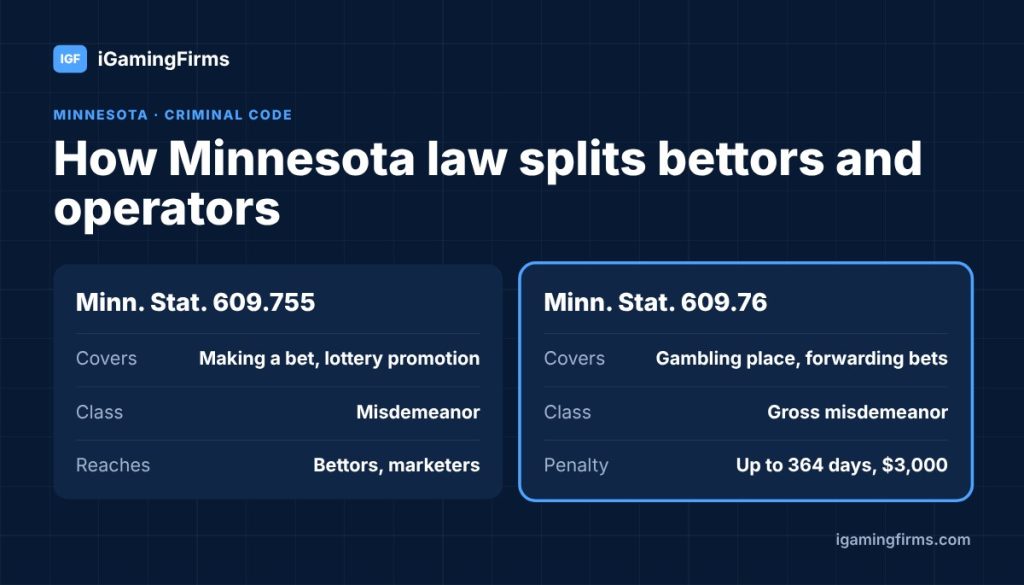
Two sections do most of the work:
- Minn. Stat. 609.755 makes it a misdemeanor to make a bet, and also to disseminate information about a lottery with intent to encourage participation. That second clause matters for marketers, because “lottery” in Minnesota law is broad.
- Minn. Stat. 609.76 is where operator and supplier risk sits. Operating a gambling place, collecting the proceeds of a gambling device, or receiving, recording or forwarding bets is a gross misdemeanor (up to 364 days and a $3,000 fine). Sports bookmaking is a felony.
Legal gambling in Minnesota is a short list: tribal casinos, licensed charitable gambling (pull-tabs, paddlewheels, tipboards, bingo and raffles), pari-mutuel horse racing, card rooms at the two racetracks, and the Minnesota Lottery. The Alcohol and Gambling Enforcement Division (AGE) states plainly that offshore casinos, sweepstakes casinos and sports betting sites are not licensed in Minnesota, and that it is illegal both for them to offer games to residents and for residents to play.
Why the tribes shape every bill
Minnesota’s 11 federally recognised Tribal Nations were the first in the US to sign gaming compacts with a state. According to the Department of Public Safety, there are 22 compacts covering 20 casinos, the Class III games are limited to slots and blackjack, and both sides agreed the compacts should be effective forever.
Two consequences follow for anyone hoping to enter the market:
- The compacts have no expiry date, so the state has no renegotiation deadline to use as leverage.
- Any bill that gives commercial operators or racetracks their own licences loses tribal support, and any bill that gives tribes everything loses the tracks and charities. Six years of failed bills come down to that split.
This is why every serious Minnesota sports betting proposal now gives the tribes exclusive licences and lets them partner with commercial platforms, the “market access” model operators will recognise from other tribal states.
Every gambling bill from the 2026 session, and what happened
The 2026 session adjourned on May 18. Here is how each gambling bill ended up.
| Bill | What it would do | Outcome |
|---|---|---|
| SF 4139 (Sen. Frentz, bipartisan) | Legalise mobile sports betting through up to 11 tribal licences, each able to partner with one platform; 22% tax; age 21+; ban college props and prediction markets | Stalled in the Senate without advancing; died at adjournment |
| SF 4474 | Ban dual-currency online sweepstakes games, with liability for operators, payment processors, tech providers and affiliates | Passed the Senate 62-3 on April 30; House did not vote; died |
| SF 4511 / HF 4437 (Rep. Greenman), folded into SF 4760 | Make operating, creating or advertising a prediction market a felony, effective August 1, 2026 | Passed inside the public safety omnibus (Senate 57-9, House 100-32); signed May 19, 2026; blocked by federal court July 27, 2026 |
Sports betting: SF 4139
SF 4139 was the most stakeholder-friendly sports betting bill Minnesota has seen. It had backing from the Minnesota Indian Gaming Association and the Sports Betting Alliance (bet365, BetMGM, DraftKings and FanDuel). The Senate bill summary sets out a mobile-only model regulated by the commissioner of public safety, with platform and supplier licences sitting under tribal operators.
Key terms operators would be pricing against:
- 22% tax on net revenue, with 15% of tax receipts to an equalisation fund for tribes that don’t take part, 15% to horse racing and 15% to sports tourism and events
- Minimum age of 21
- No prop bets on college sports and restrictions on push notifications to inactive users
- A required study on gambling activity before launch
The bill never advanced out of the Senate, and its sponsor acknowledged it had little chance before adjournment. The pattern from 2025 repeated: Klein’s SF 757 failed on a 6-6 committee vote despite support from tribes, tracks, charities and pro teams.
Are sweepstakes casinos legal in Minnesota? (SF 4474)
Not clearly. No statute names dual-currency sweepstakes, but AGE lists sweepstakes casinos alongside offshore sites as unlicensed and illegal to offer in Minnesota, and the Attorney General has written to sweepstakes brands telling them to leave (see enforcement below).
SF 4474 would have removed the doubt. It defined an online sweepstakes game as one using a dual-currency system that simulates casino-style gambling. Its reach is what B2B readers should note: the final language extended liability beyond operators to financial institutions, payment processors, technology providers and marketing affiliates. It cleared the Senate by 62-3 but the House never brought its companion to a vote. The Minnesota Alliance on Problem Gambling expects the issue to return next session. For how other states have handled the same products, see our tracker of where sweepstakes casinos are legal by state.
Is Kalshi legal in Minnesota? Prediction markets (SF 4760)
Kalshi and Polymarket are operating in Minnesota under a federal court injunction. The state’s ban rode through on a must-pass public safety bill. It defines a prediction market as a system that lets consumers wager on future outcomes such as sports, elections, entertainment or world affairs, carves out farm-related weather contracts, and makes operating, creating or advertising one a felony carrying up to five years and a $10,000 fine. It also reaches services that help users get around the ban, such as VPNs, and anyone who knowingly provides data or verification services that enable wagers, which puts data and KYC suppliers in scope.
The CFTC sued the day after signing, and Kalshi and Polymarket joined. On July 27, Judge Katherine Menendez granted a preliminary injunction, finding the plaintiffs likely to succeed on the argument that the Commodity Exchange Act preempts the law for CFTC-registered exchanges (KSTP report). She warned that any permanent relief may be much narrower, because not every listed event contract has been shown to be a federally regulated swap. Attorney General Keith Ellison has said the state will keep defending the law.
Note: some trade and court reports cite the law as “SF 3432”. Senate and House coverage identifies the enacted vehicle as SF 4760, so that is the number used here. If you are new to how these exchanges differ from sportsbooks, our prediction markets explainer covers the CFTC model.
Is DraftKings or FanDuel legal in Minnesota?
Their sportsbooks are not. Neither DraftKings Sportsbook nor FanDuel Sportsbook can take bets in Minnesota, because no form of sports betting is legal. Both brands still have a live product footprint in the state through channels that sit outside sports betting law:
| Product | Available in Minnesota? | Legal basis |
|---|---|---|
| DraftKings Sportsbook / FanDuel Sportsbook | No | Sports betting is illegal; bookmaking is a felony |
| DraftKings DFS and Pick6; FanDuel DFS | Yes | No DFS statute; contests operate without express authorisation |
| DraftKings Predictions; FanDuel Predicts | Yes | CFTC-regulated event contracts, protected for now by the July 2026 injunction |
| FanDuel Racing | Yes | Pari-mutuel horse racing is legal in Minnesota |
The same logic covers pick’em fantasy apps: paid pick’em contests (Sleeper and Betr Picks, for example) remain available because Minnesota has never passed a DFS law in either direction. That leaves them exposed if the Legislature or the AG decides to act. The practical point for operators is that the big sportsbook brands are already building Minnesota customer lists through DFS and prediction products, so a future launch would not start from zero.
Enforcement is already happening without new laws
Minnesota isn’t waiting for the Legislature. In June 2025 AGE sent warning letters to 14 offshore and sweepstakes sites. On November 5, 2025, Attorney General Ellison sent his own letters to the same 14, telling them to stop serving Minnesota by December 1.
Three details in that action matter for how you assess risk:
- It names sweepstakes brands next to offshore books. VG LuckyLand, Zula Casino and Fortune Coins were listed alongside Bovada, BetOnline, MyBookie and others. The AG’s position is that selling sweeps coins to play a game of chance for a real prize makes the site illegal gambling.
- It adds civil exposure. The AG letters lean on Minnesota consumer-protection law (deceptive and unfair practices) on top of the criminal statutes AGE cited. Civil claims are easier for a state to pursue than criminal cases against offshore entities.
- Some sites kept operating. Without a specific statute or a court ruling, the state’s leverage over sweepstakes operators is limited. That gap is exactly what SF 4474 was meant to close.
Minnesota’s AG was also one of 34 state attorneys general that filed an amicus brief backing New Jersey in its fight with Kalshi over sports event contracts.
How old do you have to be to gamble in Minnesota?
18 for every legal form of gambling the state runs or licenses, with some tribal casinos setting 21. The only 21+ threshold in state law is the one written into a bill that has not passed.
| Activity | Minimum age | Notes |
|---|---|---|
| Minnesota State Lottery | 18 | State-operated draw and scratch games |
| Pari-mutuel horse racing | 18 | At the two licensed racetracks |
| Charitable gambling (pull-tabs, bingo) | 18 | Licensed charitable gambling only |
| Tribal casinos | 18 at most venues | Some set 21, often where alcohol is served; check the property |
| Proposed online sports betting (SF 4139) | 21 | In the bill text; the bill did not pass |
| Sweepstakes/DFS | Operator policy | No state statute sets an age; most operators require 18 or 21 |
For KYC teams, the practical point is that any future regulated product would carry a 21 threshold while existing legal gambling in the state sits at 18, so age checks need to be configured per product, not per state. Our legal gambling age by state table shows how that compares nationally.
Where your business stands in Minnesota today
Most pages on this topic answer one question for players: “can I play?” If you sell to, market for or process payments for gambling operators, the more useful question is how exposed your specific role is, and how a 2027 bill would change that. This map is built from the statutes, the AG letters and the 2026 bill texts above.
| Your role | Exposure today | What raises it | Practical move |
|---|---|---|---|
| Licensed US sportsbook or iGaming operator | Low if you geofence Minnesota out; high if you accept Minnesota wagers (sports bookmaking is a felony) | Nothing; no licence exists to apply for | Keep Minnesota blocked; build tribal partnership relationships now, since every viable bill routes licences through the 11 tribes |
| Sweepstakes casino operator | High. Named in AG letters; state treats dual-currency play as illegal; civil and criminal theories in play | A revived SF 4474 would make it explicit and criminal | Treat Minnesota as a likely exit market; plan the geoblock and player-balance wind-down before a bill passes |
| Prediction market (CFTC-registered DCM) | Protected for now by the preliminary injunction | A narrower final ruling on which contracts are swaps, or an appeal outcome | Track the case; map which of your contracts would fall outside “swap” if relief is narrowed |
| Affiliates and media | Moderate for promoting unlicensed operators (the AG’s consumer-protection theory and the lottery-promotion clause in 609.755) | SF 4474 named marketing affiliates; SF 4760 criminalises advertising prediction markets (currently enjoined) | Pull Minnesota-targeted sweeps and offshore promotion; keep legal-status content informational |
| Payment providers and PSPs | Moderate. “Forwarding bets” in 609.76 is broad, and the AG’s civil route doesn’t depend on proving a crime | SF 4474 named financial institutions and payment processors directly | Add Minnesota to merchant restrictions for sweepstakes MCCs; document your geolocation controls |
| Platform, game, data and KYC suppliers | Low to moderate, depending on how directly you serve Minnesota-facing sweeps or prediction market clients | SF 4474 named technology providers; SF 4760 reaches data and verification services (currently enjoined) | Review contracts with sweeps and prediction market clients for state carve-outs and termination rights |
None of this is legal advice. If you are making a market-entry or exit decision, a specialist iGaming law firm or licensing consultant should review your exact structure.
What a legal Minnesota market could be worth
Lawmakers keep coming back to this because the numbers are meaningful for a state of about 5.8 million people.
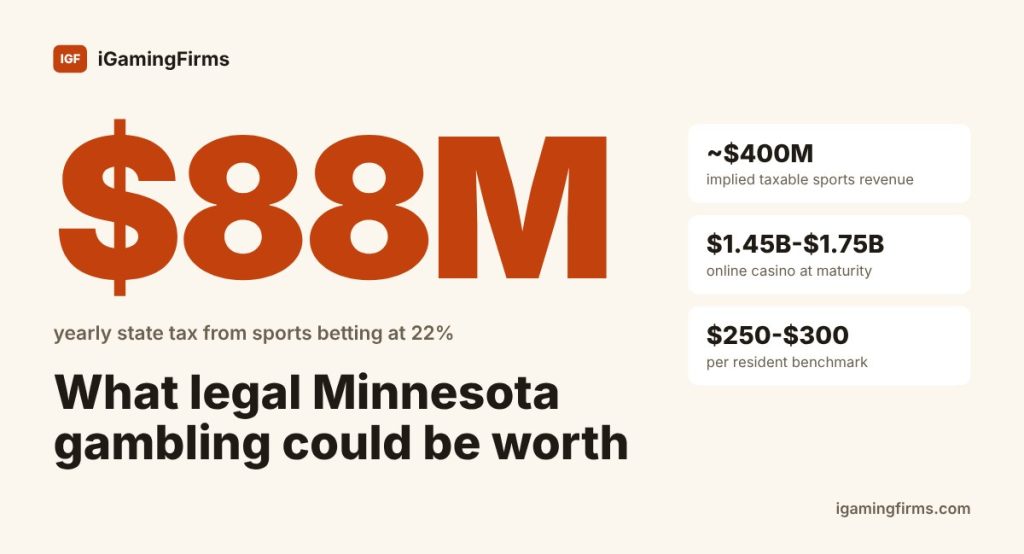
- Sports betting: the Minnesota Indian Gaming Association has said a 22% tax would bring in about $88 million a year for the state, which implies taxable revenue of roughly $400 million a year ($88M divided by 0.22).
- Online casino: BettingUSA estimates $1.45 billion to $1.75 billion a year at maturity, using $250 to $300 per resident. That benchmark comes from New Jersey and Michigan, which each generated roughly $305 per resident in 2025. Treat it as a ceiling-style comparison, since no Minnesota online casino bill has ever been filed.
For context, Minnesota is one of the few states with no regulated sports wagering of any kind, and the only Midwestern state without it. Our US gambling laws by state overview shows where it sits nationally.
Will Minnesota legalize online gambling in 2027?
Sports betting is the only vertical with a realistic path, and even that is uncertain. Online casino legalisation isn’t on the table: no bill has ever been introduced, and the tribes have little reason to share a market they already control permanently.
The 2027 session convenes in January after the November 2026 elections, and advocates expect meaningful turnover in the Legislature. Watch these signals to judge whether 2027 is different:
- Which committee a sports betting bill starts in. In 2026 opponents tried to move SF 4139 out of Commerce and into State and Local Government, where previous bills died. A Commerce start with a vote is a real sign of momentum.
- Whether the tribe-track-charity deal holds. SF 4139’s revenue splits were the first to keep all three groups on side. Any change to the 15% allocations will tell you if the coalition is fraying.
- The prediction market ruling. If Minnesota loses on preemption, legislators who wanted to stop sports event contracts may see a regulated sportsbook market as the only lever left. If the state wins, the urgency fades.
- A sweepstakes ban returning. A bill that passed one chamber 62-3 is likely to come back early. If it passes, expect a short window for operators to exit.
- Anti-expansion pressure. Opponents such as Sens. John Marty and Erin Maye Quade have helped stop bills in committee before. Their committee assignments in 2027 matter as much as the bill text.
The realistic best case for operators is a 2027 law followed by a regulatory build and a launch no earlier than 2028. Plan around that timeline, not around headlines that call Minnesota “close”.
What to do next
If Minnesota is on your roadmap, the work you can do now is relationship and compliance work, not launch work. Start conversations with tribal operators about market access, make sure your KYC and geolocation stack can hard-block the state, and check whether your payment providers already restrict sweepstakes traffic there. To see how a neighbouring tribal state handled the same compact problem, compare Minnesota with online gambling law in Wisconsin.
This page will be updated as the prediction market case moves and when 2027 bills are filed.