Is online gambling legal in Wisconsin? Mostly no. Real-money online casinos and online poker are illegal, and statewide mobile sports betting is legal under state law but not live, because no tribal compact amendment has been signed and the law now faces a constitutional lawsuit.
If you run a sportsbook, supply a platform, manage affiliate traffic or process payments, that makes Wisconsin a confusing market to read. Headlines from April 2026 said the state “legalized online sports betting”, yet nobody in Wisconsin can place a legal bet on a phone from their living room. This guide covers the laws that decide what is legal, how the tribal compacts work, why online sports betting is stuck, why online casino is a much harder problem, and where your type of business stands today.
The short answer: is online gambling legal in Wisconsin?
As of October 2026, real-money online casinos and online poker are illegal in Wisconsin, and statewide mobile sports betting is legal on paper but not yet available.
- Online sports betting: legalized by 2025 Wisconsin Act 247 (Assembly Bill 601), signed on April 9, 2026. It only works through servers on tribal land, and no tribe can launch until its gaming compact is amended and cleared by the U.S. Department of the Interior. No compact amendment for statewide mobile betting has been completed, and a lawsuit filed in August 2026 asks a court to strike the law down.
- Online casino and poker: no authorising law, no bill, and a state constitution that blocks the Legislature from authorising new forms of gambling.
- Everything legal runs through the 11 tribes. Wisconsin has no commercial casino or sportsbook licence of any kind.
Wisconsin online gambling status at a glance (October 2026)
| Vertical | Status | What it rests on |
|---|---|---|
| Online casino (real money) | Illegal | No authorising law; making a bet is a misdemeanor and taking bets is a felony under Wis. Stat. ch. 945 |
| Online poker | Illegal | No licensing framework; poker is not among the games the constitution allows |
| Statewide mobile sports betting | Legal, not live | 2025 Wis. Act 247; waiting on tribal compact amendments and federal review; challenged in court since August 2026 |
| Mobile sports betting on tribal land | Limited | Geofenced apps inside a tribe’s own property, such as Oneida’s |
| Retail sports betting | Legal at tribal casinos | Compact amendments signed since 2021 (Oneida Nation was first) |
| Tribal land-based casinos | Legal | Class III compacts with all 11 federally recognized tribes |
| Sweepstakes (dual-currency) casinos | Unregulated | No Wisconsin-specific ban; no licence either; depends on the “no consideration” exemptions in s. 945.01(5) |
| Prediction markets (sports contracts) | Contested | State DOJ sued Kalshi, Polymarket, Crypto.com, Robinhood and Coinbase in April 2026 |
| Daily fantasy sports | Operating, no state licence | Paid contests are available; there is no Wisconsin DFS licence to apply for |
| Lottery and pari-mutuel | Legal, state-run or licensed | Expressly allowed by Article IV, Section 24 of the constitution |
For the same snapshot across every state, see our US gambling laws by state tracker.
What Wisconsin law actually says
Wisconsin has no “online gambling” statute. It doesn’t need one, because the criminal code treats almost every bet as a crime no matter where it is placed. Two sections in Chapter 945 of the Wisconsin Statutes do most of the work:

- Wis. Stat. 945.02 makes it a Class B misdemeanor to make a bet, to enter a gambling place intending to bet, or to run a lottery.
- Wis. Stat. 945.03 is where operator and supplier risk sits. Commercial gambling is a Class I felony, and it covers running a gambling place for gain, receiving, recording or forwarding bets, holding stakes, and using a “wire communication facility” for gain to transmit information that helps someone place a sports bet.
That last clause matters for B2B readers. It is written broadly enough that anyone who earns money from moving sports-betting information into Wisconsin, not just the bookmaker, should treat it as part of their risk picture.
The definition of “bet” in s. 945.01(1) is the hinge of the whole system. Anything the statute excludes from that definition is not gambling under state criminal law. The existing exclusions include the state lottery, licensed bingo and raffles, pari-mutuel wagering, and genuine skill contests. In 2026 the Legislature added one more, which is how online sports betting was legalised (more on that below).
The constitutional ceiling
Above the statutes sits Article IV, Section 24 of the Wisconsin Constitution. Since a 1993 amendment approved by voters, it says the Legislature may not authorise gambling in any form except what the section itself allows: the state lottery, charitable bingo and raffles, and pari-mutuel on-track betting. The same amendment says the lottery cannot include casino-style games.
This is the main reason online casino is a different problem from online sports betting in Wisconsin. Lawmakers can’t simply pass an iGaming licensing bill the way New Jersey or Michigan did. A commercial online casino market would almost certainly need a constitutional amendment, which takes two consecutive legislative sessions and a statewide vote.
How tribal casinos fit in
All casino gambling in Wisconsin happens on tribal land under the federal Indian Gaming Regulatory Act (IGRA). Then-Governor Tommy Thompson signed Class III compacts with all 11 federally recognized tribes in 1991 and 1992, before the 1993 amendment. Today those tribes run more than 20 casinos, from Potawatomi in Milwaukee and Oneida near Green Bay to Ho-Chunk’s properties and rural northern casinos such as Lake of the Torches and St. Croix.
The 1993 amendment created an obvious question: could compacts signed before it survive, and could they grow? In Dairyland Greyhound Park v. Doyle (2006), the Wisconsin Supreme Court held that the amendment was prospective and did not cancel the original compacts. That ruling is why the compacts remain the “operating system” of Wisconsin gambling, and why almost every expansion since then has come through a compact amendment rather than a new statute.
The state benefits through revenue sharing written into the compacts. Wisconsin received just over $66 million in tribal shared-revenue payments in 2024, according to reporting by The Center Square.
How retail sports betting arrived
Sports betting first came to Wisconsin in 2021 through an amendment to the Oneida Nation’s compact, not through any law passed by the Legislature. The amendment allowed wagering on pro and college sports at Oneida’s casinos, with games involving the University of Wisconsin Badgers excluded. Other tribes, including the Forest County Potawatomi and St. Croix Chippewa, have since amended their own compacts and opened in-person sportsbooks. Oneida also runs a mobile app, but it only accepts bets from people physically on Oneida land.
Is online sports betting legal in Wisconsin? Legal on paper, not live
Assembly Bill 601 passed the Senate 21-12 on March 17, 2026, and Governor Tony Evers signed it on April 9, 2026 after all 11 tribes wrote to say they backed it. It became 2025 Wisconsin Act 247.
What Act 247 actually does
The Act doesn’t create a licence, a regulator or a tax rate. It does one narrow thing: it adds another exclusion to the definition of “bet”. A sports or event wager placed by someone physically in Wisconsin on a phone or other device is no longer a “bet” if the server that conducts it is located on a tribe’s Indian lands and the wager is offered under a tribal-state compact. In other words, the change works through definition rather than authorisation.
The model copies Florida’s “hub-and-spoke” structure, where the Seminole Tribe takes statewide mobile bets through servers on its reservation. That structure survived a federal challenge in West Flagler Associates v. Haaland, which is why Wisconsin’s tribes and lawmakers chose it.
The three gates before launch
For any tribe to go live statewide, three things have to happen in order:
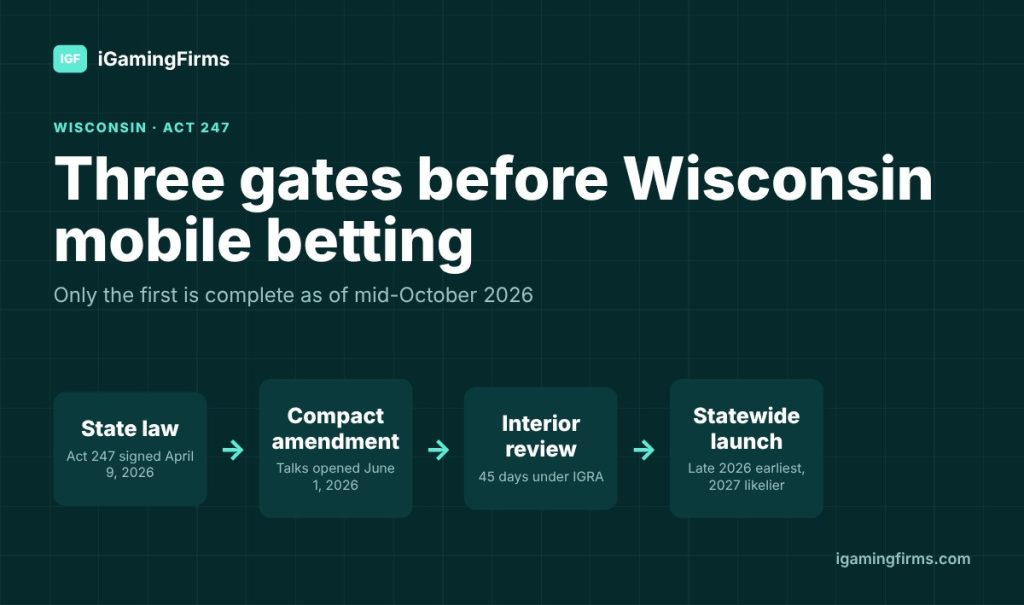
- State law allows it. Done with Act 247, though now under legal challenge.
- The tribe and the governor sign a compact amendment covering mobile sports betting: revenue share to the state, regulation, responsible gaming, and how the tribes share the market.
- The Department of the Interior reviews it. Under IGRA, Interior has 45 days to approve, reject, or let the amendment take effect by doing nothing.
Only gate one is complete. Evers formally opened compact talks with tribal leaders on June 1, 2026, and as of mid-October no amendment for statewide mobile betting has been signed or sent to Interior. Industry trackers put the first launch at late 2026 at the very earliest, with 2027 more likely.
The two issues slowing negotiations
How the 11 tribes share the market. Evers made clear he would not sign the bill unless every tribe supported it, and in his signing statement he backed “a joint venture” with each tribe contributing and benefiting equally. Larger operators such as Potawatomi and Oneida have the scale to launch on their own, while smaller rural tribes would rely on a shared platform. Whether the state ends up with one joint tribal sportsbook, a hub serving several tribal brands, or 11 separate apps is the single biggest open question for platform and odds suppliers.
A governor on his way out. Evers is not running again, and his term ends on January 4, 2027. Compact amendments are signed by the governor. If talks aren’t finished by then, they pass to whoever wins the November 3, 2026 election, who may want different terms. Treat that handover as a real timeline risk, not a footnote.
Why the national brands are on the sidelines
The Sports Betting Alliance (DraftKings, FanDuel, BetMGM, Fanatics and bet365) opposed AB 601. Their argument was commercial: because the market runs under IGRA, the tribe must keep the majority of revenue, which has been widely reported as at least 60%, leaving any commercial partner a minority share. The Alliance said that makes Wisconsin hard to justify and pushed instead for a constitutional amendment opening sports betting to commercial licences. That didn’t happen, so for now any national brand that wants Wisconsin has to come in as a tribal partner on the tribe’s terms.
The lawsuit against Act 247
The constitutional challenge that was flagged during the bill’s passage is now live. On August 5, 2026, the Wisconsin Institute for Law & Liberty (WILL) sued in Waukesha County Circuit Court on behalf of the Brown County Taxpayers Association and Citizens Defending Liberty. The suit makes two claims:
- State constitution: redefining “bet” is, in effect, authorising sports betting, which Article IV, Section 24 does not allow, wherever the server sits.
- Equal protection: only the 11 federally recognized tribes can offer statewide mobile betting, which the plaintiffs call an unlawful race-based benefit.
The plaintiffs want the law declared unconstitutional and an injunction stopping state officials from taking any step to authorise statewide mobile wagering, including compact negotiations. In its late-September response, the state DOJ argued that the plaintiffs lack standing and fail to state a claim. No hearing date or injunction had been reported as of mid-October. If a court grants an injunction, compact talks could stall until the case is resolved, so build that into any launch plan.
Will Wisconsin legalize online casinos?
Not soon. Act 247’s carve-out covers sports and event wagers only. Online slots, table games and poker are still “bets” under s. 945.01, so offering them to people in Wisconsin remains commercial gambling, a Class I felony.
In theory the same hub-and-spoke method could be extended to tribal online casino: another carve-out in the “bet” definition, then compact amendments, then Interior review. In practice it runs into three problems sports betting didn’t face to the same degree:
- The constitution names casino games. The 1993 amendment specifically bars casino-style games from the state lottery, and Wisconsin courts have read Section 24 as a clear limit on new gambling. A casino carve-out would invite a far stronger constitutional challenge, and the sports betting carve-out is already being tested.
- No political appetite has shown up. No online casino bill has been introduced in Wisconsin, and AB 601 itself only passed after a fight inside the Senate Republican caucus.
- Tribes have reason to wait. iGaming competes directly with land-based slot revenue, which is the core of tribal gaming income. Expect the tribes to see how mobile sports betting performs first.
The realistic read for operators: if Wisconsin ever gets online casino, it will be tribal-run and it will come after mobile sports betting has been live for some time. Nothing points to that before 2028.
Is online poker legal in Wisconsin?
No. Poker is not among the forms of gambling Article IV, Section 24 allows, there is no poker licensing framework, and Wisconsin has not joined the Multi-State Internet Gaming Agreement that lets regulated states share online poker player pools. Real-money online poker sites that take Wisconsin players fall under the same s. 945.03 commercial gambling exposure as online casinos.
Grey areas: prediction markets, sweepstakes and offshore books
Three models sit outside the tribal system and each carries a different level of risk in Wisconsin.
Is Kalshi legal in Wisconsin?
Kalshi is in litigation with the state. On April 23, 2026, Attorney General Josh Kaul filed three lawsuits in Dane County against Kalshi, Polymarket and Crypto.com, with Robinhood and Coinbase also named as defendants. The state argues that sports event contracts are illegal commercial gambling under s. 945.03. The Ho-Chunk Nation had already sued Kalshi on similar grounds in August 2025. The platforms say federal CFTC oversight preempts state law, so the outcome may depend on how federal courts rule on that question nationally. Our guide to how prediction markets and event contracts work covers the federal side.
Are sweepstakes casinos legal in Wisconsin?
They are unregulated rather than legal. Wisconsin has not passed a sweepstakes-specific ban, unlike the states that did so in 2026, including Indiana, Tennessee and Maine. Dual-currency sites operate in the state by relying on the rule that a promotion without “consideration” isn’t a lottery. That isn’t the same as being legal. There is no licence, the state DOJ has shown it will use the general gambling statutes against new online models, and neighbouring Minnesota’s Senate passed a ban 62-3 in 2026 before it died in the House. Sweepstakes operators should treat Wisconsin as an exposed market rather than a safe one. See our state-by-state sweepstakes legal map for where bans have already landed.
Offshore sportsbooks and casinos
Offshore sites that take Wisconsin customers are committing commercial gambling under state law. Tribal witnesses told lawmakers that Wisconsin residents placed an estimated $1 billion in offshore or illegal sports bets in 2024, which was a big part of the case for AB 601.
How old do you have to be to gamble in Wisconsin?
Wisconsin uses two thresholds: 18 for the state-run and charitable forms the constitution allows, and 21 for most tribal casino floors and for the mobile sports betting that Act 247 will eventually bring.
| Activity | Minimum age | Notes |
|---|---|---|
| Wisconsin Lottery | 18 | State-run draw and scratch games |
| Pari-mutuel | 18 | On-track betting allowed by Article IV, Section 24 |
| Bingo and raffles | 18 | Licensed charitable games |
| Tribal casinos | 21 at most venues, 18 at a few | Set by each tribe’s compact and house policy; check the property |
| Online sports betting via tribal apps (when live) | 21 | Expected in the compact amendments; not yet live statewide |
| Sweepstakes/DFS | Operator policy | No Wisconsin statute sets an age; most operators require 18 or 21 |
For KYC teams, that means an 18-year-old can legally buy a lottery ticket but cannot use the tribal sportsbook app once it launches, so age checks need to be set per product rather than per state. Our legal gambling age by state table shows how other markets split the same products.
Where your business stands in Wisconsin today
Most pages on this topic answer one question for players: “can I play?” If you supply, market for or process payments for operators, the more useful question is how exposed your specific role is today, and what changes once compact amendments are signed. This map is built from Chapter 945, Act 247 and the enforcement actions above.
| Your role | Exposure today | What changes it | Practical move |
|---|---|---|---|
| Licensed US sportsbook (commercial) | High if you accept Wisconsin bets; there is no commercial licence and taking bets is a felony | Only a tribal partnership under an approved compact | Keep Wisconsin geofenced; open partnership talks with the larger tribes now, before platform choices are locked in |
| Online casino operator | High; no legal route exists | A future carve-out plus compacts, or a constitutional amendment, neither in sight | Block Wisconsin; monitor only |
| Sportsbook platform, odds and data suppliers | Low when serving tribal operators on tribal land; moderate if feeding offshore books that take Wisconsin bets (s. 945.03 wire clause) | The joint-venture decision, each compact’s supplier licensing terms, and the outcome of the WILL lawsuit | Prepare for a tribal-led tender; the joint-venture model would mean one large platform deal rather than 11 small ones |
| Sweepstakes casino operator | Moderate to high; unlicensed, and the DOJ is actively testing new models in court | A ban bill in the 2027 session, or DOJ action | Plan a Wisconsin geoblock and player-balance wind-down before you need one |
| Prediction market | In litigation with the state | The Dane County rulings and federal preemption cases | Track the cases; separate sports contracts from other event contracts in your exposure analysis |
| Affiliates and media | Moderate if promoting offshore books to Wisconsin users; low for informational content | Launch of tribal apps, which creates a legal product to promote | Pull offshore promotion aimed at Wisconsin; build state content now so it is ready at launch |
| Payment providers and PSPs | Moderate for offshore and sweepstakes merchants (“custodian of anything bet” is broad) | Compact terms on payments and KYC for tribal mobile apps | Restrict Wisconsin for unlicensed gambling merchants; document geolocation controls |
None of this is legal advice. If you’re making a market-entry or exit decision, have a specialist iGaming law firm or licensing consultant review your exact structure.
Wisconsin compared with its neighbours
| State | Online sports betting | Online casino | Model |
|---|---|---|---|
| Wisconsin | Legal, not live | Illegal | Tribal-only, servers on tribal land |
| Illinois | Live | Illegal | Commercial licences |
| Michigan | Live | Live | Commercial and tribal licences |
| Iowa | Live | Illegal | Commercial, tied to casinos |
| Minnesota | Illegal | Illegal | No legal sports betting of any kind |
Wisconsin’s path looks much more like Florida’s than like Illinois or Michigan. For the full picture next door, see our guide to online gambling law in Minnesota.
What to watch next
- The WILL lawsuit in Waukesha County. A motion to dismiss ruling or an injunction request will decide whether compact talks can continue on schedule.
- The first signed compact amendment. It will set the template for revenue share, technology standards and whether a joint venture is mandatory.
- The joint-venture structure. One shared tribal platform or separate tribal brands decides how many supplier contracts exist.
- The November 3 election and the January 4, 2027 handover. Unfinished talks pass to a new governor.
- Interior’s 45-day review. Once an amendment is submitted, launch timing becomes predictable.
- The prediction market lawsuits. A state win strengthens the tribal market; a loss weakens it.
What to do next
For most B2B companies, Wisconsin in 2026 is a relationship and readiness market, not a launch market. If you’re a sportsbook platform or odds and data supplier, start conversations with tribal gaming operators now. Make sure your KYC and geolocation stack can hard-block Wisconsin until launch and then allow it precisely, since every bet must route through a server on tribal land. If you’re planning a sportsbook launch elsewhere in the meantime, our guide on how to start a sportsbook covers licensing and platform costs.
This page will be updated when the court rules on Act 247, when the first compact amendment is signed and when 2027 bills are filed.