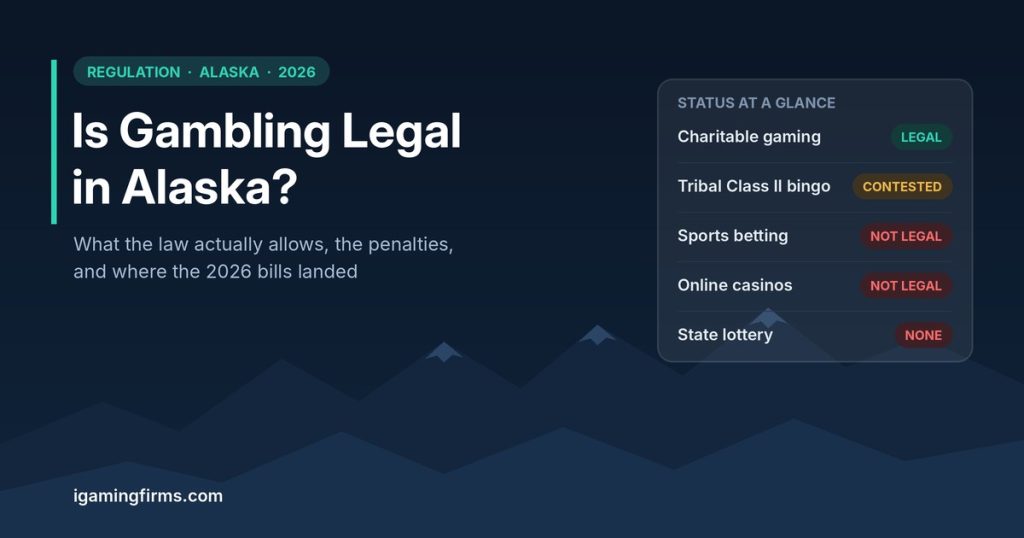
Short answer: Gambling is mostly illegal in Alaska. The only legal forms are permitted charitable gaming (pull-tabs, bingo, raffles and the “classics”), social games in a private home with no house cut, the PFD raffle, and Class II electronic bingo at a few tribal halls. Commercial casinos, a state lottery, sports betting, online casinos and online poker are not legal, and both 2026 sports betting bills died in committee.
If you run a sportsbook, an online casino, an affiliate site or a gaming tech business, Alaska probably sits on your map as a grey block marked “not yet.” That’s mostly right. But “not yet” hides detail that matters when you’re deciding whether to geo-block the state, what your affiliates can promote there, or whether to lobby for the next sports betting bill.
This guide covers what Alaska law allows, what it bans and how hard, where the tribal gaming fight stands, what happened to the 2026 bills, and how each product you might sell lines up against the state’s gambling statute. For the same picture across every state, see our US gambling laws by state guide.
Is gambling legal in Alaska? Mostly no, with four real exceptions
Gambling is illegal in Alaska unless a law specifically authorizes it. The criminal code defines “unlawful” as anything “not specifically authorized by law,” so the default is a ban, not a grey area.
Here’s what is authorized or tolerated today:
- Charitable gaming run by permitted nonprofits and municipalities under Title 5 (pull-tabs, bingo, raffles, lotteries and Alaska’s “classics” like the Nenana Ice Classic).
- Social gambling in a private home, as long as nobody runs a house bank, sets house odds or takes a cut.
- Tribal Class II gaming (bingo and electronic bingo machines that look like slots) at a handful of tribal halls, including two newer ones near Anchorage and in Juneau that are still under legal challenge.
- The Permanent Fund Dividend raffle, which the statute names as an exception.
Here’s what isn’t: commercial casinos, a state lottery, retail or online sports betting, real-money online casinos and online poker. Daily fantasy sports, sweepstakes casinos and prediction markets operate in the state without specific authorization, and each carries a different kind of risk (more on that below).
| Activity | Status in Alaska (October 2026) |
|---|---|
| Charitable pull-tabs, bingo, raffles, classics | Legal with a Department of Revenue permit |
| Home poker and social games | Legal if there is no house bank, house odds or rake |
| Tribal Class II gaming | Operating; two newer halls legally contested |
| Commercial casinos | Not legal |
| Sports betting (retail and mobile) | Not legal; HB 145 and SB 194 died May 2026 |
| Online casinos and online poker | Not legal |
| State lottery | None |
| DFS, sweepstakes casinos, prediction markets | Operating without specific authorization |
How Alaska law defines gambling (and why it’s stricter than most states)
Everything runs through one section: AS 11.66.280. Under it, gambling means staking something of value on a “contest of chance” or a future event outside your control, with an understanding you’ll receive something of value for a certain outcome.
The key phrase is how Alaska defines a contest of chance: any game where the outcome depends “in a material degree” on chance, even if skill also plays a part. That’s the material degree test, and it’s tougher than the “dominant factor” test many states use.
This was a deliberate choice. Old Alaska case law (Morrow v. State, 1973) held that chance had to dominate for something to count as gambling. In 1978 the Legislature rejected that approach when it rewrote the criminal code, and the Alaska Department of Law has pointed to that history in its own opinions since. So if your legal team is used to arguing “skill predominates,” that argument carries less weight in Alaska than in a dominant-factor state.
The statute also carves out a few things that are not gambling at all:
- Bona fide securities, commodities and insurance contracts
- Amusement devices that pay out only replays, or tickets redeemable for toys, candy or novelties at the same location (lawmakers added the redemption-ticket rule in 2016, in what was nicknamed the “Dave & Buster’s bill,” to make room for arcade chains)
- Activities the Department of Revenue authorizes under AS 05.15 (charitable gaming)
- The PFD raffle under AS 43.23.230
Penalties: light for players, heavy for whoever runs the game
Alaska’s code is built to go after operators and organizers, not bettors. That split matters for B2B readers, because almost every role in the supply chain falls on the “promoter” side.

| Offense | Statute | Who it targets | Classification |
|---|---|---|---|
| Gambling | AS 11.66.200 | Players | Violation (not a crime) on first offense; fine of up to $1,000 for later offenses. Being a player in a social game is an affirmative defense. |
| Promoting gambling, 1st degree | AS 11.66.210 | Anyone who promotes or profits from an unlawful gambling enterprise | Class C felony |
| Promoting gambling, 2nd degree | AS 11.66.220 | Anyone who promotes or profits from unlawful gambling | Class A misdemeanor |
| Possession of gambling records, 1st degree | AS 11.66.230 | Records used by an unlawful gambling enterprise | Class C felony |
| Possession of gambling records, 2nd degree | AS 11.66.240 | Records used in unlawful gambling | Class A misdemeanor |
| Possession of a gambling device | AS 11.66.260 | Machines and equipment used in unlawful gambling | Class A misdemeanor |
| Forfeiture | AS 11.66.270 | Money, devices and records | Property used in violations can be forfeited |
Some older guides still say a repeat player offense is a class B misdemeanor. The current text of AS 11.66.200 treats it as a violation with a fine cap of $1,000, so check any compliance memo that relies on the older wording.
Two definitions decide which row you land in:
- “Promoting gambling” covers anyone, other than a player, whose conduct “materially aids” any form of gambling. That includes setting up the activity, running the playing phase, and handling the financial or recording side.
- “Gambling enterprise” means a gambling business with five or more people involved in running, financing or owning it, that has operated for more than 30 days or grossed $2,000 or more in a single day. Any online sportsbook or casino taking Alaskan action would clear that bar on its first busy afternoon.
What gambling is legal in Alaska?
Charitable gaming (the backbone of legal gambling in Alaska)
Charitable gaming is regulated by the Department of Revenue’s Tax Division under AS 05.15. Only municipalities and “qualified organizations” (charitable, civic, educational, fraternal, religious, veterans, labor, political, police and fire groups, and similar) can hold permits. For-profit businesses can take part only as licensed operators, vendors, distributors or manufacturers working on a permittee’s behalf.
The authorized games are raffles, lotteries, bingo, pull-tabs, and contests like the rain, goose, mercury and salmon classics, fishing derbies and the ice classics.
The scale is modest. According to figures from the Department of Revenue’s 2024 annual report, published in Alaska Business magazine:
- Charitable gaming produced about $40.9 million in net proceeds in 2024
- The state collected close to $3 million in taxes and fees
- More than 1,000 vendors hold pull-tab permits
- The average net proceeds margin across permit holders was 11%
- Net proceeds must be spent within one year, and only on political, educational, civic, public, charitable, patriotic or religious uses
Pull-tabs carry a tax of 3% of gross receipts less prizes. Pull-tab manufacturers pay a $2,500 annual license fee and distributors pay $1,000, per the Department of Revenue’s fiscal notes.
If you’re a supplier, note that Alaska pull-tabs are still paper only. The 2026 attempt to change that failed (see the legislative section below).
Is poker legal in Alaska? Social gambling
Home poker is legal; commercial poker is not. A “social game” is gambling in a home where there’s no house player, no house bank, no house odds and no house income. A poker night with friends is fine. A poker night where the host takes a rake is not, and the host becomes a promoter. There are no licensed card rooms, and online poker for real money is illegal.
Are there casinos in Alaska? Tribal gaming
There are no commercial casinos. Alaska has no tribal-state gaming compact, so tribal halls can only offer Class II games under the federal Indian Gaming Regulatory Act. In practice that means bingo, pull-tabs and electronic bingo machines that look like slots. No blackjack, roulette or true Class III slots. That’s a sharp contrast with states where tribes hold Class III compacts, like Wisconsin.
The bigger issue is land. The Alaska Native Claims Settlement Act of 1971 wiped out nearly all reservation land in the state. Metlakatla, on Annette Island, is the one reservation left, and for decades it and Klawock were the only places running casino-style halls.
That changed briefly. A 2024 Interior Department opinion said tribes could have jurisdiction over Native allotments, and the National Indian Gaming Commission then approved a gaming ordinance for the Native Village of Eklutna. Eklutna’s Chin’an Gaming Hall opened in Birchwood, on the edge of Anchorage, in early 2025. Alaska Business reported the hall paid out more than $16 million in jackpots between its January 2025 soft opening and January 1, 2026. The state, under Gov. Mike Dunleavy, sued in April 2025 to challenge the tribal halls’ legality.
Then the ground shifted again. On September 25, 2025, Interior Deputy Secretary Kate MacGregor revoked the 2024 opinion and told the NIGC to reevaluate actions based on it. That put both the Eklutna hall and the Tlingit and Haida hall on Douglas Island in Juneau in legal limbo.
Both halls opened or kept operating anyway. The Chin’an hall kept expanding (local TV reported nearly 5,000 extra square feet and 89 more machines in May 2026). Tlingit and Haida soft-opened Two Coppers Casino in Juneau in June 2026 with about 100 electronic gaming machines, and held its grand opening in July.
The court fights have gone the tribes’ way so far. On September 14, 2026, the Ninth Circuit affirmed the dismissal of the neighbors’ lawsuit against Eklutna in Holl v. Avery, holding that the tribe’s sovereign immunity meant the case couldn’t go ahead without it. The state’s own lawsuit and the NIGC’s reevaluation are still open, and the NIGC had not announced a decision on either hall as of mid-October 2026.
For suppliers of Class II electronic bingo systems, these halls are the one live opportunity in the state, and the most legally exposed one. A single NIGC decision could close them.
Cruise ship casinos
Ships on Alaska itineraries do run casinos, but they close while the ship is in port (and in some protected waters, such as Glacier Bay) and reopen once it’s back underway. That doesn’t make gambling legal on land. It works only because the casino isn’t operating in an Alaska port.
How old do you have to be to gamble in Alaska?
Ages vary by game, and some popular state guides get them wrong. Under Title 5, you must be 19 to play bingo (AS 05.15.180) and 21 to buy pull-tabs (AS 05.15.187). Calcutta pools are 18 and up. Anyone running charitable gaming as a licensed operator must be at least 21. Sweepstakes and DFS platforms set their own minimums, because no Alaska statute sets one for them. Our legal gambling age by state table compares Alaska with the other 49 states.
What’s not legal (and what happened in 2026)
Is sports betting legal in Alaska?
No form of sports betting is legal. The most serious attempt so far is HB 145, sponsored by Rep. David Nelson. Its key terms:
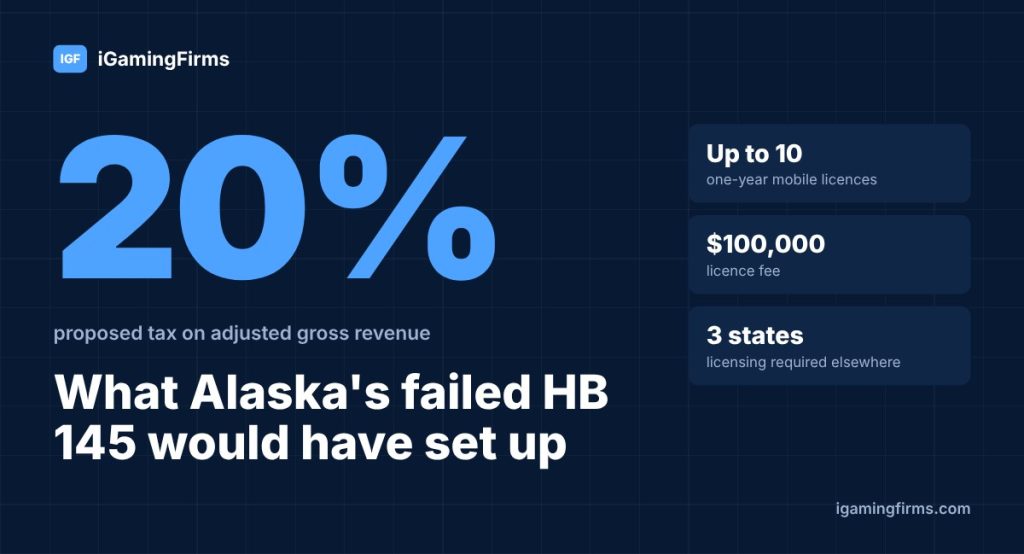
- Mobile only, regulated by the Department of Revenue
- Up to 10 licenses, each one year long, with a $100,000 fee
- Applicants must hold (or partner with someone who holds) a mobile sports betting license in at least three other states
- 20% tax on adjusted gross revenue
- 21+ only, college and Olympic betting allowed, no extra municipal taxes
- The market would not open until at least three licensees were ready
A Senate companion, SB 194 from Sen. Mike Cronk, used the same title. Neither moved far. HB 145 was heard and held in House Labor and Commerce on February 27, 2026, and SB 194 was heard and held in Senate Labor and Commerce on May 8, 2026. The regular session ended May 20, 2026, closing out the 34th Legislature. A failed bill has to start over in a new Legislature, so any sports betting push in 2027 begins at zero, under a new governor.
The demand signal is real, though. GeoComply testified that it logged 126,933 geolocation checks from Alaska between January 1, 2024 and May 1, 2025, from people trying to reach legal sportsbooks in other states.
Electronic pull-tabs (SB 170)
SB 170, from Sen. Jesse Bjorkman, would have allowed tablet-based electronic pull-tabs (screens no larger than 13 inches, no cabinets, no spinning reels), set new prize limits, and allowed charitable gaming on Alaska Marine Highway ferries. It passed the Senate on May 11, 2026, but never got a House floor vote. Bjorkman said opposition came from for-profit businesses in the pull-tab market, and that a revival depends on the next governor. Supporters pointed to Minnesota, where tablet e-tabs sell alongside paper pull-tabs.
Is online gambling legal in Alaska?
No. Real-money online casinos, online poker and online sportsbooks are illegal, and no bill to legalize online casinos or poker has advanced. Alaska is also one of the few states without a lottery. Because there’s no lottery and no commercial gaming regulator, any future iGaming framework would have to be built from nothing, which is part of why operators rank Alaska near the bottom of their expansion lists.
Where each product category stands
Most Alaska guides are written for players, so they list which apps “accept Alaskans.” If you’re an operator, affiliate or supplier, the more useful question is how each product holds up against AS 11.66.280 and who carries the risk if the state decides to act.
| Product | Status in Alaska | The legal hook | Who carries the risk |
|---|---|---|---|
| Charitable pull-tabs, bingo, raffles | Legal with a permit | Excluded from “gambling” under AS 05.15 | Permittees, operators and vendors must follow Department of Revenue rules |
| Tribal Class II electronic bingo | Operating, legally contested | Federal IGRA plus disputed land jurisdiction | Tribes and their Class II suppliers |
| Real-money online casino or sportsbook | Illegal | Contest of chance plus “gambling enterprise” | The operator (class C felony exposure), plus anyone who “materially aids” it |
| Daily fantasy sports | Offered by major operators, no specific law | The material degree test makes a pure “skill game” defense weaker than in dominant-factor states | DFS operators if the state reinterprets |
| Sweepstakes casinos | Operating, no Alaska statute addresses them | Rely on the no-purchase-necessary model to avoid the “stake something of value” element | Sweepstakes operators, as other states have moved to ban the model |
| Prediction markets (sports event contracts) | Available via CFTC-regulated exchanges | Federal preemption claims, which are being fought in courts elsewhere | Exchanges, depending on how federal-state litigation resolves |
Are offshore gambling sites legal for Alaskans?
No. Some state guides still say it’s “perfectly legal” for Alaskans to use offshore casinos because the law only targets operators. That’s wrong. AS 11.66.200 makes the player’s own bet a violation, and in August 2025 Alaska’s attorney general joined a 50-state letter asking the Justice Department to block offshore gambling sites, seize their domains and cut off their payments.
A note for affiliates in particular: the definition of “promoting gambling” covers anyone, other than a player, whose conduct materially aids unlawful gambling. There’s no public record of Alaska prosecuting an affiliate, but sending Alaska traffic to unlicensed offshore books for a revenue share is exactly the kind of conduct that definition was written to reach. Most compliance teams geo-block or exclude Alaska from real-money casino and sportsbook campaigns for that reason.
Are sweepstakes casinos legal in Alaska?
Sweepstakes casinos operate in Alaska, and no Alaska statute addresses them. Several player-facing guides call them “fully legal,” which overstates it: no Alaska law authorizes them either. They rely on the no-purchase-necessary model to avoid the “stake something of value” element in AS 11.66.280, and that same model is what other states have moved to ban. Our sweepstakes casino legal map tracks which states have acted.
Is Kalshi legal in Alaska? Prediction markets
Sports event contracts are available to Alaskans through CFTC-regulated exchanges such as Kalshi, and Alaska has taken no action against them. The exchanges rely on federal preemption claims that are being fought in courts elsewhere, with mixed results, so the legal footing can change quickly. For how the contracts work, see prediction markets explained; we track the court rulings in the monthly regulation roundup.
What this means for you
- Operators: Alaska is closed for real-money online casino and sports betting. If HB 145 or a successor ever passes, the three-state licensing requirement and 10-license cap would favor established national brands. Watch the January 2027 session and the next governor’s revenue plan.
- Affiliates: Treat Alaska as a geo-block state for real-money casino and sportsbook offers. DFS, sweepstakes and prediction market content is where Alaska traffic can go today, but each of those categories is exposed to regulatory change.
- Suppliers: Paper pull-tabs and Class II systems are the only real B2B markets. Electronic pull-tab vendors should track whether SB 170’s framework (tablets only, 13-inch screens, per-charity prize limits) gets reintroduced.
- Compliance and legal teams: Don’t import skill-game analysis from dominant-factor states. Alaska’s material degree test, plus its broad “promoting” definition, is the frame to work from. If you need outside counsel, compare iGaming law firms.
Alaska won’t be a quick market to open. A small population, no professional sports teams, no lottery to build on and a Legislature that let both 2026 gaming bills die all point the same way. The thing that could change the picture fastest isn’t a statute at all: it’s how the Interior Department and the courts settle the tribal land question. For comparison, Georgia shows a state holding a similar hard line, while Kentucky shows how fast one can open once lawmakers move.
This article is for general information about the regulatory landscape and isn’t legal advice. Talk to Alaska-licensed counsel before making market-entry or marketing decisions.