Twelve months ago, a US sweepstakes casino could serve players in roughly 45 states and treat the rest as edge cases. That map is gone. Ten states have now passed laws aimed squarely at dual-currency sweepstakes casinos, four more have been off-limits for years under existing gambling law, and attorneys general in states with no ban at all are filing lawsuits, sending cease-and-desist letters and writing to Google and Meta about ads.
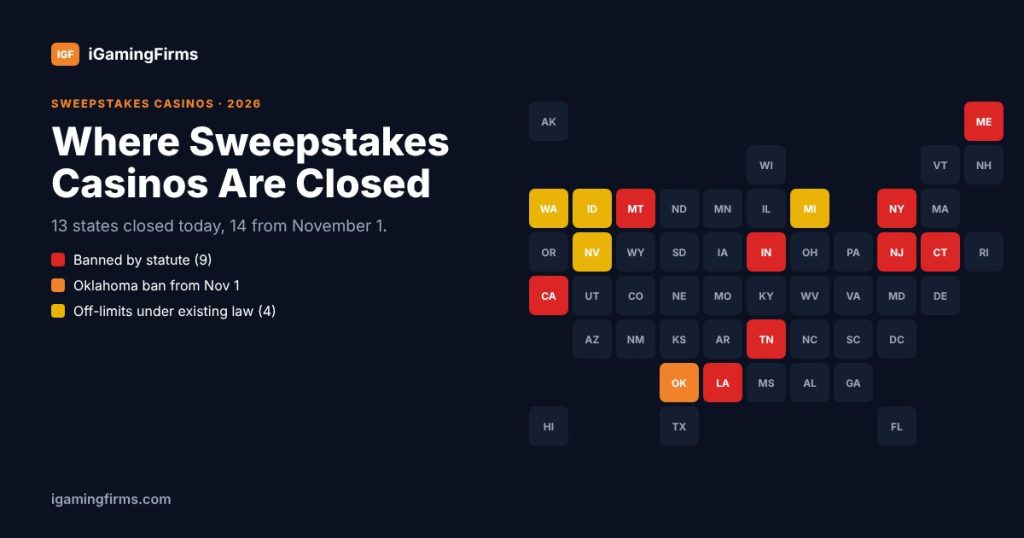
The short answer: sweepstakes casinos are not legal in every state. As of October 15, 2026, dual-currency sweepstakes casinos are banned by statute in nine states (California, Connecticut, Indiana, Louisiana, Maine, Montana, New Jersey, New York and Tennessee), Oklahoma’s ban starts on November 1, 2026, and Idaho, Michigan, Nevada and Washington are off-limits under existing law and enforcement. That makes 13 closed states today and 14 from November. The other 36 states and DC have no sweepstakes-specific ban, but “no law” no longer means “no risk”: Florida, Illinois, Iowa, Kentucky and Maryland are all using existing powers against operators.
If you run a sweepstakes brand, send it traffic, supply its games or process its payments, the question is no longer just “is this state open?” It is also “does this state’s law reach me?” This guide answers both: what a sweepstakes casino is, the full state-by-state legal map (bans, effective dates, penalties, pending bills and AG actions), an index of who operates which brands, and what the new laws mean for each type of business. For the wider picture across casino, sports betting and lottery, see our US gambling laws by state guide.
What is a sweepstakes casino?
A sweepstakes casino is an online site or app that offers casino-style games (slots, table games, bingo, sometimes live dealer or sports picks) using two virtual currencies instead of cash wagers:
- Gold Coins (names vary): play-only currency with no cash value. Players buy them in packages.
- Sweeps Coins (or Stake Cash, Sweepstakes Cash and similar): given away “free”, usually as a bonus with each Gold Coin purchase, and also available without purchase through an alternative method of entry (AMOE) such as a mailed-in request. Sweeps Coins won in play can be redeemed for cash or gift cards.
The legal theory rests on the three elements of gambling found in most state laws: prize, chance and consideration. A sweepstakes casino has a prize and chance, so the model depends on removing consideration. The argument is that nobody pays to play for prizes, because Sweeps Coins are free and a “no purchase necessary” route exists, so the games are lawful promotional sweepstakes, the same category as a soft-drink bottle-cap contest.
Regulators and legislators increasingly reject that argument. The New York Attorney General’s investigation of VGW found that players could obtain Sweeps Coins in practice the same way they would buy chips in a casino. The 2025 and 2026 bans work by defining the dual-currency system itself as gambling, which removes the “no consideration” defence no matter how the AMOE is set up.
What are the different types of sweepstakes?
“Sweepstakes” covers four quite different businesses, and the laws treat them differently:
| Type | How it works | Legal position (2026) |
|---|---|---|
| Promotional sweepstakes | A brand runs a prize draw to sell its products (cereal, soda, retail) | Legal nationwide under sweepstakes and promotion law; California’s AB 831 expressly carves out occasional promotions incidental to real product sales |
| Online dual-currency sweepstakes casinos | Gold Coins and redeemable Sweeps Coins on casino-style games | The model targeted by every state ban covered in this guide |
| Sweepstakes sportsbooks and pick’em apps | The same dual-currency model applied to sports picks | Most 2026 bans (Indiana, Tennessee, Oklahoma) also cover simulated sports wagering |
| Retail sweepstakes parlors and “internet cafes” | Terminals in shops or cafes that reveal sweepstakes results through slot-style games | Regulated or banned separately in many states (North Carolina’s ban dates to 2010) |
Pure social casinos, where coins can never be redeemed for cash or prizes, are a separate product again. None of the 2025 and 2026 bans reach them, which is why many operators have responded to new bans by switching a state to “Gold Coin only” play instead of leaving entirely.
Are sweepstakes casinos legal under federal law?
No federal statute specifically authorizes or bans dual-currency sweepstakes casinos. Legality is decided state by state. Federal laws such as the Unlawful Internet Gambling Enforcement Act only bite where the underlying activity is already illegal under state law, which is why each new state ban also changes the federal payments picture for that state.
In what states are sweepstakes casinos illegal?
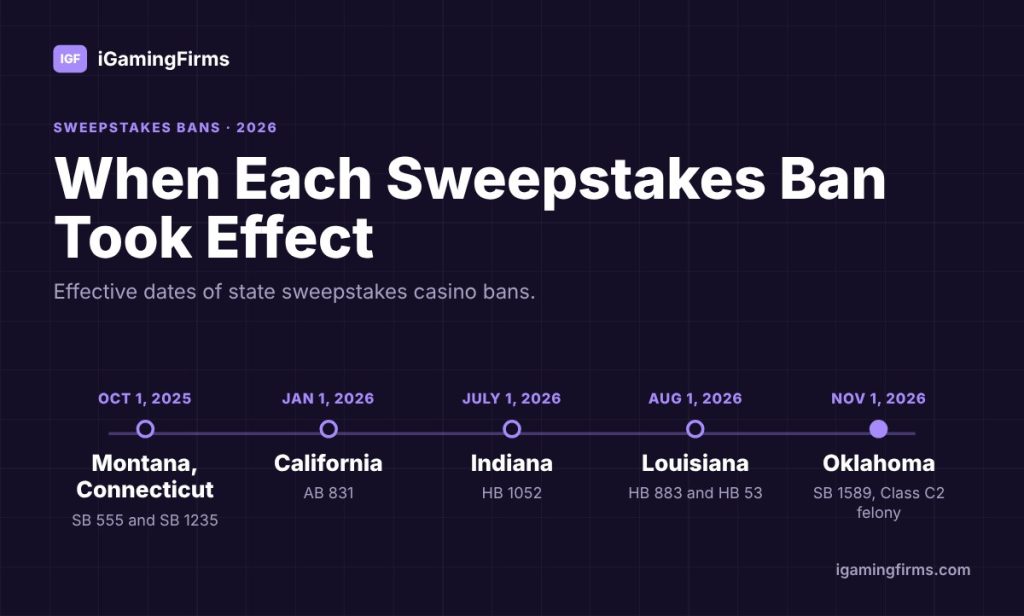
Fourteen states, once Oklahoma’s law takes effect on November 1, 2026. Here is every closed state, the legal instrument behind it and when it took effect.
| State | Legal basis | Signed / effective | Key detail |
|---|---|---|---|
| Montana | SB 555 | Signed May 12, 2025; effective Oct 1, 2025 | First state to pass a direct ban |
| Connecticut | SB 1235 (Public Act 25-112) | Signed June 2025; effective Oct 1, 2025 | Bars unlicensed online sweepstakes gaming alongside the state’s licensed iGaming market |
| New Jersey | A 5447 | Signed Aug 15, 2025 | Fines of $100,000 for a first offense and $250,000 for later violations |
| California | AB 831 | Signed Oct 11, 2025; effective Jan 1, 2026 | Reaches anyone who knowingly supports operation or promotion, including payment processors, geolocation and content suppliers |
| New York | S 5935 | Signed Dec 5, 2025; effective on signing | $10,000 to $100,000 per violation; covers suppliers, platforms, payment and geolocation firms and media affiliates |
| Indiana | HB 1052 | Signed Mar 12, 2026; effective July 1, 2026 | Civil penalties up to $100,000, enforced by the Indiana Gaming Commission |
| Maine | LD 2007 | Signed April 2026; effective July 2026 | Fines of $10,000 to $100,000 per violation, plus revocation of any Maine gaming licence the violator holds |
| Tennessee | SB 2136 | Signed May 22, 2026 | Covers “operation, conducting or promotion”; enforced by the Attorney General through the Consumer Protection Act |
| Louisiana | HB 883 (Act 182) and HB 53 (Act 48) | Signed May 2026; effective Aug 1, 2026 | Fines up to $100,000 and up to five years in prison; HB 53 makes electronic sweepstakes gambling a racketeering predicate |
| Oklahoma | SB 1589 | Veto overridden May 2026; effective Nov 1, 2026 | Operating or supporting is a Class C2 felony; tribal gaming under IGRA is exempt |
| Washington | Existing law (RCW 9.46.240) | Long-standing | Online gambling ban; almost all operators have excluded the state for years |
| Idaho | State constitution, Art. III § 20 | Long-standing | Some operators allow Gold Coin play only |
| Michigan | Gaming Control Board enforcement | Cease-and-desist letters since early 2024 | No sweepstakes statute; regulator treats the model as unlicensed online gambling |
| Nevada | Unlicensed gaming law; SB 256 (2025) raised penalties | Long-standing | No sweepstakes-specific ban, but no operator path without a Nevada licence |
Be careful with state counts you find elsewhere. Several pages ranking for this topic are months out of date: one widely cited 50-state guide still lists Indiana and Maine as “pending” and says Tennessee and Oklahoma have no ban, and another still describes New Jersey as only “considering” a ban that was signed in August 2025. Totals of 12, 14 or 15 “banned” states usually differ on whether they count Oklahoma before November 1 and whether they count Michigan and Nevada, which rely on enforcement and general gaming law rather than a sweepstakes statute.
The full 50-state sweepstakes casino legal map (October 2026)
The table below covers every state and DC. “Open” means no sweepstakes-specific law or completed enforcement action closes the state; it does not mean the state endorses the model, and many operators block open states anyway (often regulated iGaming states such as Delaware, Pennsylvania and West Virginia) as a business choice.
| State | Status (Oct 15, 2026) | What to know |
|---|---|---|
| Alabama | Open | No sweepstakes bill or AG action found |
| Alaska | Open | No action found; see our Alaska gambling law guide |
| Arizona | Open | No statute; a number of operators exclude Arizona on their own; see Arizona’s sweepstakes and tribal casino rules |
| Arkansas | Open | SB 524 (2025) pulled and sent to interim study |
| California | Banned | AB 831, effective Jan 1, 2026 |
| Colorado | Open | No action found |
| Connecticut | Banned | SB 1235, effective Oct 1, 2025 |
| Delaware | Open | No statute; many operators block it |
| District of Columbia | Open, bill pending | B26-0656 would legalize online casinos and ban sweepstakes; under Council review |
| Florida | Open, under AG action | AG sued Stake and VGW in August 2026; SB 1580 and HB 189 died in March 2026; see Florida’s online gambling picture |
| Georgia | Open | No statute; see Georgia gambling law |
| Hawaii | Open | SB 3281 deferred in 2026; all gambling is otherwise banned and many operators block the state |
| Idaho | Off-limits | Constitution; Gold Coin play only at some brands |
| Illinois | Open, under regulator action | Gaming Board and AG sent cease-and-desist letters to 65 operators in early 2026; Stake.us and others have exited |
| Indiana | Banned | HB 1052, effective July 1, 2026 |
| Iowa | Open, under regulator action | SF 2289 (signed May 15, 2026) gives the Racing and Gaming Commission cease-and-desist and injunction powers over unlicensed sweepstakes; no monetary penalty |
| Kansas | Open | No action found |
| Kentucky | Open, under AG action | AG Russell Coleman sued VGW on June 17, 2026, alongside separate suits against prediction market operators; see Kentucky gambling law |
| Louisiana | Banned | HB 883 and HB 53, effective Aug 1, 2026 |
| Maine | Banned | LD 2007, effective July 2026 |
| Maryland | Open, under regulator action | Cease-and-desist letters in 2025; 2026 ban bills passed the House but were not enacted |
| Massachusetts | Open | 2026 ban bill failed |
| Michigan | Off-limits | Gaming Control Board enforcement |
| Minnesota | Open | SF 4474 passed the Senate, died in the House May 18, 2026; see Minnesota gambling law |
| Mississippi | Open | SB 2104 failed in 2026 |
| Missouri | Open | HB 1251 filed, no hearing |
| Montana | Banned | SB 555, effective Oct 1, 2025 |
| Nebraska | Open | No action found |
| Nevada | Off-limits | Unlicensed gaming law |
| New Hampshire | Open | No action found |
| New Jersey | Banned | A 5447, signed Aug 15, 2025 |
| New Mexico | Open | No action found; see New Mexico gambling law |
| New York | Banned | S 5935, Dec 2025; $8 million VGW settlement Sept 2026 |
| North Carolina | Open (online) | Retail video sweepstakes terminals are banned; online dual-currency sites are not specifically addressed |
| North Dakota | Open | No action found |
| Ohio | Open, bill pending | HB 298 would legalize online casinos and ban sweepstakes; in committee since 2025 |
| Oklahoma | Ban from Nov 1, 2026 | SB 1589; operators are already switching the state to Gold Coin only; see gambling age rules by state |
| Oregon | Open | No action found; see Oregon gambling law |
| Pennsylvania | Open, bill pending | HB 2801 pre-filed late September 2026; in the House Gaming Oversight Committee |
| Rhode Island | Open | No action found |
| South Carolina | Open | No sweepstakes-specific action |
| South Dakota | Open | No action found |
| Tennessee | Banned | SB 2136, May 22, 2026; see Tennessee online gambling law |
| Texas | Open | SB 517 (2025) targeted game rooms and died; see Texas gambling law |
| Utah | Open | All gambling banned by the constitution, no sweepstakes-specific action; some operators block it |
| Vermont | Open | No action found |
| Virginia | Open | HB 161 failed in 2026; could return in 2027 |
| Washington | Off-limits | RCW 9.46.240 |
| West Virginia | Open | No statute; many operators block it |
| Wisconsin | Open | No action found; see Wisconsin gambling law |
| Wyoming | Open | No action found |
What states are banning sweepstakes casinos next?
The timeline explains why the map changed so fast. Bills that failed in 2025 came back in 2026 with more votes, and the language got broader each time.
- Before 2025: Washington, Idaho and Nevada were off-limits under general gambling law. Michigan’s Gaming Control Board started sending cease-and-desist letters in early 2024, and VGW left Connecticut in 2024 after a state order.
- 2025, the first wave: Montana (SB 555, signed May 12), Connecticut (SB 1235, June), New Jersey (A 5447, August 15), California (AB 831, October 11) and New York (S 5935, December). Louisiana’s legislature passed a ban (SB 181) that Gov. Jeff Landry vetoed in June 2025, saying the model was already illegal. Bills failed in Arkansas, Florida, Illinois, Maryland, Mississippi and Texas.
- Late 2025: Tennessee AG Jonathan Skrmetti sent cease-and-desist letters to nearly 40 operators, confirmed on December 29, 2025.
- Early 2026: Illinois regulators sent 65 cease-and-desist letters. Indiana passed HB 1052 and Gov. Mike Braun signed it on March 12. Maine’s LD 2007 was signed in April.
- May 2026: Oklahoma overrode Gov. Kevin Stitt’s veto of SB 1589 (Senate 34-10, House 68-19), Tennessee signed SB 2136, Louisiana signed HB 883 and HB 53, and Iowa signed SF 2289. Bills failed in Florida, Maryland, Massachusetts, Minnesota, Mississippi and Virginia.
- Summer and fall 2026: the action moved to attorneys general. Kentucky sued VGW on June 17, Florida sued Stake and VGW on August 19, and New York announced an $8 million settlement with VGW on September 9. Pennsylvania’s HB 2801 was pre-filed at the end of September.
The states most likely to move next are the ones with live bills or repeat attempts: Pennsylvania (HB 2801), Ohio (HB 298), DC (B26-0656), and Florida, Maryland, Minnesota, Mississippi and Virginia in their 2027 sessions. The direction is one-way. No state has passed a law to license or regulate dual-currency sweepstakes casinos, even though the industry’s trade group, the Social Gaming Leadership Alliance (SGLA), has proposed a framework with age verification and responsible-play rules. Meanwhile the National Council of Legislators from Gaming States (NCLGS) model iGaming legislation recommends an outright sweepstakes ban, and several pending bills (DC, Ohio, Pennsylvania) pair online casino legalization with a sweepstakes ban.
Is it a crime to run an illegal sweepstakes casino?
In a growing number of states, yes, and the penalties are no longer just civil. The range now runs from civil fines to felony exposure:
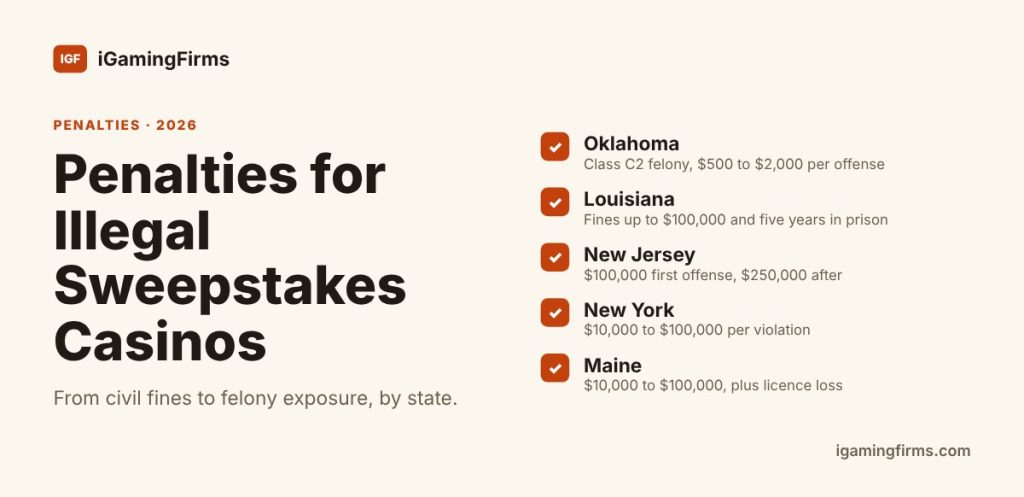
- Oklahoma: operating or supporting dual-currency sweepstakes games is a Class C2 felony from November 1, 2026, with fines of $500 to $2,000 per offense. The law reaches geolocation providers, gaming suppliers, platform providers, promoters and media affiliates, which is the part Gov. Stitt’s veto objected to.
- Louisiana: HB 883 treats dual-currency sweepstakes as “gambling by computer”, with fines up to $100,000 and up to five years in prison, and HB 53 makes electronic sweepstakes gambling a racketeering predicate.
- California: AB 831 adds criminal penalties under Penal Code section 337o for anyone who knowingly supports the operation or promotion of an online sweepstakes game.
- New Jersey: $100,000 for a first offense and $250,000 for each later violation, plus injunctive relief.
- New York: $10,000 to $100,000 per violation, plus revocation of, or ineligibility for, a New York gaming licence.
- Indiana: civil penalties up to $100,000, enforced by the Indiana Gaming Commission. An earlier criminal version was amended to civil in January 2026.
- Maine: fines of $10,000 to $100,000 per violation, and loss of any Maine gaming licence.
- Tennessee: violations are treated as breaches of the Consumer Protection Act of 1977, enforced by the Attorney General, on top of the state’s criminal gambling statutes.
In states without a ban, operators face consumer protection and gambling claims instead. Florida’s lawsuits against Stake and VGW in Hillsborough County Circuit Court allege violations of state gambling law and the Florida Deceptive and Unfair Trade Practices Act and also target the payment processors behind them, and Kentucky’s suit against VGW argues that its virtual coins function like casino chips.
Who carries the risk: exposure by business role
This is the part most state maps skip. The newer laws do not stop at the operator. California, New York, Louisiana, Tennessee and Oklahoma all reach the businesses around the operator, which changes the risk for affiliates, suppliers and payment firms that never touch a player directly.
| Your role | Laws that reach you | Practical move |
|---|---|---|
| Sweepstakes operator | Every ban state, plus AG consumer protection suits in open states | Geofence all 14 closed states (Oklahoma before Nov 1), keep KYC and geolocation logs, and plan redemption wind-downs in advance |
| Affiliate or media buyer | Tennessee (“promotion”), New York and Louisiana (media affiliates), California (promotion), Oklahoma (promoters and media affiliates) | Remove closed states from targeting and content; expect ad platforms to tighten after Florida’s letters |
| Game studio or content aggregator | New York (gaming content suppliers), California (content suppliers), Louisiana and Oklahoma (suppliers) | Audit which sweepstakes brands carry your titles and their geoblocking; a New York licence is at stake if you supply into New York |
| Payment processor or bank | New York (financial institutions, payment processors), California (payment processors), Florida AG suits | Screen merchant restricted-state lists against the current ban list, not last year’s |
| Geolocation and KYC provider | New York, California, Louisiana and Oklahoma name geolocation providers | Contractually require clients to block closed states, and keep evidence that your service enforced it |
| Platform or white-label provider | New York, Louisiana and Oklahoma (platform providers) | Review indemnities and state-exclusion clauses before onboarding a sweepstakes client |
| Ad platforms | Florida AG letters to Google, Meta, Reddit, Snap and TikTok (responses due Oct 23, 2026) | For buyers: assume sweepstakes ads into Florida will get harder to run |
For affiliates, the promotion clauses mean your own pages and paid campaigns are now evidence, so the state filters that apply to licensed brands in our iGaming affiliate marketing guide now apply to sweepstakes offers too. For suppliers, the exposure is already showing up in practice. Player reports tracked by Sweepsy said Hacksaw Gaming titles disappeared for Indiana players before that state’s ban took effect, and operators named by the New York Attorney General had stopped Sweeps Coin play in the state months before the settlement. If you distribute through casino game aggregators or hold licences in regulated states, the reputational and licensing risk of a sweepstakes client is now usually larger than the revenue.
What happens when a state bans sweepstakes casinos?
For operators, a new ban sets off the same sequence each time, and the brands that handled Indiana, Louisiana and Oklahoma cleanly followed a similar pattern:
- Decide between exit and Gold Coin only. Most groups switch the state to play-only Gold Coins, which keeps the player relationship without redeemable prizes. Others close accounts outright.
- Set a redemption window before the effective date. Players holding Sweeps Coin balances need notice and time to redeem. Oklahoma operators were already telling players to redeem ahead of November 1.
- Tighten geolocation, not just IP blocking. IP checks alone are easy to bypass with a VPN, and New York, California, Louisiana and Oklahoma all name geolocation providers, so regulators will expect device-level location checks at play and at redemption.
- Update terms, affiliates and suppliers on the same day. Restricted-state lists in terms of service, affiliate agreements, game supplier contracts and processor merchant files should all change together, because each of those partners now carries its own exposure.
- Keep records. The New York settlement covered past play even though VGW had stopped Sweeps Coin play in the state after a June 2025 cease-and-desist letter. Leaving a state does not end exposure for what happened before you left.
For geolocation and identity checks, compare KYC and geolocation vendors; for merchant risk, check how your payment providers handle sweepstakes merchants and restricted-state lists.
Sweepstakes casino operator index: who runs which brands
Most sweepstakes brands are run by a small number of companies, which matters when you are vetting a partner, reading an AG complaint or tracking which brands will exit a state together. The table below maps the main groups to their brands, based on the operating entities named in each brand’s terms as compiled by the SweepsKings and SweepsLounge company directories and SCCG’s July 2026 legality guide. Corporate structures change often, so check the current terms of service before you contract.
| Company (operating entity) | Base | Sweepstakes brands | 2026 legal and market notes |
|---|---|---|---|
| VGW Holdings | Perth, Australia | Chumba Casino, LuckyLand Casino, Global Poker (LuckyLand Slots closed Sept 14, 2026) | $8M New York settlement (Sept 9); sued by Kentucky (June) and Florida (August); SGLA member |
| Sweepsteaks Limited | Cyprus (linked to Australia’s Easygo) | Stake.us | Sued by Florida (August); added Illinois to its restricted list in 2026 |
| B-Two Operations Ltd (parent B2Services OÜ) | Isle of Man; Estonia | McLuck, Hello Millions, Mega Bonanza, PlayFame, Jackpota, SpinBlitz | Exited Indiana; SGLA member |
| Sunflower Limited | Israel (Delaware parent) | Crown Coins Casino | Took the top spot from Chumba in Blask’s June 2026 brand-power ranking |
| RealPlay Tech Inc. | Delaware (Tel Aviv parent) | RealPrize, LoneStar | LoneStar launched as a newer brand in the group |
| MW Services Ltd | Europe (offshore entity) | WOW Vegas, Rolla, MetaWin.us, CoinsBack | Exited Indiana; moved Illinois to Gold Coin only |
| Yellow Social Interactive | Gibraltar | Pulsz, Pulsz Bingo | Indiana and Oklahoma moved to Gold Coin only; SGLA member |
| Blazesoft (via US LLCs) | Ontario, Canada | Zula, Sportzino, Fortune Wins, Yay Casino, American Luck, Luck Party and others | Adjusted Indiana availability before the ban |
| ARB Interactive | Miami, Florida | Modo.us | SGLA member; named among brands that left Tennessee |
| A1 Development LLC | US (LLC) | Funrize, NoLimitCoins, TaoFortune, FunzCity, Fortune Wheelz, StormRush | Adjusted Indiana availability before the ban |
| High 5 Entertainment (High 5 Games) | US | High 5 Casino | Also a licensed supplier in regulated states, so it is exposed on both sides |
| Gold Coin Group LLC | Texas | Chanced, Punt | Both exited Illinois in 2026 |
| WW Funcrafters JWA | Delaware | SpeedSweeps, RichSweeps, SweepsRoyal, DimeSweeps, ThrillCoins | Added Maine as Gold Coin only in September 2026 |
| UTech Solutions LLC | US (LLC) | Scarlet Sands, JackpotRabbit, SweepShark, Mr. Goodwin, VegasWay and others | Adjusted Indiana availability before the ban |
| Woopla Inc. | Nova Scotia, Canada | Funzpoints | Moved Tennessee to Gold Coin only |
| Play Spree Ltd | Isle of Man | Spree | Restricts more than 20 states |
Two patterns stand out. First, the biggest groups are offshore or foreign-parented (Australia, Cyprus, the Isle of Man, Gibraltar, Israel, Canada), which is why states have leaned on in-state levers such as payment processors, ad platforms and suppliers rather than relying on jurisdiction over the operator alone. Second, the long tail is thinning: Gambling Insider counted roughly a dozen closures in the months to September 2026, including SweepNext, The Money Factory, LuckyStake, CoinFrenzy and The Win Zone.
Do you have to pay tax if you win a sweepstakes prize?
For the winner, yes. Sweepstakes prizes and redemptions are taxable income under federal law, whether or not the operator calls them gambling winnings, and operators report qualifying payouts to the IRS on Form 1099-MISC rather than the W-2G used by licensed casinos. For operators, that means a reporting obligation in every open state; for affiliates, it is one more reason not to describe sweepstakes redemptions as “free money.”
What to watch next
- October 23, 2026: deadline for Google, Meta, Reddit, Snap and TikTok to answer the Florida Attorney General on sweepstakes ads; the Stake and VGW lawsuits continue in Hillsborough County.
- November 1, 2026: Oklahoma’s SB 1589 takes effect, with felony exposure for operators and the businesses that support them.
- Pennsylvania HB 2801: fines up to $500,000 for operators and anyone who helps run prohibited games, with Attorney General and Gaming Control Board cease-and-desist powers; pending in the House Gaming Oversight Committee.
- Kentucky v. VGW: the first AG case to test the dual-currency model in a state with no ban.
- 2027 sessions: expect Florida, Maryland, Minnesota, Mississippi and Virginia to try again, and DC and Ohio to keep pairing iGaming legalization with a sweepstakes ban.
- More AG settlements: the New York VGW settlement covered disgorgement, penalties and costs even though VGW had already stopped Sweeps Coin play in the state in 2025.
What this means for you
If you operate or supply sweepstakes brands, treat the closed list as 14 states from November 1 and growing, and treat Florida, Illinois, Iowa, Kentucky and Maryland as active enforcement states even without a ban. If you are an affiliate, the promotion language in Tennessee, New York, California, Louisiana and Oklahoma means your own content is now part of the risk. And if you hold licences in regulated markets, New York and Maine have made clear that sweepstakes activity can cost you that licence.
For state-specific detail, start with the guides linked in the map above, our offshore betting legality guide and the monthly iGaming regulation news roundup. For advice on a specific state or contract, compare iGaming law firms with US gaming experience.
The map is changing month by month. If you spot a change we have missed, or you supply the iGaming industry and want to be listed, contact the editorial desk.
This article is general information and analysis, not legal advice. State positions change quickly; confirm current law with qualified counsel before making decisions.