What is iGaming? iGaming is real-money gambling offered over the internet: online casino, sports betting, poker, bingo and lottery played on a website or app. The term also covers the industry behind it, from the operators that take bets to the platforms, game studios, payment providers, compliance vendors and affiliates that supply them.
If you are new to the business side of online gambling, the word “iGaming” gets used for everything from a slot game to a payment provider’s sales deck. That makes it hard to work out where you fit, who you sell to, and which rules apply to you. This guide gives you a plain definition, the verticals the term covers, how the industry is put together from operator to supplier to affiliate, how countries regulate it, and how big it is, with dated sources.
What does iGaming mean?
The “i” stands for internet (some say interactive). iGaming is any wager of money or money’s worth on an uncertain outcome, placed online. If there is no real-money stake, it is not iGaming in the regulatory sense, even if the game looks like a casino game.

Two things make the term confusing for newcomers:
- Industry vs. activity. People use “iGaming” both for the activity (a player spinning an online slot) and for the business ecosystem (the “iGaming industry”). On this site we mostly mean the second.
- Broad vs. narrow usage. Globally, iGaming usually means all online gambling. In the United States it often means online casino only. The American Gaming Association, for example, reports iGaming revenue ($10.74 billion in 2025) separately from sports betting revenue ($16.96 billion) in its 2025 revenue release. When you read a US report, check which meaning it uses.
Is iGaming gambling? iGaming vs. gambling vs. gaming
| Term | What it means | Real money? |
|---|---|---|
| Gambling | Any wager on an uncertain outcome, online or in person: casinos, betting shops, lottery, gaming machines | Yes |
| iGaming | The online part of gambling, and the industry that runs it | Yes |
| Gaming (video games) | Playing video games for entertainment, including esports competitions | No stake on the outcome |
| eGaming | Used inconsistently. Some suppliers, such as sportsbook vendor Altenar, use it for online video gaming played for fun, separate from iGaming; others use it loosely for online gambling | Depends on who is using it |
So yes, iGaming is gambling: a subset of it, not a separate thing. Online gambling has existed since the mid-1990s: Antigua and Barbuda passed its Free Trade and Processing Act in 1994, allowing companies to apply for online casino licences, and the Kahnawake Gaming Commission began licensing online operators in 1996.
Is “iGaming” what gambling is called now? Partly. It is the industry’s own term and you will see it in company names, regulator reports and job titles. Newer products such as prediction markets and sweepstakes casinos are marketed with yet other labels, and whether they count as gambling is a live legal fight (more on that below).
The iGaming verticals
A “vertical” is a product line. Most operators run one or two, and many suppliers specialise in a single one. These are the main verticals, plus the adjacent models you will run into.
| Vertical | What it includes | Main suppliers behind it |
|---|---|---|
| Online casino | Slots, table games (blackjack, roulette, baccarat), live dealer games streamed from a studio, instant and crash games | Game studios, live casino studios, game aggregators |
| Sports betting | Pre-match and in-play bets on sports and esports, via a sportsbook | Sportsbook platforms, odds and data feeds, trading services |
| Poker | Peer-to-peer cash games and tournaments; the operator earns a rake or fee rather than playing against the customer | Poker networks and platforms |
| Bingo and lottery | Online bingo rooms, online sales of lottery draws and instant games | Bingo software, lottery platforms, often state lotteries |
| Daily fantasy sports (DFS) | Paid-entry fantasy contests; treated as a skill contest in some jurisdictions and as gambling in others | DFS platforms, sports data |
| Adjacent: sweepstakes and social casino | Casino-style games using virtual coins, with prize redemption in sweepstakes models | Same studios as real-money casino, in many cases |
| Adjacent: prediction markets | Event contracts on sports, elections and other outcomes, offered in the US by CFTC-regulated exchanges such as Kalshi | Exchanges, market makers, data feeds |
What are the four main types of gambling online? If you want a short list: casino, sports betting, poker, and lottery or bingo. Fantasy sports, sweepstakes and prediction markets sit at the edges and are where most of today’s legal disputes are. Crypto casinos are not a separate vertical; they are casinos or sportsbooks that accept cryptocurrency for deposits and withdrawals.
Betting and casino are close to equal in size worldwide. H2 Gambling Capital puts online betting at $148 billion in 2024, or 50% of global online gross win, in its April 2026 market update, and forecasts $248 billion for online betting and $233 billion for online casino by 2030.
How the iGaming industry is structured
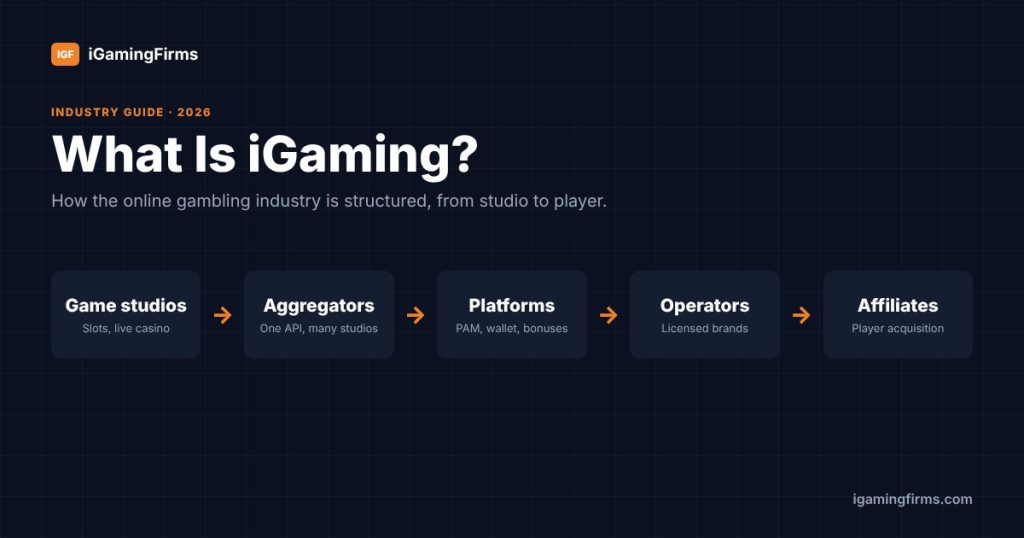
This is the part most “what is iGaming” pages skip, and it is the part you need if you sell to, work in, or invest in the industry. Every real-money bet passes through a chain of companies, and each one gets paid out of the same pool of money: what players lose.
That pool is GGR, gross gaming revenue: total stakes minus winnings paid back to players. When someone asks what GGR stands for, that is the answer, and it is the number almost every market size, tax and supplier contract is based on. NGR, net gaming revenue, is what is left after deductions such as bonuses, taxes and payment costs; definitions vary by contract.
How does iGaming work? One bet, step by step
Seen from the operator’s side, a single real-money session touches most of the industry:
- Account. The player registers with a licensed operator, whose platform runs identity and age checks through a KYC vendor.
- Deposit. Money comes in through a payment provider and lands in the player’s wallet on the operator’s platform.
- Play. A casino game is served from the studio’s remote game server, usually through an aggregator; a sports bet is priced with odds and data from a feed provider.
- Settlement. The outcome is settled, the wallet is credited or debited, and the result feeds the operator’s GGR.
- Revenue split. At month end, tax goes to the regulator, royalties to studios and aggregators, fees to the platform and PSPs, and commission to any affiliate that referred the player.
The iGaming value chain at a glance
| Layer | What they do | How they usually get paid | Regulatory exposure |
|---|---|---|---|
| Operators (B2C) | Run the casino or sportsbook brand, hold the player relationship and the licence | Keep GGR, then pay everyone below | Need an operating licence in each regulated market they serve |
| Platform providers | Supply the core software: player account management (PAM), wallet, bonus engine, back office, often a front end. Sold as white label, turnkey or licensed software | Setup fees plus a share of GGR or a licence fee, set by contract | Supplier licence in many markets |
| Game studios | Build slots, table and live casino games and run them on their own remote game servers | Royalty on the GGR their games generate. Hub88 puts game provider royalties at 10% to 20% of GGR | Game certification and supplier licences |
| Game aggregators | Connect an operator to hundreds of studios through one integration | A margin on top of the studio royalty, or a blended GGR rate | Supplier licences where they supply in-market |
| Odds and data providers | Supply sports data, odds and trading services to sportsbooks | Fixed fees or GGR-based deals | Supplier licences; official league data deals in some markets |
| Payment providers (PSPs) | Process deposits and withdrawals across cards, bank transfers, e-wallets and local methods | Per-transaction fees. Gambling card payments carry merchant category code 7995 and are priced as high risk; see our payment costs guide | Payments regulation plus gambling-specific card scheme rules |
| KYC and compliance vendors | Identity and age checks, AML screening, fraud and responsible gambling tools | Usage-based pricing set by contract | Indirect: operators carry the legal duty and buy the tools; see KYC requirements by jurisdiction |
| Affiliates and marketing | Comparison sites, SEO publishers, media buyers and agencies that send players to operators | CPA (a fee per depositing player), revenue share of NGR, or a hybrid | Registration or licensing in some markets, such as US revenue-share affiliates |
| Regulators and testing labs | License operators and suppliers, set technical standards, certify games and RNGs | Licence fees and gaming taxes | They are the rule-setters |
What is an iGaming platform? It is the software stack an operator runs its brand on: player accounts, wallet, payments cashier, bonuses, game and sportsbook integrations, reporting and compliance tools. If you are comparing vendors, our list of white label casino platforms and the guide to choosing an iGaming platform provider cover the buying decision.
Why the structure matters: suppliers get licensed too
A common newcomer mistake is assuming only the casino needs a licence. In Great Britain, section 41 of the Gambling Act 2005 makes it an offence to manufacture, supply, install or adapt gambling software in the course of a business without an operating licence. In US states such as New Jersey, Michigan and Pennsylvania, affiliates paid on revenue share need a supplier licence or certification, while some states (Massachusetts and Illinois for sports betting) bar revenue share deals with marketers altogether. If you are a supplier or affiliate, your licensing map follows your customers’ markets.
A worked example: where one month of GGR goes
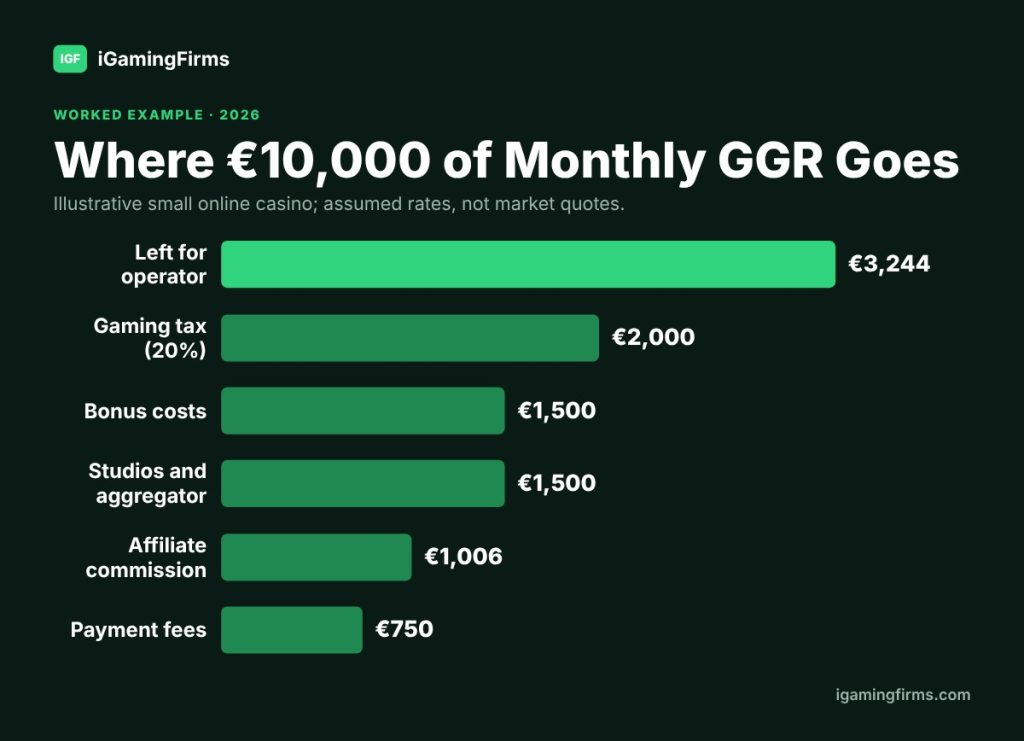
To see how the layers connect, take a small online casino that makes €10,000 GGR in a month. The rates below are illustrative assumptions, not market quotes; real contracts vary widely.
| Line | Assumption | Amount |
|---|---|---|
| GGR (stakes minus winnings) | Given | €10,000 |
| Gaming tax | 20% of GGR (rates differ by market) | −€2,000 |
| Bonus costs | 15% of GGR | −€1,500 |
| Payment fees | 3% on €25,000 of card deposits | −€750 |
| NGR (used for affiliate revenue share) | GGR minus tax, bonuses and payments | €5,750 |
| Game studios and aggregator | 15% of GGR, mid-point of the 10% to 20% royalty range | −€1,500 |
| Affiliate commission | 35% revenue share on the half of NGR from affiliate-referred players | −€1,006 |
| Left for platform fees, KYC, staff, licence costs and own marketing | €3,244 |
Two lessons fall out of this. First, roughly two thirds of GGR in this example goes to tax, suppliers and partners before the operator pays for its platform and team. Second, every supplier’s revenue is a slice of operator GGR, so when taxes rise or margins tighten, suppliers and affiliates feel it in their next contract negotiation.
Is iGaming legal? Five regulation models
There is no global iGaming law. Each country (and in the US and Canada, each state or province) decides whether to allow online gambling and how. Most fall into one of these models.
| Model | How it works | Example |
|---|---|---|
| Open licensing | Any operator that meets the rules can apply for a licence and compete | Great Britain under the Gambling Act 2005 (see our UKGC licence guide); Ontario, which opened its competitive iGaming market on 4 April 2022 with operators registered by the AGCO and contracted through iGaming Ontario |
| State by state | A federal system leaves the decision to each state, so legality differs across borders | The US after the Supreme Court struck down the federal sports betting ban in Murphy v. NCAA on 14 May 2018. Online casino is still far narrower: seven states (New Jersey, Delaware, Pennsylvania, West Virginia, Michigan, Connecticut and Rhode Island) had live online casinos in mid-2026, with Maine legalised but not yet launched. Our US gambling laws by state table tracks all 50 |
| State monopoly | One state-owned company holds the rights; everyone else is unlicensed and may be blocked | Norway, where Norsk Tipping and Norsk Rikstoto run gambling and the regulator has begun DNS-blocking unlicensed sites |
| International or “point of supply” licences | A licence from a small jurisdiction used to serve players in markets that have no local regime of their own | Curaçao, Malta and Kahnawake; see our Curaçao and MGA guides |
| Prohibition or reversal | Online gambling is banned, or a regulated market is shut down | Brazil: Law 14,790 of December 2023 created a licensed betting and online casino market, then Provisional Measure 1,394, signed on 25 September 2026, banned fixed-odds betting nationwide, including bets on RNG-based online games. Platforms had to go offline by 6 October 2026 and licences end on 25 October 2026; the measure lapses unless Congress converts it within 120 days |
Brazil is the clearest reminder that the regulatory map moves. None of the ranking explainers we reviewed mention it, yet it changed the plans of every operator, supplier and affiliate targeting Brazil. We track changes like this in our monthly iGaming regulation roundup.
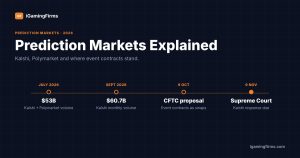
The grey edges matter too. US sweepstakes casinos and prediction markets such as Kalshi operate outside state gambling licences and are being challenged state by state; our guides to sweepstakes casino legality and how prediction markets and event contracts work cover where those fights stand.
How big is the iGaming industry?
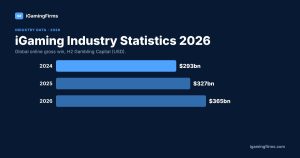
Short answer: about $293 billion in global online gross win in 2024, or 41% of all gambling, according to H2 Gambling Capital’s April 2026 update. H2 forecasts $530 billion by 2030, when online would be 51% of the global gambling market, crossing the halfway mark in 2029.
Two caveats before you quote any number:
- Licensed vs. total. H2’s figure includes offshore play. Only $132 billion (45%) of 2024 online gross win came from locally licensed operators; 55% went to offshore sites.
- GGR vs. handle. US sports betting handle (total stakes) was $166.94 billion in 2025, but revenue was $16.96 billion. Mixing the two inflates a market tenfold.
For revenue by region, growth rates and the biggest companies, see our full iGaming industry statistics and the ranking of the largest gambling companies.
Where you fit: operators, suppliers and affiliates
If you want to become an operator, you choose a vertical, a target market, a licence and a platform model, in roughly that order. Our guide on how to start a sportsbook walks through licence, platform and costs, and our comparison of gambling licence costs across 15 jurisdictions helps you budget the licence step.
If you are a supplier, your market is the operators in each regulated jurisdiction, and your licence needs follow theirs. Browse the supplier rankings to see who you compete with, from platforms and game studios to payment providers and KYC and compliance vendors.
If you are an affiliate or SEO, you sit at the end of the chain, paid out of NGR or per depositing player. Check whether your target markets require affiliate registration, and only promote brands licensed where the reader lives. Our explainer on how iGaming affiliate marketing works covers commission models, and the affiliate platforms and marketing agency categories list the tools and partners.
What is iGaming traffic?
iGaming traffic is the visitors that affiliates, publishers and media buyers send to gambling operators, usually through SEO content, comparison sites, paid ads where gambling advertising is allowed, and partner networks. It is valued by what it converts into: registrations, first-time depositors and the revenue those players generate. Because ad platforms and regulators restrict gambling advertising by market, the same traffic source can be lawful in one country and off-limits in the next, so geo-targeting and licence checks are part of the job.
The quickest way to understand the industry is still to meet it. Operators, suppliers and affiliates meet in person at trade shows such as ICE, SiGMA and G2E, which is where many supplier relationships start.