You want a gambling book that actually explains something: how the odds work, why the house wins or how the business got to where it is today.
The short answer: read Edward O. Thorp’s Beat the Dealer for blackjack math, David Sklansky’s The Theory of Poker for poker reasoning and Joseph Buchdahl’s Fixed Odds Sports Betting for how bookmakers price a market. Then add one history or policy title. Almost every “classic” gambling book was written before the US Supreme Court’s 2018 sports betting ruling. So only one title here, Jonathan D. Cohen’s Losing Big (2025), describes the legal US online betting market as it exists now.
The list below keeps the ten books from our earlier version and adds two industry titles. Each one is read with an industry lens: what it teaches about odds, the house edge, regulation or the history of the gambling business. It is not a guide to winning money. No author or publisher paid to be included. Author, publisher and date details were checked against publisher pages and library records in November 2026.
Gambling books compared: 12 titles side by side
| # | Book | Author | Publisher and first edition | Topic | What it teaches about the business |
|---|---|---|---|---|---|
| 1 | Beat the Dealer | Edward O. Thorp | 1962; revised Vintage edition 1966 | Blackjack | Why a fixed-rule casino game can lose its house edge and how casinos responded |
| 2 | Super/System | Doyle Brunson and contributors | B & G Publishing, late 1970s; later Cardoza | Poker | How professional cash-game poker was played before the online boom |
| 3 | Fixed Odds Sports Betting | Joseph Buchdahl | High Stakes, December 2003 | Sports betting | The bookmaker’s overround, value and the favourite-longshot bias |
| 4 | The Mathematics of Poker | Bill Chen and Jerrod Ankenman | ConJelCo, November 2006 | Poker | Game theory and the quantitative turn in poker |
| 5 | The Theory of Poker | David Sklansky | Two Plus Two; first version 1978, final text 1987 | Poker | Expected value as the core unit of every gambling decision |
| 6 | Positively Fifth Street | James McManus | Farrar, Straus and Giroux, April 2003 | Poker and Las Vegas | The World Series of Poker as a casino-run event in 2000 |
| 7 | Bringing Down the House | Ben Mezrich | Free Press, 2002 | Blackjack | Advantage play as a threat casinos manage |
| 8 | Molly’s Game | Molly Bloom | 2014 | Private poker | What happens when a game runs outside any licence |
| 9 | A Man for All Markets | Edward O. Thorp | Random House, 2017 | Gambling and finance | How casino math carried over to quantitative investing |
| 10 | The Biggest Bluff | Maria Konnikova | Penguin Press, June 2020 | Poker and psychology | Skill versus luck and judging decisions by process |
| 11 | Roll the Bones | David G. Schwartz | Gotham, 2006; Casino Edition later | Gambling history | How lotteries, casinos and sports betting grew into an industry |
| 12 | Losing Big | Jonathan D. Cohen | Columbia Global Reports, April 2025 | US sports betting policy | How state laws after 2018 shaped the online sportsbook market |
The order follows the review below. Books 1 to 5 teach a method. Books 6 to 10 tell a story. Books 11 and 12 explain the industry itself.
The 12 gambling books, reviewed
1. Beat the Dealer
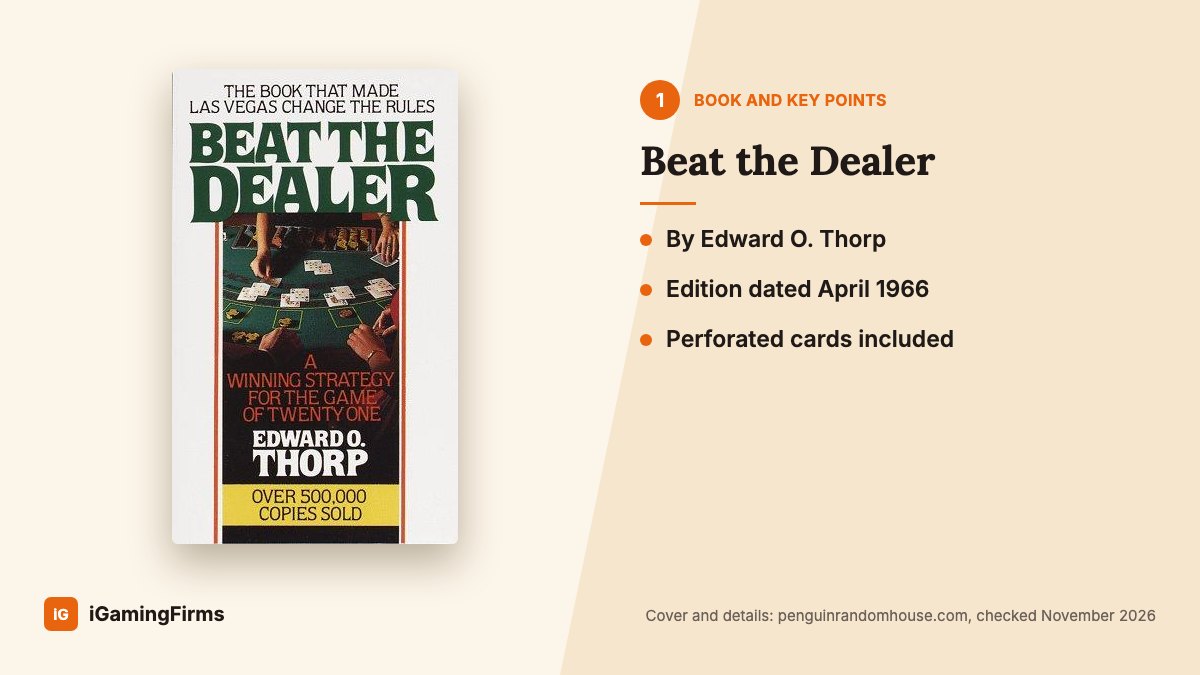
Beat the Dealer, subtitled A Winning Strategy for the Game of Twenty-One, is the book that turned card counting into public knowledge. Simon & Schuster’s page for Bringing Down the House dates it to 1962. The edition in print today is the 1966 Vintage revision (ISBN 9780394703107), which the publisher lists at 240 pages. The publisher describes a point system for counting, strategies from simple to advanced and advice on casino countermeasures and cheating.
- Author: Edward O. Thorp, a mathematics professor who later ran hedge funds.
- Publisher and dates: first published 1962; revised edition Vintage Books, 1966.
- Edition to note: the 1966 text is the one in print, so its rules and examples reflect 1960s Las Vegas.
What it teaches about the business: blackjack is unusual among casino games because the cards already dealt change the odds of the cards still to come. Thorp showed that this memory effect can, in some deck states, push the expected return in the player’s favour. That is the opposite of a slot or roulette wheel, where every spin is independent and the edge is fixed. The industry lesson is how casinos responded. Thorp’s own account in A Man for All Markets says casinos changed their rules and barred him. Countermeasures such as not dealing down to the last card followed. If you work on the operator side, this is the clearest early case of a game’s math being reverse-engineered by customers.
2. Super/System

Doyle Brunson’s multi-author manual from the late 1970s was the first time top professionals published their methods. Its contributors and later Cardoza editions are profiled in our poker books guide.
- Authors: Doyle Brunson, with sections by Mike Caro (draw poker and the probability tables), Chip Reese (seven-card stud), David Sklansky (stud high-low), Bobby Baldwin (limit hold ’em) and Joey Hawthorne (lowball, with Brunson).
- Publisher: B & G Publishing (first edition); Cardoza Publishing (later editions).
- Edition to note: several variants are now played differently and newer games are not covered.
What it teaches about the business: Super/System is a record of poker as a cash game played by professionals who travelled between private and casino rooms. Each section is written by a specialist in one variant, which shows how fragmented the game was before online poker and televised tournaments made no-limit hold ’em dominant. For anyone in poker operations, the book is useful as history. Its no-limit hold ’em section covers the game that later became the standard format of televised and online poker. It is not a guide to today’s game.
3. Fixed Odds Sports Betting
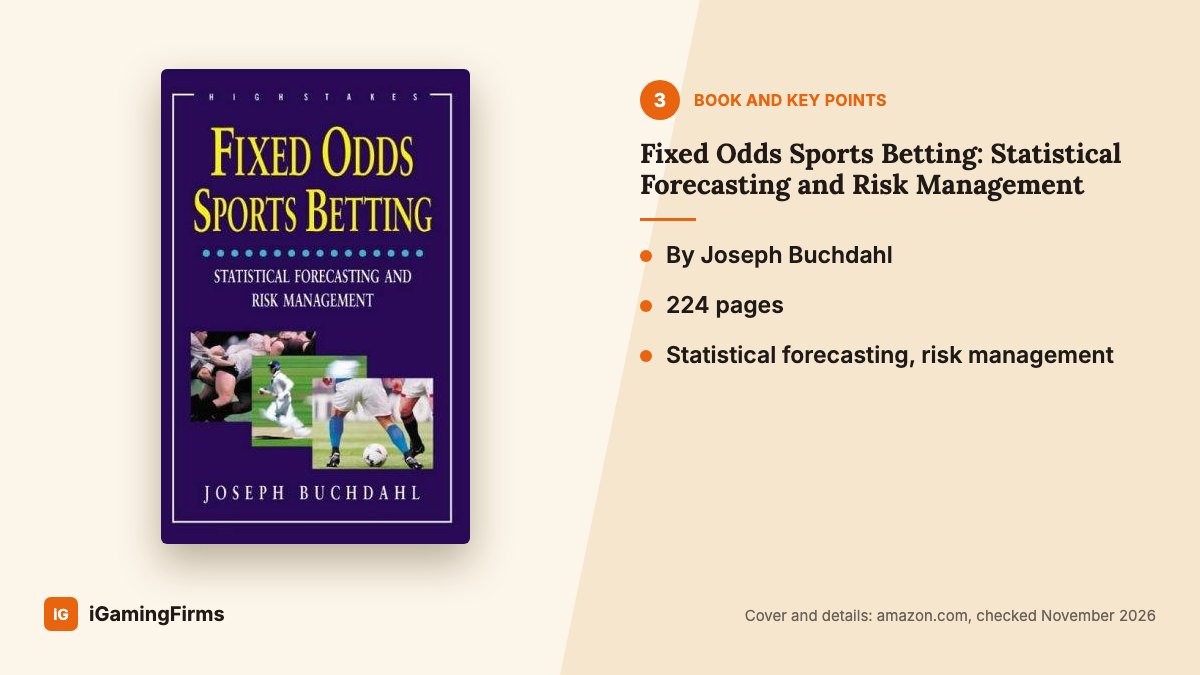
Joseph Buchdahl’s 2003 book is the clearest explanation on this list of how a bookmaker builds a price. Its contents and edition are covered in our sports betting books guide.
- Author: Joseph Buchdahl.
- Publisher and date: High Stakes Publishing, 18 December 2003.
- Edition to note: the data and markets are British fixed-odds football from the early 2000s. Buchdahl’s later High Stakes titles include Squares and Sharps, Suckers and Sharks.
What it teaches about the business: the overround is the bookmaker’s built-in margin. Add up the implied probabilities of every outcome in a market and the total comes to more than 100%. The excess is what the operator expects to keep. The favourite-longshot bias explains why that margin is not spread evenly: long shots tend to be priced worse than favourites. The publisher’s description also claims the book shows how to turn high-risk gambling into a “low-risk investment.” Treat that as the book’s claim, not a finding. The industry value is the pricing explanation, not a promise of profit. If you need the basics first, our guide on how to read betting odds explains how prices convert to probabilities.
4. The Mathematics of Poker
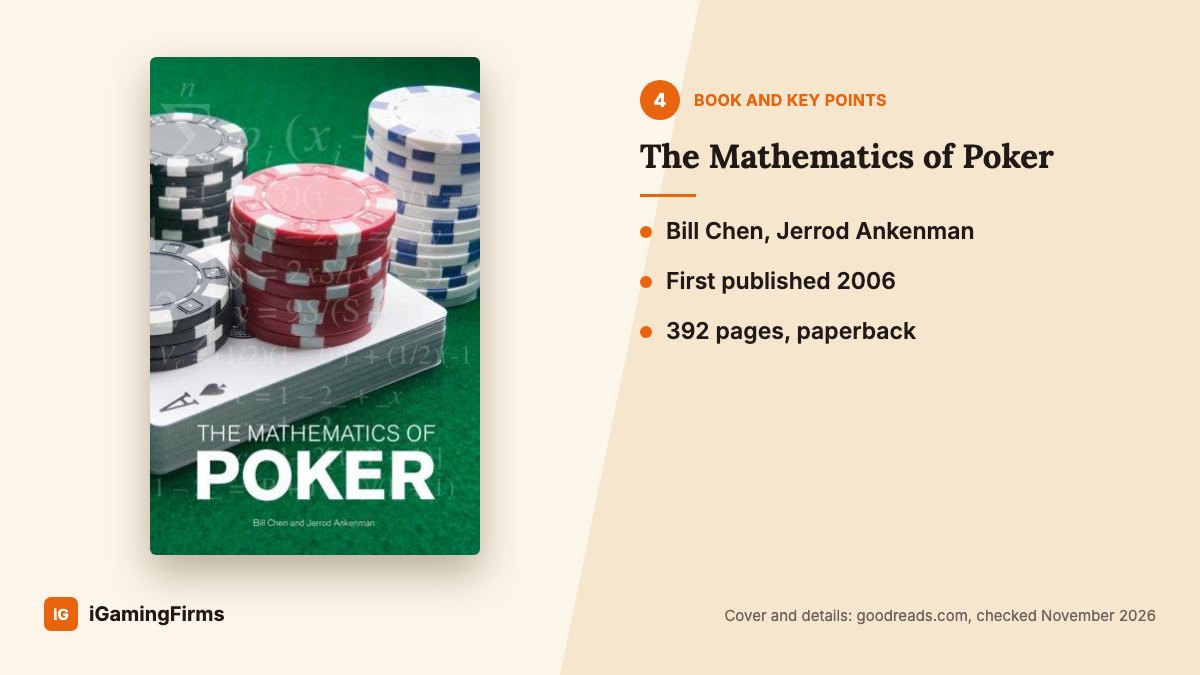
Bill Chen and Jerrod Ankenman’s 2006 book brought formal game theory to poker. Edition details and where it fits in a study plan are in the poker books guide.
- Authors: Bill Chen and Jerrod Ankenman.
- Publisher and date: ConJelCo, November 2006.
- Edition to note: the publisher says “most of the mathematics of poker is really not terribly difficult,” but the book uses formal game theory throughout.
What it teaches about the business: this is the book that explains why modern poker looks the way it does. The game-theory approach it popularised is the same thinking behind today’s solver software. For an operator, that matters in two ways. It widens the skill gap between serious and casual players. It also raises the question of where study tools end and real-time assistance begins, which online poker rooms have to answer in their rules on third-party tools. The book itself is pure theory with no operator content, but it is the background you need to follow those debates.
5. The Theory of Poker
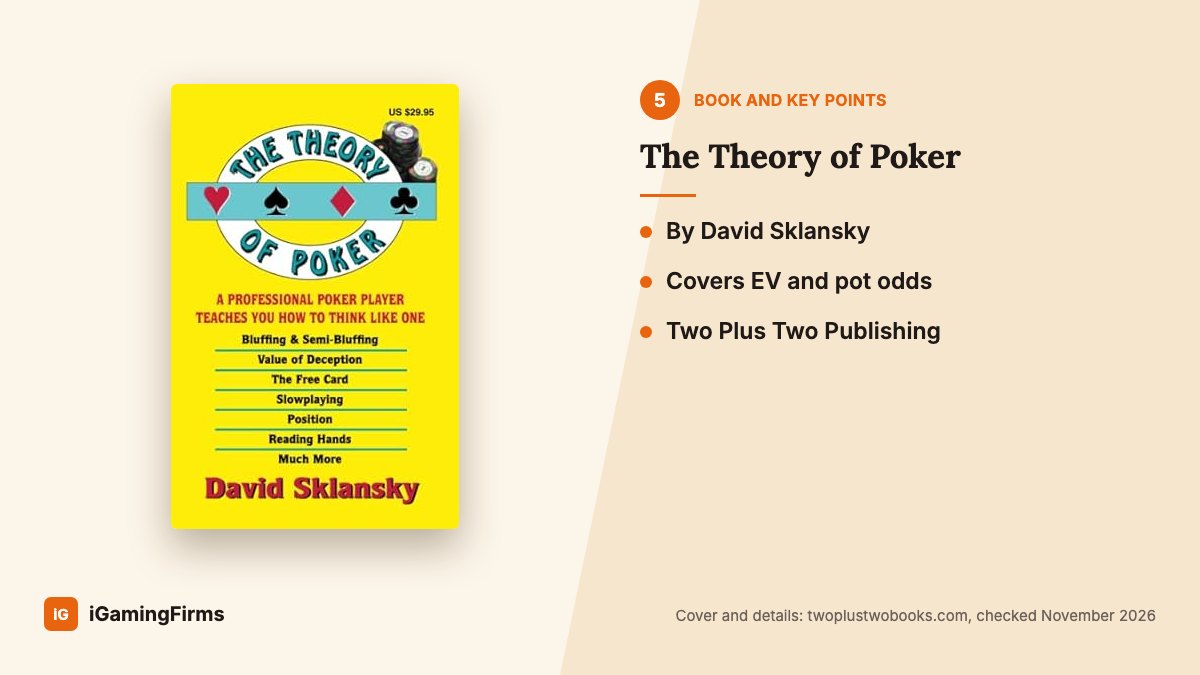
David Sklansky’s general theory of the game first appeared in 1978 and reached its final text in 1987. The poker books guide covers its editions and how it compares with solver-era titles.
- Author: David Sklansky.
- Publisher and dates: Two Plus Two Publishing; first version 1978, final text 1987.
- Key ideas: expected value, semi-bluffing, optimum bluffing frequency, implied and reverse implied odds and the Fundamental Theorem of Poker.
- Edition to note: many hand examples come from stud, draw and lowball rather than hold ’em.
What it teaches about the business: expected value is the single idea that links every product in the gambling industry. A slot’s return to player, a sportsbook’s hold and a poker player’s edge are all expected values. Sklansky’s Fundamental Theorem frames it from the player side: you gain when opponents act differently from how they would if they could see your cards. The operator lesson is simple. In poker the house does not take the other side of the bet. It earns from the rake, so its interest is in game volume and a healthy player pool, not in who wins each hand.
6. Positively Fifth Street
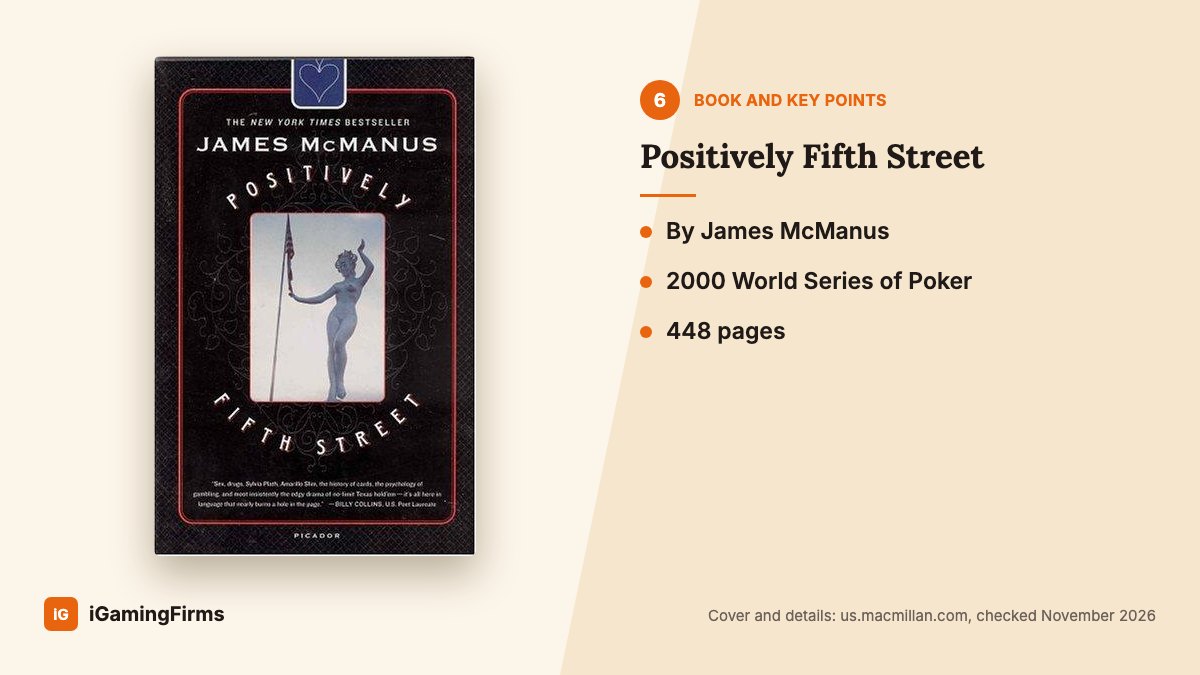
Positively Fifth Street is James McManus’s account of the 2000 World Series of Poker. Harper’s Magazine sent him to Las Vegas to cover the tournament and the trial over the death of Ted Binion, a member of the family that ran Binion’s Horseshoe. He then staked his advance on a place in the main event and played it himself. Open Library lists the first edition from Farrar, Straus and Giroux on 16 April 2003 at 416 pages and the Picador paperback on 1 March 2004 at 448 pages.
- Author: James McManus.
- Publisher and dates: Farrar, Straus and Giroux, 2003; Picador paperback, 2004.
- Type: long-form journalism and memoir, not strategy.
What it teaches about the business: the book captures the World Series of Poker when it was still a family-run casino promotion in downtown Las Vegas, before online qualifiers and television turned it into a global media property. It shows how a tournament can work as marketing for a casino and how closely a casino’s fortunes were tied to its owners’ personal lives. For anyone studying event-led marketing in gambling, it is a useful look at the model before it was corporatised.
7. Bringing Down the House
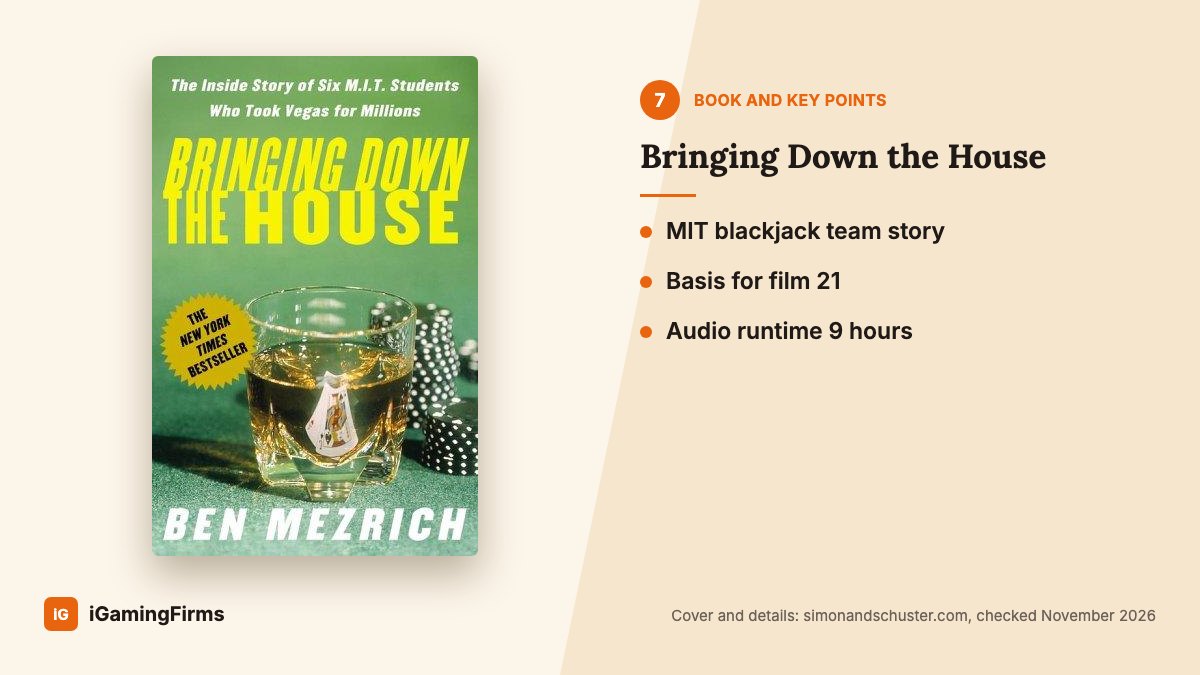
Bringing Down the House: The Inside Story of Six M.I.T. Students Who Took Vegas for Millions is Ben Mezrich’s narrative of an MIT blackjack team. Open Library dates the Free Press hardcover to September 2002 at 272 pages. Simon & Schuster’s current page is the Atria paperback from September 2003, also 272 pages, at a $16.00 list price.
- Author: Ben Mezrich.
- Publisher and dates: Free Press, 2002; Atria paperback, 2003.
- Type: narrative nonfiction, told through a student named Kevin Lewis. The publisher says it inspired the film 21.
What it teaches about the business: the publisher says the team won more than three million dollars and that its system was based on Thorp’s 1962 Beat the Dealer. The book is the bridge between items 1 and 9: it shows Thorp’s math applied by an organised team rather than a lone player. The publisher also notes the team drew the attention of casino owners and private investigators. For operators, that is the useful part: it shows advantage play as a security and surveillance problem, which is why casinos invest in game protection.
8. Molly’s Game

Molly’s Game is Molly Bloom’s 2014 memoir about running private high-stakes poker games for celebrities and financiers in Los Angeles and New York. It was published by HarperCollins and later adapted into the 2017 film of the same name.
- Author: Molly Bloom.
- Published: 2014.
- Type: memoir, not strategy.
What it teaches about the business: this is the book on this list about unlicensed gambling. Bloom was charged in April 2013 by the US Attorney’s Office for the Southern District of New York, alongside 33 other defendants, in a case involving illegal sports gambling and money laundering. She pleaded guilty in December 2013 to running illegal poker games and was sentenced in 2014 to a year of probation and community service. Read as an industry case study, the memoir shows what licensing exists to prevent: no player protection, no anti-money-laundering checks and no regulator if a debt goes unpaid. Compare it with our overview of US gambling laws by state to see how legal poker is supposed to work.
9. A Man for All Markets
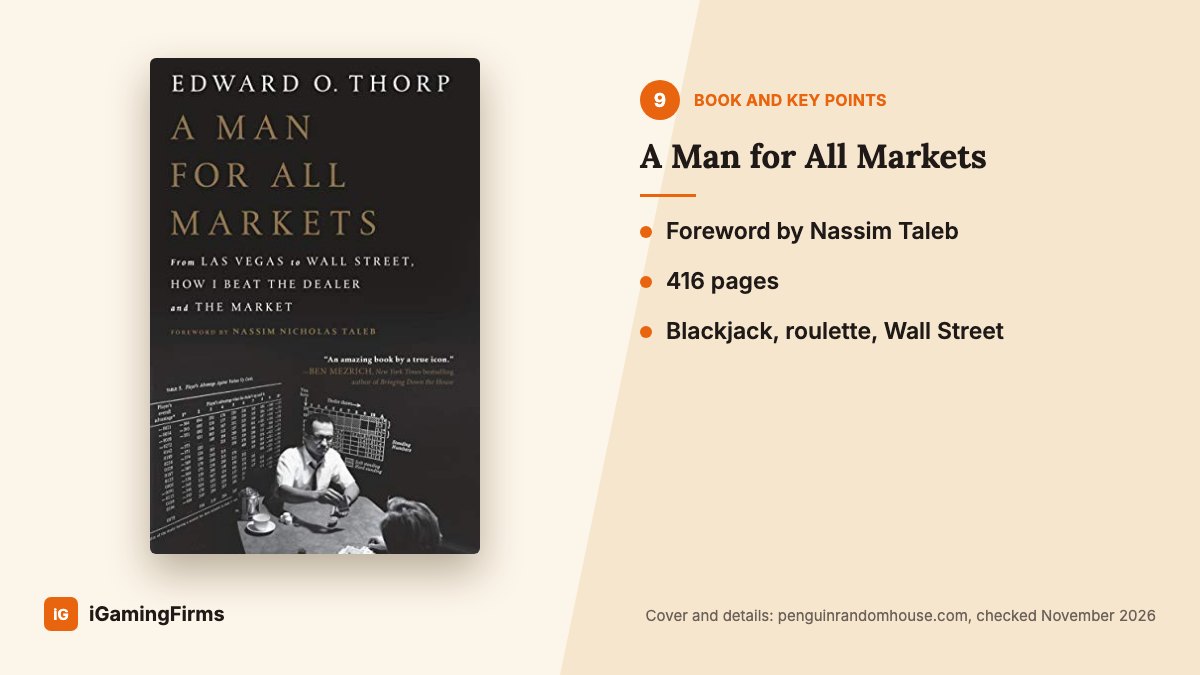
A Man for All Markets: From Las Vegas to Wall Street, How I Beat the Dealer and the Market is Thorp’s memoir. Open Library records the Random House first edition in 2017 (ISBN 9781400067961) at 396 pages plus plates. Penguin Random House now sells the paperback (ISBN 9780812979909) at $23.00. The foreword is by Nassim Nicholas Taleb.
- Author: Edward O. Thorp.
- Publisher and date: Random House, 2017.
- Type: memoir covering gambling and quantitative finance.
What it teaches about the business: Thorp’s author site says the book covers how card counting led casinos to change their rules and bar him. It also covers his work with Claude Shannon on a wearable computer to beat roulette and his move to Wall Street, where he spotted the Bernie Madoff scheme. For the gambling industry, the key idea is that casino games and financial markets share one toolkit: probability, bet sizing and risk control.
10. The Biggest Bluff

The Biggest Bluff follows Maria Konnikova, a psychologist and writer who had never played poker, as she trained under Erik Seidel to compete at the World Series of Poker. Open Library records the Penguin Press hardcover on 23 June 2020 at 368 pages. Penguin Random House says she won over $300,000 in tournament earnings while researching it and that the book was one of the Times’ 100 Notable Books of 2020.
- Author: Maria Konnikova.
- Publisher and date: Penguin Press, June 2020; paperback later.
- Type: narrative nonfiction on decision-making.
What it teaches about the business: the book’s main argument is that skill is real but never enough, because outcomes include variance you cannot control. That distinction between skill and chance is not only a reading theme. It is a legal one. Many jurisdictions treat games differently depending on whether skill or chance predominates, which is why poker, daily fantasy and casino games often sit under different rules. The book is also a clear explanation of why judging a decision by its result is a mistake.
11. Roll the Bones
Roll the Bones: The History of Gambling by David G. Schwartz is the broadest industry history on this list. The author’s site lists the first edition from Gotham in 2006 and says it was named the National Council on Problem Gambling’s Book of the Year for 2006. A revised Casino Edition expands the casino chapters.
- Author: David G. Schwartz, a historian of gambling and Las Vegas and a former UNLV administrator and faculty member.
- Publisher and date: Gotham, 2006; Casino Edition later.
- Coverage: ancient games, the first lotteries, Venice’s Ridotto, the spa casinos of Europe, Monte Carlo, Macau, Reno, Las Vegas and sports betting.
What it teaches about the business: the Casino Edition’s site lays out the timeline you need to understand modern regulation. It covers the first modern casino in Venice in 1638 and Nevada’s legal casino regime, which dates from 1931. It then covers the spread of casinos to other states starting with New Jersey in 1976 and on to tribal lands, riverboats and Asia. That arc explains why US gambling law is a patchwork. Each expansion came through a separate state or tribal decision rather than one national framework. Pair it with our primer on what iGaming is to carry the story into online gambling.
12. Losing Big
Losing Big: America’s Reckless Bet on Sports Gambling by Jonathan D. Cohen is the only title here written about today’s market. Columbia Global Reports published it on 1 April 2025 as a 192-page book (ISBN 9798987053706) at $18.00.
- Author: Jonathan D. Cohen, a historian who leads gambling policy at the American Institute for Boys and Men. He also wrote For a Dollar and a Dream: State Lotteries in Modern America.
- Publisher and date: Columbia Global Reports, April 2025.
- Type: policy argument and recent history.
What it teaches about the business: the book starts from Murphy v. NCAA, decided on 14 May 2018. In that ruling the Supreme Court struck down the federal law that barred states from authorising sports betting. The publisher says almost forty states have since legalised sports betting and that companies such as FanDuel and DraftKings dominate the market. Cohen argues that state systems were shaped by industry lobbying to favour sportsbook profits. He links phone-based betting, user targeting and personalised offers to rising harm among young men. You do not have to agree with every conclusion to find it useful. It is the clearest critique an operator or affiliate will face from regulators and lawmakers. It also explains why advertising and promotion rules keep tightening.
Gambling books by topic
If you only want one area, here is how the twelve titles split.
Blackjack and casino math
Beat the Dealer gives the method, Bringing Down the House shows it used by a team and A Man for All Markets tells the story behind it. Read them in that order and you get the math, the practice and the casino response.
Poker
The Theory of Poker is the conceptual base. The Mathematics of Poker adds formal game theory. Super/System is the historic manual. Positively Fifth Street, Molly’s Game and The Biggest Bluff show the culture around the game, from the World Series to illegal private tables. For player-focused picks by format and skill level, see our poker books guide.
Sports betting
Fixed Odds Sports Betting explains pricing from the bookmaker’s side. Losing Big explains the US legal market and its critics. Together they cover the two questions an industry reader asks: how the margin is built and how the market is regulated. For a wider view of whether the model pays off, see our analysis of whether sports betting is profitable. For nine titles on line-setting, market efficiency and bankroll maths, see our sports betting books guide.
History and policy
Roll the Bones covers several thousand years of gambling. Losing Big covers the years since 2018. Between them sits the regulatory story you need for licensing, compliance or market-entry work.
What is The Gambler book about?
The Gambler is a short novel by Fyodor Dostoyevsky, first published in 1866. Britannica notes that he dictated it to the stenographer Anna Snitkina to meet a publisher’s deadline. He married her the following year. The novel studies the psychology of compulsive gambling. It is set around the roulette tables of a fictional German spa town and draws on Dostoyevsky’s own life. It is fiction, so it teaches nothing about odds. It does capture the European spa-town casinos that, in the account given in Roll the Bones, culminated in Monte Carlo.
Is gambling a big problem?
For a minority of people, yes. The National Council on Problem Gambling estimates that about 2.5 million US adults (1%) meet the criteria for a severe gambling problem in a given year. Another 5 to 8 million (2 to 3%) have mild or moderate problems. NCPG defines problem gambling as gambling behaviour that damages a person or their family. That is the context for Losing Big, which argues that easy mobile access raised these risks after 2018. It is also the reason behind the responsible gambling rules operators now face.
What is the best book for gambling addiction?
None of the twelve books here is a treatment guide. A book should not replace professional help. Losing Big is the closest on this list because it treats addiction as a public health and policy issue. Roll the Bones was recognised by NCPG, though it is a history. If gambling is causing harm to you or someone close to you, start with the National Problem Gambling Helpline. It is 1-800-MY-RESET (1-800-697-3738), free and confidential, with call, text and chat 24 hours a day. NCPG also offers self-assessment tools. A counsellor can recommend reading that fits your situation.
Which gambling books explain how casinos and sportsbooks make money?
Three titles do this directly. Fixed Odds Sports Betting explains the overround, the margin a bookmaker builds into every market. The Theory of Poker explains expected value, which is the same concept as a casino’s house edge seen from the other side. Beat the Dealer shows the rare case where a game’s edge could flip to the player, which explains why casinos guard blackjack rules so closely. If the vocabulary is new, our A to Z of sports betting terms covers hold, vig and juice.
Are older gambling books still accurate?
The math is. The markets and rules are not. Expected value, overround and probability do not change. But Beat the Dealer describes 1960s blackjack rules, Super/System predates online poker and Fixed Odds Sports Betting predates legal US mobile betting by 15 years. Use older books for principles. Use recent sources such as Losing Big and current regulator pages for anything about law, products or prices. Also check the legal age where you live. Our guide to the legal gambling age by state shows it differs by state and by product.
Dates, post-2018 titles and the current helpline
Reprint dates are not first editions. It is easy to date a book by the printing on sale today. An earlier version of this page did exactly that, giving Beat the Dealer as 1966. Library records show the Sklansky text began in 1978 and was finalised in 1987. Thorp’s book first appeared in 1962. The date matters because it tells you which rules, games and markets the author was writing about.
Include a book from after 2018. Most classic gambling books date from the 1960s to the 2000s, before the biggest change in US gambling in decades. After Murphy v. NCAA, sports betting moved from Nevada and offshore books to state-licensed mobile apps. Losing Big covers that shift directly. Without a post-2018 title, a reading list gives you a picture of the market that is out of date.
Use the current helpline. Older references, including an earlier version of this page, give 1-800-GAMBLER. NCPG’s own page now lists the National Problem Gambling Helpline as 1-800-MY-RESET, with 1-800-522-4700 for text. If you publish anything about gambling, check the current number before you print it.
Your next step
Pick the one area you need: blackjack, poker, sports betting or the industry itself. Choose one method or history book and one recent title from the list above. Before you buy, check the publication date on the publisher’s page and confirm whether you are getting a first edition or a later revision. If you work in the industry, start with Fixed Odds Sports Betting for pricing and Losing Big for regulation. Those two cover the margin and the policy debate that shape the market today.