If you run a sportsbook, an affiliate site or a supplier business in the US, prediction market apps now compete for the same customers, the same ad inventory and the same state regulators as you do.
The short answer: the US prediction market app landscape is a handful of exchanges with many storefronts on top. Kalshi alone handled about 81% of the $120.73 billion traded across eight tracked exchanges in October 2026. The big consumer brands are now buying their own exchanges: DraftKings runs DKeX, Robinhood routes to Rothera, Fanatics agreed to buy Water Street Labs and FanDuel sits on CME Group. For operators and affiliates, the exchange behind an app now decides its fee economics, its state legal exposure and how long its affiliate deals are likely to last.
This guide looks at 11 apps as products and distribution channels: who runs each exchange, its CFTC status, where it is sold, how it charges, what volume it reports and which states are fighting it. It is written for B2B readers. It is not a recommendation to trade or to sign up anywhere. For the basics of how event contracts work, start with how prediction markets work and where they are legal.
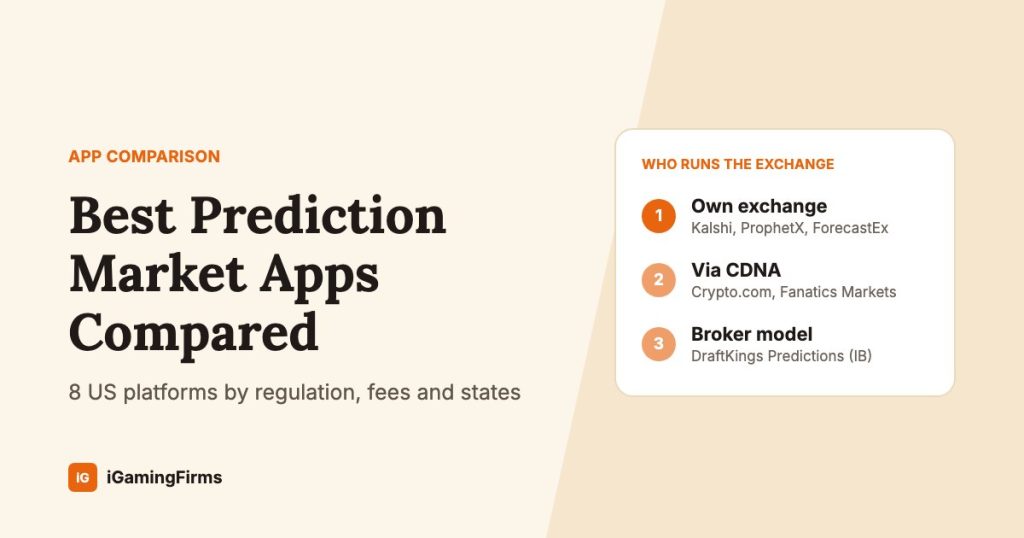
Prediction market apps compared: 11 US platforms side by side
The table shows the app, the legal entity and CFTC role behind it, the exchange that actually lists the contracts and how the app reaches customers. Facts were checked against company pages, CFTC filings and news reports in November 2026.
| # | App | Operator and CFTC role | Exchange behind the app | Distribution | Sports contracts and state friction |
|---|---|---|---|---|---|
| 1 | Kalshi | KalshiEX LLC, designated contract market (DCM) | Own exchange | Own iOS and Android apps plus web; also reached through brokers such as Robinhood | Sports offered widely; lost three of four federal appeals on sports preemption; criminal charges in Arizona and Utah |
| 2 | Polymarket | Polymarket US (QCX LLC), DCM; international site is separate and not CFTC-regulated | Own US exchange | US iOS app rolled out from May 2026; the international platform operates separately | Named in Louisiana restraining order; sued Louisiana in federal court |
| 3 | ProphetX Prediction Market | ProphetX, DCM and derivatives clearing organization (DCO) since June 2026 | Own exchange and clearinghouse | iOS, Google Play, web | Sports only; converted from a sweepstakes exchange |
| 4 | Crypto.com Prediction Markets | Crypto.com | Derivatives North America (CDNA), DCM and DCO | Own exchange; also supplies other apps | Inside the Crypto.com app, the OG app and partner apps | Lost Ninth Circuit appeal over Nevada; stopped sports contracts in Nevada in November 2025 |
| 5 | DraftKings Predictions | GUS III LLC, Introducing Broker (IB) and NFA member | DKeX (former Railbird exchange) since June 2026 | Unified DraftKings: Sports & Casino app | Sports contracts in 18 states, mostly states without legal sportsbooks |
| 6 | Fanatics Markets | Morton St. Trading Investments, LLC (FCM) d/b/a Fanatics Markets | CDNA today; agreed to buy its own DCM and DCO from BGC | Standalone app plus unified Fanatics Sports & Casino app | 23 states and four territories as of June 2026 |
| 7 | ForecastEx | ForecastEx LLC, DCM and DCO, affiliate of Interactive Brokers | Own exchange | Through member brokers such as Interactive Brokers and Robinhood | Economics, climate and politics focus; low state friction |
| 8 | Manifold | Manifold Markets, Inc.; not CFTC-regulated | None; play money | Web and mobile | No cash payouts, so outside the state fight |
| 9 | FanDuel Predicts | FanDuel with CME Group | CME Group | Standalone mobile app | Sports contracts only where FanDuel has no sportsbook licence |
| 10 | Robinhood | Robinhood Derivatives, LLC, FCM | Kalshi, ForecastEx, Rothera and CDNA | Inside the Robinhood brokerage app | Lost Ninth Circuit appeal over Nevada; named in Louisiana order |
| 11 | Novig | Ludlow Exchange LLC, DCM since June 2026 | Own exchange | Own app and web | Sports only, 21+ only; launched nationwide in August 2026 |
The 11 prediction market apps, profiled
1. Kalshi

Kalshi is the market leader and the default counterparty for much of the industry. Its App Store listing names KalshiEX LLC as developer and carries an 18+ age rating. Kalshi recorded $98.15 billion in October 2026 volume, up 61.3% from September, according to DeFi Rate data reported by SiGMA. On 29 October it raised $1 billion at a $40 billion valuation, after entering perpetual futures in September 2026 with CFTC approval.
Fee model: Kalshi’s published fee schedule sets taker fees at round up(0.07 x C x P x (1-P)), where C is contracts and P is price. That peaks at $1.75 per 100 contracts at 50 cents. Designated markets also carry a maker fee using a 0.0175 coefficient. For the revenue side, see how Kalshi makes money from fees and spreads.
Legal fights: Kalshi won in the Third Circuit against New Jersey in April 2026. It then lost in the Ninth Circuit over Nevada on 28 August 2026, in the Sixth Circuit over Ohio and Tennessee on 25 September and in the Fourth Circuit over Maryland in November. Arizona filed the first criminal charges against KalshiEX LLC in March 2026. Utah followed in October with charges naming Kalshi and its two co-founders. The CFTC itself also stayed one of Kalshi’s mention contracts in November and gave the company until 11 December to answer.
What it means for you: Kalshi is the liquidity hub. Robinhood, Interactive Brokers and other brokers route to it, so a court loss for Kalshi in a state can switch off sports contracts across several storefronts at once. Affiliates should also note that Kalshi pulled its X affiliate badges in February 2026 after the platform tightened its paid partnership rules, as The Block reported.
2. Polymarket
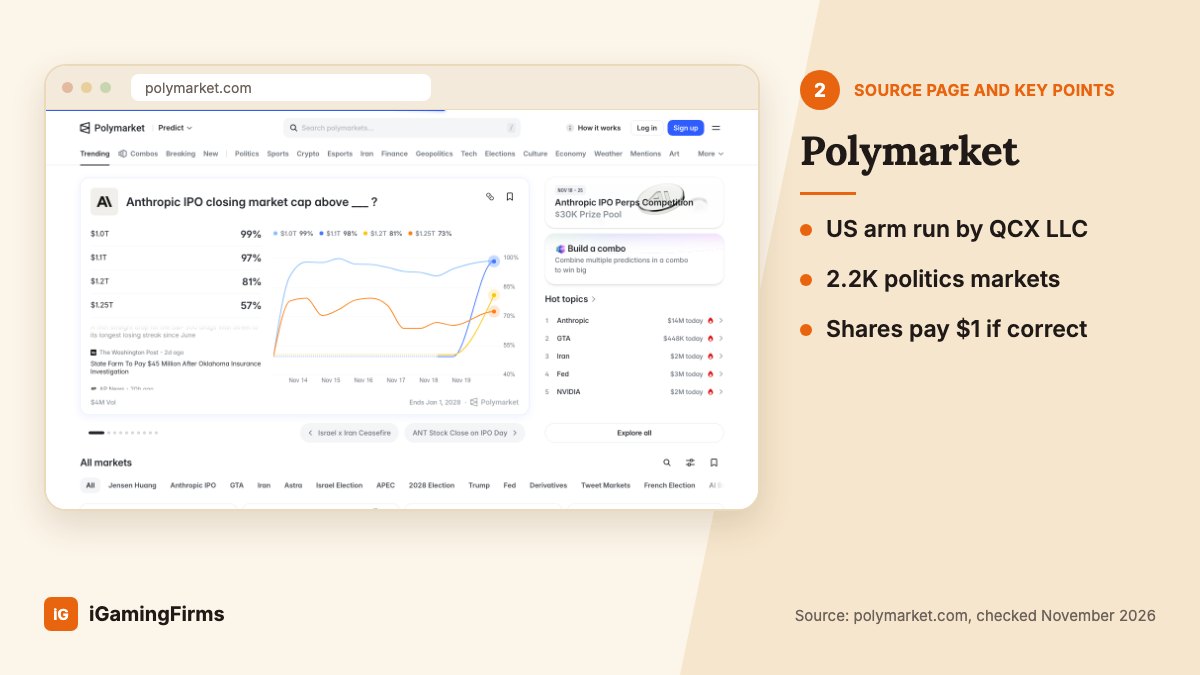
Polymarket runs two businesses. The global crypto platform is not regulated by the CFTC. The US business, Polymarket US, runs on the QCX exchange it acquired in July 2025 and is a CFTC-designated contract market. The US iOS app dropped its waitlist and began rolling out to users in May 2026, as Yogonet reported. Polymarket US traded $14.77 billion in October 2026, up 69.8% from September, per the DeFi Rate data in the SiGMA report.
Fee model: The Polymarket US fee schedule effective 25 November 2026 uses Fee = coefficient x C x p x (1-p). App and web takers pay a coefficient from 0.11 down to 0.0695 depending on 30-day volume. API takers pay 0.0695. Makers earn tiered rebates. At the top tier the taker fee at 50 cents is $1.74 per 100 contracts, level with Kalshi. The international site uses its own category-based fee table.
Legal fights: Louisiana’s attorney general sued Polymarket alongside Kalshi, Robinhood, Coinbase and Gemini in November 2026. A state judge then issued a temporary restraining order with a hearing set for 30 November. Polymarket has sued in federal court in response. For the full legal picture, read whether Polymarket is legal in the US.
What it means for you: Two brands share one name. Any affiliate or media partner has to make sure US traffic lands on the regulated US app, not the global site. For a structural comparison of the two leaders, see Kalshi vs Polymarket on regulation, fees and liquidity.
3. ProphetX Prediction Market
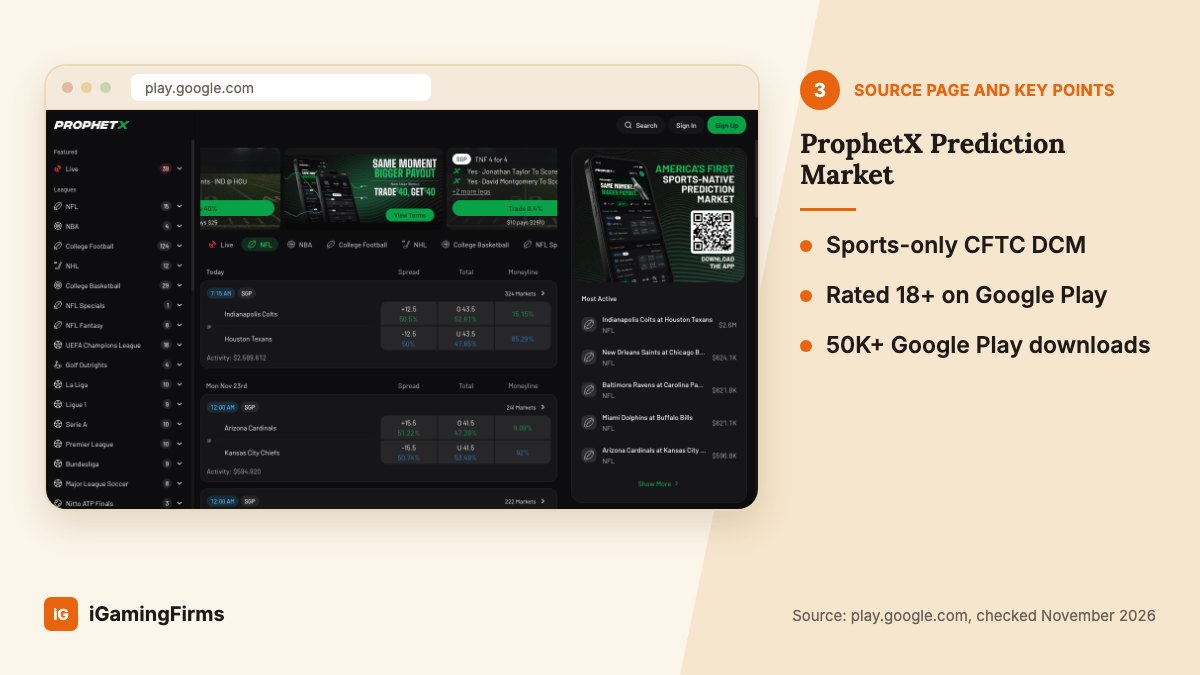
ProphetX started as a peer-to-peer sports exchange running a sweepstakes model. On 11 June 2026 the CFTC approved its applications to register as both a DCM and a DCO, which means it lists and clears its own contracts. Its App Store listing names ProphetX OpCo LLC as developer and markets “no house cut” sports trading with live markets, player props and parlays. It is also on Google Play. The company’s site is prophetx.co.
Volume: DeFi Rate’s October tracker put ProphetX at $306.3 million, up 27.3% month on month. That is a fraction of Kalshi’s volume, which shows how hard it is for a sports-only exchange to build depth.
What it means for you: ProphetX is a direct-clearing model with no broker layer. That gives it control of fees and product, but it also has to fund liquidity on its own. Suppliers of odds data, trading tools and market making are the natural B2B partners here.
4. Crypto.com Prediction Markets
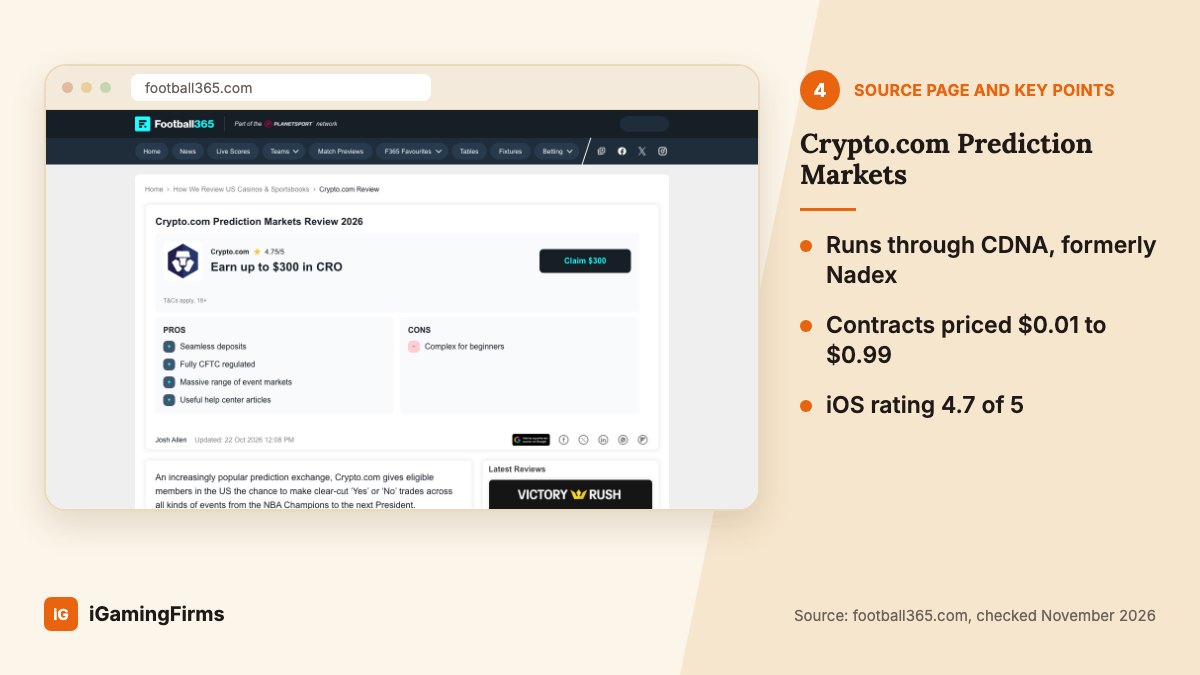
Crypto.com Prediction is offered by North American Derivatives Exchange, Inc. d/b/a Crypto.com | Derivatives North America (CDNA), the former Nadex. Crypto.com says CDNA is registered with the CFTC as a DCM and DCO. The product lives inside the Crypto.com app and in OG, a standalone prediction app Crypto.com launched on 3 February 2026. DeFi Rate’s October tracker recorded $2.19 billion for Crypto.com and Nadex.
The B2B angle: CDNA is the industry’s main wholesale exchange. It supplies contracts to Fanatics Markets, to Underdog in 16 states, to Truth Social’s Truth Predict and, since 8 September 2026, to Robinhood, which routes a selection of football contracts to it. Casino operator High Roller Technologies signed a letter of intent with CDNA in January 2026.
Legal fights: Crypto.com sued Nevada regulators in 2025, lost its bid for an injunction and stopped offering sports contracts in Nevada on 3 November 2025. The Ninth Circuit upheld the Nevada ruling against it in August 2026. CDNA has since petitioned the Supreme Court.
What it means for you: If you want a branded prediction product without your own DCM, CDNA is the most visible white-label route. The trade-off is that every partner inherits CDNA’s court record and state exits.
5. DraftKings Predictions
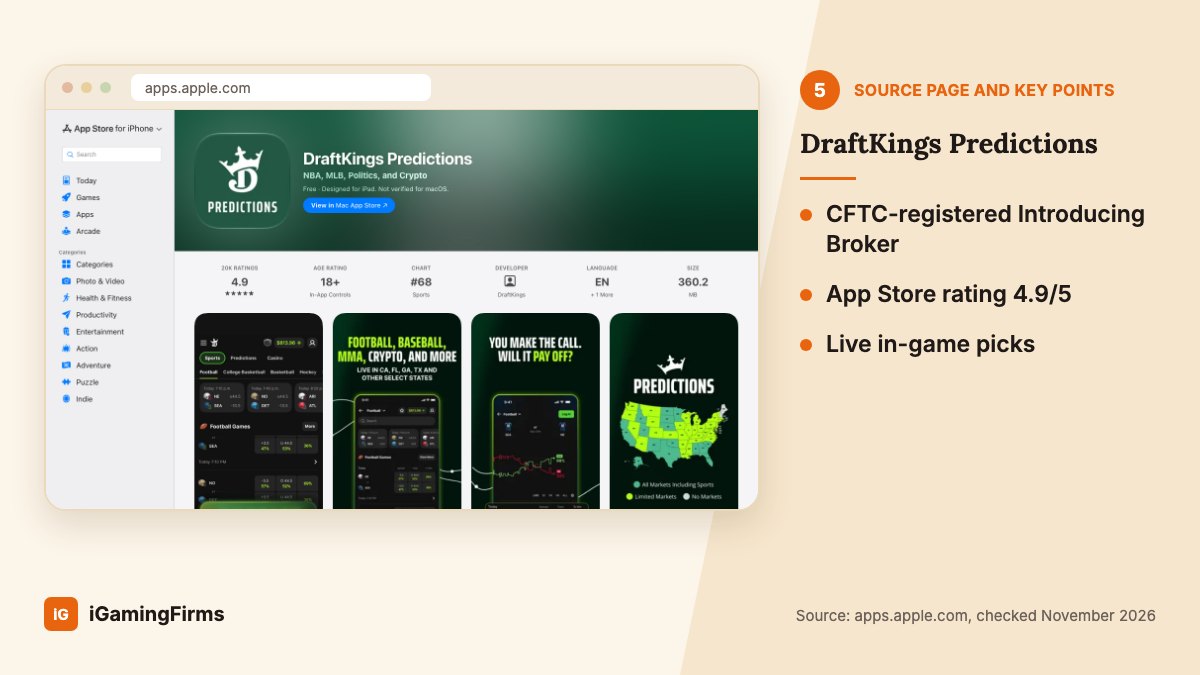
DraftKings Predictions is run by GUS III LLC, a CFTC-registered Introducing Broker and NFA member. It launched in December 2025 in 38 states and has since expanded to 48, with Maine and New Hampshire the exceptions, according to SBC Americas. Sports contracts are offered in 18 states. On 26 June 2026 DraftKings launched DKeX, its own exchange built on the CFTC licence it bought with Railbird. It also folded predictions into the unified DraftKings: Sports & Casino app. The company said predictions were generating about $3.4 billion in annualized consumer volume at that point.
Fee model: Before DKeX, customers trading through DraftKings paid an exchange fee to the venue plus a fee to DraftKings, InGame reported. Owning the exchange lets DraftKings keep both layers of economics.
What it means for you: This is the clearest example of a sportsbook using prediction markets to reach states where it holds no betting licence. Affiliates working DraftKings deals should check whether a campaign promotes the sportsbook, the prediction product or both, because the two sit under different regulators.
6. Fanatics Markets

Fanatics Markets launched on 3 December 2025 using markets and pricing from CDNA, after Fanatics bought Paragon Global Markets in July 2025. Its disclosures name Morton St. Trading Investments, LLC, a CFTC-registered futures commission merchant (FCM) and NFA member, as the business behind the brand. The App Store listing describes the CDNA link. By June 2026 the app was live in 23 states and four US territories, with FanCash loyalty rewards tied to trading.
Recent changes: On 27 July 2026 Fanatics agreed to acquire Water Street Labs and CX Clearinghouse from BGC Group, a DCM and a DCO. On 2 September it launched Fanatics Sports & Casino, one app with one account across sportsbook, casino and Markets.
What it means for you: Fanatics is moving from a CDNA storefront to an owned exchange. Expect contract range, fees and state coverage to shift once it lists on its own venue. A loyalty currency that spans merchandise, betting and trading is also a new cross-sell model that affiliates will compete against.
7. ForecastEx
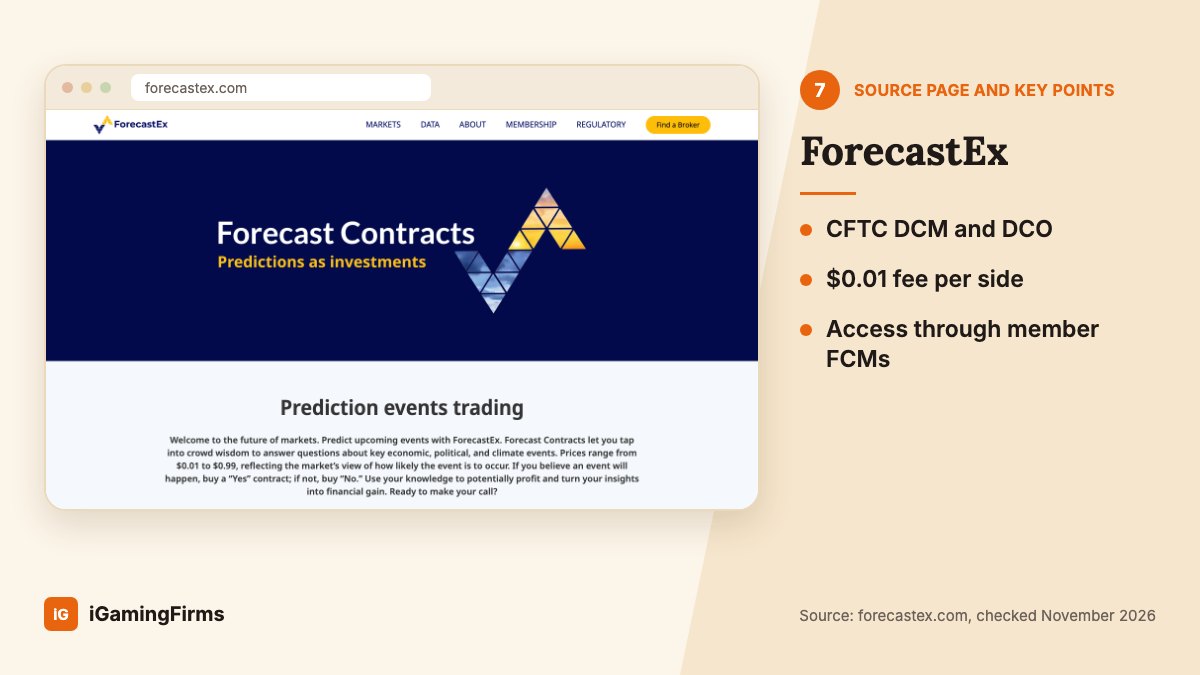
ForecastEx is a CFTC-registered DCM and DCO for “Forecast Contracts” on economic, climate and political questions. You do not sign up with it directly. Members such as Interactive Brokers, which describes itself as a clearing member and affiliate of ForecastEx, give their customers access. Robinhood also lists ForecastEx as one of its venues.
Fee model: The ForecastEx fee schedule filed with the CFTC charges $0.01 per contract to each side, with no transaction fee on block trades between 22 September and 1 December 2026. Contracts earn a monthly incentive coupon on collateral. ForecastEx withholds 50 basis points of the interest as an administrative clearing fee. Interactive Brokers charges no commission of its own on these contracts.
What it means for you: ForecastEx traded just $14.4 million in October per DeFi Rate’s tracker. It is a reference point for macro and climate contracts rather than a sports competitor, which keeps it largely clear of the state gambling fight.
8. Manifold
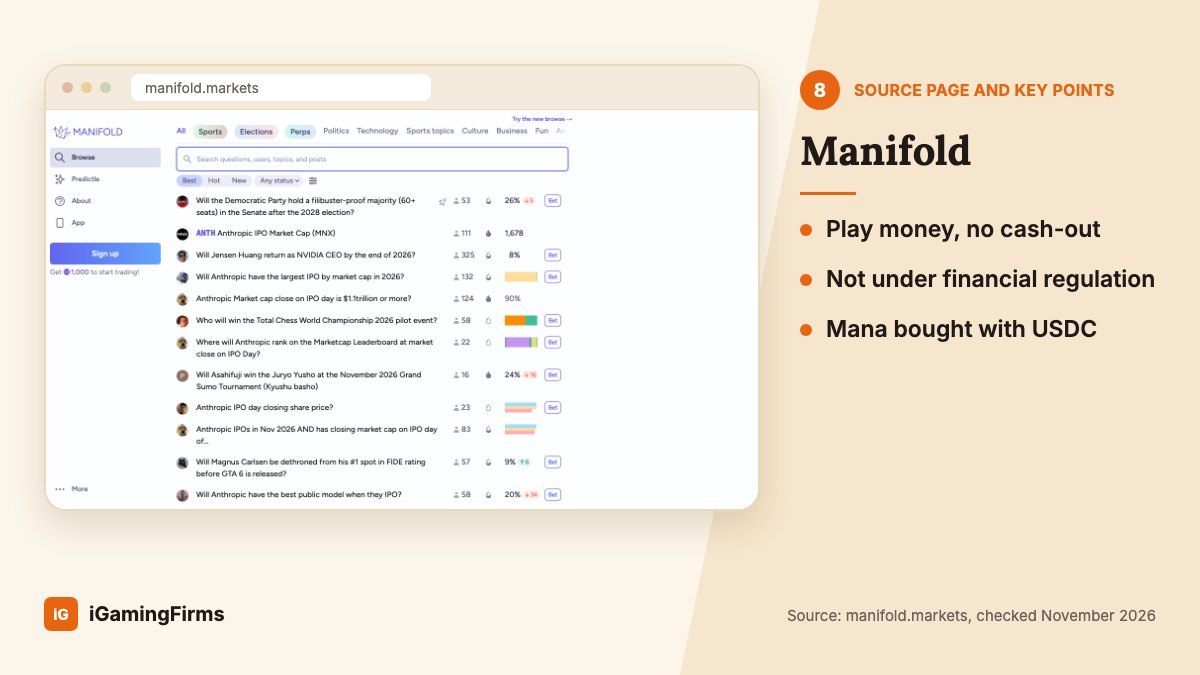
Manifold is a social forecasting site run by Manifold Markets, Inc. It runs on Mana, a play currency that cannot be cashed out. It says it does not operate under financial-services or gambling rules for that reason. It ended its Sweepcash real-money feature in March 2025 and returned to a Mana-only model. Anyone can create a market on any question.
What it means for you: Manifold is not a competitor for deposits. It is useful as a free sandbox. Product teams and content teams can test how a market question reads, how it resolves and what crowd interest looks like before a regulated exchange would ever list it.
9. FanDuel Predicts
FanDuel Predicts is a standalone app built by FanDuel with CME Group, which owns the exchange. It launched in five states on 22 December 2025. In the launch release the companies said sports contracts would stop in any state that legalizes online sports betting. By January 2026 the app was live in all 50 states, with sports contracts in 18, including California and Texas. Its App Store listing names FanDuel, Inc. as developer.
What it means for you: FanDuel’s rule is the cleanest version of the sportsbook strategy: sports event contracts only where it has no sportsbook licence, financial and economic contracts everywhere else. That keeps it out of conflict with its own state regulators while it builds a database of customers in unlicensed states.
10. Robinhood
Robinhood offers event contracts through Robinhood Derivatives, LLC inside its brokerage app. In June 2026 it began routing contracts to Rothera, a CFTC-licensed exchange and clearinghouse run through its joint venture with Susquehanna. Its disclosures list KalshiEX LLC, ForecastEx LLC and Rothera Exchange and Clearing LLC as venues. CDNA was added for football in September. Robinhood said in early June that over 16 billion event contracts had already traded in 2026, against more than 12 billion in all of 2025. Event contract activity topped 13.6 billion contracts in the second quarter, Finance Magnates reported.
Legal fights: The Ninth Circuit ruled against Robinhood over Nevada in August 2026. Robinhood was also named in Louisiana’s November lawsuit and restraining order.
What it means for you: Robinhood acts as a router across exchanges. It can move flow between venues, as it did when it sent World Cup contracts to Rothera instead of relying only on Kalshi. That is the main commercial risk for stand-alone exchanges. A venue can lose volume from one partner decision even while the overall market grows.
11. Novig
Novig is another former sweepstakes sports exchange. The CFTC designated its Ludlow Exchange LLC as a DCM on 16 June 2026. It relaunched as a federally regulated prediction market on 4 August, sports only and limited to customers 21 and older, which is stricter than the 18+ minimum used by Kalshi, Polymarket and Crypto.com. Novig also signed a multi-year deal as the New York Mets’ exclusive official prediction market partner. DeFi Rate’s tracker recorded $3.27 billion for Novig in October, up 126.1% month on month.
What it means for you: Novig’s rule filings set out a referral program for affiliates, publishers and influencers, who must sign an agreement and be approved by the exchange first. That is a useful template for how regulated affiliate deals in this sector are being structured.
Which prediction market app is the biggest?
By traded volume, Kalshi leads by a wide margin. DeFi Rate’s October 2026 figures across eight exchanges show Kalshi at $98.15 billion and Polymarket US at $14.77 billion. Novig followed at $3.27 billion, then Crypto.com and Nadex at $2.19 billion, Underdog Exchange at $1.98 billion, ProphetX at $306.3 million, Gemini Titan at $42.1 million and ForecastEx at $14.4 million. CME Group, ICE Futures U.S. and DKeX were left out because complete October figures were not available.
Volume is credited to the exchange where the trade happens, not the app where the customer clicked. That matters for anyone valuing a distribution deal. Robinhood, Fanatics Markets and Underdog can drive large flow while appearing in no volume table under their own names.
What are the top 5 prediction markets?
By October 2026 exchange volume, the top five are Kalshi, Polymarket US, Novig, Crypto.com (CDNA) and Underdog Exchange. By consumer reach the list looks different. Robinhood, DraftKings, FanDuel and Fanatics bring existing customer bases of brokerage and sportsbook users. Those brands are now the main gatekeepers to retail flow, even when the contract clears somewhere else.
Are prediction markets legal in the US?
At the federal level, yes. Every app in this list except Manifold operates through a CFTC-registered DCM, FCM or Introducing Broker. The open question is whether sports event contracts on those exchanges are also subject to state gambling law. Federal appeals courts have split. The Third Circuit sided with Kalshi against New Jersey. The Ninth, Sixth and Fourth Circuits sided with Nevada, Ohio, Tennessee and Maryland. New Jersey asked the Supreme Court to take the case in September 2026. CDNA and Robinhood have filed their own petitions.
The federal regulator has picked a side. The CFTC sued Utah on 27 October 2026 to stop it enforcing state gambling law against registered exchanges. Trade reports counted it as the tenth state the CFTC has sued over prediction markets. In New York a state judge refused the attorney general’s request for a restraining order against Kalshi on 23 November, iGaming Business reported. For each state’s wider gambling rules, use the US gambling laws by state guide.
How do prediction market apps make money?
There are three layers of revenue. The exchange earns trading fees, which at Kalshi and Polymarket US follow a curve that peaks when a contract trades near 50 cents. The broker or app layer adds its own commission or charges the customer an exchange fee plus a platform fee. The clearinghouse can keep part of the interest on customer collateral, as ForecastEx does with its 50 basis point administrative fee.
This is why the sportsbook groups are buying exchanges. An app that routes to someone else’s DCM pays away the exchange fee. An app that owns its DCM keeps it and controls which contracts get listed. Robinhood’s move to Rothera, DraftKings’ DKeX and the Fanatics purchase of Water Street Labs all follow that logic.
What the CFTC and exchange deals mean for app partners
The CFTC has warned against showing event contracts as sportsbook odds
On 7 August 2026 the CFTC’s market oversight and market participants divisions reminded regulated entities that pricing event contracts in the “American odds” format used by bookmakers is likely to mislead customers about what they are trading. The release says the duty extends to oversight of affiliates and partners. For odds-comparison sites and affiliates that plug prediction prices into sportsbook-style odds tables, this is a direct compliance risk. Show prices in cents or percentages and label them as exchange prices.
Incentive programs are now a regulatory filing, not just a marketing decision
A CFTC staff advisory on self-certification of incentive programs dated 12 August 2026 reminded exchanges of their duties when they file bonus and rebate schemes. It also warned against hidden, one-off or preferential arrangements. Kalshi now files its trading rewards and liquidity provider programs with the CFTC, as its October 2026 market making filing shows. If you negotiate a bespoke promotion with an exchange, assume it may need to fit a filed program.
Exchange ownership is consolidating fast
In twelve months the sector moved from a few exchanges serving many apps to a model where each large brand wants its own venue. DraftKings, Robinhood and Fanatics have all moved. ProphetX and Novig went straight to their own DCMs. FanDuel works with an exchange owner in CME Group. For suppliers this opens a market for exchange technology, surveillance, KYC and market making. Novig, for example, deployed a third-party trade surveillance platform before launch. For affiliates it means today’s partner may soon list different contracts on a different venue under a different fee model.
What this means for operators, affiliates and suppliers
- Operators: Decide whether you need a DCM, an FCM or IB registration, or a white-label link to an existing exchange such as CDNA. Each route carries a different cost and a different legal exposure. Our guide to iGaming affiliate marketing covers how partner programs are usually structured.
- Affiliates: Map each campaign to the legal entity that will hold the customer’s account, follow the CFTC pricing warning and keep disclosure rules for influencers in mind. In June 2026 the National Advertising Division said it would refer Kalshi to regulators after the company did not take part in its inquiry into influencer and affiliate disclosures.
- Suppliers: Data, surveillance, payments and geolocation vendors now sell to exchanges as well as sportsbooks. If the Supreme Court takes the case, its ruling on preemption would reset state coverage for every sports contract in this list.
Your next step
Pick the two or three apps that overlap most with your audience or your product. For each one, write down the legal entity, the exchange that lists the contracts and the states where sports contracts are currently offered. Then check the Louisiana hearing on 30 November, Kalshi’s 11 December deadline at the CFTC and the Supreme Court’s decision on New Jersey’s petition. Those three dates will tell you whether your plans for 2027 need a state-by-state version.