This guide covers what each title actually explains about pricing, markets and the business of running a book, not just which titles are popular.
The short answer: for how sportsbooks set and move lines, read The Logic Of Sports Betting and Weighing the Odds in Sports Betting. For market efficiency and bettor psychology, read Squares and Sharps, Suckers and Sharks. For bankroll maths, read Fixed Odds Sports Betting and Sharp Sports Betting. Three of these titles are older than the edition dates you see on retail pages. Sharp Sports Betting first appeared in 2001, Weighing the Odds in Sports Betting in 2007 and Squares and Sharps in 2016, so the “new” printings carry pre-legalisation examples.
Every author, publisher, date and page count below was checked against the publisher’s own page or a library record in November 2026. No author or publisher paid to be included. None of these books can promise profit. For the operator side of that question, see is sports betting profitable.
For a wider reading list that covers casino maths, poker and US gambling policy, start with our gambling books guide.
Nine sports betting books compared
The numbers match the order of the reviews below. “Current edition” is the printing the publisher sells today.
| # | Book | Author(s) | First published | Current edition | Pages | Industry lens |
|---|---|---|---|---|---|---|
| 1 | Weighing the Odds in Sports Betting | King Yao | 2007 (Pi Yee Press) | Huntington Press, March 2022 | 312 | Evaluating and comparing prices like a line maker |
| 2 | Sharp Sports Betting | Stanford Wong | 2001 (Pi Yee Press) | Huntington Press, October 2021 | 400 | Pricing of parlays, teasers, props and money lines |
| 3 | Squares and Sharps, Suckers and Sharks | Joseph Buchdahl | 2016 (High Stakes ebook) | High Stakes paperback, 20 May 2021 | 352 | Market efficiency, wisdom of crowds, bettor psychology |
| 4 | Fixed Odds Sports Betting | Joseph Buchdahl | 18 December 2003 | High Stakes paperback | 224 | Overround, value, staking plans, favourite-longshot bias |
| 5 | The Logic Of Sports Betting | Ed Miller, Matthew Davidow | 17 May 2019 (paperback record) | Independently published | 237 | Where lines come from and how books treat customers |
| 6 | Conquering Risk | Elihu D. Feustel, George Howard | 2010 | Independent Publisher | 304 | Sport-specific models and bookmaker assumptions |
| 7 | Trading Bases | Joe Peta | 2013 (Dutton) | Penguin paperback, 2014 | 384 (paperback) | Treating a betting market like a trading book |
| 8 | The Smart Money | Michael Konik | 14 November 2006 | Simon & Schuster, 12 November 2008 | 384 | How a betting syndicate places money and gets limited |
| 9 | The Odds | Chad Millman | Trade paperback on sale 28 March 2002 | Grand Central Publishing | 288 | The Las Vegas bookmaking trade before online betting |
The 9 best sports betting books, reviewed
1. Weighing the Odds in Sports Betting
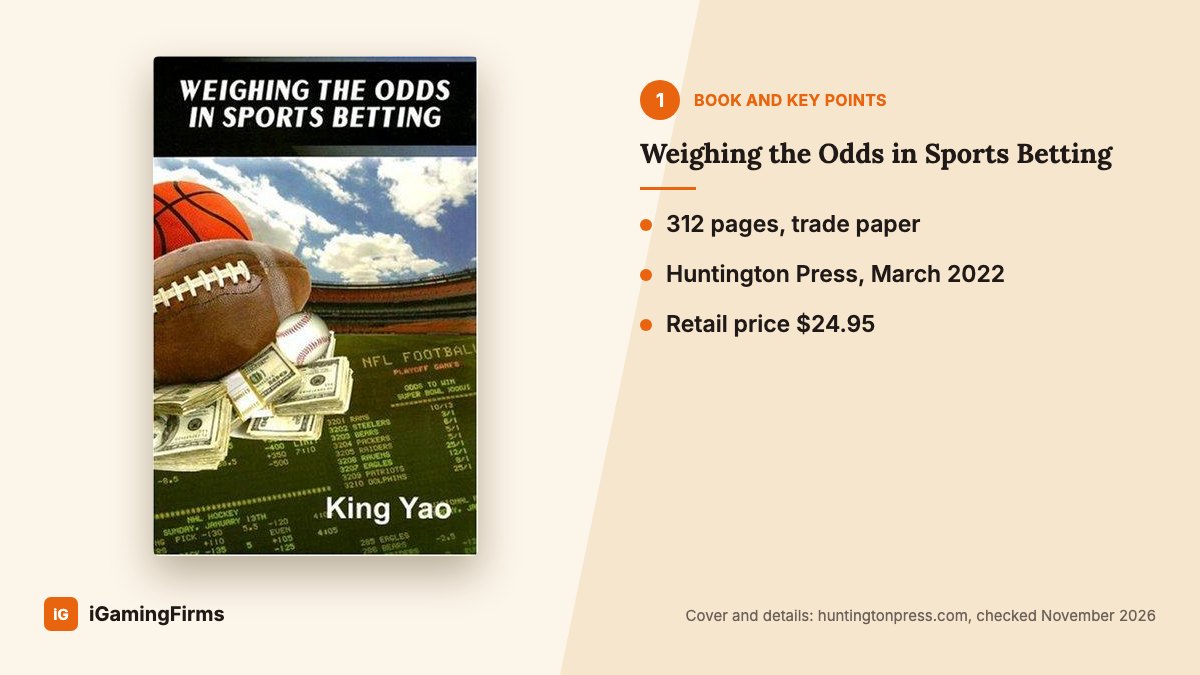
King Yao’s book first appeared from Pi Yee Press in July 2007 as a 250-page edition, according to its Open Library record. Huntington Press now sells a 312-page trade paperback dated March 2022 (ISBN 978-1-944877-55-2, $24.95). The publisher presents it as a toolkit for evaluating and comparing bets analytically rather than as a gambler. It also frames betting as a running contest of moves and adjustments against bookmakers and line makers.
That framing is why it matters to trading staff. A line maker and a sharp bettor ask the same question from opposite sides: what is this outcome really worth? Yao’s method of putting a number on each side before looking at the posted price is the same discipline a trading desk uses before it opens a market. The publisher is also candid that the book is a guide to build on, not a fixed system, because the market changes quickly.
- What it explains about lines: how to compare a posted price against your own estimate and decide whether the gap is real.
- What it explains about markets: that the bookmaker adjusts, so any edge decays once others find it.
- Limit: principles, not a model. Analysts wanting code or spreadsheets will need another title.
2. Sharp Sports Betting
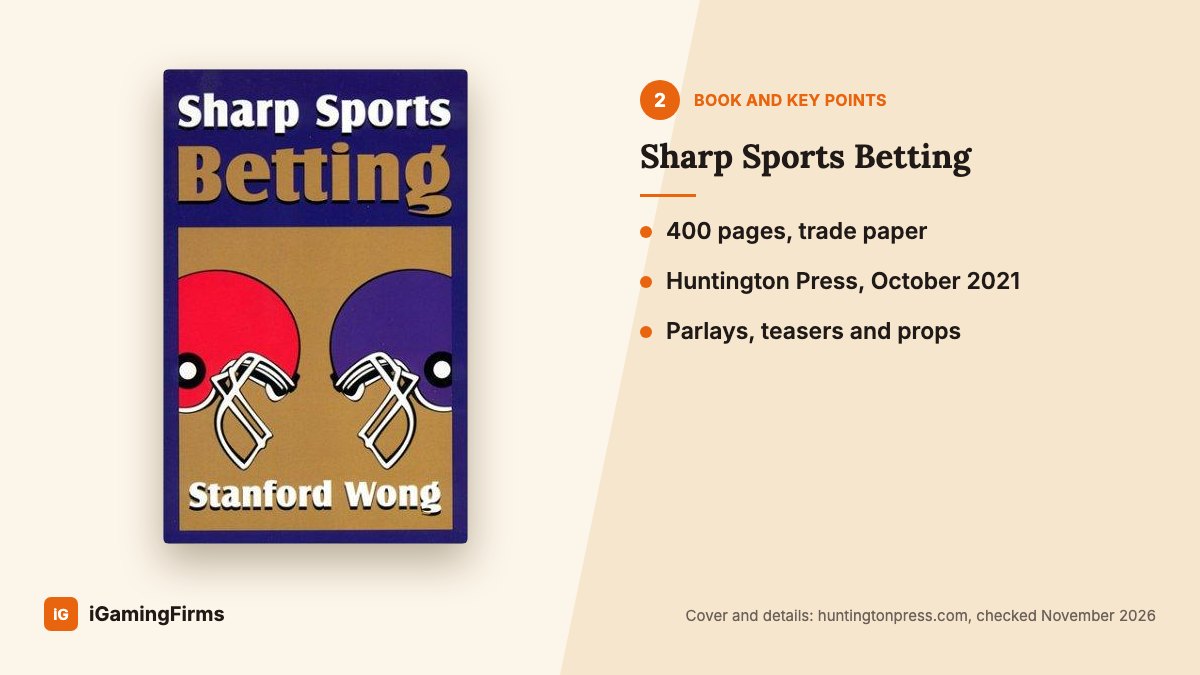
Stanford Wong’s book was first issued by Pi Yee Press in September 2001 at 380 pages, per its Open Library record. The Huntington Press page lists the current 400-page trade paperback with an October 2021 date and the same ISBN (0-935926-24-0) at $19.95. The publisher describes it as the logic and maths of intelligent sports wagers, with analyses of parlays, teasers and props and an in-depth look at money lines versus pointspreads.
For an operator, this is the book that explains why product design matters to margin. Teasers that move a point spread across key numbers can flip from bad value to good value for the customer, depending on how they are priced. If you run a sportsbook product team, its analysis of teasers and props shows which markets a sharp customer will probe first.
- What it explains about lines: how converting between a money line and a point spread exposes mispricing.
- What it explains about the business: why parlays and teasers carry more margin than straight bets unless they are priced carefully.
- Limit: the core text dates from 2001, so its examples predate same-game parlays and in-play markets.
3. Squares and Sharps, Suckers and Sharks
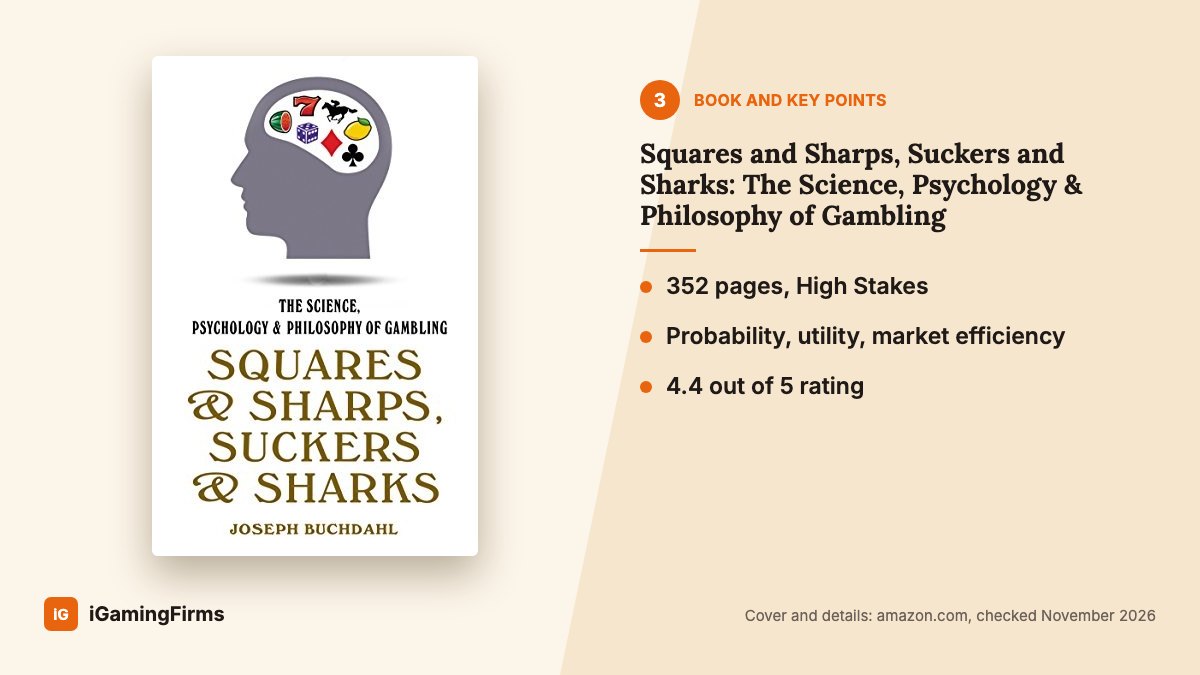
Subtitled The Science, Psychology and Philosophy of Gambling, Joseph Buchdahl’s book is published by High Stakes. The publisher dates the ebook 27 May 2016 and the current 352-page paperback 20 May 2021 (£29.95). Buchdahl also runs Football-Data, a site that offers free historical football results and odds data.
The publisher’s contents list covers probability and uncertainty, expectation versus utility, human irrationality, evolutionary views of gambling, luck and skill, market efficiency and the wisdom of crowds, why winners take all, cheating and why process matters more than outcome. Its central argument is that people gamble from a craving for control over uncertainty. For a trader or a responsible gambling team, that is a practical insight. It explains why most customers keep betting into a known margin.
- What it explains about markets: why a liquid closing price is hard to beat and why crowds price well.
- What it explains about customers: the gap between expected value and the utility bettors actually feel.
- Limit: more theory than method. It will not show you how to build a price.
4. Fixed Odds Sports Betting: Statistical Forecasting and Risk Management
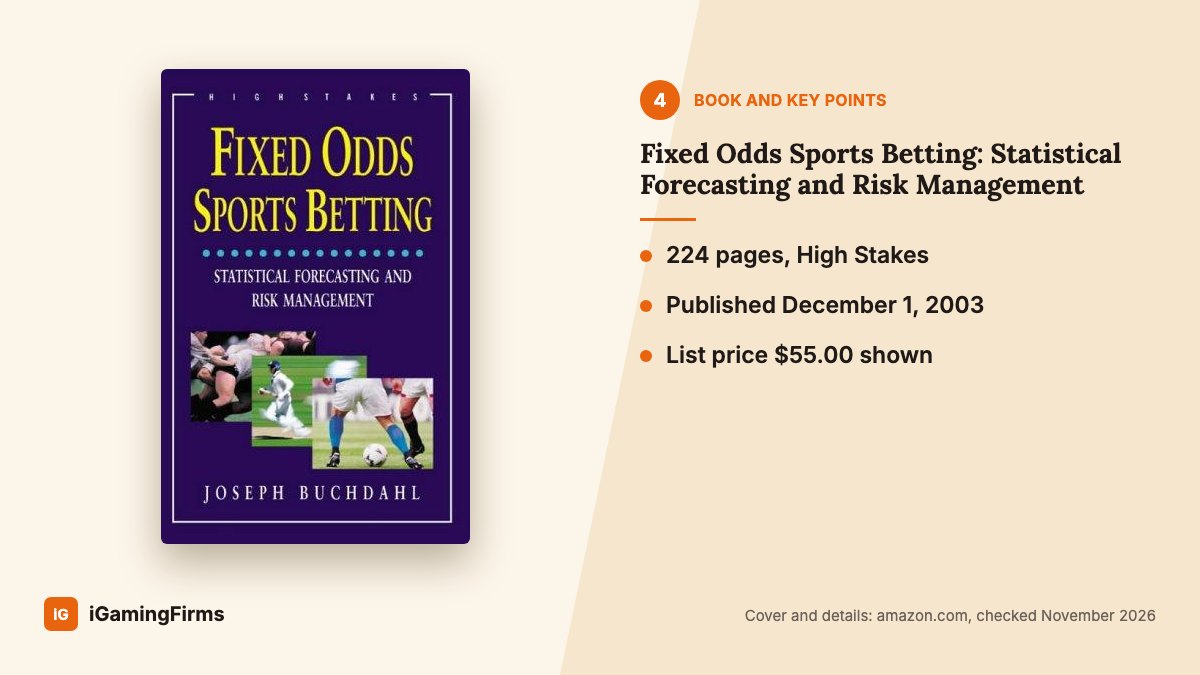
Buchdahl’s earlier book was published by High Stakes on 18 December 2003 as a 224-page paperback (ISBN 9781843440192, £29.95). Its contents list is the most useful of any book here for an analyst: markets in fixed odds betting, the bookmaker’s overround, value betting, ratings systems, profitability and risk, singles versus accumulators, staking plans and money management, the favourite-longshot bias, sports advisory services and significance testing of betting records.
The publisher notes that it uses extensive data analysis and computer simulations of staking plans. That last chapter is the one affiliates and tipster platforms should read. It shows how many bets you need before a record says anything at all. The book comes from the UK fixed odds market, so its examples use decimal and fractional prices. If those formats are new to you, start with how to read betting odds.
- What it explains about the business: how the overround is built and why accumulators compound it.
- What it explains about bankroll maths: staking plans tested by simulation rather than by anecdote.
- Limit: 2003 data and a pre-exchange-era UK market.
5. The Logic Of Sports Betting
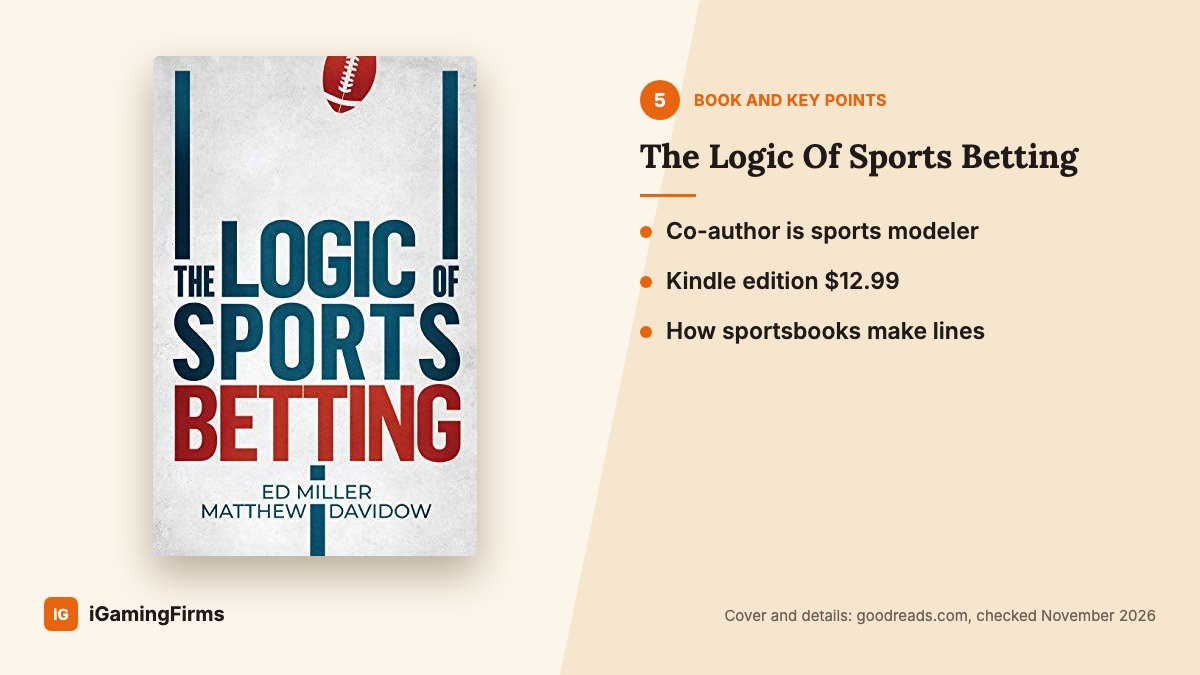
Ed Miller and Matthew Davidow’s book is self-published. Its Open Library record lists an independently published 237-page paperback dated 17 May 2019 (ISBN 9781096805724). The book’s former website, logicofsportsbetting.com, now shows a domain-registrar parking page. So any testimonial or excerpt you see quoted “from the book’s site” can no longer be checked at source.
Reviewers describe it as an explanation of where betting lines come from and how sportsbooks behave. That matters because retail sportsbooks and market-making books run different businesses. Some take the opening price from a sharper market and manage customers through limits. Others set prices and use sharp action as information. Read the book alongside our list of the sharpest sportsbooks to see which operators sit at each end of that spectrum today.
- What it explains about lines: where opening numbers come from and why they move after sharp money.
- What it explains about the business: how a sportsbook decides which bets it wants and which it does not.
- Limit: written for the market of the late 2010s, before most US states had legal mobile betting at scale.
6. Conquering Risk: Attacking Wall Street and Vegas
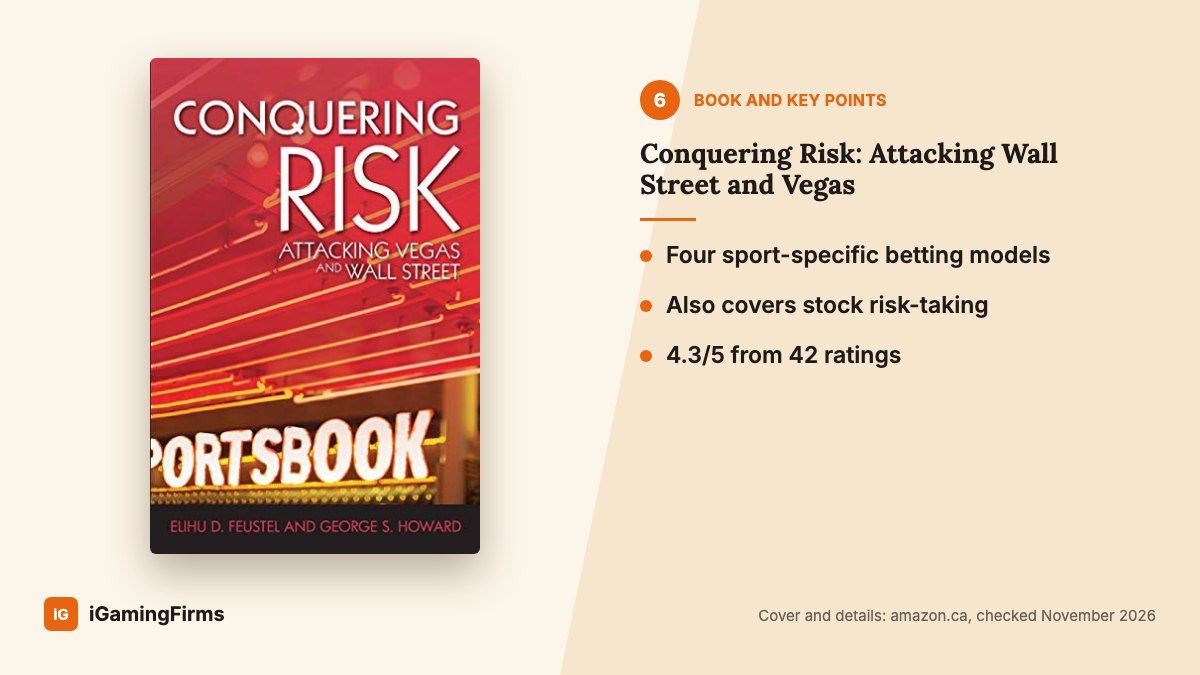
Elihu D. Feustel and George Howard’s book appeared in 2010 from an independent publisher. Its Open Library record lists 304 pages (ISBN 9781450723008). Its retail description says most of the book covers sports betting. It walks through in-depth models for MLB, NFL, NCAA Football and WNBA, plus ways to exploit market inefficiencies and incorrect bookmaker assumptions. A closing section turns the same lens on stock investing.
For analysts, this is the closest thing on the list to worked examples. Each model starts from an assumption the market makes, tests it and prices the difference. That mirrors how a trading team audits its own pricing feed. Read it as a method for finding weak assumptions, not as a set of models that still work.
- What it explains about markets: how small, repeatable mispricings come from lazy assumptions.
- What it explains about lines: the WNBA sits beside the NFL and MLB in its model set, a reminder that less-watched markets get less pricing attention.
- Limit: 2010 data. Markets have tightened since, so the specific edges described are likely gone.
7. Trading Bases: How a Wall Street Trader Made a Fortune Betting on Baseball
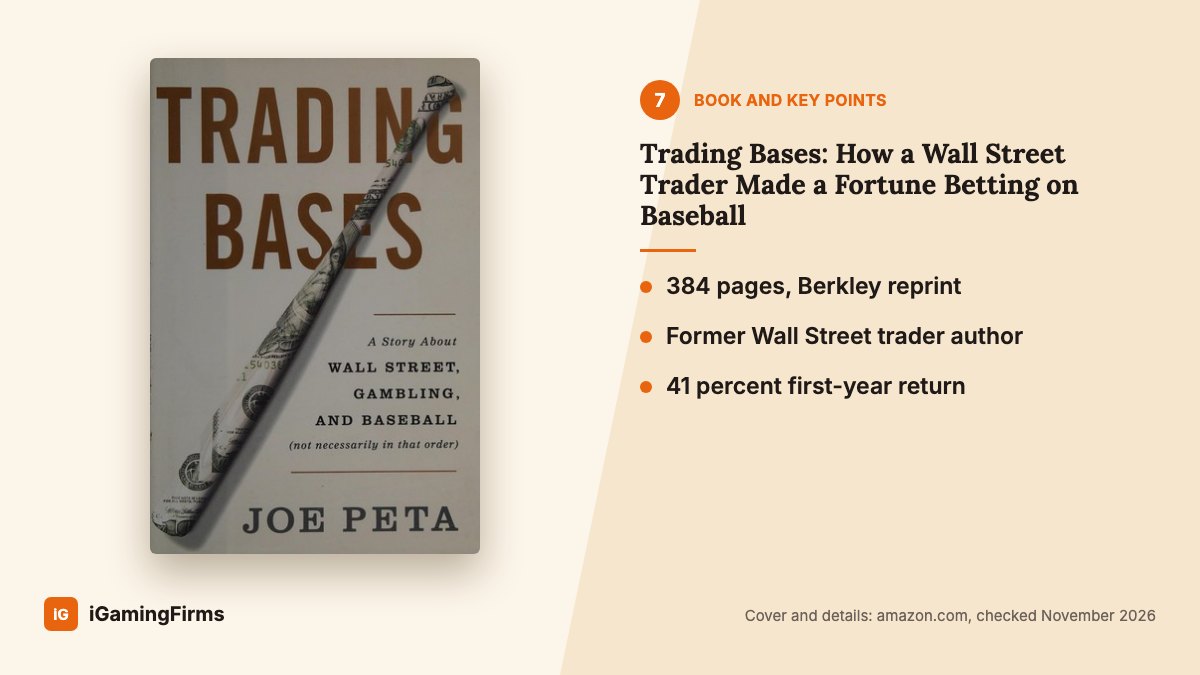
Joe Peta’s book first appeared from Dutton in 2013 as a 369-page hardcover subtitled A Story about Wall Street, Gambling and Baseball. The 2014 Penguin paperback runs 384 pages under its current subtitle (ISBN 9780451415172), according to the Open Library record. Peta, a former Wall Street trader, treats each MLB game as a position in a portfolio. The book’s own account reports a 41 percent return in the first season.
The industry value is the vocabulary. Peta talks about positions, exposure and expected return the way a sportsbook risk team does. It is the easiest book here for a finance hire joining a trading desk. Treat the return figure as the author’s self-reported result for one season, not a benchmark.
- What it explains about markets: how sabermetrics and risk analysis can be applied to price a game.
- What it explains about bankroll maths: sizing bets as a portfolio rather than one at a time.
- Limit: narrative first. The method is described, not taught step by step.
8. The Smart Money

Subtitled How the World’s Best Sports Bettors Beat the Bookies Out of Millions, Michael Konik’s book first appeared from Simon & Schuster on 14 November 2006, per its Open Library record. The Simon & Schuster page lists the current 384-page edition dated 12 November 2008. Konik’s own site notes a UK edition from High Stakes.
The publisher describes a journalist recruited as an operative for “the Brain Trust”, a secretive betting group led by Rick “Big Daddy” Matthews. It covers how the group beat Vegas lines and the offshore circuit of the time. Wagers of up to $1 million on a single game were routine. For operators this is a case study in the other side of risk management. It shows how a syndicate uses several people to get money down before a line moves. Offshore books appear here as history, not as a reference to any current operator.
- What it explains about lines: why the first bets after an opening number move it so fast.
- What it explains about the business: why books limit, profile and track linked accounts.
- Limit: a 2006 story about a pre-legalisation market. Names and details are as the author tells them.
9. The Odds
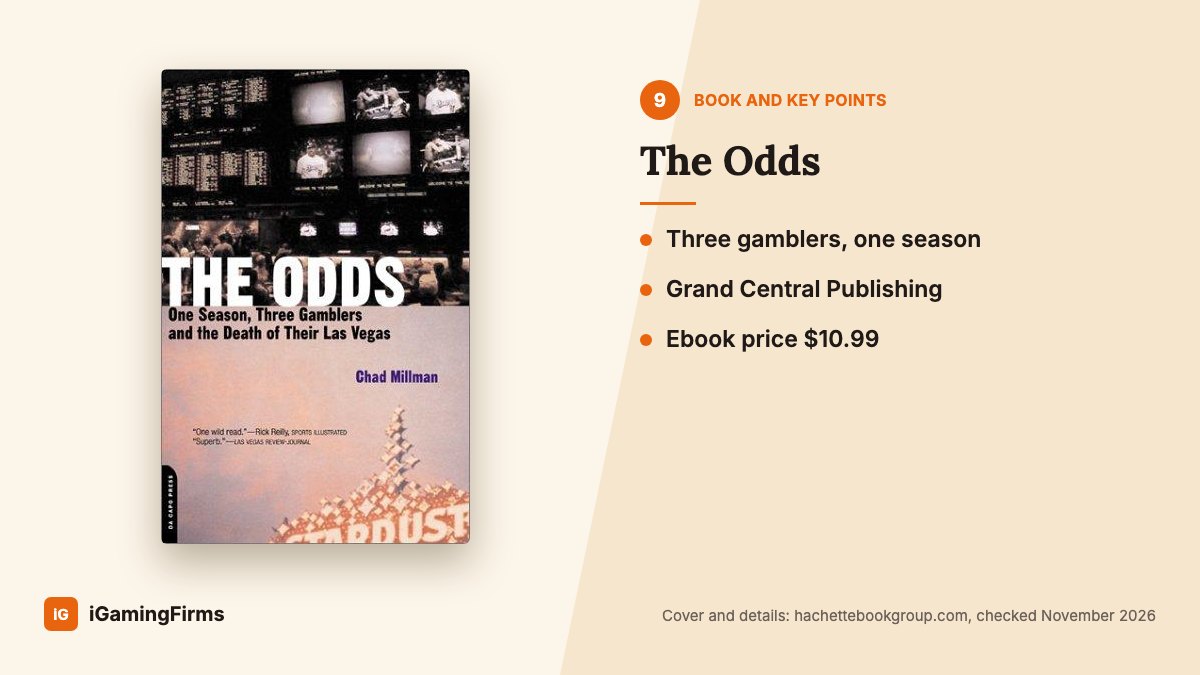
Subtitled One Season, Three Gamblers and the Death of Their Las Vegas, Chad Millman’s book is sold by Hachette Book Group under Grand Central Publishing. The trade paperback has an on-sale date of 28 March 2002 and runs 288 pages ($21.99). Hachette’s author note describes Millman as editorial director of ESPN’s domestic digital division.
It follows three people through one college basketball season. One is an Ivy League-educated former cocaine user. One is a college dropout trying to make betting his living. The third is a respected Las Vegas bookmaker close to burnout. That third character is why the book belongs on an industry shelf. It is one of the few accounts of what running a counter felt like just before online betting changed the trade.
- What it explains about the business: the daily pressure of a bookmaker carrying positions on games.
- What it explains about customers: how professional and recreational money looked from behind the counter.
- Limit: no method at all. Read it for context.
How sportsbooks set and move lines: what these books teach
The popular picture is that a bookmaker balances money on both sides and collects the commission. The evidence says otherwise. In an NBER working paper, economist Steven Levitt studied NFL wagering. He found that bookmakers post prices and change them only in small, infrequent steps. They take sizeable positions on games rather than matching buyers and sellers. They also set prices away from the market-clearing level to exploit bettor biases, earning more as a result. He also found they predicted outcomes better than their customers.
The books split along that line. The Logic Of Sports Betting and Weighing the Odds in Sports Betting explain how a price is formed and why it moves. Sharp Sports Betting shows where a fixed relationship between prices, such as money line to spread, can be exploited. The Smart Money shows the same process from the syndicate side: money arrives fast, the number moves and the late bettor gets a worse price.
If you work in trading, the practical lesson is that line movement is information. A move caused by a respected account says something about the price. A move caused by a public favourite usually does not. Tools that score this automatically are covered in our guide to betting risk management software.
Market efficiency: why the closing line matters
Squares and Sharps, Suckers and Sharks gives the theory. A liquid market aggregates many opinions, so its final price is usually the best available estimate of the true probability. That is why serious bettors and many trading teams judge a bet by whether it beat the closing price, not by whether it won.
Conquering Risk and Trading Bases look for the exceptions. Thinner markets can stay less efficient because less money and attention reach them. Fixed Odds Sports Betting adds the favourite-longshot bias, where long shots tend to be overpriced relative to their real chances. Together these three show why market efficiency is a sliding scale, not a yes-or-no question.
Bankroll maths: staking, the Kelly criterion and break-even rates
Every book in the method group comes back to the same arithmetic. At standard US pricing of -110 on both sides, you risk $110 to win $100. Your break-even win rate is 110 divided by 210, or 52.38 percent. Both sides together imply 104.76 percent, so the book’s theoretical margin on a balanced market is about 4.55 percent. For the notation, see our sports betting terms glossary.
The Kelly criterion, named after Bell Labs researcher John L. Kelly Jr., sizes a stake as a share of bankroll based on edge and odds. The formula is (bp minus q) divided by b. Here b is the net decimal odds, p is your win probability and q is 1 minus p. At even money (b = 1) with a true 52.5 percent chance, Kelly says stake 5 percent of bankroll. Many bettors use half or quarter Kelly because their probability estimates contain error. Fixed Odds Sports Betting tests staking plans like these by simulation, which is the right way to judge them.
The key point across all of these books is that staking cannot create an edge. If each bet has negative expected value, no sequence of stakes fixes it.
The business of bookmaking in numbers
Regulator data shows what these books describe. The Nevada Gaming Control Board’s September 2026 revenue report covers the 12 months to 30 September 2026. Statewide sports pools won $603.1 million at a win rate of 7.69 percent of handle. By sport, football held 7.33 percent, basketball 6.80 percent, baseball 6.93 percent and hockey 8.70 percent. Parlay cards held 30.51 percent.
The December 2025 report shows calendar 2025 at $601.4 million won and a 7.45 percent win rate, with parlay cards at 32.59 percent. That gap between straight-bet hold and parlay hold is exactly what Sharp Sports Betting and Fixed Odds Sports Betting explain: each added leg compounds the margin. It is also why parlay products get so much marketing attention. For the mechanics, see what is a parlay in betting.
Hold is not the same as profit. A sportsbook still pays taxes, market access fees, data and marketing costs out of that win. The Odds and The Smart Money show the human side of carrying that risk, game after game.
A reading order by job role
- Traders and risk managers: The Logic Of Sports Betting, then Weighing the Odds in Sports Betting, then The Smart Money to see how syndicates attack a number.
- Data scientists and quant analysts: Fixed Odds Sports Betting for the statistics, Conquering Risk for worked models, Trading Bases for portfolio thinking.
- Product and commercial teams: Sharp Sports Betting for parlay and teaser pricing, then the Nevada data above to see how product mix drives hold.
- Responsible gambling and compliance staff: Squares and Sharps, Suckers and Sharks for why customers keep betting into a margin.
- New hires from outside the industry: The Odds for context, then The Logic Of Sports Betting for the mechanics.
What is the best book about sports betting?
There is no single best one, because the books answer different questions. For how prices are made, The Logic Of Sports Betting is the most direct. For the maths of bet types, Sharp Sports Betting has been a common reference since 2001. For market theory and psychology, Squares and Sharps, Suckers and Sharks goes deepest. If you can read only two, pair one pricing book with one market-theory book.
How do you bet at a sportsbook?
At a licensed sportsbook, you pick a market, read the price and choose a stake. The book confirms the bet at that price. It settles once the event is official. From the operator’s side, each accepted bet updates the book’s position and can move the next price. All nine books assume you can read prices in American, decimal and fractional formats. Legal access depends on where you are. Real-money betting is for adults of legal age only.
Who is the most successful sports bettor?
No audited ranking exists, because bettors do not publish verified accounts. The accounts in these books are self-reported or told by a single journalist. That includes the Brain Trust in The Smart Money, the three gamblers in The Odds and Peta’s season in Trading Bases. Treat any claim of long-run success as a story until a verifiable record backs it.
What is the 1-3-2-4 strategy?
The 1-3-2-4 strategy is a positive staking progression. You stake 1 unit. After a win you stake 3 units, then 2, then 4. After the fourth bet or any loss you return to 1 unit. It is a lower-risk variant of the 1-3-2-6 system, designed to lock in some profit after the second win. As the bankroll maths above shows, the sequence does not change the expected value of each bet. If every wager carries a negative edge, the progression carries it too.
If gambling is causing harm: none of these nine books is a recovery guide. In the US, the National Council on Problem Gambling helpline is 1-800-MY-RESET. Gamblers Anonymous also offers free literature and a 20 Questions self-check.
Checking the books against today’s market
Edition dates hide how old the examples are
Retail and publisher pages show the date of the current printing. Library records show when the text first appeared. Sharp Sports Betting is listed by Huntington Press as October 2021, but its Pi Yee Press first edition dates from September 2001. Weighing the Odds in Sports Betting shows March 2022 but first appeared in 2007. Squares and Sharps shows a 2021 paperback with a 2016 ebook. If you need current market practice, adjust for that gap.
One book’s official site has disappeared
The Logic Of Sports Betting’s former site now shows a domain parking page. Quotes and reviews attributed to that site can no longer be checked. Use the library record or the book itself as your source.
The books’ claims can be checked against regulator data
Claims about parlay margins and hold are testable. Nevada’s 30.51 percent parlay card hold against a 7.69 percent overall sports pool win rate puts a number on what Wong and Buchdahl argue. Levitt’s NBER study does the same for the “balanced book” myth. Reading the books next to the data shows which ideas still hold.
Your next step
Pick the one gap you most need to close: pricing, market theory, staking or industry context. Then read the matching book with its first-edition date in mind. After that, test one idea against live data. Compare a closing price to an opening price for a week of games, or check your state regulator’s monthly hold figures by sport. That turns a reading list into working knowledge of how your market behaves.