Last updated: 31 October 2026
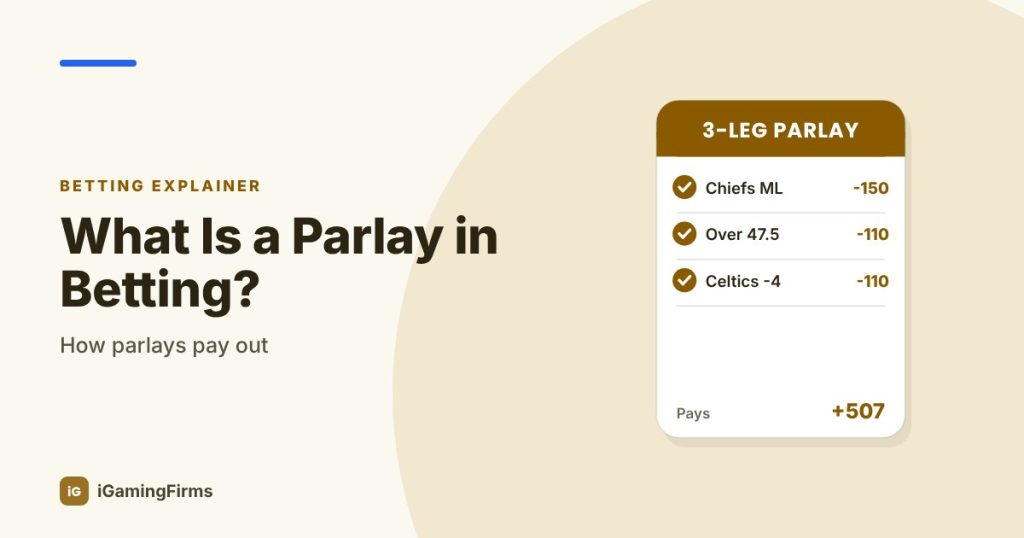
A parlay is a single bet that links two or more selections, called legs, into one ticket. Every leg has to win for the parlay to pay, and the payout is the stake multiplied by the decimal odds of every leg, so the price grows fast with each leg added while the chance of winning shrinks even faster.
Most parlay explainers stop at the payout. If you run a sportsbook, price one, or earn revenue share from one, the more useful question is why the same multiplication that makes parlays attractive to customers also makes them the highest-margin bet type on the board. This guide covers what a parlay means, how parlays pay out (with a payout and house edge table by leg count), how pushes and voids are settled, what a same game parlay is, and what the regulator data says about parlay hold.
What is a parlay in betting?
In betting, a parlay means one wager built from several selections. A customer might combine a moneyline in one NFL game, a point spread in another and an NBA total. Instead of three separate bets, they place one ticket with one stake. If all three legs win, the ticket pays at the combined price. If any leg loses, the whole ticket loses.
That is the main difference between a parlay and a straight bet. A straight bet (a single) is one selection settled on its own. A parlay is still one bet, but it carries several outcomes that all have to land. A two-bet parlay, or two-team parlay, is simply a parlay with two legs, the smallest version.
Outside North America the same bet goes by other names. In the UK and Europe it is an accumulator or “acca” (a double, treble or fourfold by leg count), and in Australia it is a multi.
Why is it called a parlay?
The word comes from gambling itself. Merriam-Webster traces “parlay” to paroli, a French borrowing from Italian for a system of letting winnings ride on successive bets. The verb dates to 1828 and the noun to 1904. That is still what a parlay does: the return from one leg rolls into the next.
How do parlays work?
Behind every parlay price is a simple calculation. To work out a parlay payout:
- Convert each leg to decimal odds. For negative American odds, decimal = 1 + 100 / odds (so -110 becomes 1.909). For positive American odds, decimal = 1 + odds / 100 (so +150 becomes 2.50). The guide to reading betting odds has the full conversion table.
- Multiply the decimals together. Two legs at 1.909 and 2.50 give 4.773.
- Multiply by the stake. A $100 stake returns $477.27, which is $377.27 profit plus the $100 stake.
- Convert back if needed. A decimal price of 4.773 is about +377 in American odds.
You cannot multiply American odds directly. Two of the top-ranking parlay guides reviewed for this article present the payout as “stake x cumulative odds” or multiply fractional odds as if they were decimals, which gives the wrong number. A three-leg parlay at 3/1, 4/1 and 5/1 is 4.0 x 5.0 x 6.0 = 120.0 in decimal, so a £10 stake returns £1,200, not the £600 one glossary page shows.
Do parlays increase odds?
Parlays increase the payout odds and decrease the probability of winning. Each extra leg multiplies the price, but it also multiplies the chance of the ticket losing. Those two effects are not symmetrical, and the gap between them is where the sportsbook’s margin comes from.
What does a parlay pay? The payout table by leg count
The table below uses the standard -110 price on every leg, the price a book offers on both sides of a typical spread or total. “Fair payout” is what the parlay would pay with no margin, assuming each leg is a true 50/50. “House edge” is the share of each dollar staked the book expects to keep over time.
| Legs at -110 | Decimal price | Profit on $100 | Fair profit (no margin) | Chance all legs win | Theoretical house edge |
|---|---|---|---|---|---|
| 1 (straight bet) | 1.91 | $90.91 | $100 | 50% | 4.5% |
| 2 | 3.64 | $264.46 | $300 | 25% | 8.9% |
| 3 | 6.96 | $595.79 | $700 | 12.5% | 13.0% |
| 4 | 13.28 | $1,228.33 | $1,500 | 6.25% | 17.0% |
| 5 | 25.36 | $2,435.91 | $3,100 | 3.1% | 20.8% |
| 6 | 48.41 | $4,741.27 | $6,300 | 1.6% | 24.4% |
| 8 | 176.45 | $17,544.64 | $25,500 | 0.39% | 31.1% |
| 10 | 643.08 | $64,208.16 | $102,300 | 0.098% | 37.2% |
Calculation: decimal price = 1.909 raised to the number of legs; house edge = 1 minus (1.909 x 0.5) raised to the number of legs. Real legs are rarely exact coin flips, so treat this as the clean model, not a forecast.
What does a 2-team $100 parlay pay?
A two-team $100 parlay at -110 on both legs pays $264.46 in profit, or $364.46 back including the stake. That is roughly 2.6-to-1. The same $100 split into two $50 straight bets at -110 would return $90.91 profit if both won. With different prices the result changes: a -110 leg plus a +150 leg pays about $377 profit on $100.
How does a 6-leg parlay work?
A six-leg parlay works exactly like a two-leg one: six selections, one stake, every leg must win. At -110 per leg it pays about 47-to-1, but it only wins about 1.6% of the time if each leg is a true 50/50. On those numbers, the book’s theoretical edge is about 24%, more than five times the edge on a single straight bet.
Fixed parlay cards
Some books, mostly offshore and in retail, still publish fixed parlay payout tables instead of multiplying the actual prices. A classic card pays 6-to-1 on a three-team parlay at -110, against about 6.96-to-1 when the prices are multiplied, so the flat table adds margin on top of the compounding. Regulated US apps almost all price parlays from the live leg odds.
What happens when a parlay leg pushes or is voided?
When a leg ties (a push) or is cancelled (a void, for example a postponed game or a player who does not take part in a prop), most books remove that leg and settle the parlay on the remaining legs. A three-leg parlay at -110 with one push becomes a two-leg parlay paying 3.64 instead of 6.96. If only one leg is left, it settles as a straight bet, and if every leg pushes, the stake is returned.
Rules vary by book, sport and market, and same game parlays are the area with the most variation. Some books reprice the remaining correlated legs, others void the whole ticket. For an operator, the key is that the published house rules and the settlement engine say exactly the same thing, because “my payout changed” is one of the most common parlay complaints.
Why parlays carry so much more hold
A straight -110 bet gives the book a margin of about 4.5%. In a parlay that margin is applied on every leg, and the effects multiply. Two legs keep about 8.9%, three legs about 13%, and ten legs about 37%. The customer sees a bigger number on the ticket. The book sees a product where the margin rises with every leg the customer adds.
The regulator data shows the gap is real, not just theoretical:
| Market and period | Parlay hold | Overall sports hold | Source |
|---|---|---|---|
| New Jersey, Jan to Aug 2026 (completed events) | 18.2% | 9.1% | NJ Division of Gaming Enforcement |
| New Jersey, Jan to Aug 2025 (completed events) | 19.6% | 9.3% | NJ Division of Gaming Enforcement |
| Illinois, January 2026 (DraftKings parlays) | 19.5% | About 9.1% statewide | Illinois Gaming Board data via InGame |
| Illinois, January 2026 (FanDuel parlays) | 20.7% | About 9.1% statewide | Illinois Gaming Board data via InGame |
| Illinois, October 2025 (all operators) | 14.3% | 7.9% | Illinois Gaming Board data via InGame |
The New Jersey August 2026 report shows $2.31 billion in parlay handle for January to August, out of $7.22 billion in total sports handle. Working from those figures, parlays were about 32% of handle and about 64% of sports wagering win, and everything that was not a parlay held only about 4.8%. In Illinois, InGame’s analysis of January 2026 data put parlays at 31.6% of DraftKings’ handle and close to 36% of FanDuel’s.
Notice that real parlay hold (around 18% to 21% in these months) sits above the 13% theoretical edge of a three-leg -110 parlay. That fits the product mix: customers often add more than three legs, include longer-priced props, and build same game parlays that carry an extra correlation margin. Hold also swings month to month with results, which is why the Illinois October 2025 figure is lower.
Operators say the same thing in their filings. In its Q3 2025 earnings release, Flutter reported a US structural revenue margin of 12.9% and wrote that “higher levels of parlay and SGP penetration ultimately drive higher structural revenue margin”, with a longer-term target of 16%. The operator-side maths of sports betting profitability shows how that structural margin turns into the margin a book actually keeps after results and promotions.
What is a same game parlay?
A same game parlay (SGP) is a parlay where every leg comes from one game, for example a team to win, the game total to go over and a quarterback to pass for over 250 yards. The all-legs-must-win rule is the same. The pricing is not.
In a normal parlay the legs come from different games and are close to independent, so multiplying the prices is a fair starting point. Inside one game, legs move together. If the quarterback throws for 300 yards, his team is more likely to win and his top receiver is more likely to clear his line. Multiplying correlated prices would overpay, so books price SGPs with a correlation model (usually a simulation of the whole game) and add a margin on top. That is why an SGP with the same three -110 legs usually pays less than the 6.96 a cross-game parlay would. Some combinations that are almost the same outcome, such as a team’s spread and moneyline, are simply blocked.
Most SGP legs are player and game props, covered in the guide to prop bets. For correlation pricing in detail, the companies that build SGP engines and the naming differences between SGP, SGP+ and Bet Builder, see what SGP means in betting.
Other parlay types: round robins, teasers and more
| Type | How it works | What it means for the book |
|---|---|---|
| Standard parlay | Legs from different games, prices multiplied | Margin compounds with each leg |
| Same game parlay (SGP) | Legs from one game, priced with a correlation model | Compounded margin plus a correlation margin; needs a pricing engine |
| SGP+ / multi-game SGP | Several SGPs, or an SGP plus other legs, on one ticket | Stacks the margin again |
| Round robin | A list of picks turned into every smaller parlay of a set size | Many parlays on one ticket; total stake is split across them |
| Teaser | Spreads or totals moved in the customer’s favour (often 6 to 10 points in football) for a lower payout | Priced so the extra points cost more than they are worth on most numbers |
| Pleaser | The reverse of a teaser: lines moved against the customer for a higher payout | Niche product with high hold |
A common bet slip question is what “by 2’s x3 wagers” means. It describes a round robin: three picks combined two at a time, which creates three separate two-team parlays (A+B, A+C, B+C). The customer stakes the amount three times. If two of the three picks win, one of the three parlays still pays.
What parlays mean for operators
- Liability sits in the tail. A 10-leg ticket at $10 can carry a five-figure liability. Books manage this with maximum leg counts, maximum payouts per ticket and per customer, and correlation blocks. These limits need to be in the house rules and enforced in the bet acceptance logic, not just the terms page.
- Mispriced correlation is a real risk. If an SGP model underrates how strongly two legs move together, sharp customers will find it. Thin prop markets and live SGPs are the most exposed.
- Promotions are funded by the margin. Parlay profit boosts and “one leg loses, stake back” insurance only make sense because parlay hold is high. The same boost on a 4.5% straight bet often loses money.
- Customer value metrics shift. A parlay-heavy recreational customer looks very different from a straight-bet customer who regularly beats the closing price. The guide to closing line value explains how books use CLV to tell the two apart.
- Prediction markets are moving in. Kalshi launched build-your-own same game combos on 29 September 2025, with market makers quoting the other side. According to InGame, first-day volume was small (about $256,000, with $1,762 in fees), yet DraftKings and Flutter shares fell more than 10% the next day, wiping roughly $7 billion off their combined market value. That reaction shows how much of the listed sportsbooks’ value investors tie to parlay margin.
What parlays mean for affiliates
- Revenue share follows hold. On revenue share deals, parlay-heavy customers generate more net gaming revenue per dollar wagered, so the product mix of the players you refer matters as much as their volume.
- Explain, do not push. Payout maths, settlement rules and house edge content is useful and defensible. “Parlay of the day” or lottery-style ticket promotion attracts regulator and platform scrutiny, and parlays are a common target in debates about betting harm.
- Get the maths right. Several high-ranking parlay pages reviewed for this article contain calculation errors, such as multiplying fractional odds directly or misstating multi-leg payouts. Accurate tables are an easy way to be the page that gets cited.
Next step
Parlays are where much of the US sportsbook margin is made, and where pricing, product, promotions and regulation meet. If you are building the product side, see how to start a sportsbook and our comparison of sports data providers; for terminology, the sports betting terms glossary.
This article is industry analysis for operators and affiliates, not betting advice. Hold figures come from the regulator reports linked above for the periods stated. If you or someone you know has a gambling problem, call or text the US National Problem Gambling Helpline at 1-800-MY-RESET.