You want a poker reading list, but the classics on it were written for a game that online play and solver software have since changed.
The short answer: start with Winning Low-Limit Hold’Em if you are new to hold’em, Harrington on Hold’em if you play no-limit tournaments, The Mental Game of Poker if tilt costs you money and The Mathematics of Poker followed by Modern Poker Theory once you want game theory optimal (GTO) study. Nine of these eleven books first appeared before 2009. Only one, Modern Poker Theory, was written after computers proved they could beat top professionals (Carnegie Mellon’s Libratus in 2017 and Pluribus in 2019). That date line tells you which books teach durable principles and which teach the strategy your opponents now study.
Each author, publisher and year below was checked against the publisher’s own page, the author’s site or a library-style reference record in November 2026. Where a fact could not be confirmed, we say so. No publisher or author paid to be included.
This list is written for players. For gambling books read from the industry side, including blackjack maths, sports betting and US policy, see our gambling books guide.
Poker books compared: author, publisher, year and focus
The table follows the same order as the profiles below. “Era” marks whether the book predates the solver age that began with commercial GTO tools and the AI results of 2017 and 2019.
| # | Book | Author | Publisher | First published | Game or focus | Era |
|---|---|---|---|---|---|---|
| 1 | Winning Low-Limit Hold’Em | Lee Jones | ConJelCo | Current 3rd edition: June 2005 | Limit Texas hold’em at low stakes, plus online play and single-table tournaments | Pre-solver |
| 2 | Super/System | Doyle Brunson and contributors | Self-published (B & G) in 1978; later Cardoza | 1978 | Draw, stud, lowball, limit and no-limit hold’em | Pre-solver |
| 3 | Harrington on Hold’em: Strategic Play | Dan Harrington and Bill Robertie | Two Plus Two Publishing | 2004 | No-limit hold’em multi-table tournaments | Pre-solver |
| 4 | Every Hand Revealed | Gus Hansen | Lyle Stuart (Kensington) | 2008 | One no-limit tournament, hand by hand | Pre-solver |
| 5 | Ace on the River: an Advanced Poker Guide | Barry Greenstein | Last Knight Publishing | 2005 | Professional poker life, money and decision-making | Pre-solver |
| 6 | Caro’s Book of Poker Tells | Mike Caro | Cardoza Publishing (current edition) | Earlier edition cited as 1994 (see profile) | Physical tells and table psychology | Pre-solver, still current for live play |
| 7 | The Mental Game of Poker | Jared Tendler with Barry Carter | JT Press (per retail listings) | 2011 | Tilt, variance, confidence and motivation | Online era |
| 8 | Elements of Poker | Tommy Angelo | BookSurge (print edition, per retail listings) | 2007 | Tilt, position, quitting and habits | Pre-solver |
| 9 | The Mathematics of Poker | Bill Chen and Jerrod Ankenman | ConJelCo | November 2006 | Quantitative methods and game theory | Bridge to solver era |
| 10 | Modern Poker Theory | Michael Acevedo | D&B Poker | 2019 | No-limit hold’em GTO built with solver research | Solver era |
| 11 | The Theory of Poker | David Sklansky | Two Plus Two Publishing | Final version 1987 (first version 1978 under another title) | Expected value, semi-bluffing, implied odds and the Fundamental Theorem of Poker | Pre-solver theory |
Edition dates matter here. Several of these books have been reprinted by a new publisher or revised. The year in the table is the first publication where we could confirm it. Check the copyright page of the copy you buy.
The 11 poker books, reviewed
1. Winning Low-Limit Hold’Em
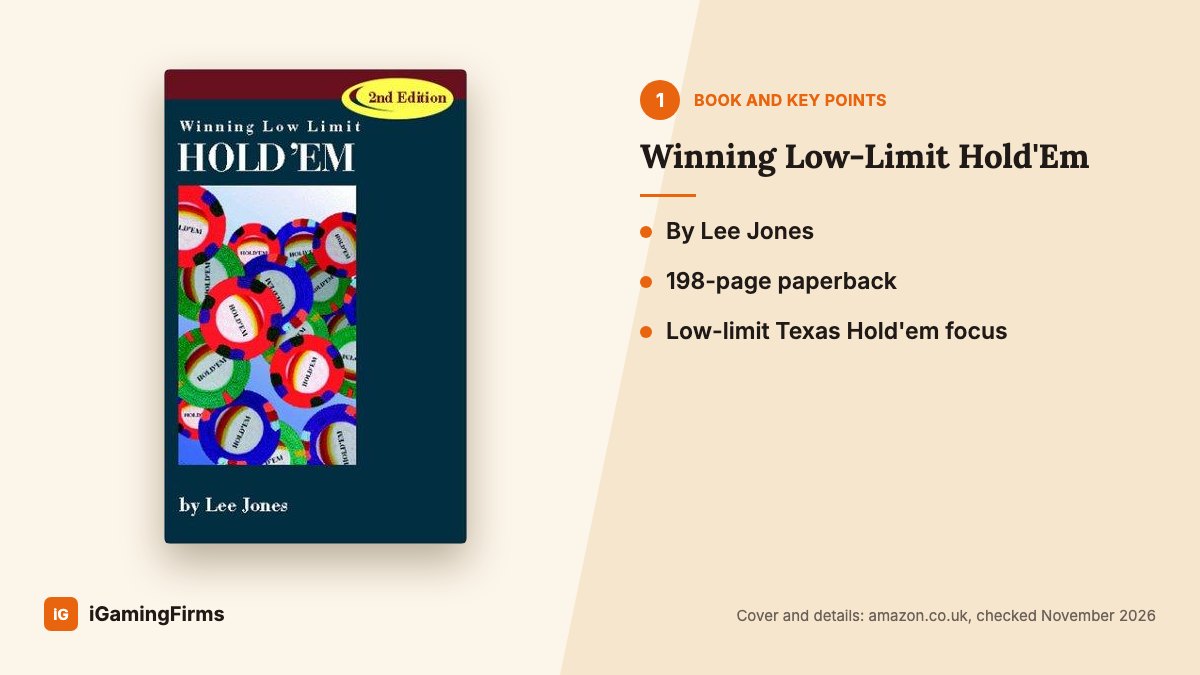
Lee Jones wrote this primer for the loose, low-stakes limit hold’em games that new players actually sit down in. ConJelCo’s page describes it as a long-standing introduction that experienced players hand to newcomers. It says the current edition was updated and expanded to cover online poker and no-limit hold’em single-table tournaments. The paperback runs 288 pages (ISBN 978-1-886070-23-3) and ConJelCo dates that paper edition to June 2005.
Why it still matters: the book’s core lesson is hand selection and patience against opponents who call too much. That lesson has not aged, because low-stakes player pools still contain many recreational players. What has aged is the limit focus. Most online and live games today are no-limit, so treat this as a first book on discipline rather than a complete no-limit manual. The publisher page quotes endorsements from Antonio Esfandiari and 2004 World Series of Poker champion Greg Raymer.
Read it if: you are learning the game and play small stakes. Skip it if: you already play no-limit regularly and understand pot odds.
2. Super/System
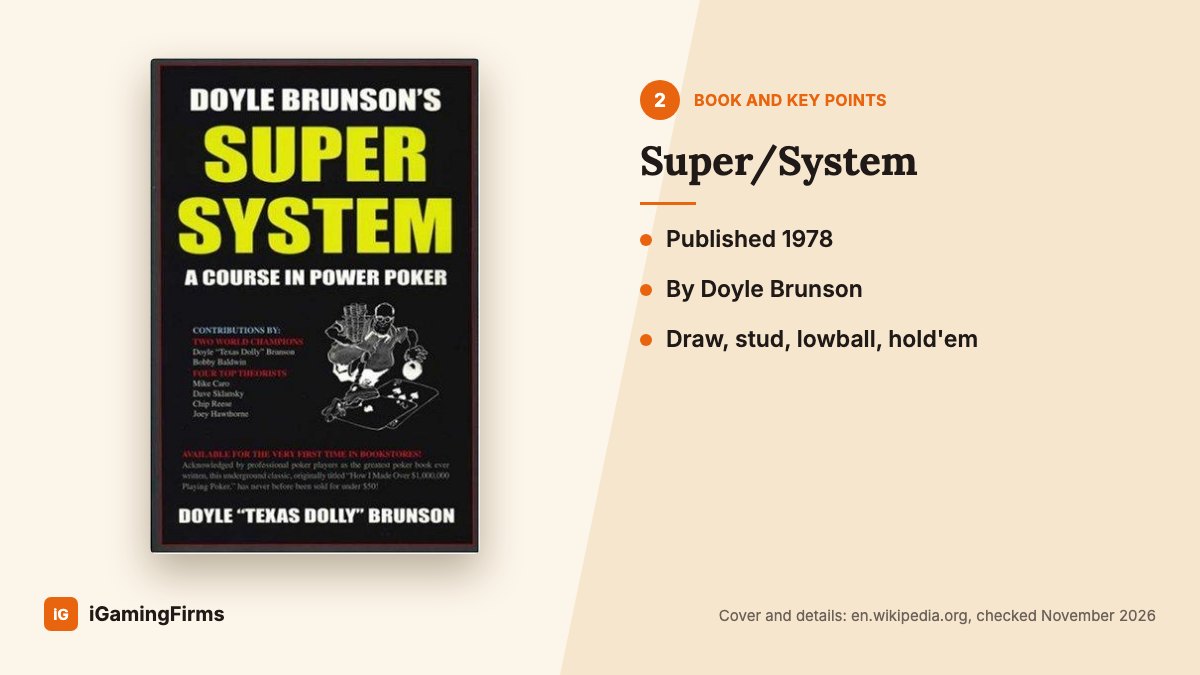
Doyle Brunson self-published Super/System in 1978 under the subtitle “How I made one million dollars playing poker.” Brunson won the World Series of Poker main event in 1976 and 1977 and collected 10 WSOP bracelets before his death in May 2023, according to his biography. The book was unusual because Brunson recruited specialists for each game. Mike Caro wrote draw poker and the statistical tables. Chip Reese wrote seven-card stud. David Sklansky wrote stud high-low split. Bobby Baldwin wrote limit hold’em. Brunson wrote no-limit hold’em himself.
Cardoza Publishing later issued a third edition (cited as 2003) under the title Doyle Brunson’s Super System. A sequel, Super System 2, followed in the mid-2000s with contributors such as Daniel Negreanu and Jennifer Harman. The book’s reference record notes that it is partly superseded, because several variants are now played differently and newer games are absent.
For the industry, Super/System marks the moment professional strategy became public. Brunson believed the book cost him money by making his opponents better. That tension between publishing an edge and keeping it runs through every book on this list and peaks in the solver era.
Read it if: you want history and multi-game context. Skip it if: you need a current no-limit manual.
3. Harrington on Hold’em: Strategic Play
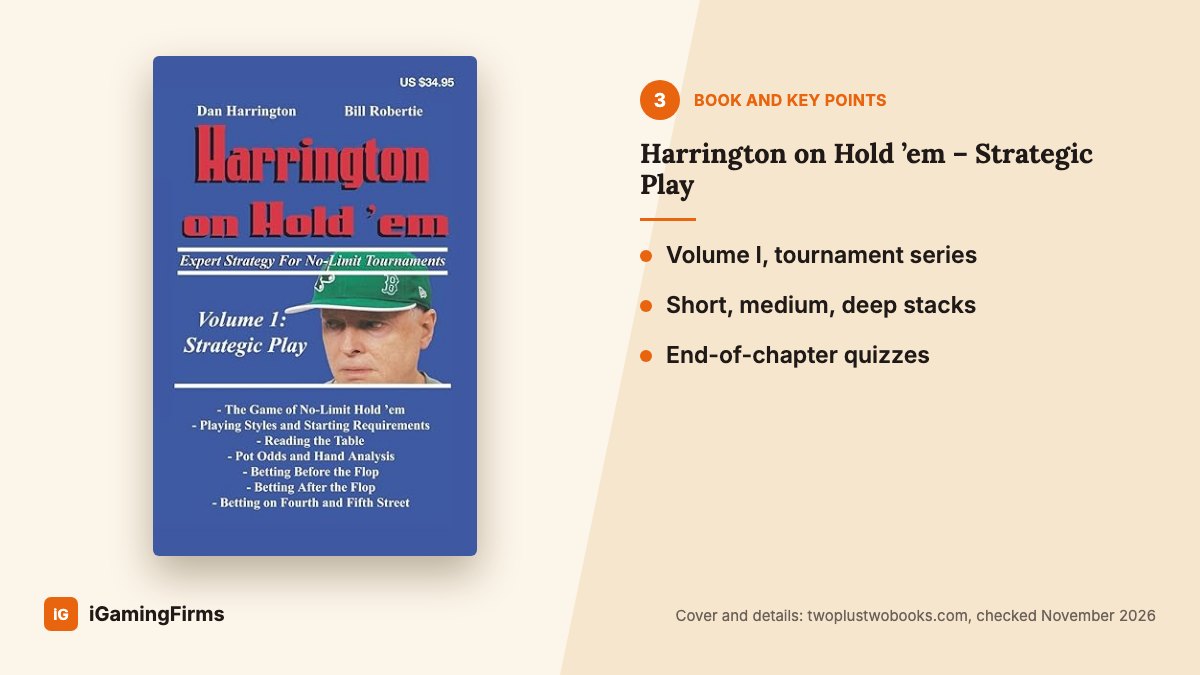
Volume I of Dan Harrington’s tournament series was published by Two Plus Two Publishing in 2004, with Volume II (The Endgame) in 2005 and Volume III (The Workbook) in 2006, per Harrington’s reference biography. Harrington won the WSOP main event in 1995. He wrote the series with co-author Bill Robertie.
The book teaches a tight-aggressive approach to the early and middle stages of multi-table tournaments, using worked hands and quizzes. It arrived in 2004 during the online poker boom and became a standard study text for the wave of new online tournament players. Harrington later added cash-game volumes in 2008 and Harrington on Modern Tournament Poker in 2014.
Read it if: you play no-limit tournaments and want a structured study text. Pair it with: a solver-era book, because stack-depth play has been refined heavily since 2004.
4. Every Hand Revealed
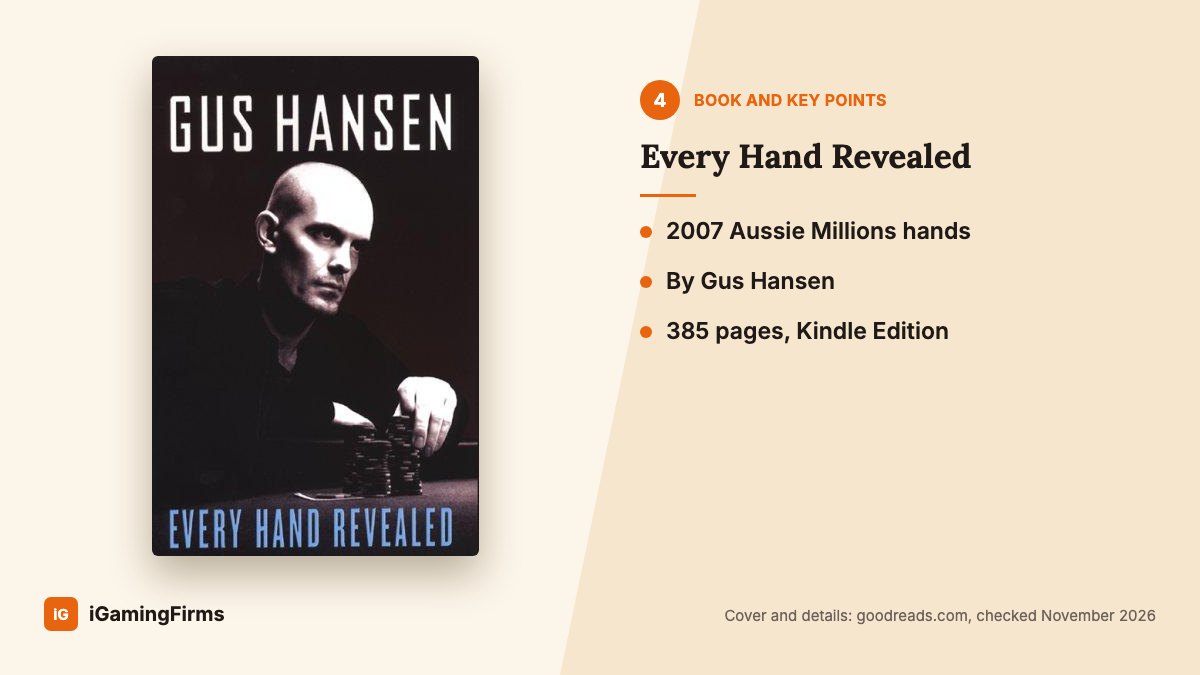
Gus Hansen recorded every hand he played on the way to winning the January 2007 Aussie Millions main event in Melbourne. The field was 747 players and first prize was A$1.5 million, according to Hansen’s career record. Lyle Stuart, a Kensington imprint, published the book in 2008. Hansen was the first player to win three World Poker Tour open titles.
The format is the value. Most strategy books show selected hands that prove a point. This one shows the folds, the marginal calls and the thinking behind a famously loose-aggressive style over an entire event. It is a record of one player in one tournament, so it does not generalise to cash games. Read it as a case study, not a system.
Read it if: you already know tournament basics and want to see aggression applied hand by hand.
5. Ace on the River: an Advanced Poker Guide
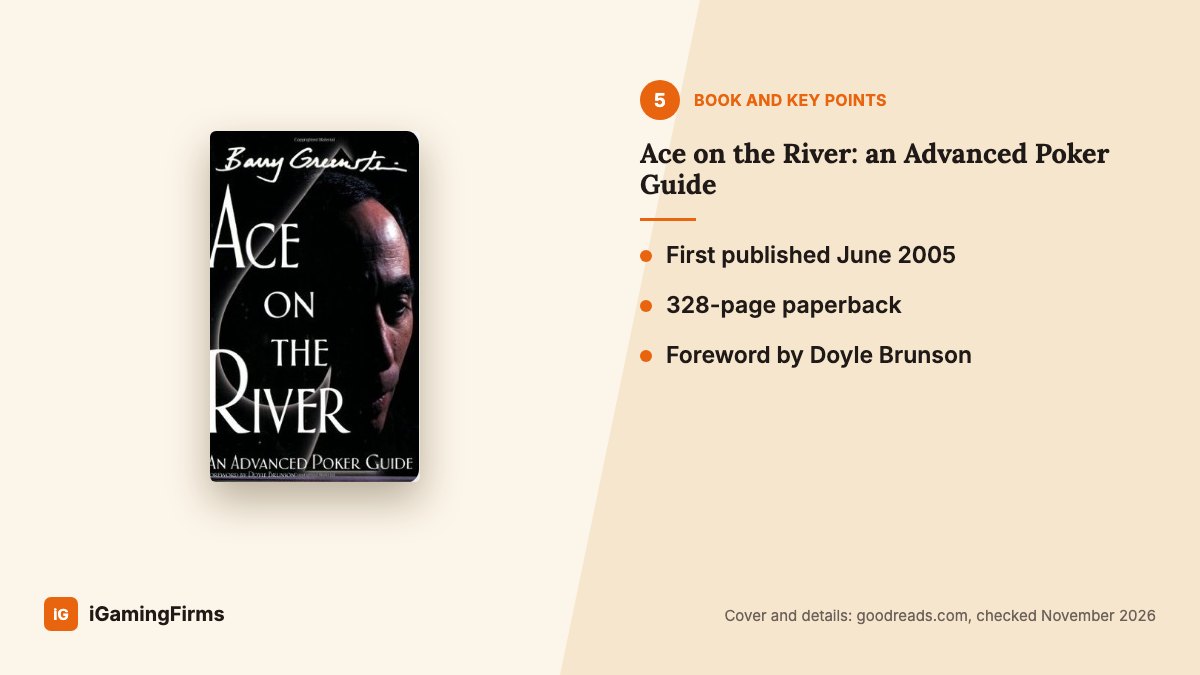
Barry Greenstein’s official site lists the book as published in 2005 and describes it as an honest look at the poker world and what it takes to succeed, with full-color photographs on every page. Last Knight Publishing is the publisher of record. Doyle Brunson wrote the foreword.
Greenstein holds three WSOP bracelets (2004, 2005 and 2008) and was elected to the Poker Hall of Fame in 2011. His nickname, “the Robin Hood of poker,” comes from donating tournament winnings to the charity Children Incorporated. The book reflects that background. It covers the life of a professional, money management and family as much as hands. That makes it the right book for a serious amateur weighing whether to play for a living. It is the wrong book if you want line-by-line strategy.
6. Caro’s Book of Poker Tells
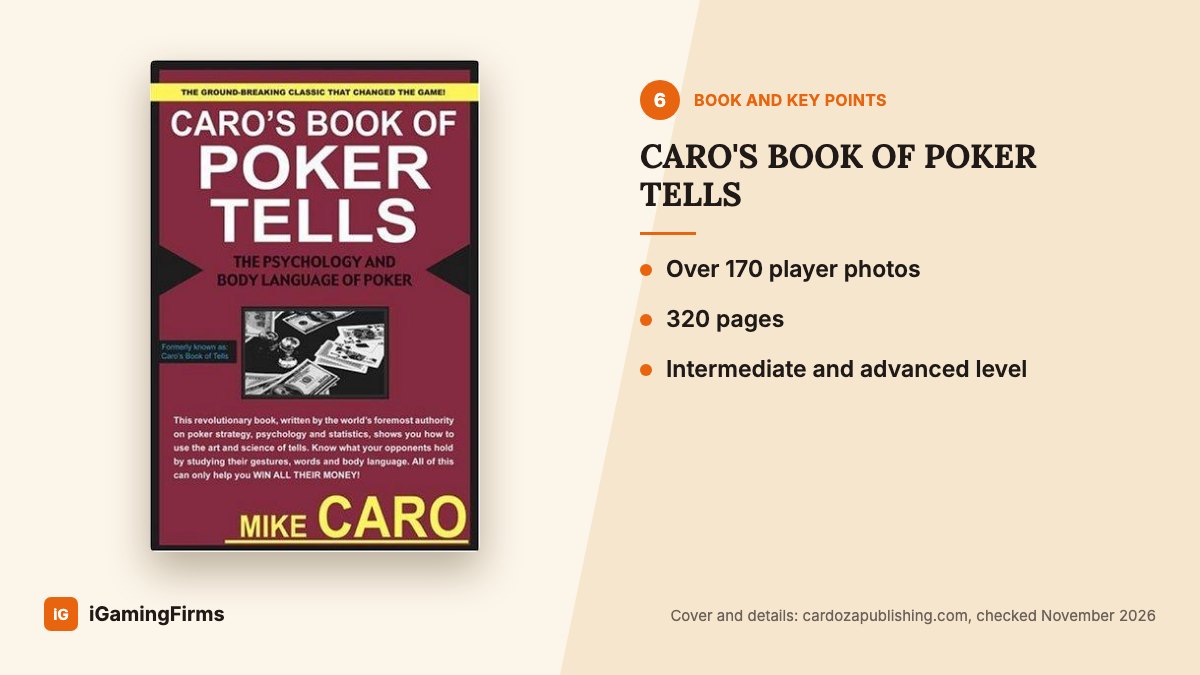
Mike Caro, known as “The Mad Genius,” wrote the draw poker chapter and statistical tables for Super/System in 1978. His tells book catalogues the physical reactions that leak information, such as shrugs, sighs, shaky hands and eye contact. The current edition is published by Cardoza. An earlier version titled Mike Caro’s Book of Tells is cited with a 1994 Carol Publishing date. Caro keeps a free poker tells collection on his own site.
The book matters more for live poker than online. Online, physical tells disappear and timing and bet sizing take their place. In live rooms, where solver-trained players still sit at the same tables as recreational ones, reading people remains an edge that software does not replace.
Read it if: you play live cash games or tournaments.
7. The Mental Game of Poker
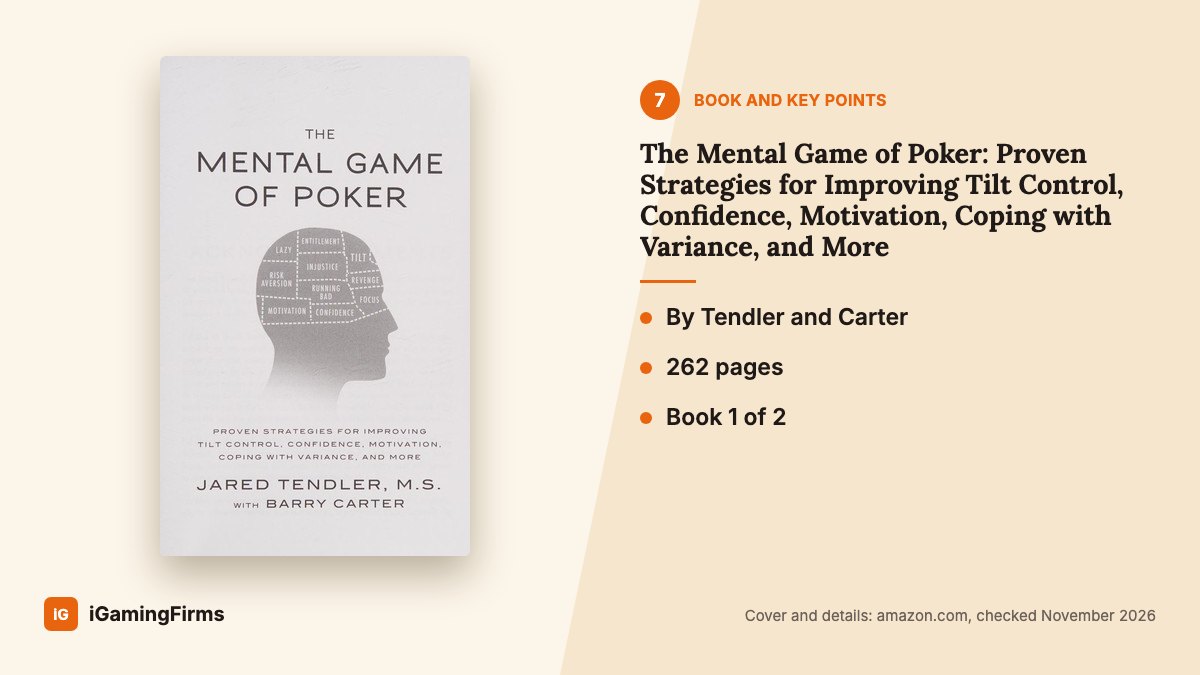
Jared Tendler is a licensed mental health counselor (MS, LMHC) who coaches poker players, athletes and financial traders. His book page says the book gives step-by-step techniques for tilt, variance, emotional control, confidence, fear and motivation, with player stories. The softcover carries ISBN 978-0-615-43613-5 and is sold in print, ebook and audiobook. Retail listings credit Barry Carter as co-author and date the first edition to 2011.
A sequel, The Mental Game of Poker 2, focuses on reaching and holding a focused “zone” state across longer sessions and more online tables. Tendler later applied the same method to markets in The Mental Game of Trading.
This is an online-era book. It was written for players grinding many tables and huge hand volumes, where variance is felt daily. That is why it shows up alongside solver books in serious study plans: knowing the right play is useless if you cannot execute it while losing.
8. Elements of Poker
Tommy Angelo, a poker coach and author, published Elements of Poker in 2007, according to his book page. The page describes a book that goes beyond strategy and statistics into the mental and emotional side of the game, including tilt, position and quitting. It is currently offered as an ebook and audiobook. Angelo’s site also lists Painless Poker and other titles.
Where Tendler gives a structured method, Angelo writes short essays built around a coach’s experience. Readers who resist workbook-style self-help often prefer this one. Neither replaces a strategy book.
9. The Mathematics of Poker
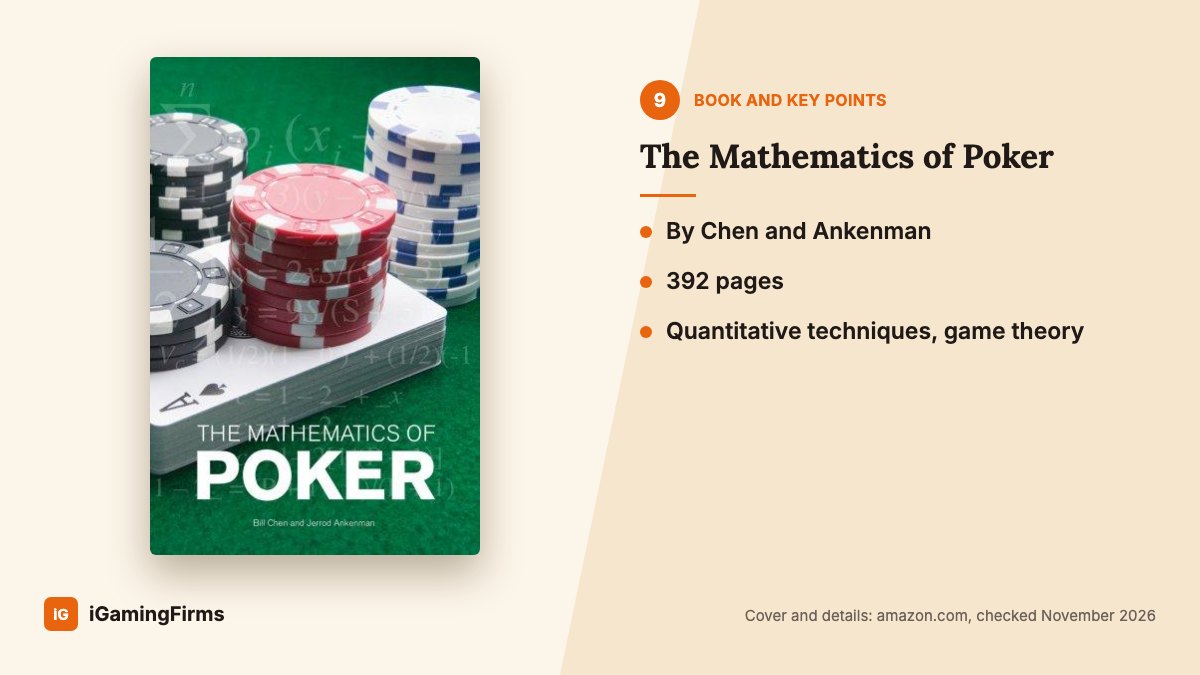
ConJelCo published Bill Chen and Jerrod Ankenman’s book in November 2006 at 382 pages, per the publisher’s page. The page frames it as an introduction to quantitative methods and game theory for readers without a strong math background. It contrasts the older generation of players, who relied on experience and intuition, with a newer one applying mathematics and computer science.
Chen holds a PhD in mathematics from UC Berkeley, works in statistical arbitrage at Susquehanna International Group and won two WSOP bracelets in 2006, per his biography. The book is the bridge on this list. It explains why balanced strategies exist years before consumer solvers let players compute them for real hands. If Modern Poker Theory feels like a list of outputs, this book explains where the outputs come from.
10. Modern Poker Theory
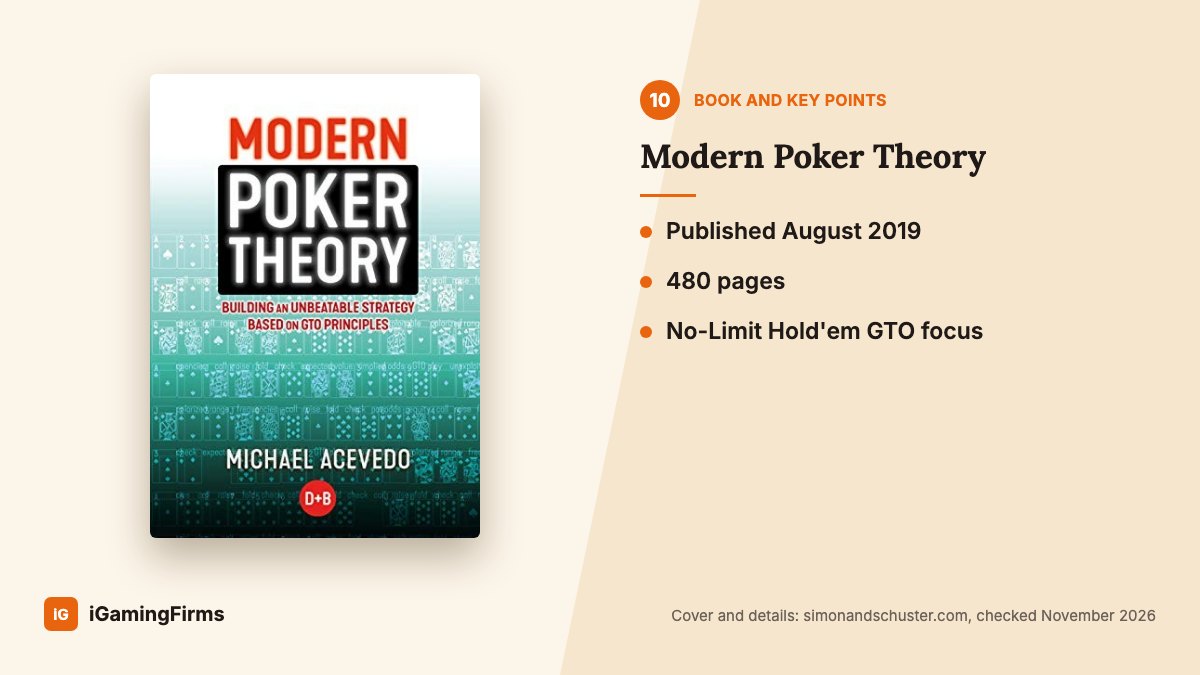
Michael Acevedo’s book is published by D&B Poker at 480 pages in paperback and ebook. The publisher describes a rigorous guide to no-limit hold’em that examines GTO play, explains how to apply it at the table and shows how to exploit players who do not use it. It says the content comes from thousands of hours of research with advanced poker software. The book came out in 2019, the same year Pluribus was announced. D&B now sells companion video packs and lists a follow-up, Modern Poker Theory: The Tournament Workbook.
This is the clearest solver-era title here. It reads like a structured summary of what solvers recommend for preflop ranges, bet sizing and board textures. It is dense. Read The Mathematics of Poker first if you have not met game theory before.
11. The Theory of Poker
David Sklansky’s book belongs on this list because it is the theoretical root that many later titles build on. Per its reference record, a first version appeared in 1978 under a different title, the final version followed in 1987 and Two Plus Two Publishing issued the 1999 edition (ISBN 978-1-880685-00-6). It introduced or popularised expected value thinking, semi-bluffing, optimal bluffing frequency, implied and reverse implied odds and the Fundamental Theorem of Poker.
It is game-agnostic, which is why it survives. The examples lean on limit games and stud, but the reasoning about value and deception applies to every format. Read it after one beginner book and before any GTO title.
How online poker and solvers changed poker books
Poker strategy writing has gone through three shifts. Each one changed which books matter.
1978 to 2003: professionals publish their edge
Super/System and The Theory of Poker both trace back to 1978. For the first time, winning players wrote down how they won. Brunson’s own view that the book cost him money shows how small the informed player pool was.
2004 to 2014: the online boom creates a mass market
Online poker turned millions of new players into book buyers. Harrington on Hold’em (2004), Every Hand Revealed (2008) and The Mental Game of Poker (2011) all served that audience: tournament players, multi-tablers and grinders who felt variance every day. Poker publishing grew alongside the poker software platforms that ran those games.
2015 onward: solvers and AI set the standard
Commercial solvers such as PioSOLVER, which describes itself as a fast GTO solver for hold’em, let players compute near-equilibrium strategies on a desktop. Then two research results ended the debate about whether machines could out-think professionals. In January 2017, Carnegie Mellon’s Libratus beat four top professionals at heads-up no-limit hold’em over 120,000 hands at Rivers Casino in Pittsburgh, finishing $1,766,250 ahead in chips. In July 2019, Pluribus, built by Carnegie Mellon and Facebook AI, beat elite professionals at six-player no-limit hold’em. CMU says Pluribus computed its base strategy in eight days using about 12,400 core hours and ran on just 28 cores during play.
Books responded. Modern Poker Theory is essentially a translation of solver output into study material. Study platforms such as GTO Wizard now offer solution libraries, trainers and hand-history analysis that overlap with what books used to do. For operators, this has a second edge. GTO Wizard says it works with poker networks to detect cheating and offers a Fair Play Check. Real-time assistance tools are now a game-integrity problem, covered in our guide to iGaming fraud detection.
What is the best book about poker?
There is no single best book, because poker is several games. If you force one pick for general strategy, The Theory of Poker is the most cited foundation, because its ideas apply to every format. For no-limit tournaments, Harrington on Hold’em: Strategic Play has the longest record as a study text. For modern no-limit theory, Modern Poker Theory is the most complete single volume on this list. For the mental side, The Mental Game of Poker. The best book is the one that matches your game, your stake and your weakest skill.
What is the best book to learn poker?
For a true beginner, Winning Low-Limit Hold’Em is the gentlest start because it was written for new players at small stakes and its current edition covers online play. Read it alongside the rules and hand rankings, then move to The Theory of Poker for the reasoning behind decisions. If you only play no-limit tournaments, Harrington on Hold’em can be your second book. Avoid starting with Modern Poker Theory or The Mathematics of Poker. Both assume you already understand pot odds, position and ranges.
Are poker books still worth reading in the solver era?
Yes, but for different reasons than before. A solver gives you an answer for one spot. A good book gives you the framework that makes those answers make sense and helps you remember them under pressure. Pre-solver books are still strongest on fundamentals, live reads and psychology. Solver-era books are strongest on preflop ranges, bet sizing and balance. The weak spot is middle-era no-limit advice, where specific lines from 2004 to 2012 have been refined. Use those books for structure and confirm specific lines with current tools.
Is poker hard to learn?
The rules are easy and the game is hard to master. Most people learn hand rankings and betting order in an evening. Winning consistently takes far longer, because poker mixes math, reading opponents, position and emotional control. That is why reading lists split into stages. Beginner books focus on hand selection and discipline at low stakes. Middle-stage books add pot odds, position and format-specific plans. Advanced books move into ranges and game theory. Many players find the hardest part is staying calm through losing runs, which is why mental-game books sit on serious lists.
What is the hardest poker game?
There is no agreed answer. Players often point to mixed games, where you rotate through several variants and must be competent at all of them. Others point to high-stakes no-limit hold’em, where opponents are skilled and a mistake costs a full stack. Pot-limit Omaha is also often called difficult because hand values run closer together. Your opponents matter more than the rules: a soft table in a complex game can be easier than a tough table in a simple one. Super/System is still the best way to see how strategy shifts across draw, stud, lowball and hold’em.
What is the 7-2 rule in poker?
The 7-2 rule is an informal side game, not an official rule. Seven-deuce offsuit is usually rated the worst starting hand in hold’em. In many home games, a player who wins a pot with 7-2 collects an agreed bounty from every other player at the table. It encourages bluffing with the worst hand and makes the game looser. No strategy book on this list treats it as part of standard play, so agree the terms before the session if your game uses it.
Editions, the solver era and game integrity
The edition you buy is not the book that was reviewed
One year and one page count do not tell you which edition you have. Winning Low-Limit Hold’Em in ConJelCo’s current 2005 edition includes online poker and single-table tournaments that older copies lack. Super/System was self-published in 1978 and later reissued by Cardoza in a revised edition, then followed by a sequel with different contributors. The Mathematics of Poker runs 382 pages per ConJelCo, not the figures some listings show. Check the copyright page before you judge a book by a review.
The solver date line sorts the list
Libratus (2017) and Pluribus (2019) changed what “good strategy” means. CMU reports that Pluribus built its base strategy in eight days on modest compute. Once equilibrium-style play became cheap to compute, pre-2015 no-limit advice became a starting point rather than a final answer. That is why this guide marks each book by era.
Poker books are now an industry and integrity issue
Study tools that grew out of solver research now sit next to the game itself. GTO Wizard’s own site says it works with poker networks on cheating detection. Operators, game studios and poker game developers have to design for players who study with the same tools that could be misused during play. For anyone in the poker business, these books show how your player base thinks and what software they are likely to use.
A reading order by goal
- New to poker: Winning Low-Limit Hold’Em, then The Theory of Poker.
- No-limit tournaments: Harrington on Hold’em, then Every Hand Revealed as a case study, then Modern Poker Theory.
- Live cash games: Caro’s Book of Poker Tells alongside a strategy book for your stake.
- Tilt and downswings: The Mental Game of Poker for a structured method or Elements of Poker for essays.
- Theory: The Mathematics of Poker, then Modern Poker Theory.
- History and context: Super/System and Ace on the River.
- Poker product, VIP or room staff: Harrington on Hold’em, The Mental Game of Poker and Modern Poker Theory show how serious players think, study and handle losing runs.
Before you play for money
Real-money poker is for adults of legal age and depends on where you live. In the US the minimum age and the legality of online poker vary by state. Check the legal gambling age by state before you play.
Your next step
Write down three things: your main game (cash or tournament, limit or no-limit), your usual stake and your biggest leak. Pick one strategy book from the table that matches the first two and one mental-game book for the third. Check the edition date on the publisher page linked above. If you work in poker operations, add Modern Poker Theory to your team’s reading so product and integrity staff understand how solver-trained players approach your tables.