Last updated: 31 October 2026
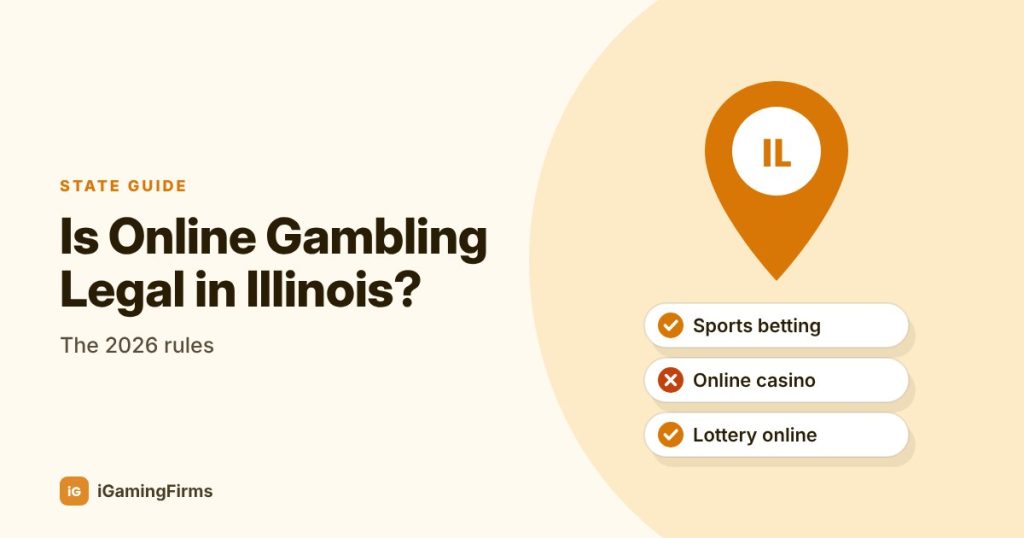
Online gambling is only partly legal in Illinois. As of October 2026 you can legally bet on sports online with one of the ten Illinois Gaming Board (IGB) authorised sportsbooks, buy lottery tickets online, and bet on horse racing through licensed advance deposit wagering. Online casino games and online poker are still illegal, because no Illinois law licenses them, and the IGB treats dual-currency sweepstakes casinos as illegal gambling too.
Illinois is one of the largest regulated betting markets in the US, so the gap between what is licensed and what is not matters to anyone building, supplying or promoting products there. This guide covers what is legal product by product, the 2026 changes that most pages have not caught up with (the SB 3019 budget law, the sweepstakes crackdown, the per-wager tax and the Kalshi injunction), the gambling age for each product, what the penalties are, what a gambling licence in Illinois actually covers, and what could change next.
Is online gambling legal in Illinois? The short answer
Illinois law starts from a general ban. Under 720 ILCS 5/28-1, a person commits gambling by playing a game of chance or skill for money, and item (a)(12) separately makes it an offence to knowingly establish, maintain or operate an internet site that lets people play or wager for money. Everything legal online is a carve-out from that ban: the Sports Wagering Act, the Illinois Lottery’s internet program and licensed pari-mutuel racing.
| Product | Status (Oct 2026) | Legal basis | Minimum age |
|---|---|---|---|
| Online sports betting | Legal, 10 IGB-authorised online sportsbooks | Sports Wagering Act (230 ILCS 45) | 21 |
| Retail sports betting | Legal at casinos, racetracks and sports venues | Sports Wagering Act | 21 |
| Online casino games (slots, blackjack, roulette) | Illegal, no licence exists | 720 ILCS 5/28-1; HB 4797 not passed | Not applicable |
| Online poker | Illegal, no licence exists | 720 ILCS 5/28-1 | Not applicable |
| Sweepstakes casinos (dual currency) | Treated as illegal by the IGB and Attorney General; no specific ban statute | 720 ILCS 5/28-1; 65 cease-and-desist letters (February 2026) | Not applicable |
| Illinois Lottery, including online sales | Legal | Illinois Lottery Law; 28-1 internet lottery exemption | 18 |
| Horse racing, including online (ADW) | Legal | Illinois Horse Racing Act; Illinois Racing Board | Set by Racing Board rules and platform terms |
| Daily fantasy sports | Offered; IGB licensing framework created by SB 3019 (2026) | SB 3019, rules pending | Operator terms until IGB rules apply |
| Prediction markets (Kalshi and others) | Operating; Illinois rules blocked by a federal preliminary injunction (2 October 2026) | Commodity Exchange Act vs SB 3019 “exchange wager” rules | 21 under SB 3019 (currently enjoined); platform terms otherwise |
| Land-based casinos | Legal, 17 casinos | Illinois Gambling Act | 21 |
| Video gaming terminals in bars and truck stops | Legal, close to 50,000 terminals | Video Gaming Act | 21 |
What gambling is legal in Illinois?
Illinois has no tribal gaming, so every legal product is either licensed by the IGB, licensed by the Illinois Racing Board, or run by the state. The market is large. A Commission on Government Forecasting and Accountability (COGFA) report released in October 2026, as reported by St. Louis Public Radio, put state gambling revenue at a record $2.7 billion for fiscal year 2026, up 19.2% on the year before.
Does Illinois have casinos?
Yes. Illinois has 17 licensed casinos, up from 10 in 2019, after the 2019 gaming expansion authorised six new licences, including Chicago, Rockford, Waukegan and the south suburbs. Bally’s Chicago and American Place in Waukegan still operate from temporary facilities. SB 3019, the only gaming-related bill to pass in the 2026 spring session, lets both apply to the IGB for longer temporary operation. COGFA says casino receipts grew 13% last year, mostly because new casinos opened rather than because existing ones performed better.
Video gaming terminals
The Video Gaming Act lets licensed bars, restaurants, truck stops and fraternal clubs run up to six terminals each. The state is close to 50,000 terminals, and video gaming produced more than $1 billion in state and local tax last year, ahead of the lottery for the second year running. For anyone comparing markets, this matters: Illinois already has a slot-style product in thousands of neighbourhood locations, and the owners of those terminals are among the strongest voices in the online casino debate.
The lottery and horse racing
The Illinois Lottery sells draw games online through its own website and app. The 28-1 statute specifically exempts lottery purchases made through the Lottery’s internet program, so this is the oldest legal form of online gambling in the state. Lottery revenue was about $788 million in fiscal 2026, roughly flat. Horse racing is legal at Illinois tracks and online through advance deposit wagering (ADW) platforms licensed by the Illinois Racing Board.
Is online sports betting legal in Illinois?
Yes. Illinois legalised sports betting in June 2019, retail betting began in March 2020 and online betting followed in June 2020. You must be 21 and physically inside Illinois when you place a bet, which apps check by geolocation. You do not need to be a resident.
Is FanDuel legal in Illinois?
Yes. FanDuel Sportsbook operates online under a licence held by Fairmount Park. According to the IGB’s list of authorised sportsbooks, the ten online brands are bet365, BetMGM, BetRivers, Caesars, Circa Sports, DraftKings, theScore Bet, Fanatics, FanDuel and Hard Rock Bet. FanDuel and bet365 have no retail sportsbook in the state. FanDuel’s online casino product is not available in Illinois, because there is no online casino licence to hold.
Illinois says those are the only operators authorised to take sports bets in the state. Any other site taking sports bets from Illinois, including offshore books, is operating outside the Sports Wagering Act.
Why can’t you bet on Illinois college teams?
The Sports Wagering Act bars online bets on Illinois college teams. Illinois has allowed limited in-person bets on in-state college teams at retail sportsbooks, restricted to game outcomes (spread, moneyline and total) with no player props, and that exception has been extended in stages since 2021. Bets on out-of-state college teams, including props, are allowed online. This is why bettors in Illinois cannot place an online bet on Illinois or Northwestern during March Madness.
How Illinois taxes sportsbooks in 2026
Illinois runs one of the heaviest sports betting tax systems in the US, and it is the part of the market operators talk about most. Under 230 ILCS 45/25-90, operators pay two separate taxes:
- Graduated tax on adjusted gross receipts. 20% on the first $30 million a year, rising through 25%, 30% and 35% bands to 40% on receipts above $200 million. It has applied to online and retail wagers since July 2024.
- Per-wager tax on online bets. Since 1 July 2025, $0.25 per online wager for the first 20 million wagers a year and $0.50 per wager after that.
The per-wager tax hits small bets hardest, because it is fixed no matter what the bet is worth. A simple illustration, using assumed figures:
| Example online bet (assumptions) | Stake | Assumed hold | Expected gross revenue | Per-wager tax (above 20m bets) | Per-wager tax as share of revenue |
|---|---|---|---|---|---|
| Straight bet | $10 | 9% | $0.90 | $0.50 | About 56% |
| Parlay | $10 | 20% | $2.00 | $0.50 | 25% |
| Straight bet | $100 | 9% | $9.00 | $0.50 | About 6% |
Both hold figures are assumptions in the range Illinois regulator data has shown (statewide hold around 8% to 9%, parlay hold close to 20% in some months). The graduated AGR tax then applies on top. The arithmetic explains why Illinois books lean on parlays and push customers away from small single bets. COGFA found parlays were about 3 in 5 of the 319 million bets placed last year and about $879 million, or 62%, of bettors’ net losses. Our parlay explainer shows how hold rises with every leg.
Operators passed some of the cost on. FanDuel added a 50-cent fee per Illinois bet in September 2025 and waived it temporarily from April to June 2026. A repeal bill, HB 5143, stalled in committee and did not pass. Illinois still collected $593 million in sports wagering tax in fiscal 2026, the fastest-growing gambling revenue source in the state, even though bettors placed fewer bets than the year before.
Are online casinos legal in Illinois?
No. There is no Illinois licence for real-money online slots, table games or live dealer games, and offering them from a site that accepts Illinois players is an offence under 28-1(a)(12). The online casino brands of FanDuel, DraftKings and BetMGM operate in states such as New Jersey, Pennsylvania and Michigan, but not in Illinois.
The 2026 bill: HB 4797
Rep. Edgar González Jr. filed HB 4797, the Illinois Internet Gaming Act, in early February 2026. It closely mirrors his 2025 bill, which did not advance. As reported by Deadspin and SBC Americas, it would have:
- taxed online casino revenue at 25% of adjusted gross revenue, after deducting promotional credits;
- charged $250,000 for a licence and $100,000 to renew;
- let existing gaming licensees partner with up to three iGaming platform providers;
- barred the IGB from licensing any casino operator that has cut its workforce by 25% or more since late February 2020.
The bill did not pass in the 2026 spring session. Online casino now needs a new bill in the 2027 session at the earliest. Opposition from video gaming terminal operators and concern about land-based casino jobs (the reason for the workforce clause) are the obstacles to watch.
Is online poker legal in Illinois?
No. Real-money online poker is covered by the same 28-1 ban, and Illinois has no online poker licence or interstate poker agreement. Live poker is legal in licensed casinos. Free-to-play poker apps where you cannot win money fall outside the gambling definition.
What about offshore casinos?
Several ranking pages for this search describe offshore casinos as legal for Illinois players or a harmless grey area. That is wrong. Offshore operators are not licensed in Illinois, operating a site that takes Illinois wagers is an offence under 28-1(a)(12), and placing a bet is gambling under 28-1(a)(1). Prosecutions of individual players are rare, but there is no Illinois licence, no IGB dispute process and no protection of player funds. Illinois also has a long-standing loss recovery statute (720 ILCS 5/28-8) that lets a person who loses money gambling sue to get it back, and plaintiffs’ lawyers have used it in class actions against online operators.
Are sweepstakes casinos legal in Illinois?
Not according to Illinois regulators. Illinois has no law that names sweepstakes casinos, but on 5 February 2026 the IGB and Attorney General Kwame Raoul announced more than 60 cease-and-desist letters (65, according to trade press) to online operators offering games of chance for money or prizes. The letters told operators to stop offering prizes to Illinois users and to block Illinois residents. Raoul’s statement was direct: “The law is clear: Gambling in Illinois must be properly licensed and regulated.”
The market response was slow at first. Two weeks after the letters, Gambling Insider found only two of the 65 platforms had restricted Illinois. Since then the list of exits has grown:
- WOW Vegas and Rolla, both owned by MW Services, removed Sweeps Coin play in Illinois from 1 May 2026, leaving Gold Coin play only. WOW Vegas also faces two class actions in Illinois.
- Stake.us added Illinois to its restricted list in 2026.
- Chanced and Punt (Gold Coin Group) left Illinois, as did Carnival Citi, Smiles Casino, Rolling Riches and Spin Saga.
A bill that would tighten the definition of illegal gambling devices, SB 1705, stayed in committee, and no new standalone sweepstakes ban was filed before the February 2026 introduction deadline. So Illinois is an enforcement state rather than a statutory ban state. For operators and affiliates, the practical answer is the same: the regulator and the Attorney General have said in writing that cash-prize online casino games are illegal in Illinois. See where Illinois sits against the other 49 states in our sweepstakes casino legal map, and compare a state that did pass a ban in our guide to sweepstakes casinos in Indiana.
Is Kalshi legal in Illinois?
Kalshi operates in Illinois, and for now the state cannot enforce its own rules against it. Here is how it got there in 2026:
- April: the IGB sent cease-and-desist letters to Kalshi, Polymarket, Crypto.com and Robinhood, calling their sports contracts illegal gambling. The CFTC sued Illinois the same month.
- June: SB 3019, passed with the fiscal 2027 budget, added “exchange wagers” (contracts on a prediction market tied to a sporting event) to the Sports Wagering Act. It requires a sports wagering licence, sets a minimum age of 21 and imposes a transaction tax of 1.75% on the first $5 million of exchange wagers a licensee takes in a fiscal year and 3.5% above that (Covers, June 18, 2026). Kalshi sued in federal court in Chicago.
- 2 October: U.S. District Judge Martha Pacold granted preliminary injunctions to the CFTC, Kalshi and Coinbase, finding the Illinois licensing rules likely preempted by the Commodity Exchange Act. She held back a decision on the tax, and told the parties to file a proposed injunction order by 29 October. As of 31 October we had not seen a reported final order on the tax question.
This is not the end of it. A federal judge in Wisconsin, also in the Seventh Circuit, reached the opposite view and refused the CFTC an injunction in July 2026 (SBC Americas), and that case is already on appeal. Expect the Seventh Circuit to decide which reading applies to Illinois. Our guide to whether Kalshi is legal tracks the national circuit split, and how prediction markets work explains the contract mechanics.
Is daily fantasy sports legal in Illinois?
DraftKings, FanDuel and other DFS operators have offered paid contests in Illinois for years without a state licence, after a long legal fight over whether DFS is gambling. SB 3019 ends that. It creates a standalone IGB licensing framework for fantasy contests, separate from sports wagering, with two-year licences, separate tiers for small and large operators and a 15% tax on adjusted gross fantasy contest receipts (entry fees from Illinois players minus prizes paid). Operators must run age and identity checks, geolocation and anti-money laundering controls. Operators already in Illinois can keep running if they apply within a set period after the IGB’s rules take effect.
Trade reports differ on the licence fees: Gambling Insider reports $500 for small operators and $7,500 for large ones, while Covers reports a range of $500 to $1,500. Check the enrolled bill before you budget.
How old do you have to be to gamble in Illinois?
- 21: casinos, sports betting (online and retail), video gaming terminals, and exchange wagers under SB 3019.
- 18: the Illinois Lottery, including online purchases.
- Horse racing and DFS: set by Illinois Racing Board rules and operator terms; DFS age rules will come with the IGB’s fantasy contest regulations.
Some ranking pages give the Illinois gambling age as “18 to 21” without saying which product is which. For anything the IGB licenses, it is 21.
What happens if you gamble illegally in Illinois?
Under 28-1(c), gambling is a Class A misdemeanour, which in Illinois carries up to 364 days in jail and a fine of up to $2,500. A second or later conviction under items (a)(3) to (a)(12), which covers running gambling operations, keeping gambling devices and operating an internet gambling site, is a Class 4 felony. For operators, the more immediate risks are IGB and Attorney General enforcement, civil loss recovery suits, and the effect an Illinois violation has on licence applications in other states.
What gambling licences does Illinois issue?
“Gambling license Illinois” covers several different permissions, all from the IGB except racing:
| Licence | Who needs it | Key 2026 numbers |
|---|---|---|
| Owners licence (casino) and organisation gaming licence (racetrack casino) | Casino and racino operators | 17 casinos operating |
| Master sports wagering licence | Casinos, racetracks and sports facilities offering betting; online-only operators | Online-only licence fee cut from $20 million to $15 million by SB 3019, no cap on number stated; $250,000 non-refundable application fee |
| Supplier, management services and occupational licences | Game suppliers, platform and technology providers, key staff | Required before supplying any licensed gambling product |
| Video gaming licences (terminal operator, establishment, technician, handler) | Route operators and the bars and truck stops hosting terminals | Close to 50,000 terminals statewide |
| Fantasy contest operator licence | DFS operators | New under SB 3019; 15% tax; IGB rules pending |
| Racing and ADW licences | Tracks and online racing platforms | Issued by the Illinois Racing Board |
There is no online casino or online poker licence to apply for. The 2019 law allowed up to three online-only sports wagering licences at $20 million each and none was ever issued. SB 3019’s cheaper, uncapped version is the first real opening for a national brand that does not want a land-based partner.
Do you pay tax on gambling winnings in Illinois?
Yes. Illinois taxes gambling winnings at its flat 4.95% income tax rate and does not allow a deduction for gambling losses, so a customer can owe Illinois tax on winnings even after a losing year. Federal rules apply on top: winnings are taxable, and from 2026 only 90% of losses can be deducted against them by people who itemise. Our guide to taxes on gambling winnings covers W-2G thresholds and what each app reports.
What could change next
- Online casino. A new iGaming bill in 2027 is likely; passage is not. Watch whether the workforce clause and a deal with video gaming interests appear in the next version.
- Prediction markets. The Seventh Circuit’s decision in the Wisconsin appeal, and any appeal of Judge Pacold’s order, will decide whether SB 3019’s exchange-wager rules ever take effect.
- Sweepstakes. Further IGB action, a statutory ban in 2027, or loss recovery class actions are all possible. Illinois has so far relied on enforcement.
- Per-wager tax. Repeal failed in 2026. With $593 million in sports tax at stake, expect changes to come only through a budget deal.
- DFS. The IGB’s fantasy contest rules, and the application window they open, are the next concrete date for DFS operators.
For updates as these land, follow our iGaming regulation roundup.
What this means for operators, suppliers and affiliates
Operators. Illinois is open for sports betting and, from SB 3019, DFS, but closed for online casino and poker. Model the per-wager tax on top of the 20% to 40% graduated tax before you price an Illinois launch, because it changes which bet types make money. The new $15 million online-only licence is the route in if you do not want a casino partner.
Suppliers. Gaming equipment, platform and managed-service providers to Illinois licensees generally need an IGB supplier or management services licence, so check which category your product falls into before you sign. If you also serve sweepstakes clients, document how Illinois is excluded, since the IGB named the activity as illegal in writing.
Affiliates. Promote only IGB-authorised sportsbooks to Illinois audiences, keep everything 21+, and do not describe offshore or sweepstakes casinos as legal in Illinois. If you cover prediction markets, say they operate under a federal injunction while the case continues, not that they are licensed in Illinois. For neighbouring markets, compare Wisconsin and Kentucky.
Next step
The dates to watch are Judge Pacold’s final injunction order (the proposed order was due on 29 October), the Seventh Circuit’s ruling in the Wisconsin prediction market appeal, the IGB’s fantasy contest rules and any iGaming bill filed for the 2027 session.
This article is general information and analysis, not legal advice. State positions change quickly; confirm current law with qualified counsel before making decisions.