Last updated: 10 October 2026
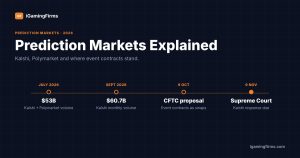
If you run a sportsbook, an affiliate site or an SEO team in the US market, Kalshi and Polymarket are no longer a side story. Together they cleared about $53 billion in notional volume in July 2026, and Kalshi alone did $60.7 billion in September. Most Kalshi vs Polymarket pages are written for retail traders deciding where to open an account. This one is written for you: it compares the two platforms on structure, regulation, fees, liquidity, settlement, KYC, state access and tax reporting, then says what the differences mean for operators and affiliates.
Kalshi and Polymarket are not the same thing. Kalshi is a US exchange, designated by the CFTC in November 2020, that settles in US dollars and holds customer funds in its own CFTC-registered clearinghouse. Polymarket is a crypto-native exchange on the Polygon blockchain that settles in USDC for international users, plus a separate CFTC-regulated US entity (QCX LLC, trading as Polymarket US) that it bought in 2025 and relaunched in December 2025. The practical differences follow from that split: who regulates each venue, what currency you hold, who can legally trade, and which court fights you inherit.
Kalshi vs Polymarket: who this comparison is for
Three readers get the most out of it:
- Operators weighing whether prediction markets cannibalise sportsbook handle, whether to build or partner, and which states are now hostile to event contracts.
- Affiliates deciding whether to send traffic to either platform, in which states, and with what compliance exposure.
- SEO and content teams who need accurate, current facts for prediction market content, because most ranking pages still describe 2025.
It is not a guide to which platform you should trade on, and it does not cover bonuses or sign-up offers.
The criteria that actually separate them
Readers who compare these two platforms tend to decide on eight things: legal status, fee model, liquidity and volume, settlement currency and custody, KYC, market coverage, state-by-state access, and tax reporting. The table gives the short version. Each row is expanded below.
| Criterion | Kalshi | Polymarket (international) | Polymarket US (QCX) |
|---|---|---|---|
| Regulator | CFTC, designated contract market since Nov 2020; Kalshi Klear is a registered clearinghouse (2024) | No US licence; CFTC settlement in 2022 ($1.4m) and US users blocked | CFTC, via the QCX LLC designated contract market and QC Clearing LLC bought with QCEX in 2025 |
| Settlement currency | US dollars | USDC on Polygon | US dollars |
| Custody | Exchange holds funds at its clearinghouse, segregated | Self-custody wallet; smart contracts hold open positions | Funds held through the US clearing entity |
| Taker fee (100 contracts at $0.50) | $1.75 (0.07 formula) | $0 to $1.75 depending on category | $1.00 to $1.75 depending on category |
| Maker fee | $0 on most series; 0.0175 formula on listed series | $0, plus rebates funded by taker fees | $0 |
| Monthly volume (Aug 2026) | $37.2bn | $8.2bn combined (The Block) | |
| KYC | Government ID required | Historically wallet-based onboarding; geoblocking tightened in 2026 | Government ID and SSN required |
| Market resolution | Internal team against published rules | UMA optimistic oracle, token-holder disputes | Exchange rules under CFTC oversight |
| Tax forms (US) | Issues Form 1099-B | No US tax forms | CFTC venue; reporting practice still settling |
| Main state fights | NJ, NV, OH, TN, MA, NY, IL, WA, WI, MN, AZ, MI, MO | Not offered in the US | NV injunction (June 2026), NY lawsuit (Sept 2026), OH cease and desist (Oct 2026) |
Regulation and legal status: is Kalshi still legal, and is Polymarket legit?
Both platforms are legal at the federal level. The fight is about whether states can also regulate them, and in October 2026 federal appeals courts disagree on the answer.
Kalshi: a CFTC exchange in a circuit split
Kalshi has been a CFTC-designated contract market since November 2020 and opened to the public in July 2021. It won its election-contract fight against the CFTC in 2024, and the Commission dropped its appeal in May 2025. Sports contracts launched in January 2025, and that is when the state fights began.
The current court record, which the AI summaries and most comparison pages do not carry, looks like this:
- Third Circuit, April 2026: ruled that New Jersey cannot block Kalshi’s sports contracts, treating them as swaps under exclusive CFTC jurisdiction.
- Ninth Circuit, 28 August 2026: a unanimous panel ruled Nevada can enforce its gambling laws against Kalshi. Kalshi had already agreed in July to stop offering the contested contracts in Nevada.
- Sixth Circuit, 25 September 2026: ruled that Ohio and Tennessee can regulate Kalshi’s sports contracts under state gambling law, holding that they are not swaps. Al Jazeera’s report has the panel detail.
- Supreme Court: New Jersey filed a certiorari petition on 2 September 2026. On 7 October, 39 state attorneys general plus DC filed in support. Whether the Court takes the case is not yet decided.
District courts are split too. In Illinois, Judge Martha Pacold granted preliminary injunctions to the CFTC, Kalshi and Coinbase on 2 October 2026, finding that sports event contracts likely are swaps. In Wisconsin, a federal judge denied the CFTC the same relief in July, and that case is on appeal to the Seventh Circuit. Arizona’s criminal charges against Kalshi were dismissed in May 2026 on preemption grounds. Massachusetts has had a state-court injunction forcing Kalshi to geofence sports markets since January 2026, and Washington’s King County court issued its own injunction in July.
The CFTC is trying to settle the question by rule. On 28 September 2026 it sent two rules to the White House for review: an interim final rule excluding “casino-style gambling products” from the swap definition, and a proposed rule defining event contracts as swaps. Neither was in force on 10 October 2026, and a Supreme Court ruling could override both.
Polymarket: offshore venue plus a licensed US exchange
Polymarket’s international platform paid a $1.4 million CFTC penalty in January 2022 and has blocked US users since. It never held a US licence. Its route back was to buy QCEX, a small CFTC-registered exchange and clearinghouse, for a reported $112 million in July 2025. The CFTC issued a no-action letter to QCX in September 2025, the US app launched by waitlist in December 2025, and the waitlist was dropped in May 2026.
So “is Polymarket legit” has two answers. Polymarket US is a CFTC-regulated exchange with the same federal standing as Kalshi, and the same state exposure. The international platform is an unlicensed offshore venue from a US regulatory point of view, with a resolution process run by UMA token holders rather than a regulated exchange. Using a VPN to reach it from the US risks frozen funds and account closure, according to Polymarket’s own terms.
Polymarket US is now collecting its own state actions. A Nevada judge granted a preliminary injunction against QCX LLC in June 2026 that bars its sports, election and entertainment contracts in the state, per the Nevada Attorney General’s release. New York sued QCX on 24 September 2026, two months after suing Kalshi. Ohio’s Casino Control Commission sent cease-and-desist letters to ten platforms including Polymarket, Robinhood and Coinbase on 2 October 2026, with a 16 October compliance deadline.
Are prediction markets gambling?
Legally, it depends on which court you ask. The Third Circuit and the Illinois district court say sports event contracts are swaps under federal law. The Sixth and Ninth Circuits say states can treat them as gambling. The CFTC says they are swaps. For an operator or affiliate, the safe working assumption is that any state with an active lawsuit or injunction treats them as gambling until a higher court says otherwise.
What is the Kalshi controversy?
There are three separate controversies and they get mixed together.
- State jurisdiction. The lawsuits above. New York’s suit, filed 31 July 2026, claims compensatory damages of at least $36 billion pending a full accounting, plus treble penalties and $100,000 per offering. That is a claim, not an award.
- Age and consumer protection. Kalshi and Polymarket US accept customers at 18. New York’s minimum age for mobile sports betting is 21, and both state complaints lean on that gap.
- Market resolution. Kalshi froze its market on Iran’s Supreme Leader Khamenei and faces class actions over how it was settled, alongside suits over sports contracts. Polymarket has its own history here: a March 2025 dispute over a $7 million market resolved by UMA token holders, and a 2025 Columbia University study that found wash-trading patterns in roughly a quarter of historical volume, without alleging wrongdoing by the platform.
Fees: the formulas, worked on the same trade
This is where the top-ranking comparison pages are most out of date. Two of the five pages reviewed for this article still say Polymarket charges no trading fees. It does, since early 2026.
Kalshi
Kalshi’s fee schedule (effective 7 July 2026) sets the taker fee at 0.07 × contracts × price × (1 − price), rounded up. The maker fee uses 0.0175 in place of 0.07 but applies only on series that list a maker multiplier; most standard series charge makers nothing. There is no settlement fee. ACH is free, debit card deposits can carry up to 2%, and Kalshi reserves the right to charge 0% to 2% on alternative payment rails.
On 100 contracts at $0.50, a taker pays $1.75. A maker on a series with maker fees pays $0.44; on a standard series, $0.
Polymarket (international)
Polymarket’s fee documentation uses the same shape of formula, contracts × rate × price × (1 − price), but the rate depends on category: 0.07 for crypto, 0.05 for sports, economics, culture and weather, 0.04 for politics, finance, tech and mentions, and 0 for geopolitics. Makers pay nothing and receive rebates of 15% to 25% of taker fees, paid daily. Deposits and withdrawals of USDC are free, though on-ramps such as Coinbase or MoonPay charge their own fees.
On 100 contracts at $0.50: $1.75 on a crypto market, $1.25 on sports, $1.00 on politics, $0 on geopolitics.
Polymarket US
Polymarket US published an exchange-wide schedule effective 1 July 2026 with the same category rates as the international venue (4% for politics and finance, 5% for sports, 7% for crypto, 0% for geopolitics), makers trading free, and volume rebates for high-volume takers. One comparison site describes Polymarket US fees instead as a flat 0.0695 curve across markets, which gives $1.74 on the same 100-contract sports trade. The two readings produce different numbers for sports and politics, so verify the current QCX schedule before quoting a fee in your own content.
What the fee comparison means in practice
On like-for-like sports and politics contracts, Polymarket is cheaper for takers and free for makers. Kalshi is cheaper only on the series where it charges no maker fee, and it offers something Polymarket’s international venue does not: no stablecoin, no gas, no on-ramp fee for ACH. For a US customer who holds no crypto, Kalshi’s all-in cost is usually lower. For an active trader already in USDC, Polymarket’s is. The pages reviewed for this article mostly reach the same conclusion but with 2025 fee tables.
Liquidity and volume: is Kalshi or Polymarket bigger?
Kalshi is bigger, by a wide and widening margin, when you count notional volume.
- July 2026: Kalshi $40.1 billion, Polymarket plus Polymarket US $12.9 billion (The Block).
- August 2026: Kalshi $37.2 billion, Polymarket combined $8.2 billion, the first monthly decline in a year after the World Cup spike (The Block, 2 September 2026).
- September 2026: Kalshi $60.7 billion, about 78% of the seven-venue total; Polymarket US $8.8 billion; Polymarket international $4.6 billion (DeFi Rate figures reported by Shift Markets, October 2026).
The Pew Research Center’s analysis of The Block data shows how fast this grew: combined monthly volume was $0.8 billion in July 2024, $12 billion in December 2025 and $53 billion in July 2026.
Two caveats you should carry into any content on this. First, volume is notional, not revenue or deposits, and Kalshi’s figures are inflated by short-dated crypto and index contracts routed in from Robinhood, Coinbase, Webull and Moomoo. Second, Kalshi’s sports share is far higher than Polymarket’s: Arkham Intelligence put sports at about 75% of Kalshi’s daily volume against 45% for Polymarket (May 2026). That is why sportsbooks care more about Kalshi, and why state regulators do too.
How many users does Kalshi have?
Kalshi does not publish a total user count. It said it added 3 million new users during the 2026 World Cup. Polymarket’s monthly active traders peaked at about 314,500 in December 2024 (Arkham, from on-chain data); comparable 2026 figures for the US app are not published. Valuations give another read on scale: Kalshi raised $1 billion at a $22 billion valuation in early 2026 (reports from March and May give different closing dates) and was reported by the Financial Times in June to be in talks at about $40 billion, with a possible 2027 IPO.
Polymarket took a $2 billion investment from ICE in late 2025 at about $8 billion, was reported by Bloomberg in April 2026 to be raising at $15 billion, and has an unconfirmed $21 billion round reported in September 2026. The October 2025 Fortune piece still ranking for this query has Kalshi at $5 billion and Polymarket at $9 billion.
Settlement, custody and what platform Polymarket uses
Kalshi runs a central limit order book. Customer cash sits at Kalshi Klear, its CFTC-registered clearinghouse, segregated from company funds. Contracts settle at $1 for the winning side after an internal team checks the outcome against the market’s published rules. Most markets pay within hours. Kalshi has also tokenised some contracts on Solana, which lets non-US venues such as Jupiter display them, but settlement stays in dollars on the exchange.
Polymarket’s international platform runs its order book off-chain with on-chain settlement on Polygon. You hold USDC in your own wallet, positions are ERC-1155 tokens, and winning shares redeem for $1.00 USDC once the UMA optimistic oracle finalises the result. UMA gives a two-hour challenge window; disputed markets go to a vote of UMA token holders. Arkham’s May 2026 figures put undisputed resolutions at about 98%, with disputes taking four to seven days.
Polymarket US is different again. It settles in US dollars through the QCX exchange and its clearing affiliate, takes ACH, debit card and wire, and does not require a wallet or stablecoin. Its participant agreement, as summarised by one comparison site, allows customer cash to be commingled or invested within CFTC rules, which is a weaker protection than Kalshi Klear’s segregation. Confirm that against the current agreement before repeating it.
Does Polymarket pay out, and does it pay in cash?
Yes on both venues, but in different money. International Polymarket pays winning shares in USDC, redeemable automatically if auto-redeem is on, and withdrawals leave as crypto in minutes. Polymarket US pays in dollars to a bank or card in three to four business days. Kalshi pays in dollars, with card withdrawals usually instant and bank withdrawals in a few business days. None of the three carries FDIC or SIPC insurance.
KYC: the gap that matters for compliance teams
Kalshi requires a government ID at onboarding; some reports say it can trade and bank out without an SSN until later in the account’s life. Polymarket US requires a government ID and a full SSN. Polymarket’s international platform has historically onboarded with a crypto wallet and no identity check for most users, which is the single biggest reason US regulators treat it differently. Reports in 2026 say it has added KYC for some products and tightened geoblocking after ISP-level blocks in several countries, so treat “no KYC” as an outdated description rather than a current fact.
For operators, this is the clearest structural difference. Kalshi and Polymarket US run the same identity, age and geolocation stack a regulated sportsbook would recognise. International Polymarket does not, and that is why it cannot be an affiliate target for US traffic at all.
Market coverage
Kalshi lists US sports, economic data (Fed, CPI, jobs), weather, politics, culture and, since 2026, perpetual futures on crypto, gold and silver. It has petitioned the CFTC for margin trading on non-sports contracts. Polymarket’s international venue leads on global politics, geopolitics, crypto and internet culture, and added perpetual futures on crypto and single stocks in September 2026, offshore only. Polymarket US launched sports-first and has broadened to “markets on everything”. Both platforms now list the same core sports and political events, which is why a cross-venue arbitrage niche exists and why Genius Sports launched Prediction.com in September 2026 to compare equivalent contracts.
Taxes and reporting
This section is missing from most pages ranking for the query, including the most current one, and it is where the two platforms differ most for a US customer.
- Kalshi issues Form 1099-B. Many preparers treat its contracts as Section 1256 contracts (60% long-term, 40% short-term, reported on Form 6781), but a 2026 KPMG analysis notes the IRS has issued no guidance on event contract reporting and that Section 1256 treatment is arguable rather than settled.
- Polymarket international issues no US tax forms. US-based preparers have treated positions as crypto property reported on Form 8949.
- Polymarket US is a CFTC-regulated venue, so the Kalshi reporting path is the obvious one, but KPMG found that reporting practice varies across CFTC-regulated venues and that not all issue 1099-B.
Two 2026 changes raise the stakes. The One Big Beautiful Bill Act raised the 1099-MISC threshold from $600 to $2,000 and capped gambling loss deductions at 90% of winnings from 2026. If a state or court succeeds in classifying event contracts as gambling, that 90% cap and W-2G reporting could follow. If they stay swaps, they do not. This is one more reason the circuit split matters beyond the sports betting industry.
Pros, cons and best-for
Kalshi
- Pros: longest US regulatory track record, dollar settlement, segregated clearinghouse, 1099-B reporting, dominant sports and macro liquidity, broker distribution through Robinhood, Coinbase, Webull and Moomoo.
- Cons: taker fees are the highest of the three on sports and politics, defendant in more state actions than any other venue, resolution disputes are handled internally with no external arbiter.
- Best for: US-facing businesses that need a licensed counterparty and a legal position the CFTC will defend in court.
Polymarket (international)
- Pros: lowest fees for makers, deepest non-US and geopolitical markets, transparent on-chain order flow, self-custody.
- Cons: no US licence and no US users, UMA disputes are decided by token holders, no tax reporting, wash-trading history, VPN use can freeze funds.
- Best for: non-US crypto-native traders, data buyers and researchers who want on-chain visibility.
Polymarket US
- Pros: CFTC exchange, dollar settlement, free maker trading, category fees capped at 7%, brand reach from the global platform, fast growth (US volume more than doubled in September 2026).
- Cons: youngest order book of the three and thin on large orders, already enjoined in Nevada and sued in New York, customer-fund protections look weaker than Kalshi Klear’s on paper.
- Best for: partners who want Polymarket’s brand with a licensed US entity behind it, and are willing to carry the same state risk Kalshi carries.
Red flags to watch
- Any page that says Polymarket has no fees. It has charged category taker fees since early 2026.
- “Available in all 50 states.” Not true of either venue in October 2026. Nevada, Massachusetts, Washington and Ohio have court orders or regulator deadlines in force; New York has live lawsuits against both.
- Volume quoted as a proxy for revenue. Notional volume on short-dated contracts can be many times the cash that changes hands.
- Resolution risk. Both Kalshi’s internal process and Polymarket’s UMA vote have produced disputed outcomes in 2025 and 2026. Neither is a sportsbook’s “official result” rule.
- Age 18 onboarding. Both regulated venues accept 18-year-olds. Every state complaint so far cites it.
What this means for operators and affiliates
For operators
DraftKings and FanDuel both launched their own prediction market products in late 2025, aimed at states without legal online sports betting such as California, Texas and Georgia. In their August 2026 earnings calls, DraftKings reported “no discernible impact” on its sportsbook and about 1% customer overlap with the largest prediction market operator in legal states; Flutter said FanDuel saw a “low single-digit” impact. Citizens analyst Jordan Bender has estimated about 5% cannibalisation across the industry. The honest answer is that the number is small today and concentrated in states where you do not have a sportsbook licence anyway.
The bigger structural play is distribution. Robinhood booked $156 million of event contract revenue in Q2 2026 by routing flow to Kalshi and other venues, and the Tunica-Biloxi Tribe announced a white-label consumer app built on Kalshi’s exchange in September 2026. If you are evaluating a partnership, Kalshi’s route is proven and Polymarket US’s is new. Either way you inherit the state litigation map above, and in Ohio you inherit a 16 October 2026 deadline.
Illinois shows the other template: the state budget created a licensing fee and a per-wager tax on prediction markets starting at 1.75%. If the Supreme Court or the CFTC’s rules settle the swaps question in Kalshi’s favour, expect more states to follow Illinois and tax rather than ban. If the Sixth and Ninth Circuit view wins, expect sportsbook-style licensing.
For affiliates
Prediction market traffic is growing fast, and it is also the category with the least settled rules. Three things to check before you send a click:
- State. Geofence your own links. Nevada, Massachusetts, Washington and Ohio have orders in force against at least one of the two venues. New York has sued both. Missouri’s attorney general ordered sports contracts to stop in September 2026.
- Venue. International Polymarket cannot take US traffic. Polymarket US and Kalshi can, with state carve-outs.
- Claims. “Legal in all 50 states”, “no fees” and “regulated like a sportsbook” are all wrong in October 2026. State attorneys general have quoted marketing language in their complaints.
Kalshi has advertised an affiliate and DSP partnerships manager role, which is the clearest public sign that it runs a formal affiliate channel. Polymarket’s partnership activity has been brand-led (LeBron James, Derek Jeter, Eli Manning, the Wall Street Journal and X). Neither publishes public commission terms, so treat any rate you see on a third-party site as unverified. For the wider supplier map, see the largest gambling companies ranking, and for how the odds feeds behind these venues compare, the odds API comparison.
For SEO teams
Google’s AI Overview for this query, captured on 10 October 2026, still says Polymarket “does not automatically provide standardized federal tax documents” and describes it as an offshore venue “with a US presence”. It does not mention the circuit split, the New York suits or Polymarket US’s fees. Content that carries dated court outcomes and the real fee formulas has a clear edge, because the sources the Overview cites (Kalshi’s own comparison page, SI, Sportshandle, MetaMask, Fox Sports) mostly do not.
What is the competitor to Polymarket?
Kalshi is the direct competitor and, by volume, the larger one. Behind them sit Crypto.com’s event contracts, Robinhood’s routed products, DraftKings’ and FanDuel’s prediction apps, Novig, ProphetX, Underdog and Rothera, plus play-money forecasting sites such as Manifold and Metaculus that matter for research but not for revenue. PredictIt, the academic venue that started the US category, is a small fraction of today’s market.
Next step
The three dates to watch are 16 October 2026 (Ohio’s compliance deadline), 29 October 2026 (the proposed injunction order in the Illinois case) and whenever the Supreme Court acts on New Jersey’s petition. The October regulation roundup tracks the Kalshi circuit split month by month, and the operator-side maths in is sports betting profitable explains why a 5% handle shift matters more than it sounds.