Last updated: 31 October 2026
The short answer: A pay per head service rents a bookmaker a ready-made betting website, odds, grading and phone support for a flat weekly fee per active player, typically $3 to $10 in 2026 pricing. For a bookie taking bets from customers in the US without a state licence, using one is illegal: unlicensed bookmaking breaks state law in every state, and a book with five or more people involved can be a federal “illegal gambling business” under 18 U.S.C. § 1955, punishable by up to five years in prison. The providers are not safe either. Federal prosecutors have charged PPH website operators themselves, and Michigan’s regulator has ordered Ace Per Head to stop serving the state.
Search for pay per head reviews and almost every result is written by a pay per head company, or by a site paid to send it customers. One “independent bookie review” on the first page is authored by the provider it praises. Another review site recommends a competitor through affiliate links. A third is a news site that discloses a decade-long partnership with the brand it ranks first. If you’re an operator sizing up this corner of the market, or an affiliate who has been offered a PPH commission deal, none of that helps you judge the business or the legal risk.
This guide explains how pay per head (PPH) services work, what the law actually says about them in the US, and profiles the six providers Google surfaces most often. Everything here comes from each provider’s own website, federal statutes, Department of Justice and state regulator releases, Trustpilot, news coverage and bettor comments on X, and none paid to be included. There are no sign-up links, and this is not a recommendation to use any of them.
What is a pay per head sportsbook?
A pay per head sportsbook is a white-labelled betting website that a PPH company hosts on behalf of an independent bookmaker, usually called an agent. The agent brings the bettors. The PPH company supplies the software and back office, and bills the agent for each player who places at least one bet that week.
The model grew out of Costa Rica call centres in the late 1990s, when bettors phoned in their wagers to clerks working on a local bookie’s behalf. Covers.com reported in 2016 that about 80% of bets were once phoned in, against about 5% by then, as the business moved online. The price has fallen with it: Covers reported early fees of about $50 per active player per week, while the providers below now advertise $3 to $10.
How PPH works, step by step
- The agent signs up and gets a branded betting site (a “skin”), an agent dashboard and player logins to hand out.
- Players bet on the site, mostly on credit. There is usually no deposit: each player has a credit limit the agent sets.
- The PPH company runs the book’s machinery: odds and line moves, live betting, grading of results, reports, and in many cases casino, racebook and live dealer add-ons.
- The agent settles with players directly, usually weekly, in cash, peer-to-peer apps or crypto. The PPH company says it never touches wager money.
- The agent pays the PPH fee for every player who was active that week, often in crypto, gift cards or money transfer services.
Two things follow from this. First, the agent carries all the betting risk and all the collection risk: if a player loses and doesn’t pay, that’s the agent’s problem, and if a big winner gets paid, that comes out of the agent’s pocket. Second, the “we never touch the money” point is the core of every provider’s legal argument, and as the next section shows, prosecutors have not accepted it.
How the per head fee adds up
The fee is charged only on active players. At an advertised $7 per head, an agent with 40 players who each bet in a given week pays $280 that week. If only 25 of them bet, the bill is $175. Add-ons change the maths: PerHead.cr, for example, charges a 10% weekly profit share for live dealer software and 15% for its premium casino, on top of the $7 per head.
Is pay per head legal?
The pay per head software is not banned as code, but using it to take bets from US customers without a state licence is illegal, and providers that knowingly serve those bookies have been charged too. The pages that rank for this question mostly say the opposite. PricePerPlayer’s legal page concludes “the simple answer is yes,” and search summaries reviewed on 12 October 2026 repeated providers’ claims that liability “falls entirely on the bookmaker… not the software provider.” Neither matches the record below.
State law: unlicensed bookmaking is a crime everywhere in the US
Since the Supreme Court struck down the federal sports betting ban (PASPA) in Murphy v. NCAA in 2018, states decide whether sports betting is legal. By the end of 2025, 39 states plus Washington, D.C. allowed some form of it, and 31 plus D.C. allowed online or mobile betting, according to Action Network’s state tracker. That does not legalise bookies. In every one of those states, only operators licensed by the state regulator may take bets. Running a PPH book is unlicensed bookmaking in a legal-betting state and in the 11 states with no legal sports betting at all (Alabama, Alaska, California, Georgia, Hawaii, Idaho, Minnesota, Oklahoma, South Carolina, Texas and Utah).
California is a good example of how state law is written. Penal Code § 337a makes bookmaking, recording bets, and holding or forwarding stakes a crime, whether done as a business or a single time, with up to a year in county jail or state prison and a fine of up to $5,000 for a first offence. Fines rise to $10,000 and $15,000 for repeat offences, and prior convictions cannot be struck.
Federal law: the Illegal Gambling Business Act, the Wire Act and UIGEA
| Law | What it covers | Maximum penalty | How it reaches PPH |
|---|---|---|---|
| 18 U.S.C. § 1955 (Illegal Gambling Business Act) | Gambling businesses, expressly including bookmaking, that break state law, involve five or more people, and run for over 30 days or gross $2,000 in a single day | 5 years in prison and a fine | An agent, sub-agents, a collector and the website operators can easily make five. This is the main charge in PPH cases. |
| 18 U.S.C. § 1084 (Wire Act) | Anyone in the business of betting who uses a wire facility to send sports bets or betting information across state or national lines | 2 years in prison and a fine | Bets travel from US players to servers or call centres in Costa Rica. The safe harbour applies only when betting is legal at both ends. |
| 31 U.S.C. §§ 5361 to 5367 (UIGEA) | Businesses in the betting business knowingly accepting payments tied to unlawful internet gambling | 5 years in prison and a fine | Covers the payment side, including fees and settlements routed through banks and payment apps. |
Money laundering and tax evasion charges usually travel with these. In the Feinman and Bowyer cases below, both men pleaded guilty to tax and money laundering counts as well as the gambling count.
Real prosecutions: agents and PPH operators
- PremierPerHead.com (2019). A federal grand jury in Ohio indicted 11 people, including the two men who ran PremierPerHead.com, a Costa Rica-based PPH website, for conspiracy to run and running an illegal gambling business. The Justice Department release describes the exact PPH model: bookmakers paid a weekly fee for each active client account, and paid it by money order, gift cards, MoneyGram, Western Union, PayPal, Bitcoin and cash.
- Jason Feinman (2026). A Calabasas, California man who ran a Costa Rica-based business operating a website “used by unlicensed and illegal gambling businesses” was sentenced to 27 months in June 2026 after pleading guilty to tax evasion, operating an illegal gambling business and money laundering, according to the Justice Department. Prosecutors said he evaded tax on about $4.2 million of income from 2018 to 2022.
- Mathew Bowyer (2025). The bookmaker who took bets from Shohei Ohtani’s former interpreter used “several Costa Rica-based websites and a call center” for agents and bettors, with more than 700 bettors at times. He was sentenced in August 2025 to a year and a day in federal prison and $1,613,280 in restitution, the US Attorney’s Office said. The fallout reached licensed casinos: Nevada fined MGM Resorts $8.5 million, Caesars $7.8 million and Resorts World $10.5 million in 2025, and the Venetian agreed a $7.2 million settlement in 2026 over dealings with him, $34 million in total (The Nevada Independent).
- Ace Per Head (2024). On 4 October 2024 the Michigan Gaming Control Board sent cease-and-desist letters to Ace Per Head and Ace23, the Costa Rica-based site it manages that serves agents and bookies for a weekly per-player fee, citing the Lawful Internet Gaming Act, the Michigan Penal Code and the Gaming Control and Revenue Act. Ace Per Head’s homepage now states it does not offer services to Michigan residents.
Older cases follow the same pattern. Covers reported in 2016 on a Brooklyn District Attorney case against a nationwide ring alleged to have handled about $927 million in NFL bets in one season. Enforcement is uneven, and offshore operators are hard to extradite, which is why the industry calls PPH a “grey area.” For anyone based in the US, the risk is not grey.
Is it illegal to use an offshore sportsbook?
For bettors, it depends on the state, and enforcement against individual bettors is rare. For the people running the book, it is clearly illegal, as above. Bettors still carry practical risk: no regulator will help if a bookie stops paying. Birches Health, a gambling treatment provider, lists credit betting, no age or identity checks and no recourse for unpaid winnings as the main dangers. Complaints on X say the same thing. Our guide to whether offshore sports betting is legal covers the bettor side jurisdiction by jurisdiction.
Where providers are based, and what licences they actually hold
Most PPH providers say they are in Costa Rica. Costa Rica has no licence for online sportsbooks. Offshore betting companies there register a local company and get a municipal data-processing licence, which lets them host servers but not take bets from Costa Ricans (Altenar’s December 2025 regulation guide). That is why no provider below quotes a gaming licence number. Claims like 247PPH’s “licensed call center business in Costa Rica” refer to that kind of permit, not to permission to take bets from Americans. A Curaçao or Malta B2B licence, which PPH providers do not claim, still would not make serving unlicensed US bookies legal. See our Curaçao licence guide for what an offshore licence does and doesn’t cover.
The six PPH providers Google surfaces most, at a glance
Facts are from each provider’s homepage and pricing pages, read on 12 October 2026. “Base” means where the provider says it is. None of them gives a gaming licence number or names the regulator that issued one.
| # | Provider | Advertised price | Free period offered | Stated base | Licence position | Regulator or court action found |
|---|---|---|---|---|---|---|
| 1 | Ace Per Head | “As low as $3/head”; FAQ says $3 to $10 | Conflicting: 6 weeks, 1 week a month, or 50% off for 5 weeks | Not stated | No licence number or regulator named on its site; Michigan’s regulator records that the Ace network claims licences in Canada and Costa Rica | Michigan cease-and-desist (Oct 2024) |
| 2 | RealBookies (also runs 247PPH) | $9 per head, 1 to 29 players | 2 weeks (4 weeks elsewhere on site) | Costa Rica | None (247PPH: “licensed call center”) | None found |
| 3 | PayPerHead.com | Not published (calculator) | Not stated | Not stated | None | None found |
| 4 | PricePerPlayer | “$7 per head or less” | 2 weeks | San José, Costa Rica | None | None found |
| 5 | PerHead.cr | $7 per head; 10% to 15% profit share on casino add-ons | None stated | Costa Rica | None | None found |
| 6 | TIGSportsbook | Not published; says market range is $5 to $25 | Not stated | Not stated | None; says it is “not a betting license” | None found |
How this list was built
This is a due-diligence list, not a ranking of who is “best.” The aim is to show what the most visible providers say about themselves and where their claims don’t hold up.
- Selection. The six are the providers that appear most often across Google’s results and AI Overviews for “pay per head reviews” and “is pay per head sportsbook legal” (checked through SerpApi on 12 October 2026, US results). That is why there are six: beyond them, providers appear only once, on a single affiliate page, with nothing verifiable to report.
- Provider facts. Each provider’s homepage and pricing or FAQ pages were read the same day. Homepage screenshots were taken in Chrome where the site loaded without a CAPTCHA, and are kept on file.
- Legal and enforcement record. Federal statutes, Justice Department press releases, the Michigan Gaming Control Board, and news coverage from Covers, The Nevada Independent and Casino.org.
- User feedback. Trustpilot, bettor comments on X, and the “reviews” pages that rank in Google, read with their affiliations in mind.
Nothing here is a hands-on test, and no account was opened with any provider. The observations about each provider’s website below describe what the pages showed on 12 October 2026.
The providers, reviewed
1. Ace Per Head

Ace Per Head is the most visible PPH brand in search. It ranked twice on page one for “pay per head reviews” when checked, and is the long-time partner of Gambling911, which ranks it top. It says it has been in the business since 1998.
- Price: “As low as $3/head” per week, depending on package size; its FAQ gives $3 to $10, and its own worked example ($100 for 10 players) implies $10.
- Products: sportsbook, racebook, casino, live betting, prop builder, custom skins, reporting and a personal account manager.
- Payments shown: Bitcoin, Ethereum, Litecoin, Stellar, gift cards and MoneyGram.
- Base and licence: no address, country of incorporation or licence number on the homepage. Michigan’s regulator noted that the Ace Gaming Network claims licences in Canada and Costa Rica, though not in Michigan. Its footer says it “does NOT process or hold any wager-related financial transactions.”
- Legal record: Michigan’s regulator ordered Ace Per Head and Ace23, the agent-facing site it manages, to stop operating in the state in October 2024. The homepage now excludes Michigan residents.
- What users say: Trustpilot shows a 2.9 TrustScore from 2 reviews (profile unclaimed, latest June 2026). Both are 1-star and complain about fees that weren’t disclosed upfront, rude support calls, and being refused use of remaining account funds.
- Red flags (as seen on 12 October 2026): three different free-trial offers on one homepage; an “independent bookie review” on its own blog written by Ace Per Head itself; a Telegram number that links to a different number from the one displayed.
2. RealBookies (and 247PPH)
RealBookies’ homepage ranked fourth for “pay per head reviews” when checked. 247PPH, which ranked third through a review on another site, belongs to the same operation: 247PPH’s homepage lists info@realbookies.com and info@rdgcorp.com as contacts, and the review notes its RDGCorp link.
- Price: $9 per head for 1 to 29 players; larger books must call for a quote. 247PPH shows the same $9 offer.
- Products: sportsbook on DGS software (“Dynamic Live 2”), live betting, virtual and live dealer casino, racebook (70+ tracks), poker, pools and prop builder.
- Base and licence: Costa Rica. No licence or regulator named. 247PPH calls itself “a recognized, licensed, call center business in Costa Rica,” with no licence number.
- What customers say (from RealBookies’ site): unnamed testimonials praising uptime and support. The site claims to be “#1 PPH Provider,” cites rankings by Outlook India and ScoresandStats, and lists BBC, ESPN, CNN and Forbes logos without linking to any coverage.
- Red flags (as seen on 12 October 2026): four different founding claims on one page (“since 1999,” “over 25 years,” “over 20 years,” “since 2006”); a two-week trial in one place and four weeks in another; a Terms and Conditions link that went nowhere; and a line promising agents they will “never lose another client to an offshore sportsbook,” which is a pitch to compete with offshore books, not to stay legal.
3. PayPerHead.com
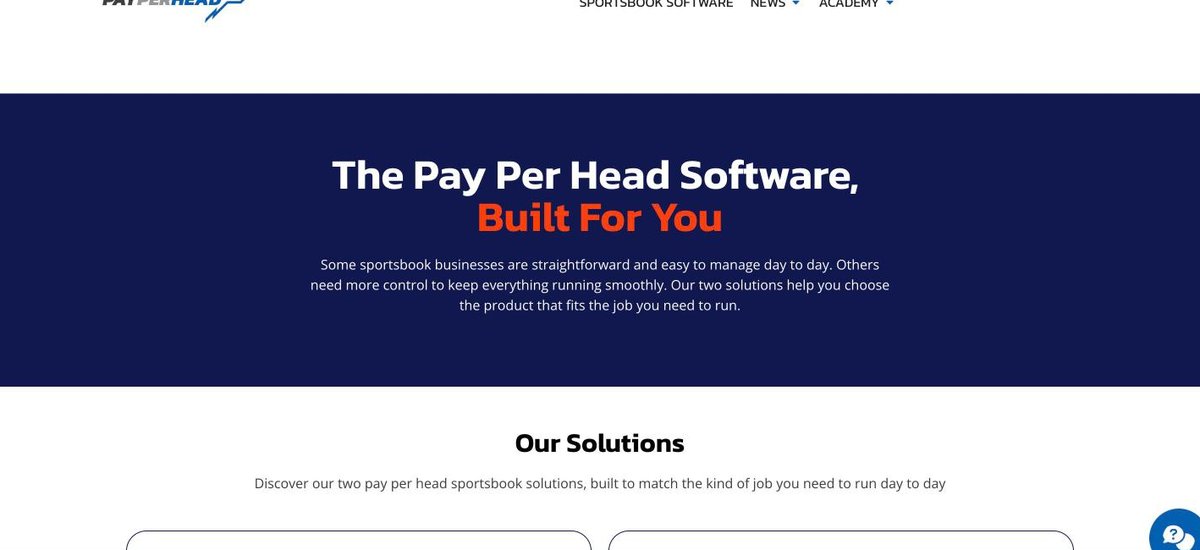
PayPerHead.com holds the category’s exact-match domain and ranked second for “is pay per head sportsbook legal” when checked, with its line that it “is not a sportsbook” widely quoted.
- Price: per player, per week, through an online calculator; no dollar figure on the homepage. It says there are no setup fees.
- Products: agent software with player management, risk tools, early parlay cash-out, sub-agents, player sign-up forms, custom sites and a “Pay & Collect Online” tool for cards, crypto and transfers.
- Base and licence: not stated. The site says it “does not accept online wagers” and is “not affiliated with any gaming business.”
- What customers say (from PayPerHead’s site): the site says the platform works for a book with “five players or 500” and lists no named clients.
- Red flags (as seen on 12 October 2026): “over 20 years” in one section and “25+ years” in the FAQ; two different copyright years. A “Pay & Collect” feature that moves money between agents and players sits awkwardly next to the claim that the platform has nothing to do with wagers.
4. PricePerPlayer
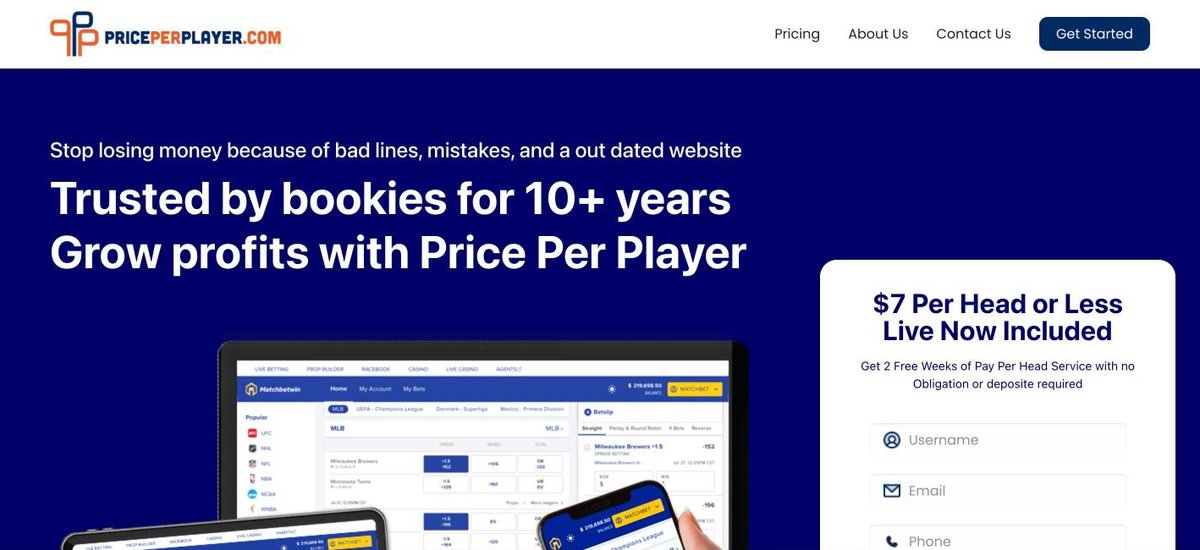
PricePerPlayer ranked third for “is pay per head sportsbook legal” when checked, with the legal page most often repeated in search summaries, and is the provider recommended (through affiliate links) by the BookiePayPerHead.net reviews that rank on page one.
- Price: “$7 per head or less,” with live betting included.
- Products: pre-game and live lines, prop builder, live dealer and virtual casino (40+ games), racebook (100+ tracks), multi-level agent hierarchies and reporting. The demo runs on the Matchbetwin platform.
- Payments shown: crypto, gift cards and Zelle.
- Base and licence: XT Online Software Services Ltda., San José, Costa Rica. No licence. It shows “endorsed by” badges without saying who endorses it.
- What customers say (from PricePerPlayer’s site): “Trusted by bookies for 10+ years,” with no named testimonials or case studies.
- Red flags (as seen on 12 October 2026): its legal page headline says PPH is “absolutely legal” and cites no statute, case or state; the Justice Department cases above contradict it. The homepage’s page text also contained what looked like injected spam links and a visible demo username and password.
5. PerHead.cr
PerHead.cr’s definition of PPH software and its claim that the software is legal were both widely repeated in search results when checked.
- Price: $7 per active player per week, no charge for players who don’t bet. Live dealer adds a 10% weekly profit share; its premium casino adds 15%. Custom site design from $300.
- Products: sportsbook, live betting, prop builder, casino, racebook (285+ tracks), multilingual call centre (English, Spanish, Chinese), online cashier and early cash-out settings.
- Payments shown: crypto, PayPal, bank wire, person-to-person transfers and cash.
- Base and licence: Costa Rica (the .cr domain and site copy); no registered address or licence. Its disclaimer says it is “the sole responsibility of the client to ensure compliance with all applicable laws.”
- What customers say (from PerHead.cr’s site): general claims of 24/7 support and “no upfront investment”; no named clients.
- Red flags (as seen on 12 October 2026): “founded in 2020” in the FAQ next to “20+ years industry experience in Costa Rica”; demo logins point to a different domain (888champs.com). The site served a CAPTCHA to our browser, so no screenshot was taken.
6. TIGSportsbook

TIGSportsbook is different from the other five. It presents itself as a B2B sportsbook software developer offering turnkey, white-label and custom builds, with PPH as one product line. It ranked seventh for “is pay per head sportsbook legal” when checked.
- Price: its own rate isn’t published. It says “most providers” charge $5 to $25 per active player per week and gives an example of 60 active players at $10, or $600 a week.
- Products: branded PPH platform with agent and sub-agent dashboards, credit limits, exposure tracking, layoff accounts, live betting and multi-currency support including Bitcoin, Ethereum and Tether.
- Base and licence: not stated. Its FAQ says “the software itself is legal” and that TIG provides “technology and infrastructure, not a betting license.”
- What customers say (from TIG’s site): no named clients or case studies on the PPH page.
- Red flags (as seen on 12 October 2026): a “GLI-Ready” badge with no certificate; launch times of 24 hours, 48 to 72 hours and 21 days on the same page; 99.99% uptime in a badge and 99.9% in the text. A tool marketed to “B2B operators” that also sells credit limits and layoff accounts for agents is selling to two very different buyers.
What the PPH “review” sites don’t tell you
- Who wrote it. Ace Per Head’s “independent bookie review” is authored by Ace Per Head. BookiePayPerHead.net carries PricePerPlayer affiliate banners and recommends it in the 247PPH review. Gambling911 discloses that Ace Per Head “has been a Gambling911.com partner for well over a decade.” SportsbookPayPerHead.com’s review of PayPerHeadGenius leaves the provider’s name blank in places and gives a 9.0/10 score with no method.
- Same company, different brands. RealBookies and 247PPH share contact addresses, so a “comparison” between them compares one operation with itself.
- Legal pages written by sellers. The most-cited legal answers come from PricePerPlayer, PerHead.cr and TIG, all of which sell PPH. None cites 18 U.S.C. § 1955, the statute used in PPH prosecutions.
Red flags for operators and affiliates
If you’re a licensed operator, a supplier or an affiliate, these are the signals that a PPH relationship carries more risk than it’s worth.
- No licence number, no regulator, no address. All six fail at least one of these.
- Fees paid in gift cards, MoneyGram or crypto. The same payment mix appears in the PremierPerHead indictment.
- Credit betting as a selling point. Licensed US sportsbooks can’t offer it the same way. It’s the feature that keeps PPH alive in legal states, and the one that ends in collection disputes.
- “We never touch the money” as the whole legal defence. Prosecutors charged PremierPerHead’s operators and Feinman anyway.
- Affiliate offers to promote PPH. Affiliates who knowingly drive US bookies to an unlicensed service can risk being treated as part of the business. Legitimate affiliate programs and payment providers that serve licensed operators will usually drop partners linked to it.
- Payment and banking exposure. The Bowyer case cost four Las Vegas casino operators $34 million in fines for taking an illegal bookmaker’s money without adequate source-of-funds checks. If a PPH agent is your customer, your AML program is on the hook.
What licensed operators can learn from PPH
PPH survives in states with legal betting because it offers two things licensed books can’t easily match: credit and a personal relationship with a local agent. The economics are simple, a flat weekly fee per active player against the licence fees, platform revenue share, KYC and compliance staff a regulated book carries. Our breakdown of whether sports betting is profitable shows how thin regulated margins are once tax and promotions come out.
For operators building a legal book, the parts worth studying are the agent tools: sub-agent hierarchies, per-player limits and fast settlement reporting. Licensed equivalents come from regulated platform and data suppliers. Start with our comparison of sports data providers, our guide to starting a licensed sportsbook and, for market entry, the licensing consultants who handle state applications.
This guide is general information, not legal advice. If you’re assessing exposure to a PPH business, talk to a gaming lawyer in the state concerned.