The short answer: iGaming affiliate marketing is a performance deal in which you refer players to a licensed casino, sportsbook, poker or bingo operator and get paid on what they do, through a fixed fee per depositor (CPA), a share of net gaming revenue (RevShare) or a hybrid of both. What you actually earn depends less on the headline rate than on how the contract defines net revenue, whether losses carry over, and whether you are licensed in the markets you send players from.
That last part is what most guides skip. This one is written from the affiliate’s side of the contract: the commission models with a worked negative carryover example, payment terms, licensing in New Jersey, Pennsylvania, Massachusetts, Ontario and the UK, Google’s ad and search policies, the metrics to track and the tracking platforms that produce your statements. Operators will find it useful as a view of what good affiliates now check before they sign.
What is iGaming affiliate marketing?
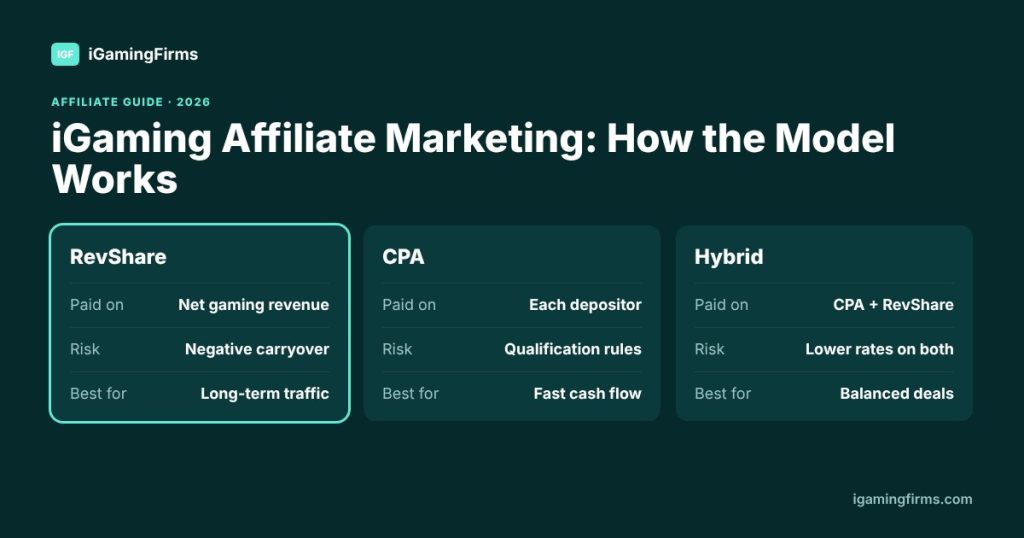
iGaming affiliate marketing is a performance partnership in which a publisher refers players to a licensed online casino, sportsbook, poker or bingo operator and is paid on what those players do: a one-off fee per qualifying depositor (CPA), a percentage of the net gaming revenue they generate (revenue share), or a mix of both (hybrid).
The flow is the same in every market:
- You join a program. Either an operator’s in-house program or a network, and you receive tracking links or codes.
- You send traffic. Review and comparison sites, sports and betting content, YouTube, streaming, newsletters, Telegram and social communities, or paid media where it is allowed.
- A player converts. They click, register and make a first-time deposit (FTD). The program’s tracking platform ties that player to your account.
- The operator calculates and pays. Usually monthly, on the program’s own reporting, under the commission plan in your contract.
If you are new to how the industry is structured (operators, platforms, suppliers and the verticals the term covers), start with our explainer on what iGaming is. For the vocabulary operators use in sports betting deals (handle, hold, GGR and the rest), keep the sports betting terms glossary open.
How do iGaming affiliates get paid? RevShare, CPA and hybrid
Almost every deal is one of three types. The headline percentage or fee matters less than the definitions underneath it.
| Model | What you are paid on | Who carries the risk | Watch in the contract |
|---|---|---|---|
| Revenue share (RevShare) | A percentage of the net gaming revenue (NGR) your referred players generate, usually for the life of the account | You. A player who wins costs you commission, sometimes for months | NGR definition, admin fee, negative carryover, lifetime vs time-limited |
| CPA | A fixed amount per player who meets a qualifying action, usually an FTD above a minimum deposit, sometimes plus verification or wagering | The operator. You are paid once whether the player is worth a lot or nothing | Qualification baseline, caps on monthly volume, quality reviews and clawbacks |
| Hybrid | A smaller CPA plus a smaller RevShare on the same player | Shared | Both sets of terms, plus whether the RevShare part is subject to carryover |
Other models: CPL, flat fees and sub-affiliate commission
You will also meet three less common structures:
- CPL (cost per lead). Paid per registration or qualified lead rather than per depositor. Rare in regulated casino and betting, because a registration without a deposit has little value to the operator.
- Flat fees. A fixed payment for a placement, listing or sponsored position, regardless of conversions. Common with large media affiliates and in markets that restrict revenue share.
- Sub-affiliate commission. An override on the commission of affiliates you recruit into the program. Blask cites Roobet’s terms: 5% of the recruited affiliate’s commission, released only after that sub-affiliate has referred five new depositing customers.
Tiers (a higher percentage once you pass a monthly FTD count) are a modifier on these models, not a separate model.
What the numbers actually look like
There is no industry-standard rate, and many figures you see online are illustrations rather than market data. Three useful reference points:
- PartnerMatrix, an affiliate software vendor, says revenue share “can vary a lot, from 5%-80%, depending on the brand”. Its tier table (25% for 1 to 9 players up to 45% for 500+) and its CPA tiers ($10 to $35 per player) are presented as an example plan, not a market survey.
- Some AI-generated answers repeat that $10 to $35 CPA range as an average. For regulated tier-1 markets such as the UK or US states, CPAs reported by programs run far higher, often into the hundreds of dollars, so don’t use the low figure to judge an offer.
- Listed affiliates show what the mix looks like at scale. Blask’s summary of 2025 reporting puts Better Collective’s revenue at 47% revenue share, 24% CPA, 5% subscriptions and 24% other income, and Raketech’s continuing operations at 47.4% revenue share, 27.3% upfront payments and 23.7% flat fees.
The practical rule: compare offers on expected value per player in your geo, not on the headline. A 40% RevShare on an aggressively defined NGR can pay less than 30% on a clean one, which is the next point.
Why the NGR definition matters more than the percentage
No regulator defines NGR for affiliate contracts. It is a contract term, and every program writes its own. A typical definition starts from gross gaming revenue (stakes minus winnings) and then deducts some mix of:
- bonuses and free bets credited to your players
- payment processing fees and chargebacks
- gaming taxes and levies
- progressive jackpot contributions
- a flat “admin fee” or platform fee, often a percentage of GGR
Blask quotes Roobet defining NGR as “gross gaming revenue less progressive contributions, non-cash incentives, chargebacks, balance adjustments, costs and taxes”. Gambling.com Group, a listed affiliate, describes its operators’ NGR as GGR adjusted for direct costs such as transaction fees, bonuses and taxation, and notes those costs can rise after a deal is signed. Each deduction is legitimate on its own. Stacked together, they can take a large share of GGR before your percentage is applied. Ask for the definition in writing, and ask whether the operator can change it during the contract (for example when a market raises gaming tax).
What is negative carryover?
Negative carryover (NCO) is a clause that carries a negative monthly NGR balance forward and deducts it from your future earnings, so you earn nothing on new revenue until the deficit is paid off. It exists because RevShare pays you a share of the house’s wins, and NCO makes you share the house’s losses too.
Programs handle it in three main ways:
- Full carryover. Any negative month rolls forward until it is cleared. This is the clause affiliates push back on hardest.
- No carryover (reset). Each month starts at zero. Affilka, which sells affiliate software to operators, writes that “many modern affiliate programs don’t do negative carryover, and we don’t recommend it either”.
- Limited or per-player carryover. Blask cites Roobet’s terms, which reset a negative month to zero “unless otherwise agreed in writing” but carry forward the deficit of any individual player who lost the program $10,000 or more, offsetting only that player’s future revenue.
The difference between pooled and per-player carryover is big. With pooled carryover, one high roller’s win can wipe out commission on every other player you referred. With per-player carryover, it only affects that player.
Worked example: same players, four deals
This is an illustration with made-up but realistic inputs, so you can see how the clauses interact. Assume you refer 40 qualifying depositors in month 1, and the cohort performs like this:
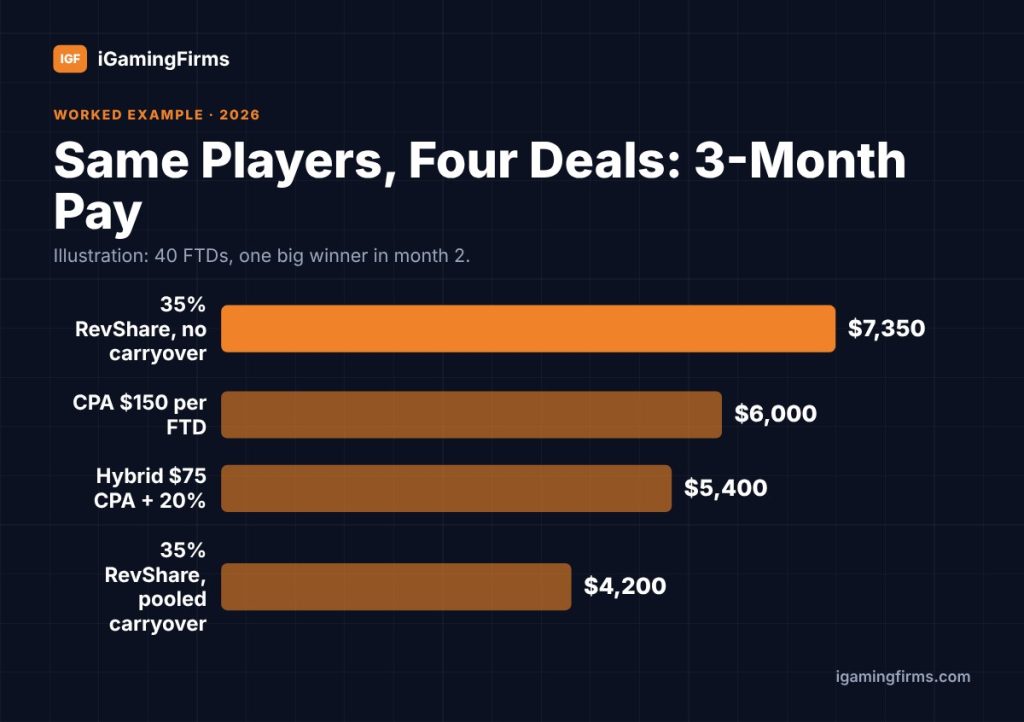
- Month 1: GGR $18,000, deductions (bonuses, payment fees, taxes) $7,000, so NGR is $11,000.
- Month 2: one player wins $15,000 net; the rest generate $9,000 GGR; deductions are $3,000. NGR is minus $9,000.
- Month 3: the big winner has left; NGR is $10,000.
| Deal | Month 1 | Month 2 | Month 3 | Total after 3 months |
|---|---|---|---|---|
| CPA $150 per FTD | $6,000 | $0 | $0 | $6,000 |
| 35% RevShare, no carryover | $3,850 | $0 | $3,500 | $7,350 |
| 35% RevShare, full pooled carryover | $3,850 | $0 | $350 (on $10,000 minus the $9,000 deficit) | $4,200 |
| Hybrid: $75 CPA + 20% RevShare, pooled carryover | $3,000 + $2,200 | $0 | $200 | $5,400 |
Three takeaways. A single winning player in month 2 cost the carryover deal $3,150 in month 3 alone. The CPA deal looks worst on a long horizon but is the only one that was not exposed to that player at all. And under a per-player carryover clause like the one quoted above, the month 3 result would match the no-carryover row, because the deficit sits only on the player who left. If your traffic skews to high-value players (VIP-heavy casino content, high-stakes poker), NCO terms matter more than the headline percentage.
Payment terms: when you actually get paid
Commission is earned when the month closes, but it is paid when the program says so. Affilka describes the common pattern: programs “tend to remunerate partners once a month”, usually “within 10 days after the end of the business month”, with minimum payout thresholds that “can be as low as $20 or as high as $200”. Below the threshold, the balance rolls into the next month.
Before you send meaningful traffic, get written answers to these:
- Payment date and method. Bank transfer, e-wallet or crypto, and who pays the fees and currency conversion.
- Threshold and rollover. What happens to balances below the minimum.
- Holds and reversals. How long a CPA can be reviewed or clawed back for fraud, bonus abuse or chargebacks.
- Statement source. Which platform the numbers come from, and whether you can see player-level data (anonymised) or only totals.
- Lifetime and termination. Whether RevShare continues on your players if the program ends the deal. In the UK, operators must keep the right to terminate affiliate contracts promptly (see the licensing section), so read what happens to your earned and future commission when that right is used.
- Licence-related holds. In US states that license affiliates, programs can hold commission for a state while your registration is pending or if it lapses.
Do iGaming affiliates need a licence?
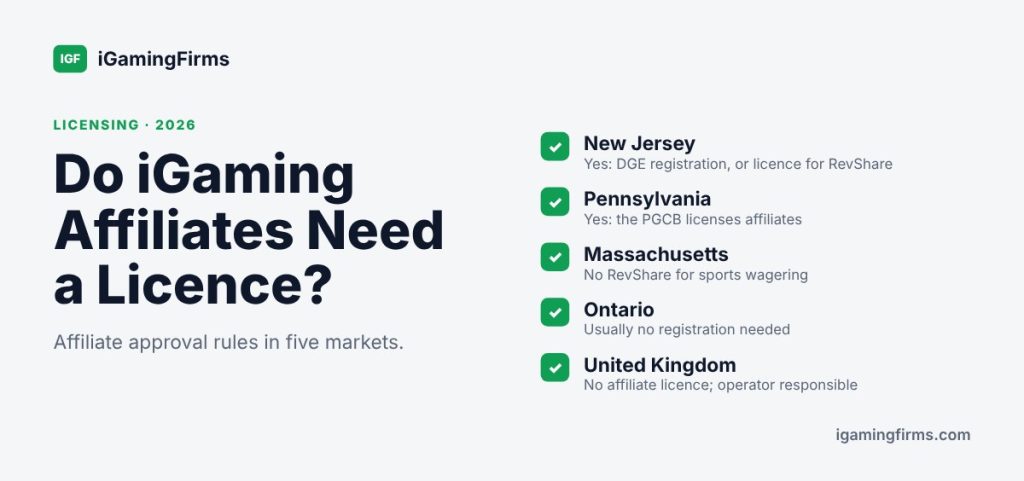
It depends on where the players are. In several US states you need your own registration or licence before an operator can pay you; in Ontario marketing affiliates may not need to register but the operator answers for what you publish; in the UK the affiliate doesn’t hold a Gambling Commission licence but is contractually bound to the operator’s licence conditions. The details below are a starting point, not legal advice. Fees and categories change, so confirm with the regulator or a specialist before you launch in a market. For the state-by-state picture of what is legal at all, see our US gambling laws by state map.
| Market | Does the affiliate need approval? | What it means for your deal |
|---|---|---|
| New Jersey | Yes. The Division of Gaming Enforcement has used two tracks: a vendor registration for CPA and media-buy deals, and an ancillary casino service industry enterprise licence for revenue share (GPWA reported a $2,000 upfront fee for the licence in 2015; check current fees with the DGE) | RevShare in NJ needs the heavier licence. Many affiliates start on CPA while that is processed |
| Pennsylvania | Yes. The Pennsylvania Gaming Control Board licenses affiliates and marketing partners; 2018 reporting noted an application fee even at the CPA level and a certification fee every five years | Budget time and fees per state before you count on US revenue |
| Massachusetts (sports betting) | Rules apply to the operator: 205 CMR 256.01(3) bars operators from paying third parties for marketing “in exchange for a percentage of sports wagering revenue earned from users” they direct to the operator | No RevShare at all. CPA and flat fees only |
| Ontario | Usually no. The AGCO’s suppliers application guide lists businesses that “might sometimes be called ‘marketing affiliates'” among those that may not need to register, with each case decided individually | The AGCO’s 2022 advertising notice says operators must ensure their marketing affiliates meet the standards, and that “public advertising of inducements, bonuses and credits is strictly prohibited”. No bonus-led landing pages for Ontario traffic |
| United Kingdom | No affiliate licence for publishers that only refer players to licensed operators. The operator is responsible under LCCP condition 1.1.2, “including for affiliates where they have breached a relevant advertising code of practice” | Your contract must bind you to the operator’s licence conditions and codes and let it terminate promptly. Since 19 January 2026 bonus wagering is capped at 10x and mixed-product promotions are banned, so older bonus copy is now inaccurate |
Two patterns run through all five. First, regulators increasingly regulate the affiliate through the operator, so the operator’s compliance team becomes your de facto regulator: creative approvals, takedown requests and audits of your pages. Second, the payment model itself can be regulated. Massachusetts bans RevShare for sports wagering, and New Jersey treats RevShare as a heavier licensing category than CPA. If you work US traffic, your commission plan may differ state by state for the same brand.
If you are on the operator side in Britain, our UKGC licence guide covers the licence your affiliates are working under.
How do you become an affiliate for a US sportsbook?
People search this for specific brands (DraftKings and Fanatics are common examples). The mechanics are the same for any licensed US operator: apply to the brand’s program, then complete the vendor registration or licensing step in each state where you will send players before commission is paid for that state. Expect the program to ask for your registration numbers and to restrict RevShare where state rules require it.
Google Ads and gambling affiliates
Paid search is possible for affiliates, but only inside a narrow lane. Google’s gambling and games policy requires advertisers to “apply for certification from Google” to run gambling or gambling-promoting content, with a separate application for each country. Affiliates fall under online gambling-promoting content, which covers “aggregator or affiliate sites that provide information about, or a comparison of, other gambling services”. The conditions:
- the site must not offer gambling itself or link to gambling services it owns
- it must “link exclusively to fully licensed and authorized gambling entities” in the targeted region
- its footer must state that all outbound links go only to gambling entities licensed and authorized in that location
- certification must be renewed after any material change to the application details
In practice that means one certification per country, a landing page that links only to brands licensed for that country, and no social casino promotion through affiliates (the policy does not allow aggregators and affiliates to promote content that directly promotes social casino games).
SEO for iGaming affiliates: what changed from 2024 to 2026
Organic search is still the core channel for most affiliate businesses, and it is the one that changed most. Three shifts matter, and the second one also answers the AI content question.
Parasite SEO became a named policy
Google introduced new spam policies alongside its March 2024 core update, and site reputation abuse is the one that hit gambling hardest. Under Google’s current spam policies, the problem is third-party content hosted mainly to borrow a host site’s ranking signals.
One of Google’s own examples is a medical site hosting a low-quality, third-party “best casinos” page that isn’t integrated with the site. The policy was revised in November 2024 and again in August 2026 (the page is dated 28 August 2026). It now says that inside the EEA, affected pages may be categorized as separate from the main site but won’t get a manual action, while pages shown to users outside the EEA, including the US and UK, can still receive one.
What it means for you: renting a “betting” section on a newspaper or university domain is a short-term bet, and a tactic that seems to survive in an EEA market may not survive for UK or US searchers. Our iGaming SEO guide has the full 2026 update timeline.
Scaled and expired-domain content is explicitly covered
The same policy page defines scaled content abuse as “when many pages are generated for the primary purpose of manipulating search rankings”, regardless of how they are made, and expired domain abuse as an expired domain “purchased and repurposed primarily to manipulate search rankings”. Both describe common affiliate shortcuts: thousands of near-identical bonus or slot pages, and casino content dropped onto old domains.
Can you use ChatGPT for affiliate marketing?
Yes, as a drafting and analysis aid. The policy targets the purpose and the result (many pages with little value), not the tool. The risk is publishing AI-written reviews at scale without real checking of licences, terms and payout facts, which is exactly what the scaled content policy describes. Use AI to speed up research and first drafts, then have someone who knows the market verify every licence, rate and term before it goes live.
The results page itself changed
We checked the live US results for “igaming affiliate marketing” on 15 October 2026. An AI Overview sat above the organic results. Page one was led by affiliate tracking vendors (Tracknow and Voluum took the top two spots), followed by an affiliate agency, a payments company and an ad network, with a Reddit thread and a BlackHatWorld post in a separate “discussions and forums” block. On our 11 October check, a Reddit thread from a new affiliate held the top organic spot, so community results move in and out quickly.
That is a different pattern from gambling money terms. On our 6 October check of queries like “best online casino uk”, no AI Overview appeared. For you, the split is useful: informational and B2B queries around affiliate marketing now get AI answers and community results, while “best casino” style commercial queries still lean on publishers and comparison sites. Plan content accordingly, and don’t assume an AI-answer strategy transfers to money pages.
How to start as an iGaming affiliate
The sequence that avoids the most expensive mistakes:
- Pick a legal market first, then a niche. Choose the geos you can serve under the rules above, then a focused vertical (sports betting, casino, poker, bingo, lottery) and angle you can cover better than generalist sites.
- Choose one main traffic source. SEO content, YouTube or streaming, a newsletter or community, or paid media where Google certification and local law allow it. Spreading across all of them early dilutes your data.
- Screen programs before you apply. Use the checklist further down: licensing, NGR definition, carryover, payment terms and tracking.
- Build content that would survive a compliance review. Age and safer gambling messaging, accurate terms, no bonus-led pages where inducements can’t be advertised, and links only to brands licensed for the reader’s market.
- Track the full funnel. Clicks, registrations, FTDs and player value per program, so you can compare deals on real numbers.
- Renegotiate or switch models once you have data. A few months of FTD and player-value data is your strongest argument for a better rate or a different model.
Which metrics should iGaming affiliates track?
Your statement shows commission. These ratios tell you why it moved:
| Metric | How to calculate it | What it tells you |
|---|---|---|
| Click-to-registration rate | Registrations ÷ clicks × 100 | How well your traffic matches the brand and its landing page |
| Reg2Dep (registration-to-FTD rate) | FTDs ÷ registrations × 100 | Player intent and how smooth the operator’s KYC and cashier are |
| EPC (earnings per click) | Commission ÷ clicks | The fairest way to compare programs and placements on the same page |
| Commission per FTD | Total commission from a cohort ÷ FTDs in that cohort | Whether RevShare is beating the CPA you were offered for the same players |
| NGR per player | Cohort NGR ÷ active players | Player quality; falling NGR with stable GGR points to rising deductions |
| Retention or churn | Players still active after 30, 90 and 180 days | How much a lifetime RevShare is really worth |
What is the 80/20 rule in affiliate marketing? It is the Pareto idea that most results come from a small share of inputs. In iGaming it shows up twice: a small group of high-value players usually drives most of a cohort’s NGR (which is why carryover terms matter so much), and a small group of pages, keywords or partners usually drives most of your FTDs. Use the metrics above to find your 20% and put your effort there.
Tracking platforms: where your numbers come from
Every statement you receive is produced by the operator’s affiliate platform. In regulated iGaming the most widely used include Cellxpert, NetRefer, MyAffiliates, Affilka by SOFTSWISS and Income Access, with PartnerMatrix, ReferOn, Track360, RavenTrack, Scaleo, Alanbase and IREV used by specific operator profiles. Media buyers often add their own click tracker on top to compare networks and placements.
The platform matters to you for three reasons:
- It holds the commission logic. NGR deductions, carryover rules and CPA qualification are configured there. If a statement looks wrong, ask which plan you are assigned to and how it is set up.
- It decides attribution. Cookie windows, postbacks for app installs and how a player who clicked two affiliates is assigned.
- It shows how much data you get. Some programs give player-level (anonymised) reporting; others only totals. Better visibility makes disputes rare.
Our comparison of iGaming affiliate platforms covers how each one handles NGR and negative carryover, and the Affiliate Platforms directory lists the providers by category.
How much can a beginner affiliate make?
There is no reliable published average, and anyone quoting one is guessing. What community threads and practitioner accounts consistently show is a slow start: new affiliate sites often see few or no depositing players in their first months while content ranks and programs approve them. Earnings depend on the geo you can legally serve, the value of the players your content attracts, and the deal terms above. A useful early milestone is not revenue but data: enough FTDs to see your real CPA value and player quality, so you can negotiate a better deal or switch models.
Is iGaming the highest-paying affiliate niche?
It is often described that way, because a lifetime RevShare keeps paying for as long as a player stays active, and because CPAs in regulated markets are high compared with most retail affiliate programs. The catch is everything above: licensing costs, negative carryover, operator-defined NGR, advertising restrictions and Google’s tighter treatment of gambling content. A smaller offer in a market you can serve legally will usually beat a bigger one you can’t.
Which casino affiliate programs should you join?
We don’t rank operators or their programs. What you can do is screen any program against the same checklist:
- Is the brand licensed in every market you will send players from, and can you prove it?
- Is the NGR definition in writing, including the admin fee and every deduction?
- Is there negative carryover, and is it pooled or per-player?
- Is RevShare lifetime, and does it survive termination?
- What is the payment date, threshold and method?
- Which tracking platform does it use, and what reporting do you get?
- Does it require your state registrations (US) before paying, and does it support your creative within UK and Ontario rules?
If you are an operator setting up or outsourcing a program, our list of iGaming marketing agencies includes firms that run affiliate management.
Common mistakes affiliates make
- Comparing headline percentages. Compare effective payout per player after NGR deductions and carryover.
- Sending traffic before the licence is in place. In licensing states, commission for that state can be held, or never paid, until you are approved.
- Leaving old bonus copy live. UK pages still showing wagering above 10x, or Ontario pages advertising sign-up offers publicly, put the operator at risk, and UK operators must be able to end an affiliate contract promptly when that happens.
- Building on borrowed authority. Parasite sections and expired domains are named in Google’s policies.
- Ignoring traffic quality. Incentivised or bot traffic and bonus abusers get CPAs reversed and can end the relationship. Check how the program defines and reviews fraud before you scale.
- Not reading the termination clause. A lifetime RevShare is only lifetime until the contract says otherwise.
Regulators and Google both changed the rules for affiliates several times in the past two years, and both will change them again.