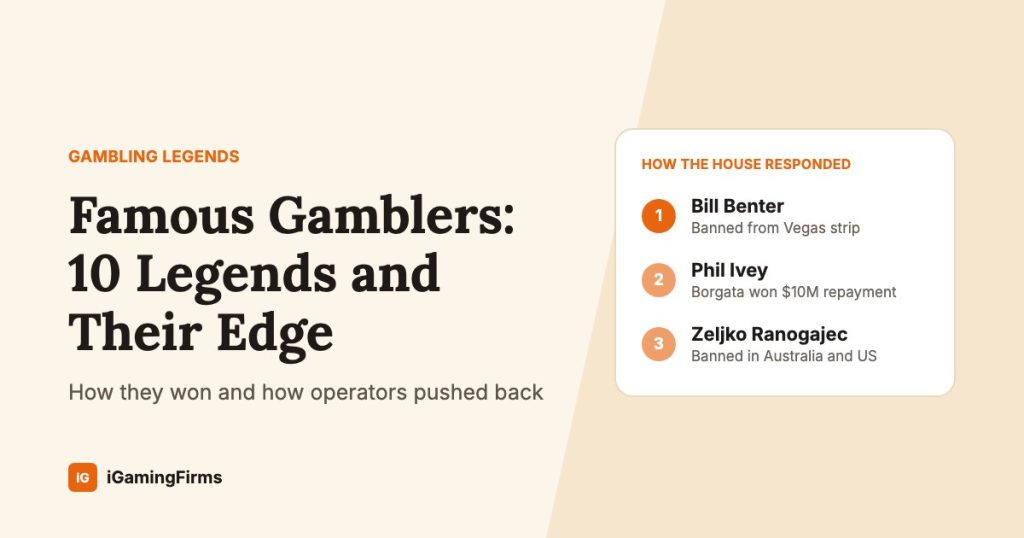
This guide gives the source for each headline figure and shows what the casinos, bookmakers and courts did once these players started winning.
The short answer: the most famous gamblers in history, such as Edward Thorp, Bill Benter and Billy Walters, won mainly with maths, models and scale rather than luck. Each of their stories forced a lasting change on the industry. Thorp’s card counting led Las Vegas casinos to rewrite blackjack rules in 1964. Nevada then made computer-assisted play a crime in 1985. Benter’s horse racing model pushed the Hong Kong Jockey Club to publish far more racing data to level the field. Phil Ivey’s edge sorting case even changed how English courts define dishonesty.
This guide profiles ten people, keeps every figure tied to a named source and drops any number that could not be checked. It is written for operators, risk teams, affiliates and analysts who want the industry lesson behind each story, not a reason to bet.
Famous gamblers compared: method, result and industry impact
| # | Name | Main arena | How they won | Verified headline result | What it changed in the industry |
|---|---|---|---|---|---|
| 1 | Edward O. Thorp | Blackjack, roulette | Card counting proven by probability theory; first wearable computer with Claude Shannon | Beat the Dealer (1962) sold over one million copies | 1964 Las Vegas blackjack rule changes; later device bans for advantage play |
| 2 | Bill Benter | Hong Kong horse racing | Statistical model combined with the public odds | Says his operations have “probably made close to a billion dollars overall” | Hong Kong Jockey Club suspended syndicate phone accounts in 1997, then published more data |
| 3 | Billy Walters | US sports betting | Computer Group models, then an information network and runners | Publisher cites a 36-year winning streak | Sportsbook limits, account closures and line-moving tactics that shaped how books manage sharp money |
| 4 | Phil Ivey | Poker; baccarat and punto banco | Poker skill; edge sorting at baccarat | 11 WSOP bracelets; about £7.7 million punto banco win that the casino refused to pay | UK Supreme Court ruling that edge sorting is cheating; US Borgata judgment |
| 5 | Archie Karas | Las Vegas poker, pool, craps, baccarat | High-stakes play with no stated system | Turned a $10,000 loan into more than $40 million, then lost nearly all of it in 1995 | House bet caps on a single player; Nevada excluded person listing in 2015 |
| 6 | Zeljko Ranogajec | Blackjack, horse racing pools, exchanges | Card counting, then high-volume betting plus negotiated rebates | Blackjack Hall of Fame 2011; listed on the AFR Rich List from 2019 | Debate over turnover rebates to big punters in Australian tote markets |
| 7 | Doyle Brunson | Poker | Poker skill; wrote Super/System | 10 WSOP bracelets, including the 1976 and 1977 Main Events | Published poker strategy for the public; SEC probe into his WPT Enterprises bid |
| 8 | Chris Ferguson | Poker | Game theory and computer simulation | 2000 WSOP Main Event champion; six bracelets | Full Tilt Poker co-founder; named in the 2011 DOJ civil case after Black Friday |
| 9 | Howard Lederer | Poker | Strategic, teaching-led approach | Two WSOP bracelets (2000, 2001); two WPT titles | 2012 DOJ settlement; agreed not to work for online gambling sites until the US legalises and regulates them |
| 10 | Alan Woods | Blackjack, then Hong Kong horse racing | Card counting team leader; computer model first built with Benter | Will listed assets of about A$939 million, per a book cited by Bloomberg | Syndicate scale that drew the 1997 Jockey Club phone betting ban |
The serial numbers match the order of the profiles below. Wealth figures are estimates unless a court or filing is named.
The 10 famous gamblers and what each one changed
1. Edward O. Thorp
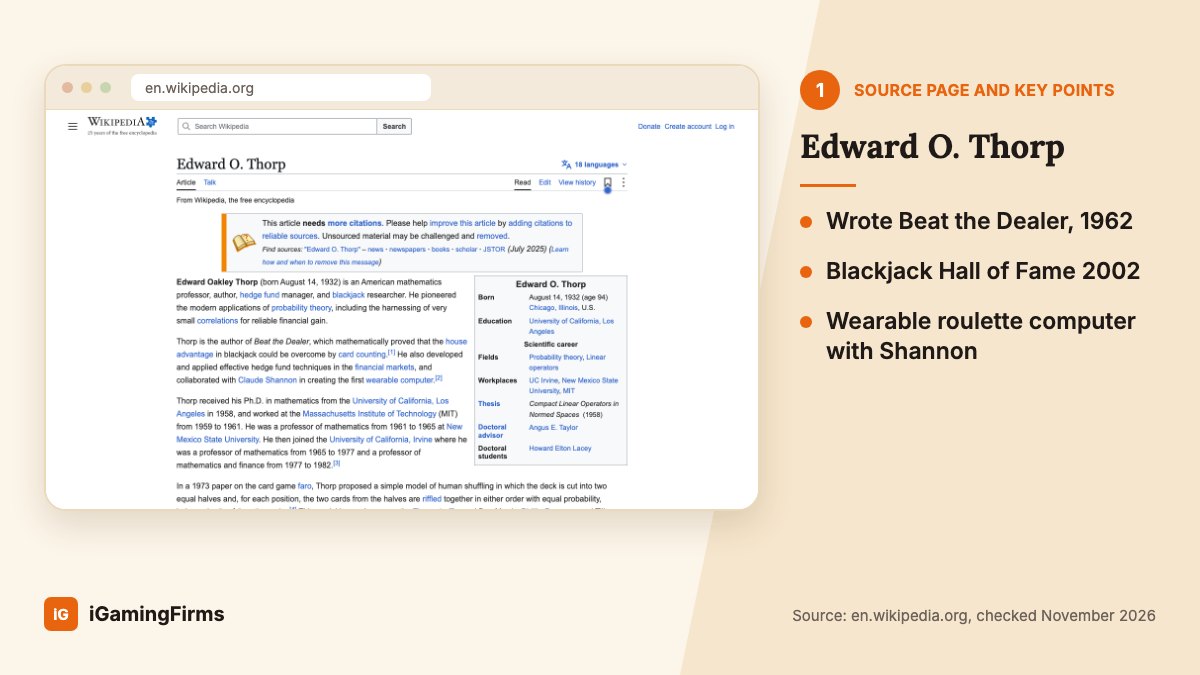
Thorp is the mathematician who proved that blackjack could be beaten. He presented his findings to the American Mathematical Society in January 1961 in a talk titled “Fortune’s Formula: The Game of Blackjack”, according to the University of California, Irvine library exhibit on his papers. Random House published Beat the Dealer in 1962. The same exhibit says the book sold over one million copies and is credited with changing the casino industry. His official biography describes it as the first book to prove mathematically that the house edge in blackjack could be overcome by card counting.
Thorp also worked with Claude Shannon, the father of information theory, on what his official site calls the first wearable computer, built to predict roulette. He was part of the first Blackjack Hall of Fame class in 2002, as the Hall’s member list shows. He later took the same probability thinking to Wall Street, which he describes in his 2017 memoir A Man for All Markets.
What it changed: casinos reacted fast. On April 3, 1964, The New York Times reported that Las Vegas had altered the rules of 21 because of the book, limiting doubling down to a two-card eleven and restricting the splitting of aces. The wearable computer work points to a second, longer-lasting response. Nevada’s NRS 465.075, added in 1985, makes it a crime to use any device designed to track cards, project outcomes or analyse strategy in a licensed casino. That is still the legal basis for device bans today.
2. Bill Benter
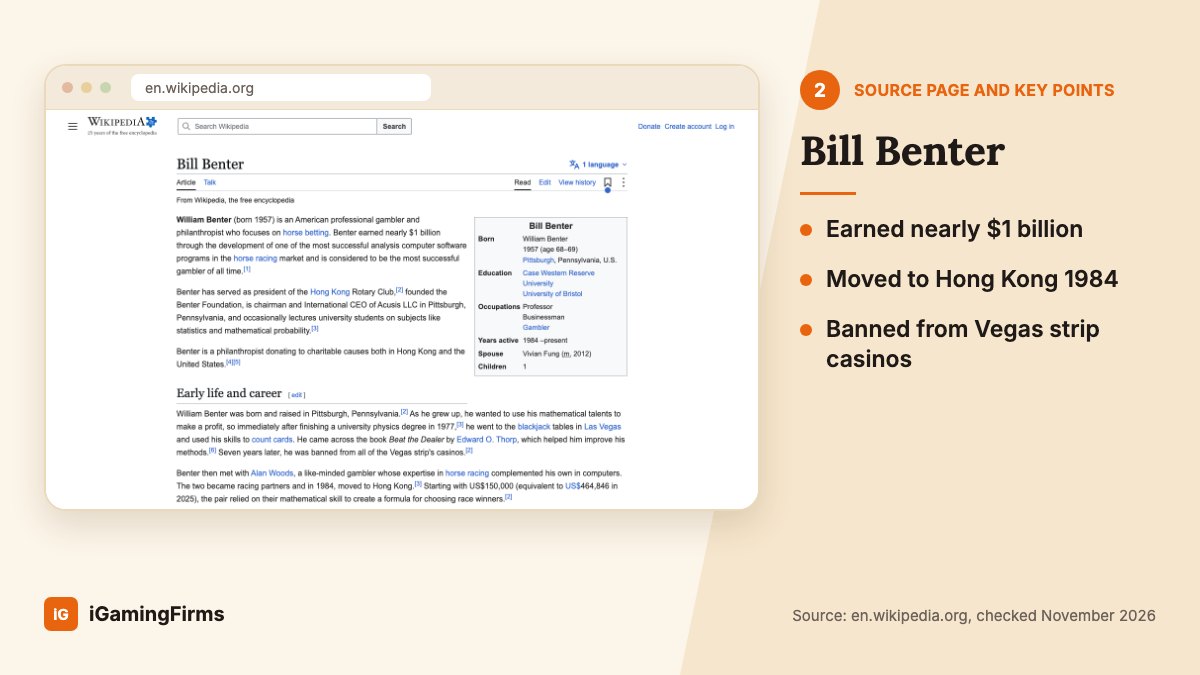
Benter, born in Pittsburgh in 1957, started as a card counter and joined Alan Woods’s Australian blackjack team around 1980. A 2018 Bloomberg Businessweek investigation reports that around 1984 he and his partners were placed in the Griffin Book, a detective agency blacklist circulated to casinos, which made it almost impossible to keep playing in Las Vegas. He moved to Hong Kong to bet on horse racing.
His model started from a multinomial logit approach that weighted factors such as speed, size, winning record and jockey skill. Bloomberg reports it tracked about 20 inputs at first and more than 120 per horse by 2000. The breakthrough was using the Hong Kong Jockey Club’s own public odds as the starting point and refining them. His 1995 paper on computer-based handicapping became, in Bloomberg’s words, a manual for a generation of high-tech gamblers. Benter told Bloomberg his operations had “probably made close to a billion dollars overall”. He added that he was not a billionaire, so treat the round “$1 billion” figure you see elsewhere as an estimate of gross winnings, not personal wealth.
He was inducted into the Blackjack Hall of Fame in 2016. He founded the Benter Foundation in Pittsburgh in 2007. It funds early childhood learning, downtown Pittsburgh projects and opioid-related community work.
What it changed: in 1997 the Hong Kong Jockey Club revoked Benter’s special betting terminal privileges and suspended his and Woods’s phone accounts to “protect the interests of the general betting public”, Bloomberg reports. The longer-term answer was transparency. The Club began publishing large amounts of technical racing data and colour-coded its odds boards to flag big swings in money. It lifted the phone betting ban later in 2001. For pool operators, the lesson is that a model-driven syndicate exploits information gaps, so closing those gaps is a defence that does not depend on banning anyone.
3. Billy Walters
Walters, born in 1946 in Munfordville, Kentucky, is widely described as one of the most successful sports bettors ever. An ESPN investigation from 2015 reports that he joined the Computer Group, founded in 1980 to apply computer algorithms to sports betting, in 1983. FBI raids hit the group in 1985. Walters was acquitted in 1992 of conspiracy and illegal transmission of wagering information. A later state money-laundering case was dismissed in 2002.
ESPN reports that a 2002 investigation found him winning up to 58% of the time in some weeks, against a break-even point of about 52.38% at standard -110 pricing. His publisher, Simon & Schuster, describes a winning streak of 36 consecutive years. Avid Reader Press released his memoir, Gambler: Secrets from a Life at Risk, on August 22, 2023. That month he entered the inaugural class of the Sports Gambling Hall of Fame at Circa in Las Vegas, the Las Vegas Review-Journal reported.
Walters was convicted of insider trading in Dean Foods shares in April 2017. A federal judge in Manhattan sentenced him to five years in prison and a $10 million fine, the Review-Journal reported. That case had nothing to do with sports betting. On January 20, 2021 the White House commuted his sentence, noting he had served nearly four years and paid $44 million in fines, forfeitures and restitution.
What it changed: Walters is the template for how sportsbooks think about sharp money. ESPN describes paid runners who placed bets without revealing who was behind them, with each bet kept under limits of about $10,000 on college games and $20,000 on NFL games. He also placed deliberate early bets to move a line before taking a larger position on the other side. Modern limit-setting, account profiling and line management grew out of this cat-and-mouse game. If you run trading, our guide to betting risk management software shows how books now automate the same defences.
4. Phil Ivey
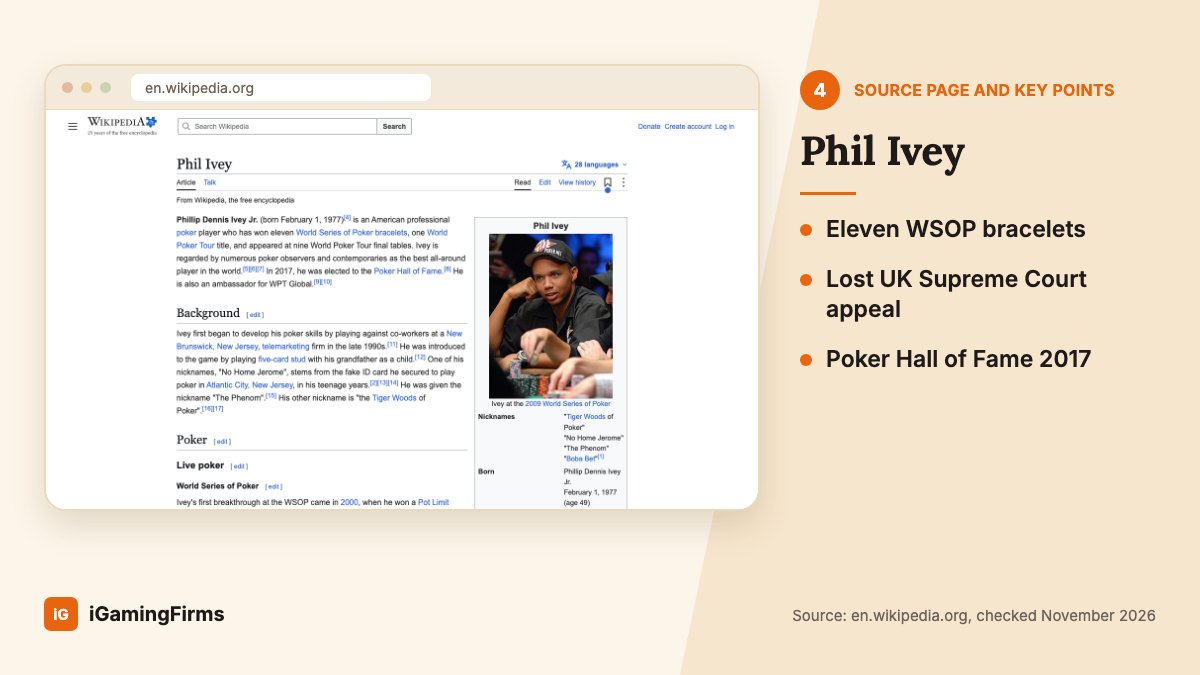
Ivey won his 11th World Series of Poker bracelet in June 2024 in the $10,000 Limit 2-7 Triple Draw Championship for $347,440. PokerGO Tour reported that the win took his WSOP earnings past $10 million and his lifetime tournament earnings past $45.3 million, citing The Hendon Mob. PokerGO Tour noted that this left him second only to Phil Hellmuth, who had 17 at the time. Ivey was elected to the Poker Hall of Fame in 2017, PokerNews reported.
For the industry, his two baccarat cases matter more than his poker titles. In August 2012 he won just over £7.7 million playing punto banco at Crockfords in London. The casino refused to pay beyond his stake. Ivey sued and lost at every level. On 25 October 2017 the UK Supreme Court ruled in Ivey v Genting Casinos (UK) Ltd that his edge sorting was cheating. The trial judge had found him a truthful witness who genuinely believed he was not cheating. The Supreme Court held that this did not matter.
In the US, the Borgata in Atlantic City sued Ivey and his partner Cheung Yin Sun over about $9.6 million won at baccarat in 2012. In 2016 a federal judge ordered Ivey to pay $10.1 million. The parties settled in July 2020 on undisclosed terms, Card Player reported.
What it changed: the edge sorting cases gave casinos on both sides of the Atlantic a clear legal basis to refuse or recover winnings from players who manipulate how cards are presented. They also pushed table games teams to tighten controls on player requests about card handling. For the wider legal picture, see our guide to whether gambling is legal in the UK.
5. Archie Karas
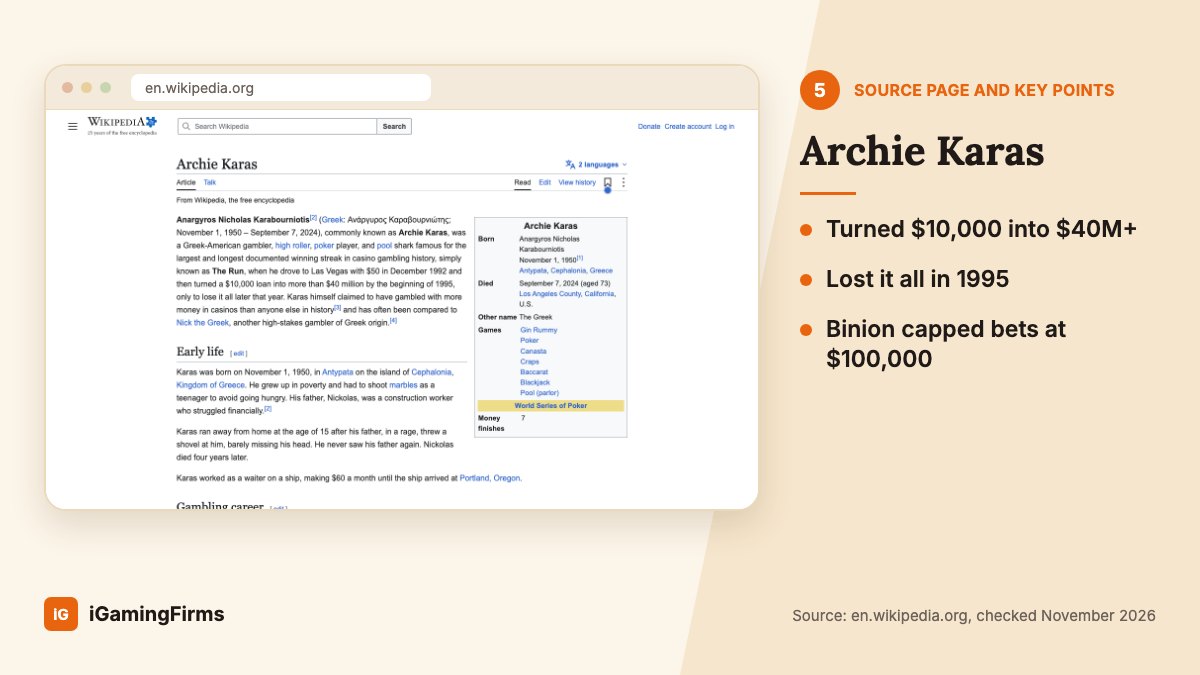
Karas, born Anargyros Karabourniotis in Greece in 1950, is the counterexample on this list. PokerNews reported his death at 73 in September 2024. It recounts how he drove to Las Vegas with $50 in December 1992, borrowed $10,000 from a poker player and turned it into $30,000 at razz before repaying the backer. Over less than three years he built a bankroll of more than $40 million through high-stakes poker, pool, craps and baccarat. In 1995 he lost all but $12 million within three months, mostly at craps and baccarat. He later lost the rest. No counting system or model was ever described. The streak is known simply as “The Run”.
Later events were less romantic. PokerNews reports he was sentenced to probation and a fine in 2014 after being caught cheating at blackjack in a San Diego-area casino. The Nevada Gaming Commission added him to its excluded person list on September 17, 2015, under his birth name with “Archie Karas” listed as an alias.
What it changed: Karas shows the other house tool besides banning: the betting cap. In a 2008 PokerNews series based on Karas’s own account, Jack Binion capped his craps buy bets on the 4 and 10 at $100,000. When a floor man let him buy the 4 for $200,000, Karas rolled it at once and collected $920,000. Binion reversed the change on the spot. A streak without an edge is something casinos can afford to accept, because variance usually brings the money back, as it did here. A capped maximum protects the house from the tail risk while the edge does the rest.
6. Zeljko Ranogajec

Ranogajec, born in Hobart in 1961, began as a card counter at Wrest Point casino. The Herald Sun reported in 2010 that he was banned from most Australian casinos, including Wrest Point and Jupiters on the Gold Coast. He was later turned away by US casinos too. He was inducted into the Blackjack Hall of Fame in 2011. He worked with Alan Woods in the 1980s and, as Bloomberg’s Benter investigation notes, went on to run a global algorithmic gambling operation.
His later edge was as much commercial as mathematical. Australian press reports describe large turnover rebates negotiated with wagering operators, including Tabcorp. In 2011 Tabcorp told the Herald Sun it had investigated and found no evidence of illegal activity. The Examiner reported in 2012 that he was named as leader of a syndicate that profited from a rebate arrangement with Tote Tasmania before the state sold the business. The Australian Financial Review reported a confidential settlement with the Australian Taxation Office in October 2012. Press coverage has also linked him to the UK pool betting firm Colossus Bets. Its chief executive until 2020 was Bernard Marantelli. He rarely gives interviews and has called claims that he is the world’s biggest punter “a big exaggeration”. Treat turnover estimates attached to his name as unconfirmed.
What it changed: Ranogajec put a spotlight on rebates. A tote pool takes a fixed commission, so a high-volume player who gets part of that commission back can win even with a small edge. Operators gain liquidity from such deals, while recreational players face sharper competition in the same pool. If terms such as turnover, handle and rebate are new to you, our glossary of sports betting terms explains them.
7. Doyle Brunson
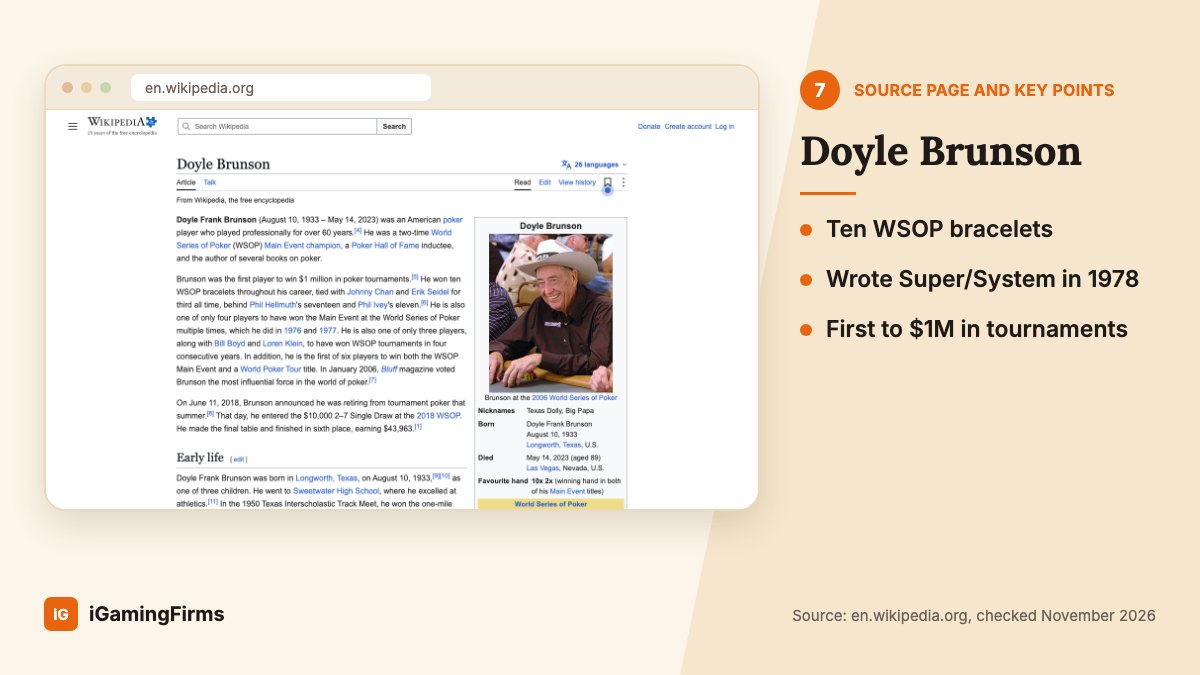
Brunson, born in Longworth, Texas, in 1933, won the WSOP Main Event in 1976 and 1977 and took 10 bracelets in all. His WSOP player profile lists 46 cashes and $5,161,028 in WSOP winnings. He was inducted into the Poker Hall of Fame in 1988. He died in Las Vegas on May 14, 2023, aged 89, the Las Vegas Review-Journal reported.
His lasting contribution is Super/System, first self-published in 1978. The book is credited with showing ordinary players how professionals actually played and won. That made poker a game you could study, which later fed the market for strategy books, training sites and software.
What it changed: Brunson’s career also shows how poker became a corporate business. In July 2005 he made an unsolicited offer to buy WPT Enterprises, the listed owner of the World Poker Tour. On December 14, 2005 the SEC filed an action to enforce subpoenas on his lawyers. It was investigating whether the offer and its promotion broke antifraud rules after WPT’s share price spiked and then fell. Brunson invoked the Fifth Amendment. Press reports in 2007 said the SEC had dropped the matter. Once poker had listed companies, TV rights and online rooms, securities law became part of the game.
8. Chris Ferguson
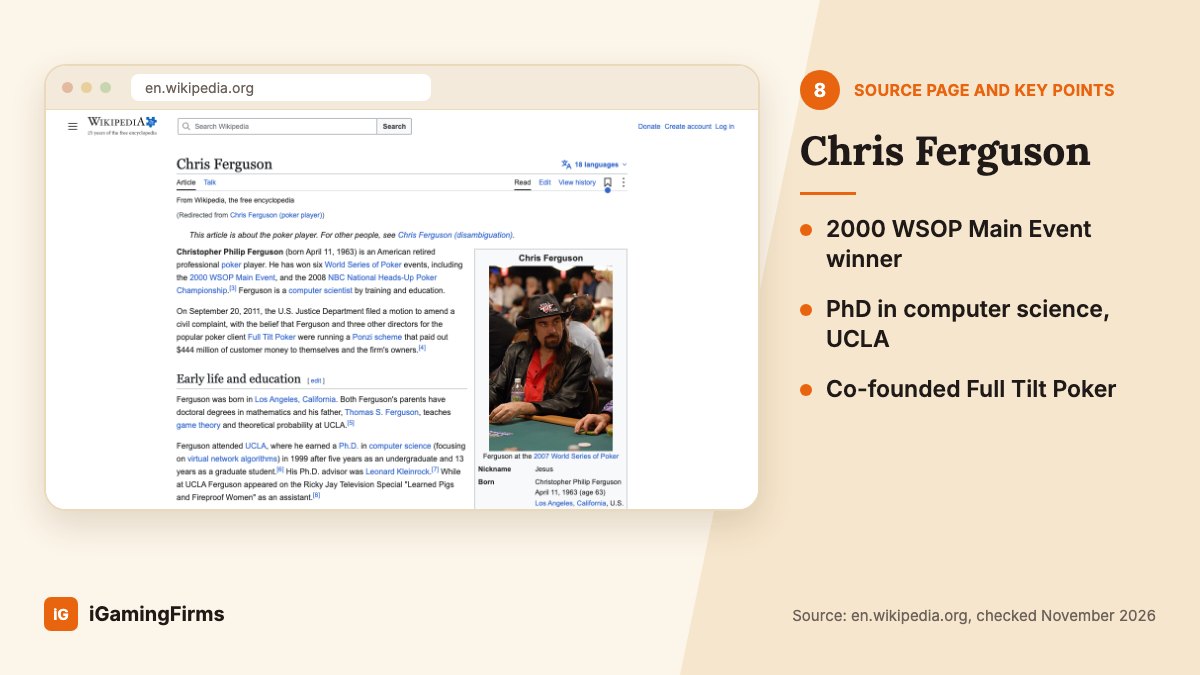
Ferguson earned a PhD in computer science from UCLA in 1999 and won the 2000 WSOP Main Event a year later, beating T. J. Cloutier heads-up for $1.5 million. He built his style on game theory and his own computer simulations, years before solver software became normal for serious players. In 2017 he won his sixth bracelet at WSOP Europe in a €1,650 pot-limit Omaha eight-or-better event, Card Player reported. It was his sixth cash at that WSOP Europe, on top of 17 cashes at the Las Vegas series that summer.
Ferguson co-founded Full Tilt Poker in 2004. After the US government’s April 2011 action against online poker, known as Black Friday, the site could not repay about $300 million in player funds, Card Player reports. In September 2011 the Justice Department amended its civil complaint to allege that Full Tilt’s directors, Ferguson among them, had run what it called a global Ponzi scheme. Ferguson’s lawyer denied the allegation. Card Player reports that he settled the government’s civil case in 2013 and that no criminal charges were filed. He took a five-year break from the game after Black Friday.
What it changed: Full Tilt became the case study for why player funds must be segregated. When the site was shut, the money owed to players was not there. Players were repaid only years later, after PokerStars acquired Full Tilt’s assets. The episode is still the standard argument for keeping player funds separate from operating money. Our map of US gambling laws by state shows where online poker is legal today.
9. Howard Lederer
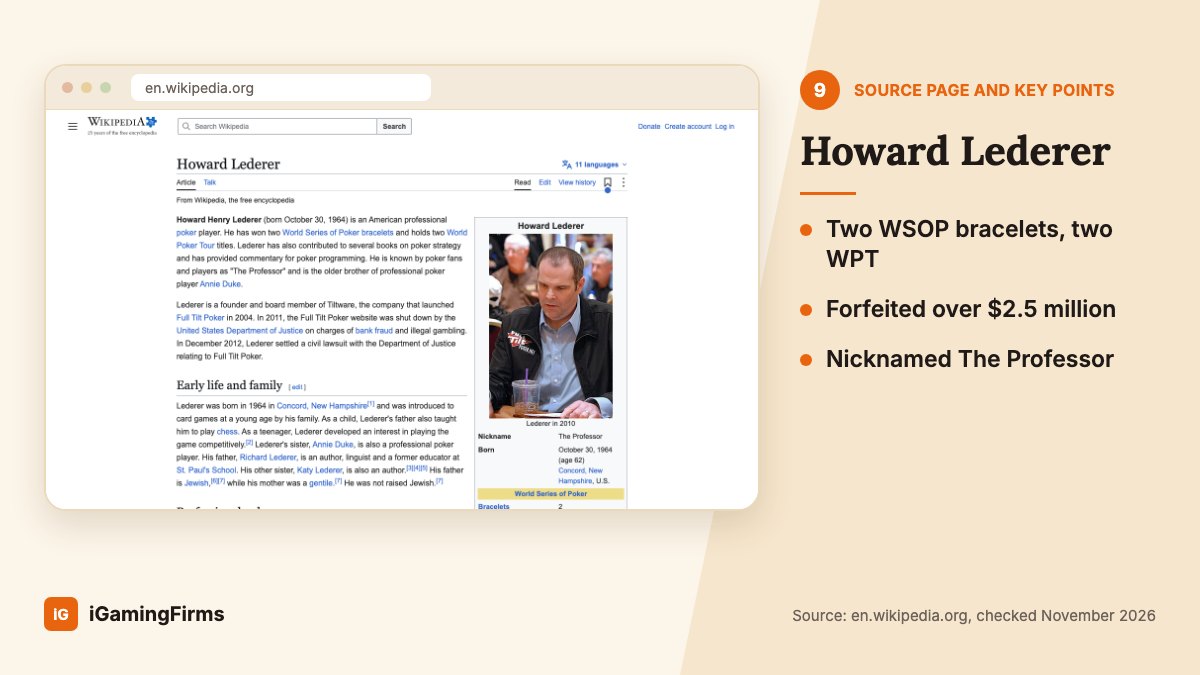
Lederer, known as “The Professor” for his analytical, teaching-led approach, won WSOP bracelets in 2000 and 2001 and World Poker Tour titles in 2002 and 2003. He was a founding member and onetime president of Tiltware, the company behind Full Tilt Poker. He also sat on the board of the Poker Players Alliance, the US players’ lobbying group, from 2006 to 2011.
After Black Friday, federal prosecutors in Manhattan sought $42.5 million from him in the civil case. In December 2012 he settled. Card Player reported that he agreed to forfeit cash, a Las Vegas property, a classic car and other assets. Reports at the time put the total at more than $2.5 million. He admitted no wrongdoing. He also agreed not to work for any online gambling site until the US has legalised and regulated the industry.
What it changed: Lederer’s settlement terms are a rare example of a personal industry ban written into a civil deal. Together with Ferguson’s case, his story marks the point at which US online poker moved from offshore growth to a state-by-state licensed model. Founders and directors learned that they could be held personally responsible for how player money was handled.
10. Alan Woods
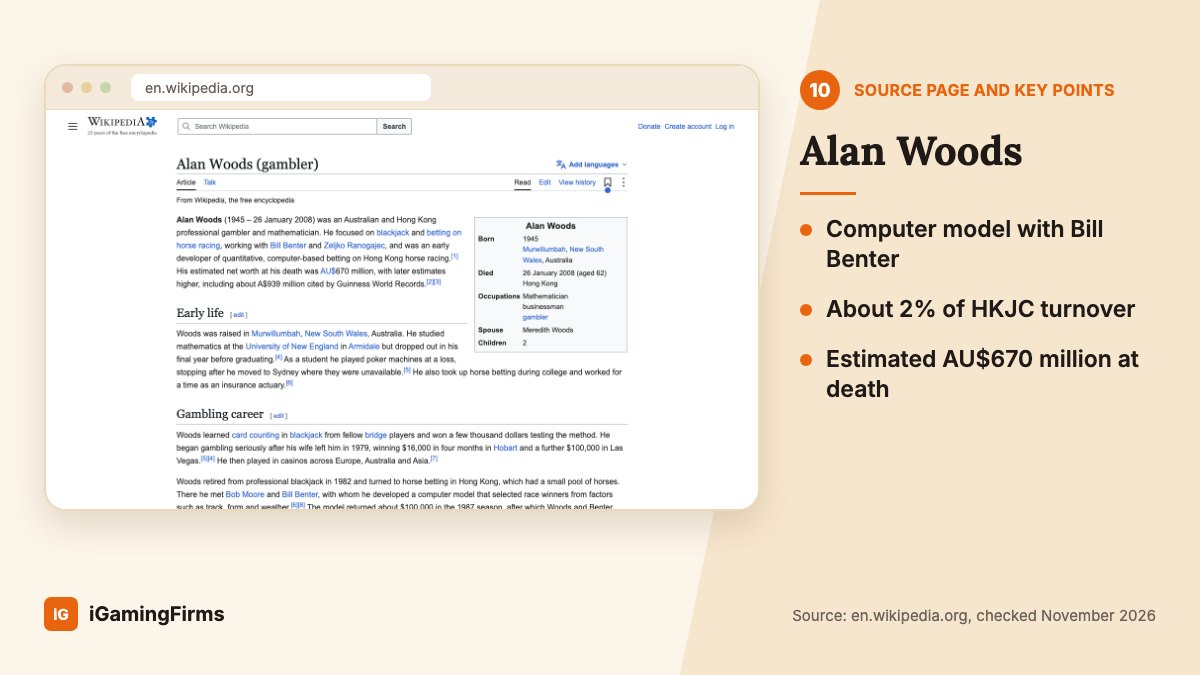
Woods, an Australian born in 1945, studied mathematics, trained as an insurance actuary and led the blackjack team that Bill Benter joined around 1980. The two moved to Hong Kong to build a horse racing model. Bloomberg reports that they split in 1986 after Woods demanded a 90% share of the partnership. Woods then hired programmers to build on the code and ran his own large syndicate. He later admitted in an interview that Benter’s model was the best.
His syndicate was caught by the Jockey Club’s 1997 phone betting ban along with Benter’s. Bloomberg reports he earned about $10 million in the 1994-95 season and died of cancer on 26 January 2008, aged 62. Interviews put his wealth at about A$900 million. A book by a former policeman, cited by Bloomberg, says his will listed assets of A$939,172,372.51. He also worked for a time with Zeljko Ranogajec, whom he called both a colleague and a rival. From 1999 until his death he largely funded Bluelight, an online harm reduction forum.
What it changed: Woods proved that a model could be copied and improved by a rival team once the core idea was known. That is why the Hong Kong market filled with competing syndicates and why, as Bloomberg notes, profits there were eventually competed away. A Malta-based sports betting firm founded by former Woods employees later attracted outside investment. For operators, this is the origin of the professional syndicates that still sit on the other side of large pool and exchange markets.
Who is the greatest sports gambler of all time?
There is no audited league table. Billy Walters is the name cited most often for US sports betting. He has the strongest public record: a 36-year winning streak described by his publisher, a 2023 Sports Gambling Hall of Fame induction and an ESPN investigation that reported weekly win rates of up to 58%. If you include horse racing, Bill Benter has the stronger case. He told Bloomberg his operations have probably made close to a billion dollars. His published model is still studied. The two worked in very different markets. Walters beat fixed-odds bookmakers in a fragmented, often illegal US market. Benter beat a single pari-mutuel pool with high commission. Our breakdown of whether sports betting is profitable explains why so few people beat the margin over thousands of bets.
Who is the richest sports gambler?
Among the people here, the largest wealth figure tied to a named source belongs to Alan Woods, whose will listed assets of about A$939 million according to a book cited by Bloomberg. Bill Benter’s figure of close to a billion dollars refers to what his operations made overall, not his net worth. He has said he is not a billionaire. Zeljko Ranogajec appeared on the Australian Financial Review Rich List with an estimated A$600 million in 2019 and 2020 and A$610 million in 2021. Every one of these is an estimate. Professional gamblers rarely publish accounts. A rich list figure is a journalist’s valuation, not an audited balance sheet.
What famous people have gambling addictions?
The most cited historical case is Fyodor Dostoevsky. His roulette habit began at Wiesbaden in 1863. He wrote his 1866 novel The Gambler under a strict deadline to pay off gambling debts, with a contract clause that would have handed his publisher Stellovsky free rights to his works for nine years if he missed it. Being on a famous gamblers list is not a diagnosis, though. None of the ten people profiled above has been publicly described as having a gambling disorder. Archie Karas lost more than $40 million and later faced a cheating conviction, but that record shows risk-taking and variance, not a medical finding. If gambling has stopped being a choice for you or someone close to you, contact a local problem gambling helpline or a health professional.
Are there any successful gamblers?
Yes, but they share a profile. The long-run winners on this list all had a measurable edge: a counting system (Thorp, Ranogajec), a model (Benter, Woods), an information network (Walters) or a skill game where they beat other players rather than the house (Brunson, Ivey, Ferguson, Lederer). Poker is different from casino games because the operator takes a rake and the players compete against each other. The one person here who won with no stated edge, Archie Karas, gave nearly everything back in 1995. The pattern matters for operators too. A customer who wins consistently in a house-banked game is a sign of an edge. The response, whether a limit, a review or exclusion, should follow the evidence.
What was Phil Ivey accused of?
Ivey was accused of edge sorting at baccarat and its variant punto banco. The technique uses tiny asymmetries in the printed pattern on the backs of cards. According to the Supreme Court judgment, Ivey and an associate persuaded the croupier to rotate the high-value 7s, 8s and 9s so they faced one way while the other cards faced the other way. That told him whether the next card was likely to be high. Crockfords refused to pay out the £7.7 million he won on 20 and 21 August 2012. The courts backed the casino. In the US, the Borgata recovered through a 2016 judgment of $10.1 million that was settled in 2020.
How the industry answered each type of edge
Put the ten stories side by side and the operator response tracks the kind of advantage involved, not the size of the win.
- Card counting: rule changes in 1964, then blacklists such as the Griffin Book and exclusion from tables. Thorp, Benter, Woods and Ranogajec were all affected.
- Devices and computers: criminal law. Nevada’s NRS 465.075 has banned devices that track cards or analyse strategy in licensed casinos since 1985.
- Pool betting models: account suspensions in 1997, followed by more public data and visible odds-movement signals from the Hong Kong Jockey Club.
- Sports betting syndicates: betting limits, account closures and line management. These are the problems modern risk tools now handle.
- Edge sorting: civil courts. The UK Supreme Court in 2017 and a US federal court in 2016 both sided with the casinos.
- Online poker operators: federal enforcement, forfeitures and a later shift to state-by-state licensing.
- Pure variance: bet caps. Karas’s run was allowed to continue because the house had the edge.
What these cases changed in law and regulation
The Ivey case changed English law beyond casinos
In Ivey v Genting the Supreme Court did more than rule on a baccarat game. Lord Hughes, with whom the other four justices agreed, held that cheating does not require dishonesty as a separate element. The court also disapproved the second limb of the long-standing R v Ghosh test for dishonesty, which had asked whether the defendant realised ordinary people would see the conduct as dishonest. A gambling dispute therefore reshaped how dishonesty is assessed in English law, which is why the case is cited far beyond gaming.
Hong Kong’s answer to Benter was data, not just bans
Benter is usually remembered for the billion-dollar figure. The more useful lesson for operators is what the Hong Kong Jockey Club did after suspending syndicate accounts in 1997. It published more racing data and colour-coded its odds boards to show large money moves, giving ordinary bettors some of the information the syndicates had. It then restored phone betting in 2001 and allowed internet wagering from home. Reducing the information gap protected the pool without shutting out the biggest customers for good.
Lederer’s settlement included a personal industry ban
Full Tilt Poker is usually discussed in dollar amounts. Lederer’s December 2012 settlement also barred him from working for any online gambling site until the US legalises and regulates online gambling. That condition shows regulators treating individual directors, not just companies, as responsible for how player money is handled. It is a point any founder in an unlicensed or grey market should take seriously.
Your next step
Pick the profile closest to your role and read the primary record behind it before you cite any figure. Table games and compliance teams should start with the Ivey v Genting judgment and Nevada’s NRS 465.075. Trading and risk teams should read the ESPN account of Walters’s runner network and the Bloomberg account of Benter’s model, then check how their own limits and account reviews would treat a modern equivalent. Writers and affiliates should keep wealth figures labelled as estimates and name who made them.