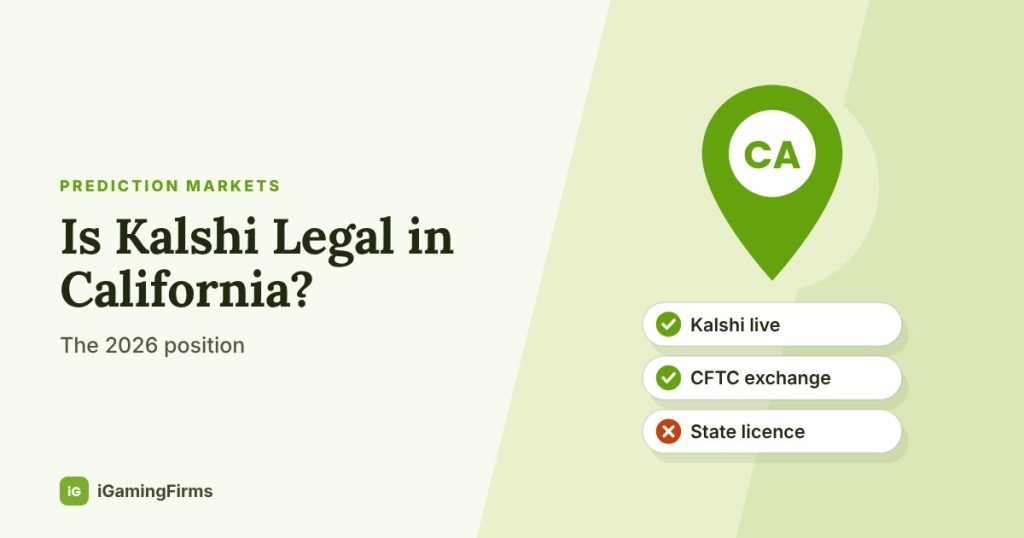
Kalshi is live for California residents on 28 November 2026, sports contracts included, except on the lands of two tribes where a federal court has barred sports contracts. No California state court, regulator or attorney general has ordered it to stop. It operates there on a federal theory, not a state one: Kalshi is a CFTC-designated contract market and argues that the Commodity Exchange Act gives the CFTC exclusive jurisdiction over its event contracts, so California gambling law does not reach them. That theory is now losing in the Ninth Circuit, the federal appeals court that covers California, which ruled on 28 August 2026 that the sports contracts are likely not “swaps” and on 16 September 2026 that they are likely Class III gaming under federal Indian gaming law when traded from two California tribes’ lands.
If you are an operator, affiliate or SEO lead weighing a California prediction market play, you will often read that Kalshi “prevailed” against the tribes. That was true in November 2025 and is wrong today. This guide gives you the dated record: what California law says, what the state’s attorney general and tribes have done, the circuit split, which partner apps are live in the state, and where the promotion and licensing risk sits.
The short answer for October 2026
| Question | Status on 28 November 2026 |
|---|---|
| Can Californians use Kalshi? | Yes. Kalshi geofences Nevada and some other states for contested contracts. In California it must block sports contracts only on two tribes’ lands, under a 4 November 2026 federal injunction. |
| Are sports contracts offered in California? | Yes, since Kalshi launched them in January 2025. Also through Robinhood, DraftKings Predictions and FanDuel Predicts. |
| Has California sued or sent a cease and desist? | No. Attorney General Rob Bonta has joined nine multistate amicus efforts against Kalshi, the latest on 29 October 2026, but California has filed no action of its own. |
| Has any court ruled on Kalshi in California? | Yes. The Ninth Circuit held on 16 September 2026 that two California tribes are likely to win their claim that Kalshi’s sports contracts are unlawful Class III gaming on their lands. On 4 November 2026 Judge Jacqueline Scott Corley granted a preliminary injunction barring Kalshi from offering sports contracts on those two tribes’ lands (not statewide). |
| Is there a California statute on prediction markets? | No. California has passed nothing in 2025 or 2026. Minnesota is the only state with a ban. |
| Minimum age | 18 under Kalshi’s rules, against 21 for regulated sportsbooks in most states. |
Why Kalshi says it is legal in California
Kalshi’s position is the same in every state. KalshiEX LLC has been a designated contract market (DCM) under the CFTC since November 2020, it clears trades through its own registered clearinghouse, and it describes each market as an event contract, a type of swap. Section 2(a)(1)(A) of the Commodity Exchange Act gives the CFTC exclusive jurisdiction over swaps traded on a DCM, so, in Kalshi’s reading, state gambling laws are preempted.
That is also the answer to the common question “why isn’t Kalshi gambling?” Kalshi does not take the other side of a trade. Users buy and sell yes or no contracts against each other and Kalshi charges a fee per trade. Positions can be sold before the event settles. In Kalshi’s framing that makes it an exchange, not a bookmaker.
Two things in the record support Kalshi. In 2024 it beat the CFTC itself in the D.C. courts over election contracts, and the Commission dropped its appeal in May 2025. In April 2026 the Third Circuit, in KalshiEX v. Flaherty, upheld an injunction that stops New Jersey from enforcing its sports betting law against Kalshi, holding the contracts are swaps. The CFTC now sides with Kalshi and has sued several states to block enforcement. In June 2026 it proposed rules that would formally allow sports outcome contracts.
So “is Kalshi legal in the USA” has a clean federal answer: yes, as a CFTC-regulated exchange. The fight is over whether that federal status displaces state and tribal law, and the courts are split.
What California law says
California has no statute that mentions prediction markets or event contracts. What it has is a broad bookmaking ban, a constitution that locks most gambling to tribal compacts and a 2022 referendum result.
Penal Code section 337a
Penal Code 337a makes it an offence to engage in pool selling or bookmaking, to keep a place for recording bets, to receive or forward money staked on “any contest of skill, speed or power of endurance” or any “unknown or contingent event”, to record bets, or to lay, offer or accept a bet on such a contest. A first offence carries up to one year in county jail or a state prison term, a fine of up to $5,000, or both. The section expressly covers anyone who does these things “in a single instance”, not only people running a business.
That wording is why the Ninth Circuit’s “it is sports gambling regardless of what Kalshi calls it” finding matters so much in California. If a court applies the same functional test to 337a, the offering side (an exchange, a broker app, or an affiliate “offering” a bet) is the exposed party. California has not prosecuted individual traders of prediction markets, and nothing in the record suggests it intends to, so the “what happens if you get caught gambling in California” question is, in practice, a question about operators and promoters rather than users.
The constitution and tribal exclusivity
Article IV, section 19 of the California Constitution bars the Legislature from authorising lotteries (other than the state lottery) or “casinos of the type currently operating in Nevada and New Jersey”. Subdivision (f), added by Proposition 1A in 2000, lets the Governor negotiate compacts with federally recognised tribes for slot machines, lottery games and banking or percentage card games on Indian lands. Sports wagering is not on that list, which is why it needs a constitutional amendment, and why both 2022 measures failed: Proposition 26 (in-person sports betting at tribal casinos and racetracks) lost by roughly two to one and Proposition 27 (online sports betting run by commercial operators) lost by more than four to one, after close to half a billion dollars was spent on the campaigns.
The practical effect is that California’s gaming economy belongs to the tribes. The National Indian Gaming Commission’s region covering California and northern Nevada reported $12.1 billion in gross gaming revenue for fiscal 2024. Any product that looks like sports betting to Californians is, in the tribes’ view, taking a market voters refused to open to anyone.
Daily fantasy as a precedent
In July 2025 Attorney General Bonta issued an opinion that daily fantasy sports contests are illegal sports wagering under California law. He did it by opinion, not by legislation, and the same office is the one that would act on prediction markets. Operators who assumed DFS was safe in California because it had run for a decade learned otherwise. Treat that as the template for how the state moves.
What has happened in California: a dated timeline
| Date | Event |
|---|---|
| January 2025 | Kalshi launches sports event contracts and markets them as available in all 50 states, California included. |
| March 2025 | Robinhood opens a prediction markets hub routing orders to Kalshi, giving it reach to about 25 million brokerage users. |
| 22 July 2025 | Blue Lake Rancheria, Chicken Ranch Rancheria of Me-Wuk Indians and Picayune Rancheria of Chukchansi Indians sue Kalshi and Robinhood in the Northern District of California (No. 3:25-cv-06162-JSC) under IGRA, RICO and the Lanham Act. |
| 9 October 2025 | Preliminary injunction hearing before Judge Corley. |
| November 2025 | Judge Corley denies the injunction. Kalshi keeps operating. |
| December 2025 | DraftKings Predictions launches with sports contracts in states without legal sports betting, California among them. |
| January 2026 | FanDuel Predicts, built on CME Group markets, goes live in all 50 states with sports contracts in 18, including California. |
| 12 June 2026 | AG Bonta announces California has joined a 37-state amicus brief backing Ohio in the Sixth Circuit, his seventh multistate filing against prediction markets. No California suit is filed. |
| June 2026 | DraftKings announces its prediction product is available to Californians. A California resident files a private suit in July calling it illegal sports betting. |
| August 2026 | Kalshi signs multi-year sponsorships with the Dodgers, Padres and Giants and hires a second Sacramento lobbying firm. OpenSecrets data show Kalshi spent $62,000 on California lobbying in the first half of 2026 and the Coalition for Prediction Markets $50,000, both targeting the AG’s and Governor’s offices. |
| 28 August 2026 | Ninth Circuit, KalshiEX v. Assad: Kalshi’s sports contracts are likely not swaps, Nevada may enforce its gaming law. Kalshi seeks rehearing en banc. |
| 16 September 2026 | Ninth Circuit, Blue Lake Rancheria v. Kalshi: reverses the injunction denial, holds the contracts are likely Class III gaming on tribal lands. Remanded to Judge Corley. |
| 7 October 2026 | Three California tribes (Greenville Rancheria, Kletsel Dehe Wintun Nation, Alturas Indian Rancheria) and one Oklahoma tribe launch their own apps on Kalshi’s exchange. The same day 145 tribes and tribal organisations file a Supreme Court amicus brief against Kalshi. |
| 8 October 2026 | The California Nations Indian Gaming Association calls the partnerships “disappointing” and says the activity “is still illegal”. |
| 29 October 2026 | AG Bonta joins a ninth multistate amicus effort against Kalshi, in a Tenth Circuit case supporting Utah. California still files no suit of its own. |
| 30 October 2026 | The Supreme Court extends Kalshi’s deadline to respond to New Jersey’s petition (No. 26-299) from 9 November to 7 December 2026. |
| 4 November 2026 | The Ninth Circuit denies Kalshi’s petition for rehearing and rehearing en banc in KalshiEX v. Assad, leaving the Nevada ruling in place. |
| 4 November 2026 | Judge Corley grants a preliminary injunction barring Kalshi from offering sports contracts on the lands of Blue Lake Rancheria and Chicken Ranch Rancheria. The tribes must supply boundary maps by 13 November and Kalshi must report on compliance within 21 days. |
The tribal case: what the Ninth Circuit actually decided
The opinion in Blue Lake Rancheria v. Kalshi (No. 25-7504), written by Judge McKeown for a panel with Chief Judge Murguia and Judge Paez, is the first appellate ruling to apply the Indian Gaming Regulatory Act to a prediction market. Four findings matter for anyone doing business in California.
- Substance over label. “The substance of the sports event contracts offered on Kalshi’s DCM is sports gambling, regardless of whether Kalshi calls them swaps.” The court compared a $100 Kalshi contract on the Giants bought on the floor of the Blue Lake Casino Hotel with a $100 DraftKings wager on the same game: same bettor, same place, same stake, same contingency. Kalshi “may reshuffle the cards, but it cannot change the hand”.
- The CEA does not cancel IGRA. Because the contracts are likely not swaps, the CEA’s exclusive jurisdiction clause does not reach them, and even if they were swaps the court said it would still reverse. The two statutes “simply address two different questions”.
- UIGEA does not displace IGRA. Kalshi’s fallback argument, that the federal internet gambling payments law overrides tribal gaming law, failed.
- The advertising claim failed. Kalshi’s “legal in all 50 states” marketing was treated as a lay opinion on legality, so the tribes’ Lanham Act false advertising claim was rejected. That is the one point Kalshi won.
Scope is the part that is often blurred. A contract is “located on Indian lands” when a user enters it from tribal territory, so the injunction the district court granted on 4 November 2026 targets trades placed from the two tribes’ lands, not Kalshi’s California business as a whole. Picayune Rancheria left the appeal by stipulation. Robinhood is a named defendant, although reports of the 4 November order describe its prohibition as running against Kalshi Inc. and KalshiEX. Twenty-seven states and the District of Columbia filed in support of the tribes; the CFTC filed in support of Kalshi.
Why it still matters statewide: the Ninth Circuit’s reasoning that the contracts are not swaps is the same reasoning that would let a California court apply Penal Code 337a. The tribal win does not close Kalshi in California. It removes the legal shield Kalshi relies on, in the circuit where California sits.
The court record outside California and why it matters here
California is one state in a national split, and the Supreme Court is the likely venue for the final answer. The positions, with the Third Circuit, Nevada and California tribal rows updated to 28 November 2026:
| Court | Date | Holding | Status |
|---|---|---|---|
| Third Circuit (New Jersey), KalshiEX v. Flaherty | 6 April 2026 | Sports contracts are swaps; state enforcement preempted. Judge Roth dissented. | New Jersey’s cert petition (No. 26-299) filed 2 September 2026; Kalshi’s response was extended twice and is now due 7 December 2026. |
| Ninth Circuit (Nevada), KalshiEX v. Assad | 28 August 2026 | Likely not swaps; Nevada may enforce against Kalshi, Robinhood and Crypto.com’s exchange. | Rehearing and rehearing en banc denied 4 November 2026; Robinhood and Crypto.com’s exchange filed cert petitions 10 and 11 September. |
| Ninth Circuit (California tribes), Blue Lake Rancheria v. Kalshi | 16 September 2026 | Likely Class III gaming under IGRA on tribal lands. | Remanded; the N.D. Cal. court granted a preliminary injunction on 4 November 2026 for two tribes’ lands. |
| Sixth Circuit (Ohio and Tennessee) | 25 September 2026 | Not swaps; states may regulate under gambling law. Ohio had fined Kalshi $5 million. | Ohio Casino Control Commission cease and desist letters to ten platforms, 16 October 2026 deadline. |
| N.D. Illinois (CFTC, Kalshi, Coinbase v. Illinois) | 2 October 2026 | Preliminary injunctions for the platforms; likely swaps. | Injunction in force from 30 October 2026; Illinois has appealed. |
| State courts | 2026 | Massachusetts (January) and Washington’s King County (July) injunctions force geofencing; Nevada’s order of 3 April covers sports, entertainment and election contracts. | Nevada sought contempt in June over IP blocking it called inadequate. |
| New York | 31 July 2026 | State sues Kalshi as an unlicensed gambling operation, claiming at least $36 billion. | Pending. |
| Minnesota | Effective August 2026 | Statutory ban on operating or promoting a prediction market, with felony exposure. | In force; Kalshi has called it unlawful. |
For California the point is simple. Two circuits (Sixth and Ninth) say states can treat sports contracts as gambling; the Third Circuit says they cannot; the CFTC says they are swaps. California’s own circuit is on the enforcement side. California’s attorney general has signed nine multistate briefs backing state gambling laws against Kalshi. The only reason California has not acted directly is a choice, not a legal barrier.
Sports contracts versus the rest of the book
Almost every state and tribal action targets sports contracts. Election contracts were settled in Kalshi’s favour in the D.C. courts in 2024. Economic, weather and financial contracts are the kind of excluded-commodity products the CFTC has always allowed. Nevada’s order is the broadest, covering sports, entertainment and election contracts, and Minnesota’s ban is categorical.
The CFTC’s proposed rule, published on 12 June 2026 with comments closed on 27 July, treats professional and amateur sports as “gaming” but would generally permit contracts on final scores, win or loss results, point differentials and tournament advancement, while treating injuries, officiating calls, in-game discrete actions and pre-collegiate sports as contrary to the public interest. Forty-four state attorneys general, led by Ohio, filed a letter saying the rule exceeds the Commission’s authority. We found no final rule on sports event contracts in force as of 28 November 2026 (the CFTC also issued a separate interim final rule on casino-style gambling products in October 2026). Even a final rule would not bind a court that has already decided the contracts are not swaps.
For a California strategy that means non-sports markets carry far less litigation risk than sports markets, and sports markets on tribal lands carry the most.
Is Kalshi illegal gambling? Three common questions
Is Kalshi gambling or investing? Under federal law it is a derivatives exchange. Under the Ninth and Sixth Circuits’ functional test, the sports contracts are gambling. Both are true at once, which is why the question will end at the Supreme Court.
How is Kalshi legal but not Polymarket? It is not quite the right framing any more. Polymarket’s offshore exchange blocked US users after a 2022 CFTC settlement, but its US entity (QCX LLC, trading as Polymarket US) is itself a CFTC-designated contract market, relaunched in December 2025, with the same federal status and the same state exposure. Nevada enjoined it in June 2026 and New York sued it in September. Our Kalshi vs Polymarket comparison walks through the regulatory and structural differences.
What is the Kalshi controversy? Three threads. First, the preemption fight above. Second, the age gap: Kalshi admits users at 18 while regulated sportsbooks require 21 in most states, and analyses reported by CNN and the American Gaming Association in August and September 2026 put trading by 18 to 20 year olds above $5 billion for the year, mostly on sports. Third, tribal sovereignty, now split between tribes suing Kalshi and tribes building apps on it.
How old do you have to be to use Kalshi in California?
Eighteen. Kalshi’s member agreement requires the age of majority in the user’s state, which in California is 18. Kalshi’s own FAQ sets 18+ against 21+ for sportsbooks. There is no California rule setting a higher floor because there is no California regulation of the product. For affiliates this is the single most sensitive point: a campaign that reaches 18 to 20 year olds with sports content is lawful under Kalshi’s rules and is exactly what the New York and Washington complaints lean on. Tribal casinos in California set 18 or 21 by compact and house rule, so the tribes see the 18 floor as a further competitive breach.
Robinhood, DraftKings Predictions, FanDuel Predicts and Crypto.com in California
| Product | Exchange behind it | Sports contracts in California | California-specific exposure |
|---|---|---|---|
| Kalshi app | KalshiEX (own DCM) | Yes | Defendant in Blue Lake Rancheria; tribal-land injunction pending on remand. |
| Robinhood Predictions | Routes to Kalshi | Yes | Named defendant in the same case; bound by any order. |
| DraftKings Predictions | DraftKings’ own prediction venue | Yes, since December 2025; availability announced to Californians June 2026 | Private suit by a California resident filed July 2026. |
| FanDuel Predicts | CME Group | Yes, California is one of 18 sports states | No California action to date. |
| Crypto.com event contracts | North American Derivatives Exchange (rebranded OG.com) | Listed as available in California by comparison sites | Co-defendant in Nevada; cert petition filed 11 September 2026. |
| Tribal apps (Greenville, Sovereign Edge, AIR Markets) | Kalshi | Not stated in the launch announcement | CNIGA says the activity “is still illegal”; 145-tribe Supreme Court amicus. |
Notice what the big two sportsbooks did. DraftKings and FanDuel both refuse to offer sports contracts in states where they hold a sportsbook licence. Both lead with California, Texas and Georgia, the large markets that voters or legislatures have closed. The California launches are a bet that the Third Circuit view wins, made by companies that also funded Proposition 27. Our operator-side look at sportsbook economics explains why a product with a trading fee instead of a hold is attractive to them anyway.
What could change next
- The Supreme Court. Three petitions are pending (New Jersey, Robinhood, Crypto.com’s exchange). If the Court takes a case this term, argument would be in spring 2027 and a decision by the end of June 2027. It could also hold the petitions for the Fourth, Sixth and Seventh Circuit appeals or a CFTC final rule.
- The district court on remand. Judge Corley granted the injunction on 4 November 2026, the first court-ordered geofence inside California, covering the lands of Blue Lake and Chicken Ranch. Kalshi’s compliance reports and the tribes’ amended complaint come next. The order is a template for the other 100-plus California tribes.
- A CFTC final rule. It would strengthen Kalshi’s hand with the CFTC’s own regulatees and with the Third Circuit, but the Ninth Circuit has already said the contracts are not swaps, which a rule cannot override.
- Sacramento. Two Assembly bills touch the subject: AB 2446 (attorney general investigations of prediction market wagering) and AB 2617 (age verification and limits on advertising to minors). We found no enacted California statute on prediction markets. Fourteen other states had restriction bills pending in May 2026 and Minnesota’s ban is the model a California tribal coalition would copy. Bonta is up for re-election in November 2026 and has aligned with the tribes on cardrooms, DFS and racetrack machines.
- A 2028 ballot measure. Tribal-led sports betting proposals missed the 2024 ballot. A measure that legalises tribal online betting would, by design, make the state’s case against prediction markets stronger, not weaker.
What it means for operators and affiliates
If you run or white-label a prediction product. There is no California licence to apply for and no safe harbour. Your legal position is the CEA preemption argument, which has lost twice in the Ninth Circuit. The tribal route three California tribes took in October is the only structure that gives you a local partner, and CNIGA has already said it does not cure the IGRA problem. Budget for geofencing at the parcel level, not the state level: Nevada asked for $120,000 a day in penalties over IP-based blocking it called inadequate. The 4 November 2026 tribal-land injunction in California demands the same precision. The tribes had to supply boundary maps by 13 November 2026.
If you are an affiliate. Kalshi’s “legal in all 50 states” line survived a Lanham Act claim because a court treated it as opinion. Your copy will not get that protection if a California court applies 337a’s “offer” language to a promoter. Minnesota already criminalises promotion outright. Describe the federal status accurately and do not describe the product as legal sports betting in California. Keep sports creative away from 18 to 20 year olds. Promo-code pages that ignore this carry their own risk; they are not a model to copy.
If you are a tribal or commercial gaming operator. The Ninth Circuit gave you a cause of action with a worked example. Any federally recognised California tribe with a compact can now file the Blue Lake complaint with a strong chance of an injunction over its own lands, as Blue Lake and Chicken Ranch just did. The state attorney general has signed nine multistate briefs backing state gambling laws against Kalshi. Watch our monthly regulation roundup for the Supreme Court’s response dates and orders in the tribal case. Compare the Texas and Minnesota positions, which bracket the range of state responses.
Next step
The three things to watch are Ohio’s enforcement after its 16 October 2026 compliance deadline for the ten platforms, Illinois’s Seventh Circuit appeal of its injunction and the Supreme Court’s handling of the New Jersey petition, where Kalshi’s response is now due on 7 December 2026. Judge Corley granted the tribal-lands injunction on 4 November 2026 and ordered Kalshi to report on compliance within 21 days. Kalshi has until about 2 February 2027 to petition the Supreme Court over the Ninth Circuit’s Nevada ruling. Kalshi’s own announcement of the tribal apps and the Attorney General’s June 2026 release are the two California primary sources worth bookmarking.