If you run a sportsbook, an affiliate site or a supplier business, prediction markets are now competing for the same customers and the same sports handle. The platforms behind them are regulated in very different ways.
The short answer: Kalshi and Polymarket are the two largest prediction markets by volume. Both list contracts on their own CFTC-designated contract markets. Novig, ProphetX, OG.com, Robinhood, FanDuel Predicts and DraftKings Predictions follow with narrower or partner-run models. Legal exposure now depends less on the brand and more on two things: which exchange actually lists the contract and which federal appeals circuit your customers live in. Courts split in 2026 on whether sports event contracts are swaps or bets. That question is now in front of the US Supreme Court.
This comparison is written for operators, affiliates and suppliers. It is not a guide to trading or betting. It contains no promotions and none of the platforms paid to be included.
Prediction markets compared: regulator, venue, scope and legal exposure
The table lists nine platforms in the order they are profiled below. “DCM” means a designated contract market registered with the Commodity Futures Trading Commission. Facts were checked against regulator filings, company pages and news coverage in November 2026.
| # | Platform | CFTC status | Venue behind the contracts | Product scope | Fee model | Main legal exposure |
|---|---|---|---|---|---|---|
| 1 | Polymarket | US arm is a DCM (designated 9 July 2025); international site is not CFTC-regulated | QCX LLC d/b/a Polymarket US | Sports, politics, economics, crypto, culture | Taker fee formula; makers pay no fee | New York lawsuit (Sept 2026); state sports-contract challenges |
| 2 | Kalshi | DCM since 3 November 2020 | KalshiEX with its Klear clearinghouse | Broad, with sports the largest share | Taker 0.07 formula; maker 0.0175 on some series | Most active litigant: wins in the Third Circuit, losses in the Sixth and Ninth |
| 3 | Novig | DCM since 16 June 2026 | Ludlow Exchange, LLC | Sports only, 21+ | Company says pre-game straight trades in the app are commission-free | Excludes Arizona, Michigan and Nevada at launch |
| 4 | ProphetX | DCM since 11 June 2026, plus DCO registration | ProphetX LLC (exchange and clearing in-house) | Sports-first, some non-sports series | Set by its CFTC rulebook fee rules | Same state sports-contract dispute as peers |
| 5 | OG.com | Venue is a DCM and DCO | North American Derivatives Exchange, Inc. (Crypto.com | Derivatives North America); FCM Foris DAX FCM LLC | Sports, finance, crypto, politics, culture | Per-contract fee schedule set by the exchange | State cease-and-desist letters to the Crypto.com venue; cert petition filed |
| 6 | Betfair Exchange (Betfair Predicts beta) | Not a US product | Betfair Exchange liquidity under Betfair’s UK licence | Yes/No interface on exchange markets | Exchange commission model | UK gambling regulation; limited beta |
| 7 | Robinhood | Robinhood Derivatives, LLC is an FCM, not a DCM | KalshiEX, ForecastEx or Rothera, by contract | Sports, economics, politics, crypto | Commission capped at $0.01 per contract plus exchange fees | Nevada case at the Supreme Court petition stage |
| 8 | FanDuel Predicts | Venue is CME Group’s DCM | CME Group | Finance and events in all states; sports in non-sportsbook states | Set by the app and CME | State licence risk for the FanDuel sportsbook |
| 9 | DraftKings Predictions | Launched on CME; owns Railbird Exchange, a DCM since 13 June 2025 | CME Group, with Railbird to follow | Finance, events and sports in selected states | Set by the app and venue | State licence risk for the DraftKings sportsbook |
How prediction markets compete with licensed sportsbooks
A prediction market lists a yes/no contract that pays $1 if an event happens. Customers trade against each other on an order book and the venue earns a fee on each trade instead of a margin built into the odds. For a longer primer on contract mechanics, see how prediction markets work and where they are legal.
For a sportsbook, three features make this a direct competitor. First, a DCM argues that federal law lets it offer sports contracts in all 50 states, including California and Texas, where no state has licensed online sports betting. Second, the venue pays no state gaming tax. Third, the minimum age on several platforms is 18, while most state sportsbooks require 21. New York’s lawsuit against Polymarket makes exactly that point about users aged 18 to 20.
The scale is no longer small. According to The Block, Kalshi, Polymarket and Polymarket US posted $50.59 billion in combined volume in July 2026. Kalshi alone recorded $37.7 billion. Pew Research Center’s analysis of the same data found that combined monthly volume more than doubled between May and July 2026, with sports the top category on both platforms.
What the handle data shows
Analysts disagree on how much sportsbook business is moving. Eilers & Krejcik Gaming forecast $40 billion of 2026 NFL trading and wagering, with prediction markets taking about 21% ($8.4 billion). The same firm modelled only a low-single-digit handle impact in the most competitive sportsbook states. The American Gaming Association pointed to prediction markets as one factor when commercial sports betting revenue fell 15.6% in August 2026. The Tax Policy Center estimated that a 5% shift of New York sportsbook activity would cost that state about $66 million a year.
The pattern for operators is clear enough: the pressure is heaviest in states without legal sportsbooks. It also falls on NFL and college products and on younger customers.
The 9 prediction market platforms, profiled
1. Polymarket
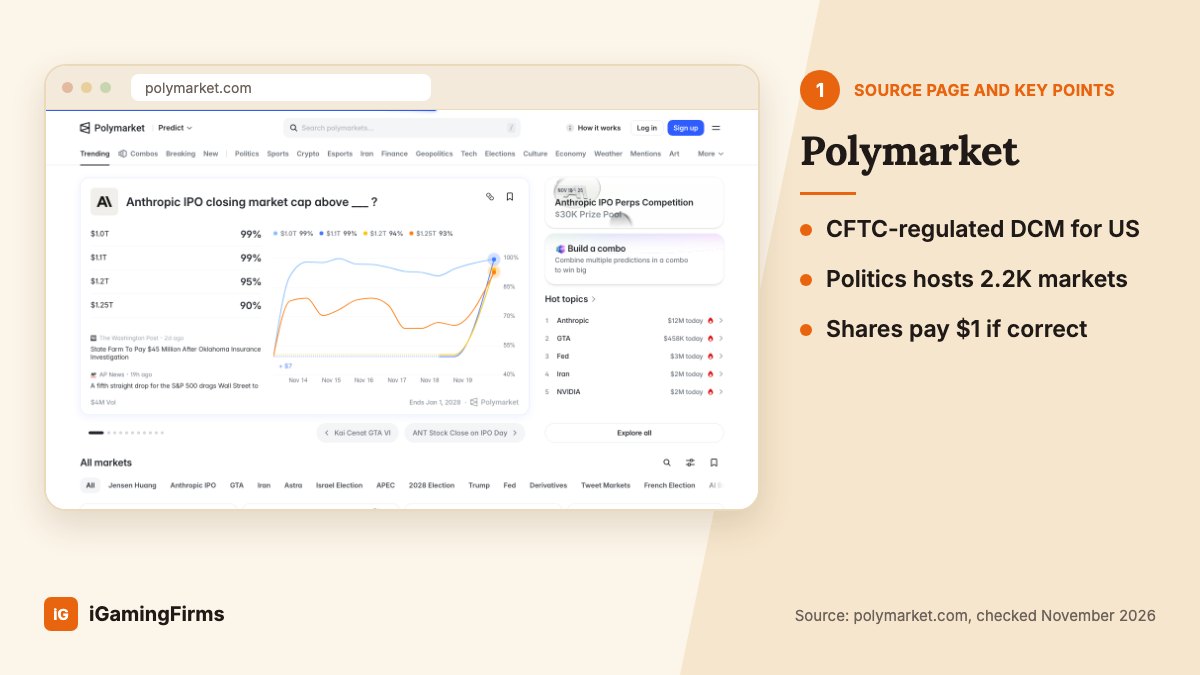
Polymarket runs two separate businesses. The international platform settles in crypto and is not regulated by the CFTC. The US business runs on QCX LLC, which the CFTC lists as designated on 9 July 2025 and which now operates as Polymarket US. For a B2B reader the split matters, because the international site’s volume is not volume a US partner can touch.
- Regulator and venue: QCX LLC d/b/a Polymarket US is the DCM. The international entity operates independently of it.
- Fees: Polymarket US charges takers a fee of Θ × contracts × price × (1 − price). Its July 2026 notice to the CFTC raised the standard Θ from 0.05 to 0.06. Later filings set different coefficients for some products and volume tiers. On the international site, the published fee table sets taker rates by category, keeps geopolitics fee-free and charges makers nothing.
- Volume: In July 2026 Polymarket’s international site recorded $7.9 billion while Polymarket US rose to $5 billion, according to The Block.
- League deals: Major League Baseball named Polymarket its exclusive prediction market exchange partner on 19 March 2026 and signed an integrity agreement with the CFTC at the same time.
- Legal exposure: New York’s Attorney General and Governor sued QCX LLC on 24 September 2026, calling the platform an unlicensed gambling operation. For the federal background, read Polymarket’s US legal status and state restrictions.
2. Kalshi
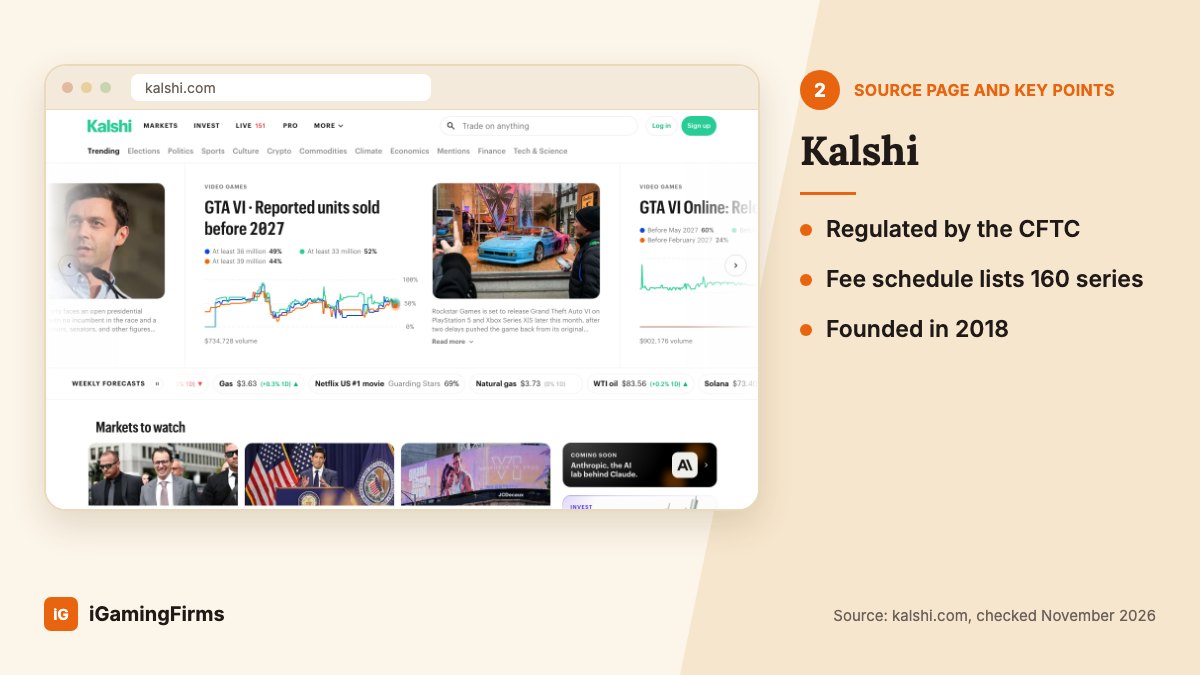
Kalshi is the largest US prediction market and the one most sportsbooks measure themselves against. The CFTC lists it as designated on 3 November 2020, years before sports contracts became its main product. Kalshi also supplies contracts to brokers such as Robinhood, so its venue sits behind other brands as well as its own app.
- Regulator and venue: KalshiEX is the DCM, with Klear as its clearinghouse.
- Fees: The fee schedule effective 7 July 2026 sets the taker fee at round up(M × 0.07 × C × P × (1 − P)) and the maker fee, where it applies, at 0.0175 on the same base. At a 50-cent price that is $1.75 per 100 contracts for a taker. Debit card deposits can carry up to 2%.
- Product scope: In a Connecticut ruling in August 2026, a federal judge noted that sports products made up 80 to 90 percent of Kalshi’s listings and revenue. That concentration is the reason sportsbooks treat it as a direct rival.
- Legal exposure: The Third Circuit sided with Kalshi against New Jersey in April 2026. The Ninth Circuit ruled against it in Nevada on 28 August 2026. The Sixth Circuit followed on 25 September 2026 for Ohio and Tennessee. New York also sued Kalshi in July 2026. Our Kalshi vs Polymarket comparison sets the two side by side on fees and liquidity.
3. Novig
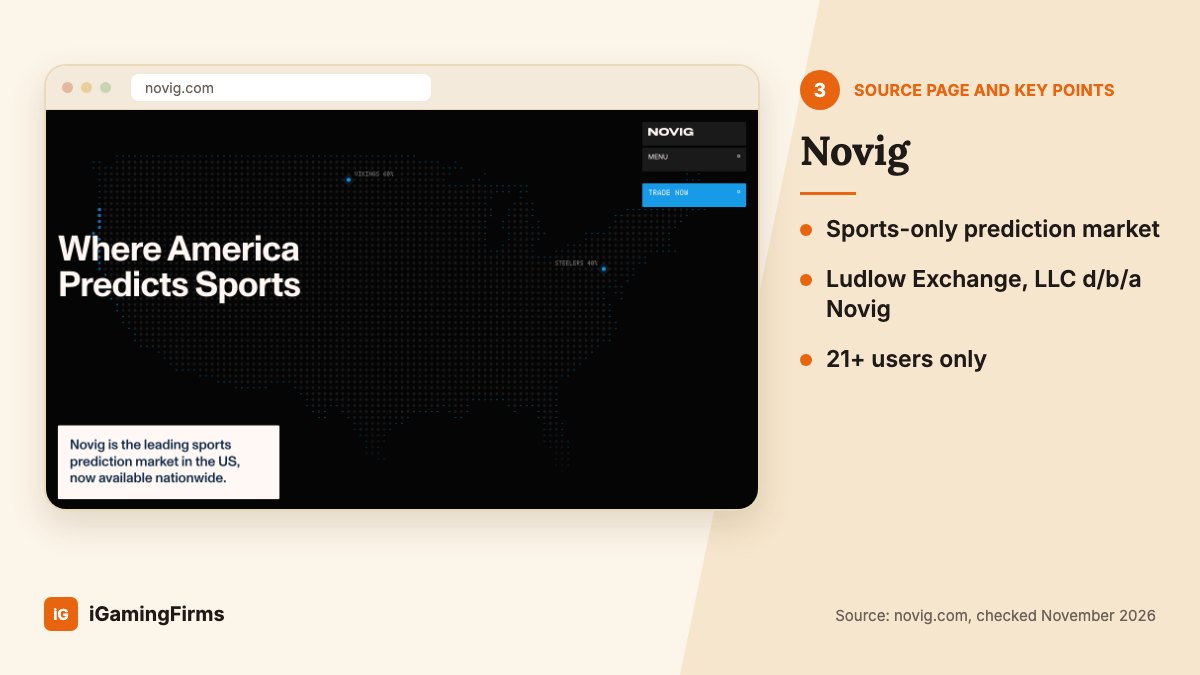
Novig moved from a sweepstakes exchange to a federally regulated sports market in 2026. Its own exchange, Ludlow Exchange, LLC, carries a different name from the consumer brand, which is worth knowing when you search CFTC filings.
- Regulator and venue: A CFTC filing states that Ludlow Exchange was designated as a contract market on 16 June 2026 and began real-money trading on 4 August 2026.
- Product scope: Sports only, for users aged 21 and over. At launch the company’s pages excluded Arizona, Michigan and Nevada.
- Fees: Novig says it builds no vig into prices and that pre-game straight trades taken in its app are commission-free. Other contract types, including parlays and live trades, follow its fee schedule.
- Distribution: The New York Mets named Novig their exclusive official prediction market partner in July 2026, the first such deal between an MLB club and a prediction market.
4. ProphetX
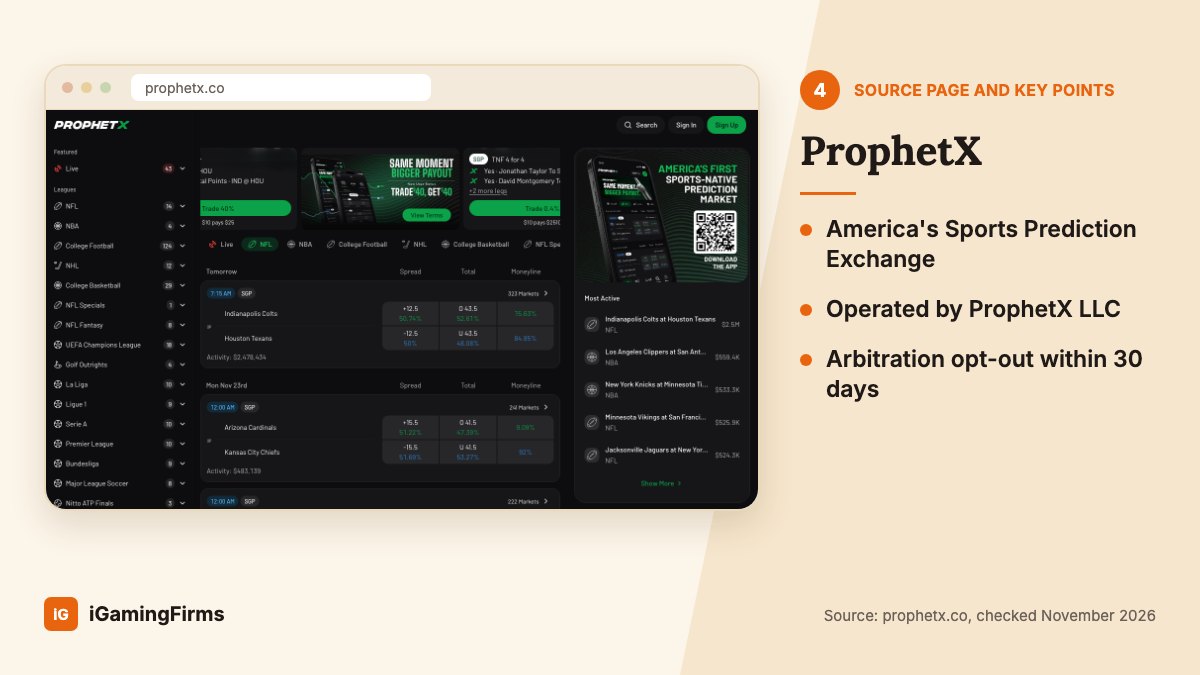
ProphetX calls itself a sports-native prediction market. It is the clearest example of a platform that is also selling its exchange to other businesses.
- Regulator and venue: The CFTC’s order of designation made ProphetX LLC a contract market in June 2026. It also holds DCO registration, so it lists and clears trades in-house.
- Launch: ProphetX announced a nationwide launch on 18 June 2026, during the World Cup.
- Supplier model: ProphetX raised $35 million in July 2026 and told Axios it is building a B2B business that sells its exchange infrastructure to other companies.
- Liquidity programs: It has certified market maker programs with the CFTC, including a Nascent Markets Program effective from October 2026.
- Terms to note: Its user terms include an arbitration agreement and class action waiver, which matters if you plan to refer customers to it.
5. OG.com
OG.com is Crypto.com’s standalone prediction market brand, launched on 3 February 2026 with Crypto.com’s chief legal officer Nick Lundgren as CEO. The venue behind it is the exchange that offered some of the first US sports event contracts in late 2024.
- Regulator and venue: OG.com’s footer names North American Derivatives Exchange, Inc. as its CFTC-regulated exchange and clearinghouse and Foris DAX FCM LLC as its futures commission merchant.
- Product scope: Sports, financials, crypto, commodities, politics and culture. Crypto.com has said margined prediction contracts depend on CFTC certification.
- Institutional access: Trading Technologies said it would add connectivity to OG.com in the fourth quarter of 2026, which opens the venue to professional trading firms.
- Legal exposure: The same exchange received cease-and-desist letters from Maryland in April 2025 and from Connecticut in December 2025. Crypto.com is one of the parties that has asked the Supreme Court to resolve the circuit split, according to Pillsbury.
6. Betfair Exchange (Betfair Predicts beta)
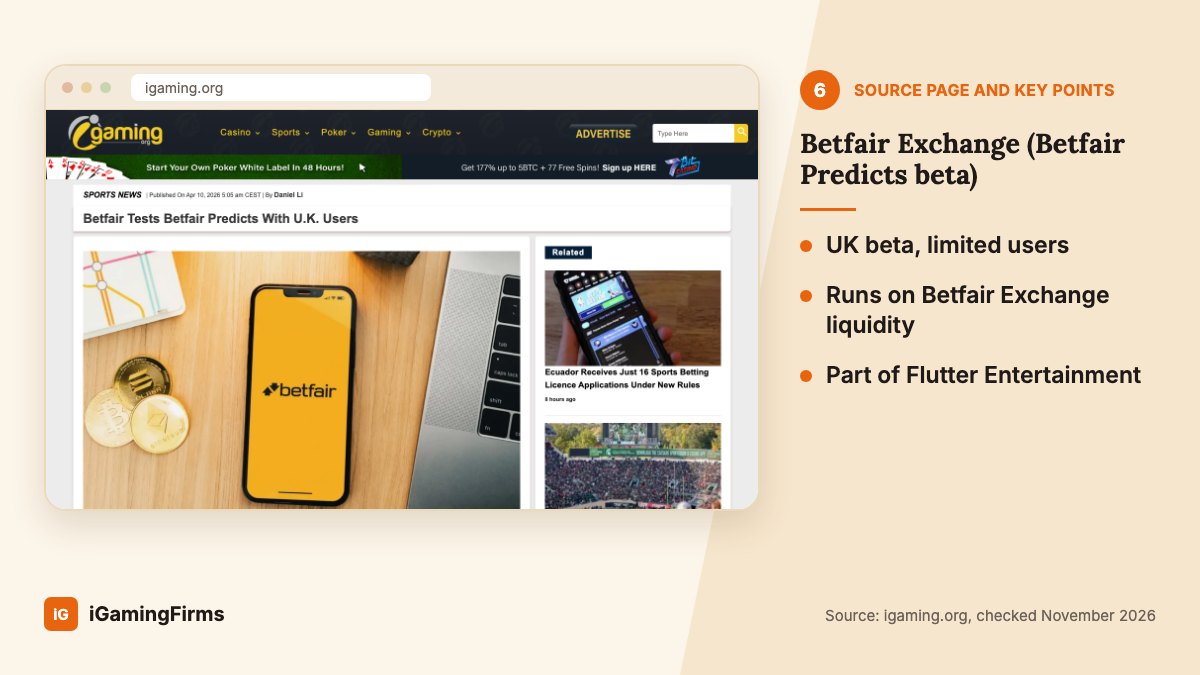
Betfair Predicts is a Yes/No interface placed on top of Betfair Exchange. Flutter began a beta with a small group of UK customers in April 2026. It matters to this list because it shows how a licensed exchange operator answers the prediction market format without a US-style federal licence.
- Regulator and venue: It runs on existing Betfair Exchange liquidity under Betfair’s UK licence, so the UK Gambling Commission framework applies. The Financial Conduct Authority’s rules on spread betting and binary options mark the other side of the line in the UK.
- Group link: Betfair gave technical support to Flutter’s US brand FanDuel when it launched FanDuel Predicts.
7. Robinhood
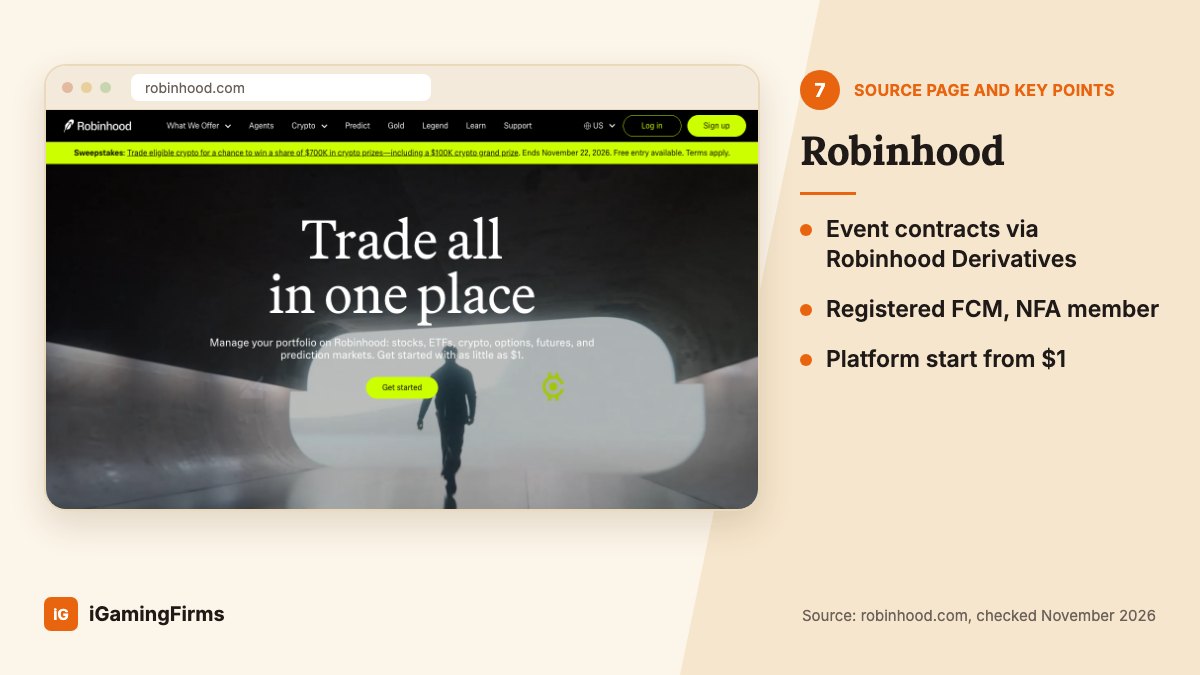
Robinhood is a broker, not an exchange. Its event contracts are offered by Robinhood Derivatives, LLC, a registered futures commission merchant. Each contract is routed to an exchange. That exchange is no longer only Kalshi.
- Venues: Robinhood’s June 2026 announcement says event contracts are offered through KalshiEX LLC, ForecastEx LLC or Rothera Exchange and Clearing LLC. Rothera is the former MIAXdx, bought by a Robinhood and Susquehanna joint venture that closed the deal on 20 January 2026.
- Fees: Robinhood says its commission never exceeds $0.01 per contract. Exchanges add their own fee.
- Scale: Robinhood reported more than 12 billion event contracts traded in 2025. Finance Magnates reported 13.6 billion contracts and $156 million of prediction market revenue in the second quarter of 2026 alone.
- Legal exposure: Robinhood Derivatives filed its own Supreme Court petition in September 2026 after losing in the Ninth Circuit over Nevada.
8. FanDuel Predicts
FanDuel Predicts is Flutter’s US prediction market app, built with CME Group. CME’s launch release of 22 December 2025 confirmed five starting states and a rule that FanDuel Predicts stops offering sports contracts in any state that legalises online sports betting.
- Regulator and venue: CME Group’s exchange lists the contracts. FanDuel is the customer-facing brand.
- Footprint: By January 2026 the app was live in all 50 states, with sports contracts in 18 of them.
- B2B angle: This is the “cannibalise yourself before someone else does” model. FanDuel keeps its licensed sportsbook where one exists and uses prediction markets only where it cannot offer one.
9. DraftKings Predictions
DraftKings Predictions launched in December 2025 in 38 states, also on CME Group’s exchange at the start. DraftKings bought Railbird Exchange, which the CFTC lists as designated on 13 June 2025, for $250 million, with plans to connect it later.
- Regulator and venue: CME Group at launch, with Railbird as DraftKings’ own DCM.
- Product scope: Financial and event contracts across its footprint, with sports contracts limited to selected states.
- B2B angle: Owning a DCM gives DraftKings control of listing and fees, the same move Robinhood made with Rothera.
The legal map: where sports event contracts stand in November 2026
The core question in every case is whether a sports event contract is a “swap” under the Commodity Exchange Act, which would put it under the CFTC’s exclusive jurisdiction, or a wager that states can regulate.
- Third Circuit (New Jersey, Pennsylvania, Delaware): A divided panel held in April 2026 that Kalshi was likely to win on the swap argument.
- Ninth Circuit (Nevada, California, Arizona and others): Held on 28 August 2026 that sports event contracts are likely bets, not swaps.
- Sixth Circuit (Ohio, Tennessee, Michigan, Kentucky): Sided with the Ninth on 25 September 2026.
- Second Circuit (New York, Connecticut, Vermont): On 4 November 2026 it refused injunctions that would have stopped New York and Connecticut enforcing their gambling laws against Kalshi and Coinbase during appeal.
- Supreme Court: New Jersey filed for certiorari on 2 September 2026. Robinhood and Crypto.com have filed too.
- Federal government: The CFTC sued Arizona, Connecticut and Illinois in April 2026 to stop them policing DCMs. That was the first time the agency took states to court over event contracts.
The practical effect is a patchwork. The same contract can be shielded by an injunction in New Jersey while regulators in Ohio or Nevada are free to act against it.
What is the most trusted prediction site?
Trust in this market comes down to the regulatory chain, not the brand. The strongest position is a platform that is itself a DCM and clears its own trades or uses a registered clearinghouse: Kalshi, Polymarket US, ProphetX and the Crypto.com venue behind OG.com all fit that test. Novig’s Ludlow Exchange is a DCM too, but it has traded real money only since August 2026. Brokers such as Robinhood add a layer: you rely on the FCM and on whichever exchange lists each contract. The international Polymarket site has no CFTC oversight at all. For a partner, “trusted” should also mean the platform can survive a court loss in your customers’ circuit without freezing accounts.
What are the top 10 prediction markets?
By US regulatory standing and volume, the ten names that matter for B2B planning in late 2026 are:
- Kalshi (KalshiEX)
- Polymarket US (QCX LLC)
- Robinhood, routing to KalshiEX, ForecastEx and Rothera
- OG.com on Crypto.com’s exchange
- Novig (Ludlow Exchange)
- ProphetX
- FanDuel Predicts on CME Group
- DraftKings Predictions on CME Group and Railbird
- ForecastEx, Interactive Brokers’ exchange, designated in June 2024
- Sporttrade, whose DCM the CFTC list shows as designated on 30 October 2026
Polymarket’s international site is larger than several of these but cannot legally serve US customers.
Which prediction market app is the best?
For a B2B reader the useful question is “best for what”. If you need the deepest sports liquidity, Kalshi leads on volume. If you need league-backed data and integrity agreements, Polymarket’s MLB deal is the strongest single example. If you want a white-label or infrastructure partner, ProphetX is the platform openly selling its exchange. If your licence portfolio is in states that warn against prediction markets, the safest model is the FanDuel one: offer nothing that overlaps your sportsbook licence.
Which crypto prediction market is the best?
Two of the platforms here grew out of crypto. Polymarket’s international site settles in stablecoins on-chain, but it is not CFTC-regulated and is not open to US users. Polymarket US trades in US dollars on a DCM. OG.com belongs to Crypto.com but runs on a CFTC-registered exchange and clearinghouse, so it is a regulated derivatives venue with crypto ownership. For a US operator or affiliate, the crypto label matters less than whether the contract sits on a DCM.
Are prediction markets gambling?
Courts now disagree. The Third Circuit treated sports event contracts as likely swaps under federal law. The Sixth and Ninth Circuits treated them as likely bets subject to state law. Platforms argue they are financial products listed on federally regulated exchanges. State regulators argue that a contract paying out on a game result is a sports wager whatever it is called. Until the Supreme Court rules, the answer depends on where your customer is.
What operators and affiliates should do about prediction markets
If you hold state gaming licences
Treat any link to a prediction market as a licensing question first. Maryland’s regulator told every licensee in a 19 November 2025 letter that “any direct or indirect association, for any financial gain” with an unlicensed sports event contract offering is an illegal activity. It added that illegal activity in any jurisdiction can bear on a Maryland licence. Nevada, Michigan and Ohio regulators have sent similar warnings. Before you sign a data, technology or marketing deal with a DCM, map every state that licenses you against its stated position.
If you run an affiliate business
Prediction market referral programs are not the same as sportsbook affiliate deals. Maryland’s letter covers indirect association, which can include revenue share and affiliate marketing. Disclosure is a second risk. BBB National Programs referred Kalshi to state regulators in June 2026 after it declined to join an inquiry into whether its influencers and affiliates disclosed paid relationships. Keep prediction market traffic in separate tracking. Geo-block states that have taken enforcement action. Read our iGaming affiliate marketing guide for how licensing rules already shape affiliate deals.
If you supply data, odds or technology
Prediction markets are buyers. MLB’s deal routes official data to prediction markets through Sportradar, according to the Associated Press. Exchanges also need market makers, settlement data and integrity monitoring. The risk is the same licence question operators face. A supplier licensed by a state gaming regulator may need to check whether serving a DCM counts as “association”. Our comparison of sports data providers covers the main suppliers in this space.
Why the venue matters more than the brand
The venue can change while the brand stays the same
Consumer comparisons treat each app as one product. In practice, Robinhood routes contracts to three different exchanges and DraftKings plans to move from CME Group to its own Railbird venue. A contract’s legal position, fee and dispute rules follow the exchange that lists it, not the app. Any partner due diligence should be done per contract venue.
Licence risk reaches partners, not only platforms
Most coverage frames the fight as states against Kalshi. Maryland’s letter shows the real exposure for the B2B market: a licensed sportsbook, affiliate or supplier can put its own licence at risk through an indirect commercial link, even for activity in another state.
The contested product is the main product
The Connecticut court’s finding that sports made up 80 to 90 percent of Kalshi’s listings and revenue means the part of the business under legal attack is most of the business. A Supreme Court ruling against the swap theory would hit sports volume across every venue on this list at once. Plan for both outcomes.
Your next step
Build a one-page exposure map before your next partnership decision. List every state where you hold a licence or send traffic. Add each state’s enforcement position and its federal circuit. Mark which of the nine venues above you touch directly or indirectly. Where a deal touches a state that has warned licensees, get written advice first. Our guide on when you need a gambling lawyer is a useful starting point.