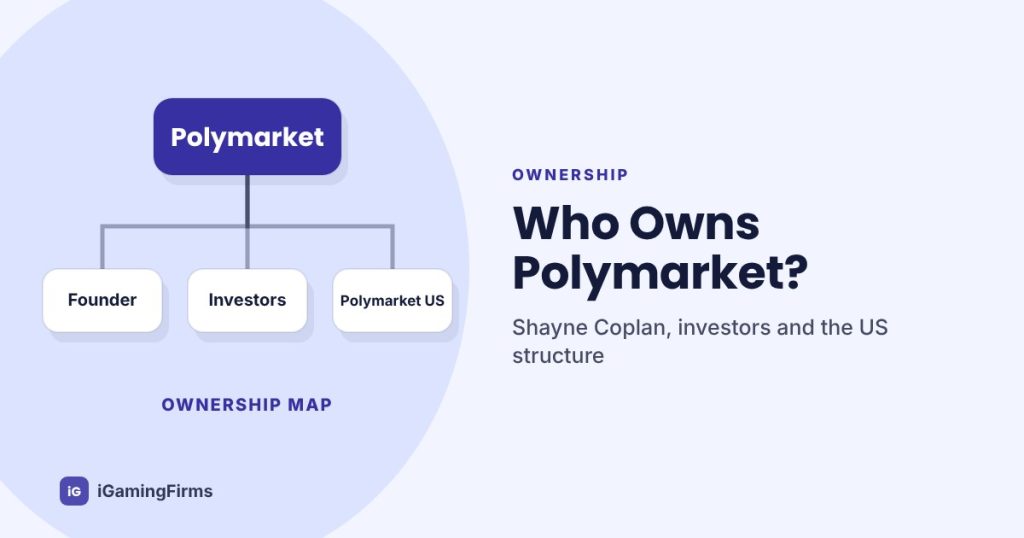
Polymarket is a privately held company. Nobody owns it outright: founder and CEO Shayne Coplan holds the largest individual stake, Intercontinental Exchange (ICE, the owner of the New York Stock Exchange) is the largest outside shareholder after putting in about $1.6 billion and a group of venture funds led by Founders Fund, Polychain, 1confirmation, General Catalyst, Dragonfly and 1789 Capital hold the rest. No cap table has ever been published, so every percentage you see online is either a reported figure or a guess.
If you run an operator or an affiliate business, the ownership question matters for practical reasons: who you would negotiate data or marketing deals with, which legal entity a state regulator is suing and how much capital sits behind a competitor that now holds a federal exchange licence. This guide separates what has been reported with a source from what has only been asserted and lays out the corporate structure, the funding history and the US set-up as they stand in November 2026.
Who owns Polymarket: the short version
Two stakes have actually been reported by a named outlet. Bloomberg, when it added Coplan to its Billionaires Index on 8 October 2025, put his holding at roughly 11 percent. ICE’s own quarterly filing, a 10-Q filed on 30 July 2026, put its holding at around 22 percent of Polymarket’s outstanding shares as of 30 June 2026 (Cointelegraph). That makes ICE the largest disclosed shareholder. Polymarket has not published the figure itself. The rounds since June will have diluted it.
Everything else is undisclosed. Founders Fund, General Catalyst, Polychain, 1confirmation, Dragonfly, ParaFi, Blockchain Capital, D.E. Shaw, G Squared, SV Angel, Valor Equity Partners and 1789 Capital have all been named as investors, but none has stated a percentage. Polymarket has not said whether Coplan holds super-voting shares either. No source backs descriptions of Coplan as holding a “controlling” or “majority” stake; the only reported figure, 11 percent as of late 2025, points the other way.
Is Polymarket American owned? The three entities
Polymarket is American-founded and run from New York, but it operates through at least three legal entities in three jurisdictions. The company has never published a chart showing how they relate.
| Entity | Where | What it does | Source |
|---|---|---|---|
| Blockratize, Inc. (d/b/a Polymarket) | Delaware, based in New York City | The company named in the CFTC’s 2022 settlement order; the original operating company | CFTC order, January 2022 |
| Adventure One QSS Inc. | Registered address in Panama City | The entity shown on the international polymarket.com site and its terms; the global, crypto-settled platform | Polymarket site footer, NPR, May 2026 |
| QCX LLC (d/b/a Polymarket US) and QC Clearing LLC | United States | The CFTC-registered exchange (DCM) and clearinghouse (DCO) bought in July 2025; runs the US platform | CFTC designation, July 2025; MarketsWiki |
Two corrections to what you will read elsewhere. The Panama entity is “Adventure One QSS Inc.”, not “Adventure One Ltd” as some summaries state. And the Panama office is a registered address rather than a working headquarters: NPR visited the listed address in May 2026, found a law office that also serves at least 15 other crypto firms and reported that Polymarket has no employees in Panama. Day-to-day operations are in Manhattan, where the company has long kept an office on the Upper East Side.
Why Panama? Polymarket has not said. The move followed the 2022 CFTC settlement that forced it to wind down US business; the international platform’s terms send user disputes to arbitration in Panama.
Who founded Polymarket and who runs it
Shayne Coplan founded Polymarket in June 2020, aged 22, building the first version alone from a Lower East Side apartment. He was born in New York in June 1998, bought Ether in the 2014 Ethereum sale as a teenager, enrolled at NYU to study computer science and left during his first year. He has been CEO since the start and is listed as founder, CEO and director of the US exchange entity as well.
Yes, he is a billionaire on paper. Bloomberg named him the youngest self-made billionaire in October 2025 on the strength of the ICE deal; Forbes put his net worth at about $1.0 billion at the time. At the reported $21 billion valuation from August 2026, an 11 percent stake would be worth over $2 billion before any dilution from the 2026 rounds, which is why you should treat any precise net-worth figure as an estimate.
Investors have also pushed for tighter governance. Bloomberg reported on 20 October 2026 that Founders Fund made its 2025 investment conditional on Coplan tightening financial controls and repaying company money he had used for private flights, rent and personal expenses, which he did.
The leadership team has filled out in 2026 as the company prepared for scale:
- Warren Jenson, chief financial officer, appointed in September 2026 in what Reuters described as part of a push to regain ground lost to Kalshi (Reuters, 10 September 2026).
- Neal Kumar, chief legal officer, who argued Polymarket’s case against the gambling label in a letter to the Financial Times in October 2026.
- J. Christopher Giancarlo, former CFTC chairman, chair of the advisory board since May 2022.
- Nate Silver (adviser since July 2024) and Donald Trump Jr. (adviser since 1789 Capital’s investment in August 2025). Trump Jr. remains a Polymarket adviser; Kalshi ended his separate advisory role there on 12 November 2026, citing 1789 Capital’s investment in Polymarket.
In November 2026 the new team began cutting costs. Polymarket confirmed on 11 November that it had laid off staff and ended contractor agreements in a company-wide reduction in force, mainly in marketing, customer experience and engineering (Bloomberg). It did not say how many people were affected. People familiar with the plan told Front Office Sports the aim is to professionalise the company ahead of a possible public listing as soon as 2027; Polymarket has not announced an IPO.
Polymarket has not published its board of directors. Claims that Founders Fund, ICE or Blockchain Capital hold board seats are plausible for investors of that size but unconfirmed.
Polymarket funding rounds and valuation
Polymarket’s last reported valuation is $21 billion post-money, from a $1 billion round led by 1789 Capital that Bloomberg reported on 31 August 2026. That is up from $15 billion in April 2026 and $9 billion in October 2025. A 1789 Capital spokesperson confirmed the firm’s share of about $300 million, but we found no company announcement that the round had closed as of 20 November 2026, so the $21 billion figure is a reported number.
| Date | Round | Lead or key investor | Amount | Valuation | Source |
|---|---|---|---|---|---|
| Oct 2020 | Seed | Polychain; 1confirmation, Dragonfly, Nascent | $4m | Not disclosed | Reported in investor profiles; not confirmed by the company |
| Announced May 2024 | Series A | General Catalyst; Polychain, Joe Gebbia | $25m | Not disclosed | Business Wire, 13 May 2024 |
| Announced May 2024 | Series B | Founders Fund; 1confirmation, ParaFi, Dragonfly, Vitalik Buterin, Kevin Hartz | $45m | About $1bn (reported) | Business Wire, 13 May 2024 |
| 2024 and 2025 (disclosed Oct 2025) | Two previously undisclosed rounds | Blockchain Capital led the 2024 round; Founders Fund led the 2025 round | $55m (2024) and $150m (2025), about $205m in total | $350m (2024) and $1.2bn (2025) | The Block, 8 Oct 2025, citing Coplan |
| Aug 2025 | Strategic | 1789 Capital (Donald Trump Jr.) | Not disclosed at the time; later reported at about $200m in total | Not disclosed | Reuters, 26 Aug 2025 |
| 7 Oct 2025 | Strategic (ICE) | Intercontinental Exchange | Up to $2bn committed; $1bn paid at signing | $8bn pre-money, about $9bn post | ICE announcement, 7 Oct 2025 |
| 27 Mar 2026 | ICE completion | Intercontinental Exchange | $600m further, plus up to $40m bought from existing holders | Not disclosed by ICE | ICE statement via Bloomberg, 27 Mar 2026 |
| Apr 2026 | Growth round | D.E. Shaw and G Squared (new); SV Angel, Dragonfly, Valor (existing) | About $1bn including ICE’s $600m | $15bn | Bloomberg, reported closed 4 Aug 2026 |
| Reported 31 Aug 2026 | Growth round | 1789 Capital (about $300m of the round, confirmed by a 1789 spokesperson) | $1bn | $21bn post-money | Bloomberg; not confirmed closed |
A note on totals. Several pages add these rows up to “$2.8 billion raised” or “$3.8 billion raised”. The honest answer is that nobody outside the company knows: the ICE $600 million sits inside the April round in some reports and alongside it in others, while the 1789 Capital amounts are reported rather than announced. Somewhere between $3 billion and $4 billion of primary capital since 2020 is the defensible range.
Did Polymarket recently raise capital? Yes, twice in 2026: the April round at $15 billion and the round reported on 31 August at $21 billion that was still being reported as “raising” rather than “raised” in early October 2026. In secondary markets, PM Insights estimated an implied value of $11.6 billion in January 2026, between the two primary marks.
Who are the main investors in Polymarket?
Grouped by what they bring, the investor list looks like this:
- Strategic: Intercontinental Exchange. About $1.6 billion in cash across October 2025 and March 2026, exclusive global distribution rights to Polymarket’s event-driven data and a joint tokenisation programme. At Token2049 on 7 October 2026, Coplan described ICE as one of Polymarket’s largest shareholders and said the two were “seriously considering” putting Polymarket equity on-chain in cooperation with regulators.
- Political capital: 1789 Capital. The venture firm co-founded by Donald Trump Jr. invested about $200 million from August 2025, then led the reported $21 billion round with about $300 million, taking its reported total to about $500 million. Trump Jr. sits on the advisory board.
- Venture: Founders Fund (Peter Thiel), General Catalyst, Polychain, 1confirmation, Dragonfly, ParaFi, Blockchain Capital, SV Angel, Valor Equity Partners. The crypto-native funds came in at seed; Founders Fund led the Series B in 2024.
- Hedge funds and crossover: D.E. Shaw, G Squared. New in the April 2026 round.
- Individuals: Vitalik Buterin, Joe Gebbia, Kevin Hartz. Named in the May 2024 announcement.
Union Square Ventures appears on several ownership pages. No funding announcement or named-outlet report we could find lists USV as an investor, so it is left out here until a source turns up.
The US structure: QCX LLC, the CFTC and Polymarket US
Is Polymarket regulated? In the United States, yes, through a separate entity. Polymarket’s international platform is not registered with the CFTC and has been off-limits to US residents since the 2022 settlement. The US product runs on QCX LLC (a Designated Contract Market) and QC Clearing LLC (a Derivatives Clearing Organization), which Polymarket bought for $112 million in July 2025 (the package is usually called QCEX). The CFTC designated QCX LLC as a DCM on 9 July 2025 and on 25 November 2025 approved an amended order of designation allowing intermediated access through futures commission merchants and retail brokerages.
Polymarket US opened to a waitlist on 2 December 2025 and dropped the waitlist in May 2026. It offers cash-settled binary contracts on a central limit order book and applies the same surveillance, clearing and reporting duties as any federally regulated exchange. Notional volume on the US exchange passed $14.5 billion in October 2026, up from about $4 billion in June, according to TickerTracker data reported alongside Polymarket’s November revenue update. Coplan is CEO and director of QCX LLC as well as of the parent.
Federal registration has not settled the state question. Nevada’s Attorney General announced on 3 June 2026 that a state court would grant a preliminary injunction against QCX LLC, barring sports, election and entertainment contracts for Nevada residents while the state’s case continues. Minnesota passed a law banning prediction markets from 1 August 2026, which the CFTC, Kalshi and Polymarket sued to block; a federal judge blocked the law in July 2026. New York’s Attorney General sued QCX LLC (d/b/a Polymarket US) on 24 September 2026, alleging illegal gambling and access for users aged 18 to 20; Polymarket countersued in Manhattan federal court the same day (Al Jazeera). Kentucky’s Attorney General has sued QCX LLC and Blockratize Inc. directly in state court (complaint dated 17 June 2026). Louisiana’s Attorney General sued Polymarket and nine other platforms on 12 November 2026 (The Block). On 9 November QCX sued Arkansas and Missouri officials in federal court (SBC Americas). Michigan and New Mexico have disputes that set precedent for QCX. If you track the Kalshi litigation, the same circuit-split logic applies here; the regulation news roundup has the current state of play.
Outside the US, the international platform is blocked or restricted in France, Italy, Brazil, Portugal, Spain, Indonesia, South Korea, Denmark and others, in most cases because the local regulator classed it as unlicensed gambling. In the UK the picture is open: on 6 October 2026 the FCA confirmed it is in talks with Polymarket and Kalshi about market entry, while reminding both that the 2019 retail ban on binary options still stands and that sports and political contracts would fall to the Gambling Commission, which said in February 2026 that such businesses may need a betting intermediary licence.
Regulatory history in brief
- 3 January 2022. The CFTC fined Blockratize, Inc. d/b/a Polymarket $1.4 million for running an unregistered facility for event-based binary options since June 2020 and ordered it to wind down non-compliant markets. The penalty was reduced for cooperation. Polymarket then blocked US users and moved its base offshore.
- 13 November 2024. The FBI searched Coplan’s Manhattan home and seized his phone, a week after the US election, in a Justice Department inquiry into whether Americans were trading on the platform. Polymarket called it political retribution.
- July 2025. The DOJ and CFTC closed their investigations without charges. Polymarket announced the QCEX acquisition the same month.
- September to November 2025. CFTC clearance for the US return, then the amended order enabling intermediated access.
- January to June 2026. Nevada’s complaint and preliminary injunction; Minnesota’s ban; a Wall Street Journal report on misleading influencer marketing that led Senators John Curtis and Adam Schiff to ask the CFTC on 25 June 2026 whether it was investigating. Bloomberg, the WSJ and CNBC reported the next day that the CFTC was already conducting a broad investigation into Polymarket, citing people familiar with the matter. The CFTC has not confirmed it publicly.
- September to November 2026. New York’s lawsuit and Polymarket’s countersuit (24 September), then the company-wide restructuring confirmed on 11 November.
How Polymarket makes money and why ownership shapes it
Polymarket is an exchange, not a bookmaker: it does not take the other side of trades and does not profit when traders lose. Its disclosed revenue lines are trading fees on the US exchange and on matched taker orders in certain market categories on the international platform, the exclusive data-distribution agreement with ICE (which is both a shareholder and the sales channel for Polymarket’s data to institutions) and yield on the stablecoin collateral behind open positions. The ICE relationship is the clearest example of ownership driving the business model: the largest shareholder is also the distributor of the product’s most valuable by-product.
Polymarket does not publish audited revenue. It told CNBC on 10 November 2026 that its annualised revenue run rate had passed $1.8 billion, up from more than $1 billion in June, helped by sports contracts and the US exchange (Casino.org). A run rate extrapolates the current pace of trading rather than measuring revenue earned over a full year, so treat it as a company-supplied figure until Polymarket files accounts.
What this means for operators and affiliates
If you are an operator. Polymarket now competes with you for the same US customer with a federal licence, roughly $1.6 billion of ICE’s money and a state-by-state legal fight it is running in parallel with Kalshi. The ownership structure tells you two things. First, ICE’s data rights mean Polymarket probabilities will increasingly show up inside institutional terminals and, potentially, inside licensed sportsbooks’ pricing models, so your odds and data suppliers may be licensing them already. Second, the Panama entity and the US entity are separate, which is why the international site can keep listing markets that QCX LLC cannot offer in Nevada. Where that matters for your own market, see the operator-side maths in our guide to whether sports betting is profitable and the size comparison in our list of the largest gambling companies in the world. Compare that reported $21 billion valuation with the market values on that list.
If you are an affiliate. Polymarket’s documented referral programme (terms updated 28 May 2026) pays 10 percent of the net trading fees your direct referrals generate and 5 percent for indirect referrals, paid daily in pUSD, with a $10,000 lifetime trading volume threshold before you earn and a 30-day window per referral. That programme belongs to the international, crypto-settled platform. Because payouts are a share of fees, note that Polymarket changed its international fee and rebate schedule from 20 November 2026; recheck your referral maths against the current fee table in its documentation. Polymarket US runs separate promotions through media partners. Because QCX LLC is a CFTC-regulated exchange, your marketing of it is subject to the CFTC’s advertising scrutiny described above and to state injunctions such as Nevada’s. Check which entity any deal is with before you sign and read our Kalshi vs Polymarket comparison for how the two US licences differ.
If you are tracking the sector for SEO or content. The ownership story is moving quarterly. The facts most likely to change next are the $21 billion round closing, an updated ICE percentage in its next filing, any IPO filing, any on-chain equity announcement and the UK FCA decision. Date-stamp anything you publish.
Polymarket ownership FAQs
Who is the largest shareholder of Polymarket?
ICE is the largest disclosed shareholder, with about 22 percent of outstanding shares as of 30 June 2026 according to its July 2026 10-Q, after investing roughly $1.6 billion. Shayne Coplan is the largest individual shareholder, with about 11 percent according to Bloomberg’s October 2025 estimate. Polymarket has not confirmed either figure.
Does Donald Trump Jr. own part of Polymarket?
Not personally, as far as has been disclosed. His venture firm 1789 Capital is an investor, with about $200 million from 2025 and about $300 million in the 2026 round it led. Trump Jr. is a Polymarket adviser. His adviser role at rival Kalshi ended on 12 November 2026.
Is Polymarket going public?
No IPO has been announced. Reports in November 2026 linked the company’s restructuring to a possible listing as soon as 2027, but Polymarket has not confirmed a timetable.
Who owns Polymarket US?
Polymarket US is run by QCX LLC, the CFTC-registered exchange that Polymarket bought in July 2025 as part of a $112 million deal that included the clearinghouse QC Clearing LLC. Coplan is CEO and director of QCX LLC.
How much is Polymarket worth?
The latest reported valuation is $21 billion post-money, from the 1789 Capital-led round reported in August 2026. That figure has not been confirmed as closed by the company.
Next step
Ownership answers will keep shifting until Polymarket either lists or publishes a cap table. ICE’s filings give the only disclosed percentage so far. For the legal picture, see is Polymarket legal in the US; for how prediction markets work, see our prediction markets explainer.
This article is general information and analysis, not legal, investment or tax advice. Ownership figures are reported, not confirmed by Polymarket; check primary filings before relying on them. Last fact-checked 28 November 2026.