Last updated: 15 October 2026
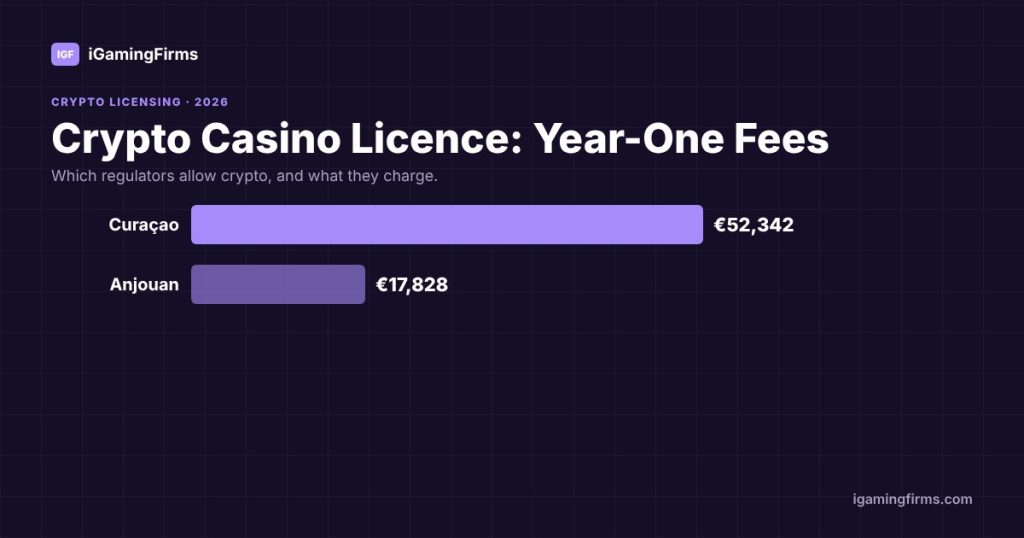
The short answer: there is no standalone crypto casino licence. You need an ordinary online gambling licence from a regulator that allows crypto as a payment method, and a separate crypto (VASP or CASP) licence only if you exchange, convert or hold crypto as a service. In 2026 the regulators with written crypto rules for gambling licensees are Curaçao (CGA, June 2026 guideline), Malta (MGA, DLT policy) and the Isle of Man (GSC, virtual currency practice note). Year-one regulator fees run from about €17,800 in Anjouan to €45,000 or more in Malta and about €52,300 in Curaçao, before tax, capital and compliance costs.
Most of what you’ll read about crypto casino licensing is written to sell you one. Agents call every offshore licence “crypto-friendly”, and search answers to “how much is a crypto license?” often quote exchange licences in New York, Dubai and Hong Kong, which have nothing to do with running a casino.
This guide separates the two. It covers which gambling regulators have actually written rules for crypto, what each costs in year one from their published fee schedules, when you also need a crypto licence, and what the 2026 rule changes in Curaçao, the EU and the UK mean for a crypto casino launch.
Do you need a separate crypto casino licence?
Usually not. Regulators license the gambling, not the coin. A crypto casino holds the same B2C licence as a fiat casino, plus approval (or written rules) for accepting crypto deposits and paying out in crypto.

A second licence comes into play only when your business does something a crypto-asset service provider does. Three situations decide it:
| How you handle crypto | What you need | Notes |
|---|---|---|
| A licensed crypto payment provider takes the deposit and credits you (in crypto or fiat) | Gambling licence with crypto approval | The simplest route. Check the provider is authorised for the exact service and the markets it serves. |
| You hold players’ crypto in your own wallets for play | Gambling licence, plus your regulator’s wallet rules | Curaçao requires segregated player, operational and treasury wallets; Malta wants a wallet management policy; the Isle of Man wants custody controls such as multi-signature. |
| You let players swap coins, convert crypto to fiat, send funds to each other or store tokens outside play | Usually a VASP or CASP licence as well, and many gambling regulators ban it outright | Curaçao and Malta both prohibit licensees from acting as an exchange. |
That third row is where most crypto casino licence confusion starts. Under the EU’s Markets in Crypto-Assets Regulation (MiCA), accepting bitcoin for bets doesn’t make you a crypto-asset service provider, but running exchange, custody or transfer services for customers can. MiCA’s CASP rules have applied since 30 December 2024 and the maximum transitional period ended on 1 July 2026, so any crypto payment provider you use in the EU now needs a granted CASP authorisation, not a pending application or an old national VASP registration. MiCA authorises custody, exchange and transfer separately, so check the provider’s authorisation service by service.
Which jurisdictions allow crypto casinos in 2026?
“Allows crypto” means very different things depending on the regulator. Some have published rulebooks; others simply don’t object. Here’s what each of the licences pitched to crypto casinos actually says, and what it costs.
| Licence | Crypto position | Written crypto rules? | Year-one regulator fees | Typical timeline |
|---|---|---|---|---|
| Curaçao (CGA, B2C) | Crypto allowed for gambling only; no exchange, custody or VASP activity | Yes, June 2026 guideline, phased to June 2027 | €4,592 application + €47,450 annual + €150 per UBO from the second | 4 to 6 months |
| Malta (MGA, B2C Type 1) | VFAs accepted with prior MGA approval; no on-platform exchange; anonymity coins banned | Yes, DLT policy (January 2023) | €5,000 application + €25,000 annual + compliance contribution from €15,000; €100,000 paid-up share capital | 4 to 6 months or more |
| Isle of Man (GSC, full OGRA) | Convertible virtual currencies accepted under five approved models; licence schedule amended | Yes, Virtual Currencies practice note (updated 2020) | £5,250 application + £36,750 annual, plus GGY duty | 4 to 6 months |
| Anjouan (B2C) | “Blockchain-based and crypto-enabled gaming” listed as permitted; no crypto rulebook published | No | €17,828 issuance (covers year one); €17,828 renewal; €500 per extra domain | 4 to 8 weeks (adviser-reported) |
| Tobique (First Nation, Canada) | Described by advisers as accommodating crypto models | None found on a regulator page | Not published; advisers quote from about US$17,500 to €36,000 in year one | 4 to 14 weeks (adviser-reported) |
| Kahnawake (KGC, CPA) | No crypto-specific rules found | None found | US$35,000 incl. first annual fee (US$20,000 a year, up to six domains) + US$5,000 per key person (rising January 2027) | 4 to 8 weeks to a preliminary permit |
| Costa Rica | No gambling licence exists; operators run under an ordinary company and data-processing permit | No | Not a gambling licence | n/a |
| Great Britain (UKGC) | No established route; the Commission is only exploring one | No | Not a realistic crypto route in 2026 | n/a |
Fees for Curaçao, Malta, the Isle of Man, Kahnawake and Anjouan come from each regulator’s published schedule, as covered in our Curaçao gaming licence guide, MGA licence guide and wider gambling licence cost comparison. Tobique doesn’t publish a fee schedule, and the two adviser quotes we found differ widely, so get a written quote that lists what’s excluded.
Curaçao: the most detailed crypto rules, and the strictest offshore ones
Curaçao is still where most crypto casinos are licensed, but it no longer means light touch. The old master and sub-licence model has been replaced by direct licences from the Curaçao Gaming Authority, and the CGA’s crypto guideline, reported by iGaming Business on 24 June 2026, applies to every B2C licensee and every group entity involved in its crypto transactions:
- Allowed: accepting crypto for gambling. Fiat-backed, regulated stablecoins are preferred; privacy coins and meme coins must be risk-assessed in your policy, and wrapped or bridged tokens of unclear origin are excluded.
- Banned immediately: acting as an exchange, payment provider, custodian or VASP; holding or swapping crypto for players outside gambling; player-to-player transfers; funds linked to mixers, tumblers or sanctioned wallets; personal, employee or UBO-linked wallets.
- Within 3 months (about September 2026): a compliant crypto policy uploaded to the CGA portal.
- Within 6 months (about December 2026): risk assessments, due diligence on your VASP partners, wallet ownership controls, transaction monitoring and staff training.
- Within 12 months (June 2027): segregated player, operational and treasury wallets, blockchain analytics, reconciliation, withdrawal whitelisting and audit-ready records. The guidance also applies the FATF Travel Rule.
Withdrawals should normally go back to the same wallet and asset used for the deposit, and the CGA can demand faster action where it sees material risk. If you’re budgeting for a Curaçao crypto casino, the blockchain analytics contract is now a licence requirement, not an optional extra.
Malta: crypto allowed, with approval for every asset
The MGA replaced its old blockchain sandbox (which closed on 31 December 2022) with the Policy on the use of Distributed Ledger Technology by Authorised Persons, published in January 2023. Some agency pages still describe a “sandbox”; that framework no longer exists. Under the policy:
- You need MGA approval before accepting any virtual financial asset, whether the player deposits in crypto and you receive crypto, or one side of the payment is fiat.
- You submit the list of assets you’ll accept and their classification. Assets with built-in anonymisation are prohibited, and changing the list needs approval.
- Any third party handling custody or crypto acceptance must be authorised under Maltese law (the policy names the VFA Act, which Malta has since moved to MiCA’s CASP regime, supervised by the MFSA rather than the MGA).
- Buying, selling or exchanging crypto on your platform isn’t permitted.
- Deposit and loss limits are still set in fiat terms, and you report your exchange rates and failed transactions monthly.
Malta gives you the strongest crypto-ready licence on this list, but it’s the most expensive one, and it doesn’t give you access to other EU markets. Each EU country licenses gambling nationally.
Isle of Man: the oldest crypto framework
The Isle of Man Gambling Supervision Commission has allowed licensees to use virtual currencies for years, and its updated Virtual Currencies practice note (February 2020) sets out five permitted models, from converting crypto to fiat before play to crypto in and crypto out against the house. Crypto in, fiat out isn’t licensable. Withdrawals must go back to an instrument the same player controls, operators need custody protections such as multi-signature, and pay-as-you-go accounts must lock withdrawals automatically at a €3,000 threshold. Adding crypto doesn’t count as a new gambling product, but your licence gets a schedule of crypto conditions.
Anjouan, Tobique and Kahnawake: permitted, but unwritten
These are the licences agents pitch hardest for crypto casinos because they’re cheaper and faster. The trade-off is that none of them publishes crypto-specific rules we could find, so the conditions you’ll operate under are whatever your licence and agent tell you. Anjouan also has legal-standing and banking risks worth reading up on before you commit, and payment and B2B acceptance for Tobique is narrower than for Curaçao, even by the account of the law firms that sell it.
Is Costa Rica a crypto casino licence?
No. Costa Rica doesn’t license online gambling. Operators that cite it have incorporated a local company under a general data-processing permit, which brings no gambling supervision, no player-protection rules and no AML oversight from a gaming regulator. Payment providers and game studios treat it accordingly, so it’s at best a stopgap, and you carry the whole compliance stack yourself.
The UK and the US: not routes for a crypto casino yet
In Great Britain there’s no established way for a licensed operator to accept crypto at scale. At the Betting and Gaming Council’s AGM on 26 February 2026, Gambling Commission executive director Tim Miller asked the Commission’s Industry Forum to explore a route, calling it a “tentative first step” with no timetable. The FCA’s new cryptoasset regime starts on 25 October 2027 (its application gateway opened on 30 September 2026), and any GB gambling route is likely to follow it.
In the US, state-licensed sportsbooks and casinos don’t take crypto directly. The furthest any regulator has gone is crypto converted to cash before it reaches the player’s account: in early 2026 DraftKings began rolling out converted-crypto funding in Illinois, Kentucky, New Hampshire and Vermont, while Massachusetts banned even converted crypto as a funding source from December 2025, as SBC Americas reported. An offshore licence doesn’t let you serve players in either country, and our guide to whether offshore betting is legal explains why.
Does one crypto casino licence cover every market?
No. A licence makes your crypto casino legal where the licensing jurisdiction’s law reaches and in markets that don’t license gambling locally. It doesn’t override the law of a country that does. Great Britain, the regulated US states, the Netherlands, Spain, Australia and most of the EU require their own licence, and an MGA, Curaçao or Anjouan licence doesn’t change that. Curaçao’s own framework also restricts where licensees may offer services, so check its list before you commit to a market.
Start with the player’s country, not the licence: list every market you’ll accept and every one you’ll geo-block by IP and KYC data, then pick a licence that fits that list.
How much does a crypto casino licence cost?
Search answers to this question often quote crypto exchange licences: free FinCEN registration in the US, a New York BitLicense at $350,000 to $1.5 million, Dubai VARA and Hong Kong capital requirements. A casino that takes crypto through a licensed payment provider doesn’t need any of those. What you’re actually paying for is a gambling licence plus the crypto compliance stack your regulator now expects.
Worked example: year-one regulator fees for a crypto casino
Assumptions: a new B2C online casino, three individual UBOs who are also the key persons, one domain, licence granted at the start of the year, crypto accepted through a licensed payment provider (no exchange or custody service). Regulator fees only, before tax.
| Licence | Year-one regulator fees | Year two | Other money tied up or due |
|---|---|---|---|
| Anjouan | €17,828 | €17,828 | Company and agent fees; agents quote a few thousand euros a year |
| Curaçao | €52,342 (€4,592 + €47,450 + 2 × €150 for the second and third UBOs) | €47,450 | Resident director; local substance from April 2027 |
| Kahnawake | US$50,000 (US$35,000 + 3 × US$5,000); US$58,000 (US$40,000 + 3 × US$6,000) if filed from 1 January 2027 | US$23,000 (US$20,000 + 3 × US$1,000) | Hosting at Mohawk Internet Technologies |
| Isle of Man | £42,000 (£5,250 + £36,750) | £36,750 | GGY duty; resident directors, local servers and bank |
| Malta (Type 1) | At least €45,000 (€5,000 + €25,000 + €15,000 minimum compliance contribution) | At least €40,000 | €100,000 paid-up share capital; 15% Malta gaming tax on revenue from Malta-based players (Type 1, since 1 October 2026; was 5%) |
Crypto compliance costs on top of the licence
Budget for the crypto-specific lines your regulator expects:
- A blockchain analytics and wallet-screening provider covering deposits and withdrawals.
- A crypto payment provider with the right authorisation for your markets.
- A written crypto policy, accepted-asset list and AML risk assessment.
- Source-of-funds checks and KYC on crypto players.
None of these vendors publish standard prices, so collect quotes. Our list of iGaming payment providers covers who processes crypto for operators.
How to start a crypto casino: the licensing steps
- Decide your markets first. The licence follows the players you’ll accept, not the other way round. List every country you’ll serve and every one you’ll geo-block.
- Decide how crypto will flow. Pass-through via a licensed provider, your own wallets, or both. If any part looks like exchange or custody as a service, take legal advice on CASP or VASP scope before you pick a licence.
- Pick the licence whose crypto rules fit that model. Use the table above. If a model you want (for example crypto in, fiat out on the Isle of Man, or on-site swaps in Curaçao or Malta) isn’t allowed, change the model or the jurisdiction.
- Confirm your partners in writing. Ask your platform, top game studios and crypto payment provider whether they will work with that licence. A cheap licence your partners won’t accept costs more than an expensive one.
- Build the crypto compliance file. Crypto policy, wallet structure, accepted-asset list, analytics provider, Travel Rule process and AML risk assessment. Curaçao and Malta both expect these as written documents.
- Apply, then keep up. Track deadlines such as Curaçao’s June 2027 full-compliance date and keep records of every wallet address and transaction for the regulator.
If you’d rather not build the stack yourself, a white label casino platform can run under its own licence while you test the market, though you inherit its crypto rules and its partners’ limits.
Are bitcoin casinos legit? What makes a crypto casino licence credible
Some are and some aren’t, and the licence is the first thing to check, whether you’re an operator choosing a white label partner or an affiliate deciding which brands to promote. A credible crypto casino licence shows:
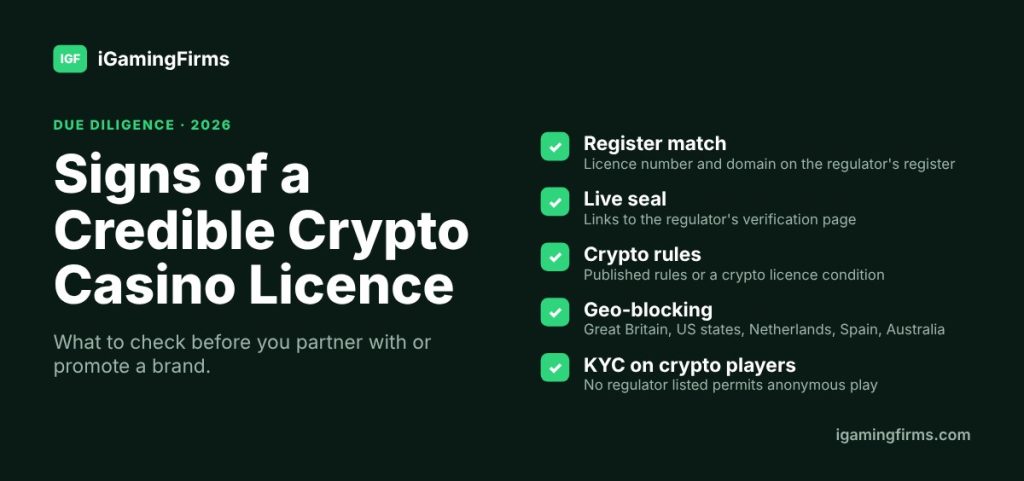
- A licence number and company name that match an entry on the regulator’s own public register, with the domain listed.
- A seal that links straight to the regulator’s verification page, not a static image.
- Published crypto rules from that regulator, or at least a licence condition covering crypto payments.
- Geo-blocking of markets that license gambling locally, such as Great Britain, the US states, the Netherlands, Spain and Australia.
- KYC on crypto players. No regulator on this list permits fully anonymous play.
For affiliates, promoting a crypto-first brand into a market where it isn’t licensed carries the same advertising risk as promoting any unlicensed operator there.
Common mistakes with a crypto gambling licence
- Buying a crypto (VASP) licence instead of a gambling licence. A VASP registration doesn’t authorise gambling anywhere.
- Offering swaps or crypto-to-fiat conversion in the cashier. Curaçao and Malta both ban licensees from acting as an exchange.
- Assuming “crypto-friendly” means “no rules”. Curaçao’s 2026 guideline brings sanctions screening, mixer blocking and wallet segregation, and Malta requires approval for each asset.
- Treating a Costa Rica company as a licence. It isn’t one, and partners will treat it that way.
- Relying on a payment provider’s “MiCA compliant” badge. Since 1 July 2026, check its granted CASP authorisation and the exact services it covers.
- Thinking one licence covers Europe. Neither an MGA nor a Curaçao licence lets you serve markets that license gambling locally.
Your next step
Write down your target markets and your crypto flow (pass-through, own wallets or both), then shortlist the two licences from the table whose crypto rules match. Ask two or three iGaming licensing consultants to quote against the regulator fees above, and ask each one what their quote leaves out: analytics, payment provider onboarding, local substance and tax.
This guide is independent information, not legal or tax advice. Fees come from the regulators’ published schedules as covered in our licence guides; crypto rules come from the MGA’s DLT policy, the GSC’s Virtual Currencies practice note and dated reporting on the CGA guideline, UKGC remarks and US state decisions. Confirm current positions with the regulator or a qualified adviser before you apply.