Last updated: 31 October 2026
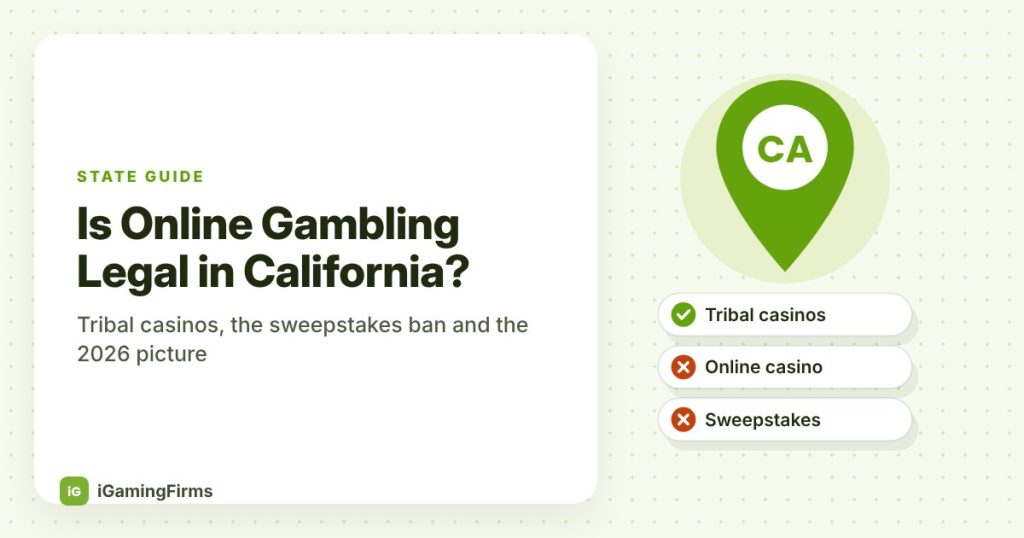
Online gambling is mostly illegal in California. As of October 2026 there is no licence for online casinos, online poker or online sports betting, and since 1 January 2026 dual-currency sweepstakes casinos are a crime under AB 831. The legal online exceptions are narrow: advance deposit wagering on horse racing, and products that operate under a federal theory rather than a state licence, such as Kalshi and other CFTC-regulated prediction markets.
California is the largest closed market in the US, and that is exactly why operators, affiliates and suppliers keep asking about it. This guide covers what is legal product by product, the sweepstakes ban and who it reaches, where Kalshi, DraftKings and FanDuel stand, the gambling age for each product, what happens to people who break the rules, and what could change before 2028.
Is online gambling legal in California? The short answer
California’s gambling economy runs on in-person play: tribal casinos under compacts with the state, licensed cardrooms, the state lottery and horse racing. The state constitution bars the Legislature from authorising “casinos of the type currently operating in Nevada and New Jersey”, and voters rejected both sports betting measures in 2022. No bill to legalise online casino or poker has moved since then.
Status table last verified: 11 October 2026.
| Product | Status (Oct 2026) | Legal basis | Minimum age |
|---|---|---|---|
| Online casino games | Illegal, no licence exists | Cal. Const. art. IV, sec. 19; Penal Code 330 | Not applicable |
| Online poker | Illegal, no licence exists | Penal Code 330; no intrastate poker law | Not applicable |
| Online and retail sports betting | Illegal | Penal Code 337a; Props 26 and 27 rejected in 2022 | Not applicable |
| Sweepstakes casinos (dual currency) | Banned since 1 January 2026 | AB 831, Penal Code 337o | Not applicable |
| Tribal casinos | Legal (Class III under compacts) | Cal. Const. art. IV, sec. 19(f); IGRA | 18 or 21, set by each casino |
| Cardrooms | Legal, licensed by the state | Gambling Control Act | 21 |
| California Lottery | Legal, retail only (no online ticket sales) | Government Code 8880 and following | 18 |
| Horse racing, including online (ADW) | Legal | California Horse Racing Board | 18 |
| Daily fantasy sports | Declared illegal by AG opinion (July 2025); peer-to-peer contests still offered | AG opinion, Penal Code 337a | Operator terms |
| Prediction markets (Kalshi and others) | Operating under CFTC status; contested in court | Commodity Exchange Act (federal) | 18 (platform terms) |
What gambling is legal in California?
Everything legal in California is either tribal, licensed by the state, or run by the state.
Tribal casinos
Proposition 1A, passed in 2000, added subdivision (f) to Article IV, section 19 of the constitution. It lets the Governor negotiate compacts with federally recognised tribes for slot machines, lottery games and banking or percentage card games on Indian lands. That gave tribes the exclusive right to Nevada-style casino games in the state. Sports wagering is not on the list, which is why legal sports betting needs another constitutional amendment.
The scale is large. The National Indian Gaming Commission’s fiscal year 2025 revenue report, released in July 2026, shows $12.6 billion in gross gaming revenue from about 88 tribal gaming operations in its Sacramento region in FY2025, which covers California and northern Nevada. That is more than a quarter of the $46.2 billion national tribal total. The California Gambling Control Commission (CGCC) acts as trustee for the tribal revenue-sharing funds and publishes the compacts.
Tribal casino gaming is in person only. No compact allows online play, and nothing in IGRA lets a tribe take online bets from players off its lands without a new legal framework.
Cardrooms
California’s licensed cardrooms offer poker and “California games” such as player-banked blackjack-style and baccarat-style games. The house cannot bank the game, so cardrooms use third-party proposition player services that rotate the player-dealer position. The CGCC licenses them and the Department of Justice’s Bureau of Gambling Control regulates them.
This is the most active fight in California gaming right now, and it has nothing to do with online play. In February 2026 the Office of Administrative Law approved Bureau rules that would have ended blackjack-style games and tightened player-dealer rotation, effective 1 April 2026. Cardrooms sued. A San Francisco Superior Court judge blocked the rules in May and struck them down on 30 June 2026, ruling that the Bureau had exceeded its authority. Attorney General Rob Bonta appealed on 17 July 2026, and the Bureau’s regulations page lists the implementation timeline as suspended. Separately, tribes used SB 549 to sue the cardrooms directly in 2025, and a Sacramento judge dismissed that suit as preempted by IGRA.
The cardroom fight matters for online policy because it shows how the two land-based camps line up. Tribes and cardrooms are still litigating over table games. Neither side has an incentive to agree an online framework that the other could use.
The lottery and horse racing
The California Lottery sells draw and scratch games through retailers. Unlike North Carolina or Michigan, it does not sell tickets online. The minimum age is 18.
Horse racing is the one form of real-money betting Californians can legally do online. Advance deposit wagering (ADW) operators approved by the California Horse Racing Board take pari-mutuel bets through apps. FanDuel’s own support page for California lists FanDuel Racing among the products it offers in the state.
Are online casinos and online poker legal in California?
No. There is no state licence for online slots, table games, live dealer games or online poker, and the constitution would block a commercial online casino without a constitutional amendment. Penal Code 330 makes playing or dealing banking and percentage games a misdemeanor, and the CGCC’s own homepage carries an advisory about unlicensed online casinos using forged Commission documents to look legitimate.
Online poker bills were filed from 2008 onward and stalled every time, mostly over whether cardrooms and racetracks could take part alongside tribes. The last serious attempt was AB 1677 in 2017. Nothing has been filed in the 2025 to 2026 session that would legalise online casino or poker.
Several of the ranking pages for this question are affiliate pages that promote offshore poker and casino sites to Californians and describe them as safe because state law “does not specifically prohibit” playing on them. That framing is misleading. An offshore site has no California licence, so it has no legal basis to take wagers from the state, and California players have no regulator to complain to. For how offshore operators’ licences interact with US state law, see our guide on whether offshore sports betting is legal.
Can you legally sports bet in California?
No. California has no legal sports betting, online or in person. In November 2022 voters rejected Proposition 26 (in-person betting at tribal casinos and racetracks) by roughly two to one and Proposition 27 (online betting run by commercial operators with tribal partners) by more than four to one. Taking or placing a bet on a sporting event with a bookmaker is an offence under Penal Code 337a.
Can I bet on FanDuel in California? Is DraftKings illegal in California?
The sportsbook products are not available. FanDuel Sportsbook and DraftKings Sportsbook do not accept wagers from inside California. What the two companies offer in the state is different:
- FanDuel: its California support page lists FanDuel Predicts (CFTC-regulated event contracts), FanDuel Fantasy, FanDuel Faceoff and FanDuel Racing.
- DraftKings: DraftKings Predictions, its event contract product, is available to Californians. Its fantasy contests continue in a peer-to-peer format, but a federal class action arguing DraftKings’ paid fantasy games are illegal in California is moving forward, and a separate private suit filed in July 2026 targets the predictions product.
So DraftKings is not illegal as a company in California, but its sportsbook is unavailable and the two products it does offer are both being challenged in court.
Daily fantasy sports
On 3 July 2025 Attorney General Bonta issued a 33-page opinion concluding that daily fantasy sports, including pick’em and draft-style contests, are illegal sports betting under California law. A Sacramento judge had refused Underdog’s request to block the opinion the day before, noting that an AG opinion “does not effect any change in law”. The industry’s response was to move California users from house-banked pick’em to peer-to-peer formats: PrizePicks switched to its Arena product, and Underdog followed. The Department of Justice said it expected compliance but has not announced enforcement. For operators, DFS in California is a product running on an untested argument, with the state’s top law officer on record against it.
Are sweepstakes casinos legal in California? The AB 831 ban
No. Governor Gavin Newsom signed AB 831 on 11 October 2025 and it took effect on 1 January 2026. It added Penal Code 337o and amended Business and Professions Code 17539.1. The Assembly passed it 79-0.
What counts as an online sweepstakes game
Section 337o covers a game, contest or promotion that meets all four tests:
- It is accessible on the internet or a phone, computer or similar device.
- It uses a dual-currency system with direct or indirect consideration (for example Gold Coins plus redeemable Sweeps Coins, including coins given away free through bonuses).
- It simulates gambling, such as slots, video poker, table games, lotteries, bingo or sports wagering.
- It awards cash or cash equivalents.
Who is liable and the penalties
This is where California went further than most states. Section 337o(a) makes it unlawful to operate, conduct or offer an online sweepstakes game in California. Section 337o(b) separately bars entities, financial institutions, payment processors, geolocation providers, gaming content suppliers, platform providers and media affiliates from knowingly and willfully supporting one, directly or indirectly.
A violation is a misdemeanor with a fine of $1,000 to $25,000, up to one year in county jail, or both. The statute exempts games lawfully run by a licensed gambling enterprise, the California Lottery, and occasional promotional sweepstakes run by ordinary businesses as advertising incidental to real product sales.
What happened in the market
Most brands left before the ban took effect. High 5 Casino stopped serving California on 19 October 2025 (Sweepsy) and others, including Pulsz, followed through the autumn. Sweepstakes poker sites such as Global Poker and ClubWPT Gold were caught too. We found no public report of a California prosecution under section 337o as of October 2026, so the law’s force so far has come from operators and their suppliers choosing to exit rather than from enforcement. Other states followed with their own bans in 2026; our sweepstakes casino legal map lists them with effective dates.
Is Stake legal in California?
Stake.us, the sweepstakes casino, ended all gameplay in California on 30 December 2025 (Sweepsy), both Gold Coin and Sweeps Coin play, and moved California accounts to redeem-only mode. Stake.com, the offshore real-money site, has no California licence and cannot legally take wagers from the state. Neither is a lawful option in California in 2026.
For affiliates the media-affiliate clause is the line to read twice. Promoting a dual-currency sweepstakes casino to California users is itself conduct the statute reaches if it is knowing and willful. For suppliers, the same applies to payment, geolocation and content contracts: if you serve sweepstakes operators, California needs to be geofenced out at your level as well as theirs. Our list of KYC and age verification vendors covers the providers that offer state-level location controls.
Is Kalshi legal in California?
Kalshi is live in California, sports contracts included, and no California court, regulator or attorney general has ordered it to stop. It operates as a CFTC-designated contract market and argues that federal commodities law preempts California’s gambling laws. California has no statute on prediction markets and has not sued Kalshi.
That federal theory is losing in California’s own federal circuit. On 28 August 2026 the Ninth Circuit held in a Nevada case that Kalshi’s sports contracts are likely not swaps, and on 16 September 2026, in Blue Lake Rancheria v. Kalshi (SBC Americas), it held they are likely Class III gaming under IGRA when traded from two California tribes’ lands. That case is back in the Northern District of California for an injunction, which would be the first court-ordered geofence of Kalshi inside the state. Robinhood, which routes orders to Kalshi, is a co-defendant. Attorney General Bonta has joined several multistate amicus briefs against prediction markets but has not filed a California action.
Is Kalshi actually legal in all 50 states? It is available in most, but not everywhere: courts in Nevada, Massachusetts and Washington have forced it to geofence some contracts, and Minnesota banned prediction markets by statute in May 2026, prompting an immediate federal lawsuit (NPR). Why isn’t Kalshi gambling? Its argument is that users trade contracts with each other on a federally regulated exchange rather than betting against a house. Two federal circuits (the Sixth and Ninth) have rejected that for sports contracts, and the Third Circuit has accepted it. Is Kalshi going to get banned? Not statewide in California on current evidence. The realistic near-term risk is an injunction covering trades from tribal lands, with the Supreme Court likely to settle the wider question.
Kalshi admits users from 18, against 21 for regulated sportsbooks in most states. For the full dated record, the court-by-court split and what it means for affiliates, read our dedicated guide on whether Kalshi is legal in California.
How old do you have to be to gamble in California?
The legal gambling age in California is 18 or 21 depending on the product and venue. It is 21 in cardrooms, 18 for the lottery and horse racing, and 18 or 21 at tribal casinos depending on each casino’s policy.
| Product | Minimum age | Source |
|---|---|---|
| Cardrooms | 21 (under-21s may not enter the premises or loiter in gaming areas) | Business and Professions Code 19921 |
| Tribal casinos | 18 or 21, set by each casino; casinos that serve alcohol on the gaming floor are generally 21 | Tribal-state compacts and house rules |
| California Lottery | 18 | California State Lottery Act |
| Horse racing, including online ADW | 18 | California Horse Racing Board rules |
| Charitable bingo | 18 | Penal Code 326.5 |
| Prediction markets (Kalshi) | 18 | Platform terms, no state rule |
| Fantasy contests (peer-to-peer) | 18 in most cases | Operator terms, no state rule |
Some ranking pages state that California cardrooms are 18+. They are not: Business and Professions Code 19921 bars anyone under 21 from the premises of a licensed gambling establishment, apart from separated non-gaming areas. The 18+ option in California is a tribal casino that has chosen that age, typically one without alcohol on the gaming floor.
Can I bet on FanDuel at 18? Is DraftKings 18 or 21? In states with legal sportsbooks, both require 21 almost everywhere. In California the sportsbooks are not available at any age. The products they do offer in the state (prediction markets, peer-to-peer fantasy, and racing on FanDuel) set their own minimum ages, generally 18.
What happens if you get caught gambling illegally in California?
California rarely prosecutes individual players for online play. The criminal exposure sits mostly with the people who run, offer or promote illegal games:
- Penal Code 330 (banking and percentage games): a misdemeanor carrying a fine of $100 to $1,000, up to six months in county jail, or both. It applies to anyone who deals, plays or conducts a prohibited game.
- Penal Code 337a (bookmaking and pool selling): covers taking, recording and offering bets on sports and other contingent events, “in a single instance” included. A first offence carries up to a year in jail, a fine of up to $5,000, or both.
- Penal Code 337o (online sweepstakes): a misdemeanor with fines of $1,000 to $25,000 and up to a year in county jail, aimed at operators and those who knowingly support them.
Police can also seize money and equipment linked to illegal gambling operations. Social home games among friends are not a crime as long as nobody takes a cut or rake.
Some online summaries add underage penalties of $500 to $1,000 and a driver’s licence suspension. Those figures appear to come from a defence lawyer’s blog post, and we could not match them to any California statute, so treat them with caution.
What are the legal restrictions on gambling in California?
Four rules explain almost every “is X legal in California” question:
- The constitution limits what the Legislature can do. Article IV, section 19 bars Nevada and New Jersey-style casinos and private lotteries, then carves out the state lottery, horse racing, charitable bingo and tribal compact gaming. Anything else needs a constitutional amendment, which in practice means a ballot measure.
- Tribes hold exclusivity over house-banked casino games. Cardrooms can offer poker and player-banked games only, and the fight over where that line sits is in the Court of Appeal.
- Sports betting is illegal in every form. Penal Code 337a is broad enough that the AG used it to declare daily fantasy illegal.
- Online, the state has gone after workarounds one by one. DFS by AG opinion in 2025, sweepstakes casinos by statute in 2026. Prediction markets are the workaround still standing, and the tribes are the ones fighting it.
What could change next
- A 2028 sports betting measure. No sports betting measure qualified for the November 2026 ballot. The California Nations Indian Gaming Association (CNIGA), whose chair James Siva has said tribes have been polling voters since 2022, is preparing a tribal-led measure for 2028, according to Legal Sports Report in July 2026. Expect it to put tribes in control of any online product, as Prop 26 did for retail.
- The cardroom appeal. If the Court of Appeal reinstates the Bureau’s rules, blackjack-style games at cardrooms end, which the California Gaming Association says would cost cardrooms roughly half their revenue.
- The Kalshi remand. A tribal-land injunction from the Northern District of California would be the first in the state, and other tribes could copy the complaint.
- Sweepstakes enforcement. AB 831 has worked through deterrence. A first prosecution of a supplier or affiliate under 337o(b) would test how far the “knowingly and willfully support” language reaches.
- Online casino. No bill and no ballot plan. Of all the products in this guide, online casino is the least likely to change before 2030.
For monthly updates on these cases and bills, follow our iGaming regulation roundup.
What this means for operators, suppliers and affiliates
Operators. There is no licence to apply for. Any California revenue in 2026 comes from tribal partnerships for land-based gaming, ADW racing, or federally regulated event contracts with real litigation risk. If you are planning for 2028, the entry route will almost certainly run through a tribe, as it did under Prop 26 and as it does in Florida through the Seminole Tribe’s compact.
Suppliers. AB 831 names payment processors, geolocation providers, content suppliers and platform providers. If any of your clients run dual-currency sweepstakes, your contracts and controls need to show California is excluded. Cardroom and tribal suppliers should watch the Court of Appeal, since the outcome changes which games their clients can run.
Affiliates. Do not promote offshore casinos, sweepstakes casinos or offshore sportsbooks to California audiences. The sweepstakes statute names media affiliates, and Penal Code 337a’s “offer” language is what courts would look at for promoters of betting. If you cover prediction markets, describe the federal status accurately rather than calling them “legal sports betting in California”, and keep sports content away from 18 to 20 year olds. Compare how a neighbouring tribal-gaming state handles this in our guide to gambling law in Oregon, or a large closed market facing the same questions in Texas.
Next step
The dates to watch are the Court of Appeal’s schedule in the cardroom case, Judge Corley’s remand order in Blue Lake Rancheria v. Kalshi, and whether a 2028 tribal initiative is filed for title and summary in 2027.
This article is general information as of the date above, not legal advice. Confirm your position with qualified California gaming counsel before making market decisions.