Last updated: 31 October 2026
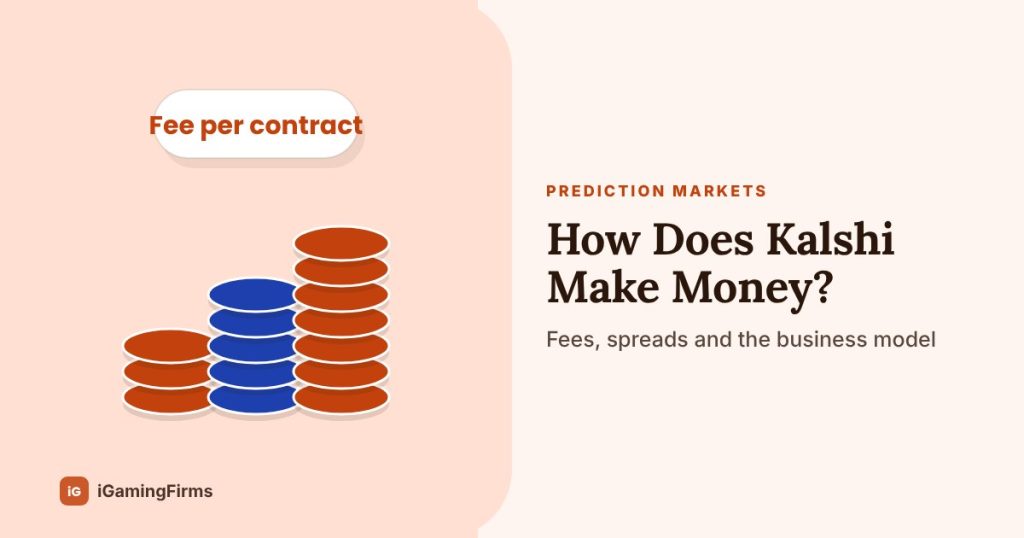
Kalshi makes money mainly by charging a trading fee on every matched contract, worked out as 7% × contracts × price × (1 − price), so it earns the same whichever side wins and never bets against its customers. On top of that it earns smaller amounts from maker fees on some markets, payment fees on card deposits and its distribution deals, and it is reported to have passed a $4 billion annualised revenue rate in July 2026.
If you run a sportsbook, an affiliate site or an SEO team, that model matters because it is the first serious US competitor whose revenue does not come from a hold built into the odds. This guide breaks down the fee formula with a table, works one $10,000 trade through Kalshi and through a sportsbook, lists every revenue stream with its source, covers how Polymarket makes money, and ends with what the economics mean for operators and affiliates.
How Kalshi makes money, in one table
Kalshi is a designated contract market regulated by the Commodity Futures Trading Commission (CFTC). It runs an order book: one member’s order is matched against another’s, and the exchange takes a fee. Kalshi’s own help centre (March 2026) puts it plainly: it makes money “by charging a transaction fee on the expected earnings of the contract.”
| Revenue stream | How it works | Size or status (source, date) |
|---|---|---|
| Taker trading fees | 0.07 × C × P × (1 − P), charged on orders that match immediately | The core of revenue; 2025 fee revenue $263.5m, 89% from sports (InGame via CDC Gaming, Jan 2026) |
| Maker trading fees | 0.0175 × C × P × (1 − P), only on series that set a maker multiplier | Applies to selected markets, including major sports leagues (InGame, 2025); not broken out |
| Payment fees | Up to 2% on debit card deposits; 0% to 2% on alternate rails; ACH and wire free | Kalshi fee schedule, effective 7 July 2026; revenue not disclosed |
| Interest on customer cash | Kalshi pays members interest (APY) on eligible cash balances, passing through interest from its banking partners; the rate and minimum balance change, so check the current terms | Kalshi help centre, checked 31 Oct 2026; any spread Kalshi keeps is not disclosed |
| Broker and partner distribution | Robinhood, Webull, Coinbase and others route orders to Kalshi as futures commission merchants | Exchange fees apply to routed flow; any revenue share is not public |
| In-house market making | Affiliate Kalshi Trading quotes both sides in some markets | Co-founder said it was “not profitable” and under 6% of sports making volume (Yahoo Finance, late 2025) |
| Perpetual futures fees | Tiered taker fees of 12.0 to 2.6 basis points, maker 5.0 to 0.6 bps, by 30-day volume | Kalshi fee schedule, July 2026; new and small next to event contracts |
Everything except the first row is either small or undisclosed. When you read about Kalshi’s revenue, you are reading about trading fees.
Kalshi fees: the formula and what it costs per contract
Yes, Kalshi charges fees, but only when an order is matched. The Kalshi fee schedule, effective 7 July 2026, sets two formulas:
- Taker fee: round up (M × 0.07 × C × P × (1 − P)), where C is the number of contracts, P is the price in dollars and M is the series multiplier, 1 by default.
- Maker fee: round up (M × 0.0175 × C × P × (1 − P)), where M is 0 unless the series sets it. It is charged only when a resting order is filled.
A resting order that never fills costs nothing, and cancelling it is free. There is no settlement fee, no membership fee and no fee on ACH deposits or withdrawals.
Because P × (1 − P) peaks at 50 cents, the fee is highest on coin-flip contracts and falls towards the extremes. Kalshi’s price is the market’s implied probability, so a 25-cent contract implies about a 25% chance.
| Contract price | Taker fee per 100 contracts | Maker fee per 100 contracts (where charged) | Taker fee as % of cost |
|---|---|---|---|
| $0.05 | $0.34 | $0.09 | 6.7% |
| $0.10 | $0.63 | $0.16 | 6.3% |
| $0.25 | $1.32 | $0.33 | 5.3% |
| $0.50 | $1.75 | $0.44 | 3.5% |
| $0.75 | $1.32 | $0.33 | 1.8% |
| $0.90 | $0.63 | $0.16 | 0.7% |
| $0.95 | $0.34 | $0.09 | 0.4% |
Figures are the formula’s output rounded up to the cent for readability (the July 2026 schedule rounds to the centicent). On single-contract orders the rounding matters more: the schedule’s own table shows 1 cent per contract at the extremes and 2 cents in the middle, which is why small retail trades pay a higher effective rate than the formula suggests.
Which Kalshi markets are fee-free?
The July 2026 schedule lists a short set of series with a multiplier of 0 for both makers and takers, including annual Bitcoin and Ethereum price markets and several political and geopolitical series. It also sets a higher maker multiplier of 2 on most combo (parlay-style) markets. Kalshi’s fees help page (April 2026) adds that some markets have different fees, often around elections, awards and championships, so check the series page rather than assuming the standard rate.
What changed in Kalshi’s fees
Kalshi has altered maker fees before. On 1 July 2025 it replaced a flat 0.25 cents per contract with the current 0.0175 curve, and InGame calculated that the change left total fees almost flat but raised sports maker fees by about 6.5%, and NFL, NBA and NHL maker fees by about 15%. The July 2026 schedule keeps the same 0.07 and 0.0175 rates, adds perpetual futures with volume tiers, and rounds up to the nearest centicent rather than the cent.
One shortcut makes the taker fee easy to reason about. If you spend a stake S at price P, the fee is 7% × S × (1 − P). In other words, Kalshi charges 7% of your stake multiplied by the chance the contract loses.
Kalshi vs a sportsbook: the same $10,000 through both
Sportsbooks make money by building a margin into the odds and taking the other side of the bet. Kalshi takes a fee and takes no side. The useful question for an operator is how big each take is on the same money.
Assumptions: a customer puts $10,000 on one side of a game. At the sportsbook, the price is standard -110 on both sides. At Kalshi, the customer buys contracts as a taker on a sports series that charges maker fees, and the resting order on the other side pays the maker fee.
| Price paid | Contracts bought | Taker fee | Maker fee (other side) | Kalshi’s total take | As % of $10,000 |
|---|---|---|---|---|---|
| $0.10 | 100,000 | $630 | $157.50 | $787.50 | 7.9% |
| $0.25 | 40,000 | $525 | $131.25 | $656.25 | 6.6% |
| $0.50 | 20,000 | $350 | $87.50 | $437.50 | 4.4% |
| $0.75 | 13,333 | $175 | $43.75 | $218.75 | 2.2% |
| $0.90 | 11,111 | $70 | $17.50 | $87.50 | 0.9% |
On a series with no maker fee, Kalshi’s take is the taker column alone: $350 at 50 cents. The maker column assumes a multiplier of 1. Many major series in the July 2026 schedule set a maker multiplier of 2, which doubles the maker column (for example $175 rather than $87.50 at 50 cents) and lifts Kalshi’s total take to about 5.3% at that price.
The sportsbook side: at -110 the customer risks $10,000 to win $9,091. If the book has balanced action on both sides, its theoretical hold is 4.55%, about $455 on that $10,000. That is close to Kalshi’s $437.50 at 50 cents.
The differences sit elsewhere:
- Risk. Kalshi’s $437.50 is collected when the trade matches, whatever the result. The sportsbook’s $455 is an average. On any single unbalanced bet it either wins $10,000 or loses $9,091.
- Price sensitivity. Kalshi’s take rises on longshots and falls on favourites. A sportsbook’s margin is set by its trading team and is usually higher on parlays and props.
- Tax. A sportsbook pays state tax on gross gaming revenue. A CFTC exchange pays corporate income tax on its fees. A July 2026 Forbes analysis of a New York example found the sportsbook keeps less than half of about $10 of revenue after the 51% state tax, while Kalshi keeps over 90% of about $10 of fees.
That last point, more than the fee level, is why an exchange’s margin looks so attractive next to a sportsbook’s. Our breakdown of whether sports betting is profitable shows how volatile a book’s hold is quarter to quarter.
Kalshi’s revenue: reported figures and run rate
Kalshi is private and publishes no accounts, so every revenue figure below comes from a named report.
| Period | Revenue figure | Source |
|---|---|---|
| Full year 2025 | $263.5m fee revenue, 89% from sports | InGame, reported by CDC Gaming, 10 January 2026 |
| May 2026 | Annualised revenue above $1.5bn | Kalshi to Forbes; Dealroom, 8 May 2026 |
| June 2026 | Annualised revenue above $2bn | The Information, 18 June 2026 |
| July 2026 | Annualised revenue above $4bn, driven by World Cup trading | The Information, via Dealroom, 12 August 2026 |
Volume moved in step. Kalshi traded about $5.8 billion in November 2025, $16.8 billion in May 2026, $40.1 billion in July and $37.2 billion in August, according to The Block, and $60.7 billion in September 2026, according to DeFi Rate data reported by Shift Markets.
The implied take rate. A $4 billion annual rate is about $333 million a month. Set against July’s $40.1 billion of volume, that is roughly 0.8% of reported volume. Reported volume is notional, counted at $1 per contract, so the take on cash actually staked is higher. A 50-cent contract carries $1 of notional for 50 cents of cash.
Has Kalshi raised money recently? Yes. It raised $1 billion at a $22 billion valuation in May 2026, and Bloomberg reported on 30 September 2026 that it was finalising a round at about $40 billion. Our profile of who owns Kalshi lists every round with its source.
What Kalshi spends
Revenue is only half the model. The Information reported June 2026 operating expenses of $300 million, mostly marketing, which would be $3.6 billion a year if sustained. Kalshi is also defending suits and enforcement actions in more than ten states, including a New York suit filed in July 2026. Those two lines, marketing and legal, are where a fee-based exchange spends the money a sportsbook would spend on risk and state tax.
Market makers, spreads and who actually wins
The “spreads” in Kalshi’s business model belong mostly to market makers, not to Kalshi. Kalshi’s help centre (August 2026) says market makers “make money by collecting the spread”, buying and reselling at slightly better prices without a view on the outcome.
- Susquehanna International Group is reported to be Kalshi’s largest external market maker and is listed as a designated market maker in Kalshi’s filings.
- Kalshi Trading is Kalshi’s own affiliate. Co-founder Luana Lopes Lara said it was “not profitable” and accounted for less than 6% of sports making volume in November 2025, and that it gets no preferential access.
- Liquidity incentives. Kalshi filed a programme with the CFTC that pays traders from a reward pool for keeping tight, two-sided quotes. Designated and affiliated market makers are excluded from those rewards.
Institutional market makers also get fee terms that are not public, which InGame noted means any outside estimate of maker-fee income is uncertain.
Do people actually make money on Kalshi?
Some do, but the money flows one way on average. The Roosevelt Institute estimated in July 2026 that takers lost $583.5 million on Kalshi between July 2021 and May 2026, across about 400 million trades. Kalshi disputes the study, calling it a “fundamental calculation error” for treating takers as casual traders and makers as professionals. For you, the point is structural: Kalshi earns fees from both sides, and the losses Roosevelt describes go to the other traders, mostly liquidity providers, not to Kalshi.
How is Kalshi not gambling?
Kalshi’s case is that it is a federally regulated derivatives exchange: it lists event contracts under the Commodity Exchange Act, holds no position on outcomes and earns a fee like a stock or futures exchange. That is also why it pays no state gaming tax.
States see it differently, and the courts are split. Several state regulators and courts have treated sports event contracts as gambling, while others have sided with the CFTC position. The legal map changes weekly, and our prediction markets guide tracks the circuit-by-circuit status. The business model only works at its current margin if the federal reading survives.
Brokerage partners: who pays whom
A large share of Kalshi’s volume does not start on Kalshi’s own app. Robinhood, Webull and Coinbase route customer orders to Kalshi as futures commission merchants.
- Robinhood earned $156 million of prediction market revenue in Q2 2026, up from $10 million a year earlier, according to its 10-Q as reported by FinanceFeeds; prediction markets out-earned its crypto trading that quarter (Covers, 30 July 2026). It routes orders to KalshiEX, ForecastEx and Rothera, its venture with Susquehanna.
- Kalshi’s share. Robinhood made up 17.5% of Kalshi’s Q2 2026 volume, down from nearly 50% a year earlier (The Information, August 2026).
- Who pays whom. The customer pays the broker’s own fee, and the exchange fee applies to the routed trade. The fee schedule notes FCMs may charge different fees. No revenue-share terms between Kalshi and any broker have been published.
The falling Robinhood share matters. As brokers build or back their own venues, Kalshi has to win more flow through its own app and marketing, which is part of why its June 2026 opex was so high.
The sportsbook route: DraftKings and FanDuel
The big US operators have taken two other routes. DraftKings bought Railbird, a CFTC-licensed exchange, to run its own prediction product, so it keeps the exchange fee. FanDuel partnered with CME Group, so CME runs the exchange and FanDuel acts as the distribution front end. In their August 2026 earnings calls, DraftKings reported “no discernible impact” on its sportsbook and Flutter said FanDuel saw a “low single-digit” effect.
How does Polymarket make money?
Polymarket now makes money the same way Kalshi does: a taker fee on matched trades. Until January 2026 its international platform charged no trading fees at all, so pages that still say “Polymarket is free” are out of date.
Pine Analytics dates the rollout: crypto fees on 15-minute markets from 5 January 2026, sports from 18 February, all crypto timeframes from 6 March, and nearly every other category from 30 March 2026.
Polymarket’s fee documentation uses the same shape of formula as Kalshi, fee = C × rate × p × (1 − p), with the rate set by category:
| Category | Taker rate | Maker fee | Maker rebate (share of taker fees) |
|---|---|---|---|
| Crypto | 0.07 | 0 | 20% |
| Sports | 0.05 | 0 | 15% |
| Economics, culture, weather, other | 0.05 | 0 | 25% |
| Politics, finance, tech, mentions | 0.04 | 0 | 25% |
| Geopolitics and world events | 0 | 0 | None |
The sports rate in the current documentation (0.05) is higher than the 0.03 reported under the March 2026 schedule, so the rate has already moved once.
Polymarket US, the CFTC-regulated exchange run through QCX LLC, publishes its own schedule. River Markets reports an exchange-wide schedule effective 1 July 2026 with the same category rates, makers trading free and volume rebates for high-volume takers. An earlier April 2026 schedule used a single 0.05 taker rate with a maker rebate, according to Sacra.
Is Polymarket profitable, and how much does it earn?
Polymarket does not publish revenue or profit. Sacra estimates annualised revenue reached about $1 billion in June 2026, up from zero in 2025. Pine Analytics estimated in March 2026 that net revenue after maker rebates and referral payouts was $209 million to $342 million a year at that time. Both are outside estimates.
Polymarket also sells data. Sacra notes institutional distribution through ICE’s “Signals and Sentiment” product, after ICE invested in Polymarket in October 2025. Claims that Polymarket earns yield on users’ USDC collateral, made in some AI-generated summaries, are not documented by Polymarket.
For the full side-by-side on fees, custody and state access, see our Kalshi vs Polymarket comparison.
What Kalshi’s business model means for operators and affiliates
For operators
- The margin gap is about tax and risk, not price. At 50 cents, Kalshi’s take is close to a -110 sportsbook’s hold. The difference is that Kalshi carries no outcome risk and pays no gaming tax.
- “No vig” is a marketing line, not a zero-cost product. Takers pay close to 7% of stake on deep longshots. Expect competitors to push lower-fee or maker-free messaging, as Polymarket already does.
- Fee competition is starting. Polymarket’s taker rates run from 0% (geopolitics) to 7% (crypto), with most categories at 4% to 5% against Kalshi’s standard 7%, and makers trade free. If more volume moves to rival venues or broker-owned exchanges, Kalshi’s 0.8% take on notional is the number most likely to fall.
- Exchange ownership is a real option. DraftKings bought a DCM, FanDuel partnered with CME and the Tunica-Biloxi Tribe announced a white-label app on Kalshi’s exchange in September 2026. Owning the exchange keeps the fee; renting distribution gives it away.
For affiliates
- Lower take rate, smaller pool to share. A sportsbook revenue share is cut from net gaming revenue after a margin of several percent of handle. A prediction market’s shareable revenue is a fee of under 1% of notional, so the same customer volume funds a smaller commission.
- Polymarket’s terms are public; Kalshi’s are not. Polymarket’s referral programme, updated 28 May 2026, pays 10% of net trading fees on direct referrals and 5% on indirect ones, for 30 days or until the referral reaches the Platinum tier, and only after the referrer passes $10,000 of lifetime volume. That is a short, thin tail next to a sportsbook’s lifetime revenue share or CPA. Kalshi has not published affiliate commission terms.
- Compliance risk travels with the traffic. Kalshi is facing state actions, and the international Polymarket platform cannot take US users. Check state status before you build pages around either.
For SEO teams
The pages ranking for “how does Kalshi make money” in October 2026 are Kalshi’s own short help article, a Ledger explainer from January 2026 that quotes fees of “0.01 to 0.05% per trade” and 3.25% APY, and trader-focused how-to guides. None works the formula through a real trade or sets it against a sportsbook’s hold. Pages with the July 2026 fee schedule, dated revenue figures and a clear Polymarket fee table have a freshness gap to fill. If you write about prediction market taxes as well, our Kalshi taxes guide covers what Kalshi does and does not report.
Next step
Kalshi’s fees, its run rate and the court cases behind its margin will all move again before the end of 2026. Before you build pricing, revenue-share or content plans on these numbers, re-check the current fee schedule and the state status in our prediction markets guide.
This article is general information about Kalshi’s business model, not legal, tax or investment advice. Figures were checked on the dates shown.