You need betting software built, but you are not sure which firm builds which part, or whether to hire, outsource or rent developers to do it.
The short answer: pick betting software developers by module and by hiring model, not by a single “best” list. Platform suppliers such as Kambi, Playtech and EveryMatrix sell trading, odds and risk as finished components. Development shops such as Suffescom, Symphony Solutions and Software Mind sell engineering time through dedicated or managed teams. One fact rarely covered elsewhere: GLI-33, a lab standard widely used in US sportsbook approvals, was revised to version 2.0 on 3 November 2026. That revision sets detailed geolocation and responsible-gambling rules that any developer you hire must build to.
This page is about choosing developers for specific parts of a betting product and choosing how to engage them. If you want an agency to commission a complete custom sportsbook, see our separate guide to the best sports betting software development companies. Every company fact below was checked against the company’s own site in November 2026. No company paid to be listed.
Betting software developers compared by module and hiring model
The table lists what each firm builds or sells, how you engage it and what it says about code and licences. Numbers match the profiles further down.
| # | Developer | Modules it builds or sells | How you engage it | Code and revenue terms (company’s claim) | Licences and certifications listed |
|---|---|---|---|---|---|
| 1 | GammaStack | Sportsbook platform, PAM, risk, apps, exchange | Dedicated team (monthly), fixed price or time and material | “100% Owned Solutions”; no revenue share | ISO 9001:2015 and ISO/IEC 27001:2022 certificates shown |
| 2 | Kambi | Turnkey sportsbook, AI trading, Bet Builder, Odds Feed+, front end | Platform licence; source code licence for Allwyn | Perpetual source code licence in Allwyn deal | MGA/B2B/185/2010; GB account 39076; Alderney 9C22; Romania Class 2 |
| 3 | TRUEiGTECH | Bet builder, PAM, risk, settlement, back office, apps | Turnkey, white label, bespoke or API | No GGR share; 100% source code on bespoke builds | Shows GLI, ISO, eCOGRA and BMM logos |
| 4 | BetConstruct | Sportsbook, back office, risk tools, managed trading, retail | Turnkey or white label on its platform | Turnkey 10%-16% to BetConstruct; white label 60% | MGA/B2B/286/2014; UKGC account 40767; 16 sportsbook jurisdictions |
| 5 | Suffescom | PAM, odds integration, risk and fraud, KYC, apps | Hire developers at $15 to $25 an hour; dedicated team or fixed price | “Full Ownership with Source Code” | ISO logo shown; no gaming licence listed |
| 6 | Bettoblock | Sportsbook, crypto betting, apps, cricket and exchange software | Custom projects; dedicated team service | “100% Ownership”; no revenue share | No supplier licence listed for itself |
| 7 | Playtech | Trading Cockpit, risk management, front end, retail terminals | Platform licence plus managed trading | Set per contract | UKGC account 38516; MGA/CRP/137/2007 |
| 8 | BetMakers | Apollo platform, RaceOdds pricing, racebook, tote | White label or turnkey plus managed trading | Set per contract | Apollo described as pre-approved by Australian licensing bodies |
| 9 | EveryMatrix | OddsMatrix sportsbook, OddsFeed, PAM via Gammatrix, risk | Turnkey or individual modules | Set per contract | UKGC 39383; MGA/B2B/201/2011; Pennsylvania, Michigan and West Virginia supplier licences |
| 10 | Sportbex | Odds and data APIs, sportsbook, exchange, apps, rental sites | Custom build, white label or rental | “Keep full control”; “earn 100% of your revenue” | No licence information listed |
| 11 | Symphony Solutions | BetSymphony sportsbook, PAM, front end, apps, AI assistant | Managed Augmentation, Managed Team or Managed Service | Full source code licence; zero revenue share | No gaming licence listed |
| 12 | Software Mind | Custom sportsbook back ends, wagering apps, casino player management | Dedicated teams, outsourcing, US nearshore | Set per contract | Microsoft Azure partner; no gaming licence listed |
Commercial terms change by market and deal size, so treat every figure above as the company’s public claim and get the final version in your contract.
Which betting software developers build which module
A betting product is a stack of separate modules. You can buy all of them from one supplier or source each one from a different firm. Knowing who actually builds each layer stops you paying a development shop to rebuild something a supplier already licenses.
Odds engines and trading
This is the hardest module to build and the one that carries your money. Kambi says its turnkey sportsbook runs on “margin-driving trading and risk management” and sells pre-match and live odds separately through Odds Feed+. EveryMatrix sells OddsFeed covering 200,000+ live events a month. Playtech offers a Trading Cockpit for price management with an in-house trading team. BetMakers uses RaceOdds as its racing pricing engine. Development shops rarely build a pricing model from scratch. Suffescom, TRUEiGTECH and GammaStack integrate third-party feeds such as Betradar, LSports and Betfair instead. Our guide to the best odds APIs covers the feed contracts you will need if you take that route.
Bet builders
Same-game combinations need correlated pricing, so the bet builder usually comes from whoever owns the odds engine. Kambi calls its version a “market-leading Bet Builder” covering multi-sport combinations before and during play. TRUEiGTECH lists a “Dynamic Bet Builder” with real-time price recalculation on bespoke builds. If a custom developer offers a bet builder, ask where the correlation pricing comes from. A front end that lets players combine legs is easy. Pricing those legs correctly is not.
Player account management (PAM)
PAM holds registration, wallets, limits, KYC status and transaction history. EveryMatrix sells PAM, wallets, payments and risk through its Gammatrix platform. Symphony Solutions says BetSymphony’s PAM includes deposit limits, loss limits and self-exclusion. Suffescom, GammaStack and TRUEiGTECH all list PAM modules in custom builds. Our explainer on what PAM is in iGaming covers what the module must do before you commission one.
Risk management
Risk tools set limits per player and market, flag sharp or suspicious accounts and track liability. BetConstruct lists “risk management tools” in its sportsbook. TRUEiGTECH describes AI-driven checks that flag suspicious betting patterns. Playtech sells risk management as a service. If you plan to buy risk tooling separately from the platform, compare dedicated vendors in our review of betting risk management software.
Sportsbook and casino front ends
Front ends are where custom developers add the most value, because brand and user experience differ between operators. Kambi offers “dynamic front-end technology” on top of its trading. Playtech offers a customisable front end. EveryMatrix bought front-end specialists TOTOIT in 2020 and Goma Gaming in 2025, according to its company history. Symphony Solutions lists front-end and UI changes as a core service.
Mobile apps and retail
Native iOS and Android apps are offered by Suffescom, Sportbex, Bettoblock, GammaStack and TRUEiGTECH. Software Mind describes building a mobile-first wagering product with a secure betting engine. Retail is narrower. Playtech sells over-the-counter tills, shop TV and self-service betting terminals. BetConstruct supports betshops as a channel.
In-house team, outsourced build or staff augmentation
The second decision is how you pay for the engineering. Each model shifts cost, control and risk differently.
In-house team
You hire your own engineers and own all the knowledge. This suits operators building long-term product advantage, such as Kindred, which set out to build its own sportsbook in 2022. Even then, Kindred bought historical odds data, a custom odds API and monthly odds audits from EveryMatrix to train its pricing models, according to an EveryMatrix case study. Its platform went live in Estonia in December 2024. Cost is the main barrier. The US Bureau of Labor Statistics puts the median annual wage for software developers at $135,980 as of May 2025, before benefits. A sportsbook team needs back-end, front-end, mobile, QA, DevOps and data people.
Outsourced build
You pay a firm to deliver a defined product on a fixed price or time-and-material basis. GammaStack and Suffescom both list fixed-price and time-and-material models. TRUEiGTECH sets out a 9 to 12 month plan for bespoke builds, from discovery in the first weeks to full launch around month 12. The risk is dependency. If the contract does not give you the source code, documentation and repository access, you cannot switch developers without starting again.
Staff augmentation and managed teams
You rent engineers who work inside your process, or a managed team that the vendor runs. Suffescom advertises sports betting developers at $15 to $25 an hour with a monthly dedicated-team option. Symphony Solutions offers three versions. With Managed Augmentation you keep control. With Managed Team it takes over team and technical decisions. Managed Service covers specialist work under agreed service levels. Software Mind offers dedicated development teams and nearshore teams from Latin America for US clients. This model suits operators that already own a platform and need more hands for features, integrations or a new market.
The 12 betting software developers, profiled
1. GammaStack
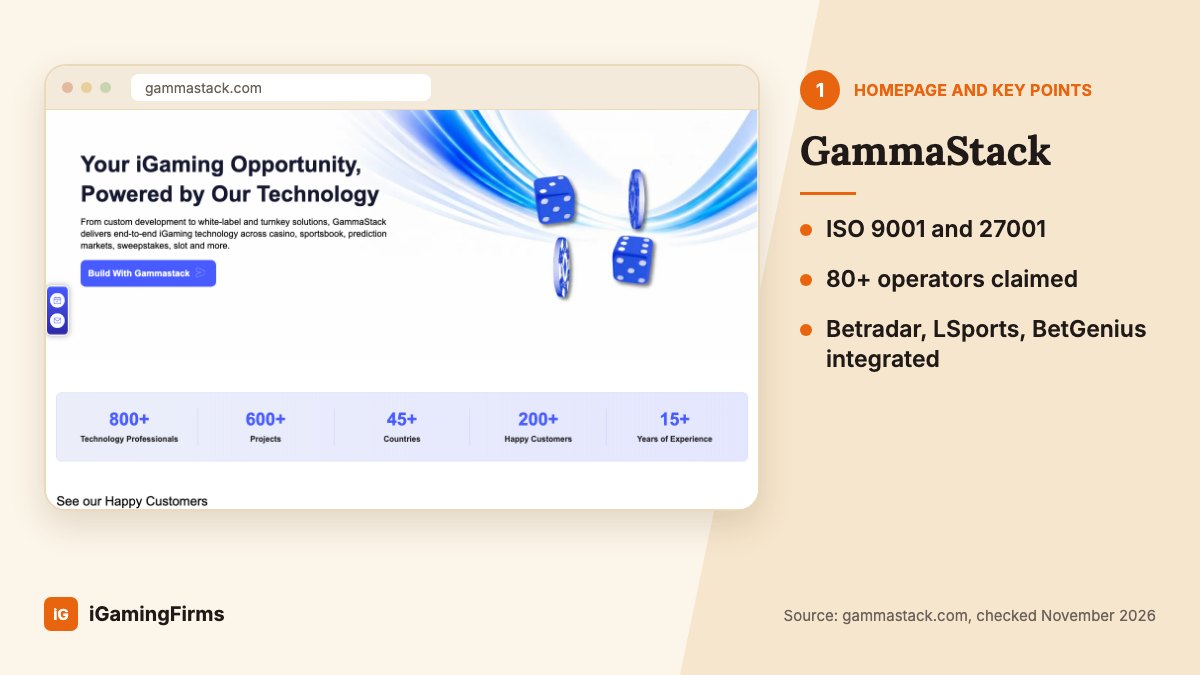
GammaStack is a development company selling sportsbook software, PAM, betting apps, exchange platforms and Web3 sportsbooks. Its sports betting developers page claims 80+ sportsbooks launched in 45+ countries, 500+ professionals and 13+ years of experience. It displays ISO 9001:2015 and ISO/IEC 27001:2022 certificates.
Engagement options are a dedicated team paid monthly, fixed price or time and material. The company says its solutions are “100% Owned” with “no revenue share from the complete service.” It names no odds supplier in its copy and shows data partner logos instead. It also displays testing-lab logos, including GLI and BMM, without certificate details. Ask for the actual lab reports and a written source code clause before you treat either claim as settled.
2. Kambi
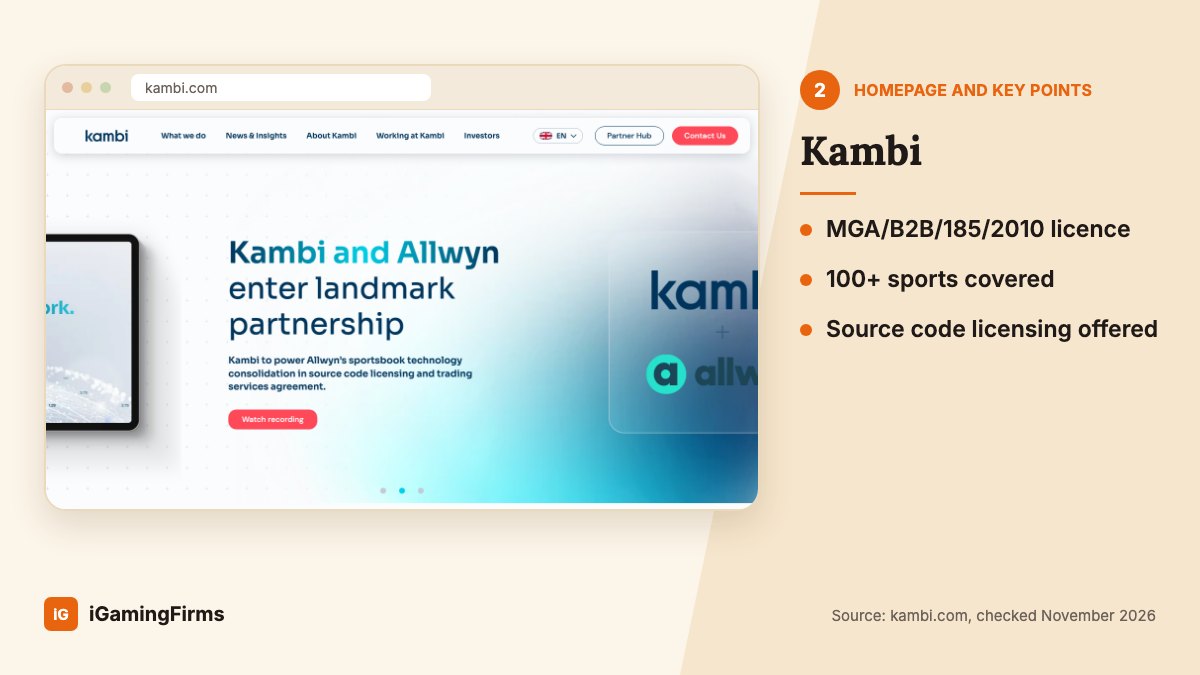
Kambi is a sportsbook supplier rather than a hire-by-the-hour developer. Its Turnkey Sportsbook bundles trading, risk, Bet Builder, player props and a branded front end for online and retail. Kambi says it has 60+ turnkey partners, including ATG, Bally’s, BetPlay, LiveScore Group, Rush Street and Svenska Spel, in 100+ regulated jurisdictions.
The biggest change this year is how Kambi sells code. On 10 November 2026 it announced a deal giving Allwyn a perpetual global licence to its sportsbook source code. Kambi will also build and train a team that transfers to Allwyn after implementation in 2027 to 2029. A long-term trading agreement sits alongside. Kambi expects about €45 to 50 million in operating profit from the deal over 2027 to 2031. Kambi Malta Limited holds MGA licence MGA/B2B/185/2010. Kambi Sports Solutions (Alderney) holds GB account 39076, Alderney licence 9C22 and a Romanian Class 2 licence.
3. TRUEiGTECH
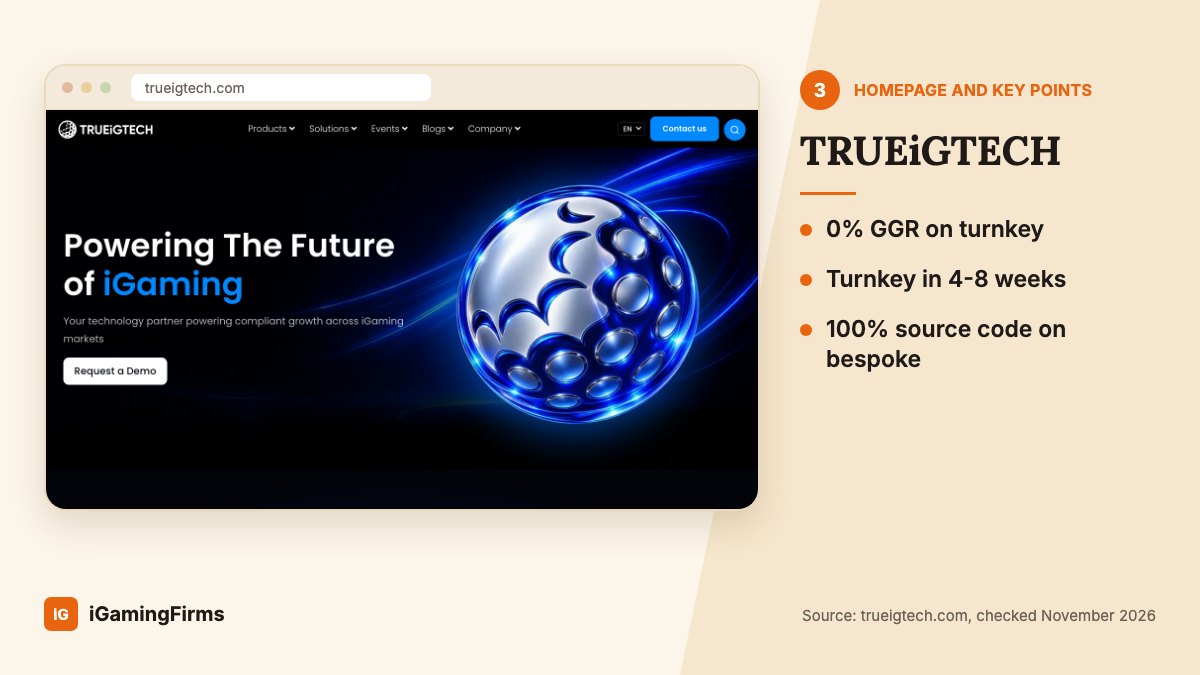
TRUEiGTECH sells turnkey, white label, retail, bespoke and API-based sportsbooks. It claims 200+ experts, 150+ platforms deployed and offices in Las Vegas, London, Berlin, Barcelona, Brasília and Birkirkara in Malta. Its headline is “100% Ownership – No GGR,” meaning a licence fee instead of a revenue share.
The bespoke sportsbook page is the most detailed module list in this group. It covers a dynamic bet builder, PAM, AI risk checks, an automated settlement engine, CRM, CMS, KYC, responsible gambling and affiliate management. Named feeds are Bet Radar, LSports, Bet Balancer and SportsData.io. It promises “100% source code ownership” with a handover package and quotes 9 to 12 months for the build. It shows GLI, ISO, eCOGRA and BMM logos and has a GLI certification page. Ask which jurisdiction each certificate covers.
4. BetConstruct
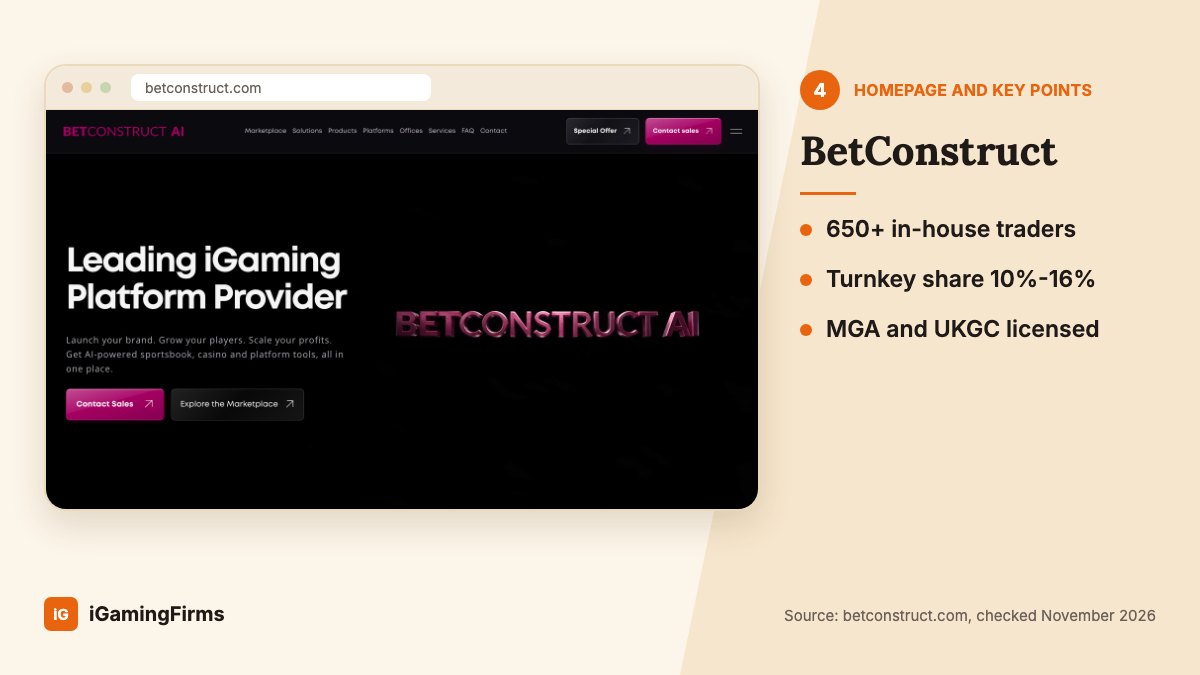
BetConstruct sells a full sportsbook with back office, risk tools and front-end customisation across desktop, mobile and betshop. It lists 140K+ pre-match and 90K+ live events a month across 120+ sports. It is the only company here that publishes its split. The sportsbook page shows 10%-16% to BetConstruct on turnkey and 60% on white label. Setup fees start at €19.9K. The company notes prices may change per market.
Its white label runs under its licences in Curacao, Malta, France and the UK. The licences page lists sportsbook certifications in 16 jurisdictions, including Ontario, Brazil, Sweden and the Netherlands. Its Dedicated Trading service covers odds and margins, market types and betting limits. Soft Construct (Malta) Ltd holds MGA/B2B/286/2014. The company is on the UK Gambling Commission register as account 40767. It does not advertise a source code option, so treat it as a platform choice rather than a development hire.
5. Suffescom
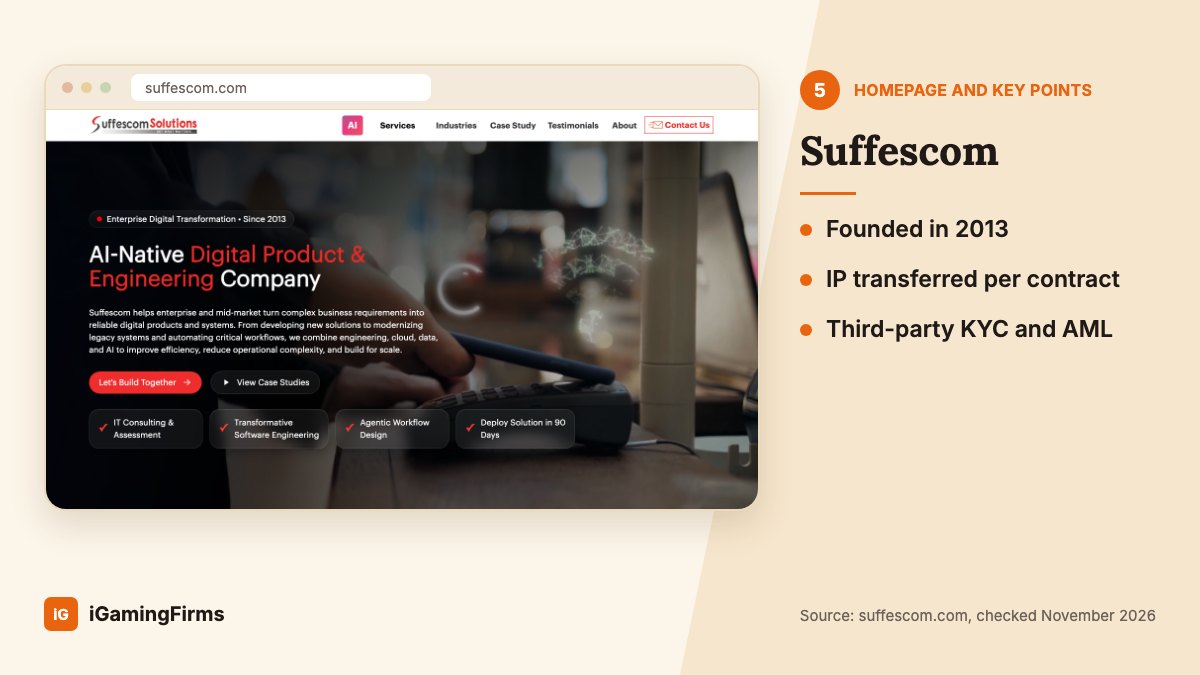
Suffescom is the clearest staff-hire option in this list. Its hire page quotes $15 to $25 an hour depending on scope. It offers dedicated teams on monthly billing, fixed-price projects and time and material. It lists a New York address plus contact numbers for India, the UK and the UAE.
It also publishes its tech stack, which few rivals do. Front ends use React, Angular, Vue and Flutter. Back ends use Node.js, Laravel, .NET Core, Java and PHP on MySQL, PostgreSQL, MongoDB and Redis. Hosting runs on AWS, Google Cloud or Azure with Docker and Kubernetes. Odds integrations named are Betradar, Betfair and Pinnacle APIs. Modules include PAM, odds management, risk and fraud detection and KYC. It promises “Full Ownership with Source Code.” It shows an ISO logo but no gaming supplier licence, so certification with a test lab stays your job.
6. Bettoblock
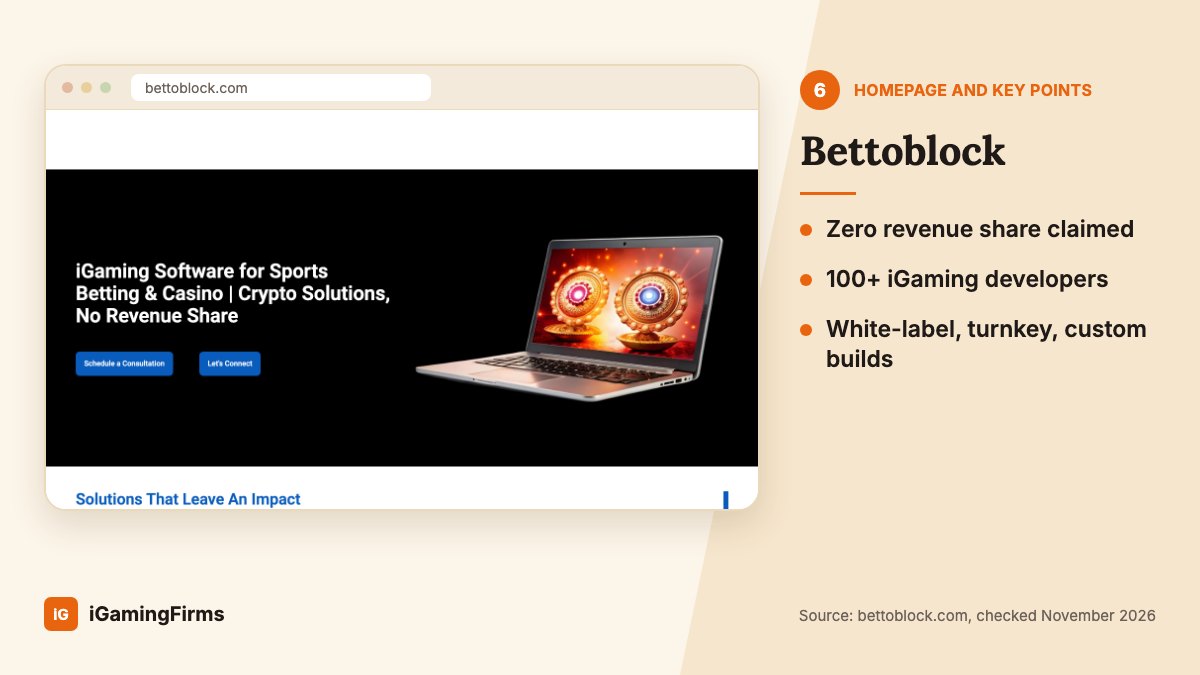
Bettoblock is a development firm based in Indore, India, claiming “100+ Talented iGaming Developers.” It builds sportsbooks, betting apps, crypto and blockchain betting products, cricket betting software and Betfair-linked exchange products. Its homepage promises “100% ownership and zero revenue share.” Its contact form offers a dedicated team service.
The company says it works only with licensed providers, which refers to partners rather than a licence Bettoblock holds. It names no odds supplier on its homepage. Its portfolio includes cricket, exchange and Teen Patti products. Ask for source code delivery in writing, since “ownership” can mean a licence to use rather than the code itself.
7. Playtech
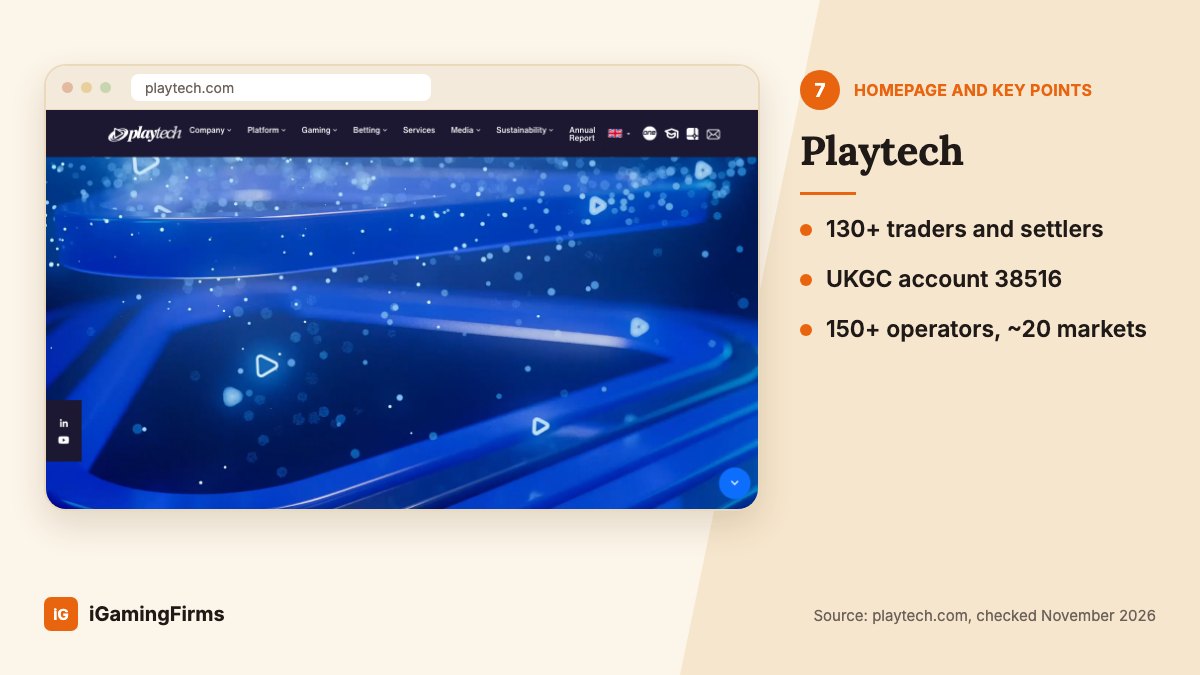
Playtech is a FTSE 250 supplier that calls itself a leading supplier of online, mobile and retail sportsbook technology. Its sports page cites more than 120 partners in 24 territories. It lists a dedicated in-house trading team monitoring bets 365 days a year, a Trading Cockpit for prices and a risk management service.
It names seven data providers: Betradar, Betgenius, Sporting Index, SiS, Manny Bernstein, XBnet and Touchbet. Retail is a large part of its offer, with tills, shop TV and self-service betting terminals. Playtech plc is on the UK Gambling Commission register as account 38516. It holds MGA critical gaming supply licence MGA/CRP/137/2007. You buy Playtech for components and managed services, not for code you own.
8. BetMakers
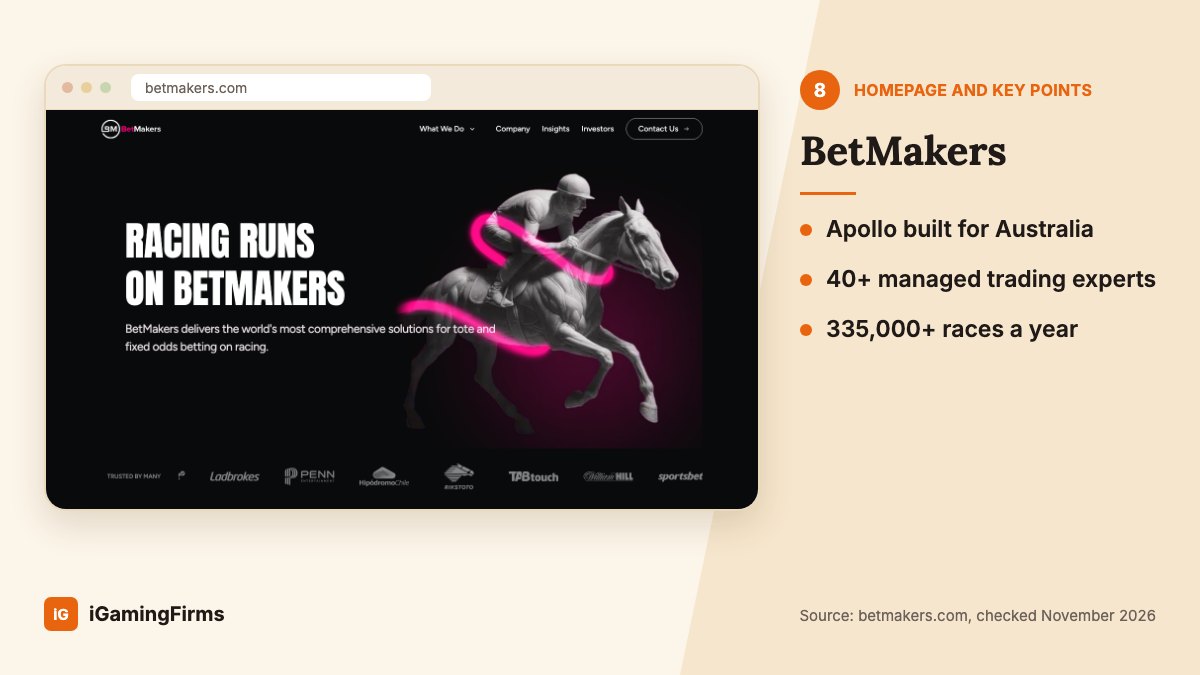
BetMakers is a racing-led supplier that publishes ASX releases through its investor centre. Its platforms page describes Apollo as a “next-generation full-stack betting platform built for the Australian market.” Apollo combines fixed odds and tote with account tools, compliance controls and a customisable front end. BetMakers says Apollo is “pre-approved by all major licensing bodies” but does not name them.
RaceOdds is its pricing engine. Managed Trading Services add 24/7 pricing, trading and risk management. RaceBook+ can launch as a standalone white-label racebook. Evoke PLC and Hollywoodbets are cited as RaceOdds users. BetMakers is the specialist pick if horse racing is a core module and you do not want to build racing pricing yourself.
9. EveryMatrix
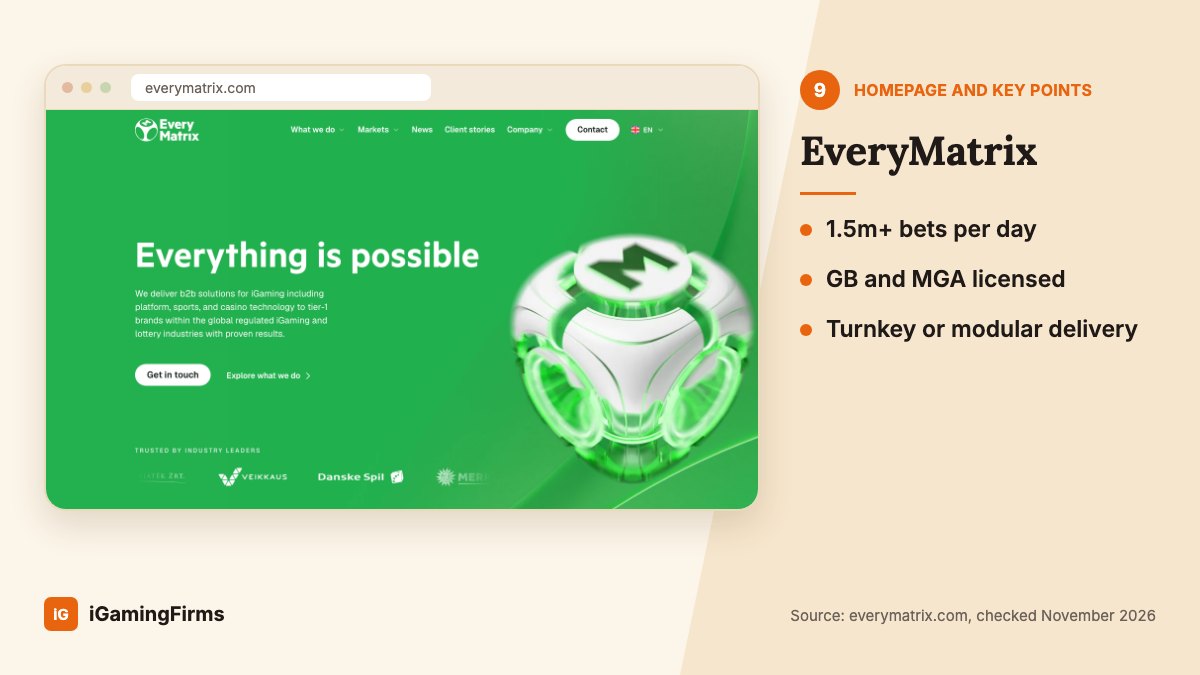
EveryMatrix is the most modular supplier here. You can take its OddsMatrix sportsbook as a turnkey platform. You can also buy OddsFeed, eSports, retail or horse racing on their own and use Gammatrix for PAM, wallets and payments. OddsMatrix first went live in 2009 and now processes 1.5 million+ bets a day, the company says. EveryMatrix bought Leapbit in 2022 and FSB in 2024 to add retail and UK coverage.
Live deployments include Hungary’s state operator, which went live on OddsMatrix for TippmixPro in 2023. Another is bet-at-home, which moved to its turnkey sportsbook the same year. Its licences page lists UKGC account 39383 and MGA/B2B/201/2011. It also lists Pennsylvania iGaming and sports wagering manufacturer licences plus supplier licences in Michigan, West Virginia, Connecticut and Ontario. That US footprint matters if you need a component supplier that state regulators already know.
10. Sportbex
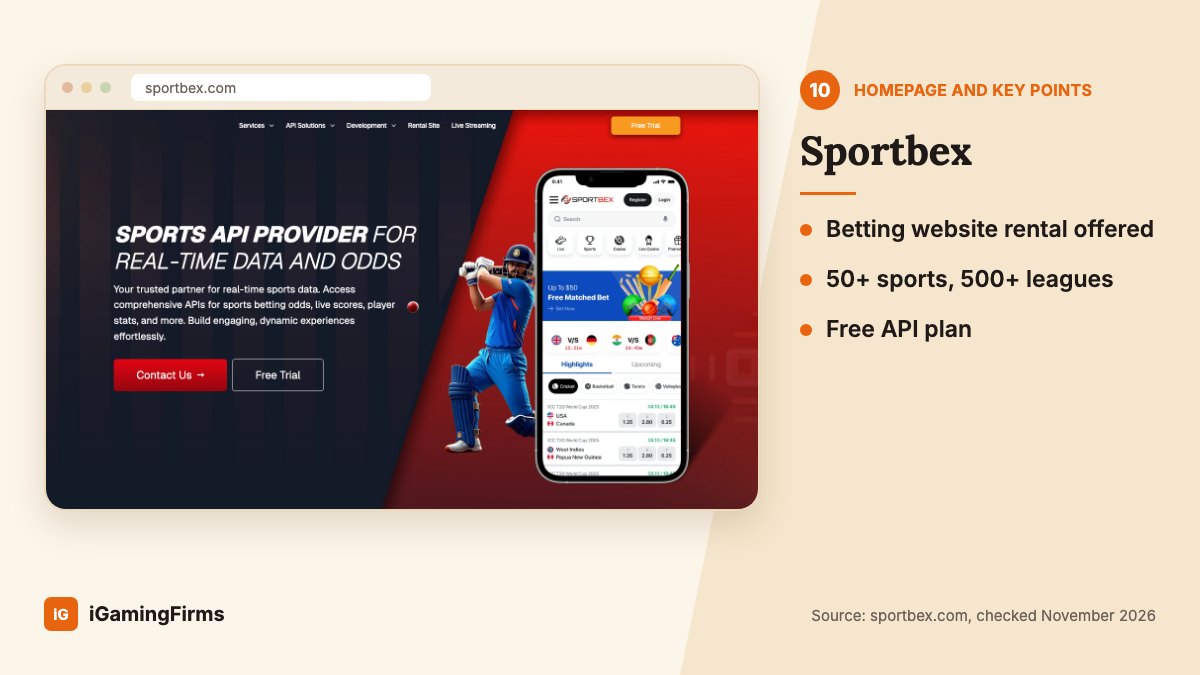
Sportbex sells data first and development second. It offers a sports data API, a sports betting API and odds APIs for soccer, cricket, tennis and horse racing, claiming 50+ sports and 500+ leagues. A free trial needs no card. Its development page offers turnkey, custom, white label and exchange builds plus iOS and Android apps in Kotlin, Flutter or React. It promises you can “earn 100% of your revenue.”
It also rents ready-made betting sites, which it says can be live “in days, not months.” Its rental page calls them “turnkey and fully managed” and says pricing depends on requirements. Sportbex lists no licence or certification on its site. A rented site does not come with a licence to operate, so check the law in your market before you sign.
11. Symphony Solutions
Symphony Solutions is an Amsterdam-based engineering firm with a 17-year history and a sportsbook product of its own. Its BetSymphony platform comes with a “full source code license” and zero revenue share. Its PAM includes deposit limits, loss limits and self-exclusion. LSports is an official data partner. BetHarmony, a conversational AI layer, lets players get bet suggestions and place bets in chat.
Its main draw for operators who already have a platform is the hiring model. Symphony offers Managed Augmentation, Managed Team and Managed Service options. It lists Ladbrokes Coral, William Hill, Entain and Caesars among its clients. It holds no gaming licence, so it fits as a build partner beside your own licensed operation.
12. Software Mind
Software Mind was founded in Krakow, Poland in 1999 as Websoft and now claims 1,600+ experts, according to its company page. Private equity firm Enterprise Investors invested €25 million in 2020. Its sports betting page describes a fixed-odds sportsbook back end with phone betting and live chat, first on-premises and later moved to Google Cloud. It also describes a mobile-first wagering product and casino player management covering payments, fraud prevention and compliance.
It lists OpenBet, Sporting Index and Bettech Gaming among clients. You hire it through dedicated development teams, outsourced projects or US nearshore teams in Latin America. It is a general engineering firm with betting experience, not a sportsbook vendor. Use it to extend your own platform team rather than to buy a finished product.
What software do bookmakers use?
Many bookmakers run a licensed sportsbook platform from a supplier and add their own front end, CRM and payments on top. Kambi’s partners, such as Rush Street and Svenska Spel, run Kambi trading and odds under their own brands. Larger groups increasingly take code in-house. Allwyn’s perpetual source code licence from Kambi and Kindred’s in-house platform show that route. Smaller operators often use a white label from suppliers such as BetConstruct, where the supplier’s licence and platform carry the launch.
How much does it cost to build a sports betting app?
Cost depends on the model more than the feature list. Published figures in this group give a range. Suffescom hires developers at $15 to $25 an hour. BetConstruct charges setup fees from €19.9K and then takes 10%-16% of turnkey revenue or 60% on white label. TRUEiGTECH plans bespoke builds over 9 to 12 months, which means paying a full team for that period before any revenue. Odds feeds, KYC checks, payments, hosting and lab testing are usually extra. Ask every developer for a line-item quote that separates build cost from monthly running cost.
Do betting and casino companies hire software engineers?
Yes. Operators and suppliers both employ large engineering teams. The firms in this list exist because demand outstrips in-house hiring. Software Mind claims 1,600+ experts and GammaStack 500+ professionals. Kambi’s Allwyn deal includes building and training a full team that will move to Allwyn. For operators the question is not whether to employ engineers but which modules they should own. Many keep product, data and front end in-house and license trading and odds.
Tech stack and regulatory skills a betting developer needs
General web skills are not enough. A betting developer must build to lab standards. Regulators test the result before you take a wager.
Geolocation
In US states, every wager must come from inside the state line. GLI-33 version 2.0, revised on 3 November 2026, says location must be cross-checked from more than one source. IP address analysis cannot be the primary source unless the regulator allows it. Regulators set the triggers. The standard’s examples include the first paid wager after login, an IP change or more than twenty minutes since the last check. Failed checks must block the action. Testing covers spoofing, VPNs, remote desktop tools, rooted devices and emulators. Ask a developer which geolocation provider they have integrated and how they handle each of those cases.
Responsible gambling tooling
The same standard requires player-set deposit and wager limits that can only be loosened after the current period ends. Players must be able to take time-outs or suspend their accounts. Accounts must also be checked against regulator exclusion lists. Accounts lock after three failed logins in thirty minutes. These rules sit in PAM, so a developer who builds PAM without them will fail lab testing.
Lab testing and certification
Many regulators, including US state regulators, require an independent test lab to certify the platform against GLI-33 for event wagering and GLI-19 for interactive gaming. GLI-19 is now at version 4.0. Our comparison of iGaming testing labs covers GLI, BMM and others. A developer with past certifications should be able to name the lab, the standard version and the jurisdiction.
Core stack
Expect a low-latency betting engine, streaming odds ingestion, a settlement engine, PAM and wallet services plus web and mobile clients. Suffescom’s published stack of Node.js, .NET, Java and PostgreSQL behind React or Flutter clients, deployed on Kubernetes, is a typical example. Software Mind’s sportsbook case moved from on-premises servers to Google Cloud, which shows the need for elastic capacity on big match days.
How to vet betting software developers
- Match the firm to the module. Ask which modules they have built and shipped to a live operator, not which they could build. A front-end shop is a poor choice for an odds engine.
- Check licences on the regulator’s register. UKGC and MGA numbers in this article can be looked up. A firm that supplies a regulated market may need its own supplier licence there.
- Ask for lab reports by name. Logos are not certificates. Request the lab, standard version and jurisdiction for each.
- Read the code clause. “Ownership,” “full control” and “source code licence” mean different things. Ask for repository access, documentation and an IP assignment or escrow clause.
- Separate build cost from running cost. Get feeds, hosting, support and lab fees as separate lines.
- Meet the actual team. With augmentation or dedicated teams, interview the engineers who will work on your code and agree how replacements are handled.
- Test match-day support. Ask for written response times for settlement errors, feed outages and peak-load incidents.
Certification, code licences and US supplier licensing
The November 2026 GLI-33 revision changes the brief
GLI-33 v2.0 carries a revision date of 3 November 2026. It sets specific geolocation rules, such as rechecks after twenty minutes and limits on IP-only checks, plus detailed account-limit rules. A developer quoting from an older template may not have priced this work in. Put the standard version in your statement of work.
A source code licence is not the same as owning code
Kambi’s Allwyn deal is a perpetual source code licence plus a team that transfers to the buyer. Symphony Solutions offers a “full source code license.” TRUEiGTECH promises “100% source code ownership” with a handover package. Bettoblock and GammaStack say “ownership” without naming source code. These are four different legal positions. Ask your lawyer to check whether you can modify, sublicense and keep using the code if the vendor relationship ends.
US supplier licensing narrows your list
EveryMatrix lists Pennsylvania sports wagering manufacturer and Michigan sports betting supplier licences. None of the hourly-rate development shops here lists a US gaming licence. If you plan a US launch, check with the state regulator whether your developer or platform supplier needs its own licence. Our guide to how to start a sportsbook sets out where that step fits in your launch plan.
Your next step
Write a one-page module map before you contact anyone. List odds and trading, bet builder, PAM, risk, front end, mobile and retail. Mark each one as buy, build or rent, then name the jurisdiction and the GLI standard version you must meet. Send that page to two platform suppliers and two development firms from this list. Ask each for a line-item quote, a named team and the source code clause they would sign. The answers will show quickly which firms fit how you want to run your book.