You want to launch a crypto casino and every software vendor promises multi-coin wallets, fast payouts and a go-live in weeks, so it is hard to see where the real differences sit.
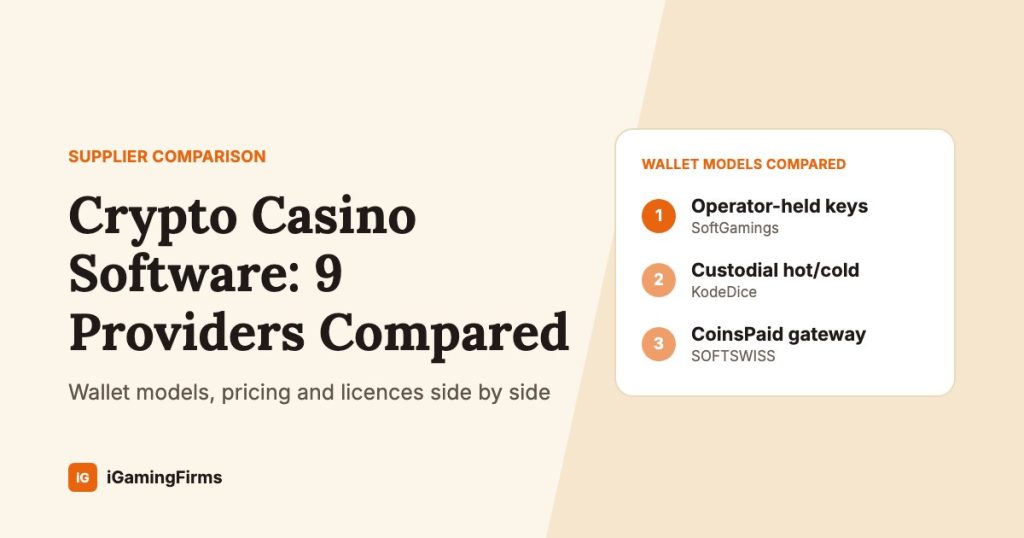
The short answer: the right crypto casino software is the one whose wallet model fits your licence. That matters more in 2026 than coin lists or game counts. Curaçao’s regulator published a Crypto Policy Guideline in June 2026. It says player wallets must be owned or controlled by the licensed entity (or an approved group or payment entity) and that operators may not convert crypto for players themselves. Of the ten providers below, only SoftGamings states in writing that the operator alone holds the wallet keys. The others leave custody to the sales call.
This comparison covers ten providers. Each fact comes from the vendor’s own pages or a regulator document, read in November 2026. No provider paid to be included and nothing here is aimed at players.
Crypto casino software providers compared
The numbers in the first column match the order of the profiles further down.
| # | Provider | Delivery models | Crypto coverage | Wallet and custody | Commercial terms | Licences and certifications |
|---|---|---|---|---|---|---|
| 1 | KodeDice | Turnkey and white label; 2-week launch advertised | Multi-coin, fiat and crypto in one back office (company says) | Company says it uses a hot, warm and cold wallet stack | Company says it takes no GGR cut | Offers a white label licence and jurisdiction advice; no lab certificates listed |
| 2 | PieGaming | White label in 2 weeks; turnkey in 4-6 weeks | EOS, BTC, ETH, ATOM, BNB, ETC, APE, BUSD, DOGE, USDT | Deposits credited after on-chain confirmations | Quote on request | States it follows ISO 27001; no gaming licence claimed |
| 3 | SoftGamings | Stand-alone crypto module, turnkey, white label and self-service | 17 assets named by network, incl. USDT on ERC20, BEP20, TRC20 and Polygon | Operator holds the keys; vendor says it has no access | Quote on request | Malta, Curaçao (GCB) and Belgian E-Class licences; ISO 27001 |
| 4 | BetConstruct | Turnkey, API and white label | BTC, ETH, USDT, LTC and more | Crypto and fiat wallets in one account; players can use their own wallets | No public rate | MGA/B2B/286/2014; UKGC account 40767 |
| 5 | BETFOC | White label in 3 days; turnkey and custom | Bitcoin and other coins (not listed) | No wallet model described | Describes a “low-GGR share” | Displays Curaçao, Malta, Belgium, Greece, Belarus and Latvia badges; holder not stated |
| 6 | GammaStack (GammaCasino) | White label 2-4 weeks, turnkey 5 weeks, custom 6-12+ months, iFrame | BTC, ETH, LTC, DOGE, SOL, XRP, USDT, USDC, BCH, TRX, Polygon | Multi-wallet support; custody not described | No GGR share on custom; low GGR share on white label and turnkey | ISO 9001:2015 and ISO/IEC 27001:2022 |
| 7 | GR8 Tech | Crypto turnkey; 4-12 weeks to go live | 15+ coins incl. BTC, ETH, LTC, USDT, USDC, XMR, XRP, TRX, SOL | Multiple balances in one account | Advertises 0.5% per crypto transaction | Supplies licensing guidance; licence holder not stated |
| 8 | NuxGame | Crypto-only, fiat plus crypto, white label, turnkey, custom, modules | 30+ assets claimed incl. BTC, ETH, USDT, USDC, DOGE, SOL, XRP, LTC | One account for fiat, crypto and stablecoins; MetaMask, Phantom and Petra | No public rate | Displays an Anjouan licence badge |
| 9 | SOFTSWISS | Launch-ready crypto casino with managed hosting | 20+ coins incl. BTC, ETH, LTC, DOGE, USDT, BCH, XRP, BNB, ADA, TRX, NEO | CoinsPaid gateway with wallet and exchange services | No public rate | GLI-19; Stable Aggregator Limited MGA/B2B/942/2022 |
| 10 | Cubeia | Turnkey (Cubeia Nano) in 1-2 weeks | BTC via Lightning; USDT and USDC on Ethereum, TRON and BSC | Custody not described | No public rate | No gaming licence claimed |
Commercial terms are set per contract. Treat every launch time above as the vendor’s own claim and get fees in a written proposal.
Platform vs white label vs custom build
Crypto casino software is the stack that runs a casino taking digital assets: player account management (PAM), wallets, a payment layer, a back office, a bonus engine and game integration. You can buy it three ways and the choice drives cost, speed and control.
White label
You rent a finished casino and put your brand on it. The vendor runs the platform and often the payment connections. Launch is fastest. PieGaming quotes 2 weeks, BETFOC says 3 days and GammaStack says 2 to 4 weeks. GR8 Tech notes that in its white label model the provider leases its gaming licence to the operator. The trade-off is control. GammaStack’s own comparison says white label buyers get no source code ownership. For a full cost breakdown see our guide to white label casino cost.
Turnkey platform
You get the same core stack but you hold your own licence, sign your own payment and game contracts and run marketing. GR8 Tech says most operators go live in 4 to 12 weeks and need one to two months to test payments, content and tracking. GammaStack says 5 weeks. SoftGamings says a crypto casino can be ready in under two months. SOFTSWISS states that its crypto and standard turnkey casinos share the same capabilities, with crypto payments the main difference. It also says operators must secure their own licence.
Custom build
You commission the software and own the code. GammaStack quotes 6 to 12+ months and full source code ownership with IP transfer on custom work. It also lists no GGR share for custom builds. Custom suits operators with a long horizon and an in-house tech team. It is the slowest route and you carry every certification cost yourself.
Modules on an existing platform
If you already run a fiat casino you may only need a crypto layer. SoftGamings sells its cryptocurrency payment solution on its own. NuxGame offers selected modules that connect to an existing product. This route keeps your current PAM and licences in place.
Crypto payment rails and custody
The wallet model decides who controls player money, how fast it moves and who is liable if something fails. Vendor pages describe four patterns.
- Operator-held keys. SoftGamings states: “only you hold the keys to the wallets, we do not have access to your cryptocurrency.” You gain control and take on key management, treasury and security.
- Tiered custodial stack. KodeDice says it runs hot, warm and cold wallets. Curaçao’s guideline allows that structure if it is documented and risk-assessed. You still need to know who can sign transactions.
- Third-party gateway. SOFTSWISS routes deposits and withdrawals through CoinsPaid with wallet and exchange services included. Your settlement then depends on a second company’s terms and licence.
- Multi-balance accounts. NuxGame, GR8 Tech and BetConstruct describe fiat and crypto balances side by side in one player account. That describes the player view. It does not answer who holds the keys.
Networks matter as much as coins. A vendor that lists “USDT” without naming the chain has not told you enough. SoftGamings is the clearest here because it lists USDT on ERC20, BEP20, TRC20 and Polygon separately. Cubeia names Ethereum, TRON and BSC for its stablecoins and Lightning for Bitcoin. PieGaming says each deposit is processed on the coin’s own network and credited once the required confirmations are complete. It also warns that card purchases through a fiat on-ramp “can still be disputed, unlike direct on-chain deposits.” That is a useful reminder that chargeback risk does not vanish if you add an on-ramp.
If you plan to use a separate gateway or orchestration layer, compare options in our guide to iGaming payment solutions.
Provably fair games
Provably fair is a method that lets a player check that a round’s result was fixed before the bet and not changed afterwards. NuxGame describes it plainly: the game commits to a hashed seed before the round and the player verifies the SHA-256 result afterwards. PieGaming and GammaStack describe the same pattern. The casino commits a hashed server seed, the player adds a client seed and the server seed is revealed after the round so anyone can recompute the outcome.
Two limits matter for operators. First, provably fair usually covers in-house “originals” such as crash, dice and mines. PieGaming says provider slots and live games use certified RNG instead. NuxGame says provably fair availability depends on which originals and crash studios you enable. Second, provably fair does not replace lab certification where your regulator demands it. GammaStack says its games are built to GLI, BMM Testlabs, eCOGRA and iTech Labs standards. SOFTSWISS states that all its products hold GLI-19 casino certification. Ask each vendor which titles are provably fair, which are lab certified and who keeps the seed logs. NuxGame says it logs rounds and seed references for dispute review.
KYC, AML and Travel Rule expectations
Crypto does not exempt a casino from identity checks. Regulators now expect more controls on crypto flows than on cards, not fewer.
KYC and wallet screening
Curaçao’s Crypto Policy Guideline requires licensees to screen deposit and withdrawal addresses with blockchain analytics and to monitor transactions on an ongoing basis. It says risk assessment may be outsourced but “visibility and accountability may not.” Withdrawals to a different wallet need KYC and AML checks plus whitelisting. Mixers and sanctioned wallets are prohibited. Privacy coins such as Monero and Zcash are not banned outright but must be treated as high-risk assets in your policy. That matters if your vendor lists XMR, as GR8 Tech does. The Curaçao Gaming Authority also publishes AML/CFT/CFP guidelines and provisions for remote identification. On the vendor side, NuxGame says it screens on-chain addresses against sanctioned wallets and known fraud clusters and routes flagged addresses to manual review. Our guide to iGaming KYC requirements covers document and age checks by market.
The Travel Rule
The Travel Rule is FATF Recommendation 16. It requires originator and beneficiary information to travel with transfers between regulated entities. In its June 2025 targeted update the FATF said 99 jurisdictions had passed or were passing Travel Rule laws. It also said most on-chain illicit activity now involves stablecoins. In the EU, Regulation (EU) 2023/1113 on information accompanying transfers of funds and certain crypto-assets has applied since 30 December 2024. Curaçao’s guideline tells licensees to recognise Recommendation 16 where transfers move between regulated entities. In practice this means your gateway or VASP partner must support Travel Rule messaging. Ask which protocol it uses and how it handles transfers from self-hosted wallets. Curaçao allows those if you verify ownership and apply analytics.
Licensing: Curaçao after the reform, Anjouan and others
Software vendors sell technology, not permission to operate. Your licence decides which wallet model, coins and suppliers you may use. For a full jurisdiction comparison see our guide to the crypto casino licence.
Curaçao under the LOK
The National Ordinance on Games of Chance (LOK) came into force on 24 December 2024 and replaced the old offshore regime. Licences are now issued by the Curaçao Gaming Authority (CGA) as online gaming licences for operators and supplier licences for B2B firms, each in provisional and indefinite-term forms. The CGA’s fee schedule sets a EUR 4,592 application fee. Annual fees total EUR 47,450 for an operator licence (EUR 24,490 licence fee plus EUR 22,960 supervisory fee) and EUR 24,490 for a supplier licence.
Crypto is allowed with conditions. The June 2026 guideline phases in obligations. Prohibitions on mixers, sanctioned wallets and personal or employee wallets applied at once. Licensees had to upload a crypto policy by September 2026, complete risk assessments and VASP due diligence by December 2026 and fully implement wallet segregation, analytics and reconciliation by June 2027. Player, operational and treasury wallets must be segregated. Licensees “may accept crypto payments for gambling services only” and may not act as exchanges or VASPs.
Anjouan
Anjouan Gaming is the licensing authority for internet gaming on the Autonomous Island of Anjouan in the Union of the Comoros. It operates under the Anjouan Offshore Financial Authority and issues B2C and B2B licences. Its notices show active supervision in 2026. It suspended one licence pending investigation in February 2026, brought in a revised certificate verification framework from 1 April 2026 and set a 30 April 2026 deadline for Q1 compliance reports. Its public homepage does not set out a crypto policy, so confirm crypto terms during application. NuxGame displays an Anjouan licence badge and SoftGamings offers Anjouan licensing support. Read our Anjouan gaming licence guide for costs and timelines.
Other jurisdictions
GR8 Tech’s FAQ names Anjouan, Tobique and Curaçao as jurisdictions that issue licences covering digital assets. SoftGamings also offers licensing help for Tobique and Malta. Tier-one regulators such as the Malta Gaming Authority license several of the suppliers here, including BetConstruct, SOFTSWISS’s aggregator entity and BGaming. A supplier’s MGA B2B licence does not let you take players. You still need your own B2C licence in each market you target.
Which game providers allow crypto-currency play
Game studios handle crypto in two ways. Some accept crypto currency codes natively so the game shows and settles in coins. Others only accept fiat, so the platform converts the stake and displays a fiat-denominated balance. Ask your aggregator for a per-studio currency matrix before you sign. What providers state publicly:
- BGaming says on its official site that it supports cryptocurrencies as well as fiat and social casino currencies. Its operating entity Stable Games Ltd holds MGA B2B licence MGA/B2B/785/2020. It says its RNG is tested by iTech Labs and BMM Testlabs.
- SOFTSWISS says its crypto casino connects 70+ studios that use crypto as in-game currency.
- NuxGame says its library holds 18,500+ games from 140+ crypto-friendly providers.
- Cubeia lists Evolution, Pragmatic Play and Nolimit City among the providers behind its 20,000+ game crypto lobby.
- GammaStack builds crypto slots with on-chain RNG and provably fair logic for operators who want their own content.
Not every studio says this on its own site. The homepages of Pragmatic Play and Hacksaw Gaming do not mention crypto at all. Hacksaw lists licences from regulators including the MGA, UKGC, AGCO and the Swedish and Danish authorities. Studios with those licences may restrict which markets their content can serve, whatever currency the casino uses. Confirm in writing with each studio or aggregator that your licence and markets are approved.
The 10 crypto casino software providers, reviewed
1. KodeDice
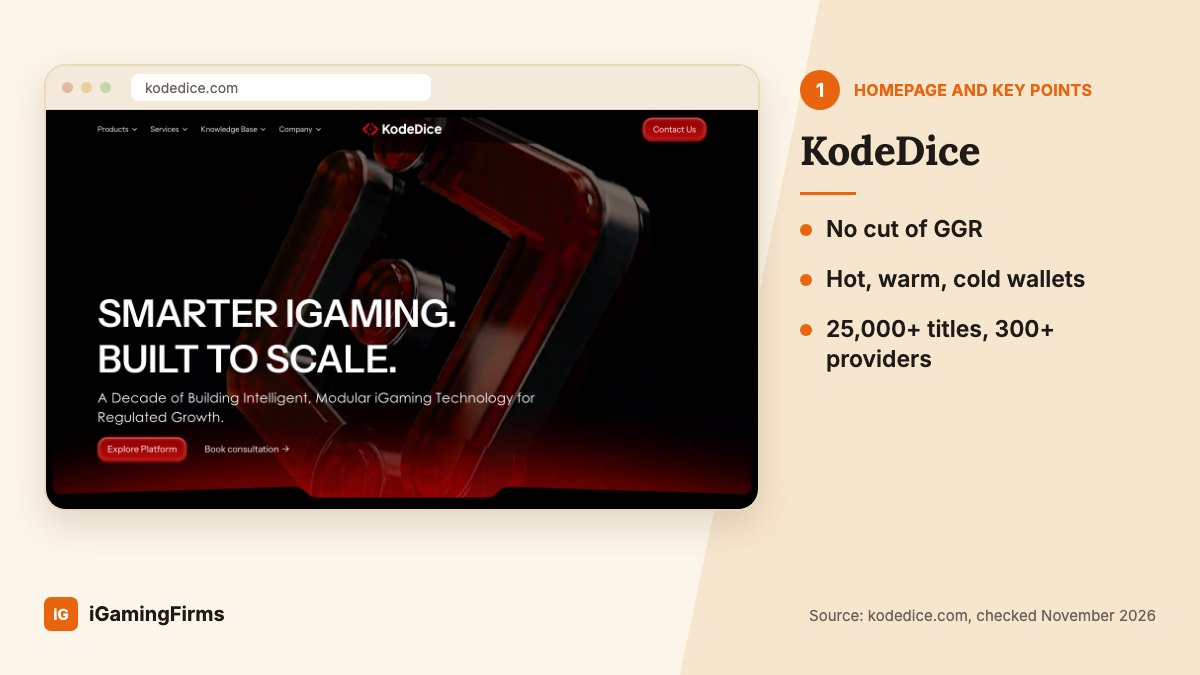
KodeDice sells turnkey and white label casino platforms with a crypto casino variant. Its footer says it operates as part of the Prometteur group. The homepage advertises a 2-week launch and says go-live depends on six variables: licence, certification, providers, payment rails, front end and go-live itself. Its game aggregator lists 25,000+ titles from 300+ providers and it cites 500+ integrated partners. The company says it can supply a white label licence and advise on jurisdiction. In its crypto material KodeDice says it takes no cut of operator GGR, supports fiat and crypto from one back office and runs a hot, warm and cold wallet stack. Ask for those terms in the contract and confirm whose licence you would launch under.
2. PieGaming
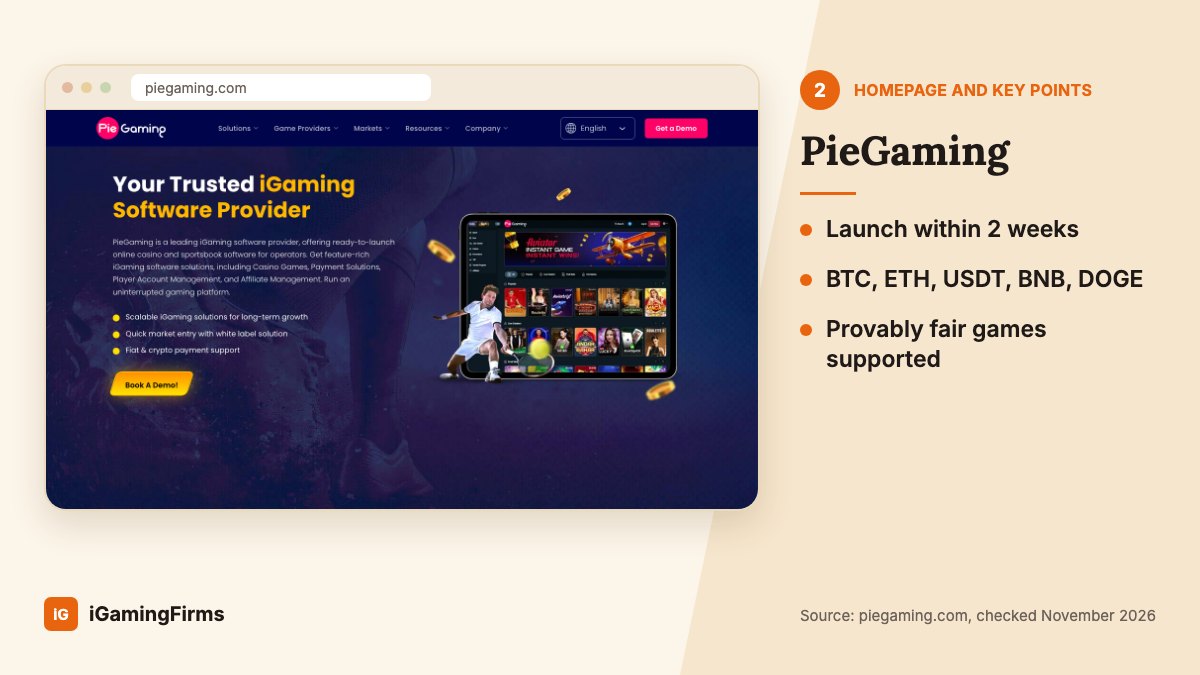
PieGaming was founded in 2014 and sells crypto casino software as white label (2 weeks) or turnkey (4 to 6 weeks). Its crypto page lists EOS, BTC, ETH, ATOM, BNB, ETC, APE, BUSD, DOGE and USDT. It says the software follows ISO 27001 information security standards. It offers 5,000+ games from 100+ providers and supports provably fair crash and dice games. Pricing is by quote. The FAQ says the operator typically handles branding, licensing and marketing. PieGaming also sells a separate crypto sportsbook. Note that BUSD is a wound-down stablecoin, so ask which assets are live today.
3. SoftGamings
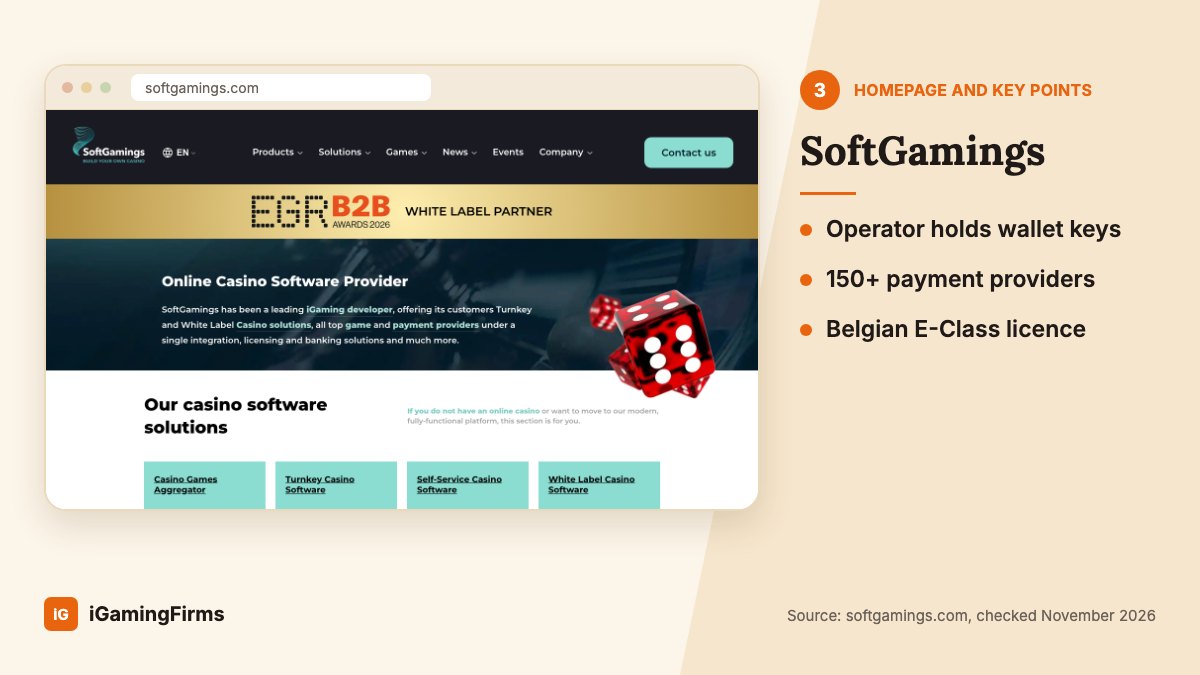
SoftGamings claims 19+ years in the industry and 500+ clients. Its cryptocurrency payment solution can be bought on its own or inside its aggregator, white label, turnkey or self-service casino offers. The page names coins by network: BTC, LTC, ETH, ETH (BEP20), BCH, USDT on ERC20, BEP20, TRC20 and Polygon, TRX, DOGE, XRP, EOS, BNB, MATIC, EGLD and WETH. It is the only vendor here that states the operator alone holds the wallet keys. SoftGamings lists a Malta licence, a Curaçao GCB licence, a Belgian E-Class licence and ISO 27001. Its “GCB” wording predates the CGA, so ask how its Curaçao status maps to the LOK. Pricing is by quote.
4. BetConstruct
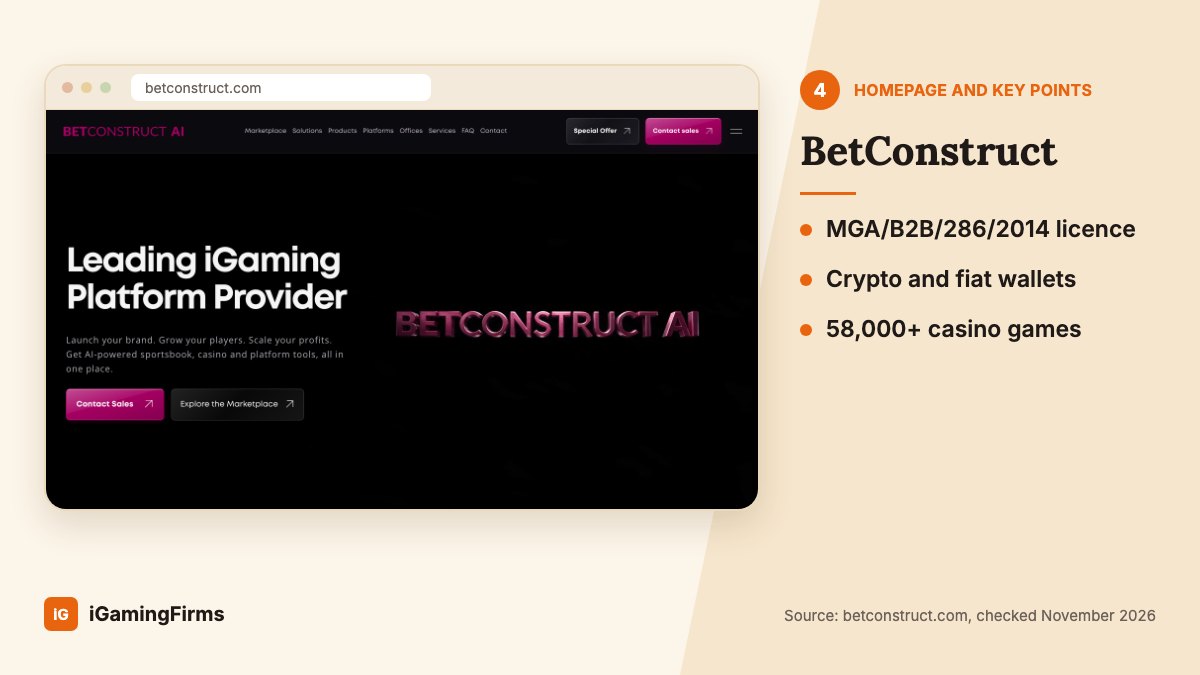
BetConstruct adds crypto to its casino and sportsbook platform. Its primary wallet supports BTC, ETH, USDT, LTC and more. A player can hold crypto and fiat wallets in one account and use their own crypto wallet. The page names Soft Construct (Malta) Ltd as operator, holder of MGA licence MGA/B2B/286/2014 issued 1 August 2018. It also lists UK Gambling Commission account 40767. Content includes 100+ game providers and a brandable crypto game set with crash, blackjack and roulette. The sportsbook lists 140K+ pre-match and 90K+ live events a month. BetConstruct also runs BetChain and a Custom Token product. It sells turnkey, API and white label setups.
5. BETFOC
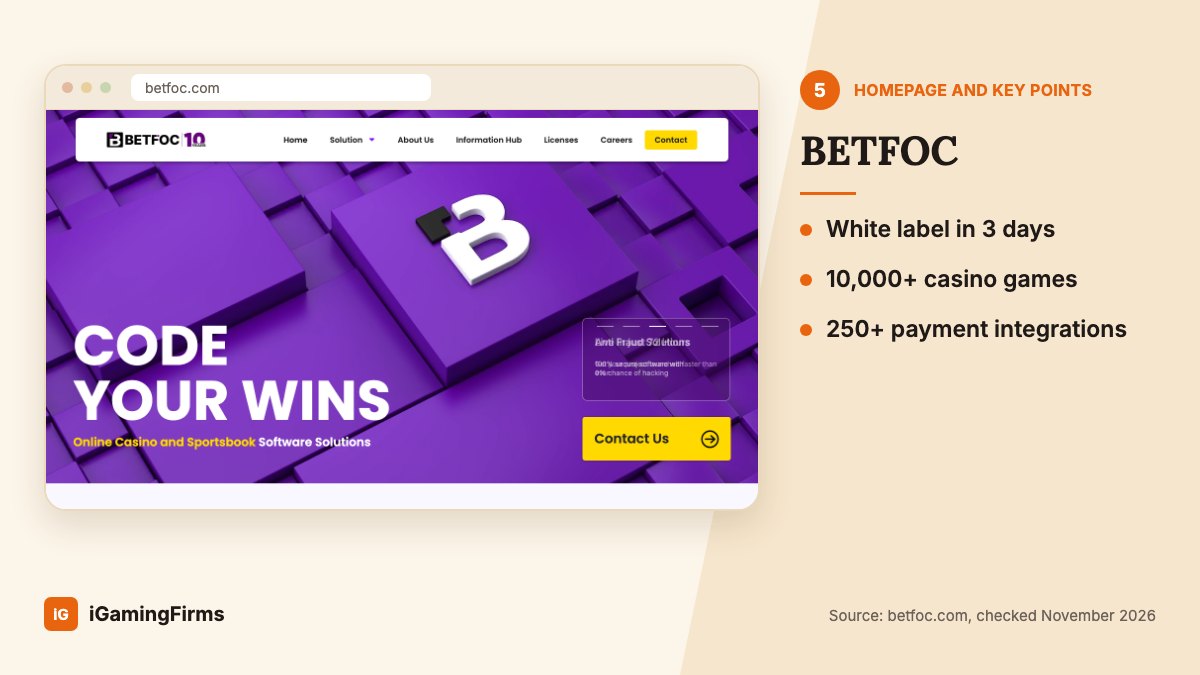
BETFOC is based in Business Bay, Dubai. It claims more than 10 years in the business and 450+ active projects. It says its white label crypto casino can launch in 3 days with 10,000+ games and multi-currency payments including crypto and e-wallets. Its homepage cites 250+ payment integrations and a “low-GGR share”. The site shows badges for Curaçao, Malta and Belgian licences, a Greek B2B licence and B2B supplier status in Belarus and Latvia. It does not say which entity holds each one. It also offers licensing consultation. Ask who holds each licence and how player crypto is stored, because the crypto page names no coins and no wallet model.
6. GammaStack (GammaCasino)
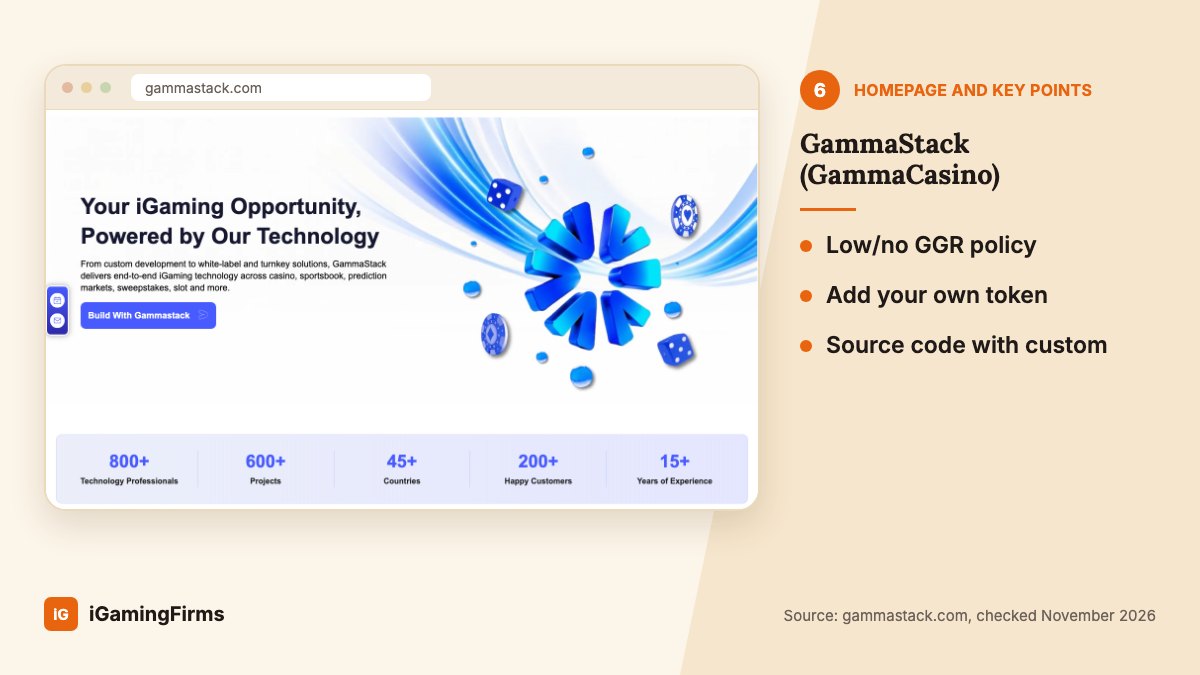
GammaStack claims 15+ years of experience and sells GammaCasino as white label, turnkey, custom or iFrame. It publishes the clearest commercial matrix in this list. Custom builds carry no GGR share and 100% source code ownership. White label and turnkey carry a low GGR share. The homepage FAQ adds that there are no hidden royalties. Its crypto page lists BTC, ETH, LTC, DOGE, SOL, XRP, USDT, USDC, BCH, TRX and Polygon, with the option to add your own token. Turnkey includes 8,000+ games from 50+ providers. GammaStack holds ISO 9001:2015 and ISO/IEC 27001:2022 and says its software runs under licences in the UK, Malta, Belgium, Curaçao, Canada, the USA, Sweden and Denmark.
7. GR8 Tech
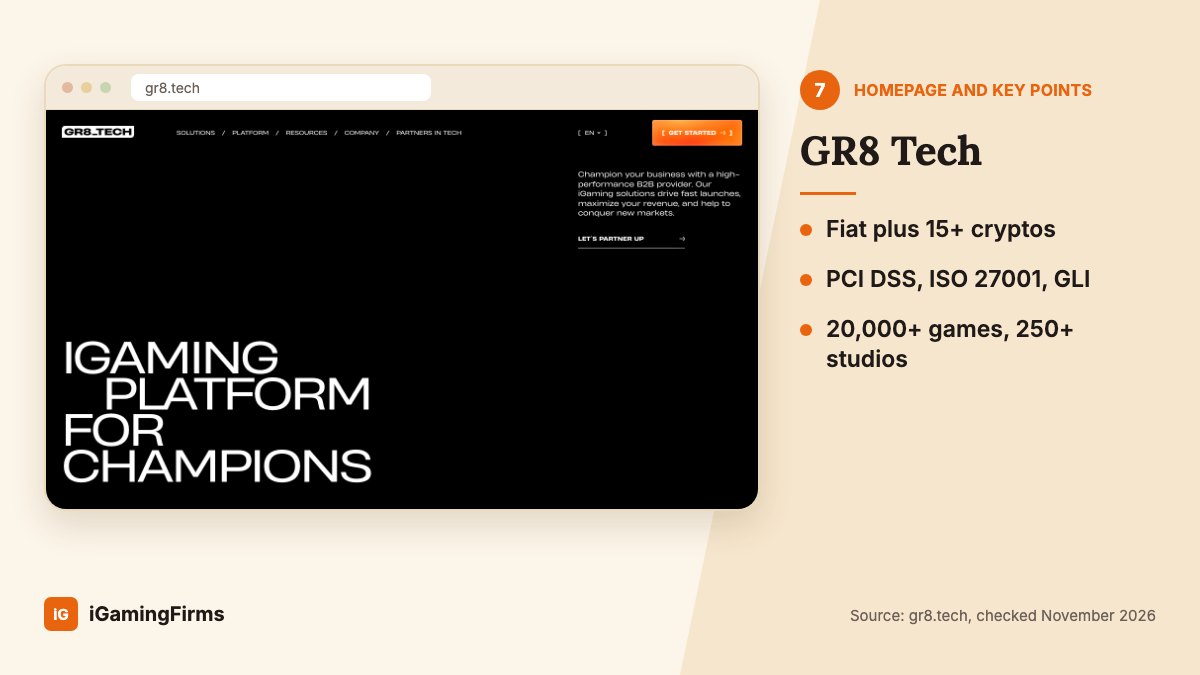
GR8 Tech is based in Limassol, Cyprus and sells GREAT_CRYPTO TURNKEY, a casino and sportsbook platform with crypto payments built in. It cites 15+ cryptocurrencies including BTC, ETH, LTC, USDT, USDC, XMR, XRP, TRX and SOL. It also lists 160+ payment methods. Players hold several currency balances in one account. It advertises “only 0.5% per transaction” on crypto and says most operators go live in 4 to 12 weeks. Its aggregation product offers 20,000+ games from 250+ providers. It supplies licensing guidance for the crypto turnkey but does not say who holds the licence. Because XMR is a privacy coin, check how that fits your regulator’s high-risk asset rules.
8. NuxGame
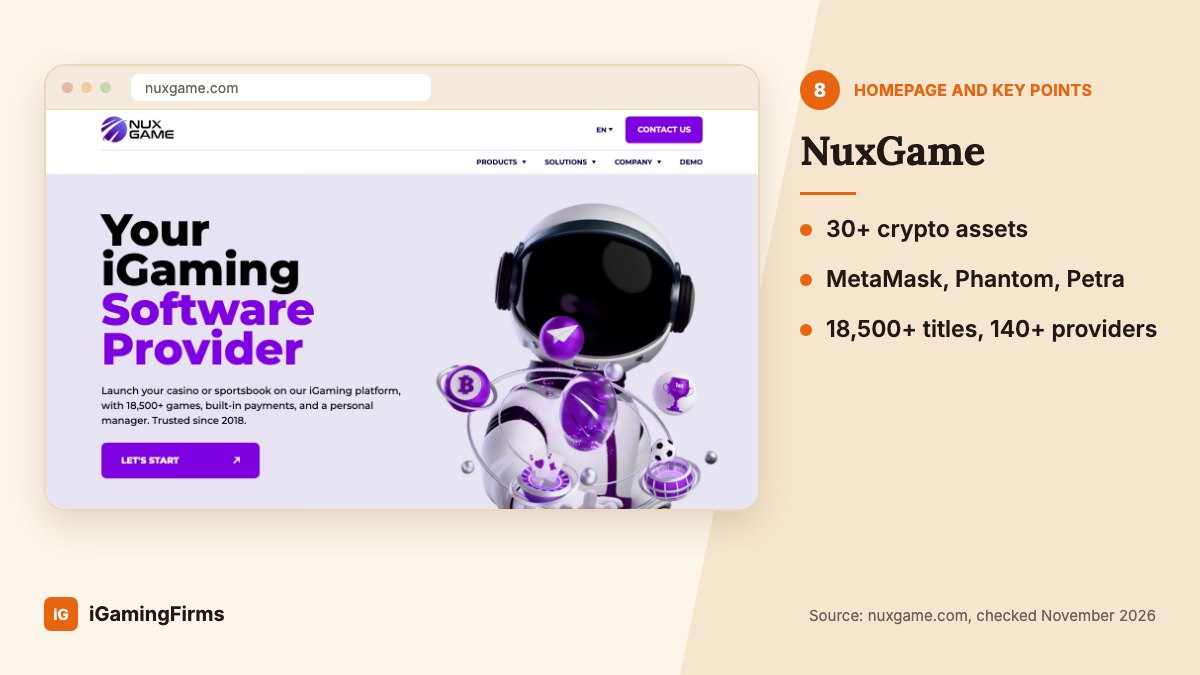
NuxGame has operated since 2018. It sells crypto-only, fiat plus crypto, white label, turnkey and custom casinos, plus sweepstakes and Telegram casino software. One player account holds fiat, crypto and stablecoin balances. Players can fund it through MetaMask, Phantom or Petra. The page claims 30+ supported assets, though its visible list shows about 25 tickers. It says it screens addresses against sanctioned wallets, logs provably fair seeds for disputes and offers 18,500+ games from 140+ crypto-friendly providers. It displays an Anjouan licence badge and offers legal consulting.
9. SOFTSWISS
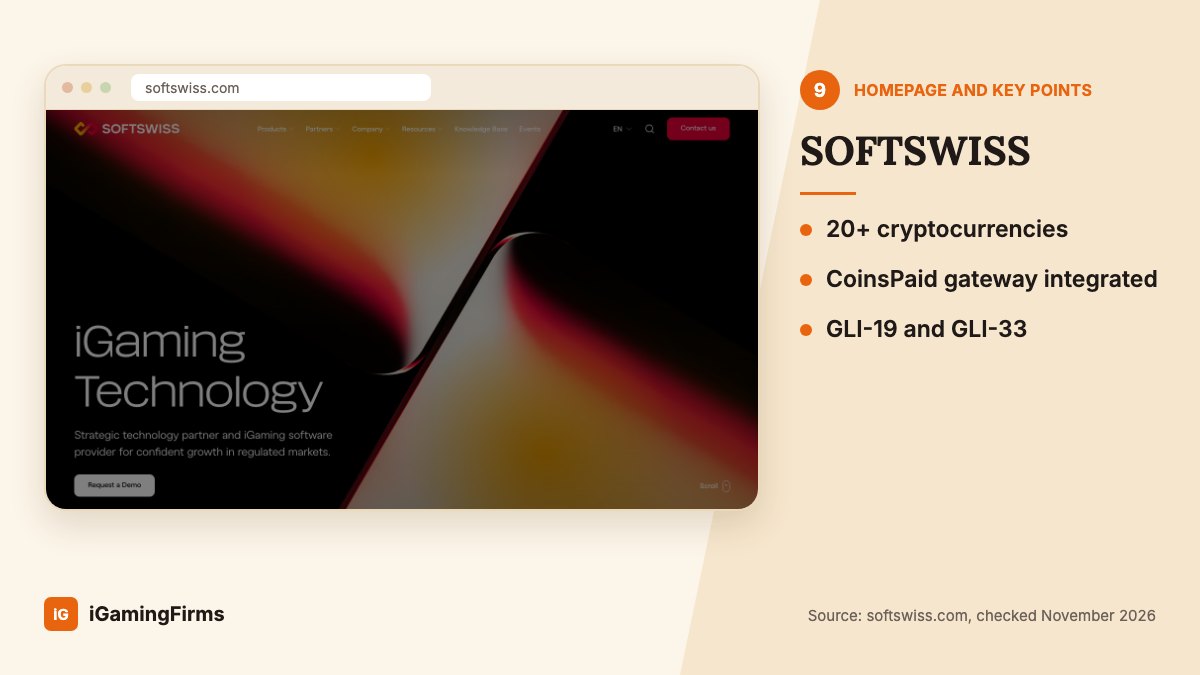
SOFTSWISS claims 17+ years, 2,200+ employees and 1,500+ brands on its ecosystem. Its crypto casino supports 20+ coins chosen before launch, with instant deposits and withdrawals through CoinsPaid integration. The solution is GLI-19 certified. The homepage FAQ says all its products hold GLI-19 and GLI-33. Stable Aggregator Limited holds MGA Critical Gaming Supplies licence MGA/B2B/942/2022. The game aggregator offers 50,000+ titles from 300+ providers. Affiliate integrations include Affilka, NetRefer and Income Access. SOFTSWISS says it provides dedicated hosting and a fully managed setup. It also says you must secure your own licence. Read the CoinsPaid terms alongside the platform contract.
10. Cubeia
Cubeia (Cubeia Sweden AB) is a Stockholm software company founded in 2007. Its Cubeia Nano turnkey comes pre-configured with games, back office, payment rails and analytics and claims a complete setup in 1 to 2 weeks. It supports Bitcoin over the Lightning Network and USDT and USDC on Ethereum, TRON and BSC, plus a card on-ramp for buying crypto. The lobby offers 20,000+ games including Evolution, Pragmatic Play and Nolimit City titles alongside provably fair games. Bonus tools include cashback and rakeback, with a built-in CRM and affiliate tools. The page does not describe custody or licences.
How to create your own crypto casino
- Pick target markets first. Where your players live decides the licence. Many markets ban unlicensed online casinos whatever the currency.
- Choose the licence. Compare Curaçao, Anjouan and others on cost, crypto rules and supervision. Budget for the CGA’s EUR 47,450 annual fees if you go to Curaçao.
- Choose the delivery model. White label for speed, turnkey for control or custom for code ownership.
- Design custody. Decide who holds keys, how player and treasury wallets are segregated and which regulated VASP handles any conversion.
- Set up compliance. KYC, wallet screening, Travel Rule messaging and responsible gambling tools need to work before launch.
- Contract content. Confirm each studio accepts your licence, markets and currencies.
- Test. Run deposits, withdrawals and bonus rules on every network you support before you open.
Our step-by-step guide on the Curaçao gaming licence covers the application itself.
Curaçao supplier rules and crypto compliance
Your supplier list is now a licence condition in Curaçao
The LOK’s two-year transition ends on 24 December 2026. From then, CGA operator licensees may only source critical goods and services from suppliers on the public register. A legal analysis of the CGA’s June 2026 announcement lists RNG game makers, live studios, sportsbook software and game aggregators among the critical categories. It says platform and payment providers are borderline cases. Before you sign, ask each software vendor and studio for proof of CGA registration.
Built-in exchange features may not fit your licence
Several platforms sell instant coin swaps as a feature. Curaçao’s guideline says operators may not convert crypto for users. A withdrawal in a different asset is allowed only if the conversion runs through a regulated VASP and stays auditable. Check whether a vendor’s exchange service is a regulated entity and who the contracting party is.
Coin lists hide compliance risk
Long coin lists look like a selling point. Under Curaçao’s rules every asset beyond fiat-backed regulated stablecoins needs its own risk assessment. Privacy coins must be treated as high risk. GR8 Tech lists Monero and PieGaming still lists BUSD. Fewer, well-documented assets on named networks are easier to license and audit.
Your next step
Pick your licence before you pick your platform. Then shortlist three providers whose delivery model fits and send each the same written questions. Who holds the private keys for player and treasury wallets? Which networks are live for each coin? Which regulated entity handles conversion? Which studios are registered with your regulator? What are the setup fee, revenue share and processing fee? Compare the written answers side by side and sign with the vendor whose custody model you can defend to your regulator.