You want poker in your lobby, but a poker table only works when other real players sit at it, so the software you choose decides whether your tables fill or stay empty.
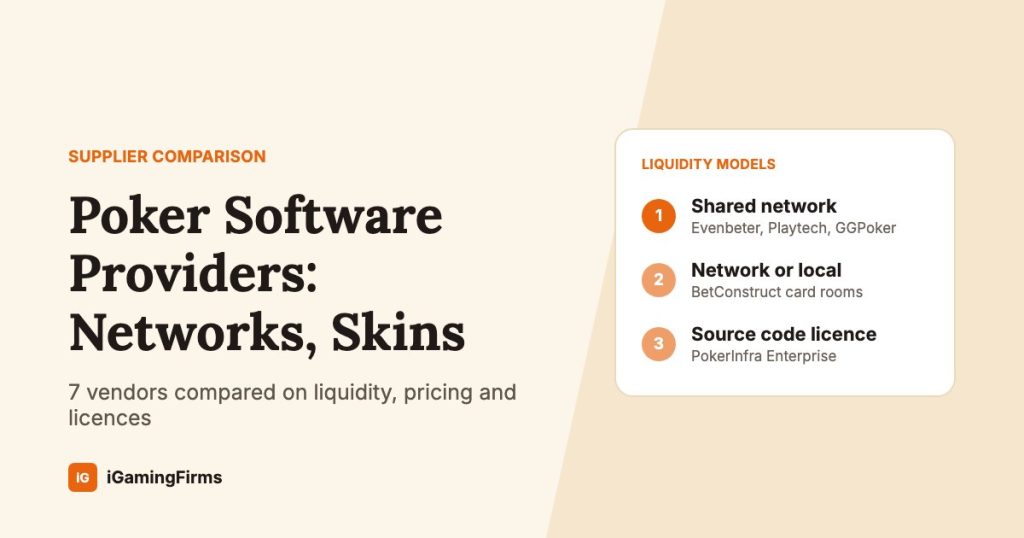
The short answer: choose the liquidity model first and the vendor second. Evenbeter, Playtech, Connective Games, BetConstruct and GGPoker can all put your players into a shared pool, while PokerInfra and Slavna Game Studio sell rooms or builds you fill yourself. None of these international pools can seat US players. US shared liquidity runs only through the six-state Multi-State Internet Gaming Agreement. Michigan’s regulator says every platform provider in multistate poker needs an internet gaming supplier licence in that state.
Each vendor fact below comes from the provider’s own product, pricing or licence pages or from regulator records, read in November 2026. No provider paid to be included. If you want a studio to build a poker product from scratch instead of a ready-made platform, see our separate list of poker game developers.
Poker software providers compared
The numbers in the first column match the order of the reviews below.
| # | Provider | What you buy | Liquidity | Commercial terms the vendor states | Licences and certification | Integrity tools the vendor names |
|---|---|---|---|---|---|---|
| 1 | Evenbeter | One-click poker games, network skin, standalone platform or standalone API | Shared through the WePlay Poker Network for skins and one-click games; none for the standalone platform | Pricing through a demo request | MGA/B2B/769/2019; RNG certificates from GLI, iTech Labs, Quinel and BMM; ISO 27001 | Anti-bot and anti-fraud tools, KYC; WePlay manages network anti-fraud |
| 2 | Playtech (iPoker Network) | Skin on the iPoker network, plus direct game launch | iPoker network across regulated European markets | Pricing through sales contact | UKGC account 38516; MGA/CRP/137/2007 | KYC, payment and risk and fraud integrations through PAM+, per the company |
| 3 | Connective Games | Configurable poker platform with a casino add-on | Says its rooms form the third biggest poker liquidity in the world | Pricing through sales contact | MGA; GLI, iTech Labs, Juego Seguro and Gaming Associates badges | None described on its poker page |
| 4 | BetConstruct | P2P poker as part of a turnkey or white label stack | Your own local card room or its global network | €10K setup; revenue share 9% turnkey or 20% white label to BetConstruct | Danish supply licence covering poker; MGA/B2C/292/2015 lists P2P poker; GLI-tested poker certification in four markets | “24/7 gameplay integrity” |
| 5 | GGPoker (GGNetwork) | Channeling of your players into GGPoker’s software | GGPoker’s global player pool | Partnership by email | GG International Limited, Isle of Man GSC licence issued 15 October 2020 | KYC fully managed by GGPoker |
| 6 | PokerInfra | White-label Cloud, Enterprise source code licence or Edge offline console | No shared pool described | Enterprise: no recurring licence fees, no revenue sharing; pricing by contact | None listed | SSL, anti-collusion monitoring, fraud detection (Enterprise) |
| 7 | Slavna Game Studio | Custom and turnkey poker games and apps | No shared pool described | No public pricing | Company says its games carry RNG+ certification | Company says its payment setup includes an anti-fraud system |
Shared-liquidity networks vs standalone skins: the choice that comes first
Ready-made poker comes in four commercial shapes. Each one moves the same two things: who brings the players and who controls the economics.
Network skin
You put your brand on a shared network. Your players sit at tables with players from every other brand on that network. The network operator usually sets tables, tournament schedules and network-wide promotions. Evenbeter’s skin product works this way: its network skin page says the WePlay Poker Network handles table configuration and tournament scheduling. It adds that you can run under WePlay’s licence or your own. Playtech’s iPoker and Connective Games’ rooms follow the same network logic.
Channeling or revenue partnership
You do not run a room at all. You send players to someone else’s client and earn on their play. GGPoker’s channeling solution is the clearest example: players sign up through a page on your site, on GGPoker.com with your code or through accounts you create in a back office. GGPoker handles KYC and payments.
Standalone room on a licensed platform
You run your own tables and keep your own player pool. Evenbeter states plainly that its standalone platform has “No shared liquidity”. BetConstruct lets you choose a separate local card room instead of its network. You control rake, promotions and player data, but you must fill the tables yourself.
Source code or custom build
You buy the code or commission a build and host it yourself. PokerInfra Enterprise and Slavna Game Studio fit here. This gives you the most control and the most work: hosting, certification in each market and liquidity are all yours. Full custom studios are covered in the poker game developers guide linked above.
A simple rule: if you cannot name where your first few hundred regular poker players will come from, start on a network or a channeling deal. If you already run a large casino or sportsbook base in one market, a standalone room starts to make sense.
The 7 poker software providers, reviewed
1. Evenbeter
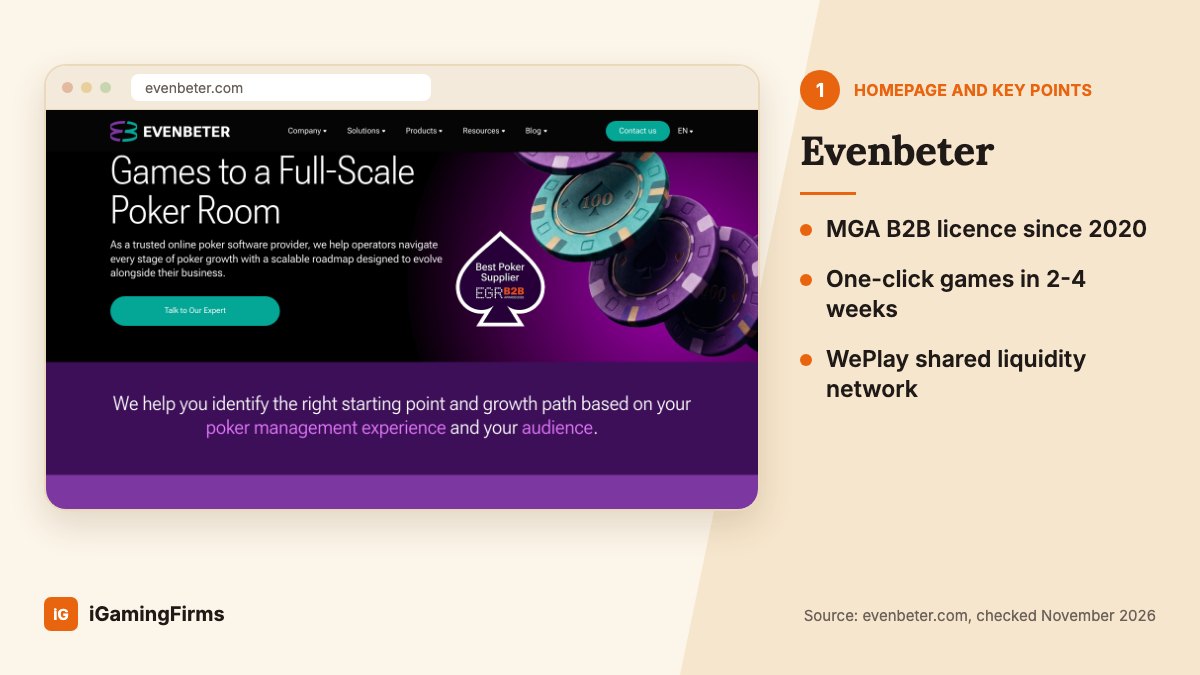
Evenbeter is the brand of Evenbet Gaming Limited, which holds Malta Gaming Authority B2B licence MGA/B2B/769/2019, issued April 2020. It is the one vendor here that sells every rung of the ladder, from a poker tile in a casino lobby to a full room of your own. Its site also shows licence logos for Denmark, Sweden and Peru.
The entry product is One-Click Poker Games: real multiplayer cash tables that a player launches from a tile, like a slot, with no separate poker lobby. Evenbeter says these launch with shared liquidity through WePlay and integrate in 2 to 4 weeks. They are cash games only, with no tournaments.
The next step is the network skin. Evenbeter says you can go live in a few weeks, either as a turnkey option that includes payments and user management or through an API that keeps your existing wallet and player accounts. WePlay manages game integrity and anti-fraud centrally and runs rake races and jackpots. The page also cites “guaranteed settlements”. There is also a multi-level affiliate and agent system with configurable commission logic.
At the top sits the standalone poker platform. It lists more than 40 games, including Hold’em, Omaha Hi-Lo, 5-card and 6-card Omaha, Short Deck, All-in or Fold, OFC Pineapple, H.O.R.S.E., Badugi and Telesina, plus more than 15 tournament types and FastFold tables. On integrity it names anti-bot and anti-fraud tools in the back office, KYC and responsible gaming tools, a GLI-certified RNG with iTech Labs, Quinel and BMM Testlabs certificates and ISO 27001 certification.
Clients: the homepage shows partner logos including 1XBET, Premier Bet, Hollywood Bets, Apuesta Total and EveryMatrix, but it does not say which of them run Evenbeter poker. Ask for references from poker operators in your market.
Fits: casino or sportsbook operators who want to test poker demand cheaply and keep a path to their own room. Ask: current peak cash-game counts on WePlay in your markets and which jurisdictions WePlay’s licence actually covers.
2. Playtech (iPoker Network)
Playtech runs the iPoker network, which serves operators in regulated European markets. Playtech plc holds UK Gambling Commission account 38516, with a remote gambling software licence active since 25 September 2014. It also holds Malta critical gaming supply licence MGA/CRP/137/2007, which its site dates to 6 December 2018.
Playtech’s poker page says iPoker was established in 2004 and supports more than 80 brands, with 1.5 million unique players and about 500,000 each month. No year is attached to those figures, so treat them as marketing totals rather than current traffic. The same page lists poker compliance for the UK, Italy, France, Spain, Denmark, Belgium, Bulgaria, Sweden, Finland, Malta, Estonia, Austria, Latvia, Switzerland and Colombia.
That jurisdiction list matters more than the headline numbers. Some European regulators ring-fence poker pools or allow sharing only with named partner markets. A skin licensed in one market usually sees only the tables its licence allows, not the full network.
On content, Playtech’s page lists Hold’em and Omaha cash games, multi-table tournaments in knockout, progressive knockout, freezeout, multi-entry and re-entry flighted formats, three-handed turbo Sit & Go and its Twister Poker lottery-style format. The company says its PAM+ platform connects KYC, payment and risk and fraud integrations. It also says it won EGR Poker Supplier of the Year in 2021, 2022 and 2023. Playtech’s homepage says it is still actively investing in new poker games, features and retention tools.
Fits: operators already licensed in one or more of the listed European markets who need busy tables from launch. Ask: which pools your licence lets you join and the commercial split on network rake.
3. Connective Games
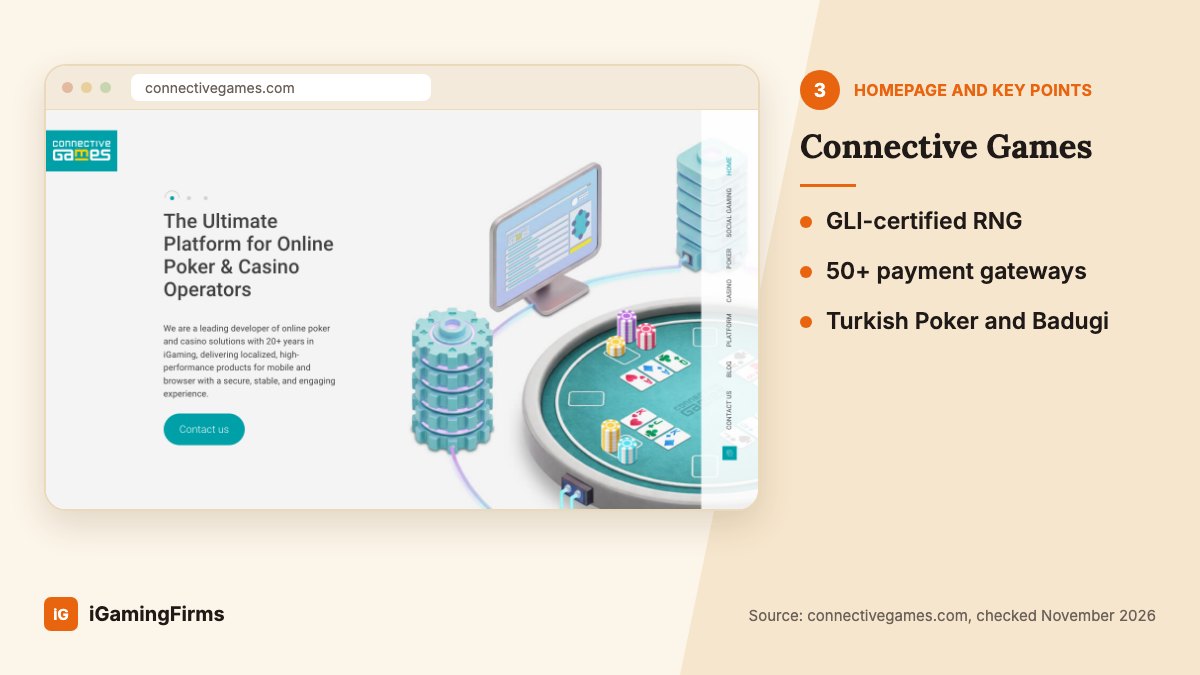
Connective Games Malta sells a poker platform that operators configure for currency, language, lobby and game mix. The company says it has more than 20 years in iGaming, has launched 22 or more poker rooms and serves 20 or more markets with 12 or more operator brands. Its own facts section gives 12 or more countries, so ask which figure is current.
Its poker page says the platform powers five of the top online poker rooms, which together form the “third biggest Poker liquidity in the world”. The page metadata says four rooms. No operator or room is named, so you cannot check the claim against a public traffic source.
Game coverage is the strongest point. The page lists Hold’em, Omaha, Stud and Draw, plus regional variants: Open-Face Chinese Poker Pineapple, Turkish Poker and Badugi. Tournament and table features include Jackpot Sit and Go, Fast Fold Poker, Bad Beat Jackpot, flight tournaments and re-entry tournaments, with full parity across platforms.
The homepage cites licences from regulators including Malta, Denmark and India. It also cites certification for the UK, Malta, Denmark, Spain and Portugal. It shows GLI, Juego Seguro, Gaming Associates and iTech Labs badges. The linked iTech Labs RNG certificate for the UK is dated June 2018. The poker page does not describe anti-collusion or bot detection, so put that question first in your demo.
Fits: operators in markets where regional variants such as Turkish Poker draw players, or who want poker and casino from one supplier. Ask: named reference rooms, current network size and a dated certificate for your market.
4. BetConstruct
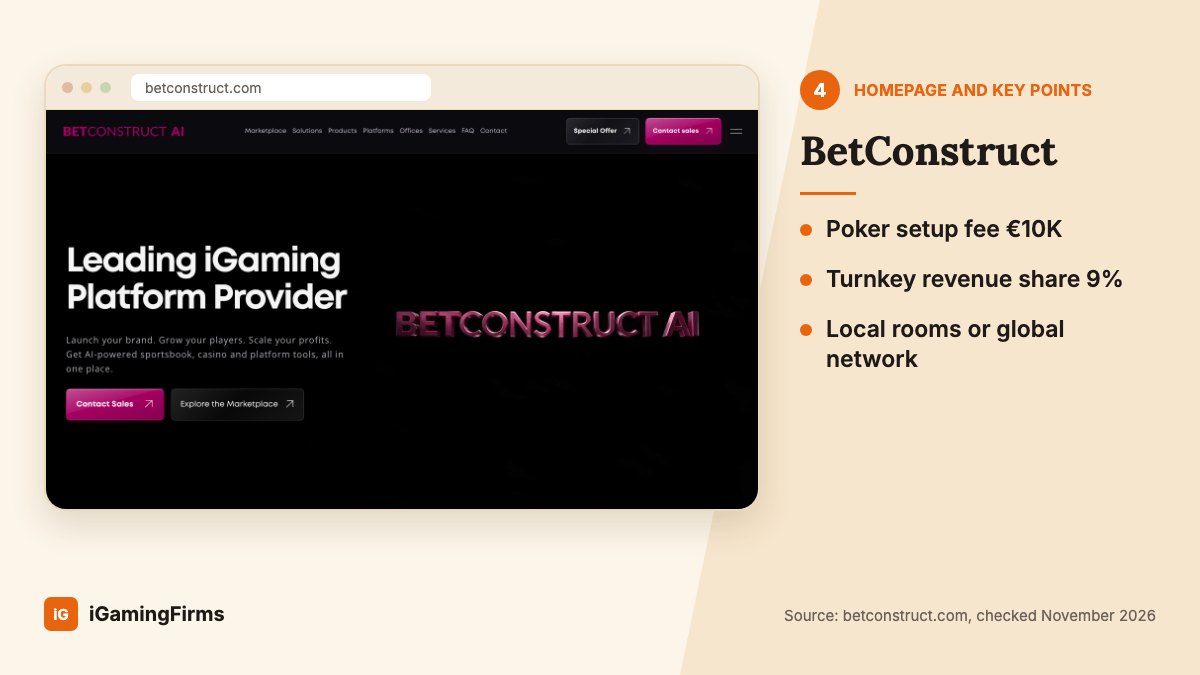
BetConstruct, part of SoftConstruct, sells P2P poker inside its wider sportsbook and casino platform. It is the only provider here with poker prices on its own site. The poker product page lists a €10K poker setup fee, or €15K for its gaming suite, payable in local currency or crypto. Revenue share is 9% to BetConstruct and 91% to the partner on turnkey, or 20% and 80% on white label.
You choose between a separate local card room and its global network. Game formats are Texas Hold’em in no limit, limit and pot limit, Omaha, 6+ Hold’em (Short Deck) and Badugi, across cash, Spin&Go, Sit & Go and tournaments. Tournament types include freeroll, freezeout, satellite, progressive knockout and multi-flight. Clients run on Windows, Mac, HTML5, a native iOS app and a PWA. Promotion tools cover deposit bonuses, rakeback and rake races.
The licence detail is worth reading closely. BetConstruct’s licences page lists a Danish gaming supply licence (J.nr. 24-453675) that names poker in its scope. Its Malta B2B licence MGA/B2B/286/2014 lists casino, betting and controlled skill games but not poker. Poker peer to peer appears under MGA/B2C/292/2015. The page also lists GLI-tested P2P poker certification for Georgia, Lithuania, Romania and South Africa. Soft Construct (Malta) Limited holds UKGC account 40767 for casino, betting and gambling software.
Fits: sportsbook or casino operators who want poker on one stack with fees known before the first call. Ask: whether the revenue share is calculated on gross or net rake and whether your target market is on the certified list.
5. GGPoker (GGNetwork)
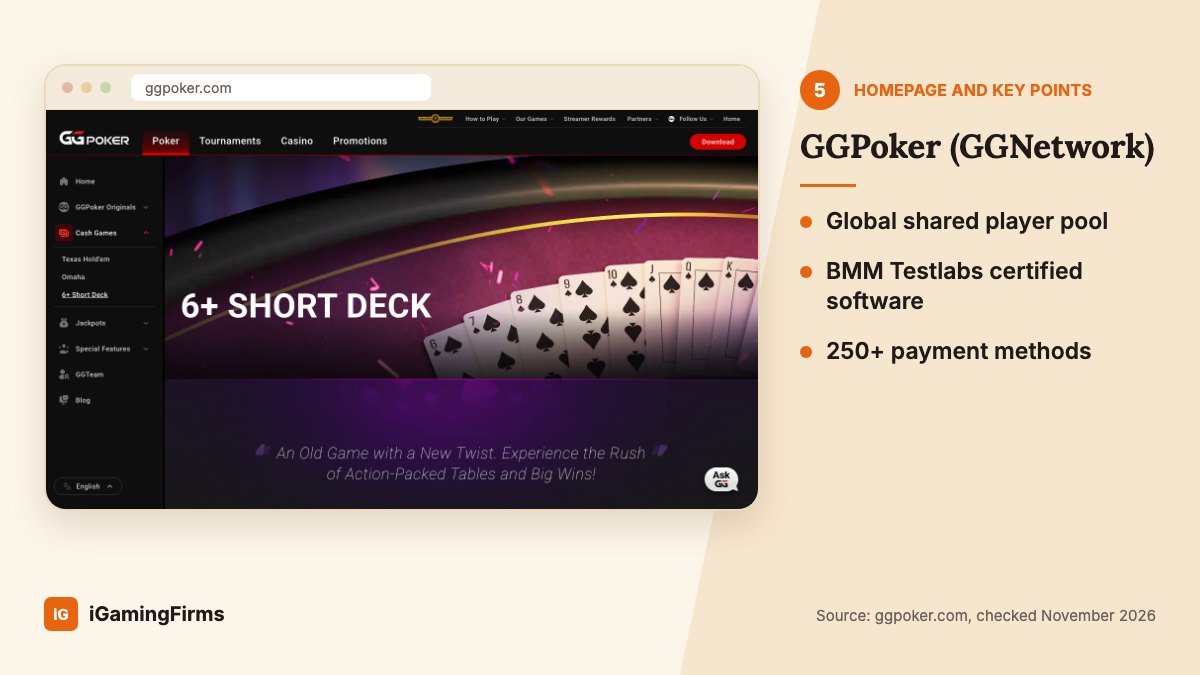
GGNetwork offers two routes. Its channeling solution is described as fully turnkey: your players get accounts on GGPoker’s software and your logo appears at the top of the app and on the table felt for players tagged to you. The network integration route says standard integrations take about one month and custom ones up to two months, with one integration covering Windows, Mac, iOS and Android and a choice of seamless or transfer wallet.
For channeling, GGPoker says integration takes hours, partners get a global player pool, there are more than 250 payment methods, cashouts typically take under 24 hours and KYC is fully managed. Your back office covers crediting and debiting funds, daily reporting, sub-agents and direct player messaging. Cash games include Texas Hold’em, Omaha and 6+ Short Deck. Tournaments include Bounty Hunters and Mystery Bounty formats.
GG International Limited, trading as GGPoker, is regulated by the Isle of Man Gambling Supervision Commission under a licence issued 15 October 2020. Its pages show a BMM Testlabs logo but do not state the scope of any certificate, so request it in writing.
Fits: brands and affiliates with a player audience who want poker revenue without running tables, payments or KYC. Ask: who owns the player relationship and data, how your share is calculated and which countries your players can join from.
6. PokerInfra
PokerInfra LLC, with a contact address in Surrey, British Columbia, sells three products. Cloud is a managed white-label platform with web, Android and iOS apps under your brand. Its headline promises a custom platform in 2 weeks. Its feature list covers real-time multiplayer, tournament and club management, bonuses, KYC, a wallet and an admin dashboard. Pricing is by contact.
Enterprise is the source code licence. The page states “No Recurring License Fees” and “No Revenue Sharing”. Deployment can be on public cloud, private infrastructure, dedicated servers or hybrid setups. Formats include Hold’em, Omaha, Omaha Hi-Lo, Seven Card Stud, Short Deck and custom formats, with cash games, multi-table tournaments and scheduled events. Security features named are SSL, anti-collusion monitoring and fraud detection.
Edge is different again: a physical poker console for offline play in clubs and venues, with no cloud servers or payment gateways to set up. None of the three products describes a shared player pool. No certifications are listed, so certification in your market is your cost and your job.
Fits: operators with their own players and engineering staff who want code ownership. It also fits clubs that want offline tables. Ask: what the source code package includes, update terms and which labs have tested the RNG.
7. Slavna Game Studio
Slavna Game Studio describes itself as a B2B development studio established in 2008, with offices in Plano, Texas and Bratislava and R&D in Ukraine. It builds custom and turnkey poker games and apps on white label solutions rather than running a network.
The company says its poker work covers Hold’em, Omaha Hi-Lo, Pot-Limit Omaha, 2-7 Triple Draw, 7 Card Stud, 5-Card Draw, Razz, HORSE and Chinese Poker in no limit, fixed limit and pot limit. It lists multiple payment gateways with an anti-fraud system, crypto support, affiliate management, live hand history and multi-currency support, plus RNG+ certification. It does not name a test lab or a jurisdiction for that certification.
Its “fully owned, no licensing fees” wording appears on slot packages. Confirm in writing whether the same ownership terms apply to a poker build.
Fits: operators who want a bespoke poker app and already have a liquidity plan. Ask: the lab behind the RNG certificate and the markets where its poker builds are live.
Shared liquidity in the US: how MSIGA changes your vendor choice
If you plan to offer real-money poker in the US, none of the international pools above can help you directly. US online poker is legal state by state. Players from different states can only share tables through the Multi-State Internet Gaming Agreement (MSIGA). For the wider state picture, see our guide to US gambling laws by state.
Which states share poker liquidity?
MSIGA has six members. Nevada, Delaware and New Jersey were already members when Michigan joined as the fourth in May 2022, according to the Michigan Gaming Control Board. West Virginia joined later. Pennsylvania became the sixth member on 23 April 2025, when Governor Josh Shapiro signed the agreement. The Pennsylvania Gaming Control Board said shared games for its roughly 150,000 online poker players would start on 28 April 2025. It said the move would grow the player pool by more than 50% to a shared market of over 38 million Americans. BetMGM and Borgata Online were named as the first participants in Pennsylvania.
What a vendor needs before it can power a US multistate room
The Michigan board set out the conditions when it joined. Operators and platform providers must meet the agreement’s terms and offer multistate poker only with member states. New platforms, platform changes and game software need approval. Servers that accept wagers outside Michigan need written approval. New suppliers, including platform providers, must hold internet gaming supplier licences. So a vendor’s MGA or UKGC licence counts for nothing here. You need the vendor licensed in every state where your room will take bets.
None of the regulator releases cited here names any of the seven vendors in this list. If the US is on your roadmap, ask each one for its state supplier licences in writing before you sign.
Licensing and certified markets: what to check
A supplier licence is not one fact. It has a regulator, a scope and a list of products. Three checks catch most problems.
- Look up the licence on the regulator’s register. The UKGC register shows each licence activity with its start date. That is how you can see Playtech’s remote gambling software licence dates from September 2014. Most other regulators publish similar registers.
- Read the scope, not just the number. BetConstruct’s Malta B2B licence does not list poker in its scope, while its Danish supply licence does. If your market recognises Malta but not Denmark, that difference matters.
- Ask for the certificate for your market and its date. Connective Games links to an iTech Labs RNG certificate for the UK dated June 2018. Evenbeter lists four RNG labs for its standalone platform. A certificate for one jurisdiction does not carry over to another. Older certificates may not match the current build. Our comparison of iGaming testing labs explains what each lab covers.
How do online poker operators make money?
Poker is peer to peer. Players play against each other, not against the house. The operator takes a small cut of each cash-game pot (the rake) and an entry fee on each tournament. That makes revenue depend on table volume, which is why liquidity drives every other decision.
The vendor then takes its share in one of three ways. On a network, the vendor or network operator keeps part of the rake your players generate. On a platform deal, you pay a setup fee plus a revenue share. BetConstruct is the only vendor here that publishes its numbers: a €10K setup fee and 9% or 20% to BetConstruct depending on turnkey or white label. On a source code licence such as PokerInfra Enterprise, you pay for the licence and keep all the rake, but hosting, updates and certification are your costs.
Rakeback, rake races and leaderboards return part of the rake to players. BetConstruct lists rakeback and rake races as promo tools. Evenbeter says WePlay runs rake races and jackpots for network skins. On a network, those programmes are often set network-wide, so check what you can and cannot change.
How much does poker software cost?
Only BetConstruct publishes a number among these seven: a €10K setup fee for poker. Evenbeter, Playtech, Connective Games, GGPoker, PokerInfra and Slavna Game Studio all price by contact or demo request. The real cost is the setup fee, plus the revenue share or licence fee, plus what you pay to certify, host and market the room. For a breakdown of how setup fees and revenue shares stack up across platforms, see our guide to white label casino cost.
Which tournament and anti-fraud features matter most?
Tournaments bring players back each week. Integrity keeps them from leaving. Compare both before you compare skins.
Tournament features
Knockout and multi-entry formats are now common. Playtech lists knockout, re-entry and flighted events. BetConstruct lists progressive knockout and multi-flight events. Connective Games lists flight and re-entry tournaments. Fast-fold cash tables appear at Connective Games and Evenbeter. Lottery-style sit and go formats appear as Playtech’s Twister Poker and BetConstruct’s Spin&Go. Bounty and mystery bounty tournaments appear at GGPoker. Multi-day flights are only useful if your pool is large enough to fill them, which is another reason the liquidity question comes first.
Anti-fraud and game integrity
Poker has threats that slots do not: collusion between players at the same table, bots and multi-accounting. Vendors vary in how much they say about this. Evenbeter names anti-bot and anti-fraud tools. It says WePlay manages network-wide integrity. PokerInfra names anti-collusion monitoring and fraud detection for Enterprise. Playtech points to risk and fraud integrations through PAM+. BetConstruct says only “24/7 gameplay integrity”. Connective Games’ poker page names nothing. On a network, your players’ fairness depends on the network’s security team. On a standalone room, it depends on yours. Our guide to iGaming fraud detection covers the tools you can add on top.
Should you buy a ready-made platform or build your own?
Ready-made poker from a network or platform vendor gets you live in weeks. Evenbeter quotes 2 to 4 weeks for one-click games, GGPoker quotes about a month for standard network integration and PokerInfra advertises 2 weeks for Cloud. A custom build costs more upfront and takes longer, but you own the product and its roadmap. Many operators add poker as one vertical within a larger casino stack. If that is your plan, compare these vendors against full online casino software platforms that bundle poker with casino and sportsbook.
Player pools, licence scope and dated network figures
A global pool is not a US pool
Network size is usually quoted as a single global number. In the US, shared poker liquidity exists only between MSIGA states. Pennsylvania only joined in April 2025. Michigan requires a state supplier licence for every platform provider. A vendor with a large international network may have no way to serve US players at all.
Licence scope can leave poker out
A vendor can be properly licensed and still not be licensed for poker in the place you care about. BetConstruct’s own licence list shows poker in its Danish supply licence and its Malta B2C licence, but not in its Malta B2B licence. Read the scope line for each licence.
Network figures come without dates
Playtech’s 1.5 million unique players has no year attached. Connective Games’ “third biggest” claim names no rooms and gives four in one place and five in another. GGPoker calls its network the largest without giving numbers. None of these is a current, market-specific player count. That is the figure you need written into your contract or term sheet.
Your next step
Write down three things on one page: the markets where you hold or will hold a licence, where your first poker players will come from and whether you want to own the room or rent seats in someone else’s. Then send the same three questions to two network vendors and one platform or code vendor from this list. Ask for active cash-game players in your market last month, the scope of the licence that covers poker there and the exact basis of the revenue share. Compare the written answers, not the brochures.