Your front end takes the bets. The harder question is what happens next: who prices the market, who watches liability, who settles the ticket and who files the numbers your regulator asks for.
The short answer: sportsbook management software is the back-office and trading layer behind a betting site: trading tools, liability and exposure control, bet settlement, player segmentation and limits, reporting and regulatory reporting plus the bonus engine. The ten platforms below all sell that layer, but they split on one thing buyers rarely check first: who operates it day to day. Only one of them, BetConstruct, prints its sportsbook revenue share on its product page (10% to 16% for turnkey), which gives you a real benchmark before any sales call.
Every vendor fact below comes from the provider’s own product, licence and news pages, read in November 2026. No provider paid to be listed. If you are comparing platform vendors, white labels or custom builds instead, this guide stays on the operations layer and links out where the topics overlap.
Sportsbook management software compared: 10 platforms by back-office module
The table maps each platform against the modules a trading team works in every day. Serial numbers match the profiles further down.
| # | Platform | Who runs trading and risk | Liability and bet monitoring | Segmentation and limits | Bonus engine | Reporting and settlement | Key licences |
|---|---|---|---|---|---|---|---|
| 1 | SOFTSWISS Sportsbook | Operator tools plus SOFTSWISS exposure team | Real-time bet monitoring, exposure and anti-fraud checks | Configurable betting limits | Bonuses, jackpots, tournaments, missions | Operator dashboard with GGR tracking | GLI-33 certified sportsbook; ISO 27001; PCI DSS |
| 2 | TRUEiGTECH | Operator, or managed trading as a service | Flags arbitrage, bonus abuse and multi-accounting | Betting limits; agent-level limits in PPH module | Free bets, odds boosts, cashback, loyalty | Audit-ready regulator reports; API settlement | Lists GLI, BMM, eCOGRA certification pages |
| 3 | Altenar | Operator, with 24/7 Altenar trading support | Vendor support around the clock | Configurable limits, full market control | Bonus engine and promo tools | Turnkey adds PAM tools | MGA Type 2 B2B; UKGC 53306; ISO/IEC 27001:2022 |
| 4 | Betby | Betby | Activity alerts, liability monitoring | Automatic risk profiling, AI segmentation | Freebets, Oddsboost, Cashout | Reporting and BI run by Betby | MGA/B2B/780/2020 |
| 5 | Delasport | Optional Trading Services; Plug & Play | Real-time monitoring, fraud alerts | Casual, VIP and sharp risk profiles | Orbit bonus engine | Real-time BI reporting | AGCO, UKGC, MGA, Denmark, Netherlands, Sweden, South Africa |
| 6 | EveryMatrix (OddsMatrix) | Operator odds control; fully managed option | Granular risk tools | Overround and market positioning control | BonusEngine down to market level | Ask for a back-office demo | UKGC 39383; MGA/B2B/201/2011; WV, PA, CT, MI supplier licences |
| 7 | Kambi | Kambi AI trading; operator tailors pricing | Network-wide integrity monitoring | Operator-tailored risk strategy | Front-end tools under operator control | Works with Kambi PAM or yours | Partners in 100+ regulated jurisdictions |
| 8 | Sportingtech | Operator | Liability dashboards, real-time alerts | Player-risk profiling, limit profiles | Free bets, jackpots, multi-bet rewards | Ask for a back-office demo | MGA/B2B/718/2019; GLI; ISO/IEC 27001:2022 |
| 9 | BetConstruct | Operator settings, 650+ in-house traders | Risk tools, suspicious match control | Configurable limits and margins | Freebets, Accumulator, Bad Beat, Profit Boost | Business dashboard, real-time player reports | MGA/B2B/286/2014; UKGC 40767 |
| 10 | Sportradar | Full, partial, operator-run or hybrid | Live exposure, projected P&L, liability alerts | Automated player profiling | Player Value Insights | Settlement within Betting Services | Ask Sportradar per target market |
Terms are set per contract. Get every module you rely on written into the order form, not only the platform name.
What is sportsbook management software?
Sportsbook management software is the operations layer that sits between your odds feed and your player wallet. Google’s AI Overview for the term describes it as a platform that runs odds feeds, risk control, player accounts and payouts. That is accurate but loose. In practice a trading team works in six modules. A vendor can be strong in one and thin in another.
1. Trading tools
This is where prices are set or adjusted: margins by sport, league or market, manual suspensions, price overrides and in-play controls. EveryMatrix, for example, describes odds control tools that adjust odds, overrounds and market positioning. The question to ask is not whether the tools exist but whose staff use them.
2. Liability and exposure management
Liability tools show what you stand to lose on each outcome in real time. They let you act before a result lands. Good systems roll exposure up from the single ticket to the event and the whole book. Sportradar’s managed trading page lists live exposure, projected P&L and liability alerts inside its consoles. Our guide to betting risk management software covers standalone risk systems that sit on top of a platform.
3. Bet settlement
Settlement turns official results into paid or lost tickets. It sounds mechanical, but it carries the most disputes: void rules, dead heats, abandoned matches, resettlement after a result correction and partial cash out. Ask whether settlement is automatic from the feed, who can resettle and whether every manual change leaves an audit trail.
4. Customer segmentation and limits
This module decides how much each player can stake. Delasport’s Trading Services, for example, set separate risk profiles for casual, VIP and sharp players. Betby’s AI Labs sorts players into risk categories automatically. Segmentation is where your margin is protected. It is also where you decide how far you restrict winning customers.
5. Reporting and regulatory reporting
Internal reporting shows GGR, hold and player value. Regulatory reporting is a separate job: the exports, logs and retained records your licensing authority can demand. TRUEiGTECH, for instance, advertises audit-ready reporting for regulators and licensing partners. If a vendor only shows you a revenue dashboard, ask what it produces for an audit.
6. Bonus engine
The bonus engine sets free bets, odds boosts, accumulator bonuses and cash out offers. It also applies wagering rules. It has to talk to both the risk layer and the wallet, otherwise promotions become the easiest route for bonus abuse.
The 10 sportsbook management platforms, reviewed by module
1. SOFTSWISS Sportsbook
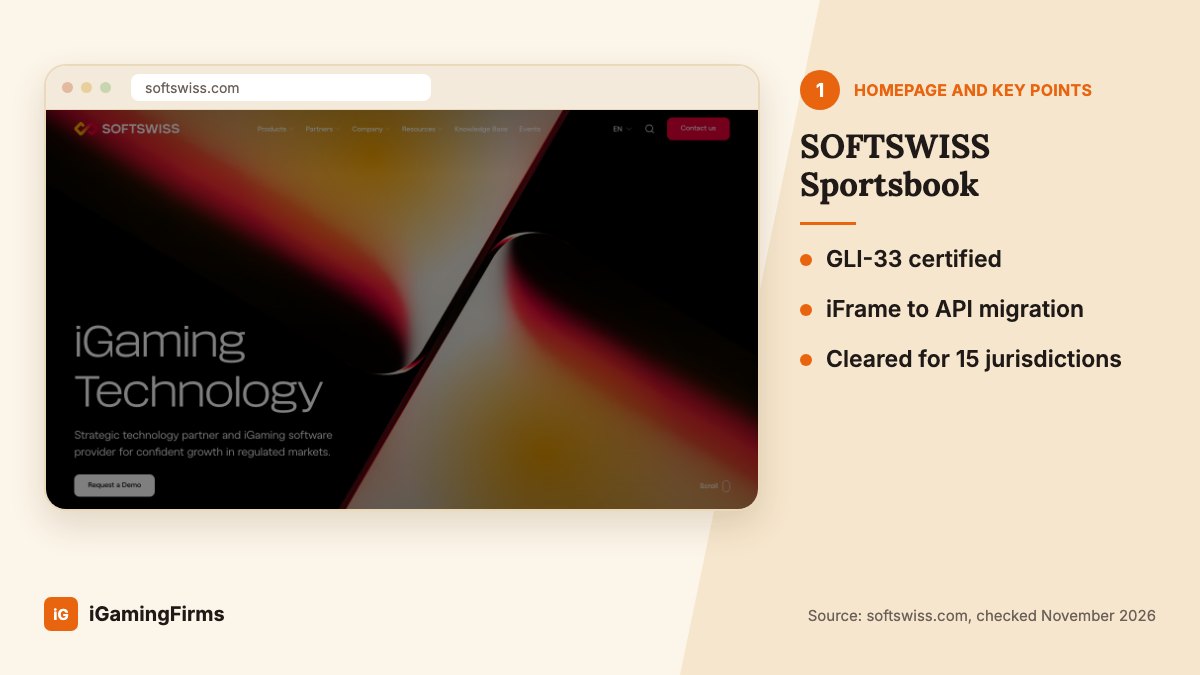
SOFTSWISS Sportsbook is sold as a turnkey platform under your own licence or integrated into an existing site by API or iFrame. The SOFTSWISS homepage says the group has served 1,500+ iGaming brands over more than 17 years. It holds ISO 27001 and PCI DSS.
- Trading tools: in-built trading tools for real-time market adjustments and liability management, with odds sourced from Feedconstruct, Betradar and Oddin.
- Liability and monitoring: the SOFTSWISS expert team runs exposure monitoring and anti-fraud checks across all events and markets. Operators get real-time bet monitoring.
- Limits: configurable betting limits to control player wagering.
- Reporting: an operator dashboard that tracks GGR and key operational data. Ask for samples of settlement and regulator exports, since the product page does not describe them.
- Bonus engine: bonuses, jackpots, tournaments, missions and leaderboards.
- Compliance: the sportsbook is described as GLI-33 certified. The compliance section names markets such as Brazil, South Africa, Nigeria, Romania, Ireland, Ghana, Serbia and Mexico.
- Plug-in fit: SOFTSWISS says most operators go live in 14 days, with complex setups taking up to a month. Pricing is quoted per operator by target markets, integration type and expected volume.
2. TRUEiGTECH
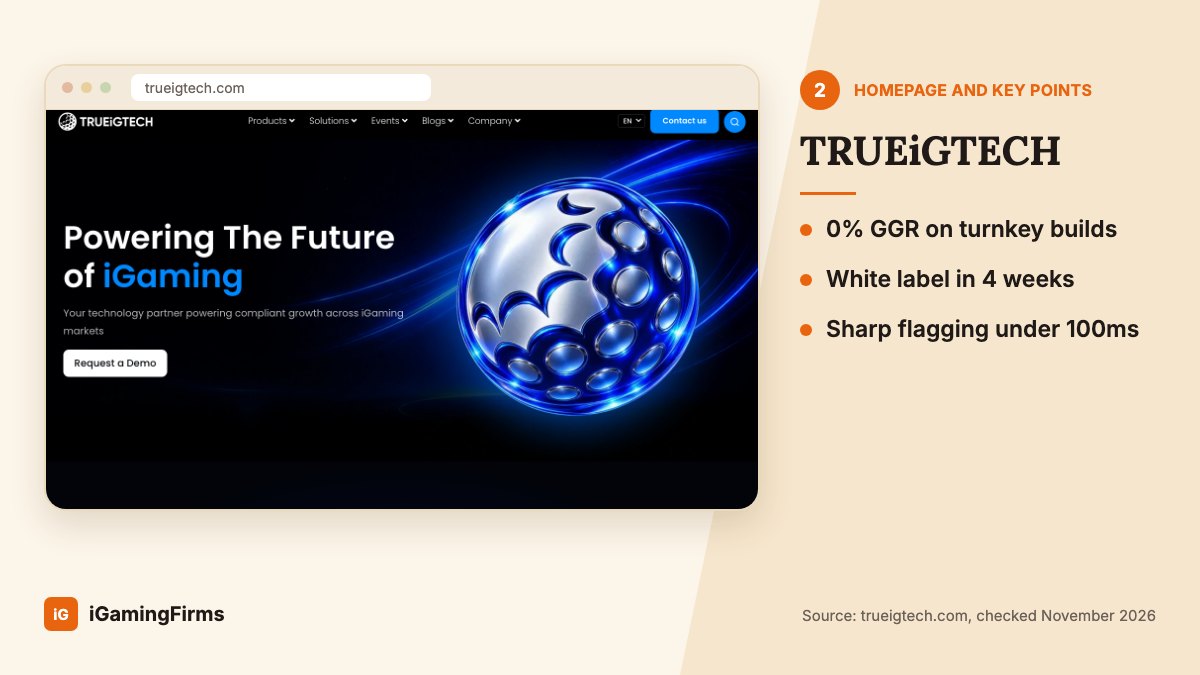
TRUEiGTECH sells sportsbook software as white label, turnkey, custom builds, iFrame and API. Its homepage lists 150+ platforms deployed in 50+ countries. It is the only platform here that also markets a pay-per-head module for agent networks.
- Trading tools: managed trading and odds management are listed as a service. Odds providers named are Betradar, LSports and BetBalancer.
- Risk and monitoring: the risk layer is pitched at spotting arbitrage betting, bonus abuse and multi-accounting.
- Settlement: the API covers odds, markets, bet placement and settlement, with instant bet validation and rapid settlement for live betting.
- Bonus engine: a configurable promotion engine for free bets, odds boosts, cashback, loyalty programmes and campaign-level bonus logic with wagering conditions.
- Regulatory reporting: built-in KYC, AML, self-exclusion and betting limits, with audit-ready reporting for regulators and licensing partners.
- Pay-per-head module: the sportsbook page offers agents lines, risk tools and reporting, plus players, limits and weekly settlements managed from one dashboard. See the PPH section below for the legal position.
- Commercial terms: TRUEiGTECH says it takes 0% of GGR on turnkey and custom builds. Its FAQ limits that to custom and specific turnkey deployments. White label carries a GGR share. It quotes 4 weeks for white label, 4 to 8 weeks for turnkey and 9 to 12 months for bespoke builds.
3. Altenar
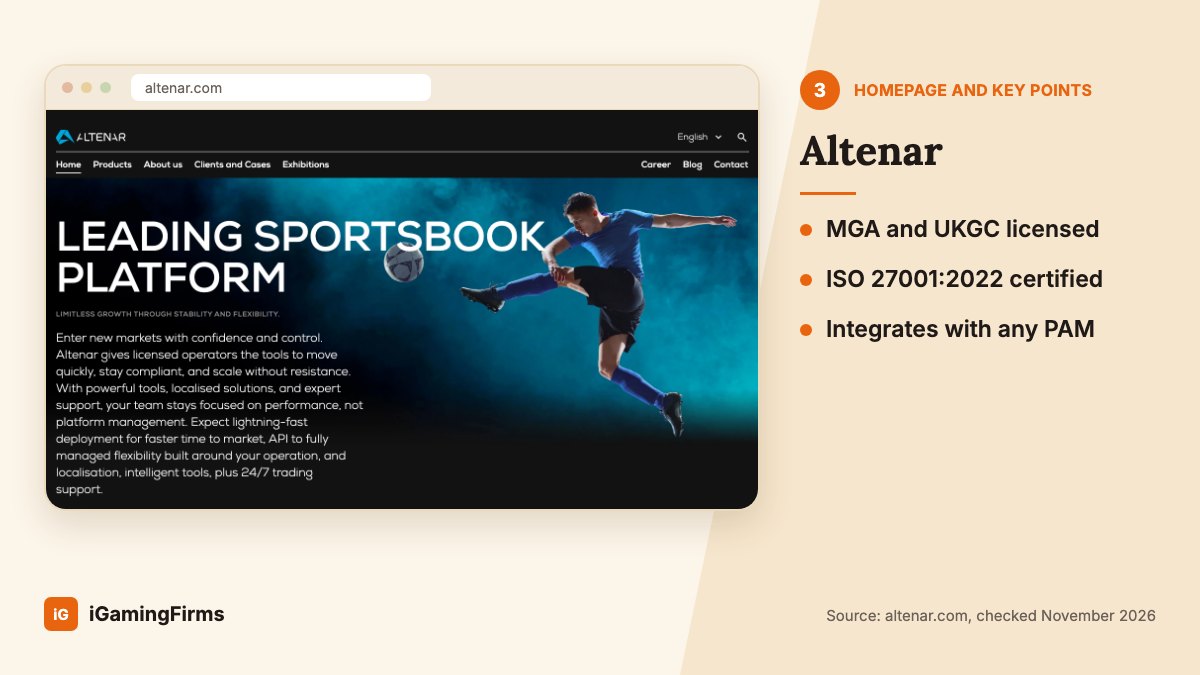
Altenar sells a sportsbook module that integrates with any PAM or front end, plus turnkey products that add player account management tools. Altenar says the module runs in more than 30 regulated markets.
- Trading tools: configurable limits and full market control for the operator, backed by 24/7 trading support from Altenar.
- Bonus engine: a bonus engine and built-in promotional tools, with region-specific bonus tools listed separately.
- Licences: Altenar Software Limited holds a Malta Gaming Authority Type 2 B2B licence. Altenar Technologies Limited is regulated in Great Britain under account 53306. It also lists Romania, the Isle of Man and Ontario (AGCO). It holds ISO/IEC 27001:2022, certificate 239970.
- Plug-in fit: a good match if you already run your own PAM and wallet and want the sportsbook as a module.
- Ask: what “24/7 trading support” covers in practice. Is it a desk that can suspend your markets, or a support line your traders call?
4. Betby
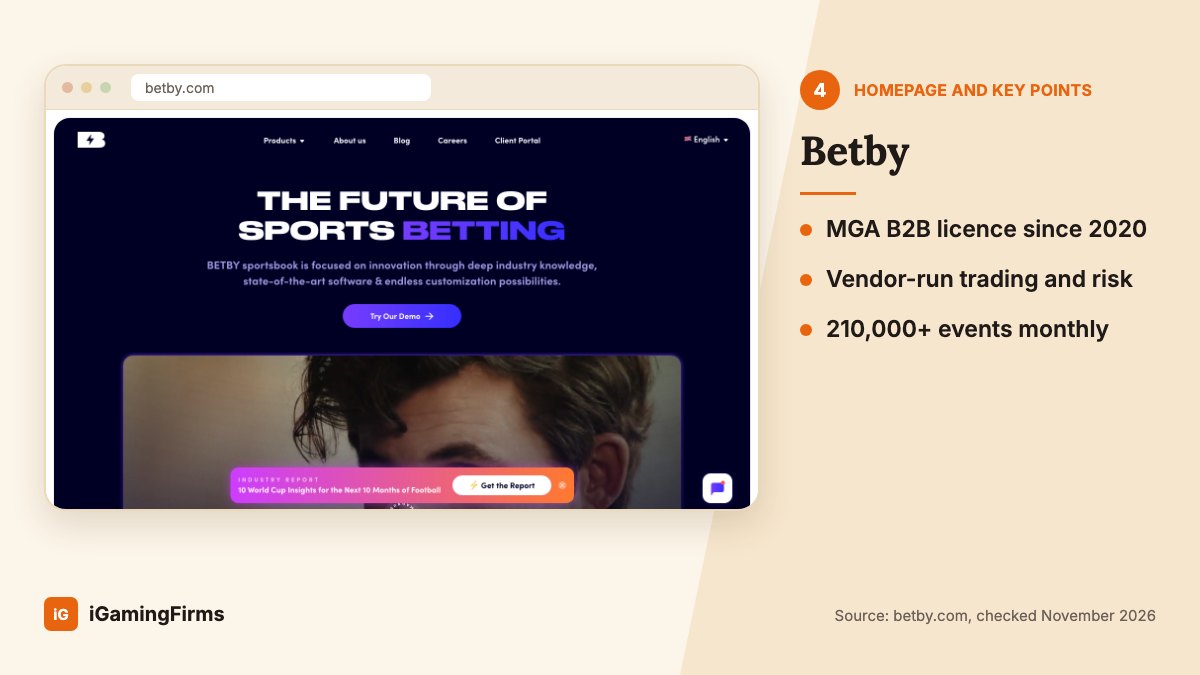
Betby is the clearest fully managed option. Its sportsbook page says it takes care of all sportsbook-related operations, including risk management, trading, client segmentation and reporting. Betby’s homepage states it is licensed by the Malta Gaming Authority under MGA/B2B/780/2020.
- Coverage: over 210,000 events a month across more than 125 sports and 3,000+ betting markets.
- Risk tools: Betby AI Labs lists activity alerts that flag suspicious behaviour in near real time, liability monitoring with granular liability tuning and automatic profiling that sorts players from low-stake and risky to high-roller VIP.
- Segmentation: AI Labs also lists churn prediction over 7 to 90 days, LTV prediction and automatic player segmentation.
- Bonus tools: a marketing toolkit with Freebets, Oddsboost and Cashout, plus live streams and stats widgets.
- Reporting: Betby runs reporting and BI. A back-office AI assistant that answers questions in plain language is listed as coming soon.
- Plug-in fit: Betby says its products can be integrated within days of signing. It suits operators whose strength is acquisition, not trading.
5. Delasport

Delasport sells DelaSports as an iFrame integration or full turnkey, a Plug & Play Sportsbook and a separate trading layer. Its awards list includes Sportsbook Supplier of the Year at SBC Awards Europe 2026.
- Trading Services: the trading services suite lists automated trading processes, dynamic odds adjustment and enhanced risk control for liability management.
- Segmentation: tailored risk profiles for casual, VIP and sharp players.
- Monitoring: real-time bet monitoring with instant detection of abnormal betting patterns, plus built-in fraud alerts.
- Bonus and reporting: the Orbit Platform lists a bonus engine and real-time BI reporting.
- Managed services: separate services cover risk and compliance, customer support and payment management.
- Licences: the site footer links to regulators in Denmark, Ontario (AGCO), the UK, the Netherlands, Sweden, South Africa and Malta.
6. EveryMatrix (OddsMatrix)
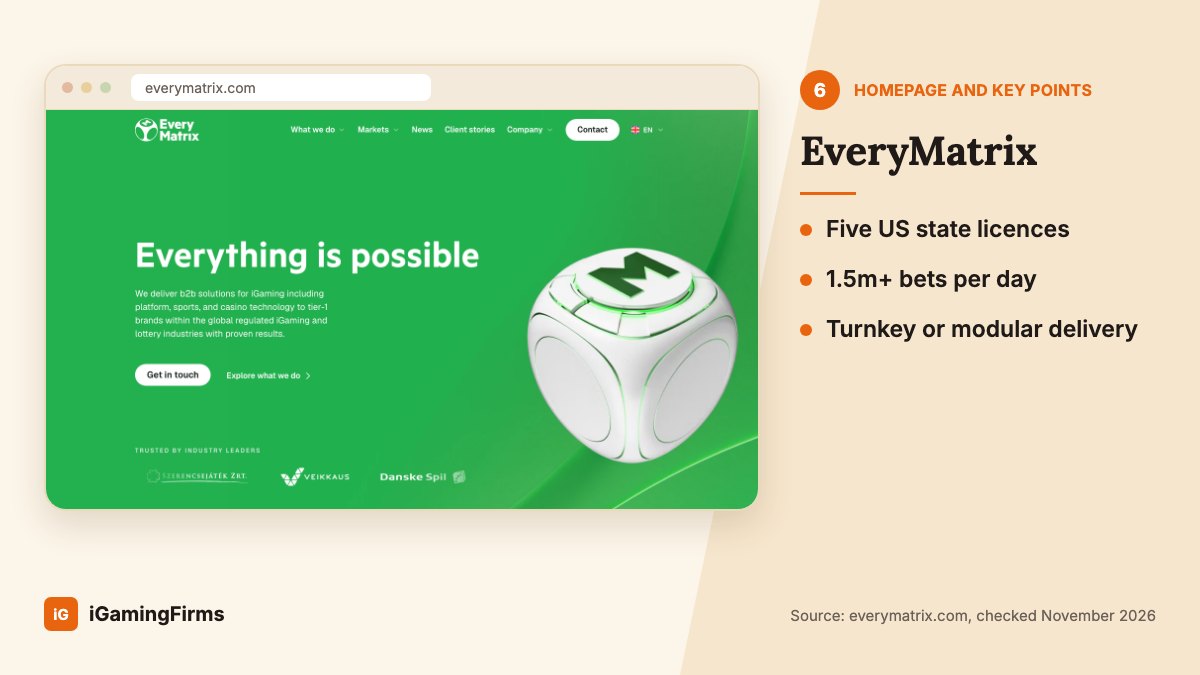
EveryMatrix’s OddsMatrix sportsbook is sold inside a full turnkey platform, as a modular product or as a fully managed solution. The group’s homepage lists 400+ clients in 50+ markets and certifications for PCI DSS, ISO 27001 and ISO 20000.
- Trading tools: odds control tools to adjust odds, overrounds and market positioning.
- Bonus engine: BonusEngine sets automated bonuses for any sport, league, tournament, event or market.
- Volume: the sportsbook page cites 1.5 million+ daily bets.
- Licences: UKGC account 39383 and MGA/B2B/201/2011. The licences page lists supplier licences in West Virginia, Pennsylvania, Connecticut and Michigan. New Jersey is listed as transactional waivers, not a full licence. It also lists Ontario, Alberta, Sweden, Denmark, Greece and Romania.
- Ask: who sets margins and limits day to day under each package. Also ask what settlement and regulator reports look like for your state.
7. Kambi
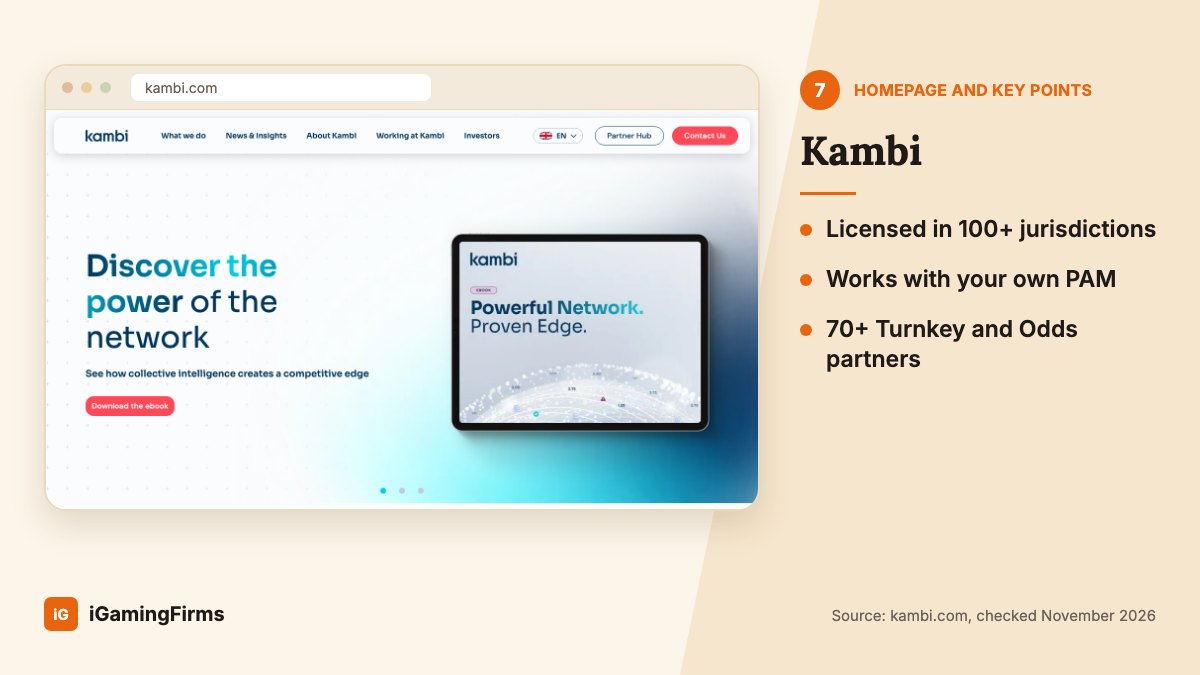
Kambi’s Turnkey Sportsbook bundles AI-driven trading, risk management and front-end tools. Kambi lists 60+ turnkey partners, 1.5bn+ bets processed a year, 100+ sports and 700,000+ live events traded annually.
- Trading split: Kambi runs the trading engine, while operators can control odds and the front end and tailor risk management and pricing strategies.
- Integrity: advanced monitoring across Kambi’s network to identify suspicious betting. The homepage also notes its participation in the IOC’s IBIS integrity system.
- Plug-in fit: operators can add Kambi’s in-house PAM or combine the sportsbook with their preferred PAM provider. Odds Feed+ delivers Kambi pricing alone through a single API.
- 2026 change: on 10 November 2026 Kambi announced a perpetual global source code licence for Allwyn, with a separate long-term deal for AI trading and risk services. Kambi expects about €45 to 50 million of operating profit from it over 2027 to 2031.
8. Sportingtech
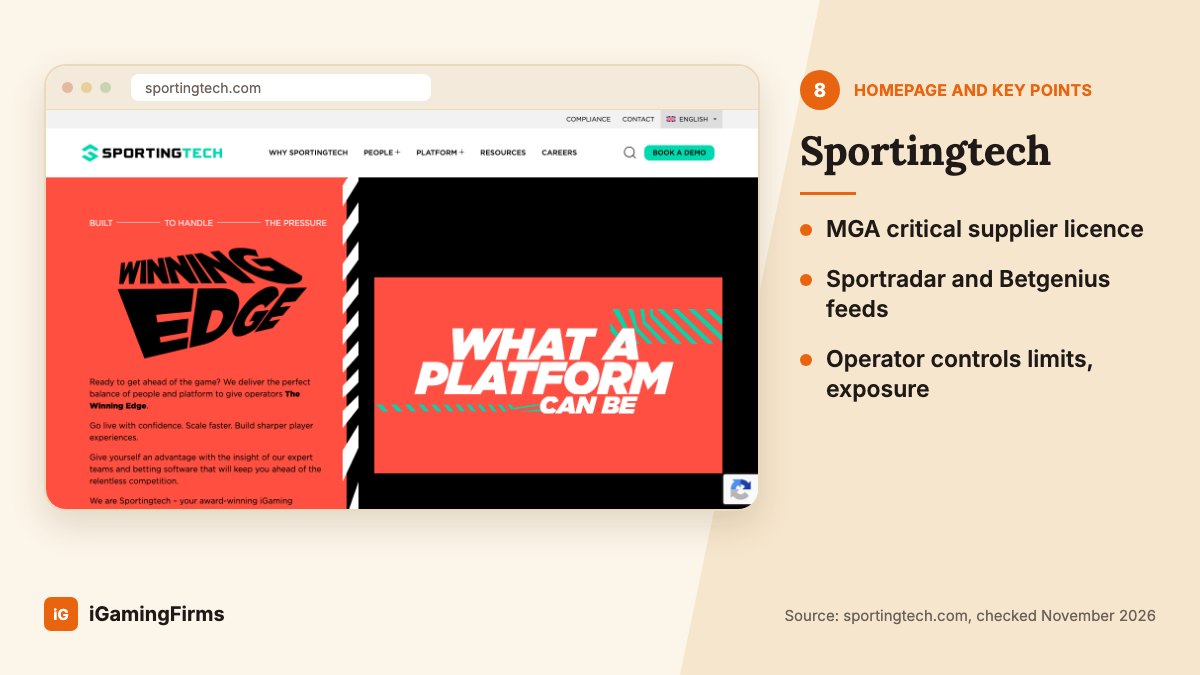
Sportingtech is built for operators who keep trading in-house. It is headquartered at Tigné Point, Malta. Its homepage cites 30 million sportsbook bets per day.
- Trading tools: complete command over pricing, limits and exposure across sports and markets, plus event tools for special markets, outrights and boosted odds.
- Risk: player-risk profiling linked to bet monitoring and liability dashboards, with real-time alerts, flexible limit profiles and market-specific risk parameters in one interface.
- Bonus engine: free bets, jackpots across leagues, bet boosts, multi-bet rewards, cash out and partial cash out.
- Feeds: official data from Sportradar and Betgenius, covering 100+ sports and 1,300+ markets.
- Licences: MGA critical supplier licence MGA/B2B/718/2019 for Type 1 and Type 2 services, issued 17 August 2020, plus GLI and ISO/IEC 27001:2022.
- Ask: the product page does not cover settlement or reporting, so request a back-office walkthrough before you shortlist.
9. BetConstruct
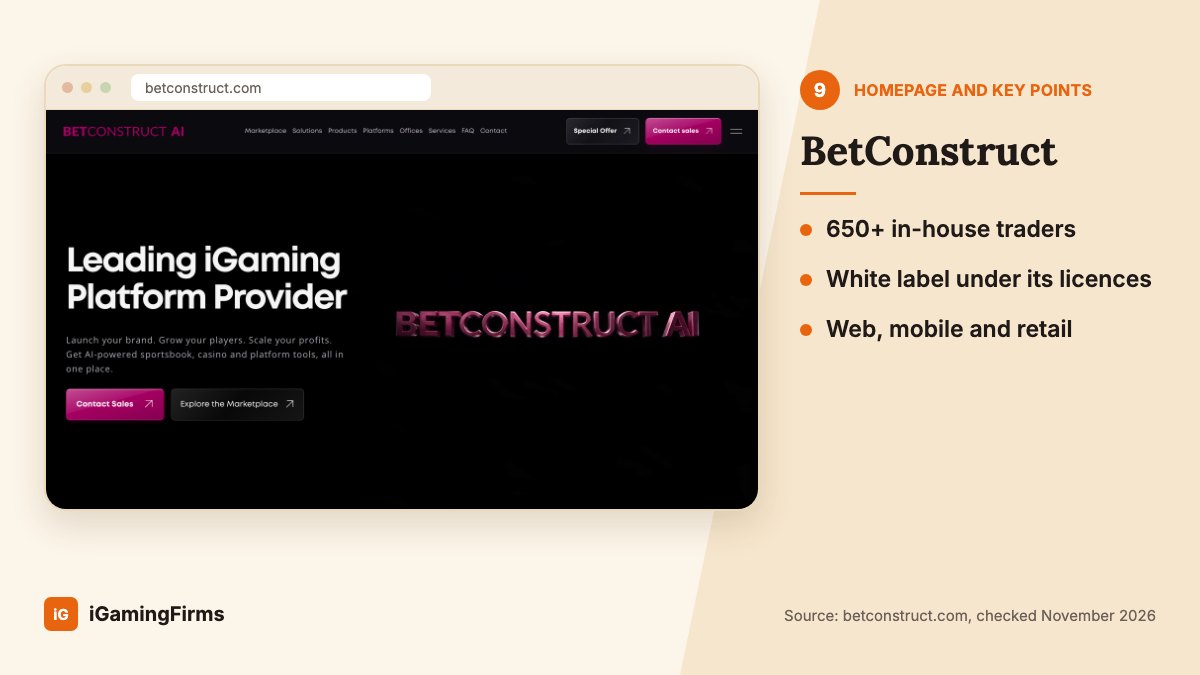
BetConstruct sells an all-in-one sportsbook with a back office for management and reporting. The site is operated by Soft Construct (Malta) Ltd, licensed by the MGA under MGA/B2B/286/2014 and by the UKGC under account 40767.
- Trading tools: fully configurable settings for limits, margins and the competition and market offer. The page lists 650+ in-house traders and a 1:1 trader-per-match ratio.
- Coverage: 140K+ pre-match events and 90K+ live matches a month across 120+ sports.
- Risk: risk management tools and suspicious match control.
- Reporting: a business dashboard with macro-to-micro reporting and real-time player reports.
- Bonus engine: Freebets, Accumulator Bonus, Bad Beat Bonus, Wagering Bonus and Profit Boost, run from the back office.
- Published pricing: a setup fee of €19.9K (€25K with multi-wallet), turnkey revenue share of 10% to 16% to BetConstruct and a white label split of 60% to BetConstruct and 40% to the partner. The page notes prices may change by market.
10. Sportradar
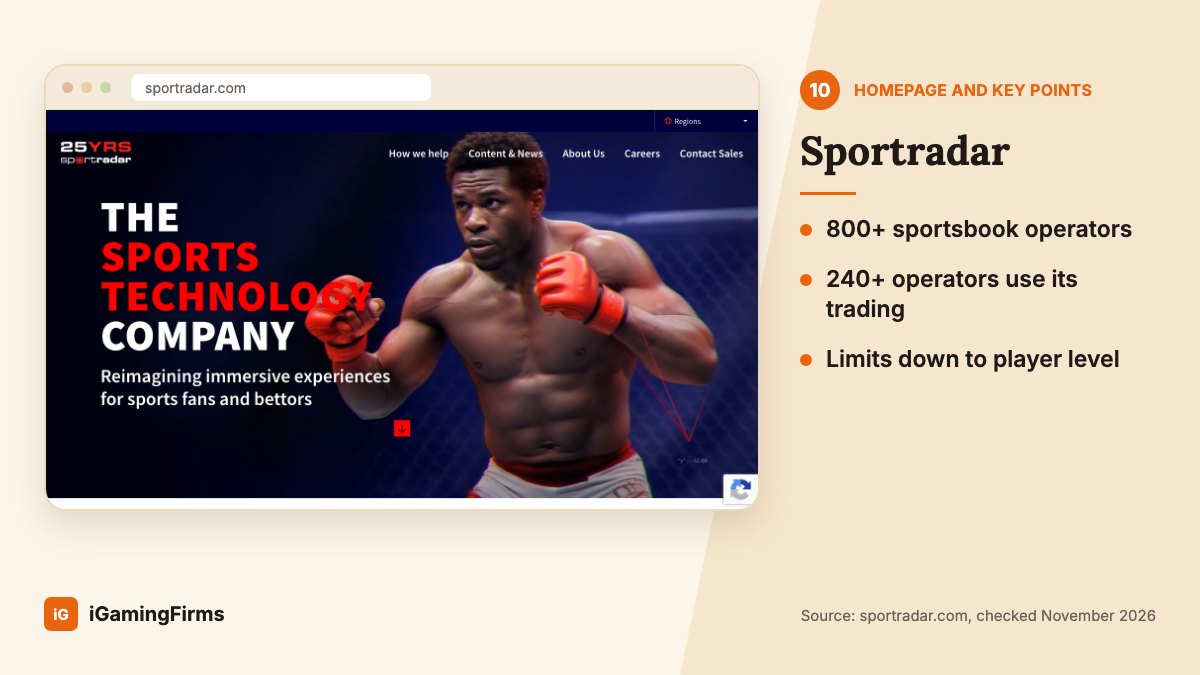
Sportradar Sportsbook lists 800+ sportsbook operators and 10bn+ bets processed in 2025. It offers the widest choice of who runs the trading layer.
- Trading models: its managed trading services page describes full or partial management, an operator-run desk using the same models and consoles as Sportradar’s own floor and a hybrid where your desk keeps core markets while Sportradar covers overnight, non-core and long-tail content 24/7. Sportradar says 240+ operators run trading with it.
- Models only: Insight Tech Risk Models let you keep trading in-house and call Sportradar’s models through the API.
- Liability: liability-driven pricing through Alpha Odds, with live exposure, projected P&L and liability alerts in the consoles.
- Segmentation: automated player profiling, with 4M+ player accounts profiled daily.
- Settlement and value: settlement sits within Betting Services. Player Value Insights aims bonus budget at players who pay it back.
How the modules plug into your platform
A sportsbook management layer has four connections. Each one is a place a project can stall.
- Odds and results feed: drives pricing and settlement. If you bring your own feed, confirm the risk engine and settlement can read it. Our list of sports data providers shows the main options.
- Player account management and wallet: stakes, payouts and bonus funds move here. Altenar and Kambi both sell into third-party PAMs. Our explainer on PAM in iGaming covers that layer.
- CRM and bonus engine: segmentation data has to reach your CRM. Bonus rules have to respect player limits.
- Regulator and data warehouse: settled tickets, voids and manual changes must reach your reporting stack in the format your licence requires.
If you are still choosing licences and a launch route, read how to start a sportsbook first. Module choice follows from that.
What software do bookmakers use?
Licensed bookmakers usually run a sportsbook platform from a B2B supplier such as the ten above, connected to a PAM, payment providers, KYC tools and a data feed. Large groups sometimes own the code outright. Kambi’s November 2026 deal with Allwyn is an example: Allwyn gets a perpetual licence to the source code while Kambi keeps supplying trading services. Smaller agent-led books often rent pay-per-head software instead, which raises the legal questions below.
Who should run trading: you or the vendor?
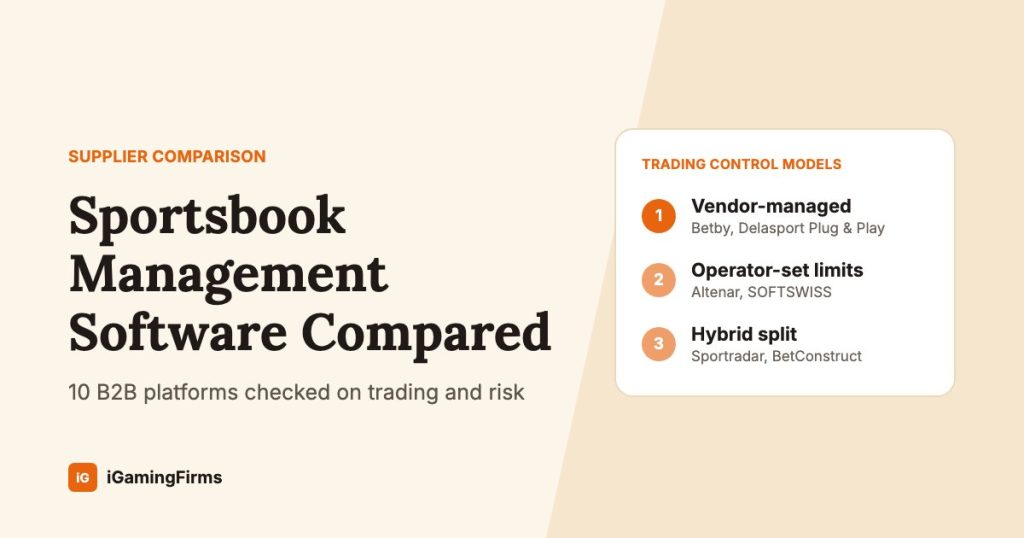
The platforms fall into three operating patterns.
- Vendor-run: Betby runs trading, risk, segmentation and reporting. Delasport’s Plug & Play and Trading Services follow the same idea. You save on traders but depend on the vendor’s view of your players.
- Operator-run with vendor support: Sportingtech, Altenar, SOFTSWISS and BetConstruct give your desk the controls. SOFTSWISS and Altenar add their own monitoring or support around the clock.
- Split by market or time: Sportradar’s hybrid lets your desk keep core markets while it covers the rest. Kambi trades while you tailor pricing strategy. TRUEiGTECH and EveryMatrix offer managed options next to operator tools.
A domestic operator with strong local knowledge often wants its own traders on home leagues. A multi-market brand with thin staff usually needs cover overnight and on long-tail events. Decide that split before you compare feature lists.
How much does sportsbook management software cost?
Few vendors publish prices, so the useful benchmarks are the ones that do. BetConstruct lists a €19.9K setup fee, a turnkey revenue share of 10% to 16% and a 60/40 white label split in its own favour. TRUEiGTECH says it takes no GGR share on custom builds and specific turnkey deals, but charges a GGR share on white label. SOFTSWISS quotes per operator based on target markets, integration type and expected volume.
Three cost lines are easy to miss. Managed trading is often priced on top of the platform. Data feeds may be billed separately by the feed owner. Certification of changes to the platform costs time and lab fees in strict markets. Model your total at launch volume and at two to three times that volume.
Is there free sportsbook management software?
“Sportsbook management software free” is a common related search. Low-cost scripts and templates exist, but they lack licensed data feeds, certified settlement and the audit trails a regulator expects. For a licensed operation the practical floor is a white label or revenue-share deal, not free software.
What is pay-per-head sportsbook software and is it legal?
Pay-per-head (PPH) software rents a bookmaker or agent a hosted sportsbook, lines and a back office, usually for a weekly fee per active player. TRUEiGTECH is the only platform in this list that markets a PPH module, offering agents lines, risk tools, reporting and weekly settlements from one dashboard. The software itself is a back-office product. The legal question is who it serves.
In the US, sports betting is legal only through operators licensed in each state. A PPH book that takes bets from US players without a state licence is operating outside that system. The federal Wire Act, 18 U.S.C. § 1084, applies to anyone in the business of betting who uses wire communications to take bets on sporting events across state or national borders, with penalties of up to two years in prison. Our explainers on pay per head sportsbook services and offshore sports betting cover the detail. This guide lists PPH tools as a market fact, not as a recommendation.
Certification, code ownership and price benchmarks
The certification standard for these modules just changed
GLI has published GLI-33 v2.0, Standards for Event Wagering Systems. The revision history shows reorganised rules for results, settlement and payment, expanded suspicious player activity monitoring and integrity controls, new responsible gaming limits and new requirements for exchange, peer-to-peer and virtual event wagering. A vendor that says “GLI-33 certified” should tell you which version and when it plans to test against v2.0.
Owning the code is now a real third option
The usual framing is rent (white label or turnkey) versus build. Kambi’s Allwyn agreement shows a third route for large groups: license the source code, keep the vendor for trading, then move the team in-house. Implementation runs 2027 to 2029. If you operate at scale, ask your vendor whether a source code licence is on the table.
You can benchmark price before the first call
Most vendors list pricing as “on request.” BetConstruct’s own page prints revenue share and setup fees, which gives you a reference point for every other quote. Bring it to negotiations and ask each vendor to price the same modules on the same basis.
Back-office checks before you sign
- Override rights: when your trader and the vendor’s trader disagree on a live market, who has the final say? Is that written into the contract?
- Settlement audit trail: every manual resettlement, void and price change should be logged with user and time.
- Limit ownership: can the vendor change a player’s limits without telling you?
- Regulator exports: ask for sample reports in your target market’s format, not a dashboard screenshot.
- Licence proof: check each supplier licence on the regulator’s own register.
- Data exit: written terms for getting bet history and player data out if you leave.
Your next step
Write down which of the six modules your own staff will operate and which you want the vendor to run. Send that split to two or three platforms from the table whose trading model matches it. Ask each for a back-office demo covering liability, settlement, limits and regulator reports, plus licence numbers for your markets and a fee model at your expected volume. Use BetConstruct’s published revenue share as your benchmark when the quotes come back.